
Life, 1895-01-03 · page 5 of 18
Life — January 3, 1895 — page 5: what you’re looking at
What you’re looking at
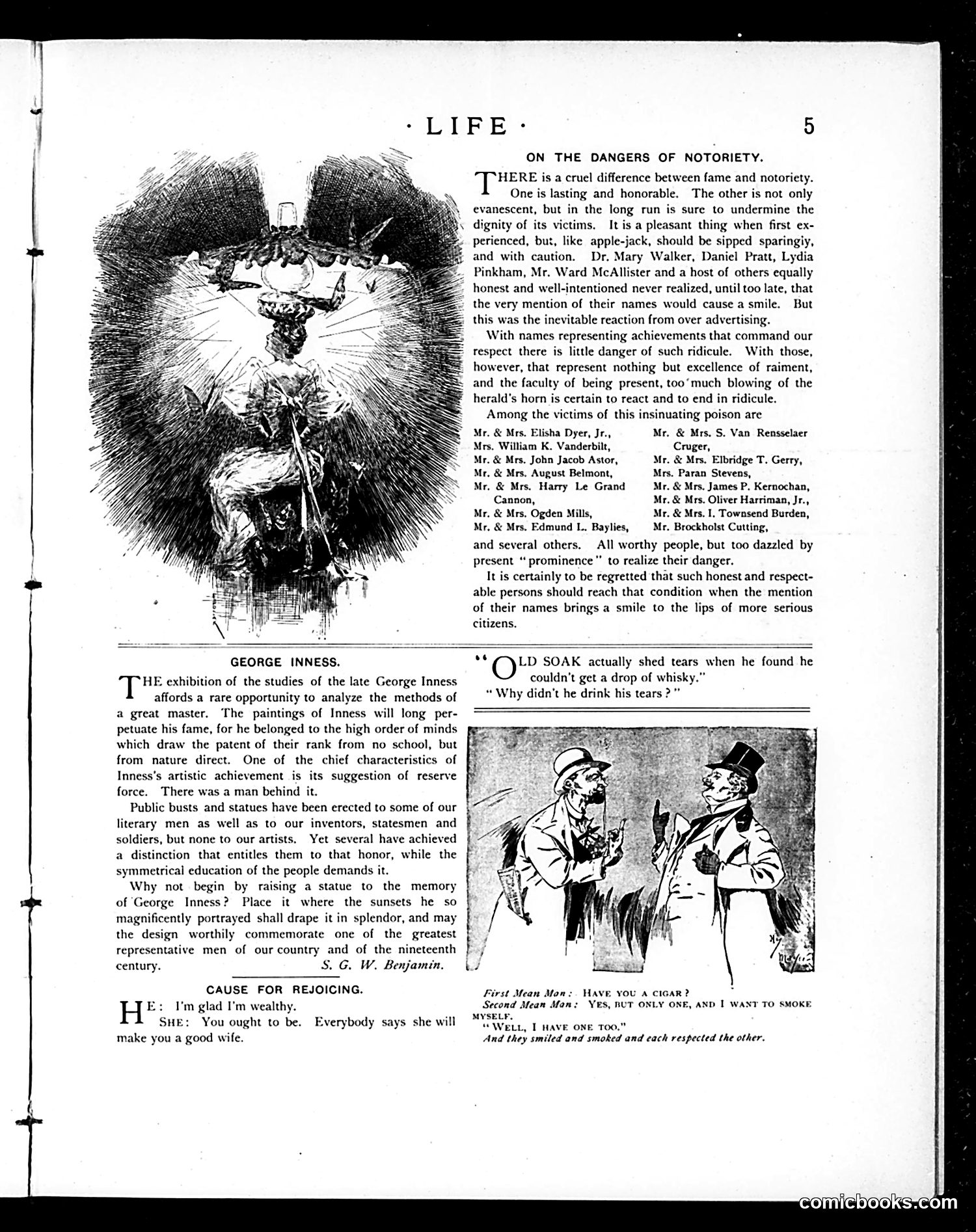
**Top Section - "On the Dangers of Notoriety":** This article warns against confusing fame with notoriety. It argues that while legitimate achievement (citing Dr. Mary Walker, Daniel Pratt, and others) deserves respect, excessive publicity can damage one's dignity. The piece cautions that even well-intentioned people can suffer from over-advertisement, listing several names of individuals whose prominence became problematic. **Bottom Cartoon - "Cause for Rejoicing":** A brief joke about marriage: a man declares he's glad he's wealthy because "Everybody says she will make you a good wife." The humor satirizes how financial status influences marital prospects rather than genuine affection or character. **George Inness Section:** A tribute to the late landscape painter, celebrating his artistic methods and suggesting a statue be erected in his honor.
📄 Transcribed text from this page (OCR, searchable)
Machine-transcribed from the original scan — historical spelling and the odd misread are preserved.
- LIFE: 5 ON THE DANGERS OF NOTORIETY. HERE is a cruel difference between fame and notoriety. One is lasting and honorable. The other is not only evanescent, but in the long run is sure to undermine the dignity of its victims. It is a pleasant thing when first ex- perienced, but, like apple-jack, should be sipped sparingiy, and with caution. Dr, Mary Walker, Daniel Pratt, Lydia Pinkham, Mr. Ward McAllister and a host of others equally honest and well-intentioned never realized, until too late, that the very mention of their names would cause a smile. But this was the inevitable reaction from over advertising. With names representing achievements that command our respect there is little danger of such ridicule. With those, however, that represent nothing but excellence of raiment, and the faculty of being present, too‘much blowing of the herald's horn is certain to react and to end in ridicule. Among the victims of this insinuating poison are Mr. & Mrs. Elisha Dyer, Jr., Mr. & Mrs. S. Van Rensselaer Mrs. William K. Vanderbilt, Croger, Mr. & Mrs. John Jacob Astor, Mr. & Mrs, Elbridge T. Gerry, Mr. & Mrs. August Belmont, Mrs. Paran Stevens, Mr. & Mrs. Harry Le Grand Mr. & Mrs. James P. Kernochan, Cannon, Mr. & Mrs, Oliver Harriman, Jr., Mr. & Mrs, Ogden Mills, Mr. & Mrs. I. Townsend Burden, Mr, & Mrs, Edmund L. Baylies, Mr. Brockholst Cutting, and several others. All worthy people, but too dazzled by present “ prominence” to realize their danger. It is certainly to be regretted that such honest and respect- able persons should reach that condition when the mention of their names brings a smile to the lips of more serious citizens. GEORGE INNESS. TH exhibition of the studies of the late George Inness affords a rare opportunity to analyze the methods of a great master. The paintings of Inness will long per- petuate his fame, for he belonged to the high order of minds which draw the patent of their rank from no school, but from nature direct. One of the chief characteristics of Inness’s artistic achievement is its suggestion of reserve force. There was a man behind it. Public busts and statues have been erected to some of our literary men as well as to our inventors, statesmen and soldiers, but none to our artists. Yet several have achieved a distinction that entitles them to that honor, while the symmetrical education of the people demands it. Why not begin by raising a statue to the memory of George Inness? Place it where the sunsets he so magnificently portrayed shall drape it in splendor, and may the design worthily commemorate one of the greatest representative men of our country and of the nineteenth century. S. G. W. Benjamin. CAUSE FOR REJOICING. H : I'm glad I'm wealthy. SHE: You ought to be. make you a good wife. Everybody says she will “ LD SOAK actually shed tears when he found he couldn't get a drop of whisky. “ Why didn’t he drink his tears ?" eae iit First Mean Mon; WAVe YOU A CIGAR? Second Mean Man; Yes, RUT ONLY ONE, ; ND I WANT TO SMOKE M , “WELL, I HAVE ONE Too.” And they smiled and smoked and each respected the other.