
Life, 1895-01-03 · page 7 of 18
Life — January 3, 1895 — page 7: what you’re looking at
What you’re looking at
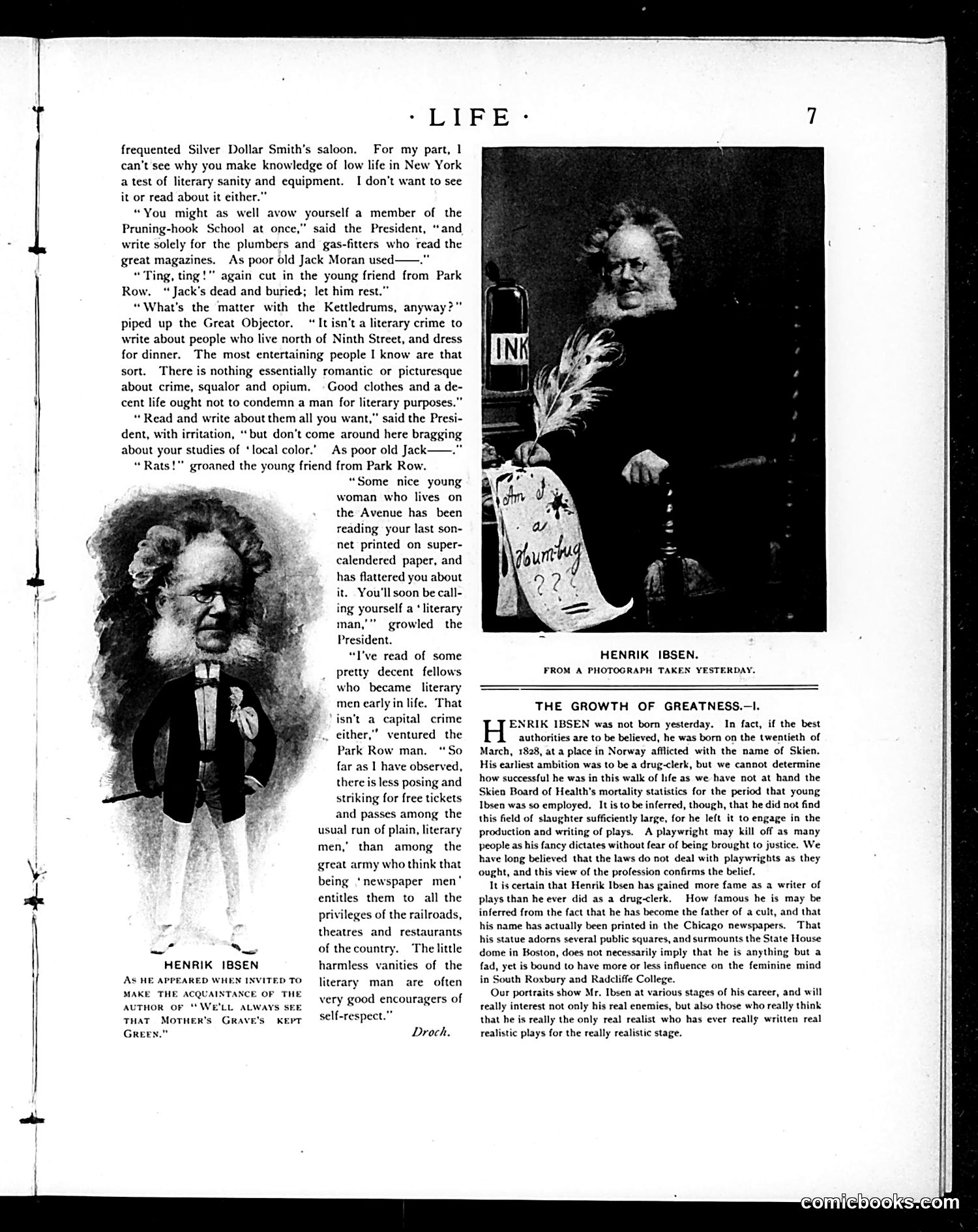
This page features two portraits of **Henrik Ibsen**, the Norwegian playwright. The left image shows Ibsen as he appeared when invited to meet the author of "We'll Always See That Mother's Grave's Kept Green"; the right shows a recent photograph. The accompanying article, "The Growth of Greatness," establishes Ibsen's literary significance while deflating pretension. The satirical dialogue above mocks American literary poseurs—particularly those from "Park Row" (newspaper district) and aspiring "local color" writers who affect sophistication about urban poverty. The President character dismisses such affectations as unoriginal posing. The satire targets Americans attempting cosmopolitan literary credentials by studying "low life," contrasting their phoniness with Ibsen's genuine artistic achievement.
📄 Transcribed text from this page (OCR, searchable)
Machine-transcribed from the original scan — historical spelling and the odd misread are preserved.
t - LIFE: 7 frequented Silver Dollar Smith’s saloon, For my part, 1 can't see why you make knowledge of low life in New York a test of literary sanity and equipment. I don’t want to see it or read about it either.” i “You might as well avow yourself a member of the Pruning-hook School at once,” said the President, “and write solely for the plumbers and gas-fitters who read the great magazines. As poor old Jack Moran used —.” “ Ting, ting!" again cut in the young friend from Park Row. “Jack's dead and buried; let him rest.” “What's the matter with the Kettledrums, anywa) piped up the Great Objector. “It isn’t a literary crime to write about people who live north of Ninth Street, and dress for dinner, The most entertaining people I know are that sort. There is nothing essentially romantic or picturesque about crime, squalor and opium. Good clothes and a de- i) cent life ought not to condemn a man for literary purposes. “Read and write about them all you want,” said the Pre: dent, with irritation, ‘but don’t come around here bragging | about your studies of ‘local color.’ As poor old Jack—.” | “Rats!” groaned the young friend from Park Row. “Some nice young woman who lives on the Avenue has been reading your last son- net printed on super- calendered paper, and has flattered you about it. You'll soon be call- ing yourself a ‘ literary man,’” growled the President. “I've read of some pretty decent fellows who became. literary men early in life. That isn't a capital crime either,” ventured the Park Row man. “So far as 1 have observed, there is less posing and striking for free tickets and passes among the usual run of plain, literary men,’ than among the great army who think that being ‘newspaper men‘ entitles them to all the privileges of the railroads, theatres and restaurants te | if x of thecountry. The little HENRIK IBSEN harmless vanities of the AS HE APPEARED WI literary man are often MAKE THE ACQUAINTANCE OF THE ery good encouragers of | AUTHOR OF “WE'LL ALWAYS SEE y i THaT Motuer’s Grave's ert — S¢lf-respect. Grees.” Droch. HENRIK IBSEN. FROM A PHOTOGRAPH TAKEN YESTERDAY. THE GROWTH OF GREATNESS.—I. ENRIK IBSEN was not born yesterday. In fact, if the best authorities are to be believed, he was born on the twentieth of March, 1828, at a place in Norway afflicted with the name of Skien. His earliest ambition was to be a drug-clerk, but we cannot determine how successful he was in this walk of life as we have not at hand the Skien Board of Health's mortality statistics for the period that young Ibsen was so employed, It is to be inferred, though, that he did not find this field of slaughter sufficiently large, for he left it to engage in the production and writing of plays. A playwright may kill off as many people as his fancy dictates without fear of being brought to justice. We have long believed that the laws do not deal with playwrights as they ought, and this view of the profession confirms the belief. It is certain that Henrik Ibsen has gained more fame as a writer of plays than he ever did as a drug-clerk, How famous he is may be inferred from the fact that he has become the father of a cult, and that his name has actually been printed in the Chicago newspapers. That his statue adorns several public squares, and surmounts the State House dome in Boston, does not necessarily imply that he is anything but a fad, yet is bound to have more or less influence on the feminine mind in South Roxbury and Radcliffe Colleg Our portraits show Mr. Ibsen at various stages of his career, and will really interest not only his real enemies, but also those who really think that he is really the only real realist who has ever really written real realistic plays for the really realistic stage.