
Life, 1895-01-03 · page 4 of 18
Life — January 3, 1895 — page 4: what you’re looking at
What you’re looking at
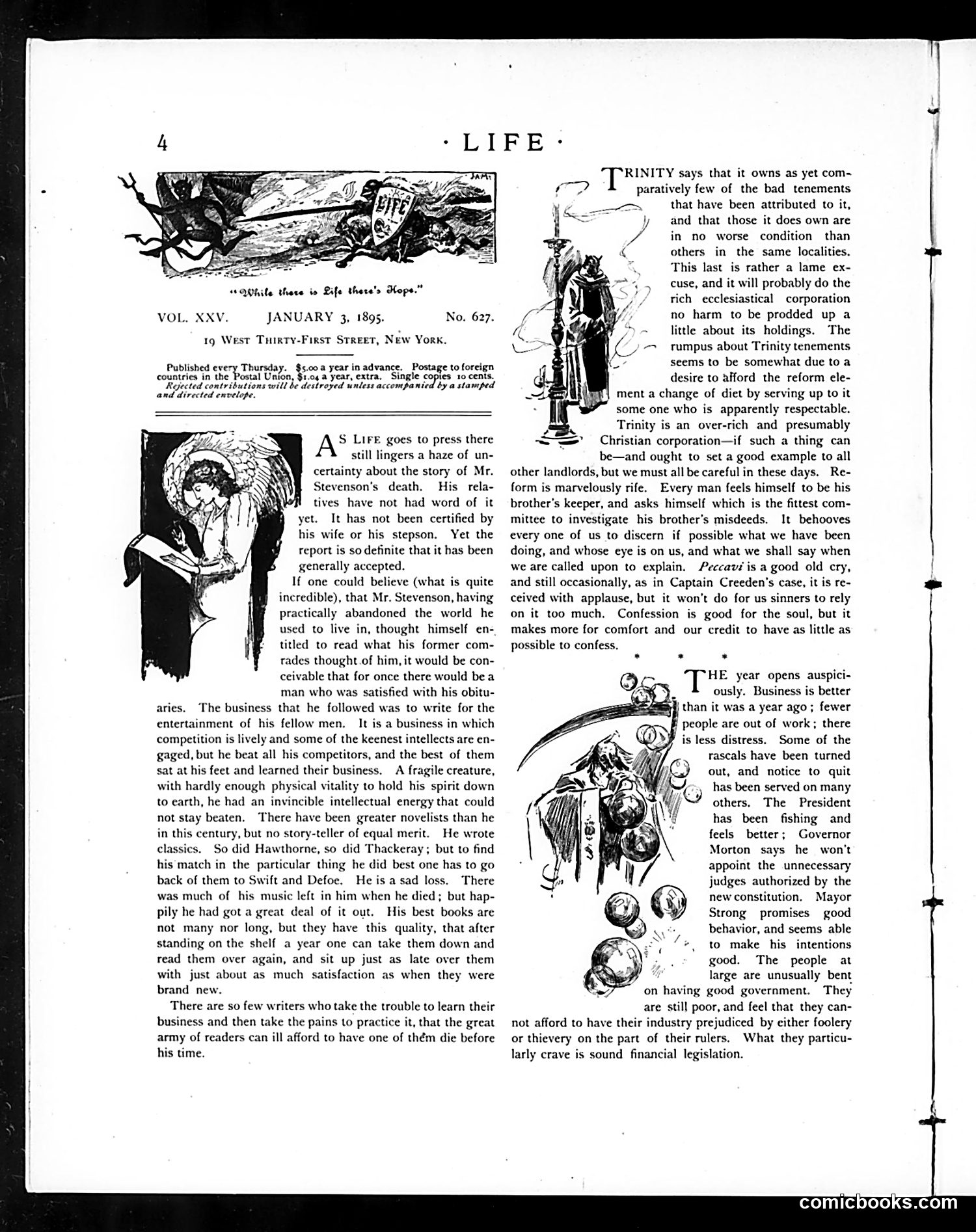
This page contains editorial commentary on current events rather than political cartoons. The main article discusses Mr. Stevenson's death—likely Robert Louis Stevenson, the celebrated Scottish author who died in December 1894. The text praises Stevenson's literary accomplishments, comparing him favorably to Hawthorne and Thackeray, while lamenting his loss to literature. The decorative illustrations appear to be thematic rather than satirical—depicting figures in period dress that complement the nostalgic tone discussing a writer's legacy. The right column shifts to contemporary 1895 American politics, mentioning President Cleveland's fishing, Governor Morton, and Mayor Strong, suggesting optimism about good governance and financial reform, though specifics remain general commentary rather than sharp satire.
📄 Transcribed text from this page (OCR, searchable)
Machine-transcribed from the original scan — historical spelling and the odd misread are preserved.
“ODhile there is Life there's Hops.” VOL. XXV. JANUARY 3, 1895. No. 627. 19 West Tuirty-First Street, New York. Published every Thursday. $s.00 a year in advance. Postage to foreign couatries in the Postal Union, $4.04 year, extra. Single copies 10 cents, Rejected contributions will be destroyed untess accompanied by a stamped and directed envelope. S LIFE goes to press there still lingers a haze of un- certainty about the story of Mr. Stevenson's death. His rela- tives have not had word of it yet. It has not been certified by his wife or his stepson. Yet the report is so definite that it has been generally accepted. If one could believe (what is quite incredible), that Mr. Stevenson, having practically abandoned the world he used to live in, thought himself en- titled to read what his former com- trades thought.of him, it would be con- ceivable that for once there would be a man who was satisfied with his obitu- The business that he followed was to write for the It is a business in which aries. entertainment of his fellow men, competition is lively and some of the keenest intellects are en- gaged, but he beat all his competitors, and the best of them sat at his feet and learned their business. A fragile creature, with hardly enough physical vitality to hold his spirit down to earth, he had an invincible intellectual energy that could not stay beaten. There have been greater novelists than he in this century, but no story-teller of equal merit. He wrote cl. So did Hawthorne, so did Thackeray ; but to find his match in the particular thing he did best one has to go back of them to Swift and Defoe. He is a sad loss. There was much of music left in him when he died; but hap- pily he had got a great deal of it out. His best books are not many nor long, but they have this quality, that after standing on the shelf a year one can take them down and read them over again, and sit up just as late over them with just about as much satisfaction as when they were brand new. There are so few writers who take the trouble to learn their business and then take the pains to practice it, that the great army of readers can ill afford to have one of thém die before his time. RINITY says that it owns as yet com~ paratively few of the bad tenements that have been attributed to it, and that those it does own are in no worse condition than others in the same localities. This last is rather a lame ex- cuse, and it will probably do the rich ecclesiastical corporation no harm to be prodded up a little about its holdings. The rumpus about Trinity tenements seems to be somewhat due to a desire to afford the reform ele- ~2€ ( ment a change of diet by serving up to it p” some one who is apparently respectable. ‘rinity is an over-rich and presumably Christian corporation—if such a thing can be—and ought to set a good example to all other landlords, but we must all be careful in these days. Re- form is marvelously rife. Every man feels himself to be his brother's keeper, and asks himself which is the fittest com- mittee to investigate his brother's misdeeds. It behooves every one of us to discern if possible what we have been doing, and whose eye is on us, and what we shall say when we are called upon to explain. Peccavs is a good old cry, and still occasionally, as in Captain Creeden's case, it is re- ceived with applause, but it won't do for us sinners to rely on it too much. Confession is good for the soul, but it makes more for comfort and our credit to have as little as possible to confess. * . HE year opens auspici- ously. Business is better | than it was a year ago; fewer E people are out of work; there J is less distress. Some of the rascals have been turned out, and notice to quit has been served on many others, The President has been fishing and feels better; Governor Morton says he won't appoint the unnecessary judges authorized by the new constitution, Mayor Strong promises good behavior, and seems able to make his intentions good. The people at large are unusually bent on having good government. They are still poor, and feel that they can- not afford to have their industry prejudiced by either foolery or thievery on the part of their rulers. What they particu- larly crave is sound financial legislation.