
Life, 1895-01-03 · page 11 of 18
Life — January 3, 1895 — page 11: what you’re looking at
What you’re looking at
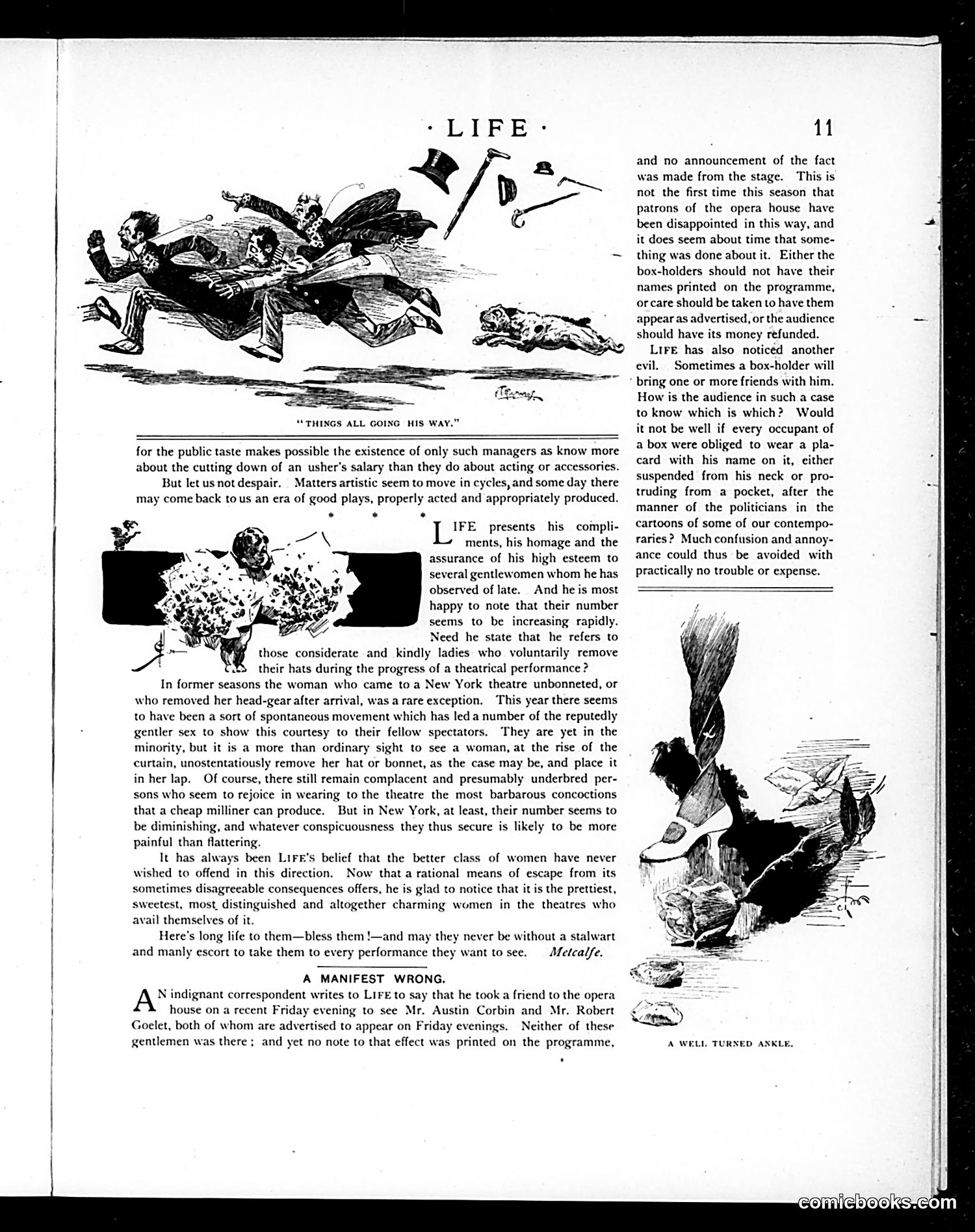
This page satirizes theater etiquette and management failures. The top cartoon ("Things All Going His Way") depicts a chaotic opera scene with figures in disarray—likely mocking incompetent theater direction or management. The main article, "A Manifest Wrong," complains that advertised performers (Austin Corbin and Robert Goclet) failed to appear on an advertised Friday evening, yet the opera house made no announcement. The satire argues this is a fraud on paying patrons who deserve either refunds or notification. A secondary complaint addresses women wearing ostentatious, cheap hats that obstruct other audience members' views—a recurring irritation in theaters of this era. The text advocates for courtesy and proper dress codes among theatergoers. The cartoon "A Well Turned Ankle" (bottom right) appears to celebrate appropriate feminine fashion.
📄 Transcribed text from this page (OCR, searchable)
Machine-transcribed from the original scan — historical spelling and the odd misread are preserved.
“THINGS ALL GOING HIS Way.” for the public taste makes possible the existence of only such managers as know more about the cutting down of an usher's salary than they do about acting or accessories. But let us not despair. Matters artistic seem to move in cycles, and some day there may come back to us an era of good plays, properly acted and appropriately produced. IFE presents his compli- ments, his homage and the assurance of his high esteem to several gentlewomen whom he has observed of late. And he is most happy to note that their number seems to be increasing rapidly. Need he state that he refers to those considerate and kindly ladies who voluntarily remove their hats during the progress of a theatrical performance ? In former seasons the woman who came to a New York theatre unbonneted, or who removed her head-gear after arrival, was a rare exception. This year there seems to have been a sort of spontaneous movement which has led a number of the reputedly gentler sex to show this courtesy to their fellow spectators. They are yet in the minority, but it is a more than ordinary sight to see a woman, at the rise of the curtain, unostentatiously remove her hat or bonnet, as the case may be, and place it in her lap. Of course, there still remain complacent and presumably underbred per- sons who seem to rejoice in wearing to the theatre the most barbarous concoctions that a cheap milliner can produce. But in New York, at least, their number seems to be diminishing, and whatever conspicuousness they thus secure is likely to be more painful than flattering. It has always been LiFe’s belief that the better class of women have never wished to offend in this direction. Now that a rational means of escape from its sometimes disagreeable consequences offers, he is glad to notice that it is the prettiest, sweetest, most distinguished and altogether charming women in the theatres who avail themselves of it. Here's long life to them—bless them !—and may they never be without a stalwart and man scort to take them to every performance they want to see. — Metcalfe. A MANIFEST WRONG. A’ indignant correspondent writes to LIFE to say that he took a friend to the opera house on a recent Friday evening to see Mr. Austin Corbin and Mr. Robert Goelet, both of whom are advertised to appear on Friday evenings. Neither of these gentlemen was there ; and yet no note to that effect was printed on the programme, 114 and no announcement of the fact was made from the stage. This is not the first time this season that patrons of the opera house have been disappointed in this way, and it does seem about time that some- thing was done about it. Either the box-holders should not have their names printed on the programme, or care should be taken to have them appear as advertised, or the audience should have its money refunded. LIFE has also noticed another evil. Sometimes a box-holder will bring one or more friends with him. How is the audience in such a case to know which is which? Would it not be well if every occupant of a box were obliged to wear a pla- card with his name on it, either suspended from his neck or pro- truding from a pocket, after the manner of the politicians in the cartoons of some of our contempo- raries ? Much confusion and annoy- ance could thus be avoided with practically no trouble or expense.