
Life, 1895-01-03 · page 10 of 18
Life — January 3, 1895 — page 10: what you’re looking at
What you’re looking at
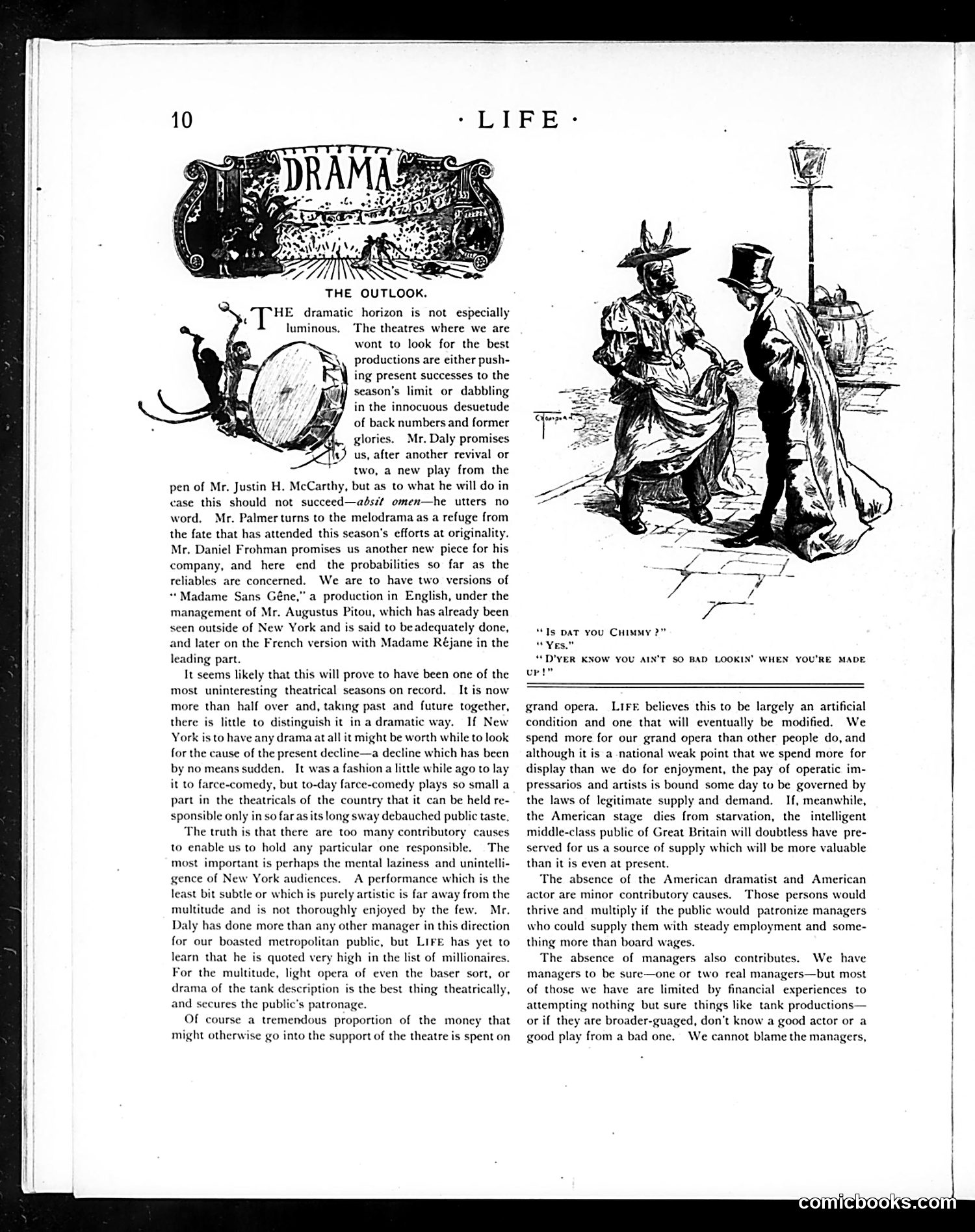
This page from Life's "Drama" section discusses the theatrical season's outlook. The text criticizes the current state of American theater, noting that theaters aren't producing particularly original work—instead reviving previous successes or dabbling with inferior plays. The main illustration shows two figures in period costume (appearing to be from a classical or historical play) with the caption "'IS DAT YOU CHIMMY?' 'YES.' 'DYER KNOW YOU AIN'T SO BAD LOOKIN' WHEN YOU'RE MADE UP!'" This joke satirizes theatrical acting and costumes, suggesting that performers only look acceptable when heavily made up and dressed in costume—implying their natural appearance is unremarkable. The dialect suggests working-class characters, adding a layer of satire about popular theater's audience and performers.
📄 Transcribed text from this page (OCR, searchable)
Machine-transcribed from the original scan — historical spelling and the odd misread are preserved.
THE OUTLOOK. HE dramatic horizon is not especially luminous. The theatres where we are wont to look for the best productions are either push- ing present successes to the season's limit or dabbling in the innocuous desuetude of back numbers and former glories. Mr. Daly promises us, after another revival or two, a new play from the pen of Mr. Justin H. McCarthy, but as to what he will do in case this should not succeed—adsz¢ omen—he utters no word. Mr. Palmer turns to the melodrama as a refuge from the fate that has attended thi son's efforts at originality. Mr. Daniel Frohman promises us another new piece for his company, and here end the probabilities so far as the reliables are concerned. We are to have two versions of “Madame Sans Géne,” a production in English, under the management of Mr. Augustus Pitou, which has already been seen outside of New York and is said to beadequately done, d later on the French version with Madame Réjane in the leading part. It seems likely that this will prove to have been one of the most uninteresting theatrical seasons on record, It is now more than half over and, taking past and future together, there is little to distinguish it in a dramatic way. If New York is to have any drama at all it might be worth while to look for the cause of the present decline—a decline which has been by no means sudden. It was a fashion a little while ago to lay it to farce-comedy, but to-day farce-comedy plays so small a part in the theatricals of the country that it can be held re- sponsible only in so faras its long sway debauched public taste, The truth is that there are too many contributory causes to enable us to hold any particular one responsible. The most important is perhaps the mental laziness and unintelli- gence of New York audiences. A performance which is the least bit subtle or which is purely artistic is far away from the multitude and is not thoroughly enjoyed by the few. Mr. Daly has done more than any other manager in this direction for our boasted metropolitan public, but LIFE has yet to n that he is quoted very high in the list of millionaires, For the multitude, light opera of even the baser sort, or drama of the tank description is the best thing theatrically, and secures the public’s patronage. Of course a tremendous proportion of the money that might otherwise go into the support of the theatre is spent on “Is pat you Cuimmy 2?” “D'YER KNOW YOU AIN’T SO BAD LOOKIN’ WHEN YOU'RE MADE uri" grand opera. LiFe believes this to be largely an artificial condition and one that will eventually be modified. We spend more for our grand opera than other people do, and although it is a national weak point that we spend more for display than we do for enjoyment, the pay of operatic im- pressarios and artists is bound some day to be governed by the laws of legitimate supply and demand. If, meanwhile, the American stage dies from starvation, the intelligent middle-class public of Great Britain will doubtless have pre- served for us a source of supply which will be more valuable than it is even at present. The absence of the American dramatist and American actor are minor contributory causes. Those persons would thrive and multiply if the public would patronize managers who could supply them with steady employment and some- thing more than board wages. The absence of managers also contributes. managers to be sure—one or two real manage of those we hav We have ‘s—but most are limited by financial experiences to attempting nothing but sure things like tank productions— or if they are broader-guaged, don’t know a good actor or good play from a bad one. We cannot blame the managers,