
A complete issue · 47 pages · 1892
Life — December 29, 1892
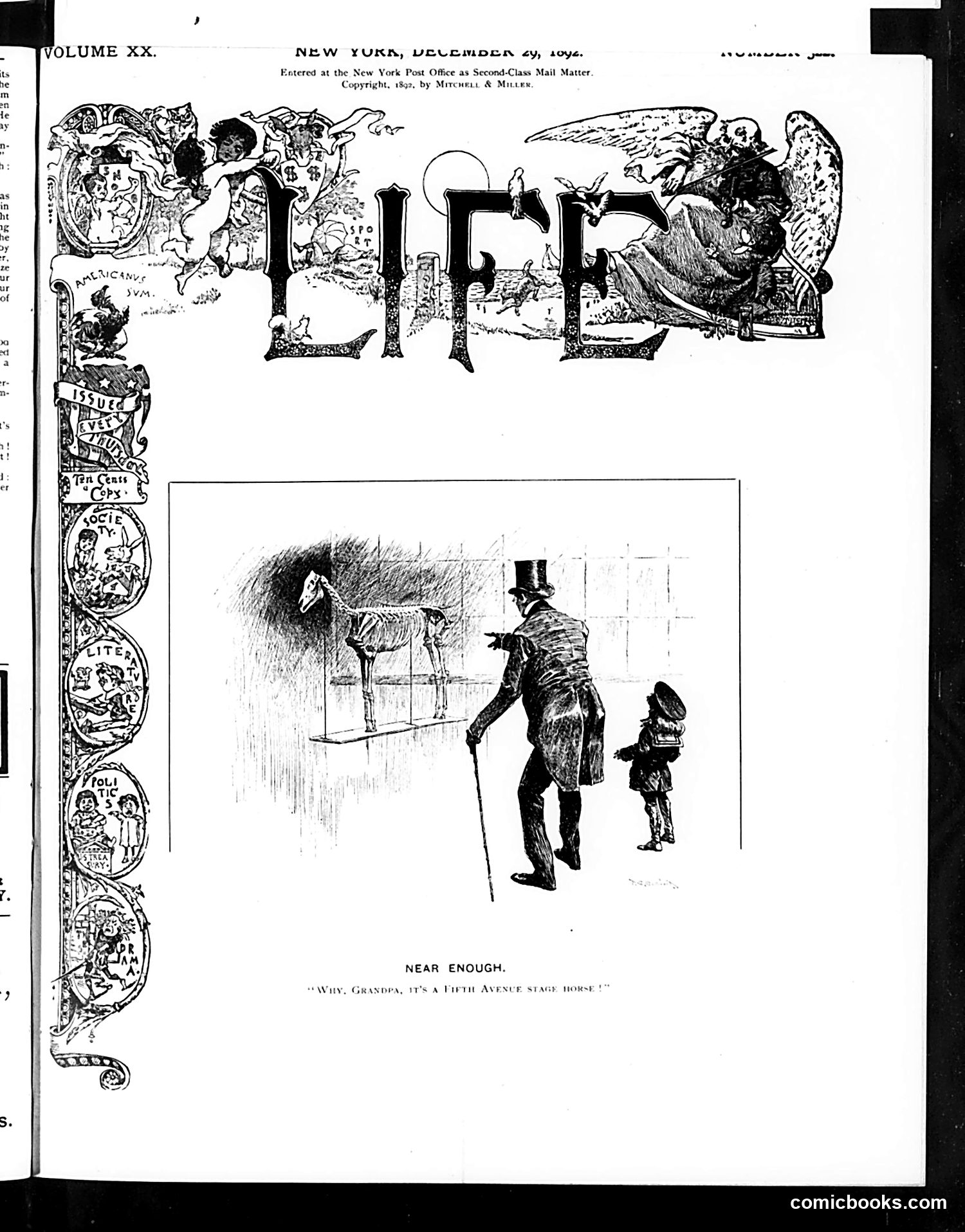
This cartoon satirizes turn-of-the-century New York City transportation. An elegantly dressed gentleman with a top hat and cane stands before a shabby, emaciated horse, while a small child waits beside him. The caption reads: "Why, Grandpa, it's a Fifth Avenue stage horse!" The joke targets the poor condition of horses used for public transportation (stage coaches/omnibuses) on Fifth Avenue, Manhattan's prestigious thoroughfare. The cartoon mocks the contradiction between Fifth Avenue's reputation as an upscale neighborhood and the deplorable state of working animals used there. The child's innocent question highlights the absurdity—calling such a wretched creature a "Fifth Avenue" horse is barely credible, hence "near enough" as sarcastic understatement.
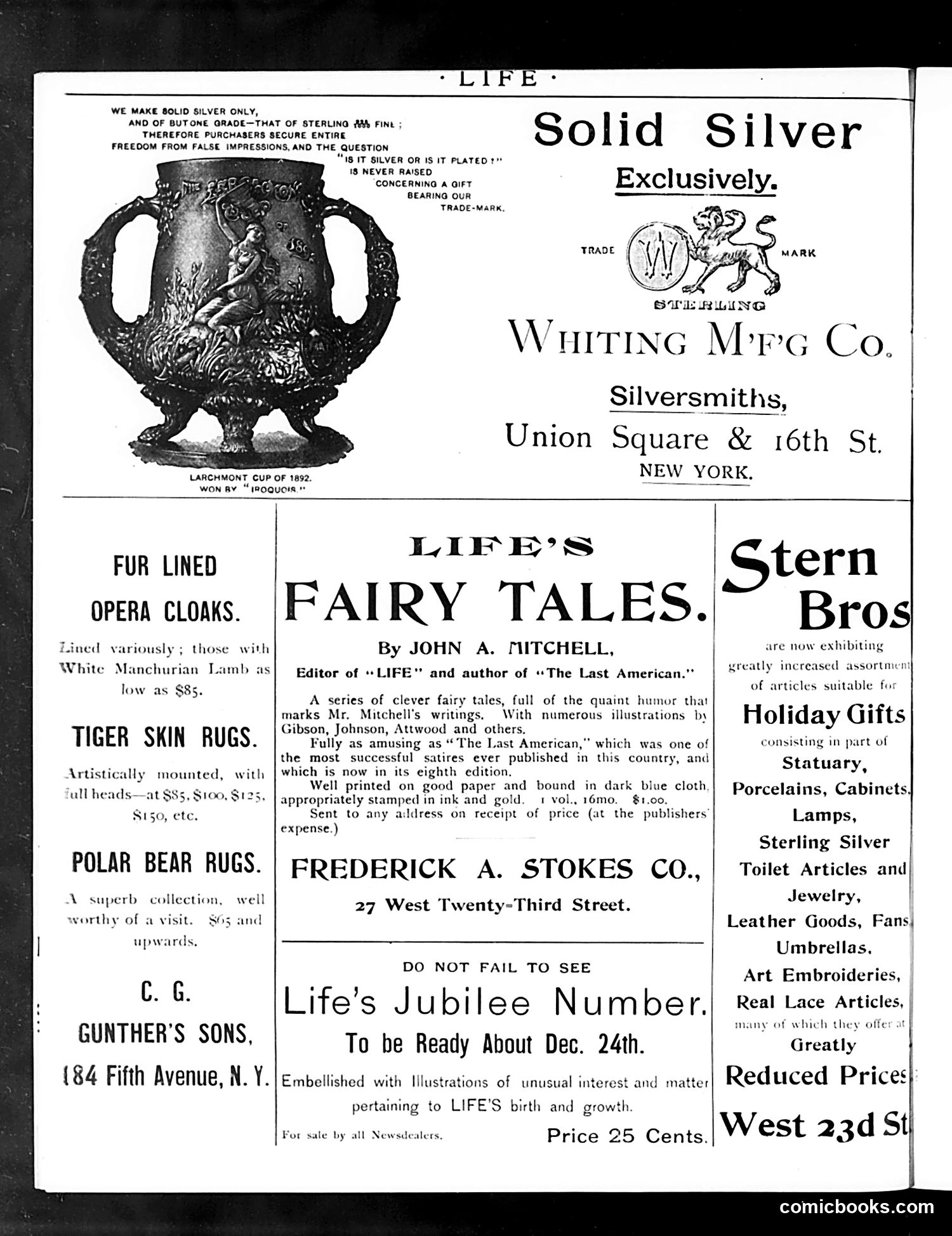
This page is primarily **advertising**, not political satire. The main content consists of multiple commercial advertisements for high-end goods aimed at wealthy consumers in late 19th-century New York: - **Whiting Mfg Co.**: Sterling silver products from silversmiths at Union Square - **Stern Bros**: Holiday gift items including porcelain, silver, jewelry, and leather goods - **C.G. Gunther's Sons**: Fur-lined opera cloaks and exotic animal skin rugs - **Frederick A. Stokes Co.**: John A. Mitchell's "Life's Fairy Tales" book The only notable editorial content is a promotion for **Life's Jubilee Number** (December 24th issue), highlighting the magazine's anniversary with illustrations of its history. The ornamental urn illustration represents the "Larchmont Cup of 1892." The page reflects *Life* magazine's role as both satirical publication and luxury lifestyle advertiser for Manhattan's elite.
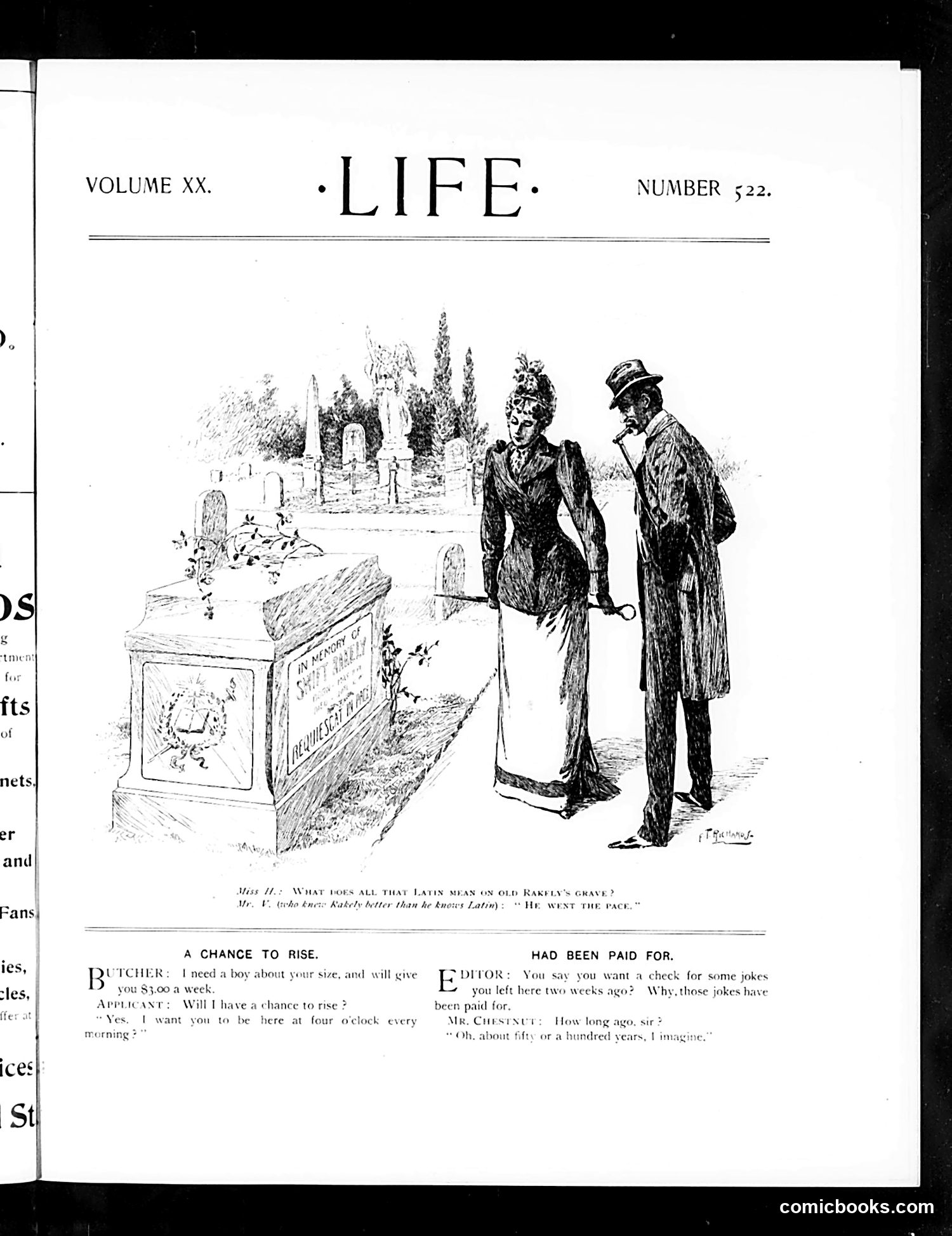
The main illustration shows a couple at a cemetery visiting a grave. The caption indicates this is social satire about Latin phrases on gravestones. The woman (Miss H.) asks what Latin inscriptions mean, and the man (Mr. U., apparently more educated) responds dismissively that Latin is "better than to be known Latin"—suggesting he doesn't understand it either but pretends otherwise. "He went the pace" appears to be a period slang expression implying the deceased lived fast or excessively. Below are two brief comic exchanges: "A Change to Rise" depicts an employment negotiation where an applicant seeks a position with early hours, and "Had Been Paid For" shows workplace banter about old jokes and payment. These are generic workplace humor rather than political satire, typical of Life magazine's miscellaneous comedic content.
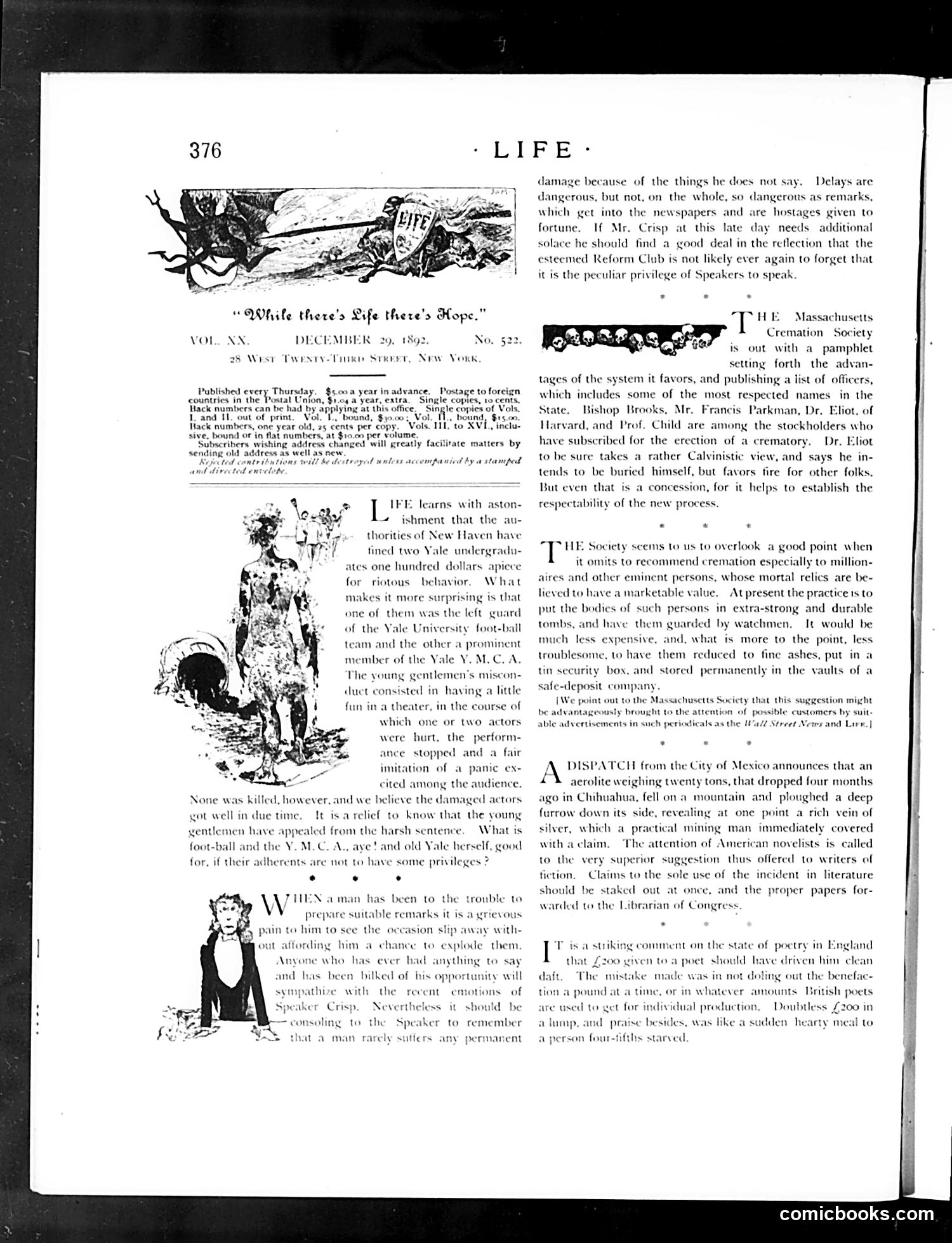
This page contains several satirical commentary pieces rather than traditional political cartoons. The main visible illustration depicts what appears to be a theatrical or social scene with figures in period dress, though the specific reference is unclear from the image alone. The text discusses various topics including Yale University students' conduct at a theater, Speaker Crisp's political standing within the Reform Club, Massachusetts cremation society practices, and a meteorite discovery in Mexico. One section critiques a British poet receiving £200—apparently a substantial but seemingly inadequate sum for artistic work. The satire targets institutional hypocrisy, misguided social practices, and cultural pretension among the American and British elite classes of the 1890s.
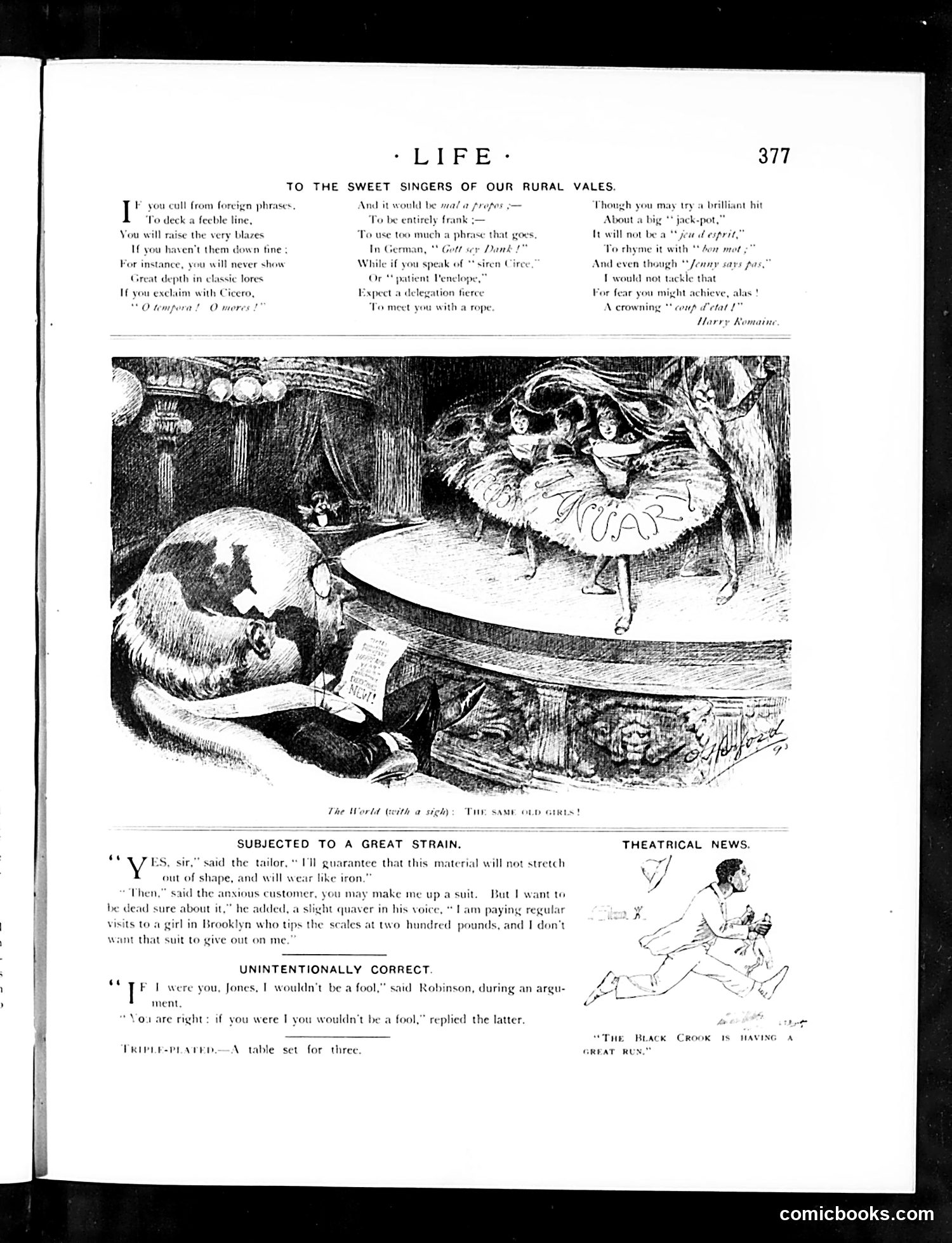
This page contains three distinct humor pieces: **"To the Sweet Singers of Our Rural Vales"** (top): A poem mocking amateur singers who use pretentious foreign phrases and overly dramatic language. It advises against theatrical affectation in simple country settings. **"The World with a Sigh"** (illustration): A satirical drawing showing what appears to be performers or dancers on stage, contrasting with an audience member. The caption references "the same old girls," suggesting commentary on repetitive entertainment or performers. **"Subjected to a Great Strain"** and **"Unintentionally Correct"**: Two brief anecdotal humor pieces. The first jokes about a customer's demanding suit specifications; the second presents a witty exchange where Robinson and Jones trade insults. **"Theatrical News"**: A small sketch labeled "The Black Crook is Having a Great Run," referring to a popular 19th-century theatrical production. Overall, the page satirizes pretension, tired entertainment formulas, and social awkwardness.
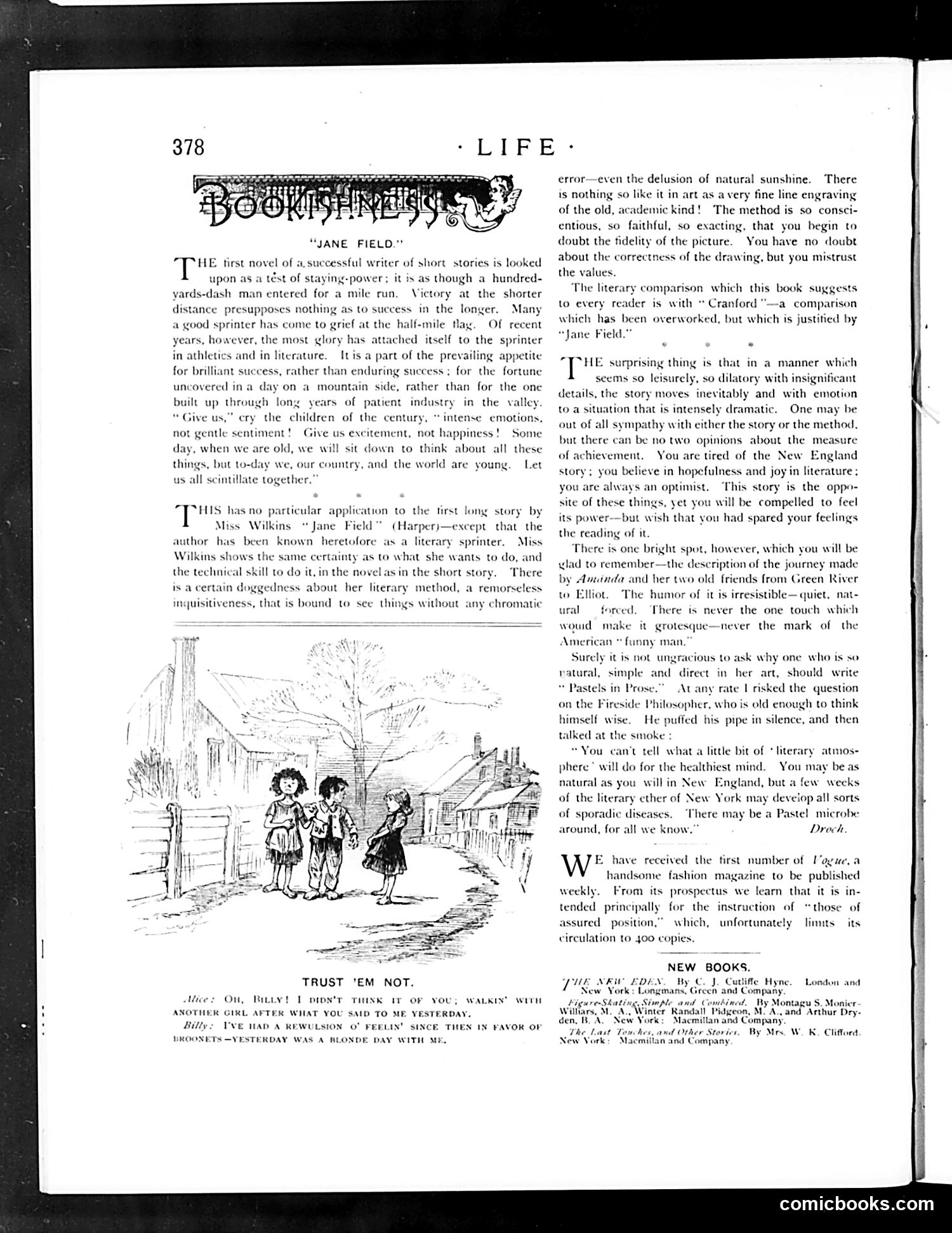
This page reviews "Jane Field," a novel by Miss Wilkins (likely Mary E. Wilkins Freeman, a prominent short-story writer of the era). The review praises Wilkins's ability to transition from short stories to longer fiction while maintaining technical skill, though noting a "doggedness" in her literary method. The small cartoon labeled "TRUST 'EM NOT" depicts three children on a street, with dialogue about whether to trust girls—likely a period-appropriate joke about gender relations. The cartoon serves as light visual relief rather than political satire. The page primarily functions as a book review and literary criticism column, not political commentary. The "New Books" section at bottom lists recent publications.
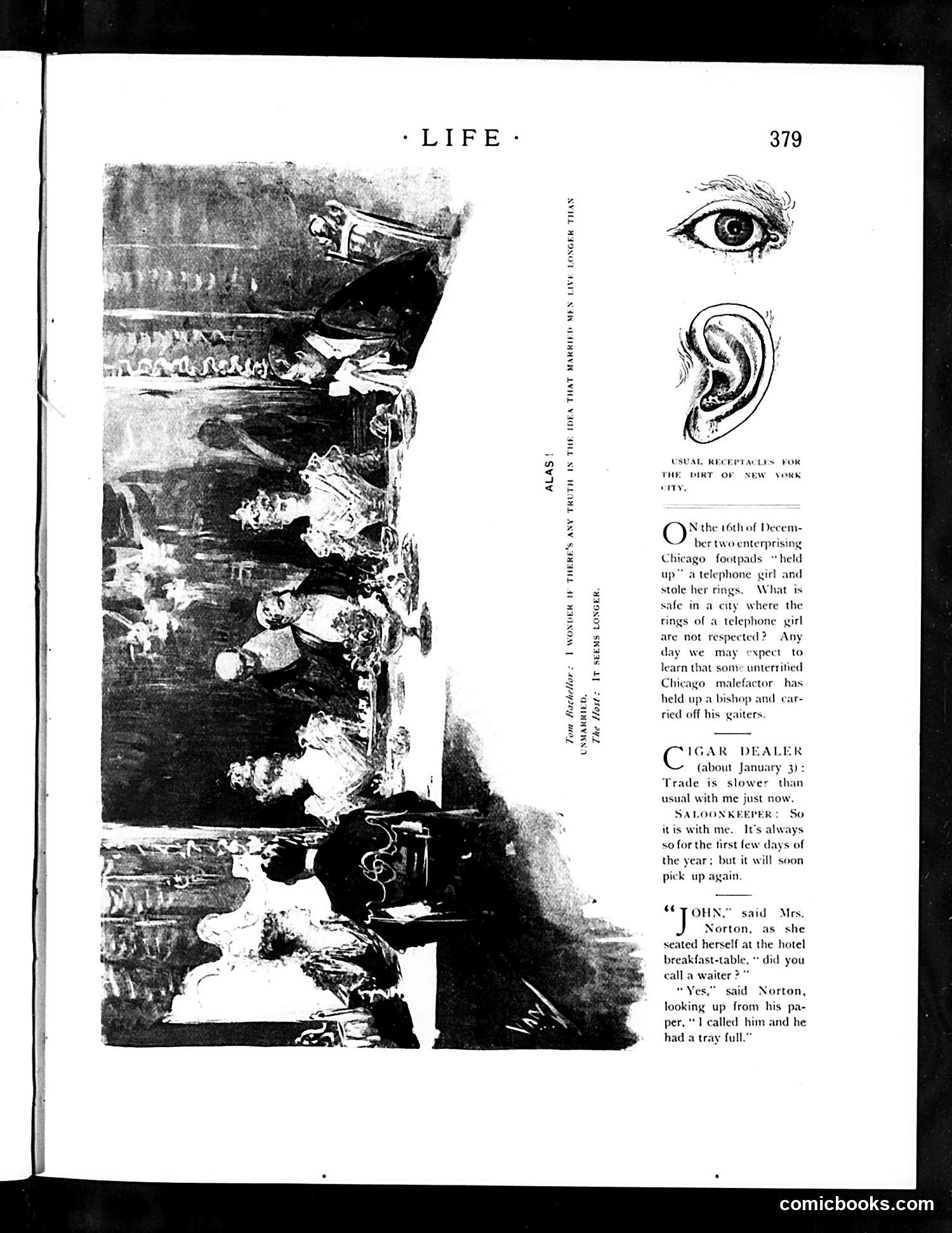
This page contains three separate satirical items: 1. **Main illustration (left)**: A darkly humorous cartoon depicting urban chaos—appears to show a street scene with multiple figures in conflict or disorder. The caption references "False Bottoms" and mentions "A Boarder" and "The Limit," suggesting domestic or housing-related satire common to the era. 2. **Anatomical drawings (right)**: Simple line illustrations of an eye and ear labeled "Usual Receptacles for the Dirt of New York City"—a joke suggesting New Yorkers are exposed to so much urban filth it accumulates in their sensory organs. 3. **Text dialogue (lower right)**: A brief comic exchange between "Mrs. Norton" and "John" about calling a waiter at breakfast, with contemporary class/service humor. The page satirizes early 20th-century urban life, housing, and class dynamics.
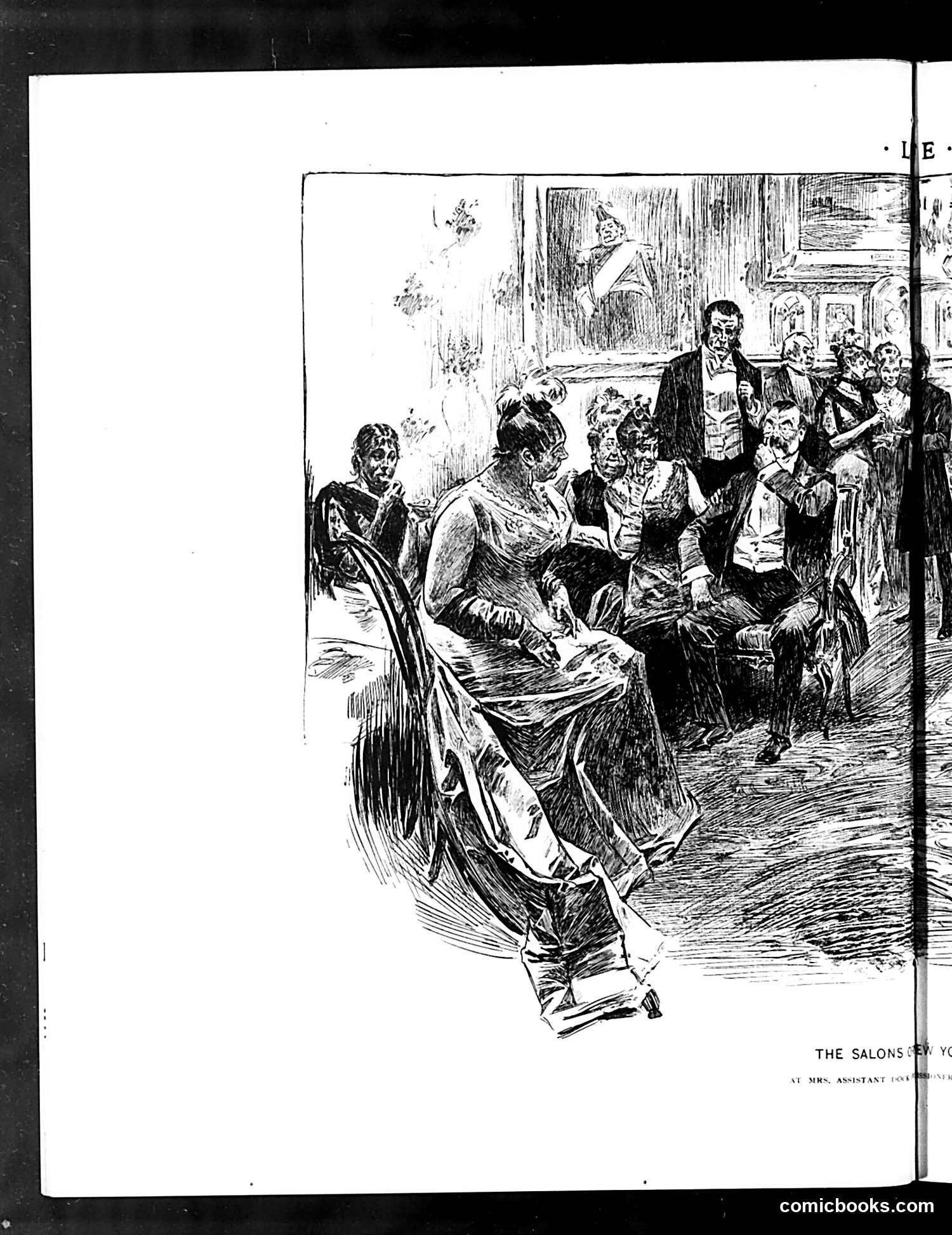
This appears to be an illustration titled "THE SALONS OF..." (text cut off) depicting a social gathering of well-dressed men and women in what seems to be an interior salon or drawing room setting. The sketch style is characteristic of early 20th-century Life magazine satirical illustrations. The scene shows fashionable Victorian or Edwardian-era figures engaged in social interaction. Without the complete caption or article text, the specific satirical target is unclear—it could be mocking high society gatherings, artistic salons, or particular social pretensions of the era. The artist's technique uses cross-hatching and expressive line work typical of period political illustration. The partial text reference to "MRS. ASSISTANT" suggests this may relate to a specific social figure or ongoing satirical feature, but full context cannot be determined from the visible portion.
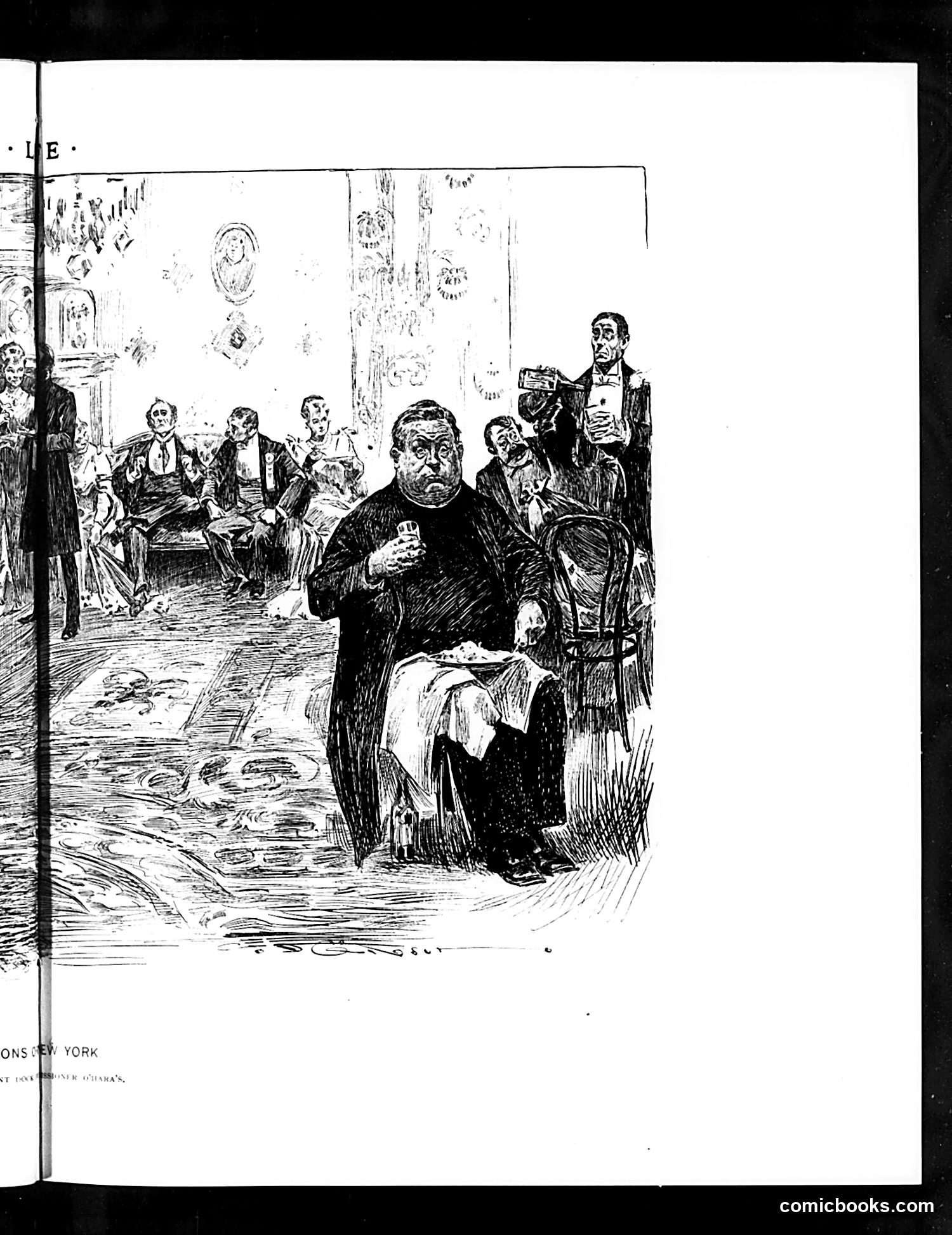
This appears to be a 19th-century satirical engraving showing a formal social gathering or official proceeding. A heavyset man in dark clothing sits prominently in the foreground, while well-dressed gentlemen stand and sit around him in what looks like an ornate interior space with decorative wall panels. The illustration's specific satirical meaning is **unclear without additional context** — the OCR text provided contains only fragmentary publication information ("ONSSEY YORK" and partial text). Without captions, article text, or visible date information identifying the figures or the historical event being lampooned, I cannot definitively explain what political or social commentary this cartoon intends. The formal setting and caricatured expressions suggest mockery of officialdom or high society, but specifics remain indeterminate.
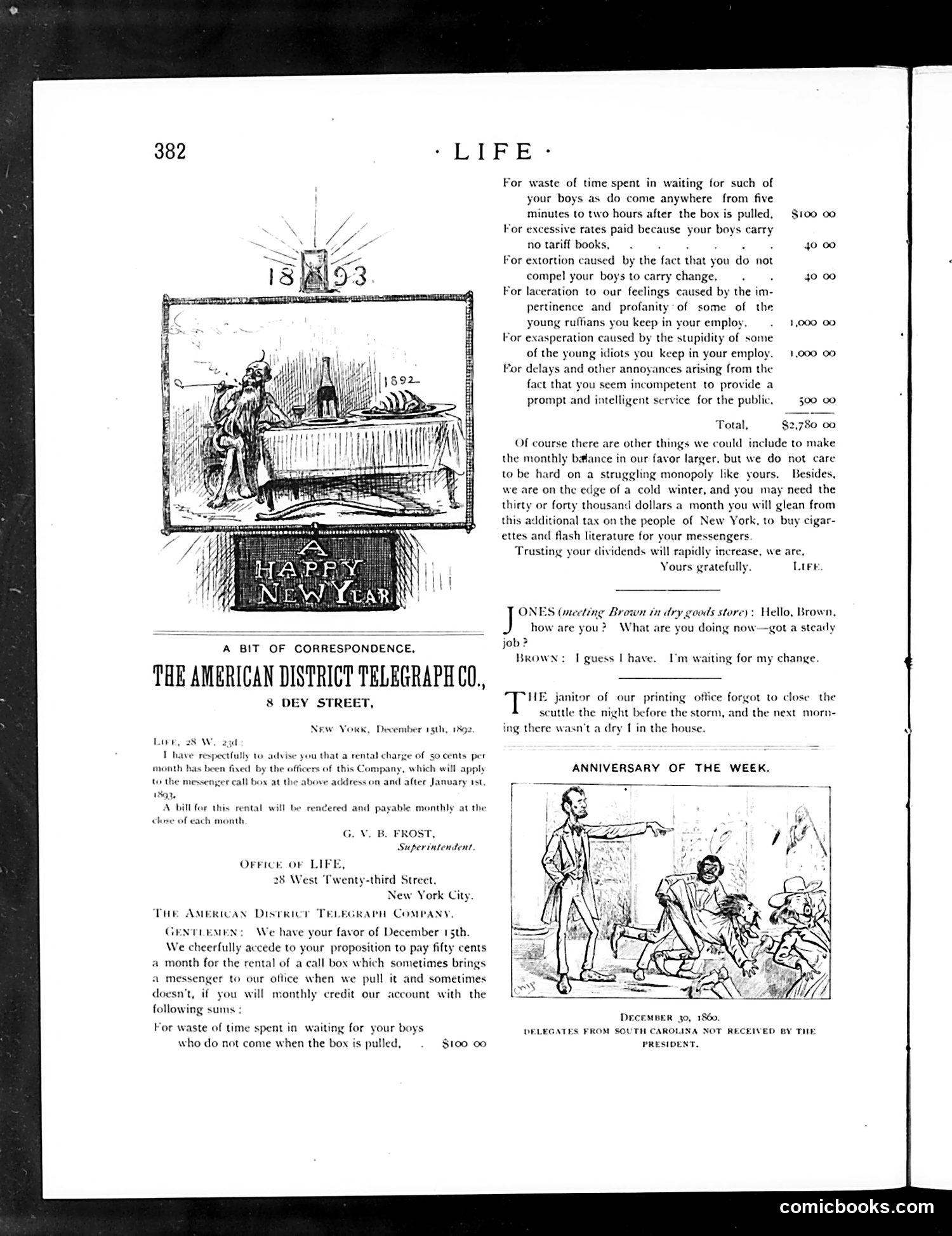
This page contains **satirical business correspondence** rather than political cartoons. The American District Telegraph Company (a messenger call-box service) receives a humorous bill from *Life* magazine for various charges incurred by their slow or unreliable service—including $100 for "waste of time spent in waiting for your boys," $1,000 for "laceration to our feelings caused by the impertinence...of some of the young ruffians," and $500 for "delays and other annoyances." *Life* responds with mock-seriousness, suggesting they'd charge more but don't want to be "hard on a struggling monopoly." The joke mocks both the telegraph company's poor service and the absurdity of billing customers for emotional distress—a satire on 1890s business practices and customer service failures.
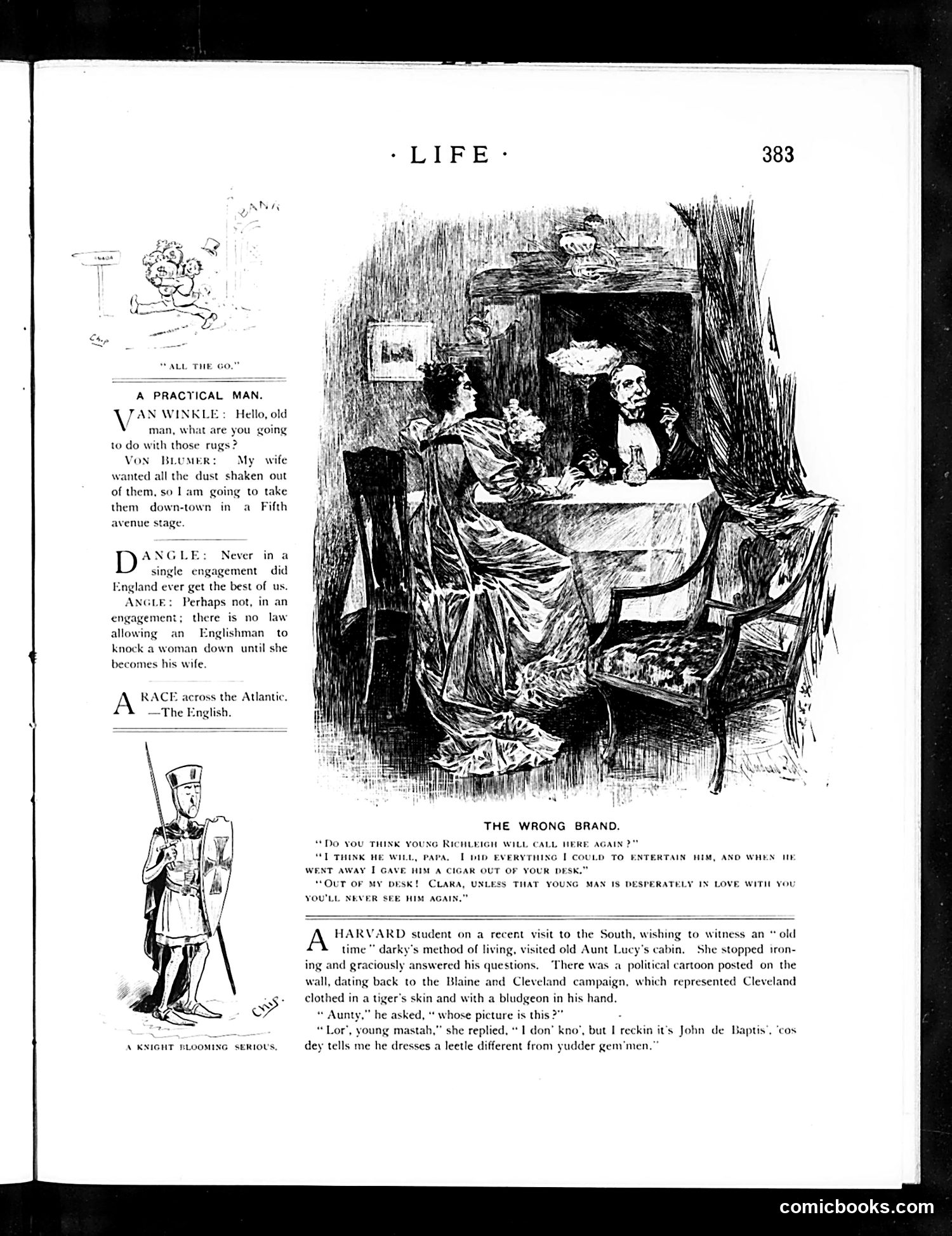
This page contains three satirical pieces about English society and courtship customs: **"A Practical Man"** (top left): A brief dialogue mocking an English husband's literal interpretation of his wife's request to have dust removed from rugs—he plans to take them to a Fifth Avenue stage theater rather than simply shake them out. **"The Wrong Brand"** (center): A sketch showing a young woman (Clara) warning a suitor that unless he's the right romantic "brand" of man, she won't see him again. The humor plays on commercial advertising language applied to courtship. **"A Race Across the Atlantic—The English"** (bottom left): A knight illustration, likely satirizing English claims of superiority. **The Harvard Student anecdote** (bottom): A story about a Northern visitor to the South encountering outdated political imagery, gently mocking regional differences in post-Reconstruction America. The page's overall theme: contrasting American practicality and commercial culture with English formality and tradition.
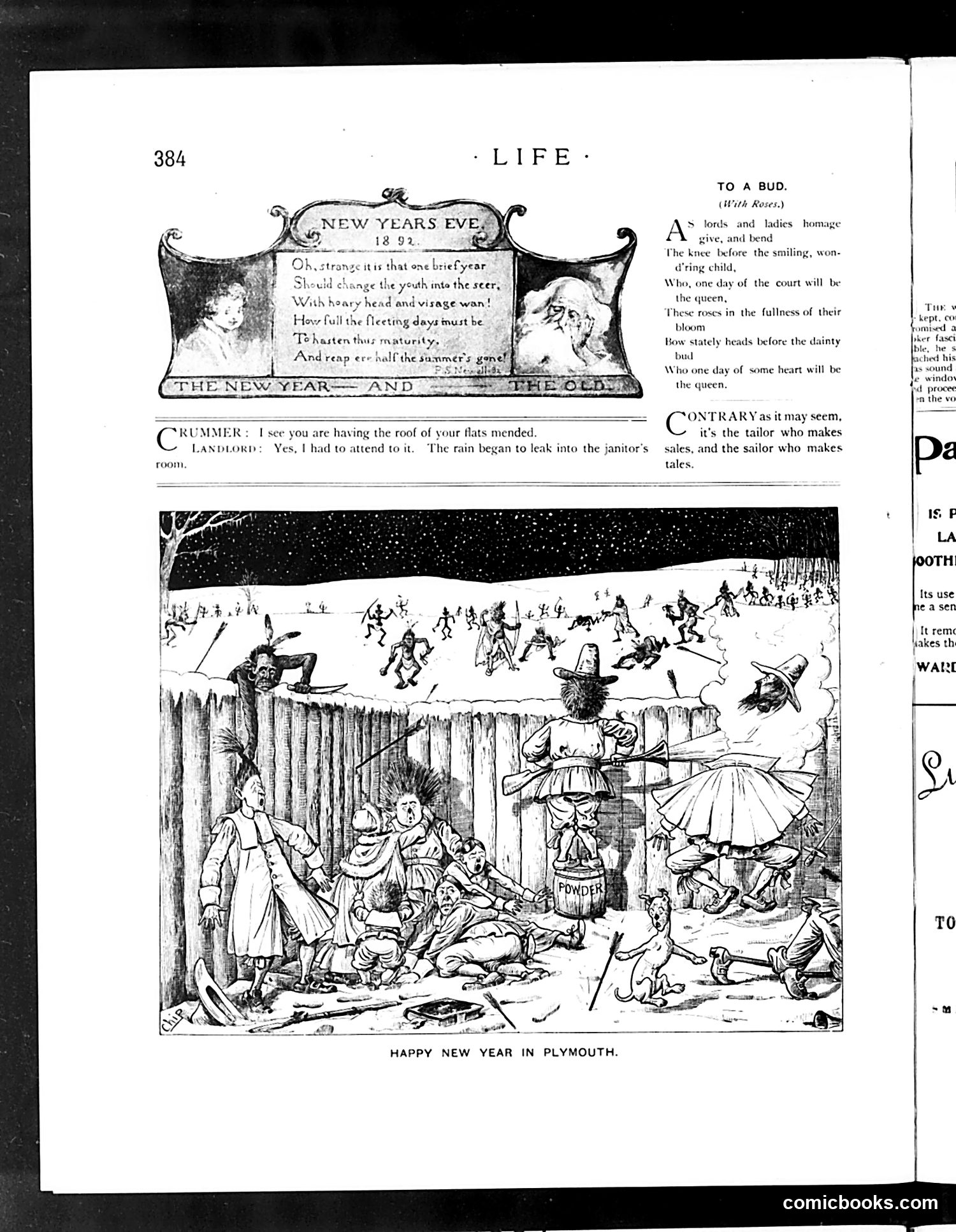
This page from *Life* magazine contains three separate pieces of New Year's 1892 content: **Top**: A decorative New Year's Eve banner with reflective verse about youth and time's passage—standard sentimental holiday fare. **Middle**: A brief comic dialogue between a Crummer and Landlord about roof repairs and rain leaks—a mundane, topical joke about property maintenance. **Bottom**: "Happy New Year in Plymouth"—a satirical illustration depicting rowdy New Year's celebrations. The scene shows what appears to be working-class revelry with people drinking, fighting, and generally behaving chaotically in a snowy setting, contrasting sharply with the refined sentiment above. The "powder" barrel visible suggests potential danger or mayhem. The page juxtaposes genteel, poetic holiday sentiments with crude reality—a typical *Life* magazine approach mocking pretension through contrast. The Plymouth reference likely means Plymouth, England, famous from historical association with the Mayflower.
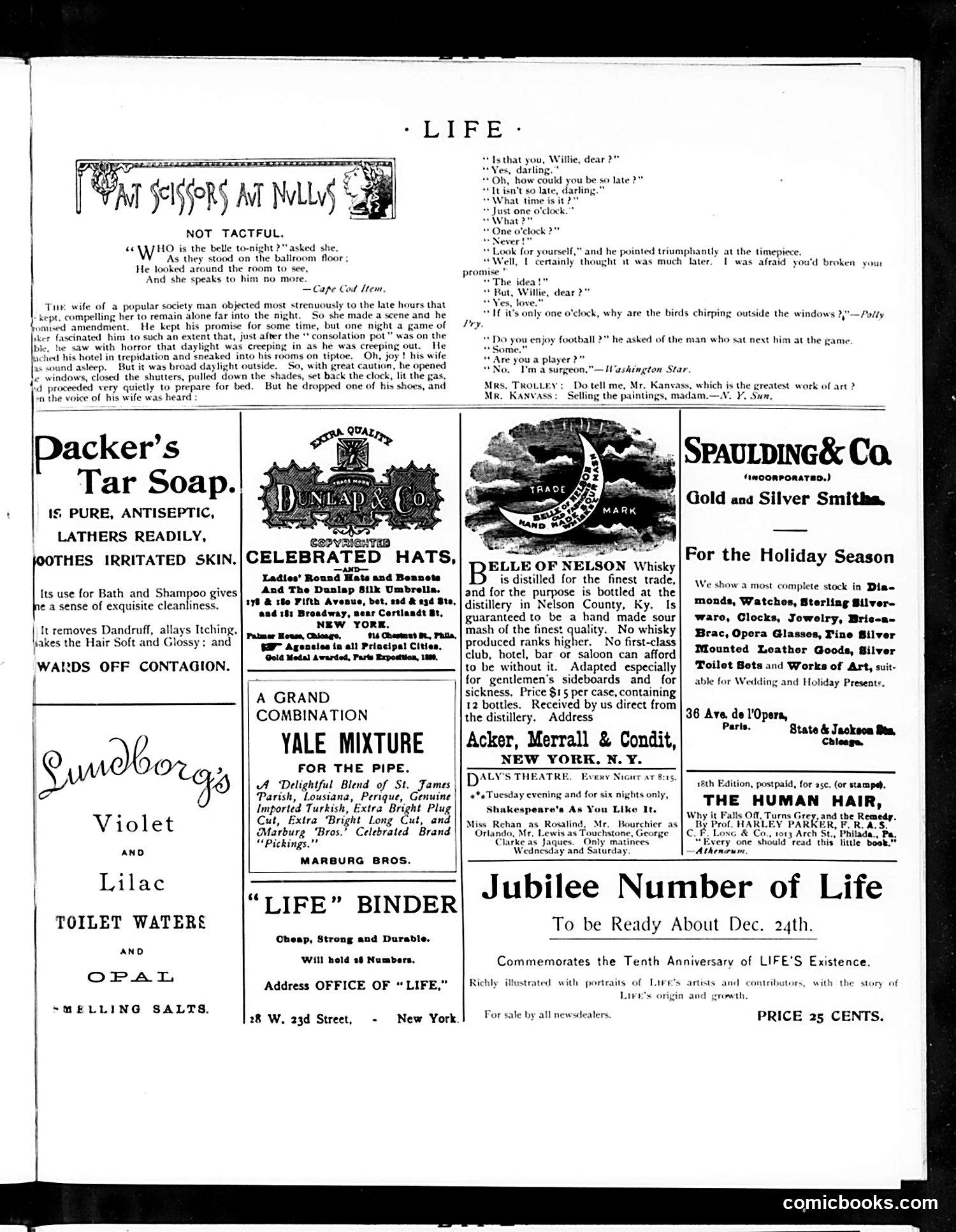
This page is primarily advertising with one central comic story titled "Not Tactful." **The Joke:** A husband sneaks home late from a poker game. To avoid his wife's suspicion, he sets back the clock to 1 a.m., dims the lights, and prepares for bed quietly. When she wakes and asks why he's so late, he points triumphantly at the clock, proving it's only one o'clock. She replies: "If it's only one o'clock, why are the birds chirping outside the windows?" **The Point:** The satire mocks the husband's poor excuse-making. His deception is transparent—birds chirp at dawn, not 1 a.m.—yet he attempted an elaborate scheme (resetting clocks, closing shutters) assuming his wife wouldn't notice obvious reality. The "tactless" element appears to be the wife's pointed exposure of his foolishness rather than diplomacy. **Context:** This reflects period anxieties about marital deception and wives' domestic surveillance of husbands' activities, particularly late-night card games.
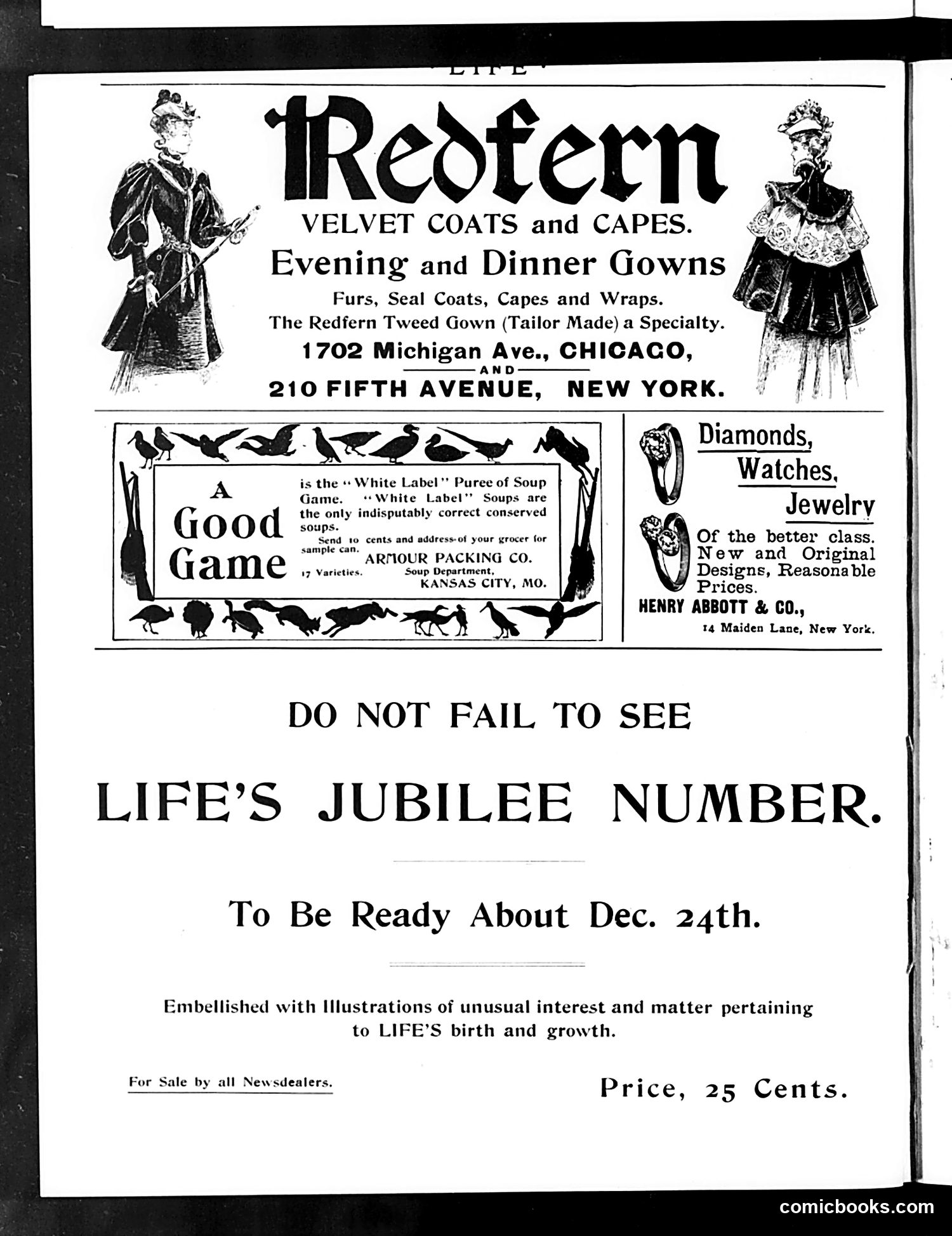
This is primarily an **advertising page** from Life magazine, not a satirical cartoon page. It contains three distinct advertisements: 1. **Redfern** (top): A high-end fashion house advertising velvet coats, capes, evening gowns, furs, and "Redfern Tweed Gown (Tailor Made)" with locations in Chicago and New York. 2. **Armour Packing Co.** (left): Promoting "White Label" canned soups as "the only indisputably correct conserved soups," available in 17 varieties. 3. **Henry Abbott & Co.** (right): Jewelry retailer offering diamonds, watches, and jewelry in "New and Original Designs" at "Reasonable Prices." The bottom section **promotes Life's upcoming "Jubilee Number"** (likely celebrating the magazine's anniversary), to be released around December 24th, priced at 25 cents. There is **no political satire or cartoon commentary** visible on this page—it's a straightforward commercial advertisement section typical of early 20th-century magazines.
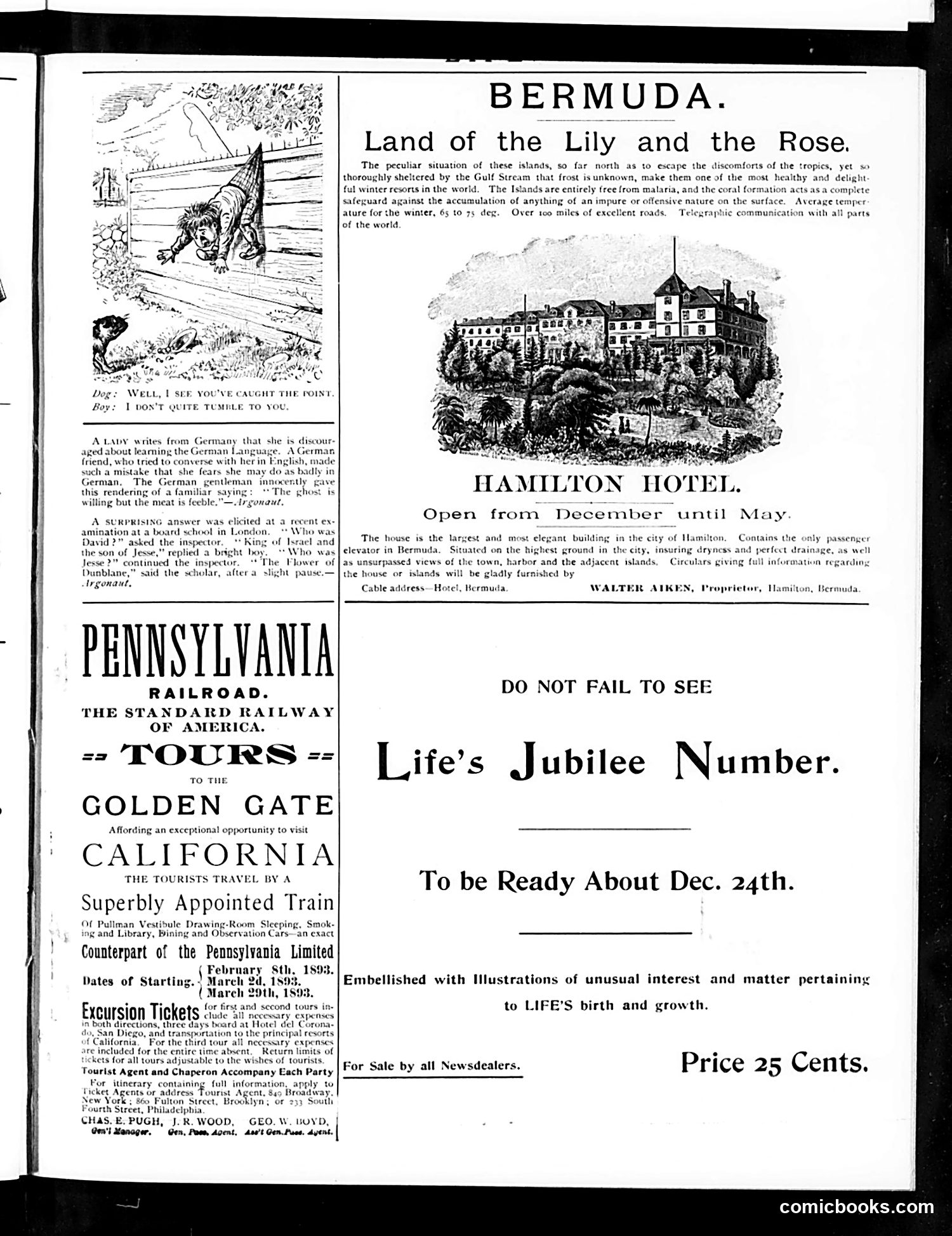
This page contains two brief satirical anecdotes rather than political cartoons: 1. **The Dog and Boy cartoon**: A simple visual joke about miscommunication—a dog catches a point (literally, by catching something in its mouth) while a boy claims not to understand it. This plays on the double meaning of "catching the point" (understanding vs. physically grabbing). 2. **The Language Anecdote**: Mocks a German woman's difficulty learning English, portraying her as making absurd mistakes in translation or comprehension—typical period humor about foreign language struggles. 3. **The School Examination Anecdote**: A child answers a biblical question ("Who was David?") with song lyrics ("Flower of Dunblane") instead of historical/religious facts, satirizing either student ignorance or the rigidity of educational examinations. The remainder is **advertising**: travel promotions for Bermuda, the Pennsylvania Railroad's California tours, and announcements for Life's upcoming "Jubilee Number." This is a typical page structure for the era's magazines, mixing humor content with commercial matter.
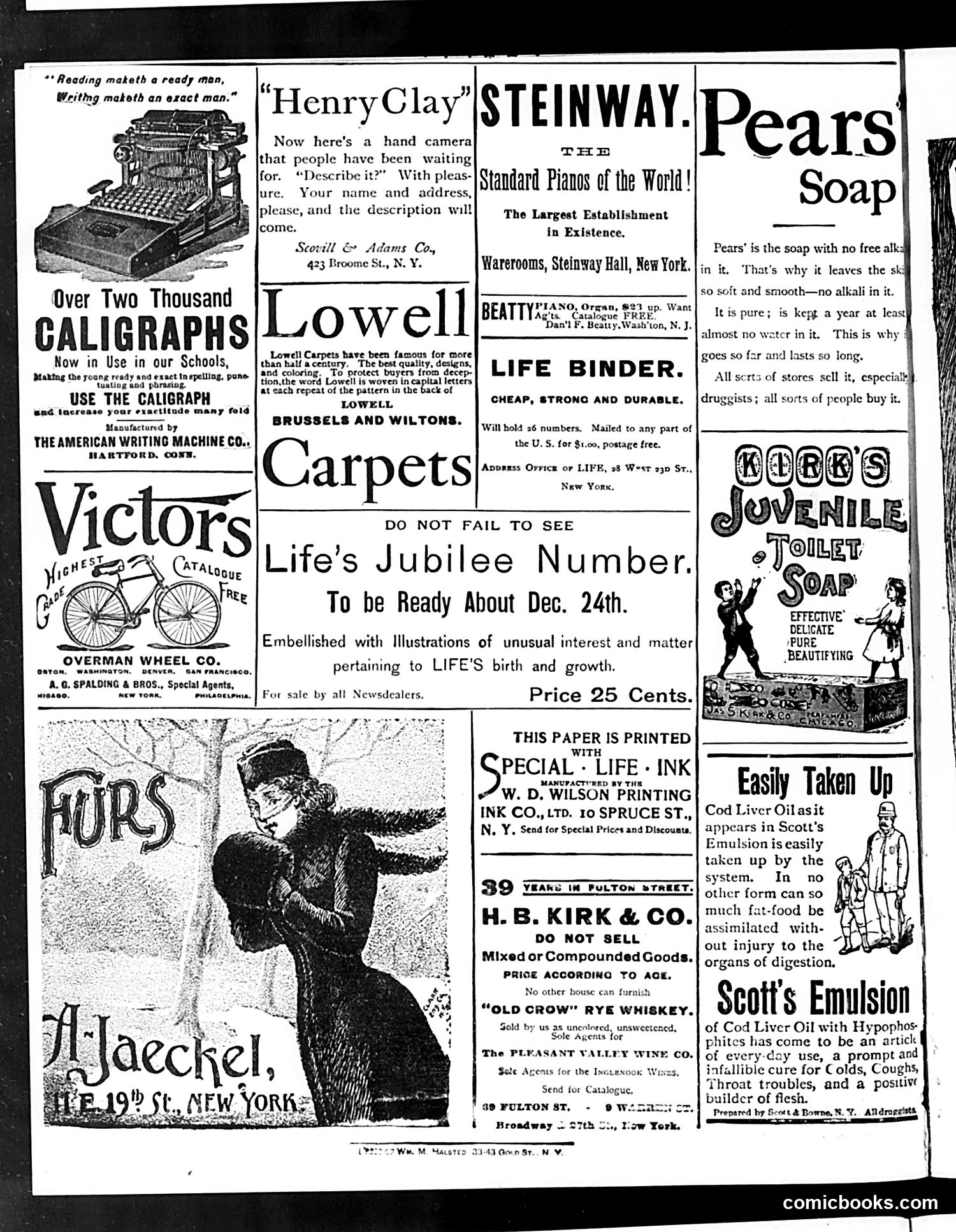
This is primarily an **advertising page** from Life magazine, likely from the 1880s-1890s based on the products and typography. Rather than political satire, it showcases period advertisements with minimal editorial content. The page includes ads for: - **Writing machines** (typewriters called "caligraphs") - **Bicycles** (Overman Wheel Co., Victor brand) - **Carpets** (Lowell brand) - **Pianos** (Steinway) - **Soaps** (Pears' and Kirk's Juvenile) - **Medicines** (Scott's Emulsion cod liver oil, claimed to cure colds and build strength) - **Whiskey** ("Old Crow" rye) The single illustration—a woman in a large coat marked "HURS" at H.B. Kirk & Co.—is a straightforward product advertisement, not satire. The page's primary interest today is **social history**: it documents consumer goods, medical claims (Scott's Emulsion as a cure-all), and advertising practices of the Gilded Age, when such publications relied entirely on advertising revenue.
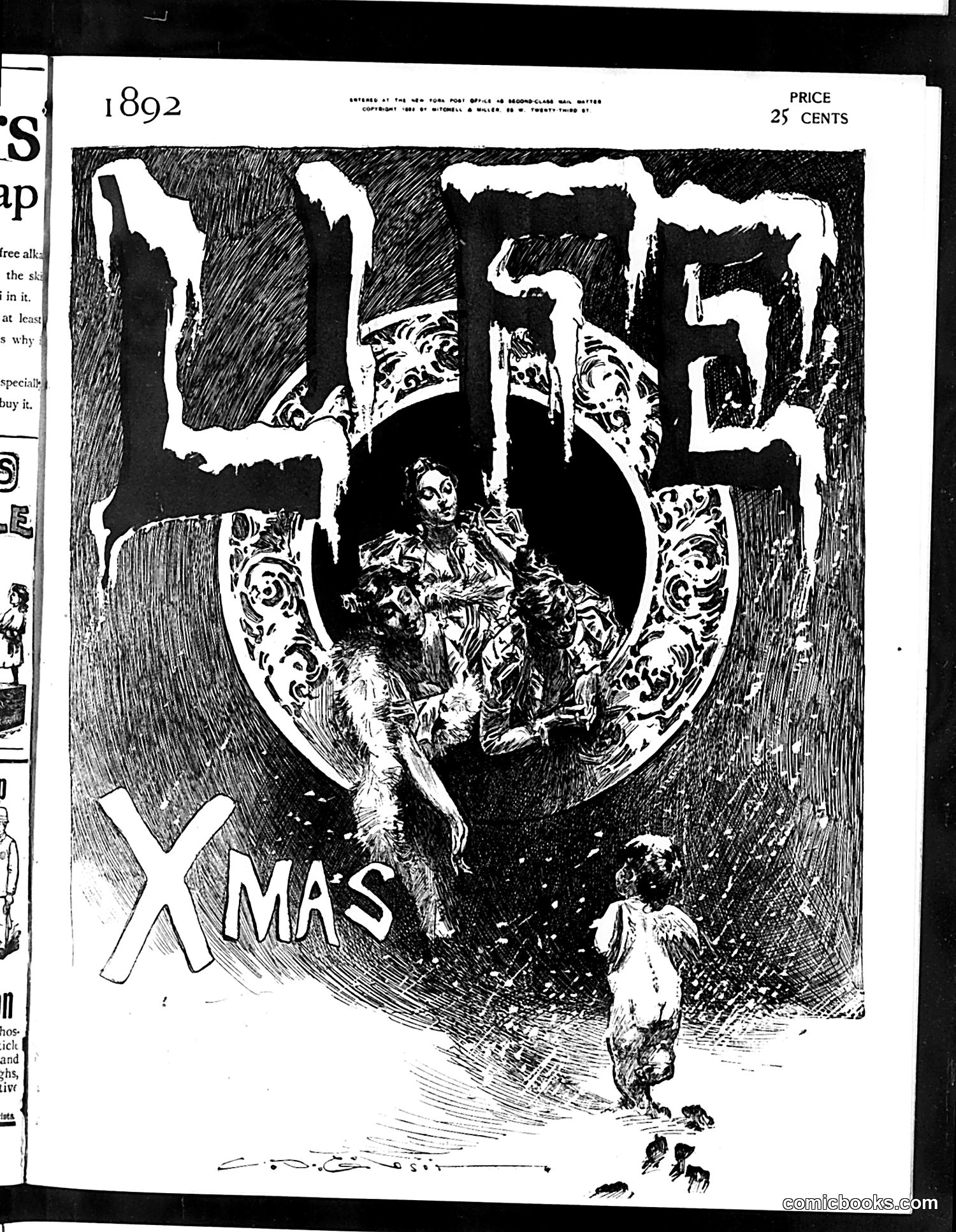
This is a Christmas-themed cover illustration from Life magazine's 1892 holiday issue. The artwork depicts a large horseshoe (a luck symbol) containing figures in elaborate period costume—appearing to be cherubs or putti in a classical style, along with what seems to be a child figure below looking up at the scene. The "XMAS" text appears at the bottom. The horseshoe itself suggests good fortune and holiday wishes. The engraving style and detailed cross-hatching are characteristic of 1890s woodcut or steel-plate illustration techniques used for magazine covers of this era. Without additional visible text explaining the specific satire or contemporary references, the primary message appears to be a sentimental, luck-themed Christmas greeting rather than sharp political commentary.
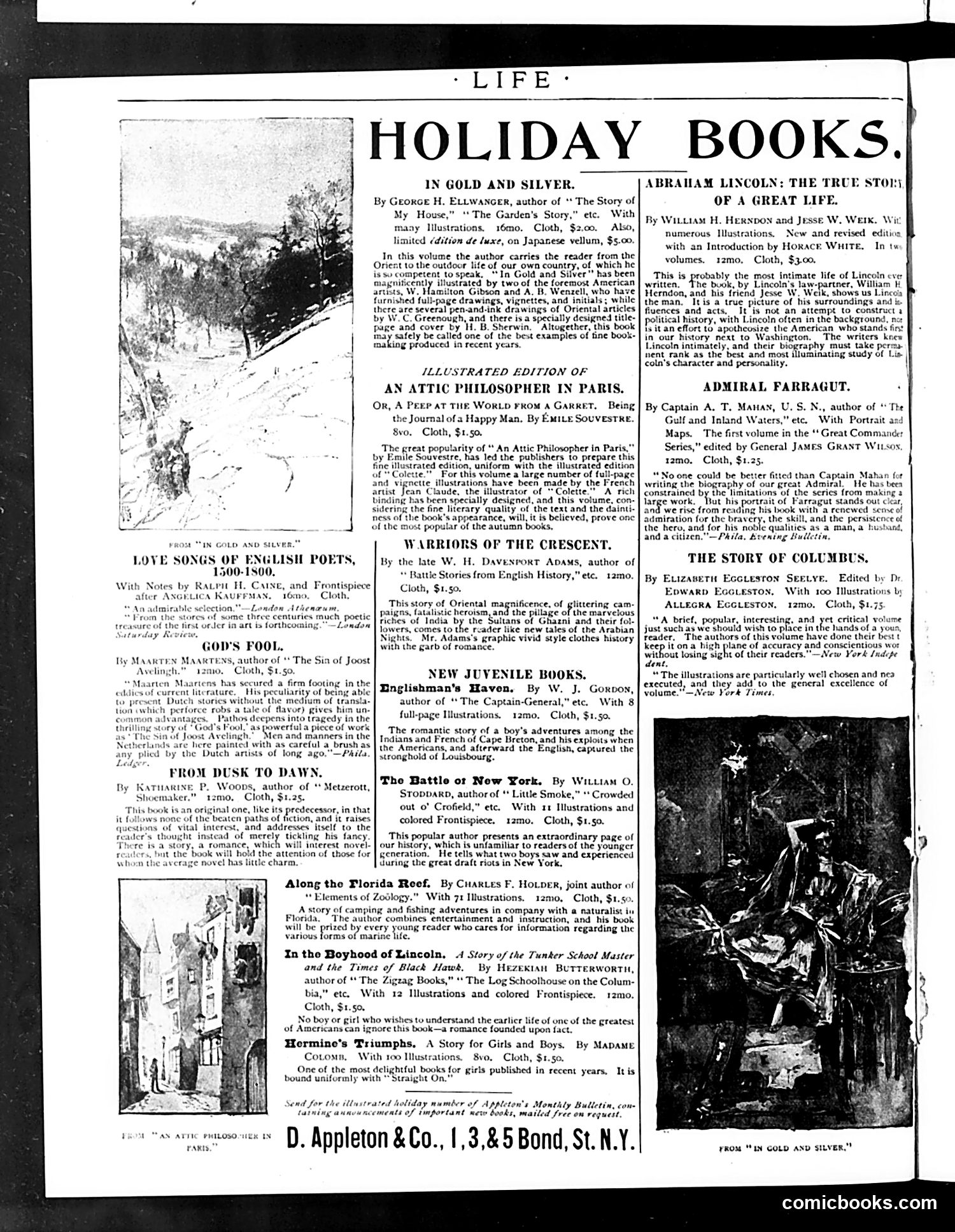
This is primarily a **book advertisement page**, not a political cartoon. It showcases holiday gift recommendations from D. Appleton & Co., featuring literary works popular in the late 19th century. The page includes titles like *"In Gold and Silver"* (with illustrations by prominent American artists), *"An Attic Philosopher in Paris"* (a French work about finding happiness in modest circumstances), and juvenile adventure stories like *"Englishman's Haven"* (about a boy's exploits during colonial conflicts in Cape Breton). Two small engravings appear—one labeled "An Attic Philosopher in Paris" showing urban/domestic scenes, another from "In Gold and Silver" depicting what appears to be an outdoor landscape. **Context for modern readers**: This reflects Victorian-era leisure reading and gift-giving culture, emphasizing illustrated editions and romantic/adventure narratives as desirable holiday presents for both adults and children. The prominence of European literature and colonial adventure tales reflects the era's literary tastes and imperial interests.
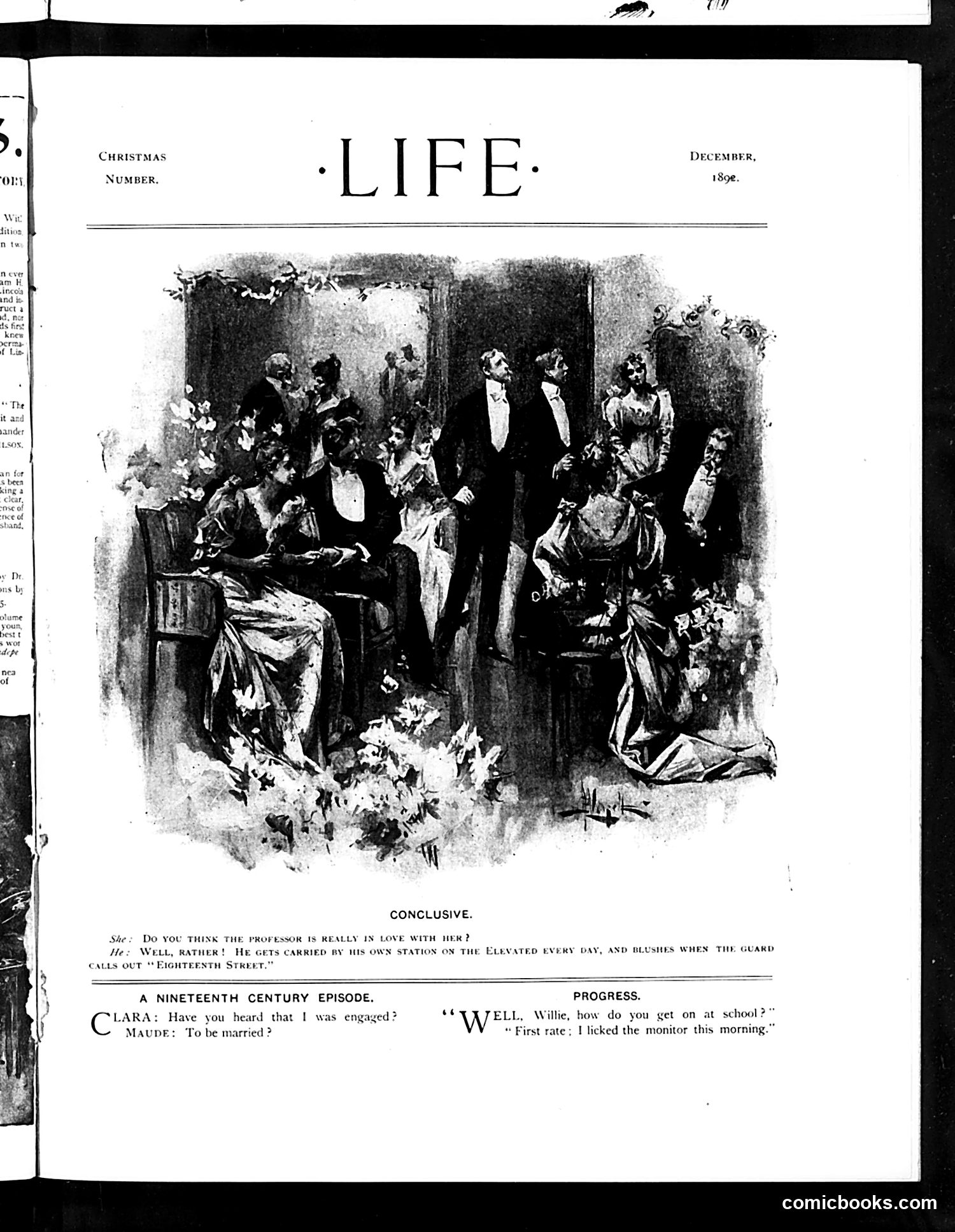
This page contains three separate satirical jokes typical of 1890s Life magazine humor: **"Conclusive"** (main illustration): A joke about a professor's romantic embarrassment. The humor relies on the "Elevated" (elevated railway) stop at "Eighteenth Street" sounding like it could be a euphemism or double entendre. The professor's repeated blushing when the guard announces the station becomes "proof" he's in love—suggesting his embarrassment at the suggestive name reveals his feelings. **"A Nineteenth Century Episode"**: A brief dialogue joke where Clara announces her engagement to be married, and Maude responds with apparent misunderstanding or deflation of the announcement's significance. **"Progress"**: A commentary on changing social values. A mother asks her son how school goes; he proudly reports he "licked the monitor" (beat up the monitor/student prefect). The title "Progress" suggests this represents modern youth behavior—possibly satirizing either permissive parenting or declining school discipline. All three rely on wordplay, double meanings, and social observation rather than political commentary.
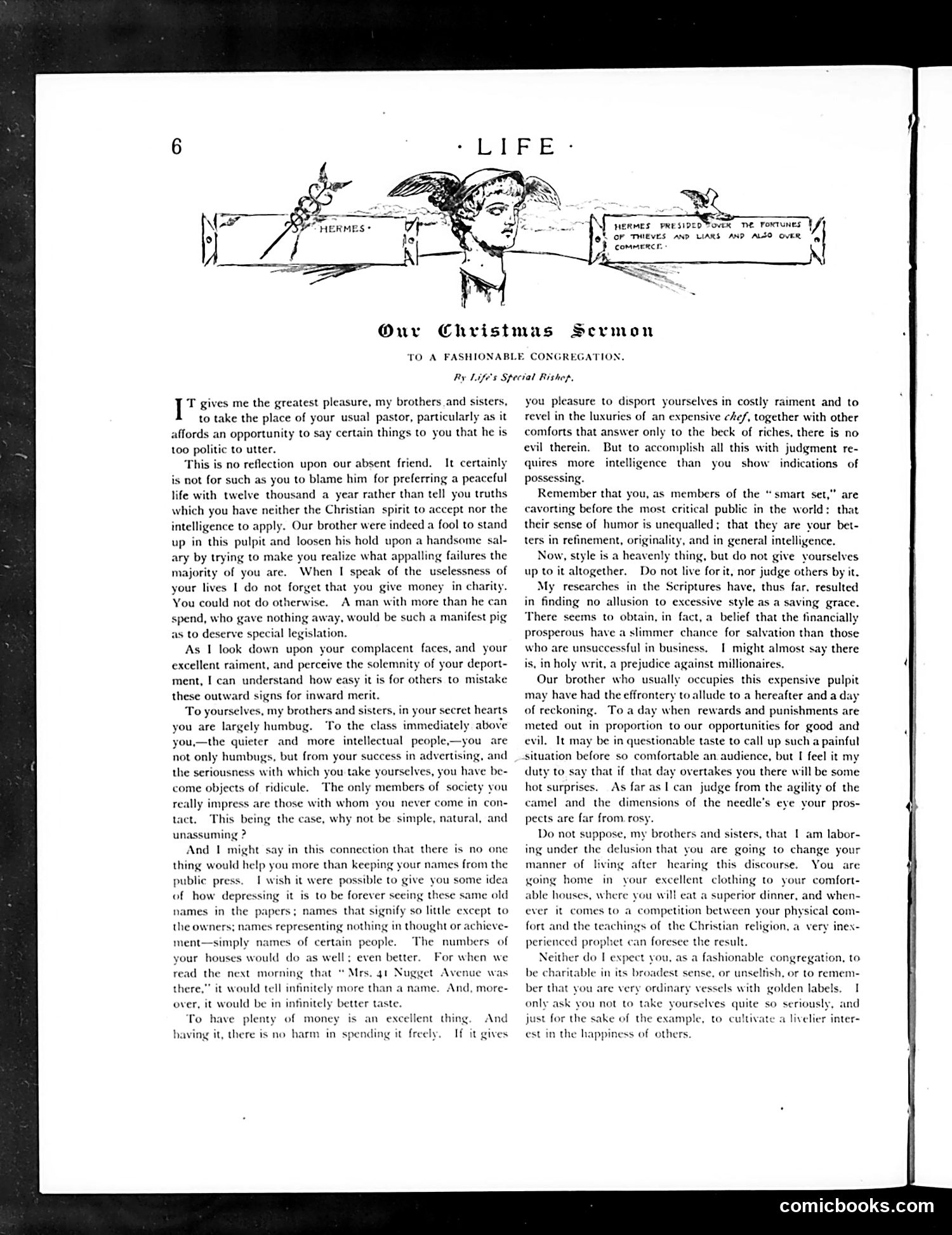
This is a satirical sermon by Life's fictional "Special Bishop" mocking wealthy, fashionable congregants. The cartoon header shows Hermes (god of thieves and liars), suggesting the sermon's ironic premise. The satire targets the "smart set"—wealthy elites who attend fashionable churches while living hypocritically. The bishop pretends to praise their charity and expensive tastes, then systematically skewers them: they're "largely humbug" in their hearts, objects of ridicule to the truly intelligent classes, and they embarrass themselves by constantly appearing in society pages. The joke is that their regular pastor won't deliver such truths because he depends on their donations. The bishop mocks their assumption that wealth brings salvation, their obsession with status and publicity, and their shallow belief that money and style constitute virtue. He suggests they'd be more impressive if they simply used their address rather than their name in newspapers. It's a classic Gilded Age critique of conspicuous consumption masquerading as respectability.
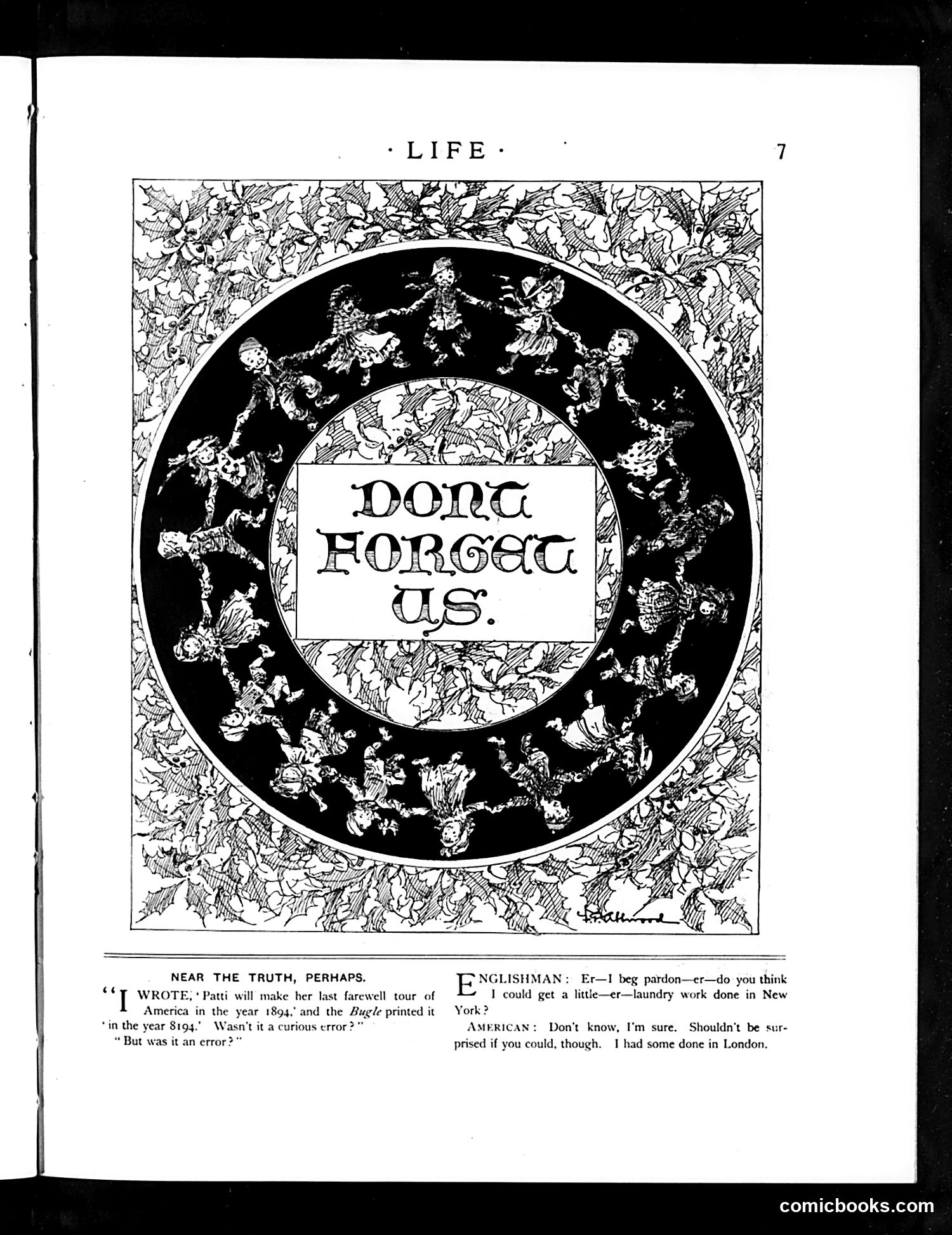
The main cartoon features a circular design with "DONT FORGET US" in the center, surrounded by cherubs or putti figures arranged in a ring—a decorative, whimsical illustration rather than overtly political satire. Below, the section "Near the Truth, Perhaps" presents a humorous anecdote about a printing error. A writer supposedly submitted that opera singer Adelina Patti would tour America in 1894, but a publication called the "Bugle" printed it as "8194"—a thousand-year error. The joke's punchline—"But was it an error?"—suggests sardonic skepticism about the publication's competence, implying such mistakes were typical. The dialogue between an Englishman and American concerns laundry service availability between New York and London, a lighthearted commentary on transatlantic differences in service quality or reliability, likely reflecting period anxieties about international commerce and American versus British standards.
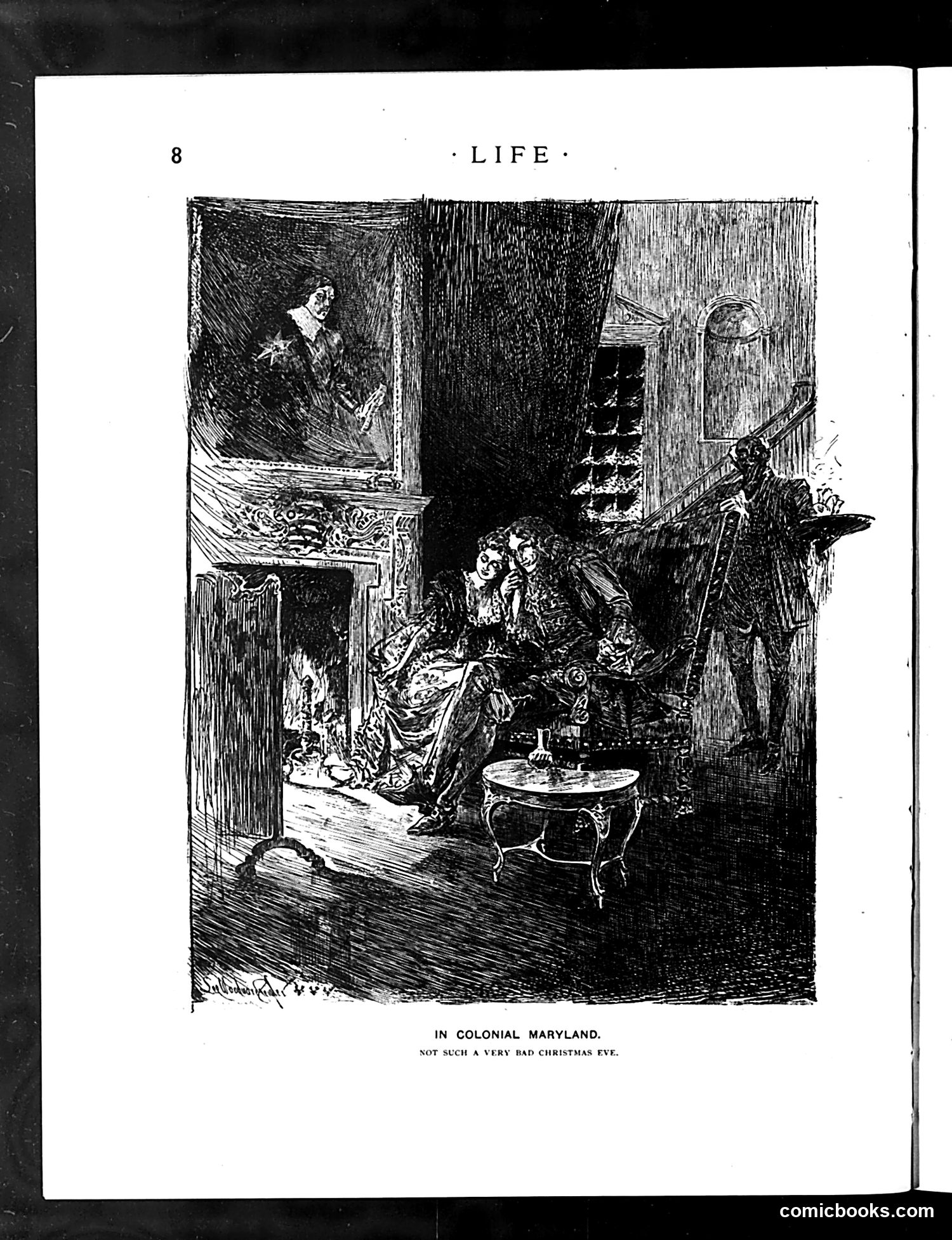
This satirical illustration depicts a Christmas Eve scene in colonial-era Maryland. The sketch shows what appears to be a domestic or tavern interior with several figures in period dress. The caption's wry tone—"Not Such a Very Bad Christmas Eve"—suggests ironic commentary, likely mocking either the hardships of colonial life or contemporary attitudes toward Christmas observance. The detailed cross-hatching and sketch style is characteristic of early Life magazine's editorial illustrations. Without additional context, the specific satirical target remains unclear—it may comment on colonial living conditions, religious observance, social customs, or contemporary nostalgia for "simpler times." The ironic caption implies the depicted scene is actually worse than the understatement suggests, though the precise critique isn't evident from the image alone.
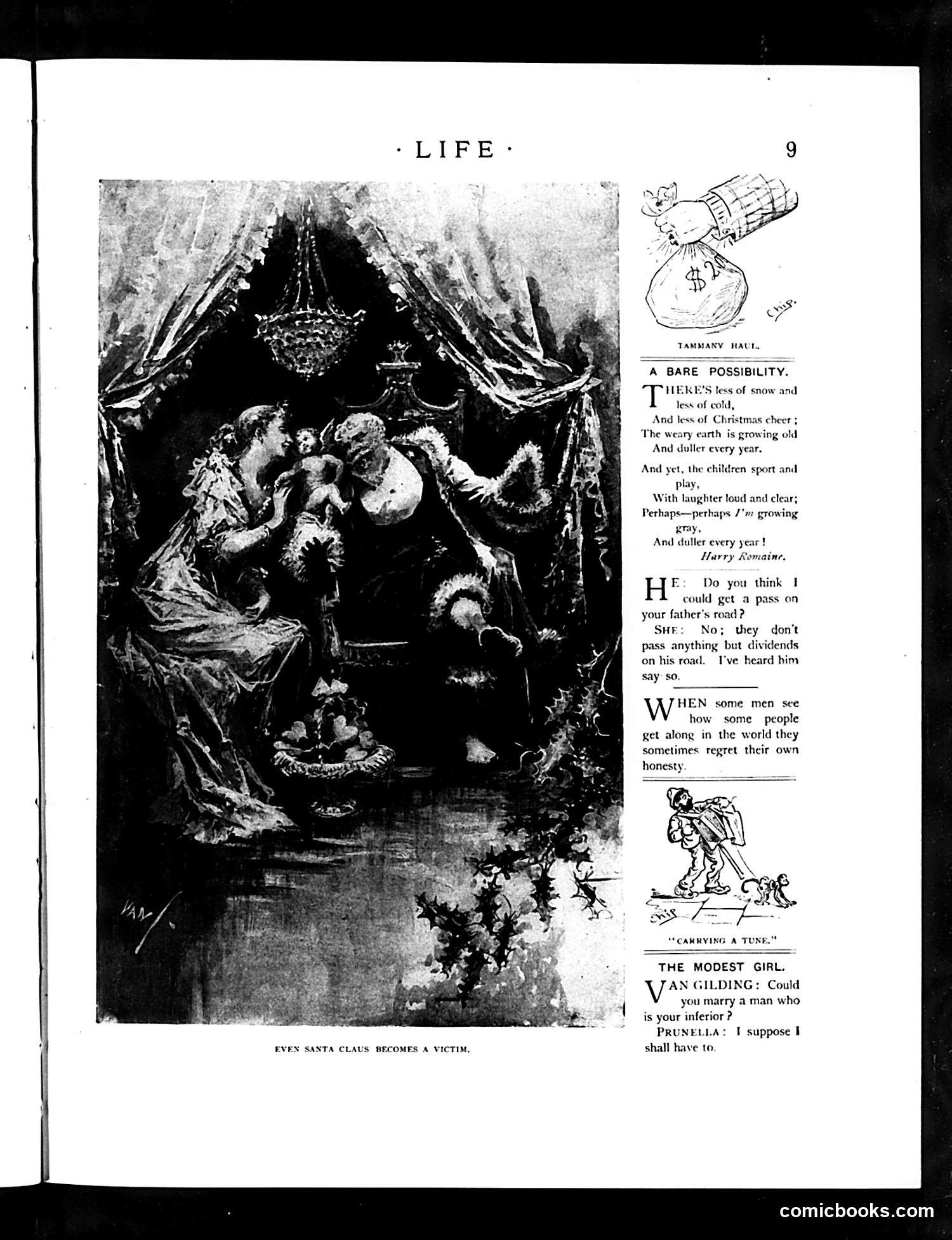
This page from *Life* magazine contains several satirical pieces targeting Gilded Age wealth and corruption: **"Even Santa Claus Becomes a Victim"** (left illustration): The large image depicts Santa trapped or victimized by wealthy figures in an ornate interior, likely referencing **Tammany Hall**—the corrupt Democratic political machine controlling New York City. The caption suggests even charitable Christmas spirit falls victim to urban corruption and greed. **"Tammany Haul"** (poem): A melancholic reflection on declining moral values and festive spirit in a commercialized world. **The railroad pass dialogue**: Satirizes railroad monopolies and wealthy industrialists who control transportation networks, allowing only financial dividends to circulate while ordinary people cannot gain access. **"The Modest Girl"**: A brief joke mocking social climbing and hypocritical attitudes toward class—women accepting inferior husbands for wealth/status. Overall, the page critiques **Gilded Age corruption, monopolistic wealth, and the erosion of genuine human values** by commercial greed.
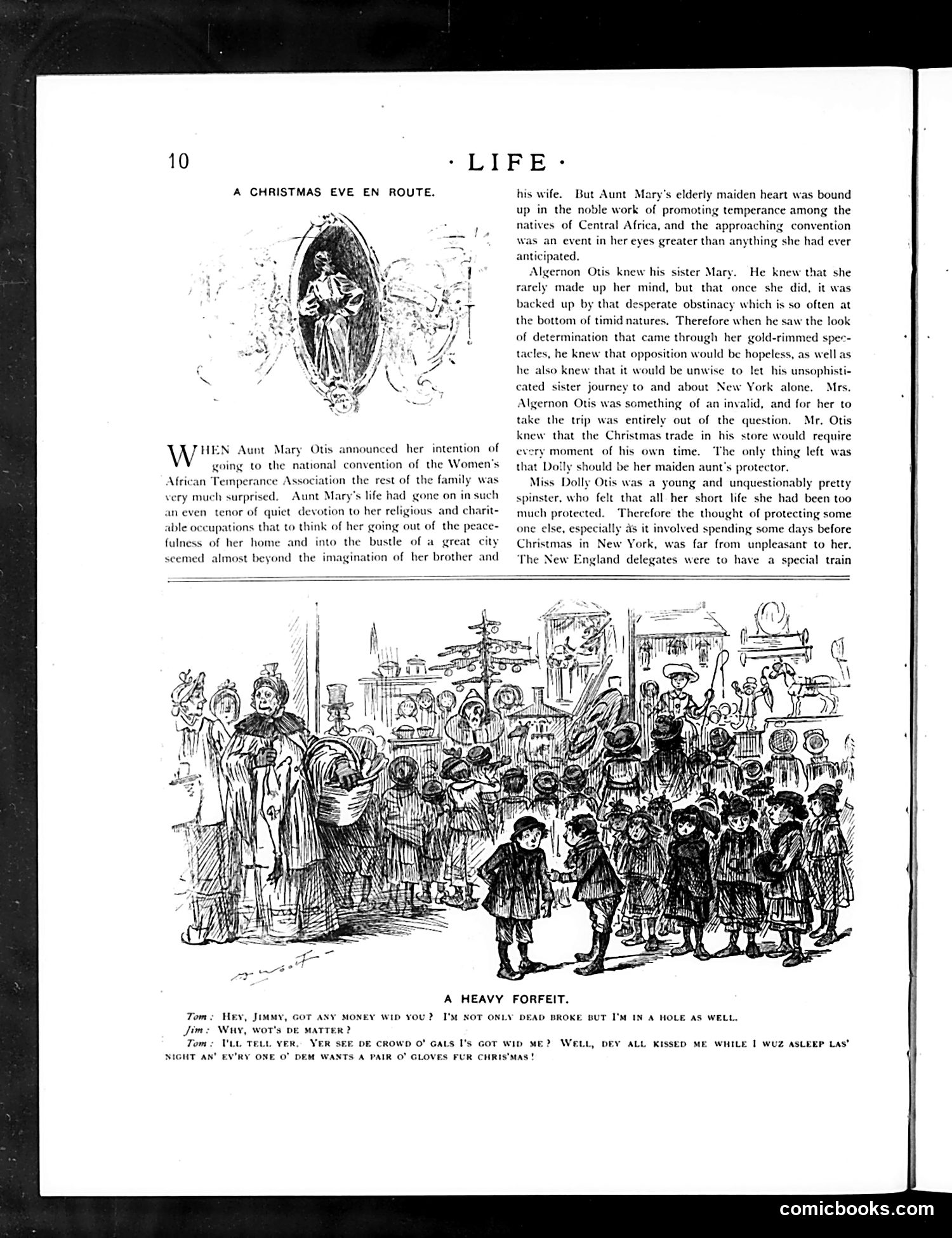
This page contains two separate pieces satirizing Christmas social customs around 1900. The top story follows Aunt Mary Otis, a temperance activist traveling to a Women's African Temperance Association convention in New York. Her brother assigns his young daughter Dolly as chaperone—an ironic "protection" since Dolly welcomes the independence the trip offers. The satire targets Victorian gender restrictions and the disconnect between earnest religious/reform movements and practical family life. The bottom cartoon, "A Heavy Forfeit," depicts working-class dialect humor. A poor man laments that women kissed him while sleeping, and now each expects Christmas glove gifts—a financial catastrophe for someone "dead broke." The joke satirizes both the expense of Christmas gift-giving and the casual presumption that kisses obligate expensive presents, likely mocking sentimental holiday culture and gender economics. Both pieces use humor to critique social conventions around charity, propriety, class, and Christmas commercialism.
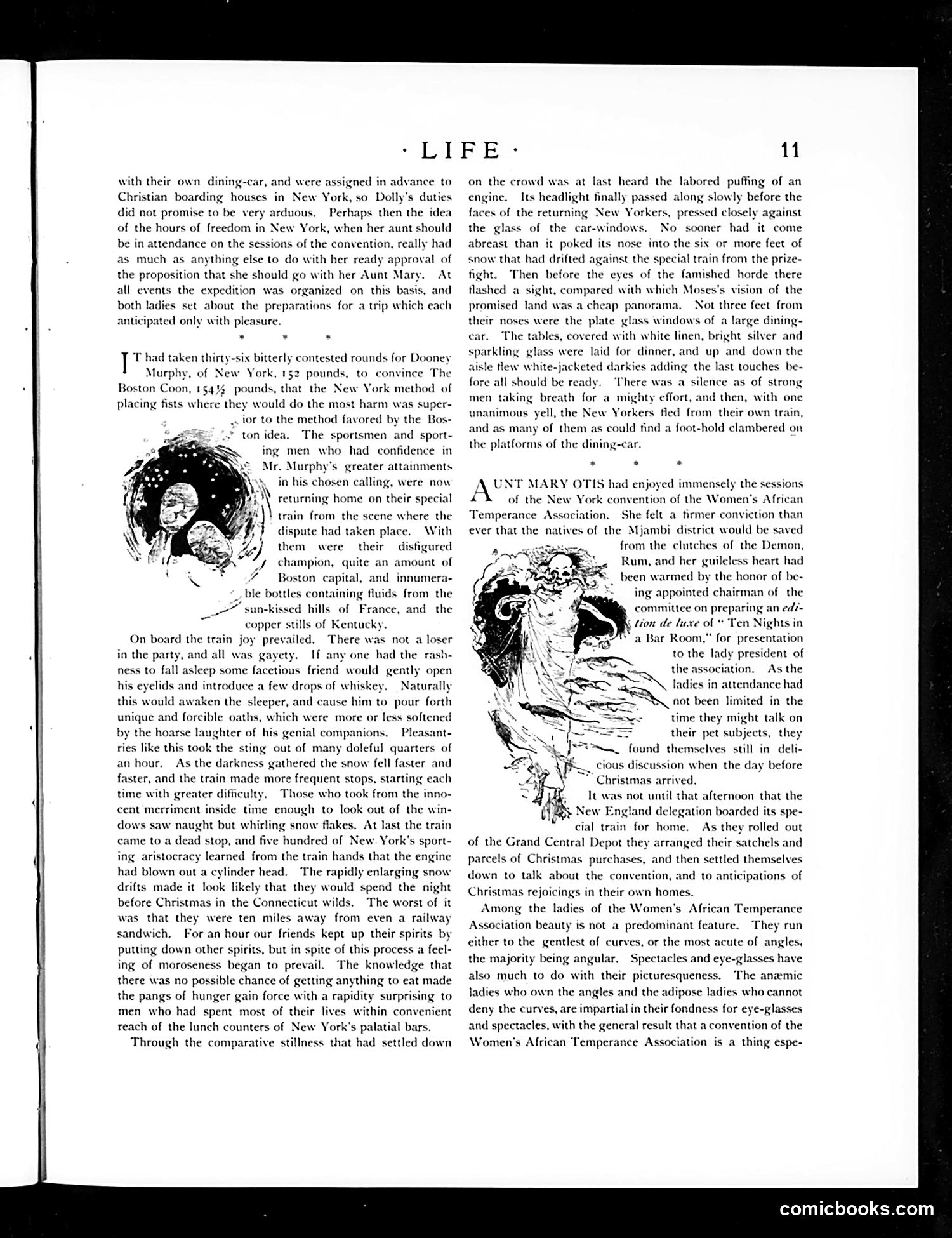
This page from *Life* magazine satirizes the collision of two groups: wealthy New York sportsmen returning from a prizefight and ladies attending a Women's African Temperance Association convention. The central cartoon depicts **Dooney Murphy**, a boxer who defeated "The Boston Coon" (a racist epithet common in the era) in a 36-round fight. Murphy's supporters are traveling home on a special train, celebrating with alcohol and loose behavior—getting drunk, playing pranks on sleeping companions, and generally acting rowdy. The satire's irony: these hard-drinking, boisterous sportsmen become stranded in a blizzard near the temperance convention train. The visual joke (unclear in the text excerpt but evident from context) likely contrasts the drunken, vulgar boxing crowd with the morally upright temperance advocates—each finding the other's presence equally objectionable. The piece mocks Gilded Age class divisions and the era's contrasting moral movements: commercialized sport and drinking culture versus organized women's reform efforts.
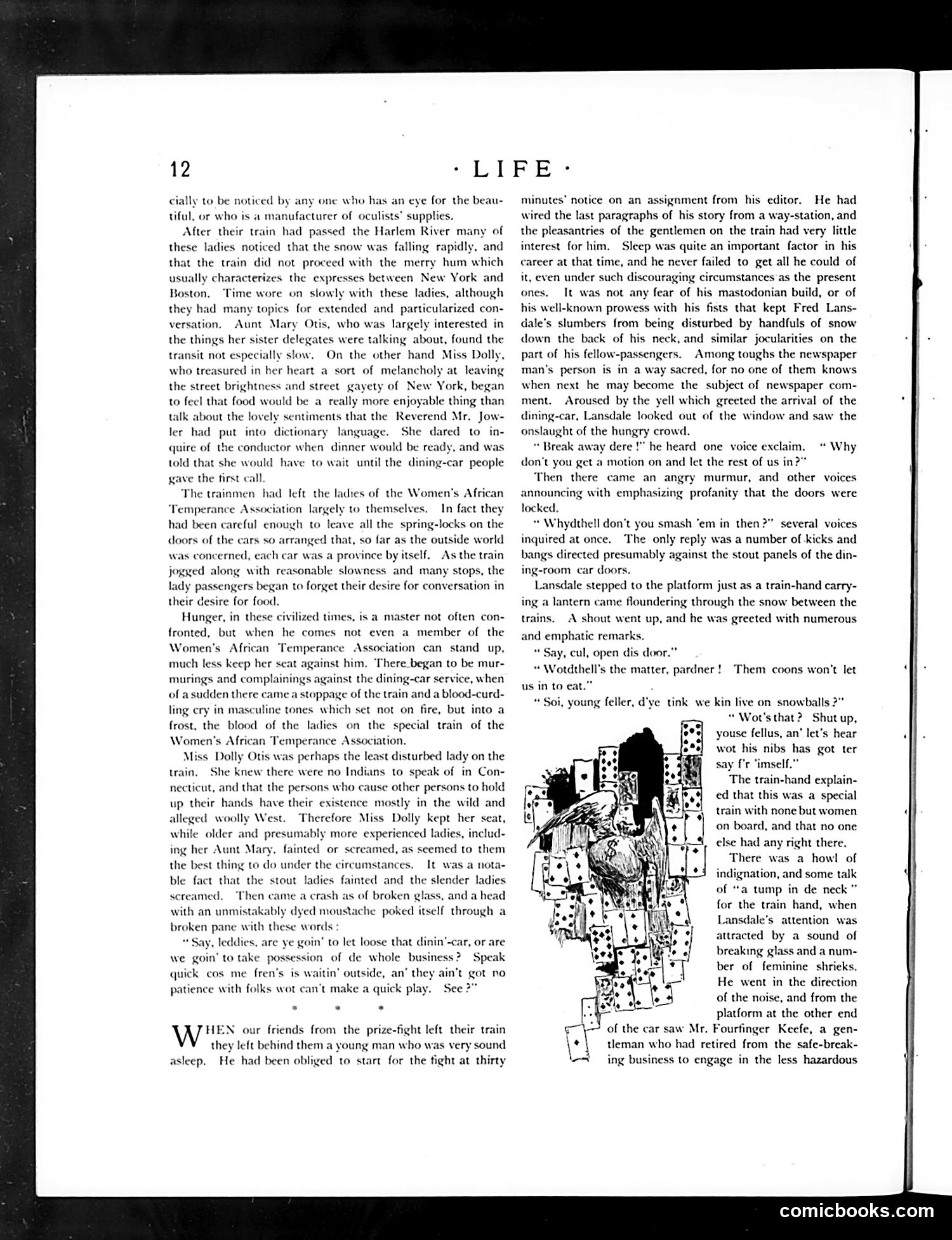
This page from *Life* magazine contains a serialized story about a train carrying members of the Women's African Temperance Association. The accompanying cartoon depicts a comedic train robbery scene. The narrative satirizes both the organization's pious temperance mission and the passengers' preoccupations—they're more interested in food than moral conversation. The cartoon shows a stereotyped robber with a "dyed moustache" demanding access to the dining car, speaking in exaggerated dialect ("leddies," "de whole business"). The satire works on multiple levels: it mocks the presumed gentility of the temperance ladies (who panic at the disturbance), contrasts their moral pretensions with base hunger, and uses the robbery as comedic disruption. The robber's focus on the *dining car* rather than valuables adds absurdist humor—he's threatening them over food service, not money. The piece reflects early-1900s attitudes: casual ethnic caricature in the robber's depiction, gentle mockery of women's reform organizations, and class-conscious humor about refined versus "civilized" behavior.
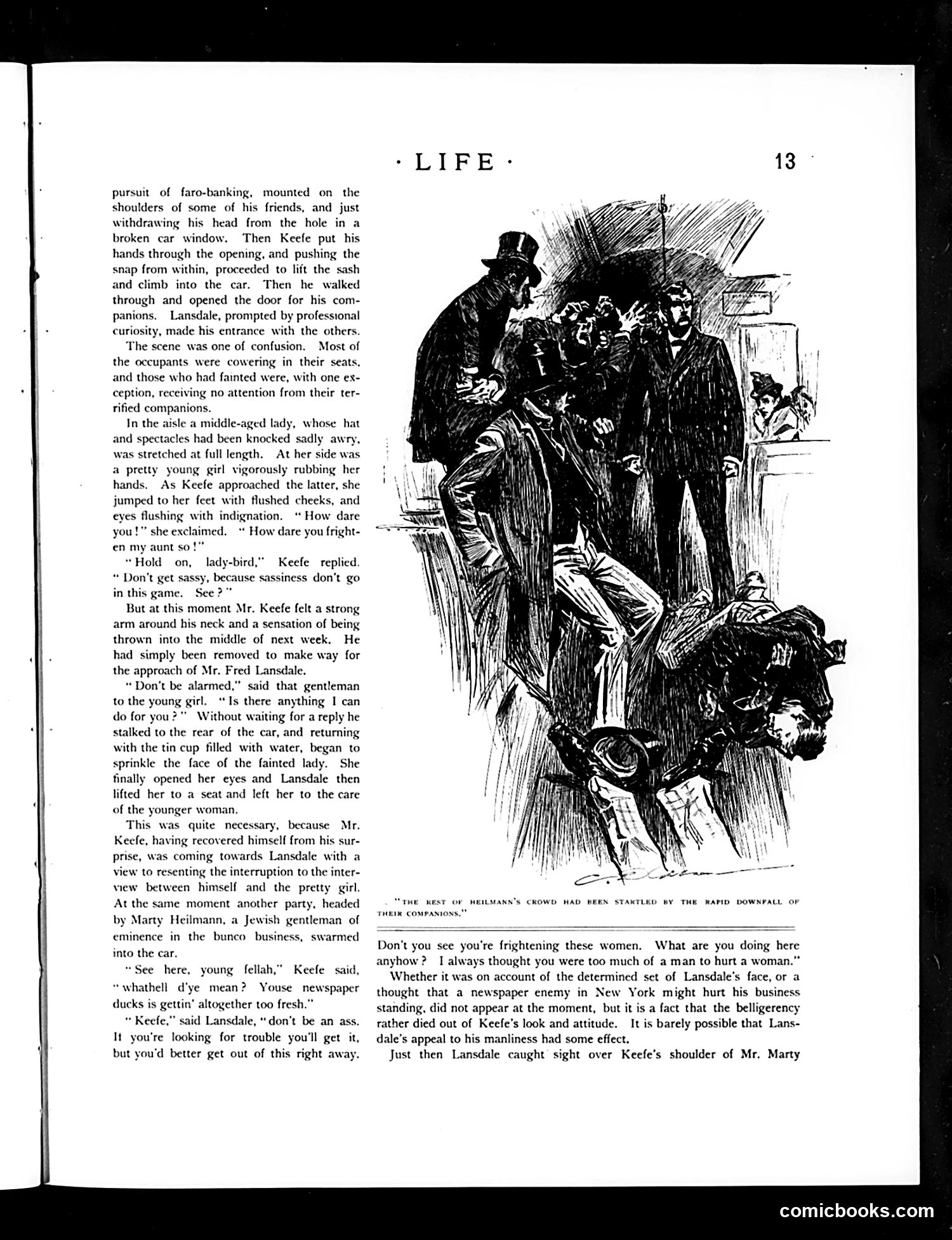
This is a narrative illustration from *Life* magazine depicting a scene of urban chaos and moral confrontation. The text describes a street brawl that has spilled into a streetcar, with multiple criminal figures—including men involved in "faro-banking" (illegal gambling) and "bunco business" (con games)—forcibly entering the vehicle. The central conflict involves three men: young Keefe (a criminal), Fred Lansdale (a newspaper man), and Marty Heilmann (described as "a Jewish gentleman of eminence in the bunco business"). When Keefe harasses a young woman and her frightened aunt, Lansdale physically intervenes, appealing to Keefe's sense of honor by shaming him for "hurting a woman." The satire critiques urban crime and the moral bankruptcy of the criminal underclass, while portraying the newspaper man as an unlikely moral authority. The illustration shows the violent, chaotic nature of this world intersecting with innocent civilians trapped in a public conveyance—a commentary on urban danger and lawlessness.
This page contains **fictional narrative text**, not a political cartoon. It depicts a train-car brawl scene featuring characters named Lansdale, Keefe, and Heilmann (described as a "bunco-man"—a con artist). The story satirizes **lower-class criminality and masculine violence** in early 20th-century America. Heilmann, a drunk swindler, attempts to assault a young woman; Lansdale and Keefe (a man with a distinctive four-fingered hand) intervene violently, defeating multiple assailants and forcing them from the moving train. The satire targets both the **criminal element** (bunco-men, sand-baggers) and the **sentimental reaction** of elderly respectability—Aunt Mary becomes hysterical and throws herself at Keefe in gratitude, which embarrasses him. The humor lies in contrasting rough, practical working-class heroism against genteel feminine excess and religious pieties. The piece reflects period anxieties about **train travel, urban crime, and class dynamics**.
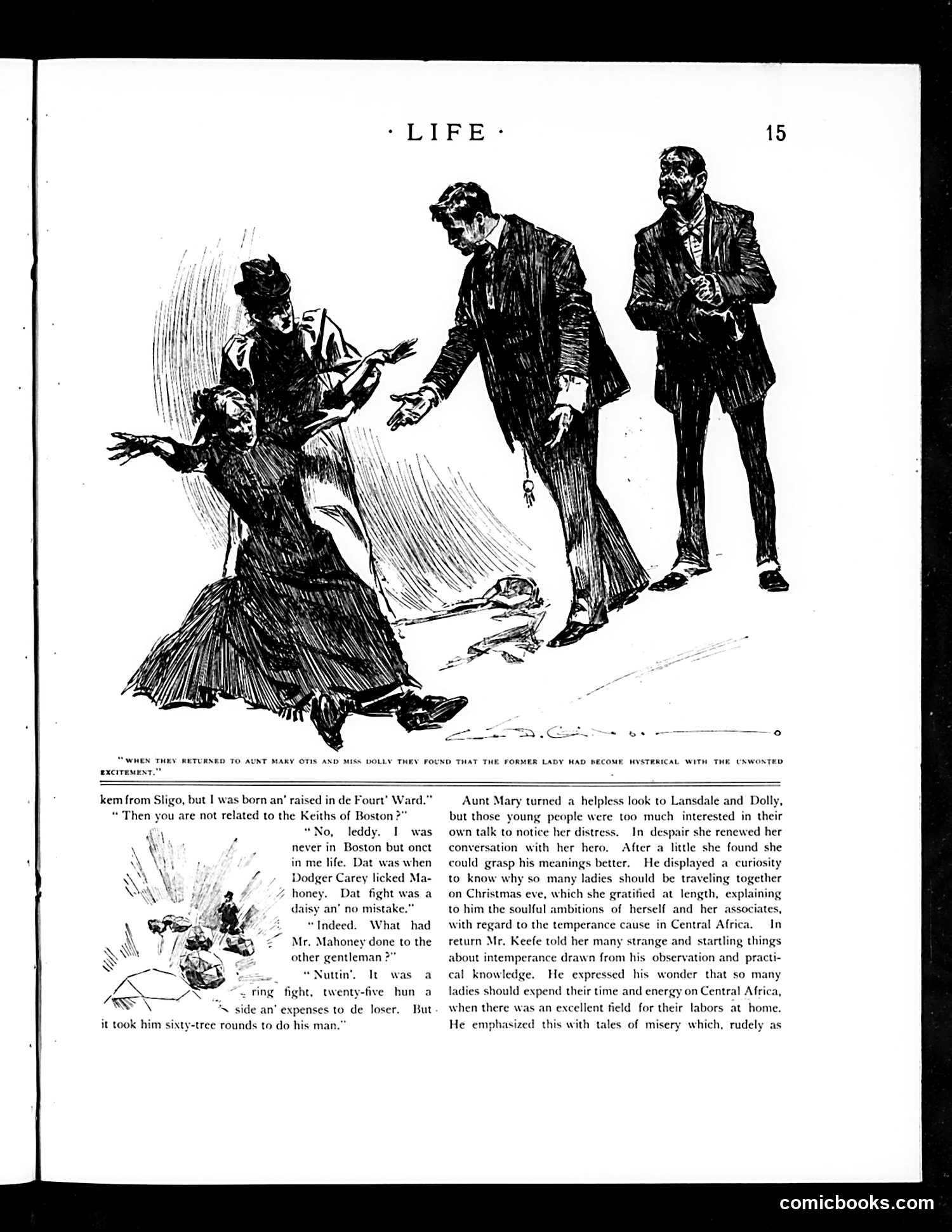
This page depicts a humorous domestic scene from what appears to be a serialized story. The illustration shows a woman in Victorian dress gesticulating dramatically while two men in suits stand nearby, with the caption explaining she's become "hysterical with the unwonted excitement." The text reveals class-conscious satire: a working-class Irish character (indicated by dialect: "de Fourt' Ward," "leddy") recounts a bare-knuckle boxing match involving "Dodger Carey," discussing sixty-three rounds and betting stakes. This contrasts sharply with the genteel ladies' missionary aspirations for "the temperance cause in Central Africa." The humor pivots on Mr. Keefe's skeptical response: why focus charitable efforts on distant Africa when urban poverty and intemperance at home—which he illustrates with "tales of misery"—demand attention? The satire mocks both the earnest but naive Victorian reformer-ladies and implicitly critiques the era's missionary zeal as disconnected from domestic social problems.
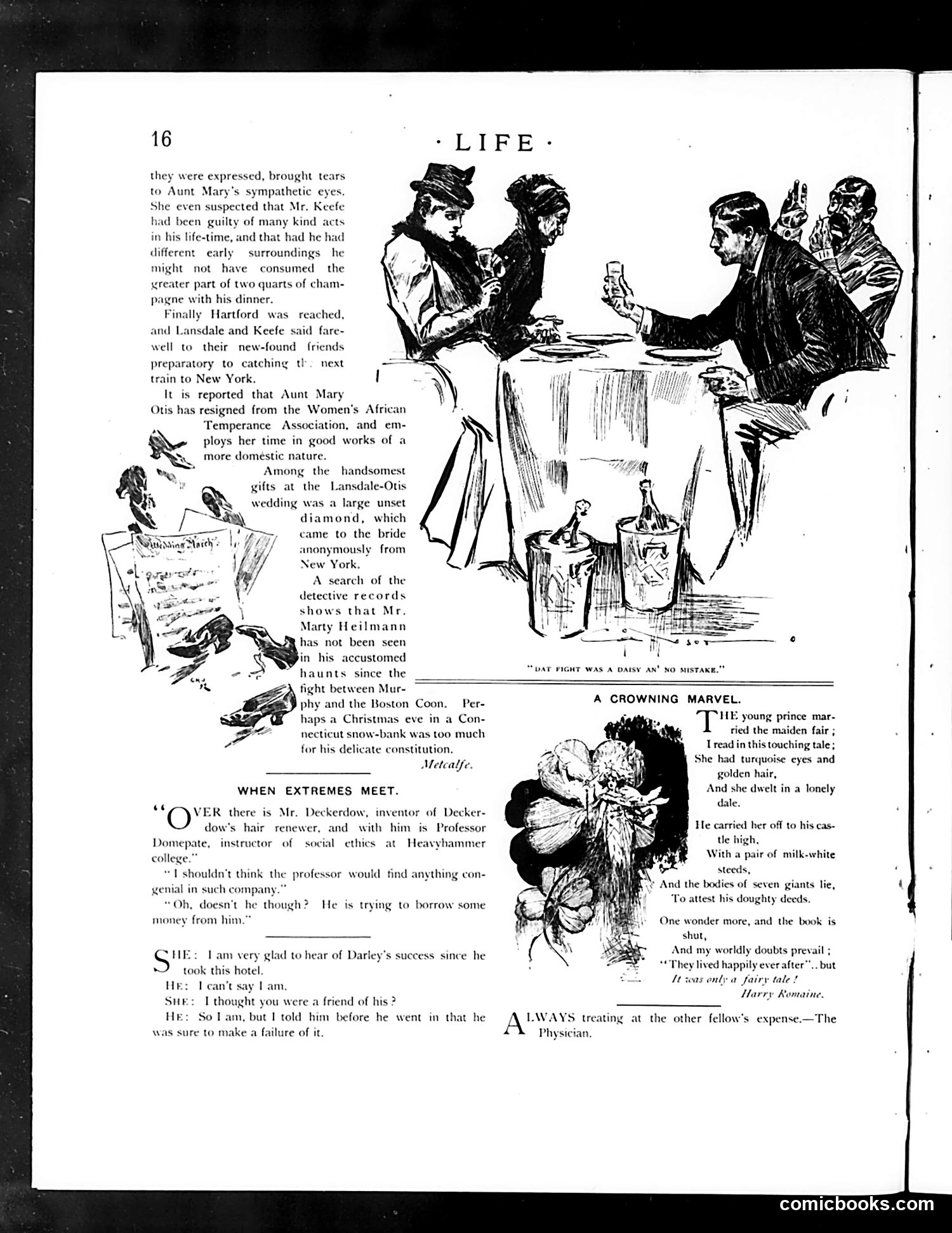
This page from the satirical magazine *Life* contains several distinct humor pieces typical of the era: **Main cartoon "Dat Fight Was a Daisy"**: Depicts what appears to be working-class men (one seemingly Irish, given "Murphy" reference, one identified as "Boston Coon"—a racial caricature) in casual debate. The humor exploits ethnic stereotypes common to early 20th-century American comedy. **"When Extremes Meet"**: A dialogue joke contrasting a wealthy hair-product inventor with a professor of social ethics who associates with him only to borrow money—satirizing hypocrisy and the professor's compromised principles. **"A Crowning Marvel"**: A poem mocking fairy-tale romance conventions, particularly the clichéd "happily ever after" ending, suggesting such narratives are unrealistic fantasies. **"Always treating..."**: A one-liner joke about physicians exploiting patients' generosity. The page mixes class commentary, ethnic humor (offensive by modern standards), and cynicism about sentimentality—typical of *Life*'s satirical approach.
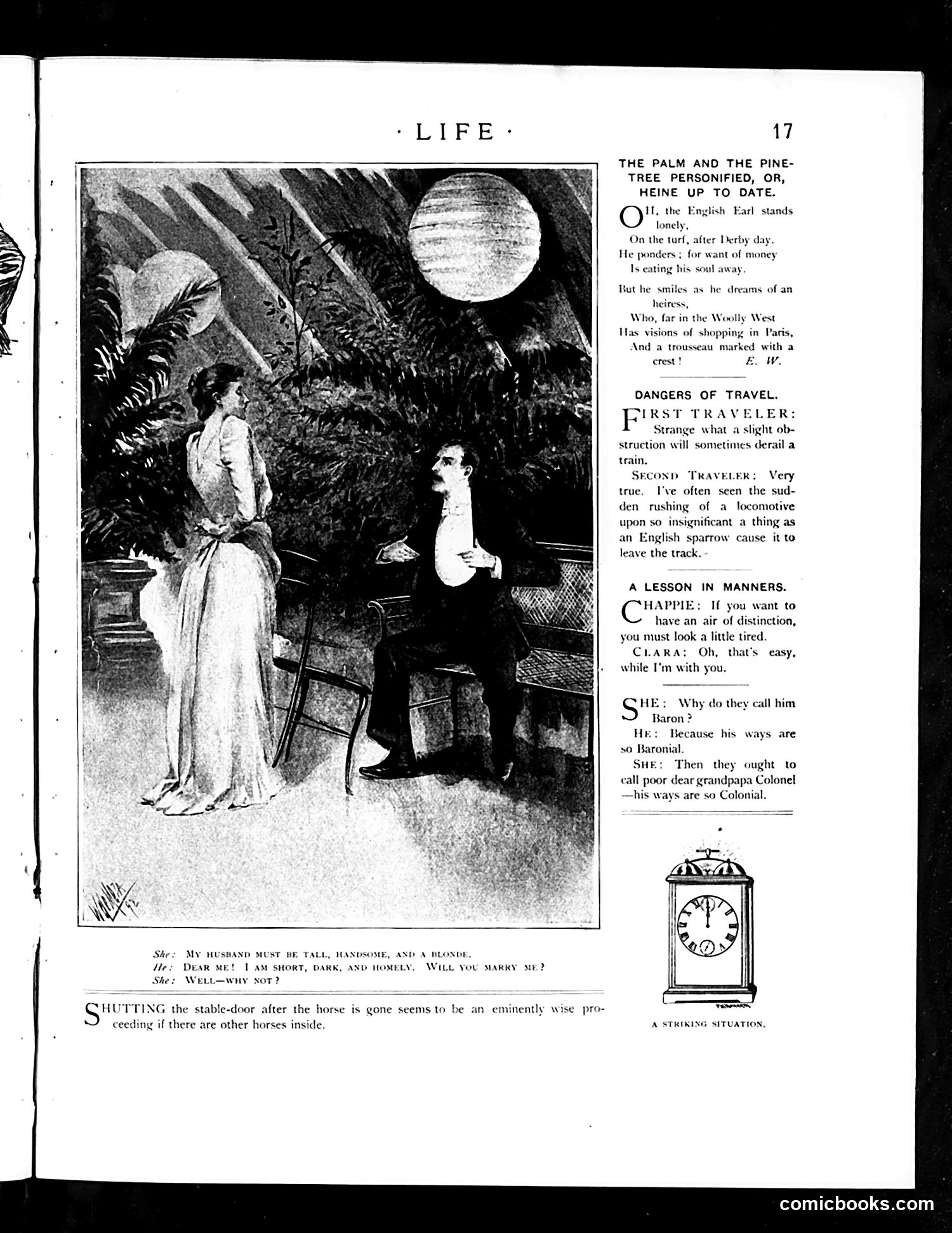
This page contains several brief comedic sketches typical of *Life* magazine's satirical humor: **Main Image:** A moonlit scene shows a woman and man in conversation beneath palm trees. The caption suggests she seeks a wealthy American heiress from the "Woolly West" with Paris shopping aspirations and a crested trousseau—while he's a broke English Earl. The satire targets transatlantic marriages of convenience between impoverished British nobility and wealthy American heiresses, a common phenomenon of the era. **Minor Jokes:** Include puns on "Baronial/Baron" versus "Colonial/Colonel," absurd travel anecdotes (trains derailed by sparrows), and a woman accepting a homely suitor—seemingly illogical choices presented as witty reversals. **Overall Tone:** Light social satire mocking class pretensions, Anglo-American wealth dynamics, and Victorian courtship conventions. The humor assumes readers recognize the era's marriage-market dynamics between declining British gentry and American industrial wealth.
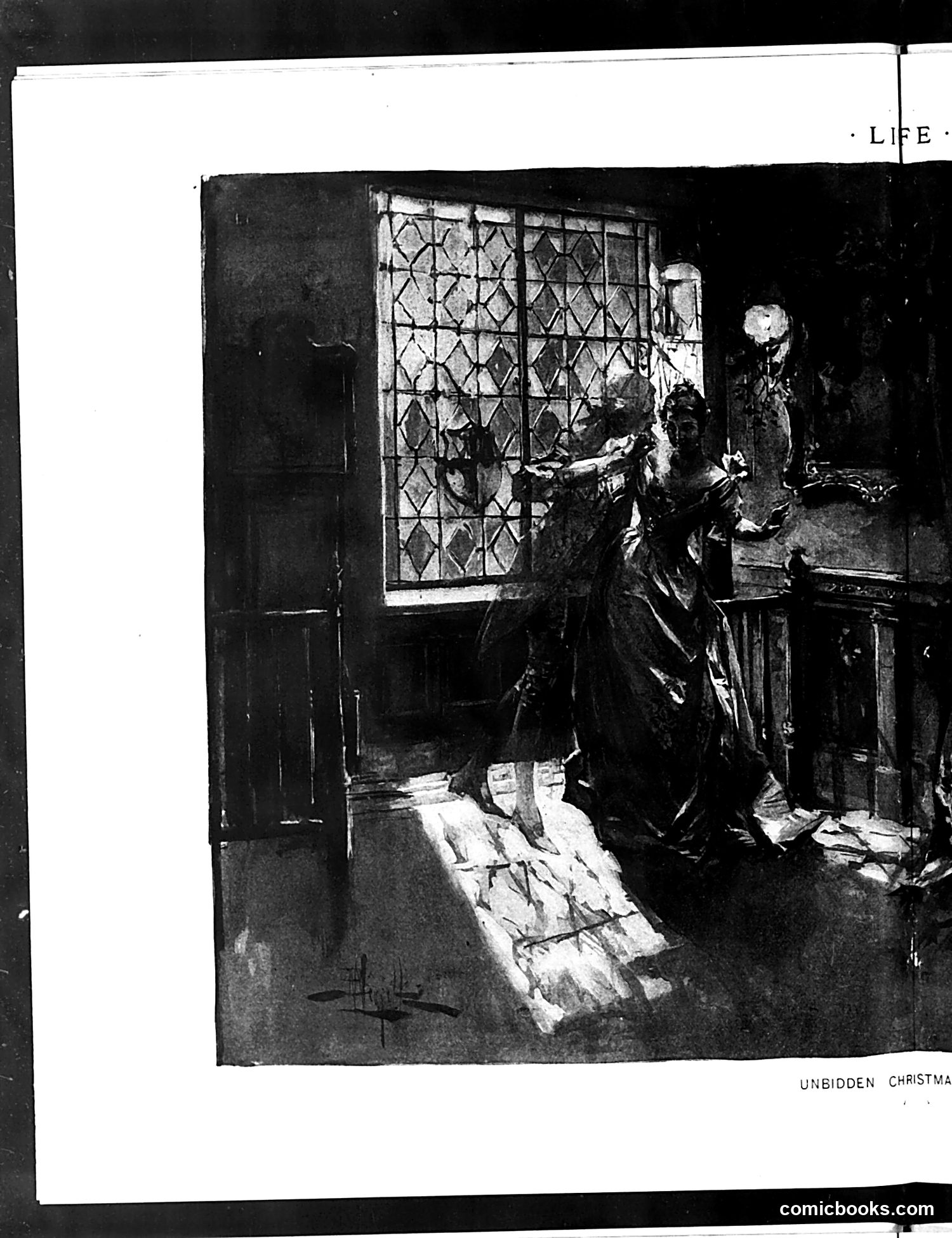
This appears to be an illustration depicting a somber holiday scene. The image shows what looks like figures in dark clothing near a window with a latticed/diamond-patterned design. There's dramatic lighting from the window creating stark shadows across the floor. The scene has a melancholic or intrusive quality suggested by the title "Unbidden Christmas" (uninvited Christmas). Without clearer visibility of specific details or additional context from the surrounding page content, the exact satirical target is difficult to determine with certainty. The composition suggests social commentary about unwanted circumstances during the Christmas season—possibly referencing poverty, loss, or unwelcome interruption during what should be a joyful holiday. The dramatic chiaroscuro style emphasizes the emotional weight of the scene.
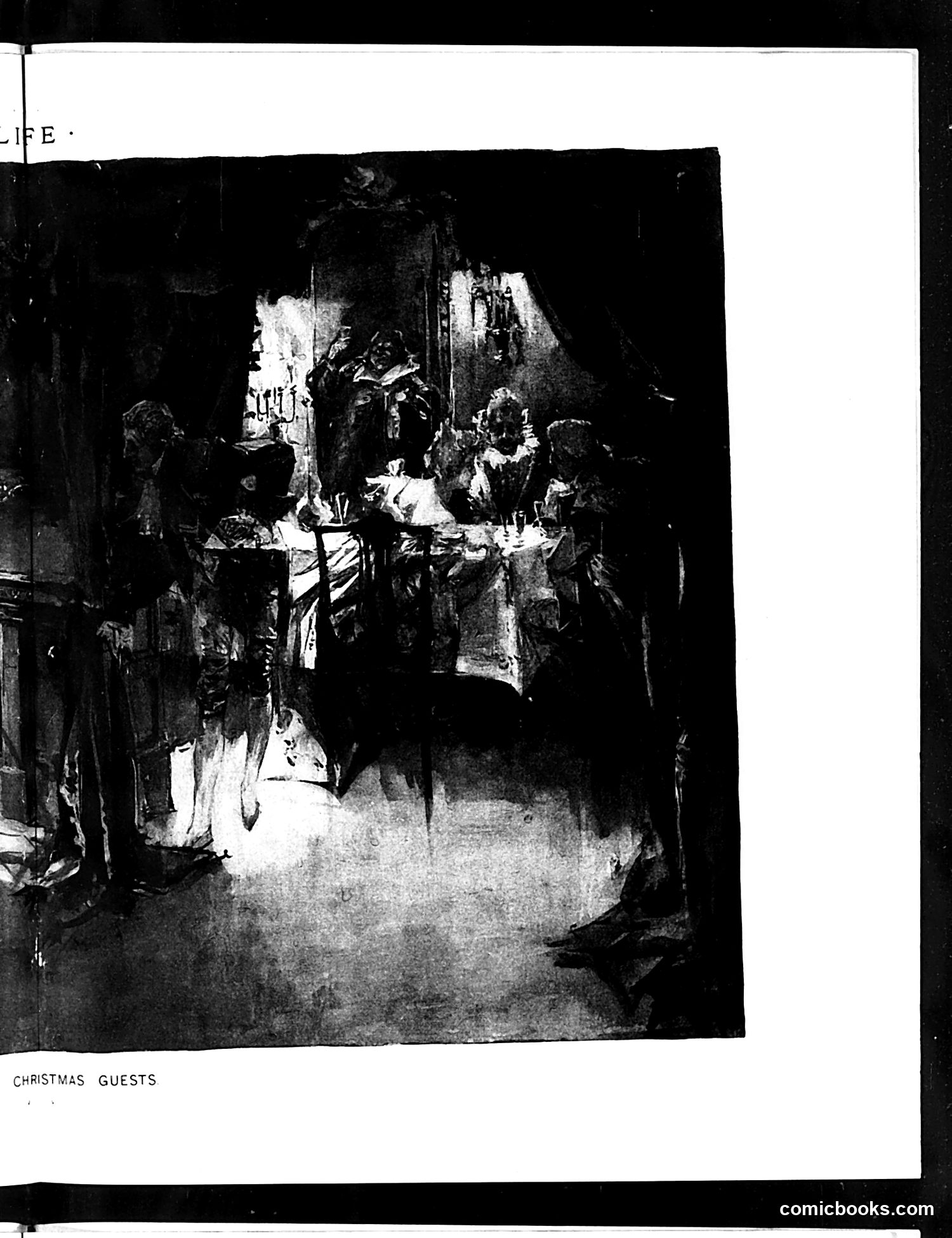
This appears to be a darkly humorous illustration titled "Christmas Guests" from *Life* magazine. The image depicts a crowded, shadowy indoor scene with multiple figures gathered around what appears to be a dining table or social gathering, rendered in high-contrast black and white. The satirical point likely concerns uninvited or unwelcome guests arriving during the holiday season—a common social anxiety theme. The dramatic lighting and crowded composition suggest chaos or discomfort rather than festive cheer. Without clearer identification of specific figures or knowing the publication date, the exact political or social targets remain unclear, though the satire appears to mock holiday social obligations and the stress of entertaining during Christmas.
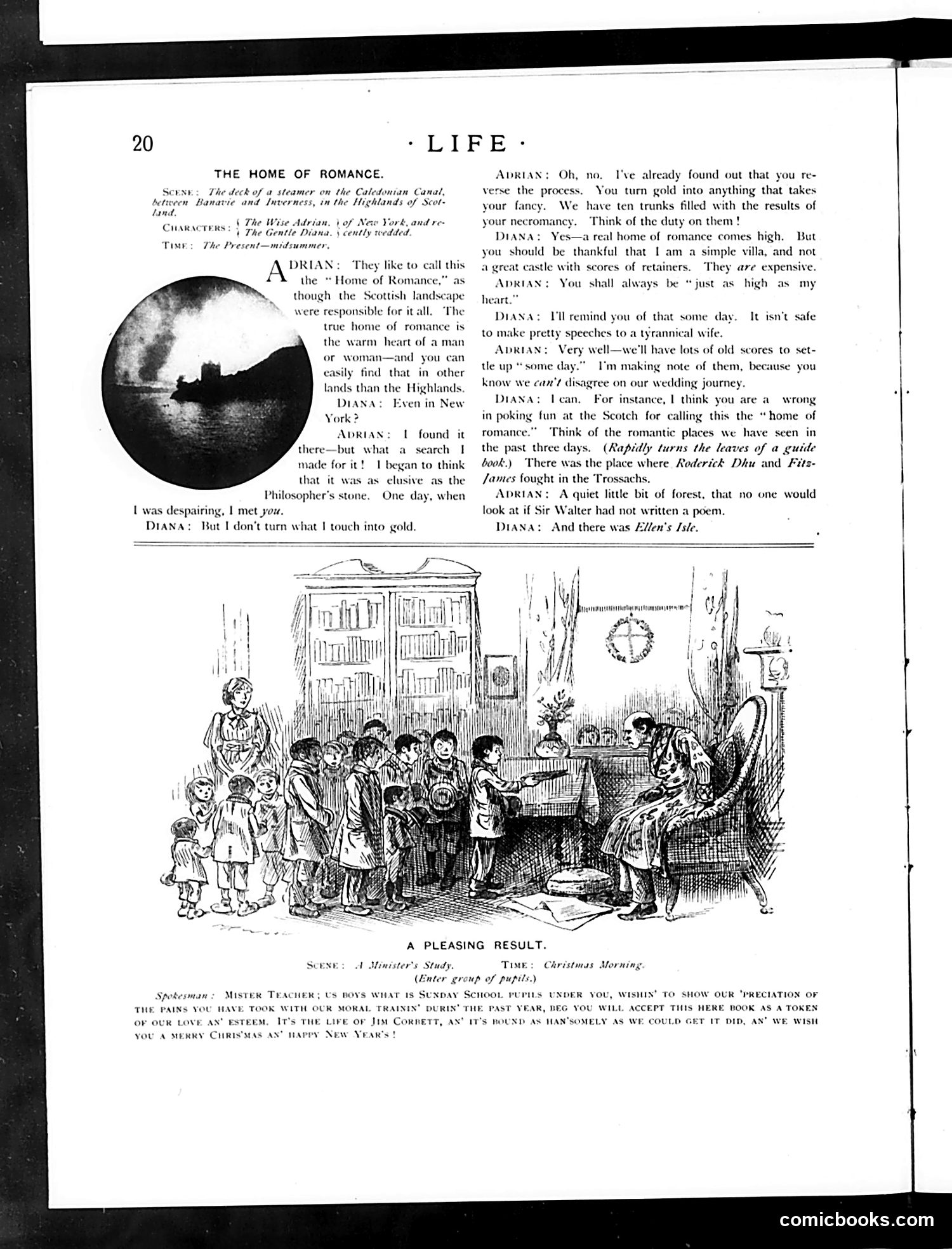
**Top Section - "The Home of Romance":** This is a comedic dialogue between Adrian and Diana, a married couple touring Scotland's Highlands. Adrian romanticizes the region as embodying romance itself, while Diana pragmatically debunks this, noting they've filled ten trunks with purchases and face import duties. The satire mocks Victorian sentimentality about "romantic" places—Diana represents the rational, modern woman who sees through flowery rhetoric about Scottish landscapes and literary references (Walter Scott's poetry, *Ellen's Isle*). The joke is that actual romance is mercenary and exhausting, not poetic. **Bottom Section - "A Pleasing Result":** Sunday School pupils present their teacher with a gift—a biography of Jim Corbett (likely the famous hunter/conservationist). The dialect-heavy speech from working-class boys humorously contrasts with the formal gift-giving ritual. The "pleasing result" suggests the teacher's moral instruction has produced respectful, grateful students, though their rough grammar undercuts the sentiment's sincerity. Both pieces gently satirize sentimentality and social pretension.
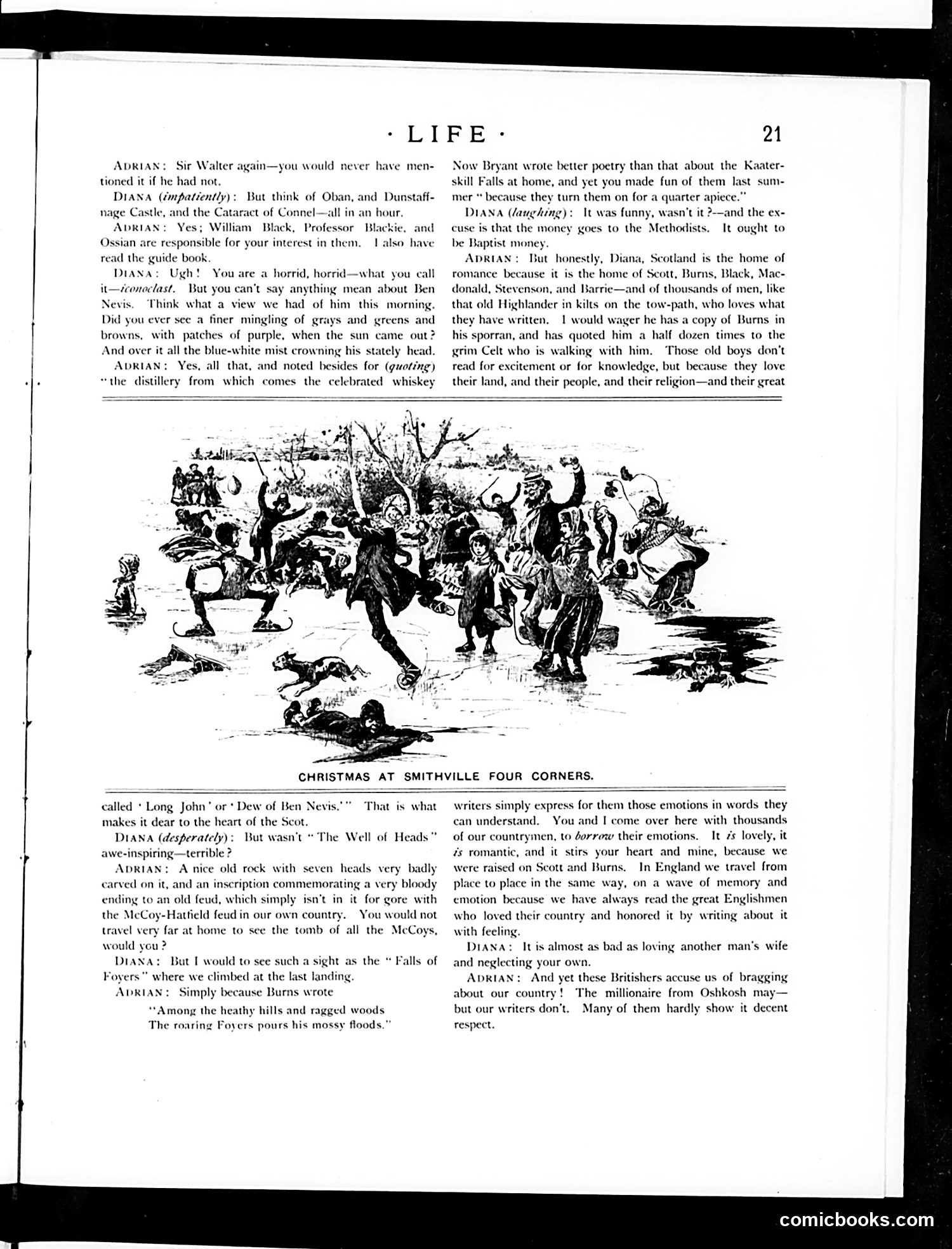
This page presents a debate between Adrian and Diana about why tourists romanticize Scotland. Adrian argues that Americans visiting Scotland are emotionally moved not by the landscape itself, but by literary associations with Scottish writers—Burns, Scott, Stevenson, Barrie—whom they were raised reading. The satire targets American tourists' manufactured sentimentality. Diana initially admires Scottish scenery and historical sites, but Adrian deflates her enthusiasm by pointing out she's actually responding to *poetry*, not reality. He compares her enthusiasm for Scottish waterfalls to her mocking American ones for turning on "for a quarter apiece"—revealing her double standard. The cartoon "Christmas at Smithville Four Corners" (illustrating the dialogue) appears to contrast rustic American celebration with the romanticized Scottish highlands being discussed above. Adrian's final jab critiques both American braggadocio and British writers' insufficient patriotism—a clever inversion of national stereotypes.
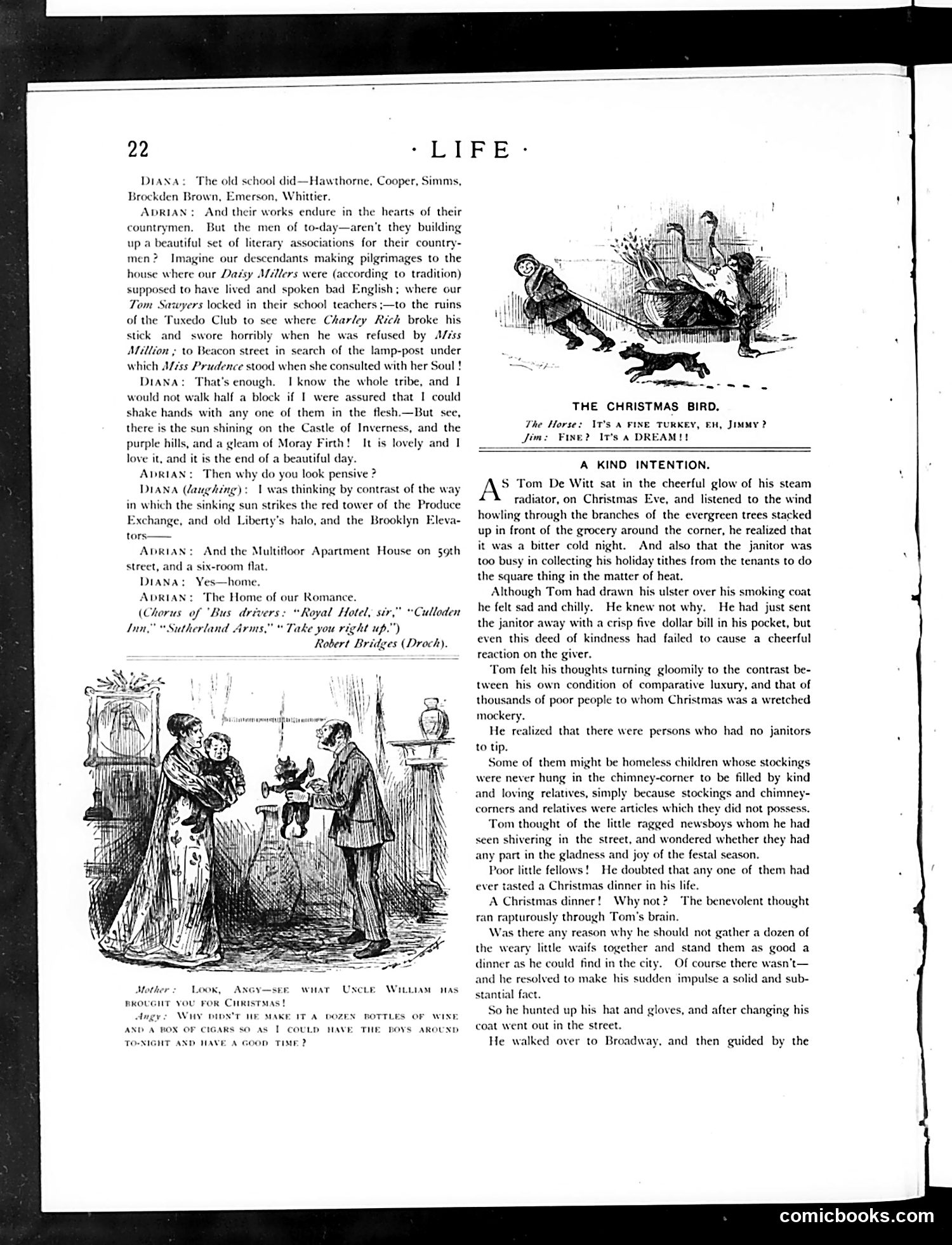
This page contains satirical commentary on American literary and cultural life, circa late 19th century. **Upper dialogue ("Diana"):** Adrian and Diana debate American literature. Adrian mockingly suggests future generations will make pilgrimages to sites associated with contemporary popular authors—the Tuxedo Club, Beacon Street—treating trivial modern fiction (references to "Daisy Millers" and "Tom Sawyers") as literary monuments. Diana dismisses this new generation of writers contemptuously. The satire targets the perceived decline of American letters from classics (Hawthorne, Emerson) to shallow contemporary popular fiction. **Lower sections:** "The Christmas Bird" and "A Kind Intention" are sentimental Christmas stories. The first shows a brief comic exchange between horses about a turkey. The second tells of Tom De Witt's charitable impulse to feed poor newsboys on Christmas—representing the era's idealized benevolent wealthy gentleman. **Political context:** This reflects Gilded Age anxieties about cultural standards and class-conscious charity typical of the period.
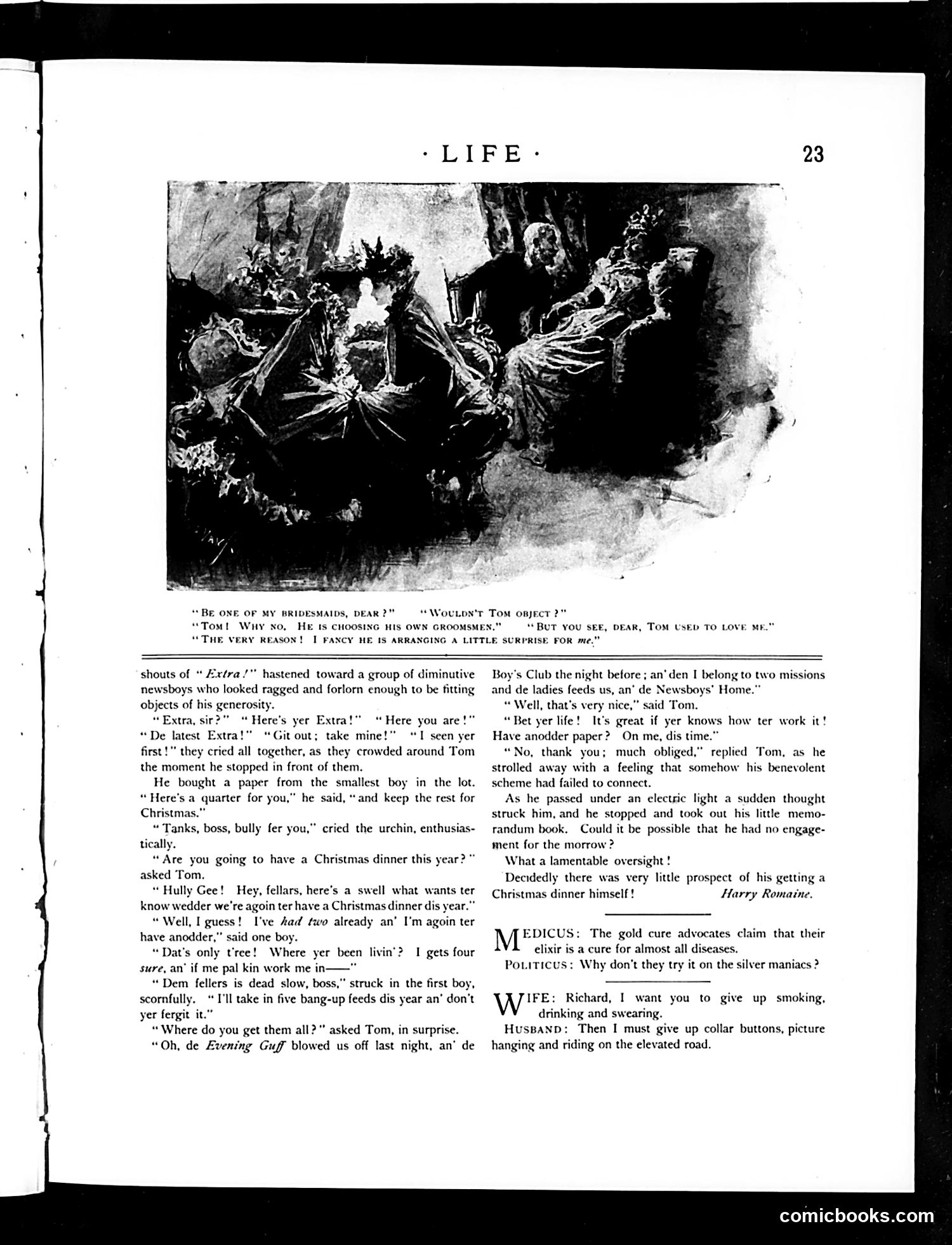
This page contains a serialized story with an illustration and several humor pieces. The main narrative follows a man named Tom who attempts charitable generosity toward poor newsboys at Christmas, only to discover they're already well-provided for through multiple charitable organizations (a Boy's Club, missions, the Newsboys' Home, and the Evening Guff newspaper). The irony is that Tom—presumably wealthy—ends up feeling his benevolence has "failed to connect," while realizing he himself has no Christmas dinner plans. The satire critiques both charitable pretension and the paradox of wealth. Below are three separate joke items: one mocking "gold cure" advocates' claims to cure all diseases; another about the "silver maniacs" (likely Populists or free-silver advocates, a political issue of the era); and a domestic humor piece about a husband forced to give up vices, but lamenting losses like collar buttons and elevated train rides. The overall tone is genteel American satire aimed at middle-class readers.
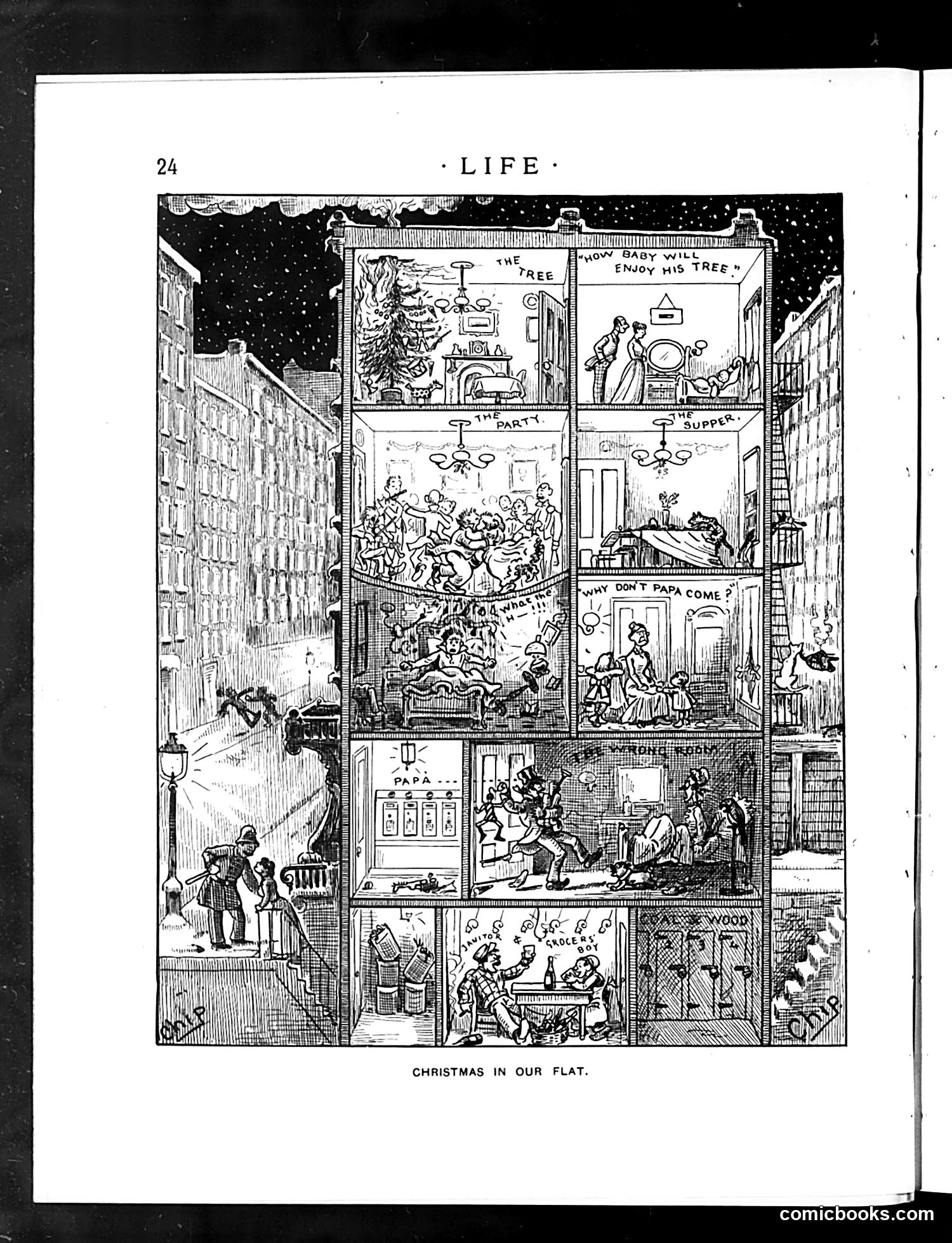
This is a single-panel cartoon depicting Christmas celebrations in a multi-story apartment building, shown in cross-section. The illustration satirizes urban apartment living during the holiday season, showing how families in cramped quarters attempt to celebrate despite spatial constraints. Visible scenes include: a decorated Christmas tree on an upper floor, a children's party, a supper gathering, people asking "why don't papa come?", domestic activities in kitchens and bedrooms, and various family moments stacked vertically. The cartoon humorously contrasts the idealized "Christmas tree" promised in the title with the modest, crowded reality of tenement or working-class flat living. The satire gently mocks the aspirations and challenges of ordinary urban families celebrating the holidays in tight quarters.
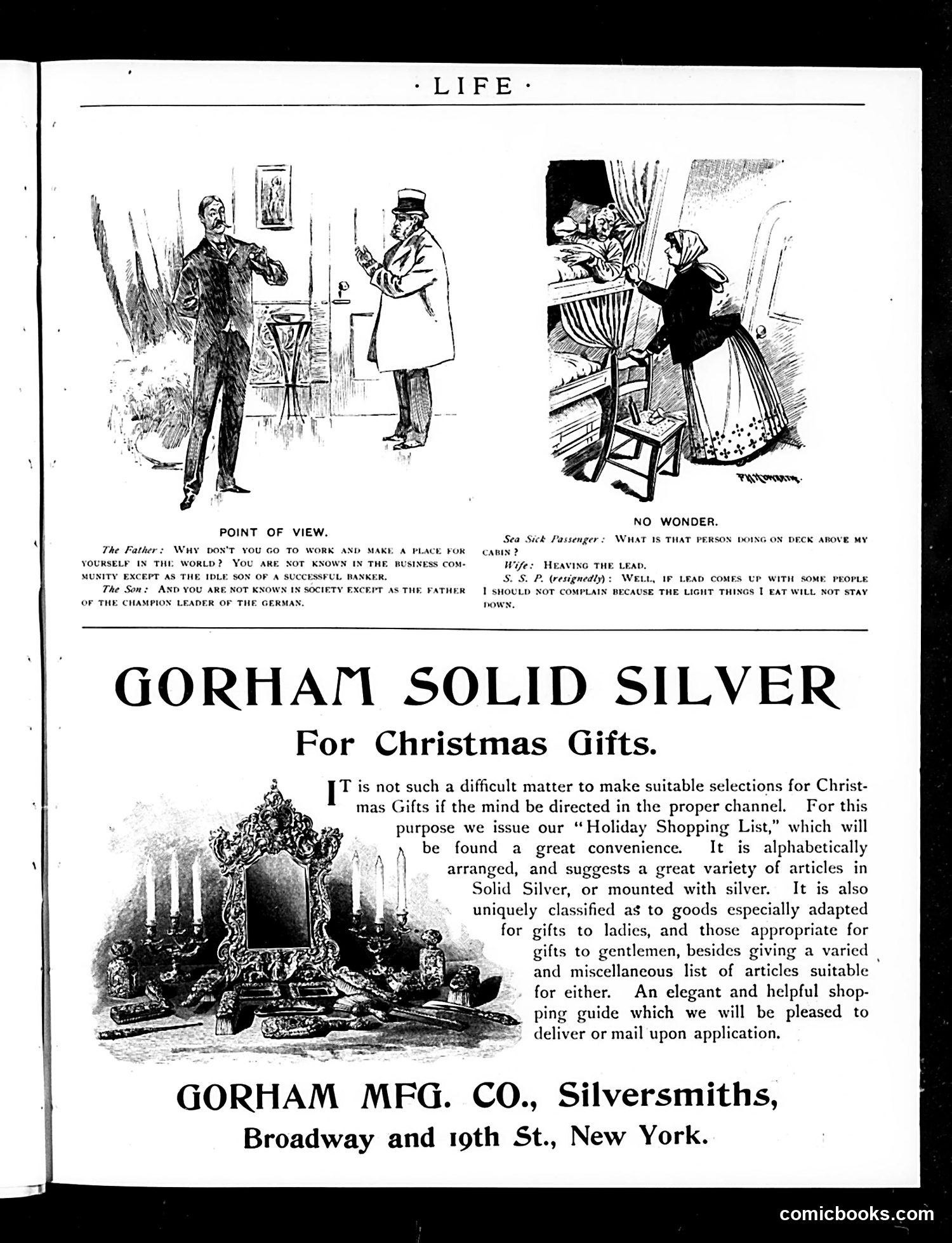
This page contains two satirical cartoons and a silver-goods advertisement. **"Point of View"** depicts a clash between generations about ambition and social standing. A wealthy banker's son is criticized for being idle and unknown in business circles; he retorts that his father is only known as "the champion leader of the German"—likely a reference to German-American social/cultural leadership, possibly satirizing the father's limited identity beyond ethnic community ties. **"No Wonder"** shows a seasick ship passenger complaining about someone on deck above his cabin. His wife responds with resignation that if lead (ballast weight) came up, she shouldn't complain about light things (like food) not staying down—a grimly humorous acceptance of seasickness as inevitable. Both cartoons use ironic reversals and class commentary typical of Life's satirical approach. The page is dominated by a **Gorham Manufacturing Company advertisement** for solid silver Christmas gifts, positioned as premium holiday merchandise for the wealthy.
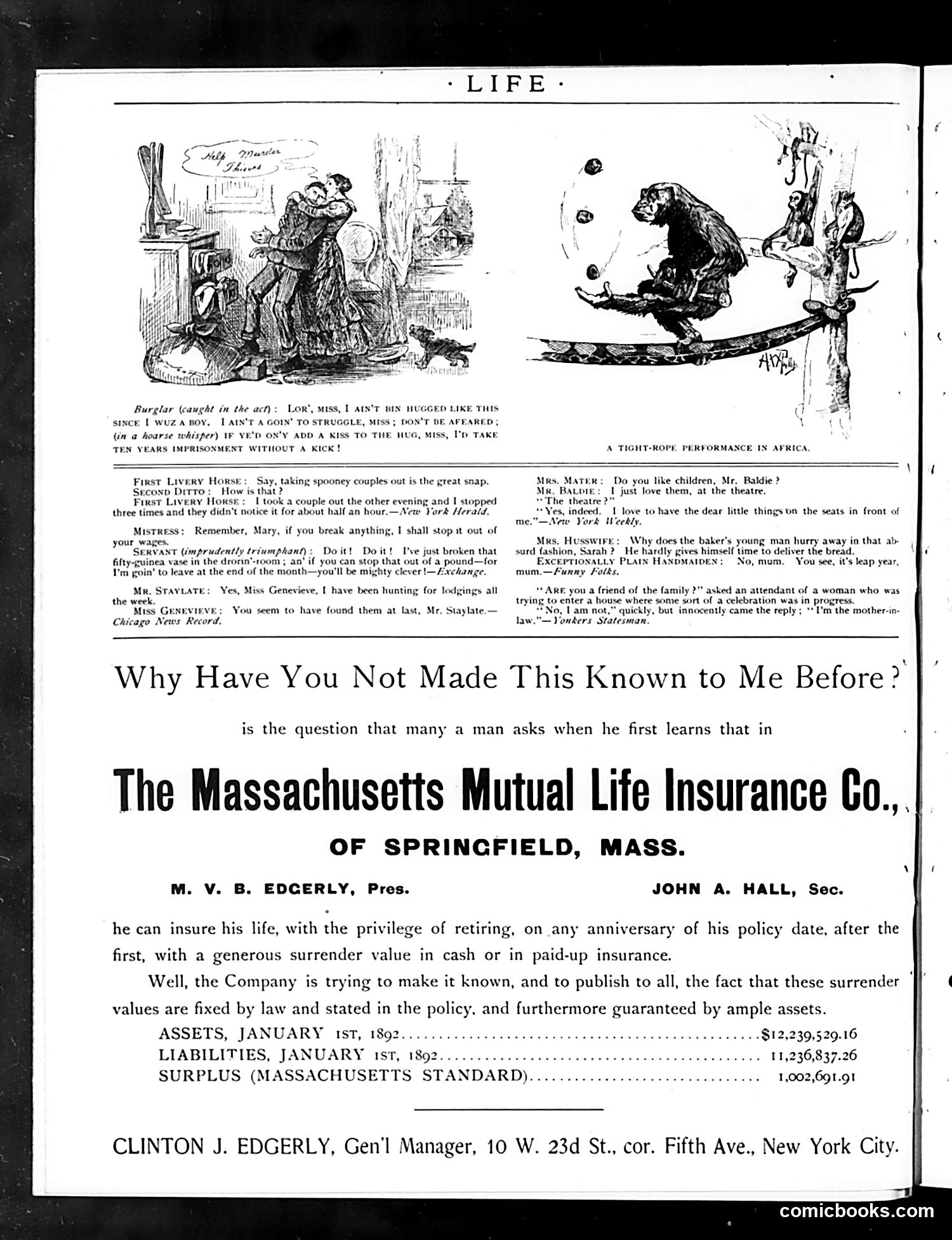
This is a **satirical humor page from Life magazine** featuring several unrelated comic vignettes typical of the era: 1. **"Burglar Caught in the Act"**: A burglar interrupts a couple to flirt with the woman, claiming he'd take ten years in prison for a kiss—crude Victorian-era romantic humor playing on the awkwardness of the situation. 2. **"Tight-Rope Performance in Africa"**: A monkey juggling balls on a tightrope—simple visual gag with no deeper meaning. 3. **Multiple short jokes** about servants breaking expensive vases, livery horses with inattentive couples, and a woman at a party who's the "mother-in-law" (implying she's not a welcome guest)—all domestic humor about class and social embarrassment. 4. **The large lower section is a **life insurance advertisement** for Massachusetts Mutual, using the phrase "Why Have You Not Made This Known to Me Before?" as a rhetorical hook—suggesting readers should regret not knowing about the company's favorable surrender values earlier. The page mixes entertainment with advertising, typical of early-1890s Life magazine.
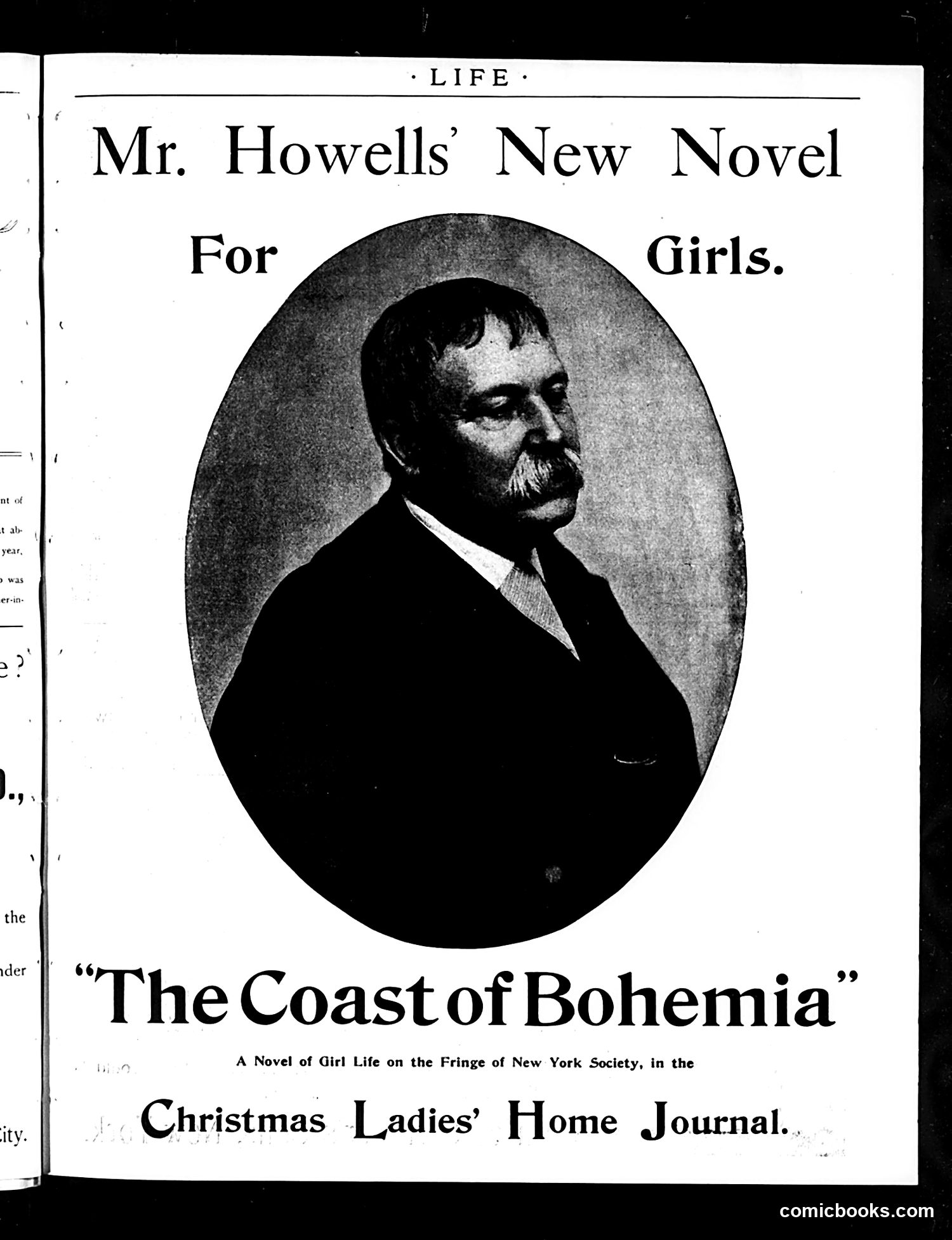
This is an advertisement for a serialized novel, not a political cartoon. It announces that author William Dean Howells has published a new work titled "The Coast of Bohemia" in the Christmas issue of *Ladies' Home Journal*. The page features a portrait photograph of an older man with a distinctive mustache (presumably Howells, though not explicitly identified as such in the visible text). The novel is described as dealing with "Girl Life on the Fringe of New York Society"—suggesting themes of young women navigating bohemian or unconventional social circles. For modern readers: this represents late 19th-century literary advertising targeting female readers interested in contemporary fiction about urban social dynamics. The "bohemia" reference likely refers to artistic or unconventional lifestyles among New York's creative class.
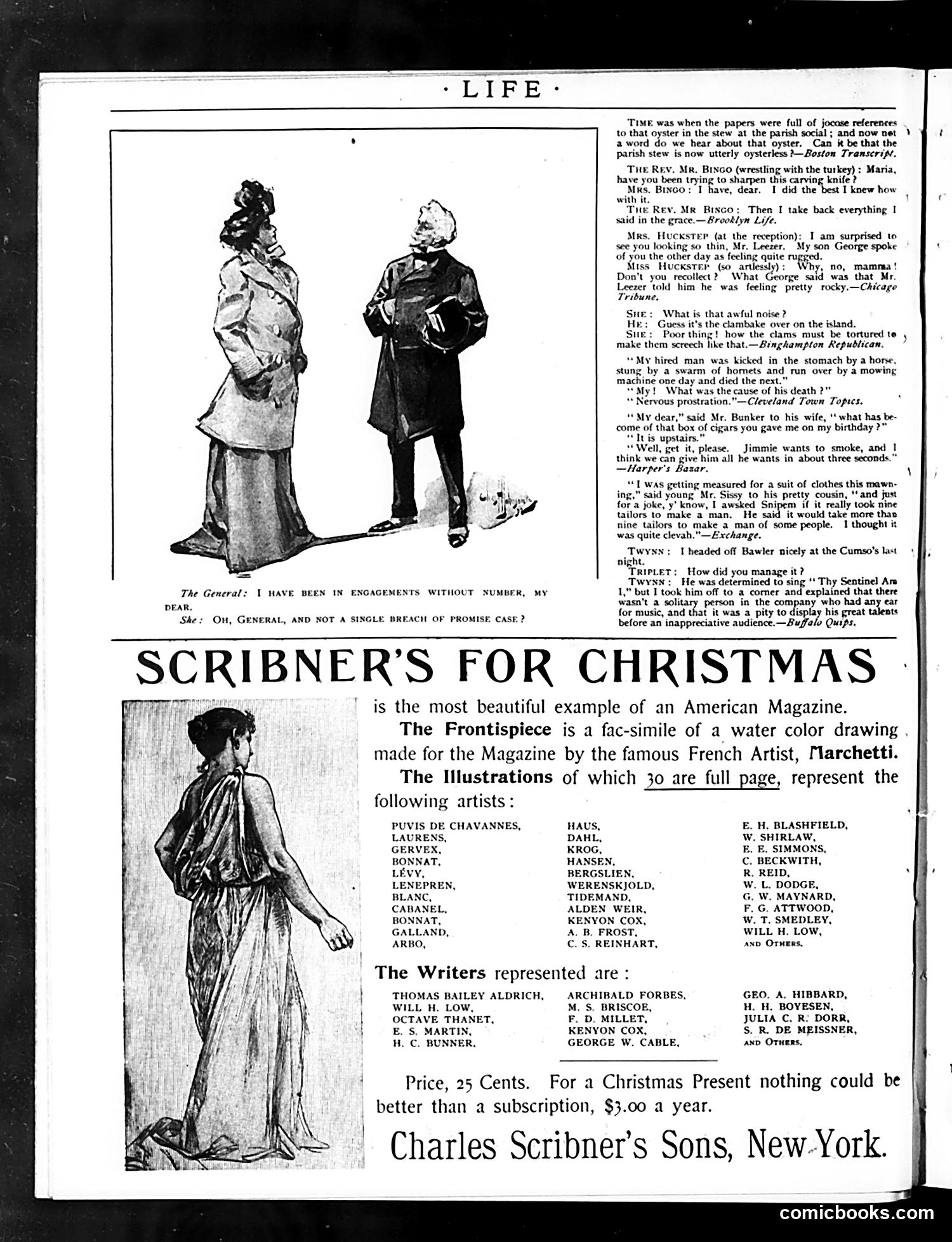
This page contains a cartoon and several brief humorous anecdotes typical of *Life* magazine's satirical format. **The Main Cartoon:** Shows "The General" and a woman in conversation. The General boasts of numerous engagements without breach-of-promise cases, while the woman skeptically asks if there's "not a single breach of promise case?" The joke plays on the double meaning of "engagements"—both military battles and romantic commitments—suggesting the General has avoided romantic entanglements despite his many dealings. **The Anecdotes** are short, punchy jokes on domestic topics: a dull carving knife, a misheard comment about feeling "rocky," tortured clams at a clambake, and a man's death attributed vaguely to "nervous prostration." These reflect turn-of-the-century humor focused on middle-class life, wives' domestic failures, and social awkwardness. The **lower half is advertising** for *Scribner's* Christmas magazine, listing famous illustrators and writers.
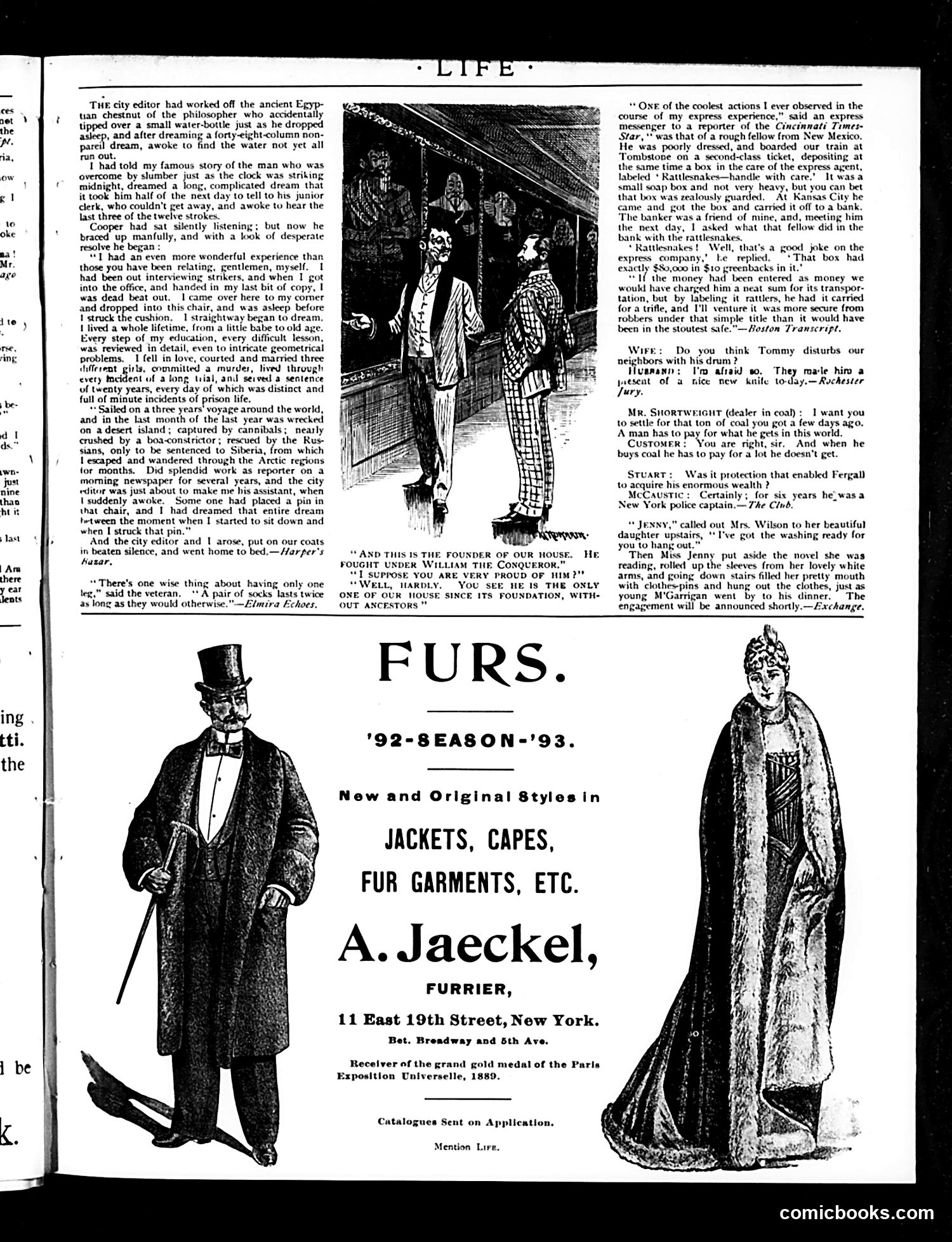
This page from Life (circa 1892-93) contains three distinct elements: **The Main Story:** A humorous anecdote about newspaper reporters competing with increasingly absurd "dream within a moment" stories. The joke satirizes journalistic one-upmanship—each editor tries to top the others' tall tales until Cooper describes dreaming an entire lifetime (education, love affairs, murder trial, Arctic exploration) in the split-second before sitting on a pin. The satire mocks both press culture and the era's fondness for elaborate storytelling. **The Small Cartoon:** A brief joke about ancestry—a character proudly references an ancestor who "fought under William the Conqueror" (1066), only to admit he's "the only one of our house since its foundation, without ancestors"—suggesting he's the sole legitimate descendant (implying illegitimacy in the family line). **The Advertisement:** A.Jaeckel, a furrier on East 19th Street, New York, advertising fur garments for the 1892-93 season, claiming a gold medal from the 1889 Paris Exposition. The page is primarily advertising with framing humor.
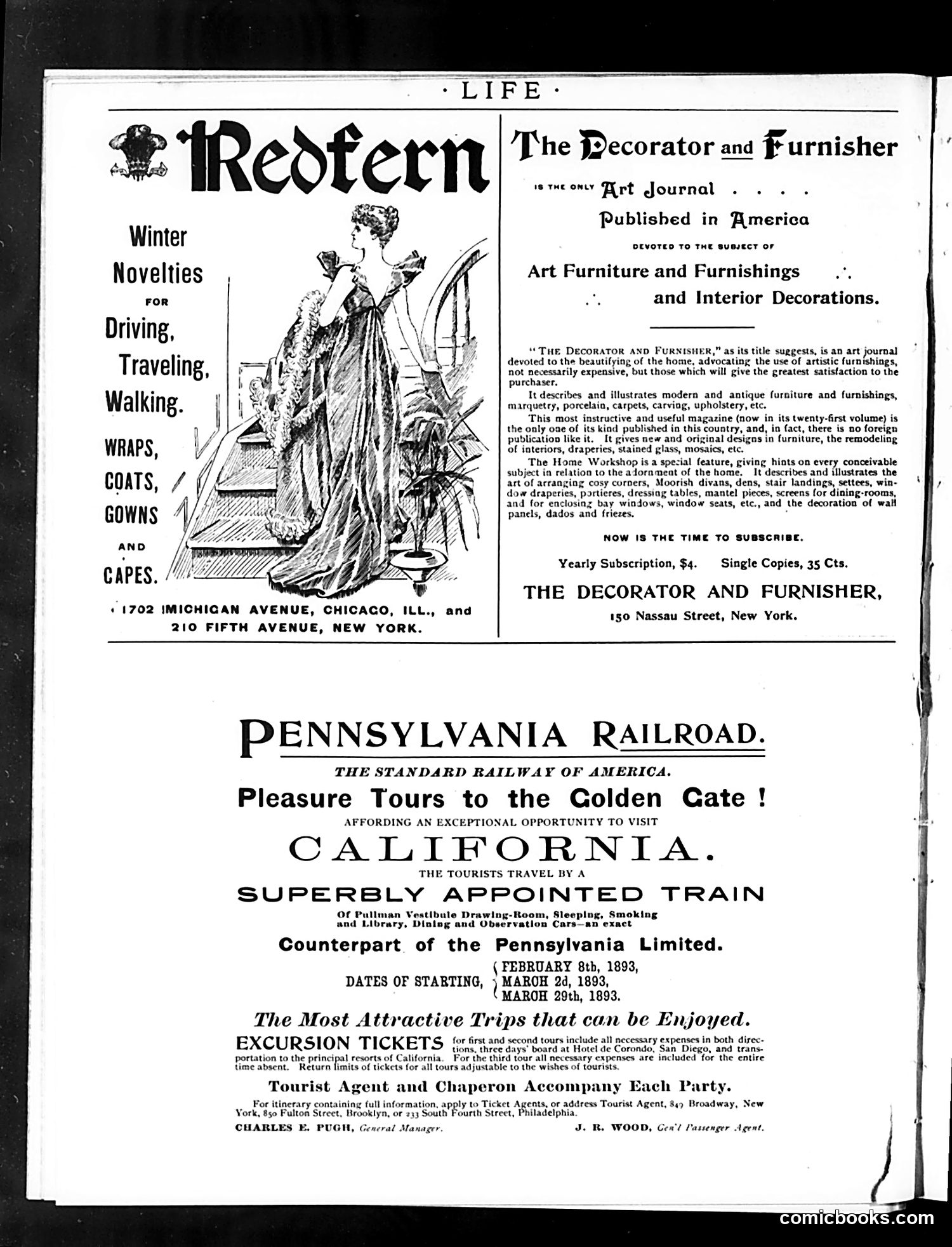
This page is primarily **advertising**, not editorial content or satire. It contains three distinct ads: 1. **Redfern** (top left): A fashion house advertising winter novelties—wraps, coats, gowns, and capes—for driving, traveling, and walking. The illustration shows an elegantly dressed woman in period costume. 2. **The Decorator and Furnisher** (top right): A trade journal promoting subscriptions ($4/year) devoted to art furniture, interior design, and home decoration. It emphasizes being "the only one of its kind published in this country." 3. **Pennsylvania Railroad** (bottom): Promoting luxury tourist excursions to California ("the Golden Gate") via the superbly appointed Pennsylvania Limited train, departing February-March 1893. Tours include accommodations and transportation to major California resorts. There is **no political satire or cartoon content** on this page—it's a straightforward collection of late-19th-century consumer advertisements targeting affluent readers.
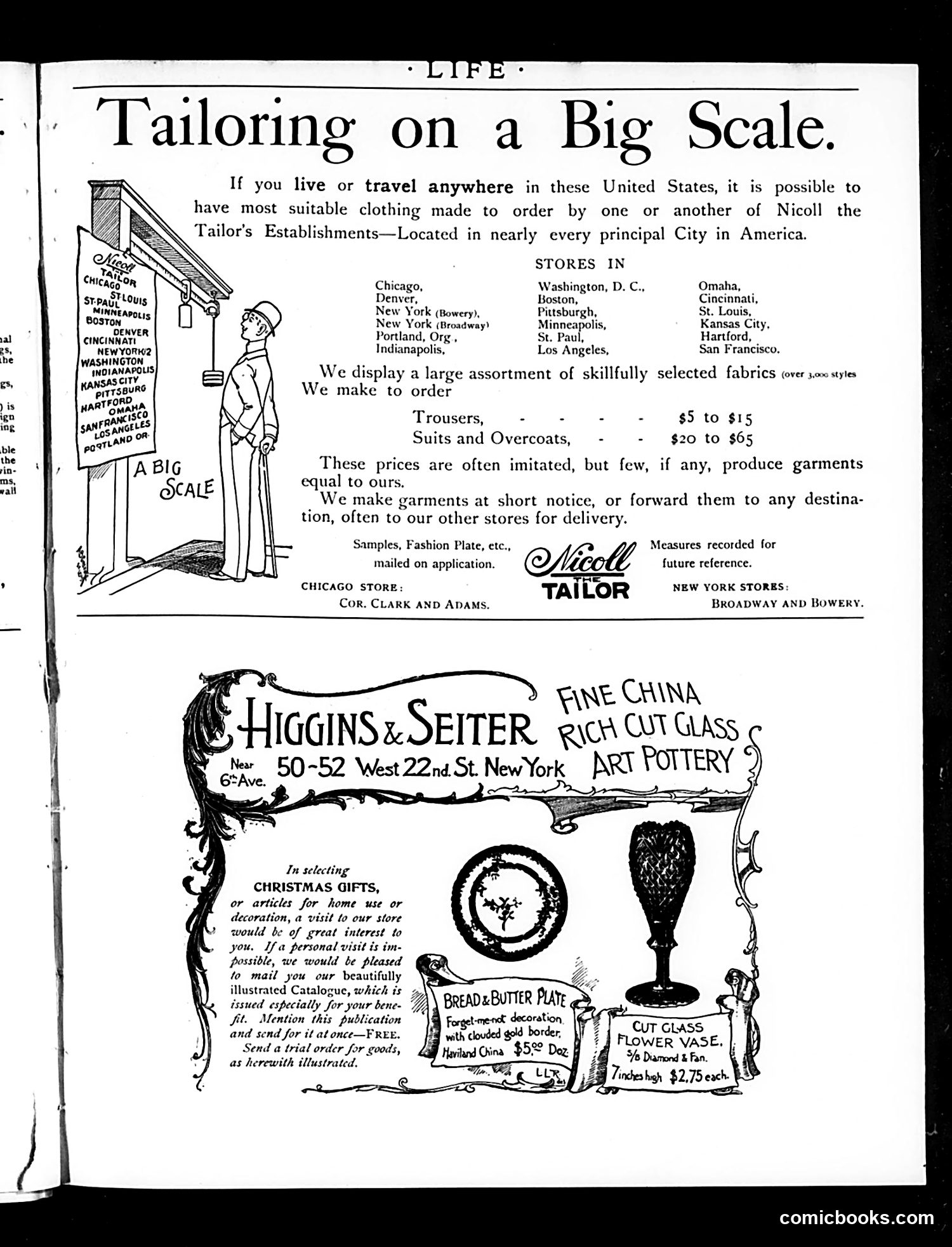
This page is **primarily advertising**, not satire or political commentary. It contains two major ads: 1. **Nicoll the Tailor** (top): Advertises mail-order custom tailoring available nationwide across major U.S. cities. The illustration shows a well-dressed man in a suit next to a building listing store locations. This reflects early 20th-century retail innovation—allowing Americans anywhere to order custom clothing by mail, a significant convenience before widespread ready-made sizing. Prices ($5-$65) were mid-range for the era. 2. **Higgins & Seiter** (bottom): A New York luxury goods store advertising fine china, cut glass, and art pottery for Christmas gifts. The decorative border and product illustrations (bread-and-butter plate, flower vase) emphasize upscale home decoration. Both ads target middle to upper-middle-class consumers with disposable income for quality goods. There is no discernible political satire or social commentary on this page.
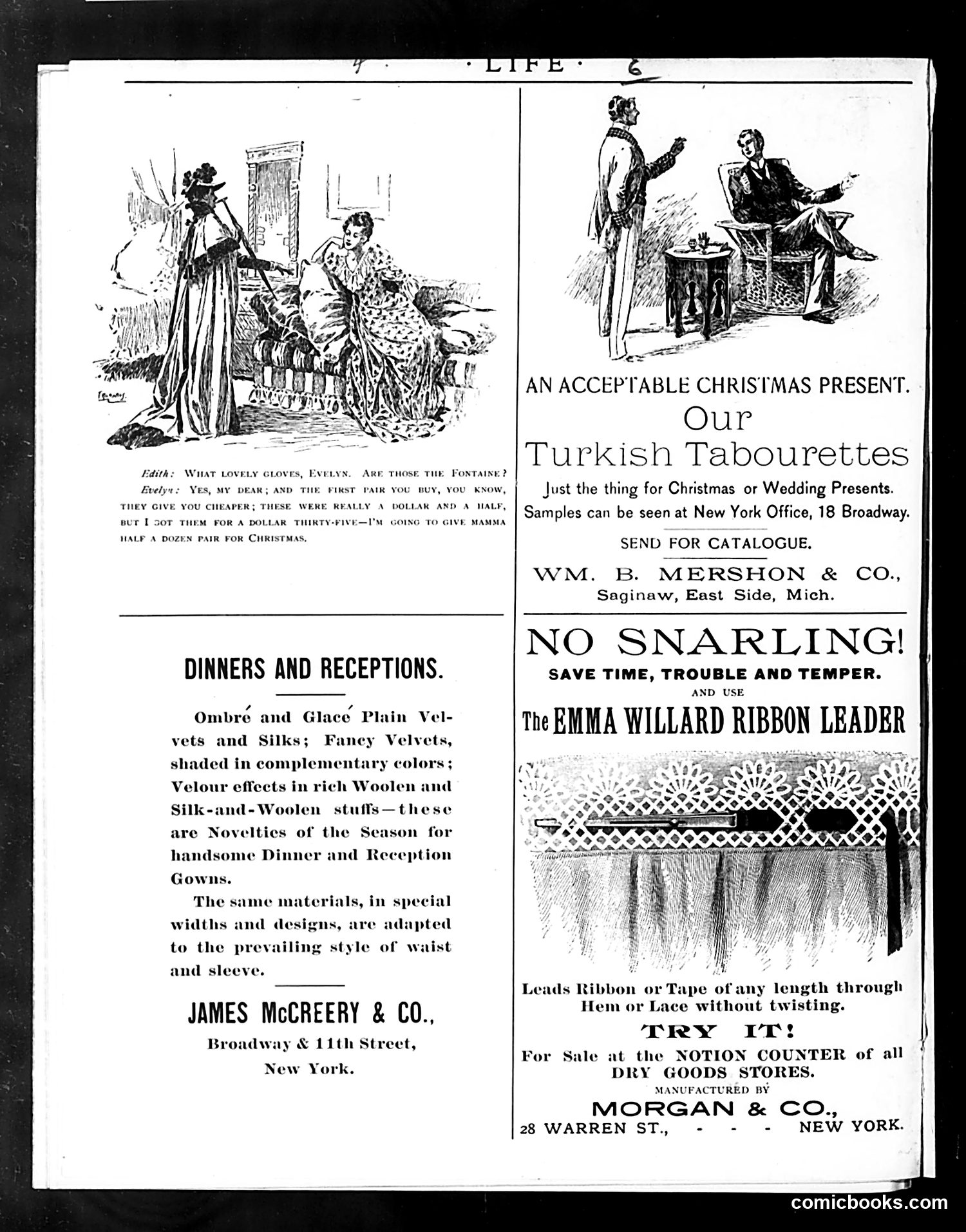
This page is primarily **advertising with one small satirical cartoon**. The cartoon depicts two women, Edith and Evelyn, discussing gloves. Evelyn brags about purchasing expensive Fontaine gloves for $1.35 (marked down from $1.50), claiming she'll buy half a dozen pairs as Christmas gifts for her mother. The satire mocks **conspicuous consumption and false economy**—Evelyn congratulates herself on the "bargain" while planning extravagant gifts, suggesting middle-class pretension about wealth and shopping savvy. The surrounding advertisements promote **luxury goods** (velvets, silks, dinner gowns), Turkish furniture, and a ribbon-threading device—all positioned as Christmas gifts for the affluent. The joke illustrates a period obsession with getting deals while maintaining appearances of generosity and refinement.

I can see this is a page from Life magazine with very dark/poor image quality that makes it difficult to read the text or discern specific cartoon imagery clearly. The left margin shows partial text fragments including what appears to be letters like "T," "S," "ER," and partial words, but the main content area is almost entirely black or too degraded to analyze. Without being able to read the OCR text reliably or see the cartoon(s) distinctly, I cannot accurately identify the figures, political references, or satirical intent as you've requested. To provide historically accurate analysis following your rules, I would need either a clearer image or more legible OCR text from this page.