
Life, 1892-12-29 · page 6 of 47
Life — December 29, 1892 — page 6: what you’re looking at
What you’re looking at
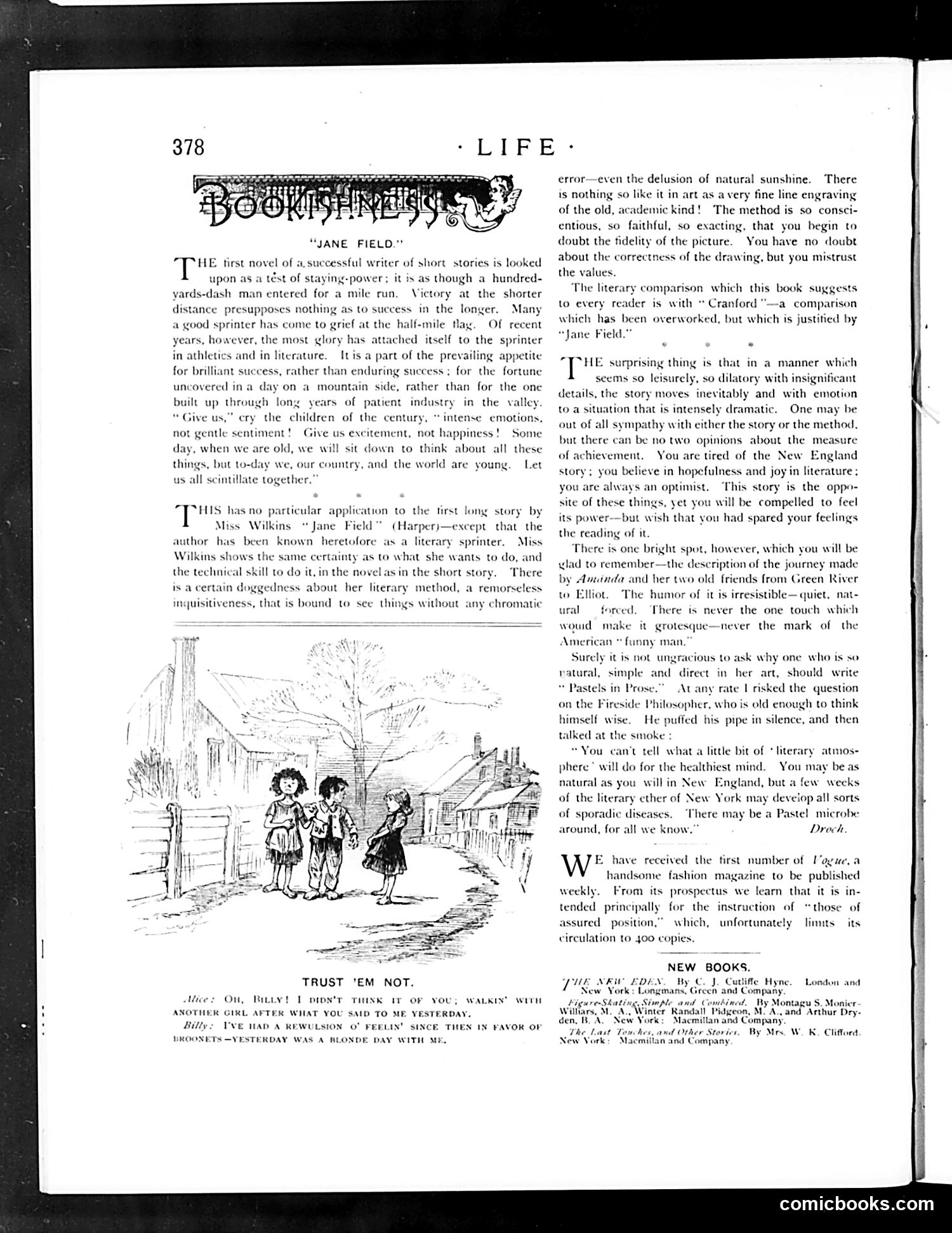
This page reviews "Jane Field," a novel by Miss Wilkins (likely Mary E. Wilkins Freeman, a prominent short-story writer of the era). The review praises Wilkins's ability to transition from short stories to longer fiction while maintaining technical skill, though noting a "doggedness" in her literary method. The small cartoon labeled "TRUST 'EM NOT" depicts three children on a street, with dialogue about whether to trust girls—likely a period-appropriate joke about gender relations. The cartoon serves as light visual relief rather than political satire. The page primarily functions as a book review and literary criticism column, not political commentary. The "New Books" section at bottom lists recent publications.
📄 Transcribed text from this page (OCR, searchable)
Machine-transcribed from the original scan — historical spelling and the odd misread are preserved.
FIELO.” HE first novel of a.successful writer of short stories is looked upon as a tést of staying-power; it is as though a hundred- yards hh man entered for a mile run. Victory at the shorter distance presupposes nothing as to success in the longer. Many OF recent years, however, the most glory has attached itself to the in athletics and in literature. It is a part of the prevailing for brilliant success, rather than enduring success ; for the a good sprinter has come to grief at the half-mile tay sprinter appetite fortune uncovered ina day on a mountain side, rather than for the one built up through long years of patient industry in the valley. “Give us,” ery the children of the century ent! “intense emotions, not gentle sentin Give us excitement, not happiness! Some day, when we are old, we will sit down to think about all these things, but to-day we, our country, and the world are young. Let us all scintillate together.” THs has no particular application to the first long story. by Miss. Wilkins author has been known heretofore as a literary sprinter. “Jane Field” (Harpery—except. that the Miss Wilkins shows the same certainty as to what she wants to do, and the technical skill to do it, in the novel asin the short story. There is a certain doggedness about her literary method, a remorseless uisitiveness, that is bound to see things without any chromatic Ee TRUST Mice: Ou, BILLY! 1 ptpytr ANOTHER GIRL AFTER WHAT YOU SAtD TO ME YESTERDAY, Billy: VVE MAD A REWULSION O° FEELIN’ SINCE THEN IX FAVOR OF LROONETS -VESTERDAY WAS A BLONDE DAY WITH ME, ‘EM NOT. THINK IP OF YOU; WALKIN’ wert error—even the delusion of natural sunshine. There is nothing so like it in art as avery fine line engraving of the old, academic kind! The method is so consci- entious, so faithful, so exacting, that you begin to doubt the fidelity of the picture. You have no doubt about the correctness of the drawing, but you mistrust the values. The literary comparison which this book suggests to every reader is with “ Cranford "—a_ comparison which has been overworked, but which is justitied by “Jane Field.” | eas seems so leisurely, so dilatory with insignificant details, the story moves inevitably and with emotion to a situation that is intensely dramatic. One may be out of all sympathy with either the story or the method, surprising thing is that in a manner which but there can be no two opinions about the measure of achievement. You are tired of the New England story; you believe in hopefulness and joy in literature ; you are always an optimist. This story is the oppo- site of these things, yet you will be compelled to feel its power—but wish that you had spared your feelings the reading of it There is one bright spot, however, which you will be ylad to remember—the description of the journey made by Amenda and her two old friends from Green River SHiot. The humor of it is irresistible— quiet, nat- ural foreed. There is never the one touch which would make it grotesque—never the mark of the American * funny man.” Surely it is not ungracious to ask why one who is so vatural, simple and direct in her art, should write * Pastels in Prose.” At any rate | risked the question on the Fireside Philosopher, who is old enough to think himself wise. talked at ~ You He puffed his pipe in silence, and then he smoke ant tell what a little bit of ‘literary atmos- phere * will do for the healthiest mind. You may be as natural as you will in New England, but a few weeks of the literary ether of New York may deveiop all sorts of sporadic diseass There may be a Pastel microbe around, for all we know.” Droch W weekly. tended principally for the instruction of “those of have received the first: number of Vague, a handsome fashion magazine to be published From its prospectus we learn that it is in- assured position,” which, unfortunately limits — its circulation to 400 copies. NEW BOOKS. By C. J. Cuttiffe Hyne . Green and Company. KigureShating, Si /. By Montagu S. Monier Willan, Ma. Wis in, M.A., and Arthur Dry- den, BLA. New York: Macmillan and Company The Last Touches, and Other Stories. By Mr WOK New Vork: Macmiilan and Company WE NEW EDEN New York : bs London and Clifford comicbooks.com