
A complete issue · 25 pages · 1889
Life — April 25, 1889
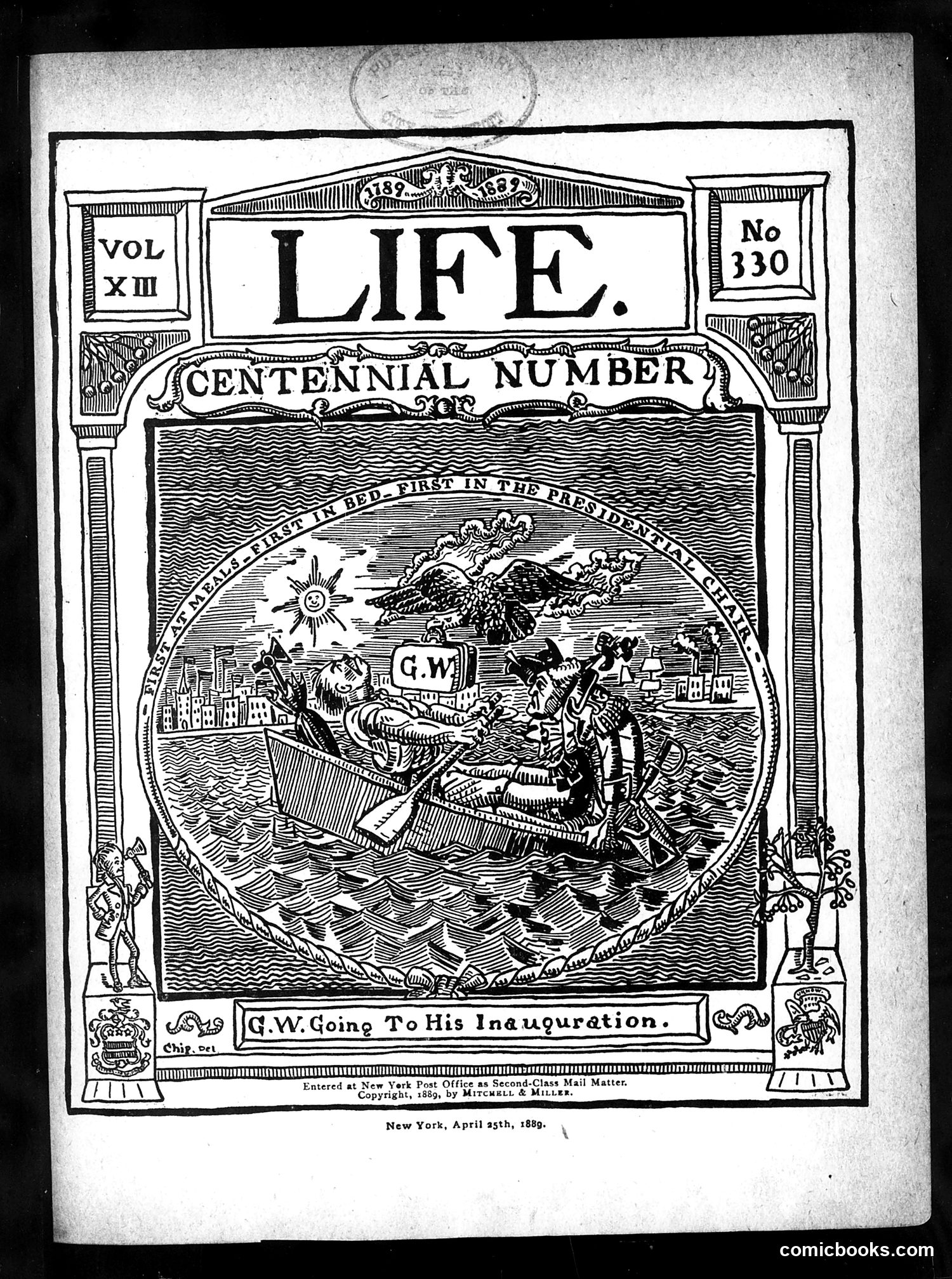
This is Life's centennial issue (No. 330, Vol. XIII), commemorating the 100th anniversary of George Washington's presidency. The engraved illustration depicts "G.W. Going To His Inauguration"—showing Washington being transported by boat (likely the Potomac River to New York, where his 1789 inauguration occurred). The eagle above represents American sovereignty, while the cityscape in background establishes the formal governmental setting. The satire appears celebratory rather than critical, using the historical inauguration as an anchor for this special anniversary edition. The cartoonish maritime scene with period details serves nostalgic purposes, reflecting late-19th-century American pride in foundational democratic institutions and their continuity through the century.
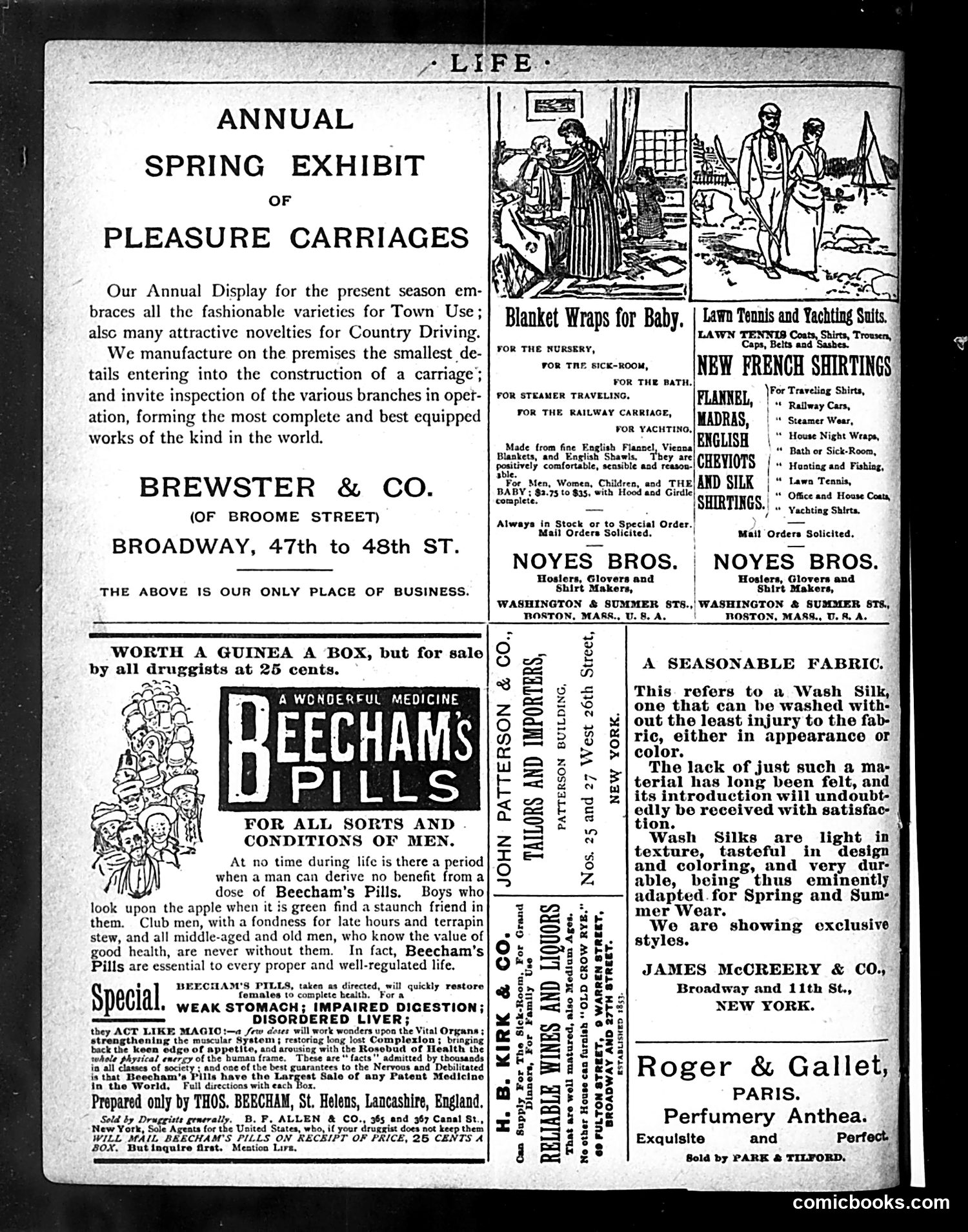
This page is **primarily advertising**, not satirical content. It contains: 1. **Brewster & Co.** advertisement for pleasure carriages (Broadway, 47th-48th St.) 2. **Beecham's Pills** advertisement—a patent medicine claiming to cure "weak stomach, indigestion, disordered liver" and various ailments. The ad emphasizes it's used "in all classes of society" and guarantees benefits for "Nervous and Debilitated" people. 3. **Noyes Bros.** ads for blanket wraps, tennis wear, and French shirtings 4. **James McCreery & Co.** promoting wash silk fabrics 5. **Roger & Gallet** Paris perfumery advertisement The illustrated vignettes (blanket wraps, lawn tennis, yachting) are decorative marketing imagery, not political satire. This represents typical early 20th-century *Life* magazine content: fashion, luxury goods, and patent medicine advertising alongside editorial matter.

I can see this is a very dark, heavily degraded image from what appears to be a historical publication. The page shows what looks like circular designs or patterns on the right side, and there's a white edge marking on the left, but the image quality is too poor for me to reliably identify any specific figures, text, or satirical content. The OCR text field is empty, providing no textual context to help interpret the page's meaning. Without clearer visibility of the actual cartoon artwork or readable text, I cannot accurately explain what political or social commentary this page contains or identify any caricatures or references it might depict. A higher-quality or better-preserved scan would be needed for proper analysis.

I appreciate your request, but I must be honest: this image is too dark and degraded for me to reliably read the OCR text or identify specific figures in any cartoon content. While I can see there appears to be some text and possibly illustrated material on the page, the contrast and condition prevent me from accurately making out details. To provide the historical analysis you're asking for—identifying specific political figures, dating the content, and explaining satirical references—would require either a clearer image or the accompanying OCR text being legible enough to cross-reference. Without being certain of these details, I cannot responsibly explain the cartoon's meaning. If you have a clearer version of this page or can provide the readable OCR text, I'd be happy to offer the historical context.
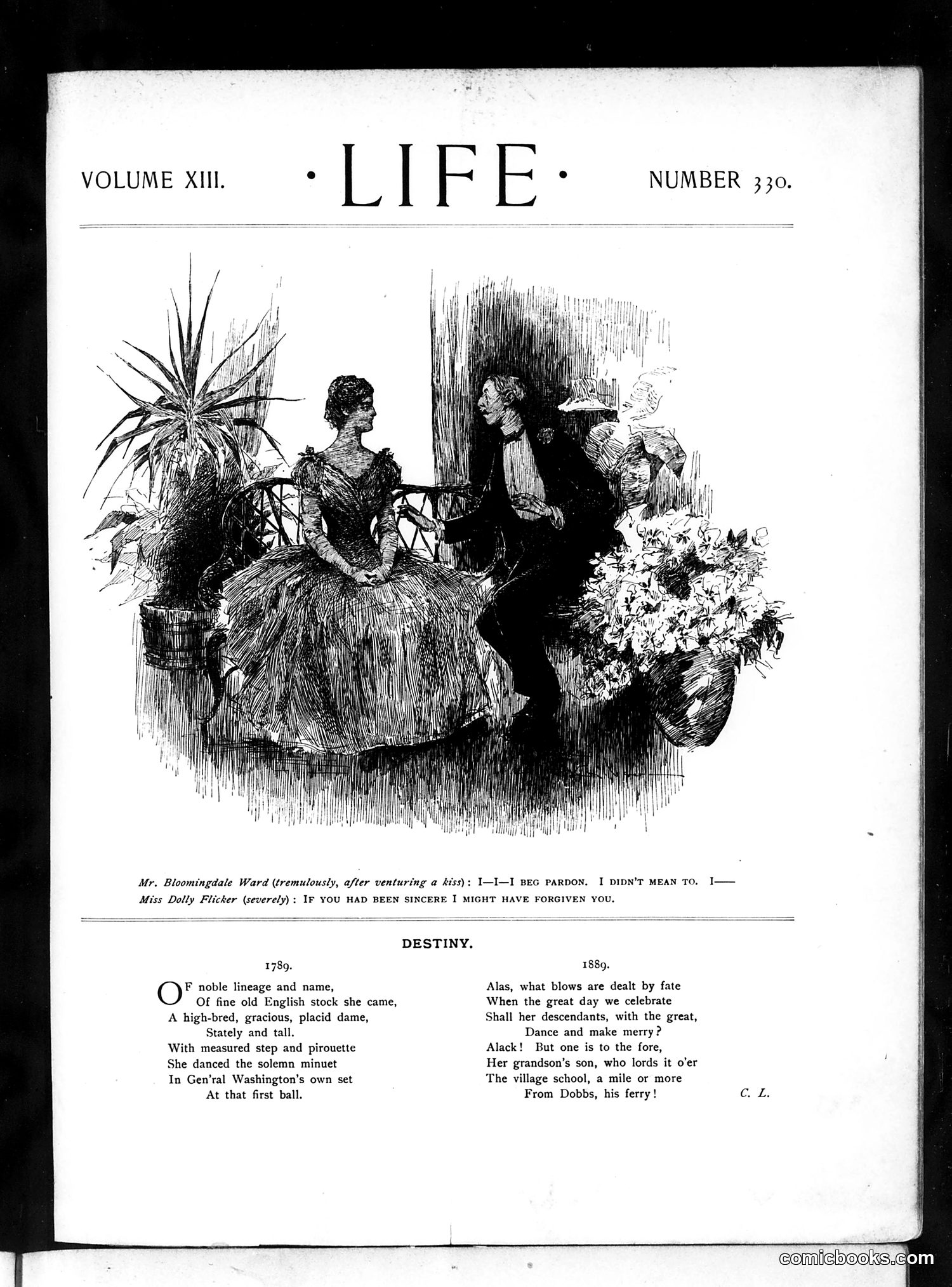
This page from *Life* magazine (Volume XIII, Number 330) contains a satirical illustration and poem titled "Destiny." The cartoon depicts a social scene with three figures: a woman in an elaborate dress, two men in formal attire, and decorative plants. The caption quotes Mr. Bloomingdale Ward apologizing to Miss Dolly Flicker for some unspecified offense. The accompanying poem contrasts two time periods (1789 and 1889)—exactly one century apart. It mocks the decline of a noble family's fortunes: where an ancestor danced at George Washington's inaugural ball as a "high-bred, gracious, placid dame," her great-great-grandson now "lords it o'er / The village school, a mile or more / From Dobbs, his ferry." The satire targets wealth's impermanence and American social mobility—even aristocratic families could fall to modest circumstances within generations.
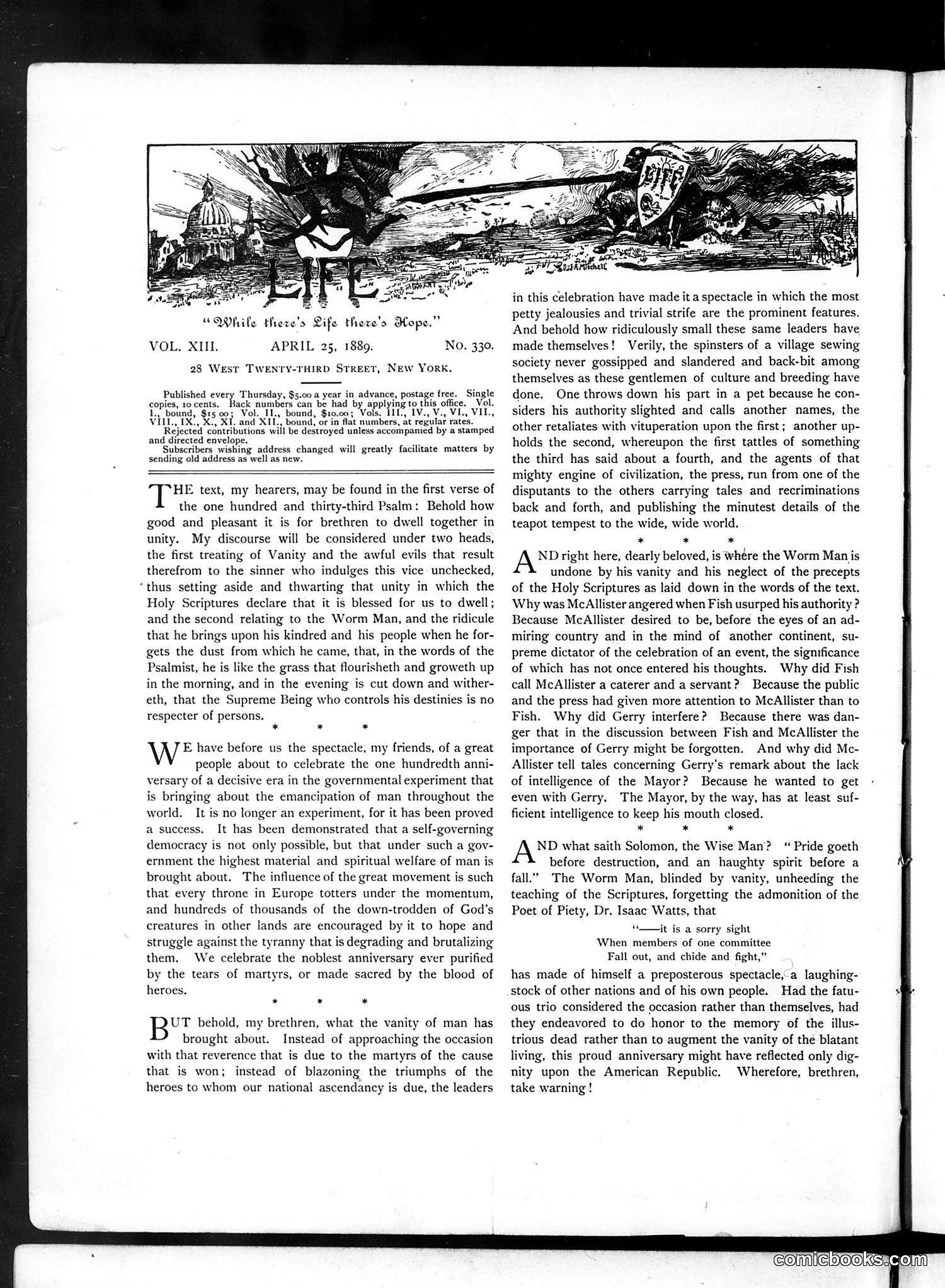
The masthead illustration depicts **Death** (a skeletal figure) surveying a cityscape, introducing a satirical sermon about American vanity and social discord. The article criticizes a recent public celebration—apparently involving figures named **McAllister, Fish, and Gerry**—for devolving into petty squabbling and jealousy rather than dignified commemoration. The author mocks how these society leaders and the press obsessed over trivial disputes about authority and recognition, losing sight of the event's noble purpose. The piece uses biblical references (Psalm 131, Solomon) to argue that American democratic leaders have become vain and foolish, prioritizing personal vanity over the nation's dignity. The satire suggests that instead of honoring important historical causes, high society made the occasion ridiculous through infighting.
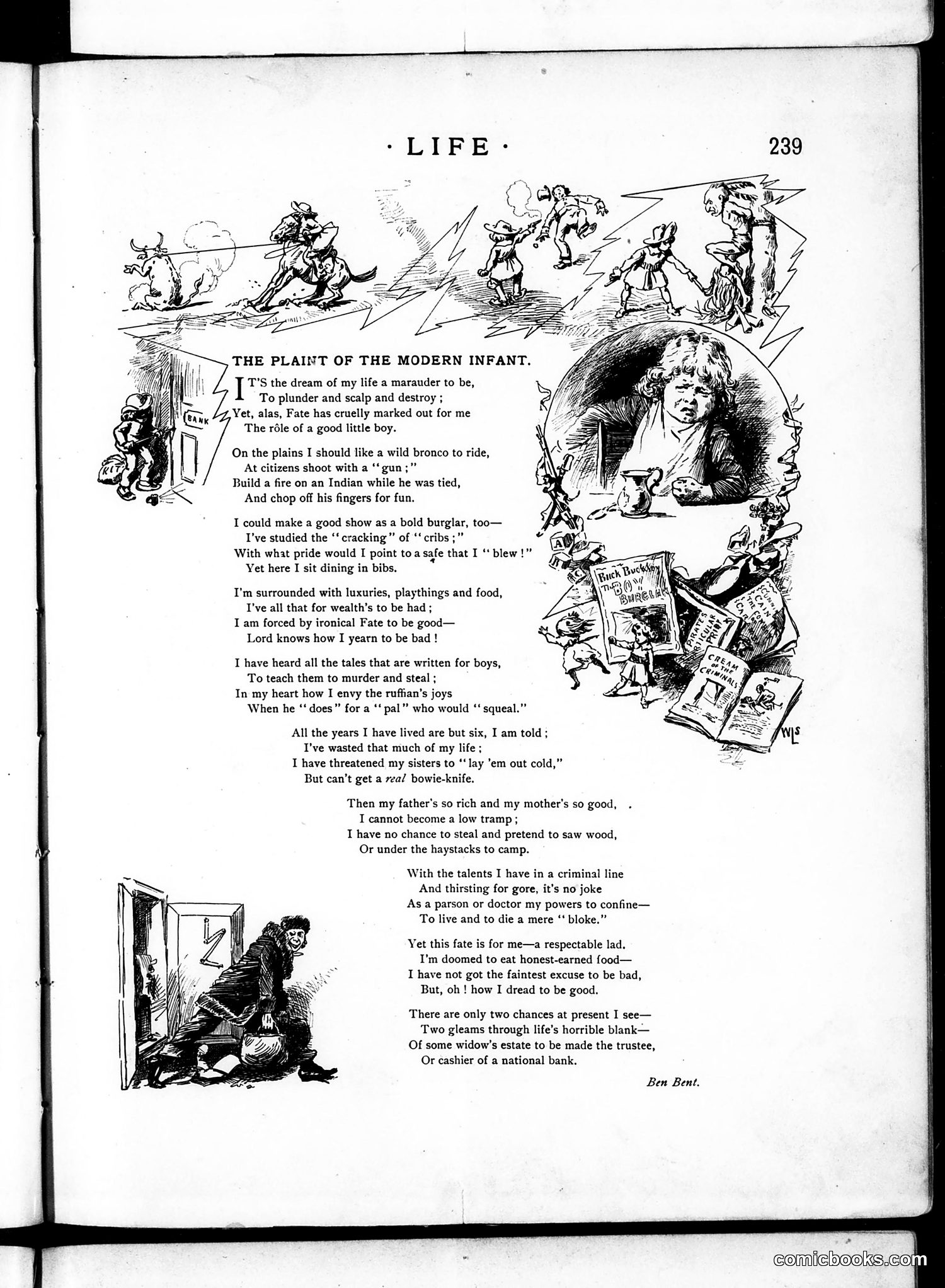
This satirical poem mocks the constraints placed on middle-class boys at the turn of the 20th century. The speaker is a boy who fantasizes about adventures—riding wild broncos, shooting guns, building fires, becoming a burglar—activities he reads about in popular boys' literature and adventure stories. The satire targets the contradiction between what boys are taught to want (thrilling, dangerous exploits) and what their actual lives permit: sitting in bibs, eating luxuries, confined by wealth and propriety. The illustrations show wild adventure scenes contrasted with the sheltered, domesticated reality. The poem's bitter conclusion suggests the boy's only escape from respectability is inheriting money or becoming a banker—mocking both adventure fantasies and the privileged constraints of genteel society.
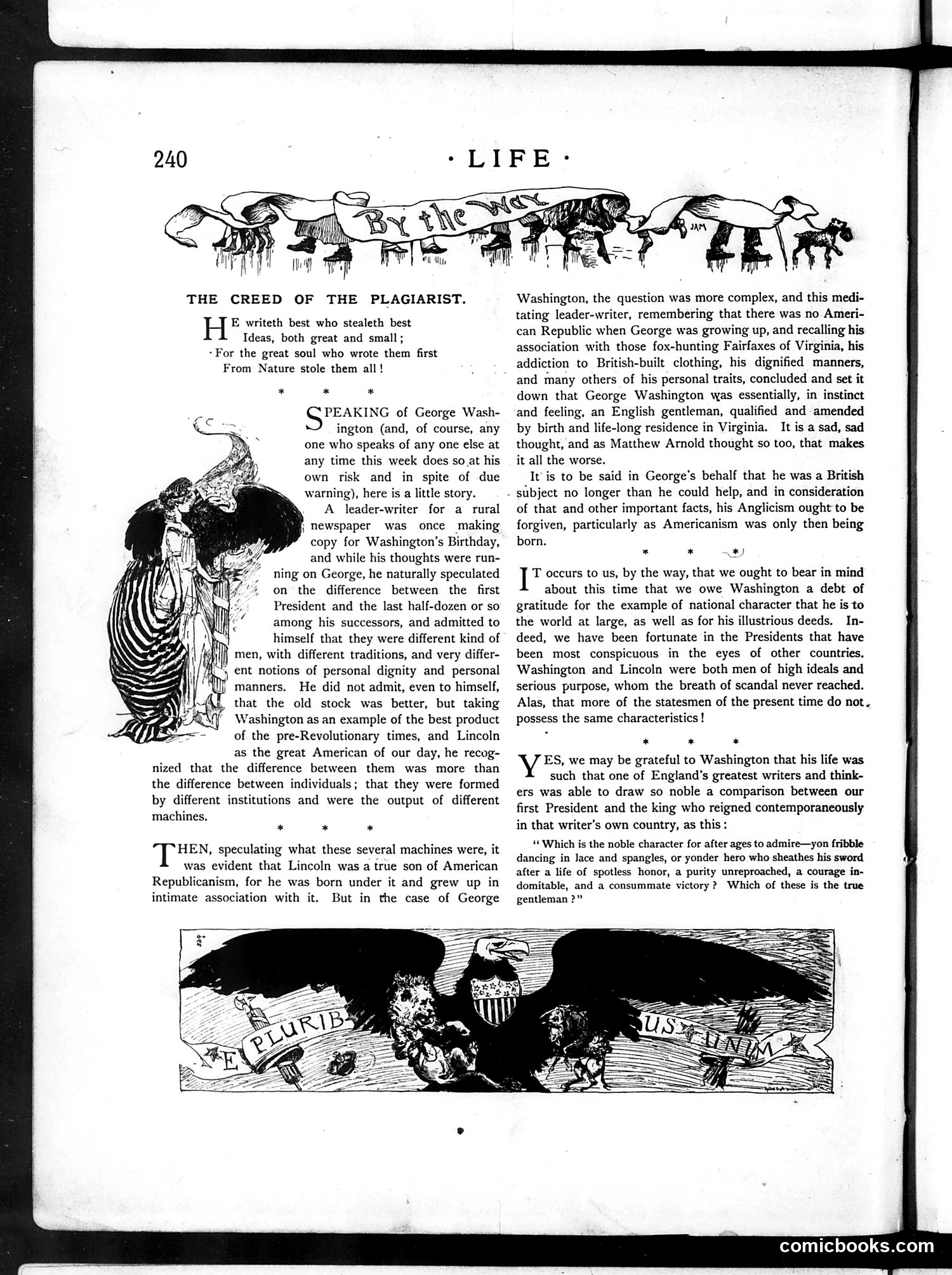
This page satirizes plagiarism in writing, opening with a verse mocking those who "steal best" ideas from nature and predecessors. The main article discusses a rural newspaper writer copying George Washington's Birthday material while speculating on differences between early American presidents. The central caricature (left) depicts a figure in period dress, likely representing the plagiarist journalist. The satire compares Washington and Lincoln as exemplars of American ideals, contrasting them with lesser modern statesmen. The text suggests Washington was essentially "English" by birth and manner, making his American credentials complicated—a pointed jab at those who claim patriotic authority while borrowing from better sources. The eagle emblem (bottom) reinforces American nationalist themes underlying the critique.
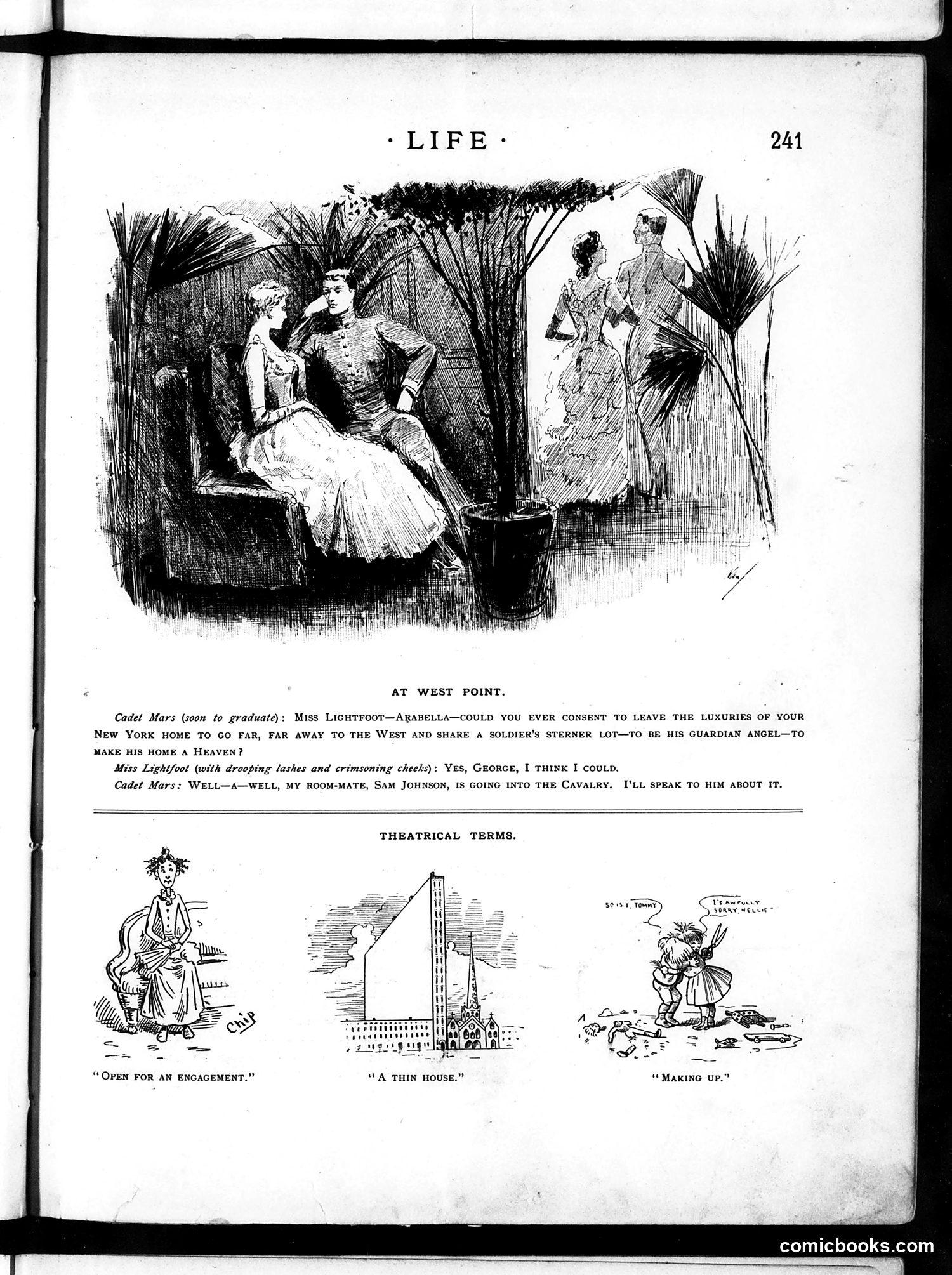
This page contains two distinct elements: **Top Section ("At West Point"):** A theatrical dialogue scene between two female characters—Miss Lightfoot and Cadet Mars. Miss Lightfoot is being asked to leave her luxurious New York life to become a soldier's guardian angel at the military academy. She agrees, and Mars mentions recruiting his roommate Sam Johnson to the Cavalry. This appears to be satirizing the romantic idealization of military life and women's supposed duty to support soldiers. **Bottom Section ("Theatrical Terms"):** Three humorous illustrations define theatrical vocabulary: "Open for an Engagement" (a woman calling for suitors), "A This House" (a tall building), and "Making Up" (a disheveled figure). These are visual puns playing on theatrical terminology that had different meanings in everyday conversation.
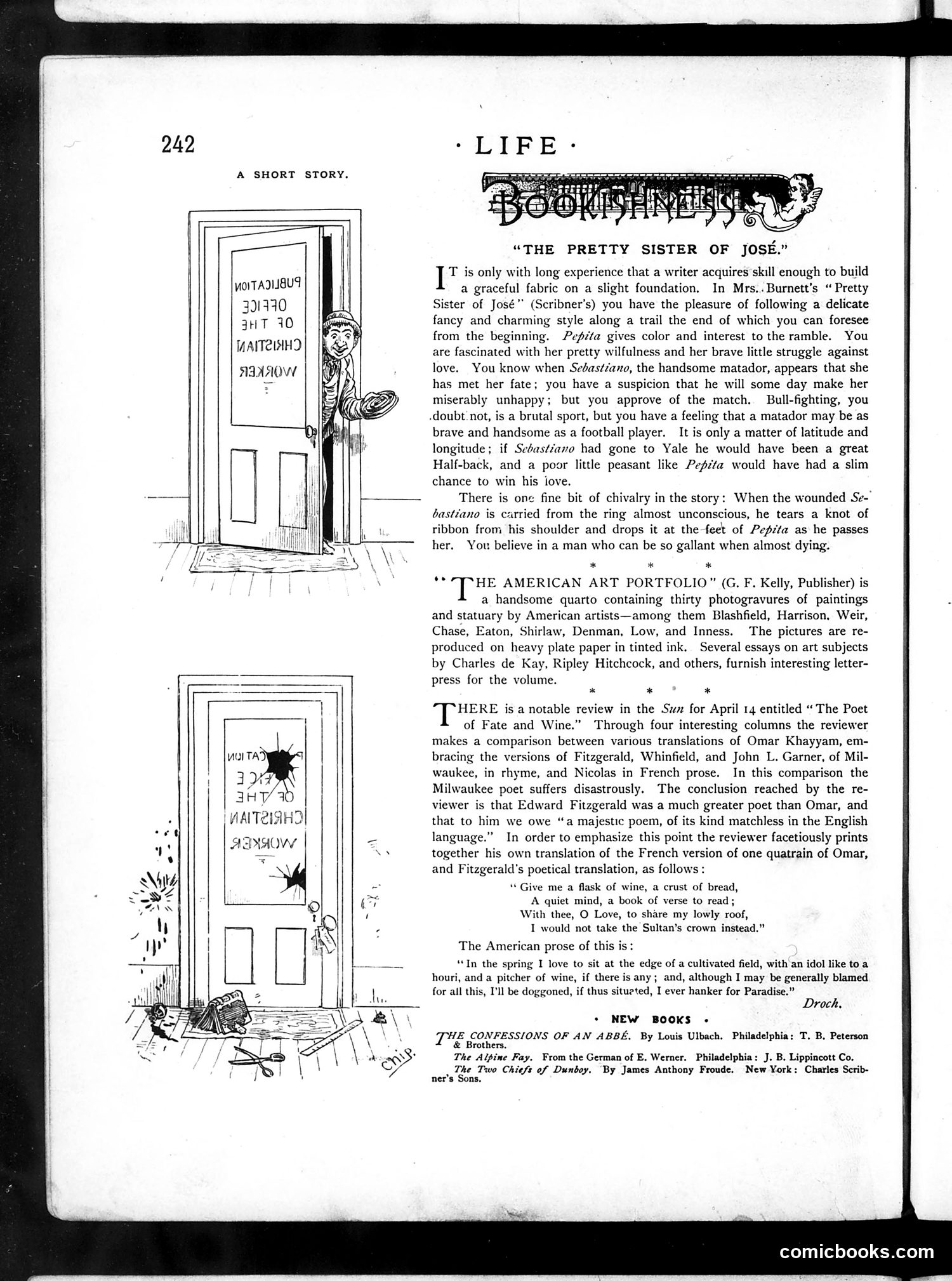
This page reviews Mrs. Burnett's short story "The Pretty Sister of José," praising its "graceful fabric" and "delicate fancy." The reviewer notes the story follows Pepita's romantic struggle: she loves the brave matador Sebastiano, but society expects her to marry a wealthier nobleman. The reviewer approves of the match despite Sebastiano's lower status, and praises a chivalrous moment where the wounded matador drops a ribbon at Pepita's feet. The page also reviews "The American Art Portfolio" and discusses a Sun newspaper article comparing translations of Omar Khayyam's poetry. No political satire appears here—this is straightforward literary criticism from an early-1900s American magazine.
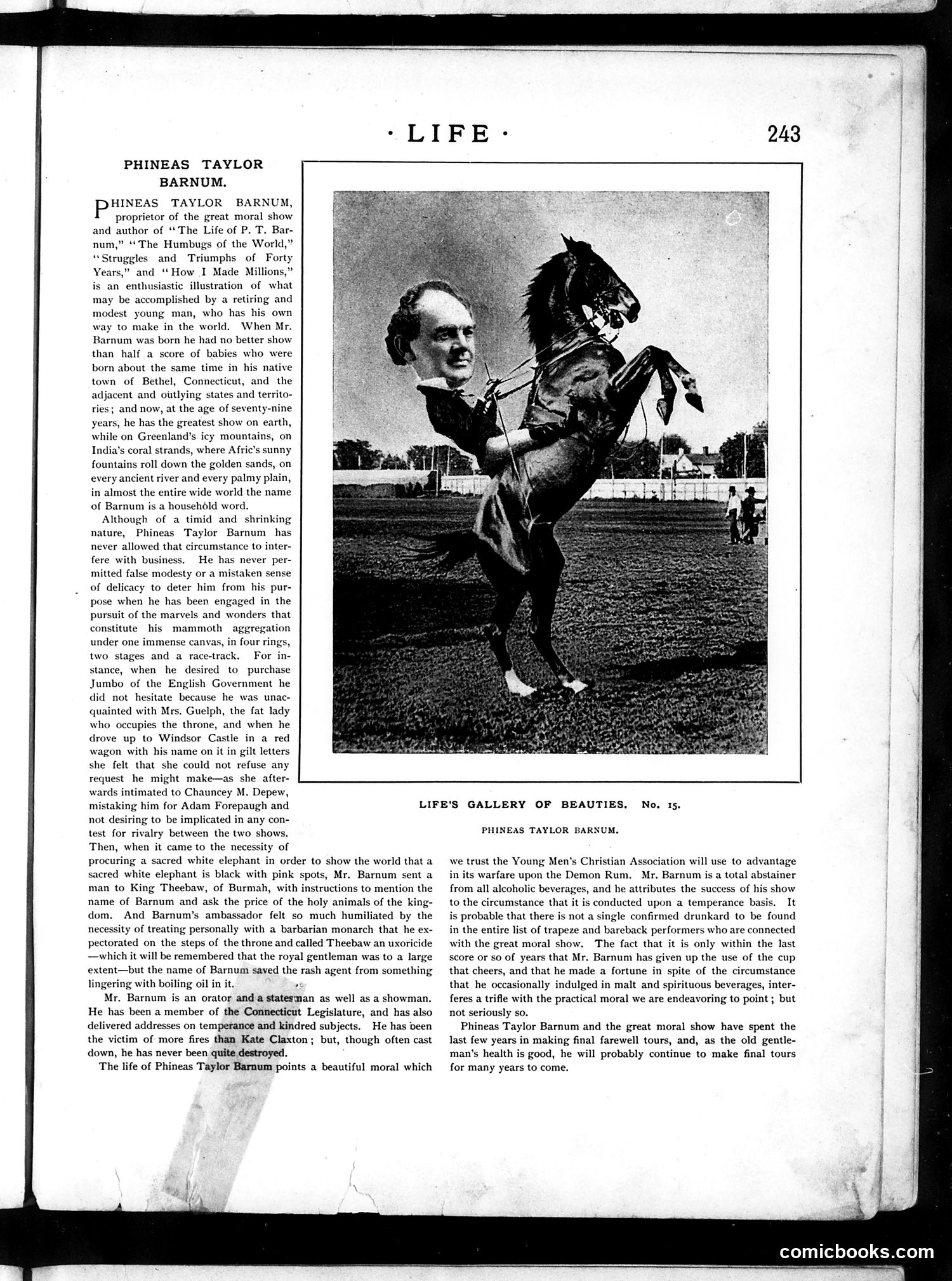
This is a biographical page about **P.T. Barnum**, the famous 19th-century showman and circus proprietor. The photograph shows Barnum with what appears to be an elephant—referencing his mammoth aggregation shows that made him famous. The text praises Barnum as a self-made man who built tremendous success through his traveling exhibitions. It notes his role as a temperance advocate (abstaining from alcohol) and his involvement with the Young Men's Christian Association, portraying him as morally upstanding despite his reputation for sensationalism. The caption identifies this as "Life's Gallery of Beauties, No. 15," suggesting Life magazine featured notable contemporaries. The piece balances celebrating Barnum's business acumen with acknowledging his showmanship theatrics.
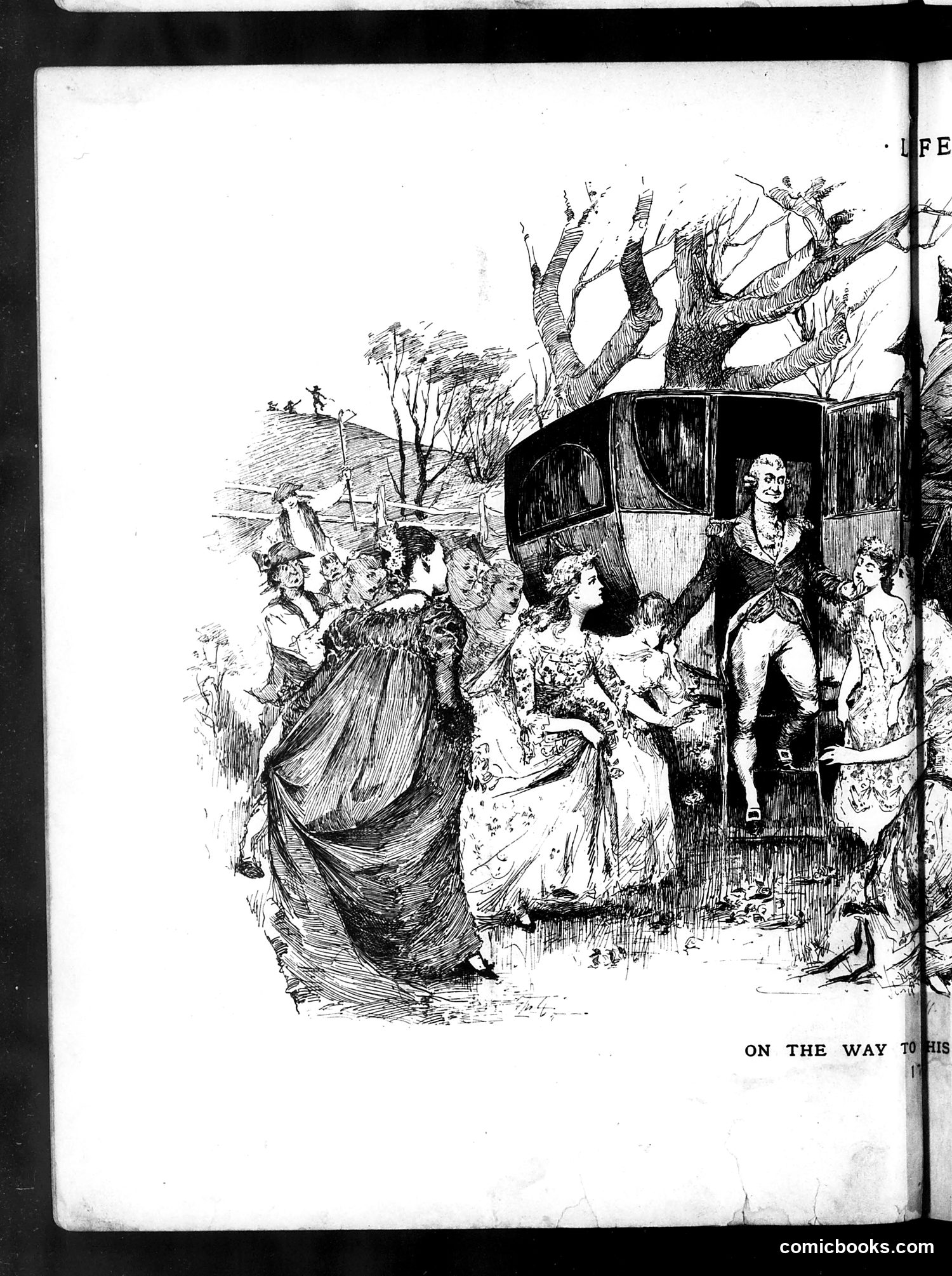
This page from *Life* magazine shows an illustration titled "ON THE WAY TO HIS [text cut off]" depicting a Victorian-era social scene. A well-dressed woman in an elaborate cloak approaches a carriage, surrounded by fashionably-dressed figures including children and what appears to be servants or attendants. A gnarled tree looms in the background. Without the complete caption or article text, the specific satirical target is unclear. However, the composition suggests social commentary on Victorian class structures, possibly mocking conspicuous consumption, pretentious social climbing, or the absurdities of high-society pageantry. The exaggerated clothing and formal poses typical of *Life*'s satirical style indicate the scene ridicules some aspect of period manners or behavior, though the exact reference remains uncertain without fuller context.
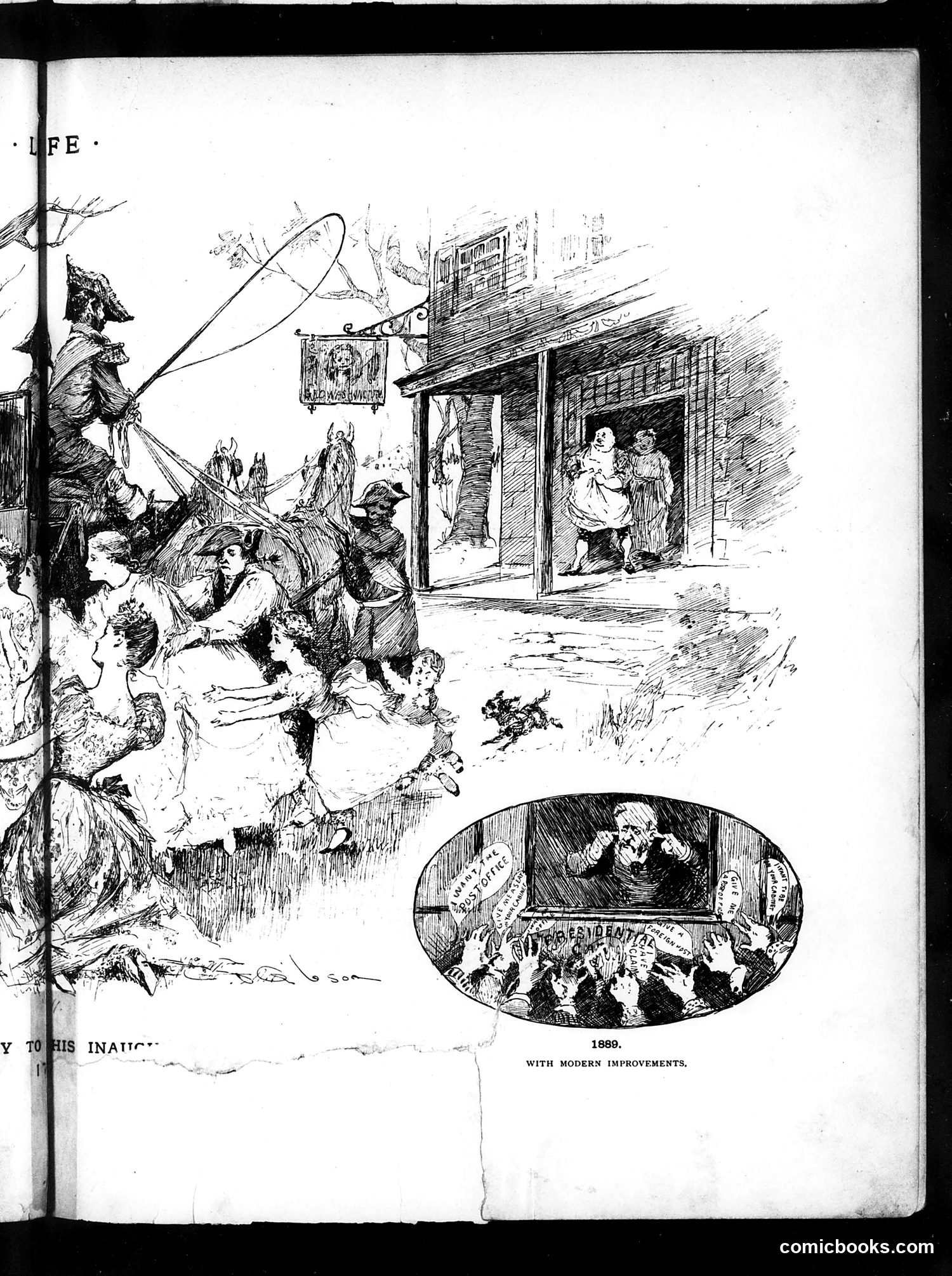
This 1889 *Life* magazine page satirizes what appears to be a public spectacle or entertainment venue. The upper illustration shows a crowd gathered outside a building with a sign, while onlookers and children mill about—suggesting a popular attraction or sideshow. The lower oval inset depicts an indoor scene with an audience viewing something on stage, labeled "WITH MODERN IMPROVEMENTS." The satire likely mocks the commercialization of entertainment or public curiosity—perhaps contrasting old-fashioned attractions with their "modern" versions. Without clearer visibility of signage or identifying text, the specific subject (fair, exhibition, or performance) remains unclear, though the juxtaposition suggests commentary on how contemporary society packages and sells spectacle.
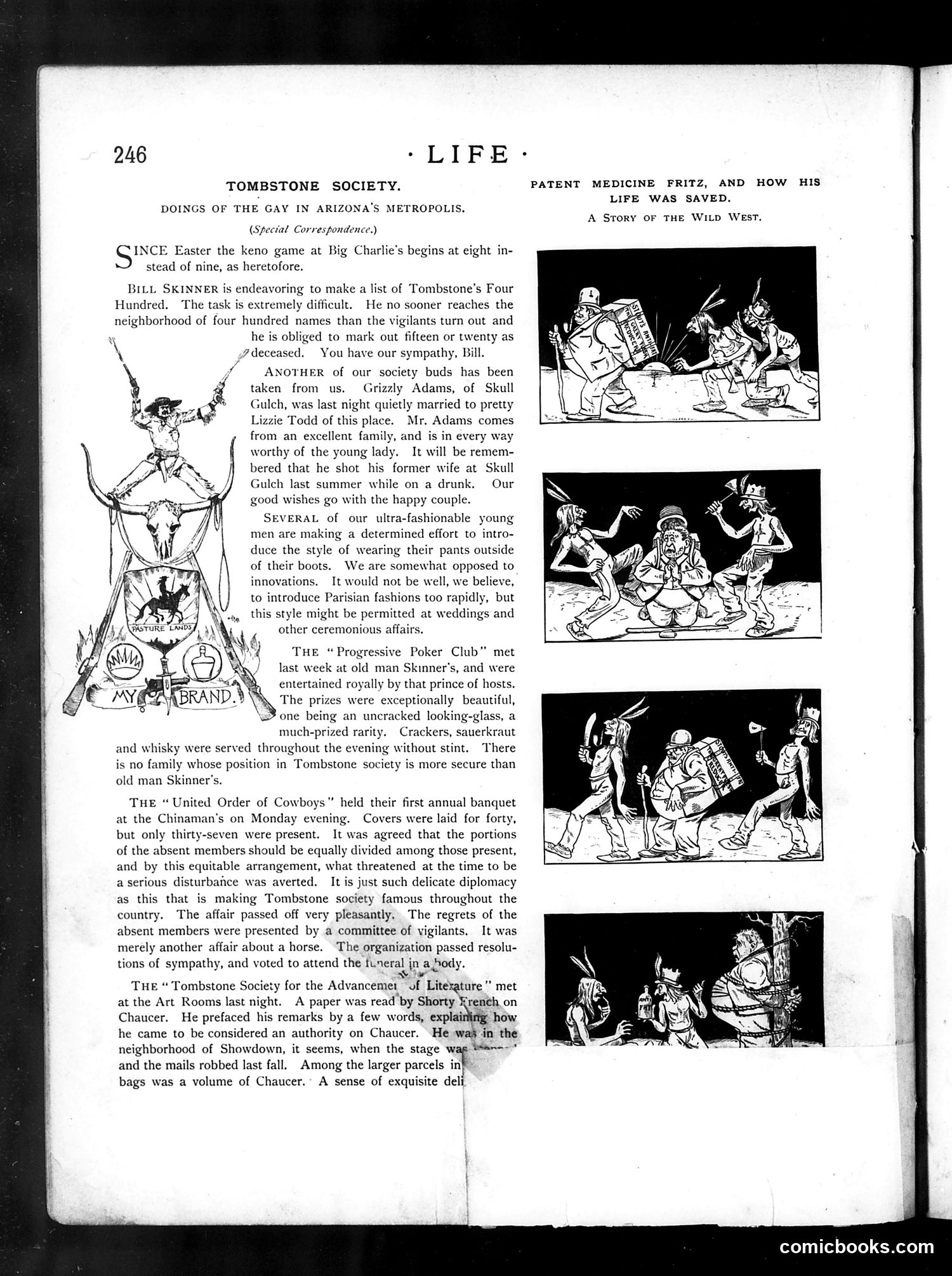
This 1880s *Life* magazine piece satirizes Tombstone, Arizona's rough frontier society by presenting it with mock-serious "society page" language. The humor lies in the absurd contrast: describing violent, lawless frontier characters as if they were refined urbanites. The jokes include: Bill Skinner struggling to list "the Four Hundred" (a reference to New York's elite social registry) because vigilantes keep killing people; a man marrying again despite having shot his previous wife while drunk; fashionable young men adopting "Parisian fashions"; a poker club where an uncracked looking-glass is a luxury prize; and a "literary society" member who became an "authority on Chaucer" only because he found a volume in robbed mail. The text and accompanying cartoons mock the pretension of frontier ruffians attempting civilization while remaining fundamentally violent and lawless. It's satire of both Tombstone's rough reality and Eastern society's affectations.
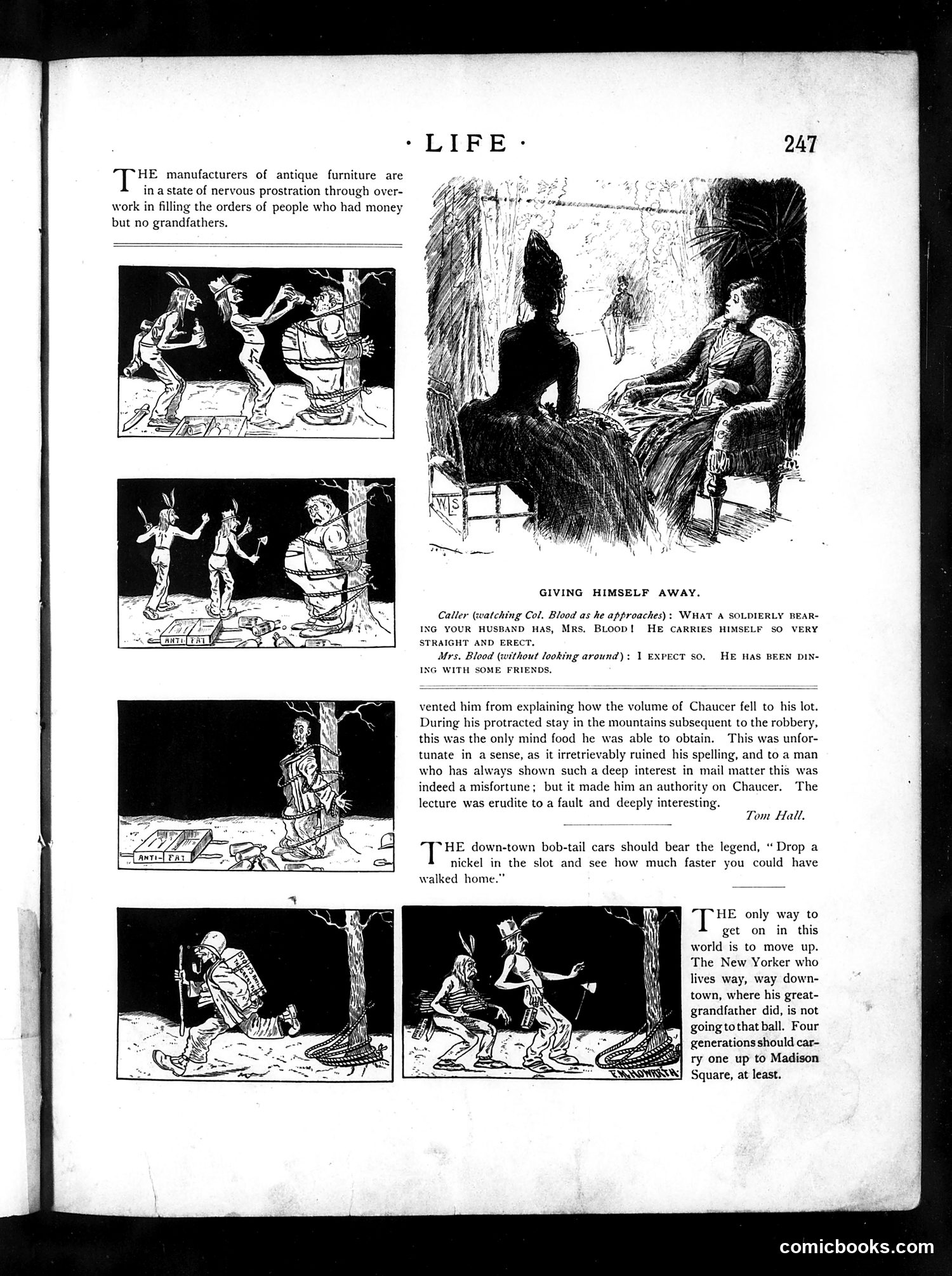
This page contains several satirical jokes about nouveau riche Americans and social climbing in the early 20th century. The opening text mocks wealthy people with "money but no grandfathers"—newly rich individuals lacking aristocratic ancestry—who frantically commission fake antique furniture to appear established. "Giving Himself Away" jokes about Colonel Blood's overly rigid posture, which his wife attributes to dining with friends (implying he's drunk and stiffening himself to hide it). The humor lies in an outsider complimenting what is actually an embarrassing affectation. Additional quips mock slow streetcars and satirize New York social geography: downtown residency (where immigrants and working-class people lived) versus uptown prestige. The final item suggests that mere generational residence in fashionable Madison Square area automatically confers social status—a jab at how wealth and geography define social acceptance rather than merit or character.
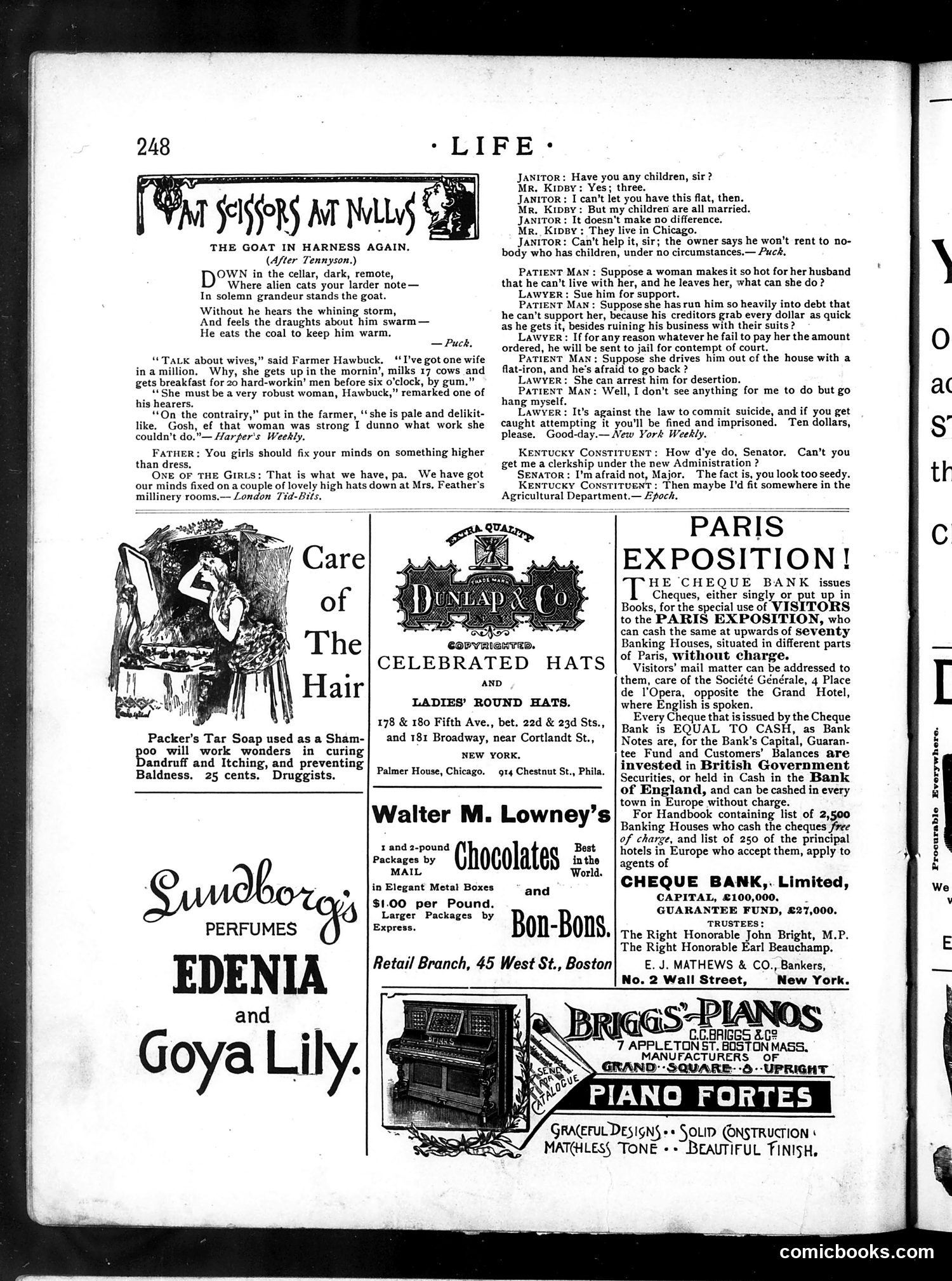
This page contains several satirical humor pieces typical of late 19th-century Life magazine: **Main Cartoons/Jokes:** 1. **"The Goat in Harness Again"** — A poem about a goat eating coal in a cellar, appears to be political satire (the reference to Tennyson suggests literary mockery), though the specific target is unclear. 2. **Multiple short comedic dialogues** addressing contemporary social issues: - A farmer's wife who works exhaustingly despite being delicate - Girls obsessed with fashionable hats rather than substance - A tenant dispute where landlords refuse to rent to anyone with children (regardless of where they live) - **Most notably**: A darkly satirical exchange about matrimonial law, where a husband faces impossible legal constraints — sued for support if he leaves, jailed for non-payment if broke, arrested for desertion if forced out, and even suicide is illegal. The lawyer profits regardless. - A Kentucky politician's constituent seeking patronage but appearing too disreputable **Overall context**: The page satirizes legal absurdities, gender relations, class pretension, and political nepotism of the Gilded Age era. The matrimonial law exchange is particularly bitter social commentary.
This is primarily an **advertising page** with minimal editorial content. The top section features an accident insurance advertisement from the United States Mutual Accident Association, presenting the sobering statistic that "one man out of every seven meets with disabling accident each year" — an appeal to readers' anxieties about workplace and everyday injuries, common concerns in the industrial era. Below are various advertisements for luxury goods and services: champagne, fine china, men's garters, portable houses, and beer. There is **no political cartoon or satire visible** on this page. Instead, it represents a snapshot of late 19th-century consumer culture and commerce, reflecting both the vulnerabilities of industrial life and the aspirational products marketed to address them.
This is primarily a **commercial advertising page** with no political cartoons or satire. It features Victorian-era business advertisements, circa 1890s, including: **Major advertisers:** - **Red Fern**: Ladies' tailor on Fifth Avenue/Broadway, New York, offering steamer wear and traveling gowns - **Darlington, Runk & Co.**: Philadelphia umbrella manufacturer claiming superiority over American competitors - **Kimball Bros.**: Boston carriage builders advertising a "Derby Wagon" - **John & James Dobson**: Carpet manufacturers offering a sale (velvet, tapestry, ingrain carpets) - **Feeley & Dollinger**: Ladies' tailoring establishment at West 19th Street - **Cherry Blossom**: Perfume/toilet powder with a legal notice about trademark protection **Bottom tagline**: "Moral: Insure in the Travelers" (insurance advertisement) The page reflects **Gilded Age consumer culture**—luxury goods targeting wealthy urban customers. No satire or political commentary is evident; this appears to be standard Life magazine advertising content from the period.
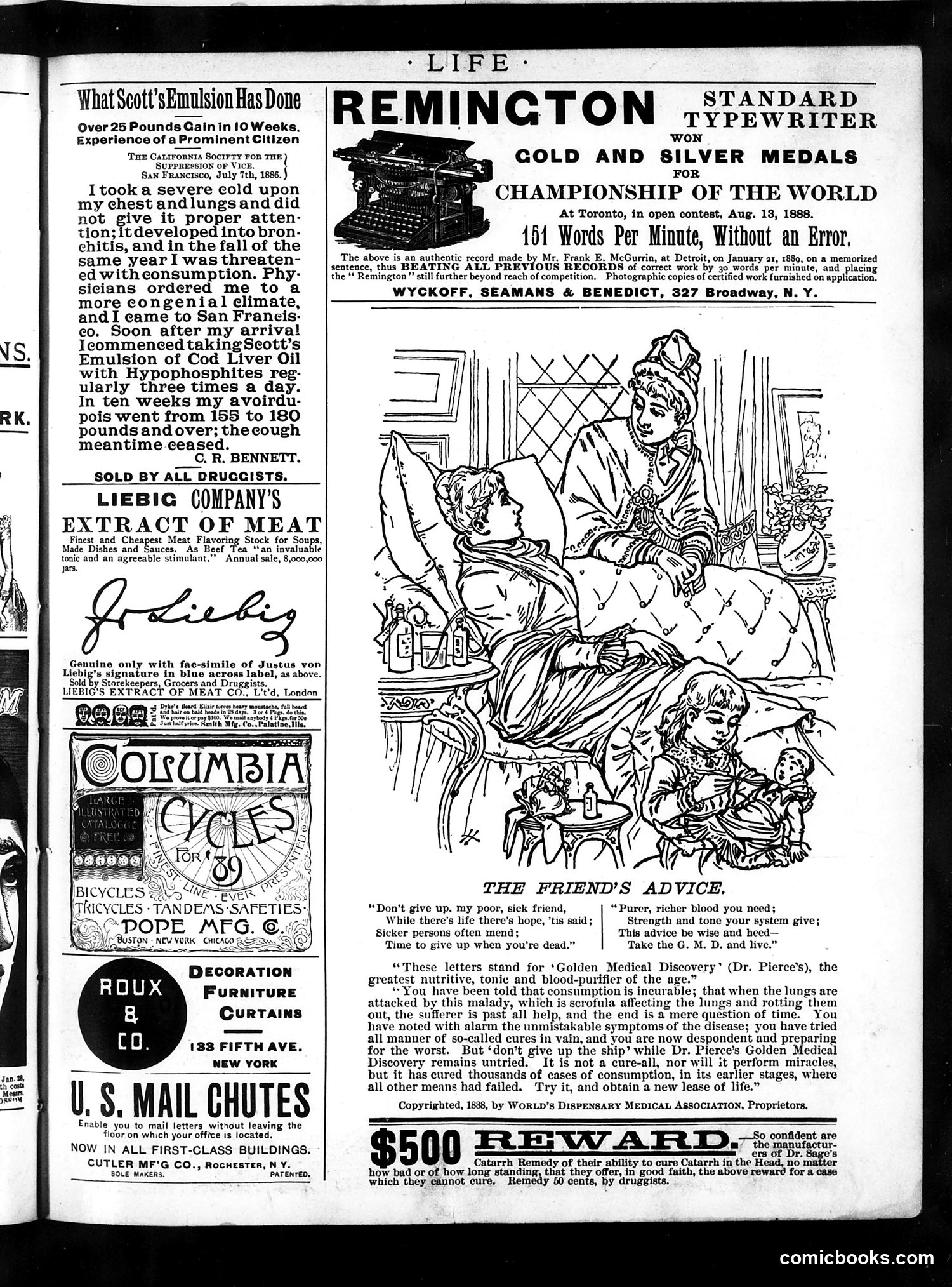
This page is primarily **advertisements**, not political satire. The layout contains multiple patent medicine and product ads typical of late-1880s magazines. The main illustrated content is "The Friend's Advice," a sentimental sketch showing someone counseling a sick patient. The dialogue promotes Dr. Pierce's "Golden Medical Discovery," a patent medicine marketed as a tuberculosis/consumption cure. The text explicitly claims it has "cured thousands of cases of consumption, in its earlier stages." Other ads include Scott's Emulsion (cod liver oil tonic), Liebig's Extract of Meat, and a Remington typewriter boasting a speed record. **Context for modern readers:** This reflects an era before FDA regulation (1906), when unproven medicines with grandiose claims saturated media. "Consumption" (tuberculosis) was genuinely deadly and incurable then, making these false-hope products particularly predatory. The advertising tone—testimonials, medical-sounding names, pseudo-scientific language—became the template regulators later sought to control.
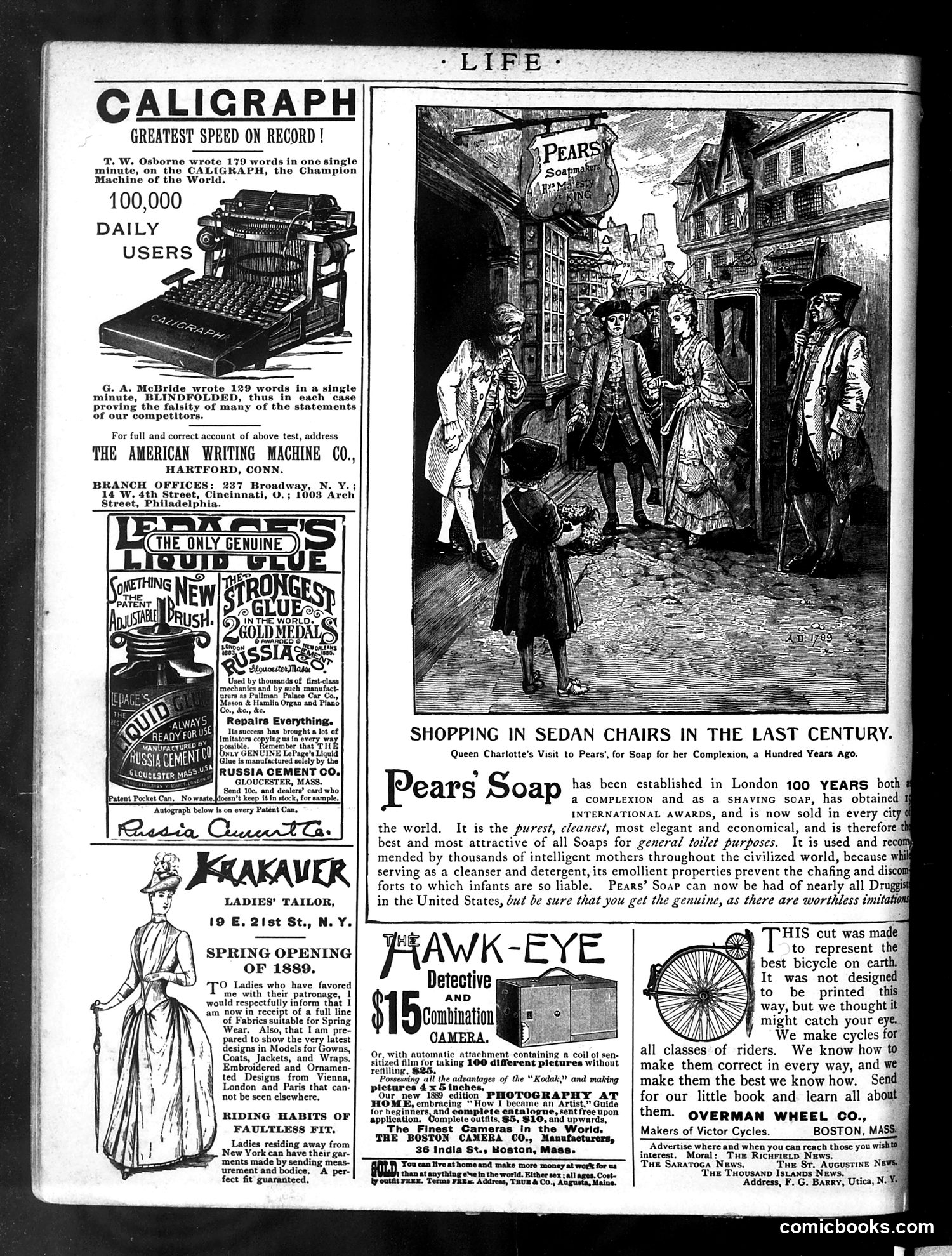
This is primarily an **advertising page** from Life magazine (circa 1889, based on the "Spring Opening of 1889" reference). The main content is commercial rather than satirical. The central illustration, "Shopping in Sedan Chairs in the Last Century," depicts a **humorous historical scene**: Queen Charlotte visiting a soap shop a hundred years prior, with figures in 18th-century dress transported in sedan chairs. This serves as **nostalgic branding** for Pears' Soap, which claims 100 years of establishment—suggesting timeless quality and elegance. The surrounding advertisements showcase period products: the **Caligraph typewriter** (competing on speed records), **liquid glue**, a **ladies' tailor**, **Russia Cement**, the **Hawk-Eye camera** (emphasizing "finest cameras in the world"), and **Victor bicycles**. Each ad employs competitive claims typical of the era: "greatest speed," "finest," "genuine" (warning against counterfeits). The page reflects 1880s consumer culture emphasizing technological progress and quality assurance, with minimal satire—it's primarily a commercial vehicle.
I cannot reliably interpret this page. The image is predominantly black with very poor contrast and visibility—the main content area is nearly illegible. While there is a "LIFE" masthead visible at the bottom and some fragmentary text along the left margin, I cannot discern any clear cartoon figures, caricatures, or illustrations that would allow me to identify the satirical content, political references, or subjects being lampooned. The OCR text provided is also too fragmentary to establish context. To properly explain this page's meaning to a modern reader, I would need a clearer image where the artwork and text are actually visible.
This page is largely illegible in the image provided. The main body of the page appears almost entirely black or severely damaged, making it impossible to discern cartoon illustrations, caricatures, or visual satirical content with confidence. The right margin shows fragmentary text snippets mentioning "Union," "Suggested," and references to "36 bi[llions]" and "York," but without legible context or visible corresponding imagery, I cannot reliably identify the figures, political references, or satirical points. The footer indicates this is from **Life, April 25, 1885**, but the page's condition prevents accurate historical analysis. A clearer image would be needed for proper interpretation.
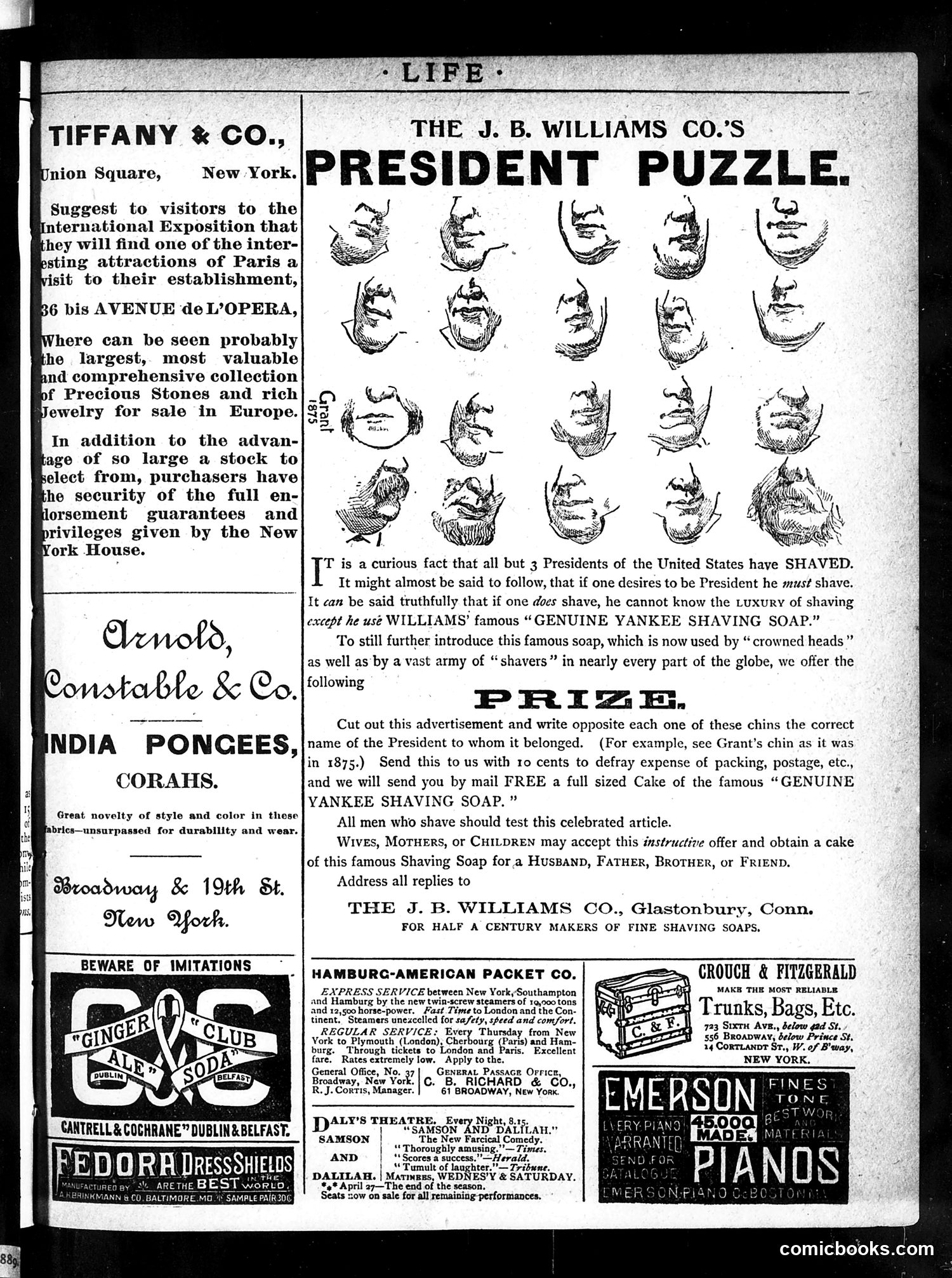
This page is primarily a **commercial advertisement** for J. B. Williams Company's "Genuine Yankee Shaving Soap," disguised as a puzzle game. The centerpiece shows **20 sketched chins/lower faces** in various styles of beard and shave. Readers are invited to identify which U.S. President each chin belonged to, cut out the ad, mail it with 10 cents, and receive a free cake of shaving soap. The advertisement's pitch exploits **patriotic vanity**: it claims that all but three U.S. Presidents shaved, implying that shaving is essentially presidential—therefore manly and desirable. The puzzle frames product promotion as an instructive, patriotic game suitable for "wives, mothers, or children" to send to husbands and fathers as gifts. The page also includes unrelated advertisements for Tiffany & Co. jewelry, ship lines, and theater performances, typical of *Life* magazine's advertising model during this era (appears to be 1870s based on the Grant reference).
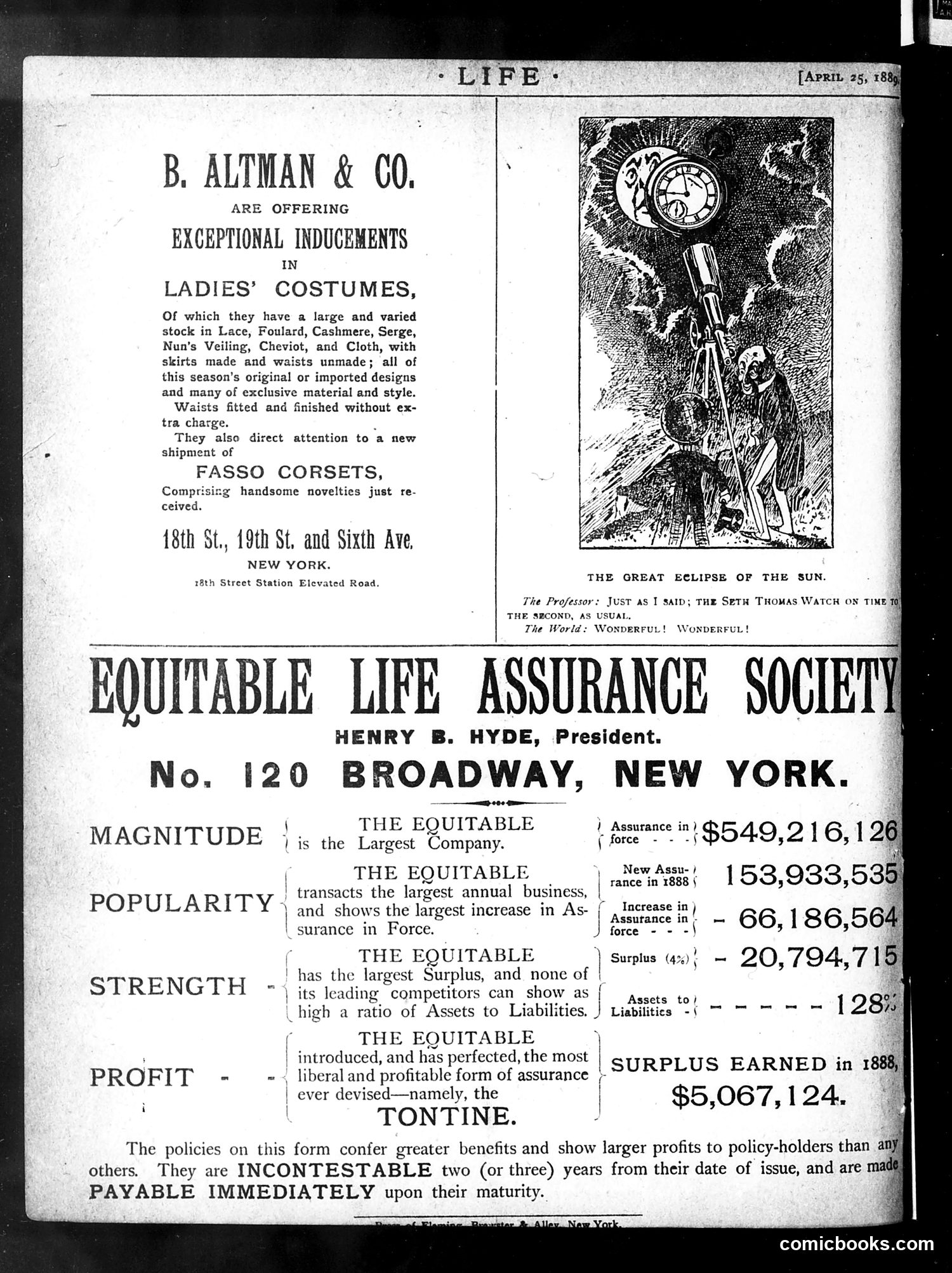
This page is primarily **advertising**, not satirical content. The dominant feature is a large advertisement for the Equitable Life Assurance Society, with smaller ads for B. Altman & Co. (ladies' clothing) above it. The only cartoon is a small illustration titled "The Great Eclipse of the Sun," showing a professor with a telescope and pocket watch observing a solar eclipse. The caption jokes that the professor's Seth Thomas watch kept perfect time "to the second, as usual," with an onlooker marveling at this coincidence. This is gentle humor about Victorian-era precision timekeeping and scientific observation—not political satire. The Equitable Life ad emphasizes the company's size, financial strength, and profitability using comparative statistics. The "Tontine" policy mentioned was a specific insurance product popular in this era.
The image quality is too poor to read the cartoon content clearly or identify specific figures and captions. While the OCR text mentions "on sale for all remaining performances," suggesting this may be theater or entertainment-related advertising or commentary, I cannot reliably make out the visual details of any cartoon(s), caricatures, or illustrations on the page. To properly explain what political or social satire is depicted—including identifying which public figures might be caricatured and what contemporary events are referenced—I would need a clearer image where the artwork and text are legible. If you have a higher-resolution version of this page, I'd be happy to provide a detailed historical analysis.