
Life, 1889-04-25 · page 6 of 25
Life — April 25, 1889 — page 6: what you’re looking at
What you’re looking at
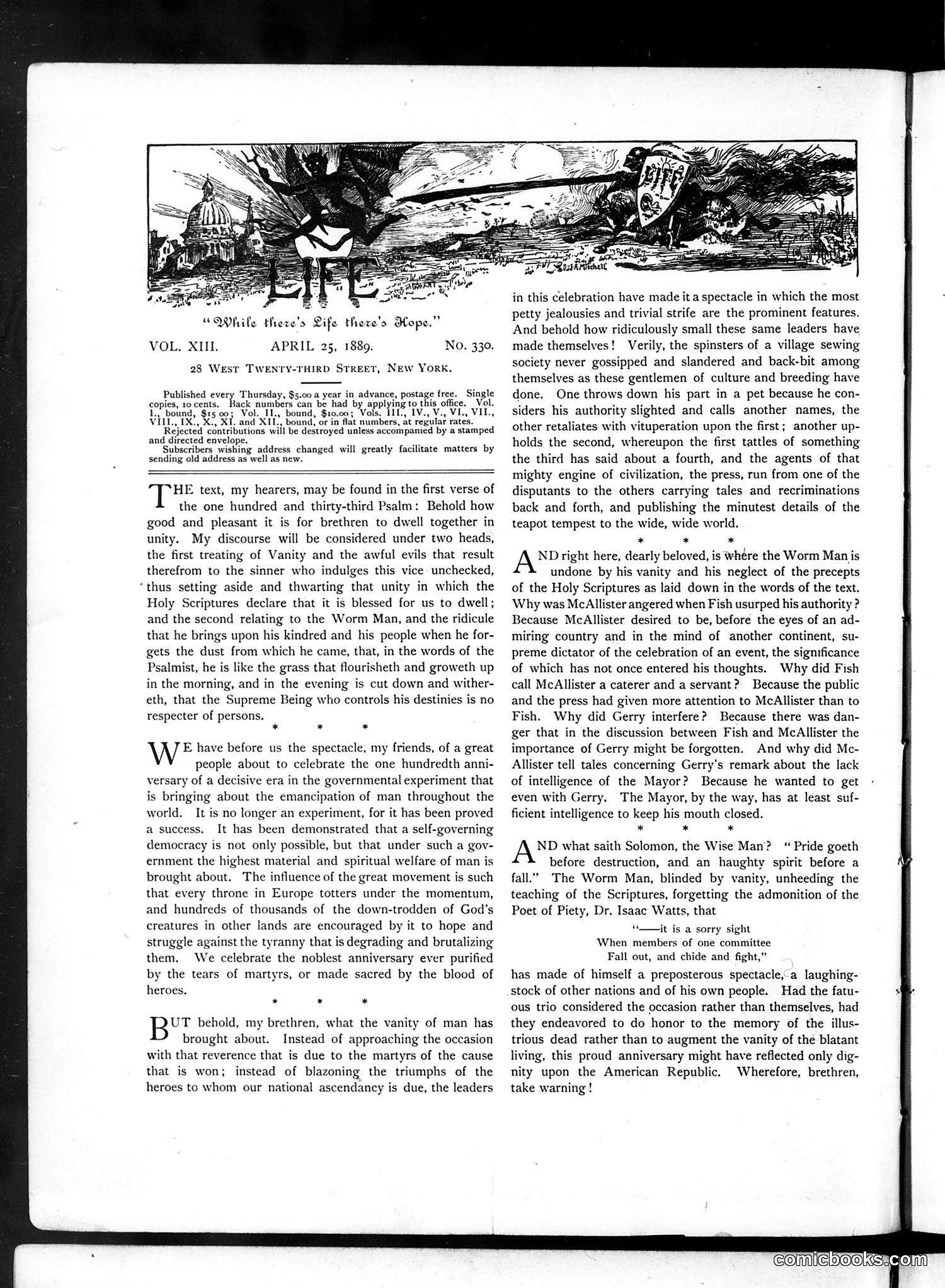
The masthead illustration depicts **Death** (a skeletal figure) surveying a cityscape, introducing a satirical sermon about American vanity and social discord. The article criticizes a recent public celebration—apparently involving figures named **McAllister, Fish, and Gerry**—for devolving into petty squabbling and jealousy rather than dignified commemoration. The author mocks how these society leaders and the press obsessed over trivial disputes about authority and recognition, losing sight of the event's noble purpose. The piece uses biblical references (Psalm 131, Solomon) to argue that American democratic leaders have become vain and foolish, prioritizing personal vanity over the nation's dignity. The satire suggests that instead of honoring important historical causes, high society made the occasion ridiculous through infighting.
📄 Transcribed text from this page (OCR, searchable)
Machine-transcribed from the original scan — historical spelling and the odd misread are preserved.
“While there's Life there's Hope.” VOL, XIII. APRIL 25, 1889. 28 West TWENTY-THIRD STREET, New York, No. 330. Published every Thursday, $5.00 a year in advance, postage free. Single copies, 1o cents, Hack numbers can be had by applying to this office. Vol. bound, $15.00; Vol. II., bound, $10.00; Vols. III. IV., V., VI. VIL, VilL., IX! X., XT. and X11, bound, or in flat numbers, at regular rates. Rejected contributions will be destroyed unless accompanied by a stamped and directed envelope. Subscribers wishing address changed will greatly facilitate matters by sending old address as well as new. HE text, my hearers, may be found in the first verse of the one hundred and thirty-third Psalm: Behold how good and pleasant it is for brethren to dwell together in unity. My discourse will be considered under two heads, the first treating of Vanity and the awful evils that result therefrom to the sinner who indulges this vice unchecked, “thus setting aside and thwarting that unity in which the Holy Scriptures declare that it is blessed for us to dwell; and the second relating to the Worm Man, and the ridicule that he brings upon his kindred and his people when he for- gets the dust from which he came, that, in the words of the Psalmist, he is like the grass that flourisheth and groweth up in the morning, and in the evening is cut down and wither- eth, that the Supreme Being who controls his destinies is no respecter of persons. * * * E have before us the spectacle, my friends, of a great people about to celebrate the one hundredth anni- versary of a decisive era in the governmental experiment that is bringing about the emancipation of man throughout the world. It is no longer an experiment, for it has been proved a success. It has been demonstrated that a self-governing democracy is not only possible, but that under such a gov- ernment the highest material and spiritual welfare of man is brought about. The influence of the great movement is such that every throne in Europe totters under the momentum, and hundreds of thousands of the down-trodden of God's creatures in other lands are encouraged by it to hope and struggle against the tyranny that is degrading and brutalizing them. We celebrate the noblest anniversary ever purified by the tears of martyrs, or made sacred by the blood of heroes. * * * Bt behold, my brethren, what the vanity of man has brought about. Instead of approaching the occasion with that reverence that is due to the martyrs of the cause that is won; instead of blazoning the triumphs of the heroes to whom our national ascendancy is due, the leaders in this celebration have made it a spectacle in which the most petty jealousies and trivial strife are the prominent features. And behold how ridiculously small these same leaders have made themselves! Verily, the spinsters of a village sewing society never gossipped and slandered and back-bit among themselves as these gentlemen of culture and breeding have done. One throws down his part in a pet because he con- siders his authority slighted and calls another names, the other retaliates with vituperation upon the first; another up- holds the second, whereupon the first tattles of something the third has said about a fourth, and the agents of that mighty engine of civilization, the press, run from one of the disputants to the others carrying tales and recriminations back and forth, and publishing the minutest details of the teapot tempest to the wide, wide world. * * * Aw? right here, dearly beloved, is whére the Worm Man is undone by his vanity and his neglect of the precepts of the Holy Scriptures as laid down in the words of the text. Why was McAllister angered when Fish usurped his authority ? Because McAllister desired to be, before the eyes of an ad- miring country and in the mind of another continent, su- preme dictator of the celebration of an event, the significance of which has not once entered his thoughts. Why did Fish call McAllister a caterer and a servant? Because the public and the press had given more attention to McAllister than to Fish. Why did Gerry interfere? Because there was dan- ger that in the discussion between Fish and McAllister the importance of Gerry might be forgotten. And why did Mc- Allister tell tales concerning Gerry's remark about the lack of intelligence of the Mayor? Because he wanted to get even with Gerry. The Mayor, by the way, has at least suf- ficient intelligence to keep his mouth closed. * * * ND what saith Solomon, the Wise Man? “ Pride goeth before destruction, and an haughty spirit before a fall.” The Worm Man, blinded by vanity, unheeding the teaching of the Scriptures, forgetting the admonition of the Poet of Piety, Dr. Isaac Watts, that “——it is a sorry sight When members of one committee Fall out, and chide and fight,” has made of himself a preposterous spectacle,a laughing- stock of other nations and of his own people. Had the fatu- ous trio considered the occasion rather than themselves, had they endeavored to do honor to the memory of the illus- trious dead rather than to augment the vanity of the blatant living, this proud anniversary might have reflected only dig- nity upon the American Republic. Wherefore, brethren, take warning !