
Life, 1889-04-25 · page 10 of 25
Life — April 25, 1889 — page 10: what you’re looking at
What you’re looking at
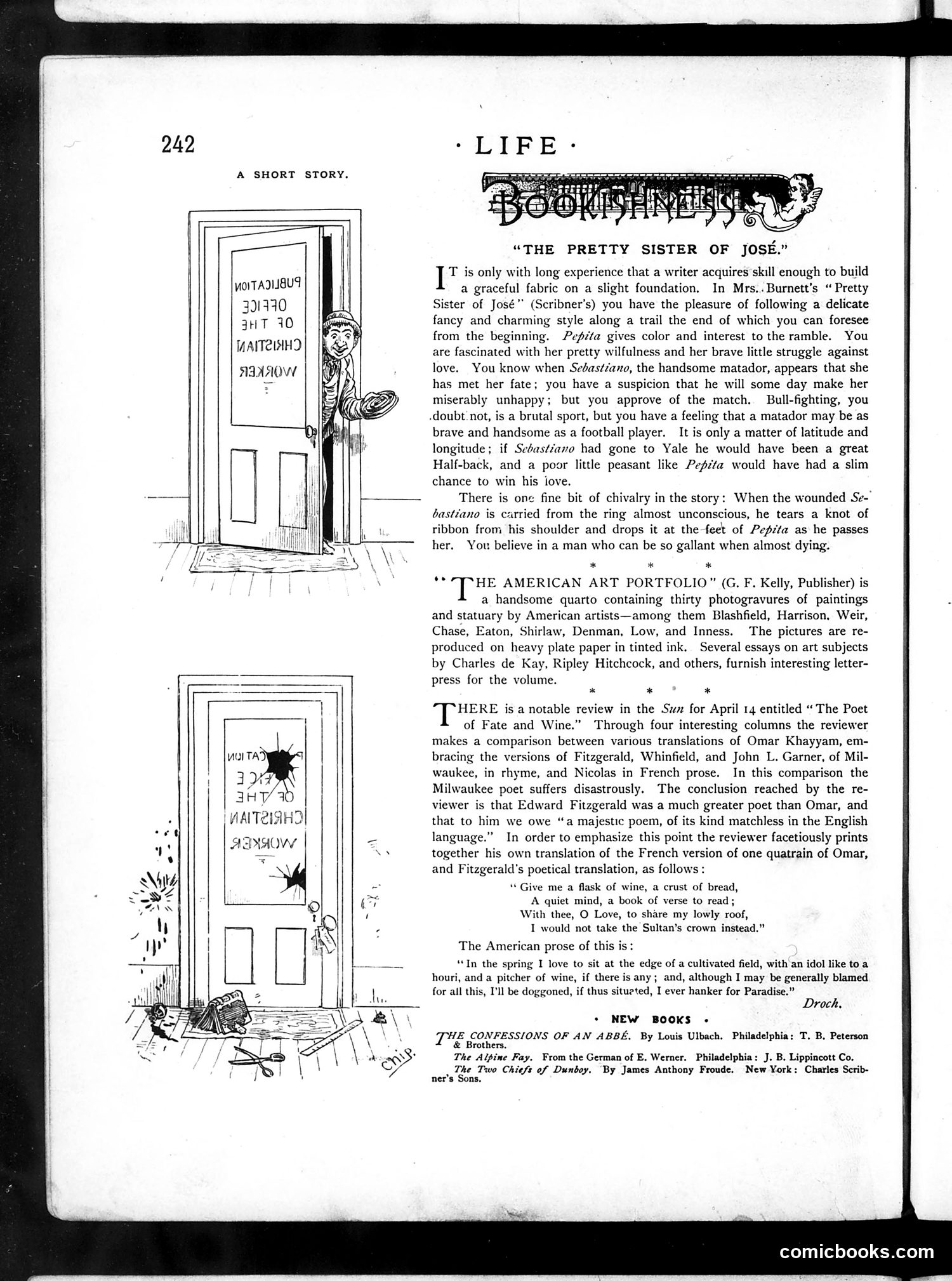
This page reviews Mrs. Burnett's short story "The Pretty Sister of José," praising its "graceful fabric" and "delicate fancy." The reviewer notes the story follows Pepita's romantic struggle: she loves the brave matador Sebastiano, but society expects her to marry a wealthier nobleman. The reviewer approves of the match despite Sebastiano's lower status, and praises a chivalrous moment where the wounded matador drops a ribbon at Pepita's feet. The page also reviews "The American Art Portfolio" and discusses a Sun newspaper article comparing translations of Omar Khayyam's poetry. No political satire appears here—this is straightforward literary criticism from an early-1900s American magazine.
📄 Transcribed text from this page (OCR, searchable)
Machine-transcribed from the original scan — historical spelling and the odd misread are preserved.
A SHORT STORY. —] | “THE PRETTY SISTER OF JOSE.” T is only with long experience that a writer acquires skill enough to build MOITAIIGUI a graceful fabric on a slight foundation. In Mrs..Burnett’s “ Pretty 391940 Sister of José" (Scribner's) you have the pleasure of following a delicate 3HT 10 f fancy and charming style along a trail the end of which you can foresee from the beginning. /Pefzta gives color and interest to the ramble. You WMAlTeltHD are fascinated with her pretty wilfulness and her brave little struggle against AIAAOW ) love. You know when Sedastéano, the handsome matador, appears that she $ has met her fate; you have a suspicion that he will some day make her . miserably unhappy; but you approve of the match. Bull-fighting, you -doubt not, is a brutal sport, but you have a feeling that a matador may be as brave and handsome as a football player. It is only a matter of latitude and longitude; if Sedastéavo had gone to Yale he would have been a great Half-back, and a poor little peasant like Pefzta would have had a slim chance to win his iove. There is ong fine bit of chivalry in the story: When the wounded Se-" bastiano is carried from the ring almost unconscious, he tears a knot of ribbon from his shoulder and drops it at the-feet of Pepzta as he passes her. You believe in a man who can be so gallant when almost dying. * * * oe HE AMERICAN ART PORTFOLIO” (G. F. Kelly, Publisher) is a handsome quarto containing thirty photogravures of paintings and statuary by American artists—among them Blashfield, Harrison, Weir, Chase, Eaton, Shirlaw, Denman, Low, and Inness. The pictures are re- produced on heavy plate paper in tinted ink. Several essays on art subjects by Charles de Kay, Ripley Hitchcock, and others, furnish interesting letter- press for the volume. * * * HERE isa notable review in the Sz for April 14 entitled “The Poet of Fate and Wine.” Through four interesting columns the reviewer : makes a comparison between various translations of Omar Khayyam, em- wai TAD bracing the versions of Fitzgerald, Whinfield, and John L. Garner, of Mil- Vy waukee, in rhyme, and Nicolas in French prose. In this comparison the ¢ Milwaukee poet suffers disastrously. The conclusion reached by the re- SHY 4 A ‘ viewer is that Edward Fitzgerald was a much greater poet than Omar, and | MAIT2IAHD| that to him we owe “a majestic poem, of its kind matchless in the English language.” In order to emphasize this point the reviewer facetiously prints together his own translation of the French version of one quatrain of Omar, and Fitzgerald's poetical translation, as follows : “ Give me a flask of wine, a crust of bread, A quiet mind, a book of verse to read ; With thee, O Love, to share my lowly roof, I would not take the Sultan's crown instead.” The American prose of this is: “In the spring I love to sit at the edge of a cultivated field, with an idol like to a houri, and a pitcher of wine, if there is any; and, although I may be generally blamed for all this, I'll be doggoned, if thus situated, I ever hanker for Paradise.” Droch, + NEW Books - THE CONFESSIONS OF AN ABBE. By Louis Ulbach, Philadelphia: T. B. Peterson & Brothers. The Alpine Fay. From the German of E, Werner. Philadelphia: J. B. Lippincott Co. 1 (he Tivo Chiefs of Dunboy. By James Anthony Froude, New York: Charles Serib- ner's Sons, comicbooks.com