
Life, 1889-04-25 · page 8 of 25
Life — April 25, 1889 — page 8: what you’re looking at
What you’re looking at
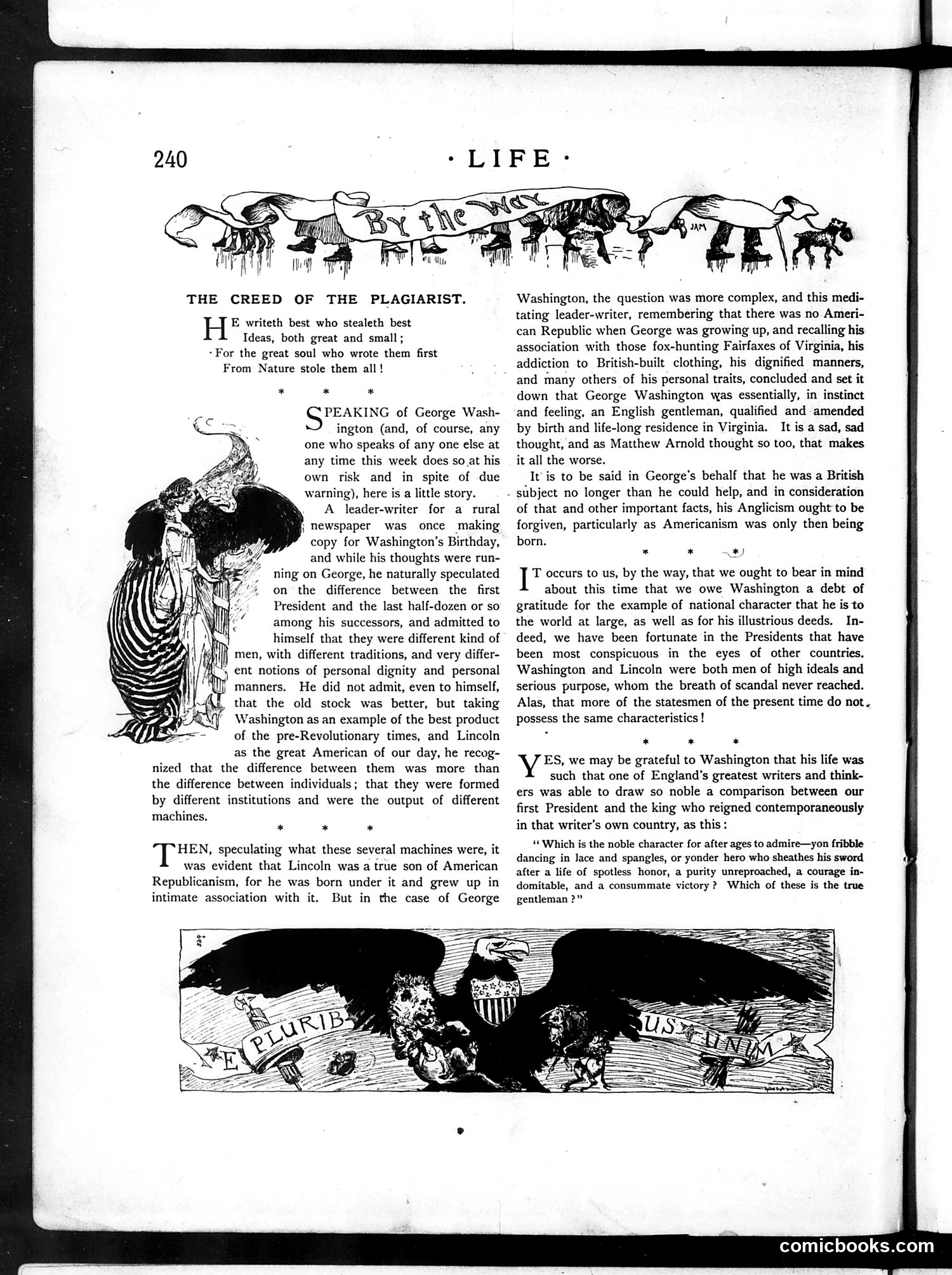
This page satirizes plagiarism in writing, opening with a verse mocking those who "steal best" ideas from nature and predecessors. The main article discusses a rural newspaper writer copying George Washington's Birthday material while speculating on differences between early American presidents. The central caricature (left) depicts a figure in period dress, likely representing the plagiarist journalist. The satire compares Washington and Lincoln as exemplars of American ideals, contrasting them with lesser modern statesmen. The text suggests Washington was essentially "English" by birth and manner, making his American credentials complicated—a pointed jab at those who claim patriotic authority while borrowing from better sources. The eagle emblem (bottom) reinforces American nationalist themes underlying the critique.
📄 Transcribed text from this page (OCR, searchable)
Machine-transcribed from the original scan — historical spelling and the odd misread are preserved.
THE CREED OF THE PLAGIARIST. E writeth best who stealeth best Ideas, both great and small; -For the great soul who wrote them first From Nature stole them all! * * * PEAKING of George Wash- ington (and, of course, any one who speaks of any one else at any time this week does so at his own risk and in spite of due warning), here is a little story. A leader-writer for a rural ; Newspaper was once making copy for Washington's Birthday, and while his thoughts were run- ning on George, he naturally speculated on the difference between the first President and the last half-dozen or so among his successors, and admitted to himself that they were different kind of men, with different traditions, and very differ- ent notions of personal dignity and personal manners. He did not admit, even to himself, that the old stock was better, but taking Washington as an example of the best product of the pre-Revolutionary times, and Lincoln as the great American of our day, he recog- nized that the difference between them was more than the difference between individuals; that they were formed by different institutions and were the output of different machines. * * * HEN, speculating what these several machines were, it was evident that Lincoln was a true son of American Republicanism, for he was born under it and grew up in intimate association with it. But in the case of George Washington, the question was more complex, and this medi- tating leader-writer, remembering that there was no Ameri- can Republic when George was growing up, and recalling his association with those fox-hunting Fairfaxes of Virginia, his addiction to British-built clothing, his dignified manners, and many others of his personal traits, concluded and set it down that George Washington was essentially, in instinct and feeling, an English gentleman, qualified and amended by birth and life-long residence in Virginia. It is a sad, sad thought, and as Matthew Arnold thought so too, that makes it all the worse. It'is to be said in George's behalf that he was a British - subject no longer than he could help, and in consideration of that and other important facts, his Anglicism ought to be forgiven, particularly as Americanism was only then being born. * * wy T occurs to us, by the way, that we ought to bear in mind about this time that we owe Washington a debt of gratitude for the example of national character that he is to the world at large, as well as for his illustrious deeds. In- deed, we have been fortunate in the Presidents that have been most conspicuous in the eyes of other countries. Washington and Lincoln were both men of high ideals and serious purpose, whom the breath of scandal never reached. Alas, that more of the statesmen of the present time do not. possess the same characteristics ! . * * * Yrs we may be grateful to Washington that his life was such that one of England’s greatest writers and think- ers was able to draw so noble a comparison between our first President and the king who reigned contemporaneously in that writer's own country, as this : ““ Which is the noble character for after ages to admire—yon fribble dancing in lace and spangles, or yonder hero who sheathes his sword after a life of spotless honor, a purity unreproached, a courage in- domitable, and a consummate victory? Which of these is the true gentleman ?” comicbooks.com