
A complete issue · 20 pages · 1889
Life — April 4, 1889
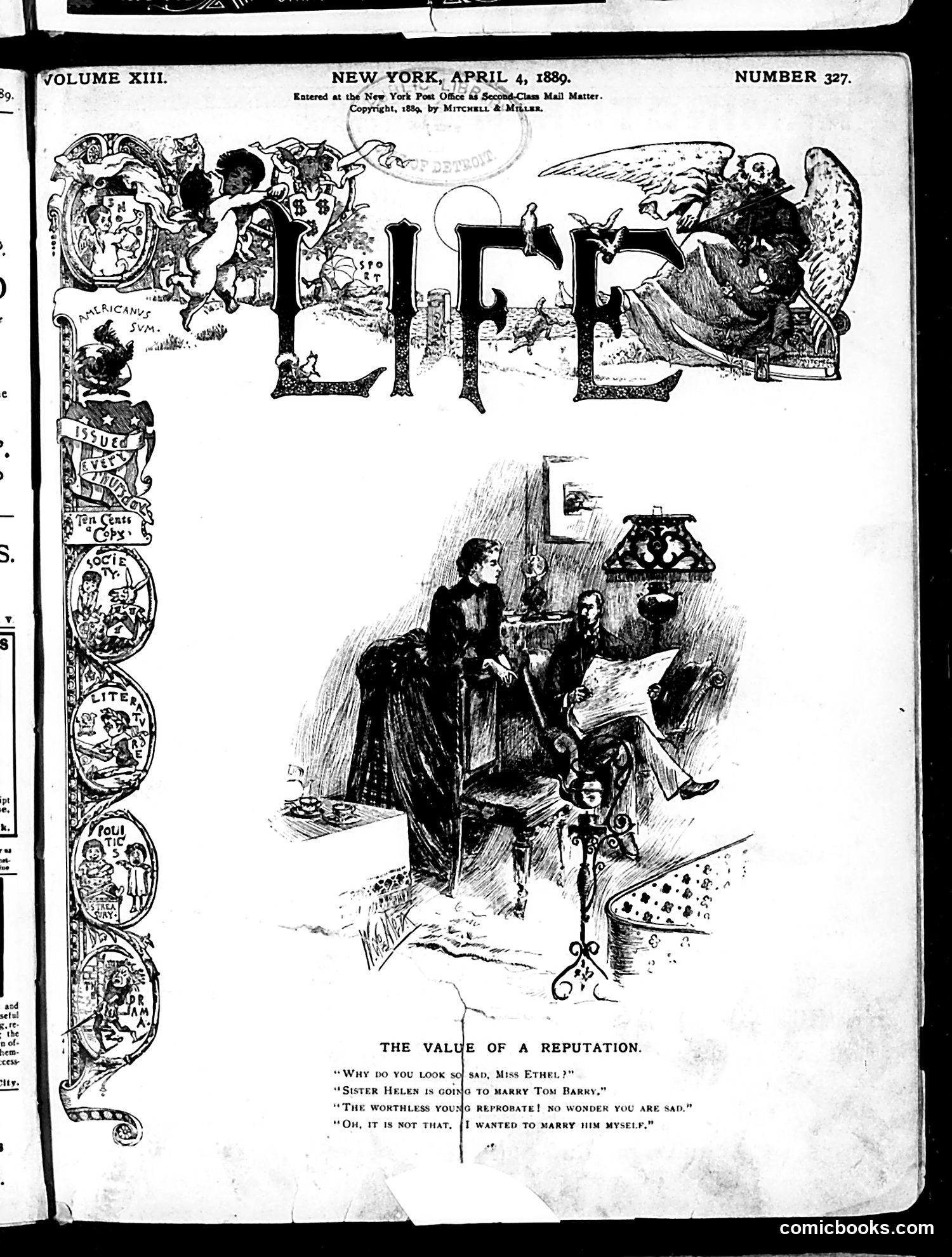
This satirical comic from Life magazine (April 4, 1889) depicts a domestic scene illustrating social reputation concerns of the era. The dialogue reveals the central joke: Miss Ethel appears distressed, prompting inquiry into her sadness. She explains her sister Helen intends to marry Tom Barry, whom Ethel characterizes as "worthless." However, Ethel's real concern isn't moral—she protests "I wanted to marry him myself," suggesting her objection stems from personal disappointment rather than genuine ethical concern about Barry's character. The satire mocks Victorian-era social pretenses, where respectability and reputation were paramount. The cartoon suggests that despite public claims about morality and propriety, individuals' actual motivations were often self-interested rather than principled. The title underscores the irony: reputation matters less than personal desire.
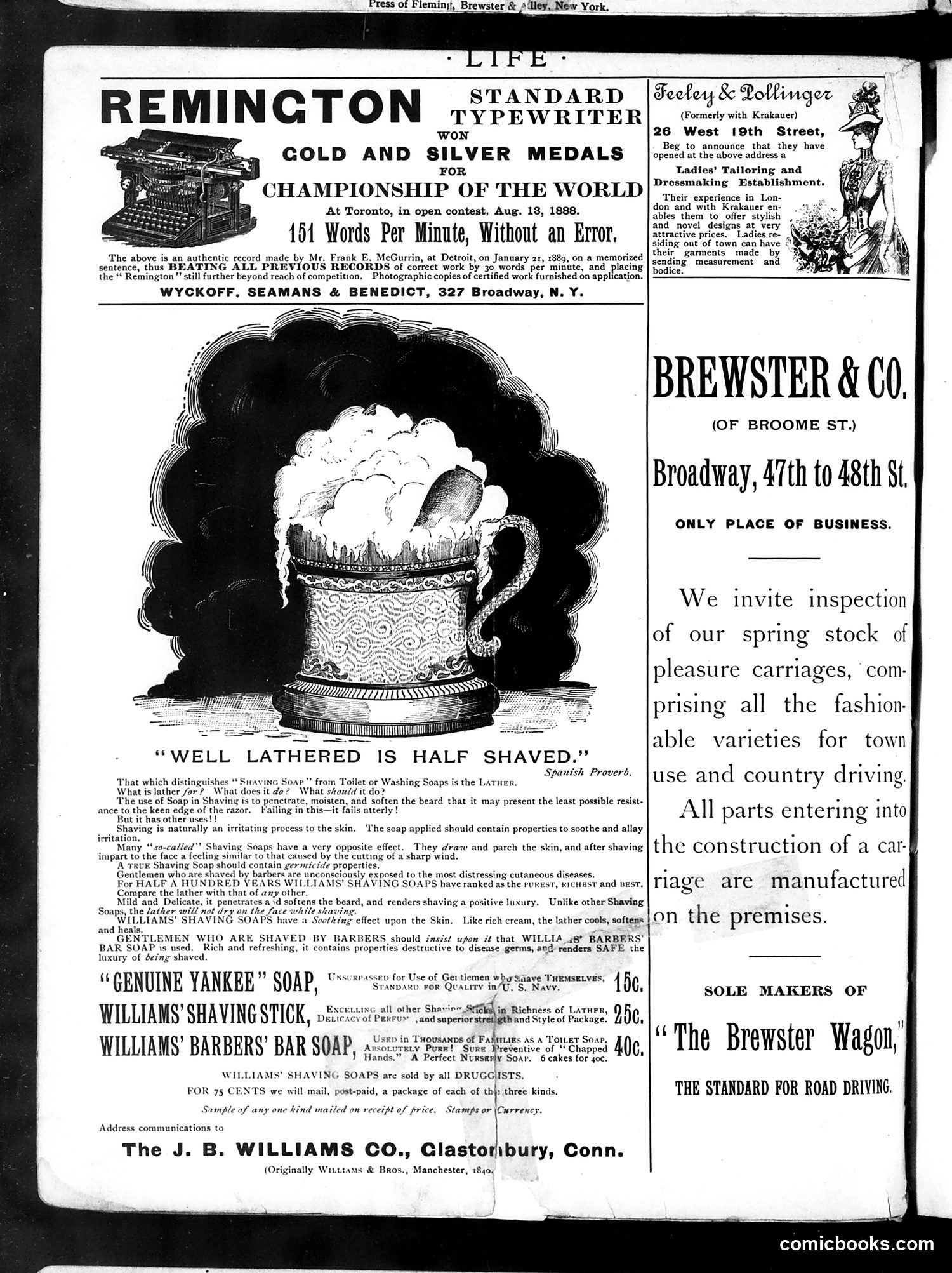
This page is primarily **advertising**, not political satire. The dominant content features: 1. **Remington Typewriter ad** - promoting a typing speed record (161 words per minute, set in Toronto, August 1888) 2. **J.B. Williams Shaving Products ad** - the central illustration shows an elaborate shaving mug with the Spanish proverb "Well Lathered is Half Shaved." The lengthy text promotes three shaving products (soap, stick, barber's bar) and claims they prevent skin diseases and cutaneous problems. 3. **Brewster & Co. carriage advertisement** - promoting pleasure carriages manufactured on their Broadway premises. The page reflects late-19th-century commercial culture, with ads emphasizing product quality, manufacturing credentials, and health/safety benefits—typical Life magazine content from this era.
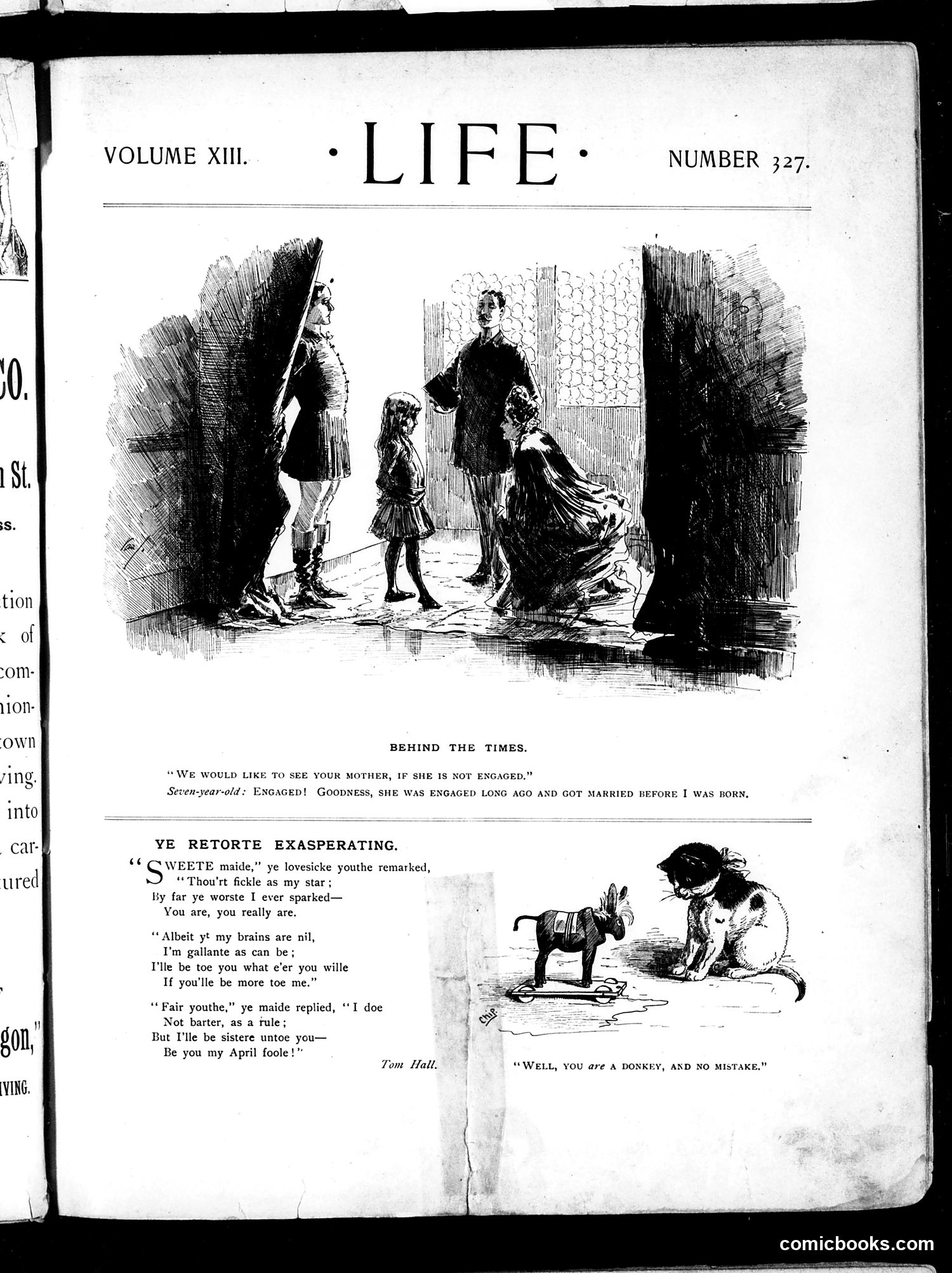
This page contains two distinct satirical pieces: **"Behind the Times"** (top): A domestic scene where a child reports their mother is "engaged," prompting an adult's surprised response. The seven-year-old clarifies the mother was actually engaged "long ago" before the child's birth—satirizing outdated social conventions and the gap between modern expectations and reality. **"Ye Retorte Exasperating"** (bottom): A flirtation poem attributed to Tom Hall, featuring dialogue between a "sweete maide" and a youth. The accompanying illustration shows a woman with a toy donkey, captioned "Well, you ARE a donkey, and no mistake"—a pun-based visual joke mocking failed romantic banter and the foolishness of courtship rhetoric. Both pieces use humor to critique social pretenses of the era.
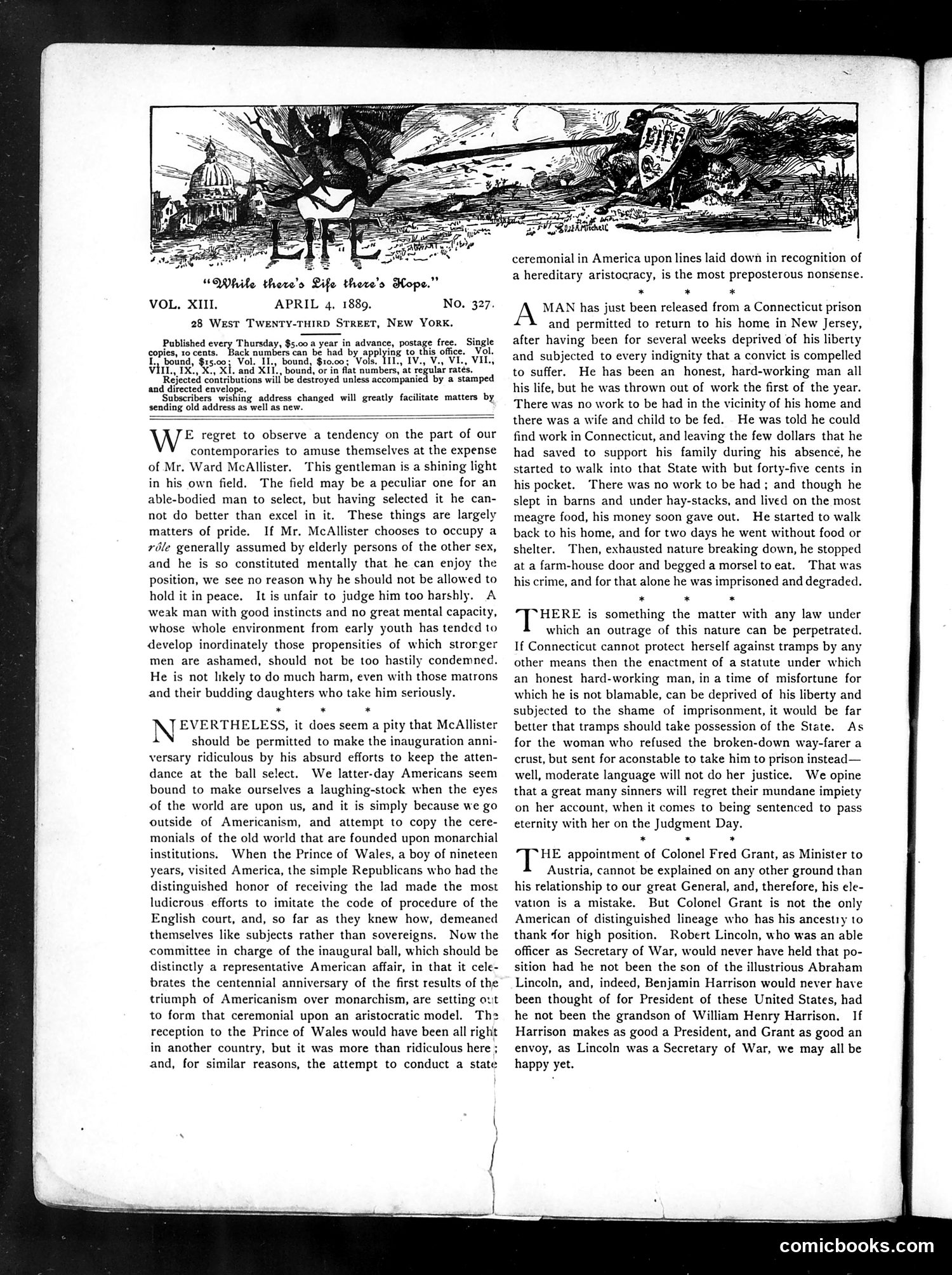
The masthead cartoon depicts a skeletal death figure overlooking a landscape with a domed building (likely the Capitol), with the caption "While there's Life there's Hope." The page's editorial content attacks **William McAllister**, a gentleman whom the editors accuse of using his social position to mock and ridicule others—particularly targeting "Mr. Walt McAllister" for his "absurd efforts" at maintaining aristocratic pretensions in America. The text also criticizes the upcoming inaugural ball ceremonies copying old-world monarchical traditions, arguing such imitation is ridiculous for a Republic. Finally, the editors express skepticism about **Colonel Fred Grant's** appointment as Minister to Austria, suggesting it results from his family connections (son of President Ulysses S. Grant) rather than merit—contrasting it unfavorably with Lincoln's meritocratic appointments.
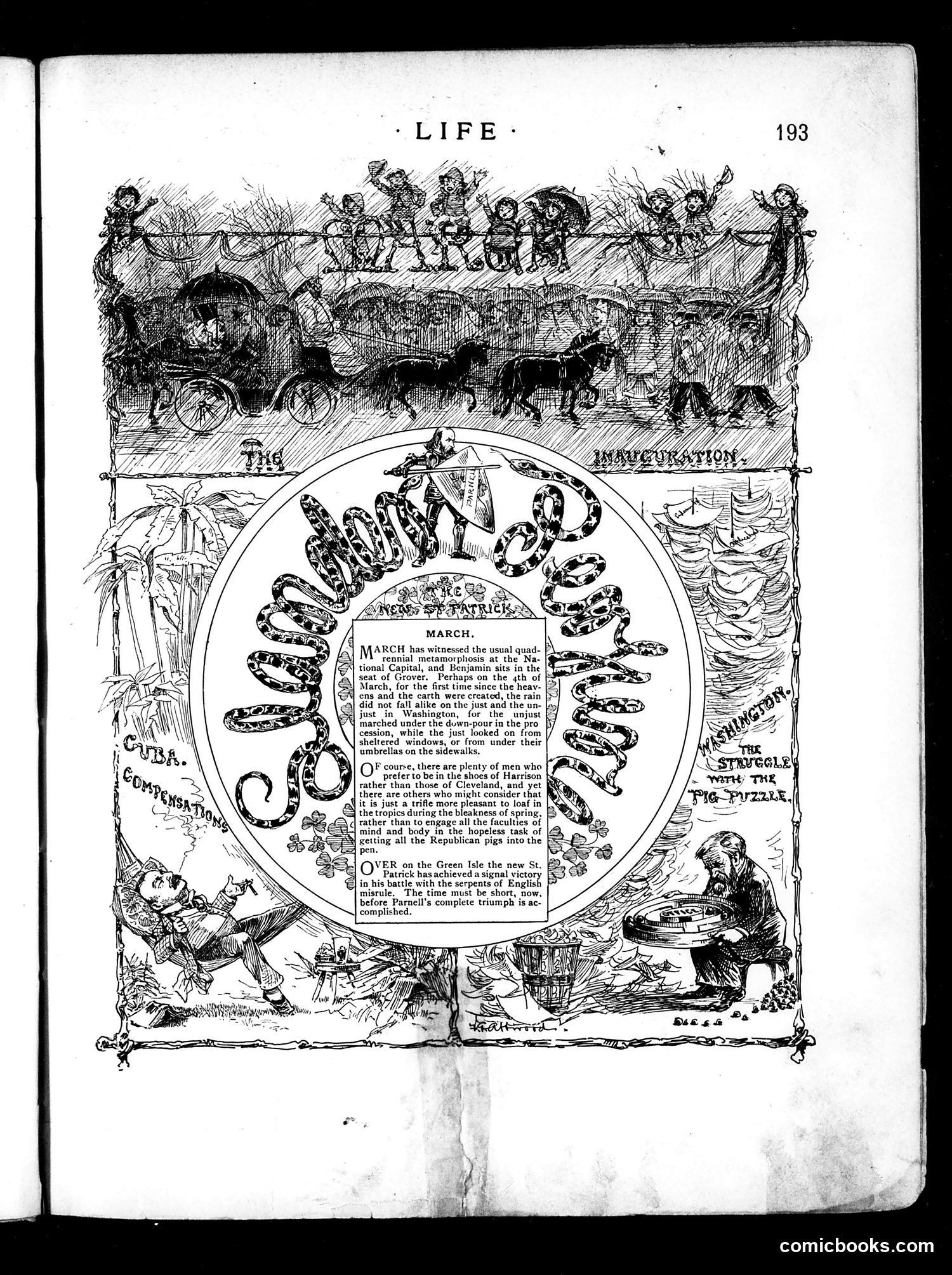
This page satirizes President Grover Cleveland's inauguration (referenced in the text as occurring March 4th). The central circular design features snakes arranged in a spiral pattern, labeled "The Inauguration," clearly using serpents as a visual metaphor for political deception or duplicity. The surrounding decorative panels reference contemporary political issues: "Cuba" and "Cuttensack" appear on the left margin, while "The Struggle" and "The Pig-Puzzle" appear on the right, suggesting multiple controversial policy matters facing the administration. The text mocks Republican resistance to Cleveland's policies, particularly mentioning difficulty with "Republican pigs" and references to Patrick's "signal victory...in his battle with the serpents," likely comparing political struggles to mythological combat. The overall satire presents the new administration as morally serpentine and politically problematic.
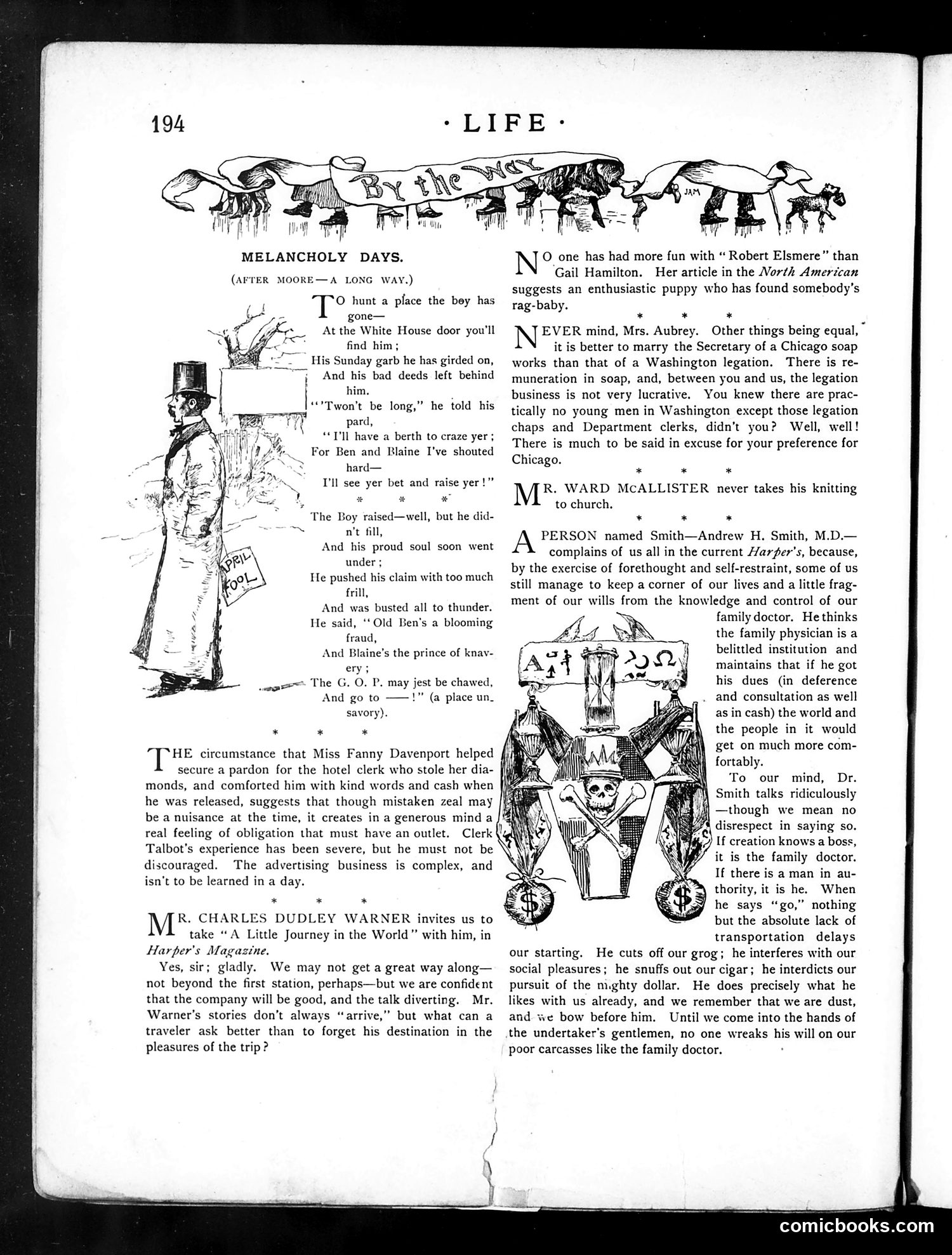
The main cartoon, titled "Melancholy Days (After Moore—A Long Way)," depicts a sad figure in formal dress leaning against a post. The accompanying poem tells of a boy who left home, never to return, suggesting themes of loss and disappointment. This appears to be a literary parody or commentary, possibly referencing Thomas Moore's poetry about melancholy subjects. The right column contains social commentary rather than political satire, mocking specific individuals: "Robert Elmere" (likely a literary character), a Dr. Andrew H. Smith (criticized for excessive medical authority), and comments on Chicago business culture versus Washington legation life. The tone is humorous, contemporary gossip rather than serious political critique.
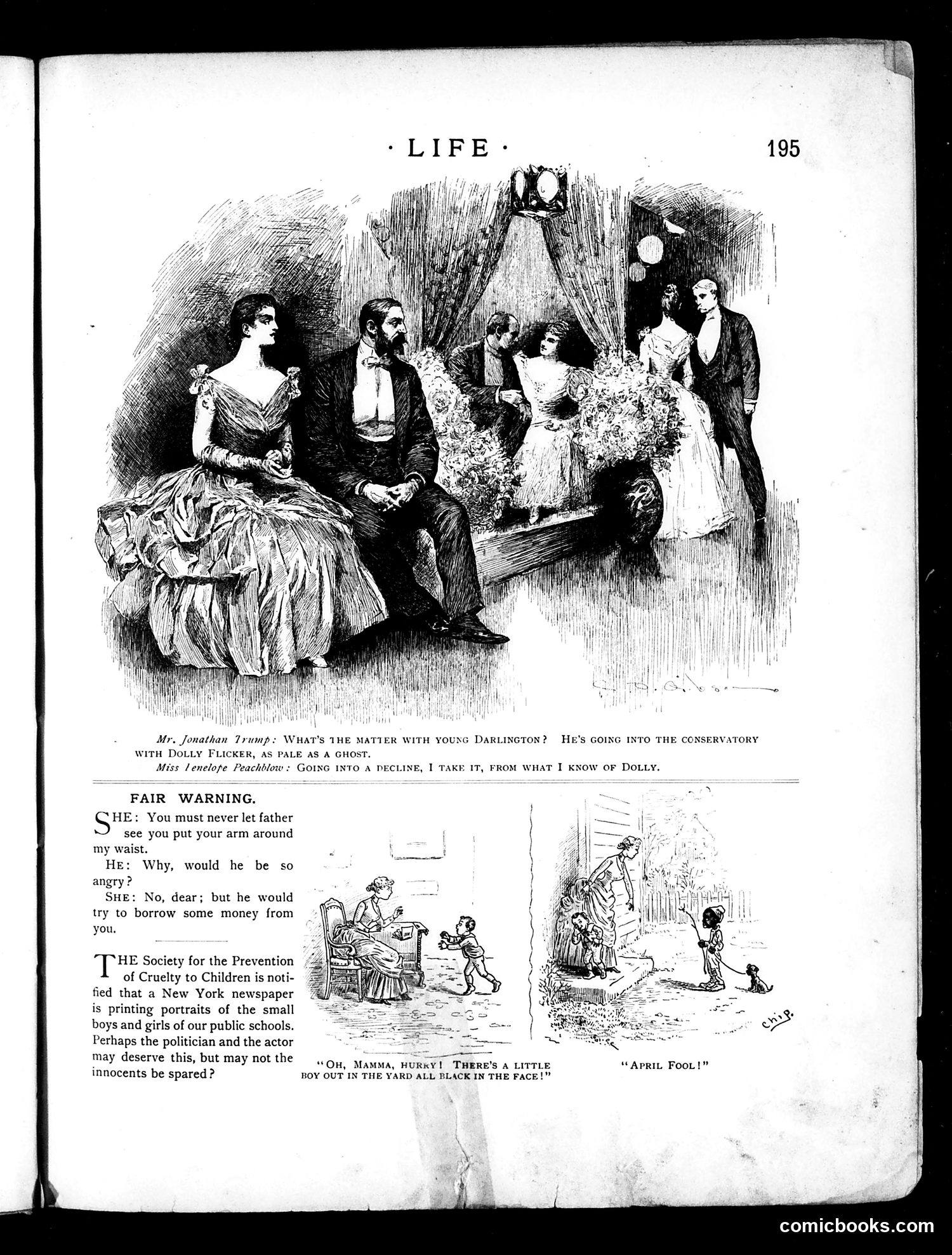
**Top Cartoon:** This depicts a parlor scene where "Mr. Jonathan Trump" comments on young Darlington entering a conservatory with pale Dolly Flicker. Miss Dorothy Peachblow implies Dolly is declining—likely suggesting an improper romantic or sexual situation. The satire mocks gossipy high-society speculation about young people's behavior and reputation. **"Fair Warning" Section:** A dialogue between a young woman and man about her father discovering his arm around her waist. The woman jokes he'd borrow money from the man—satirizing both paternal protectiveness and young men's financial precarity. **Bottom Cartoons:** Two domestic scenes featuring children and caretakers, with captions about messy play ("all black in the face") and an April Fool's prank. These satirize typical childhood mischief and parental exasperation.
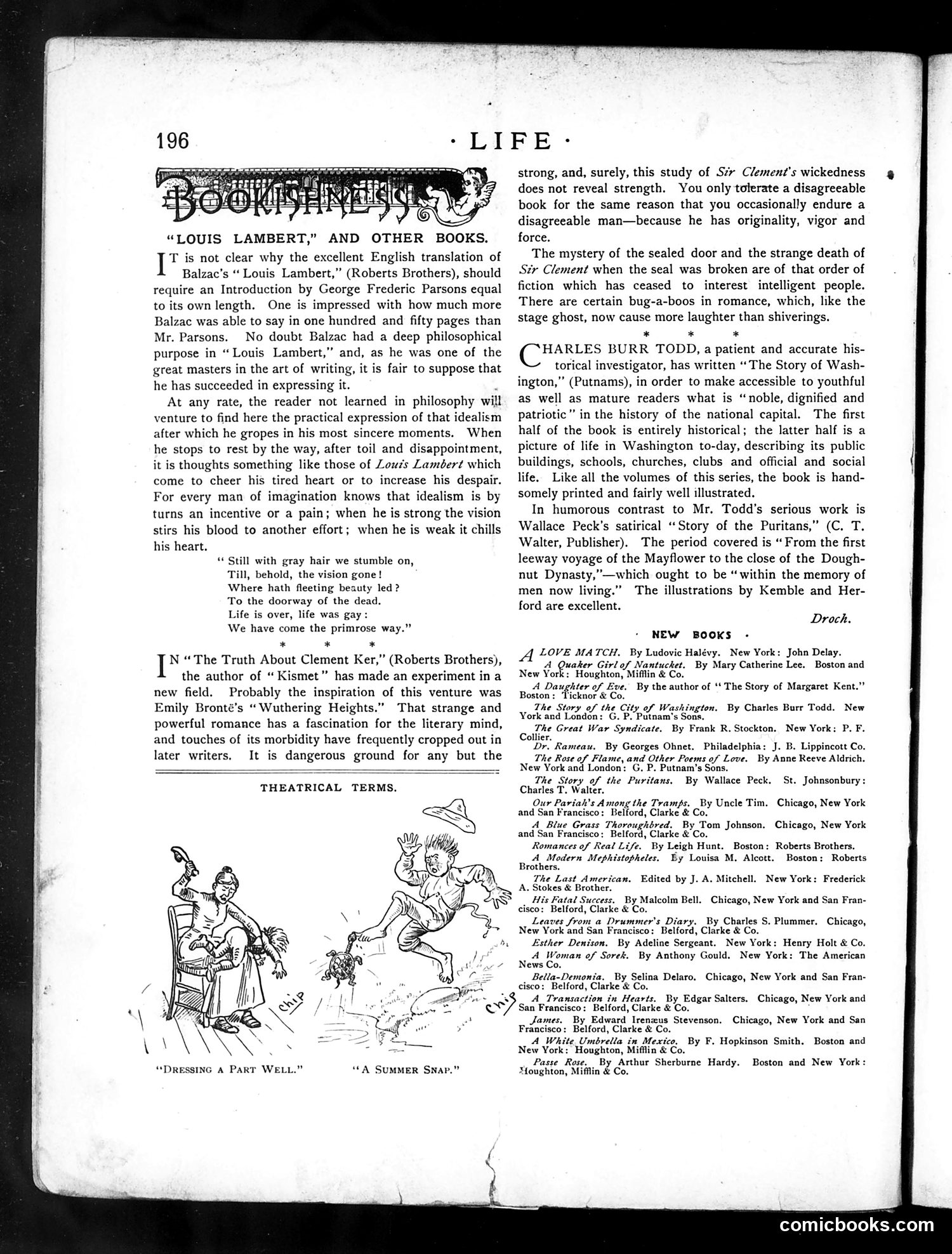
This page contains book reviews and literary criticism rather than political cartoons. The main content discusses "Louis Lambert" by Balzac and works by Charles Burr Todd and Wallace Peck. Two small theatrical illustrations appear at the bottom labeled "Dressing a Part Well" and "A Summer Snap"—these are humorous sketches about theatrical costume and behavior, not political satire. They depict exaggerated character types common to stage comedy of the era. The page functions as a literary section of *Life* magazine, reviewing contemporary books and offering theatrical commentary. The illustrations provide light, generic humor rather than commentary on specific political figures or events. Without additional context about these particular works' cultural significance, the specific satirical points are unclear to modern readers.
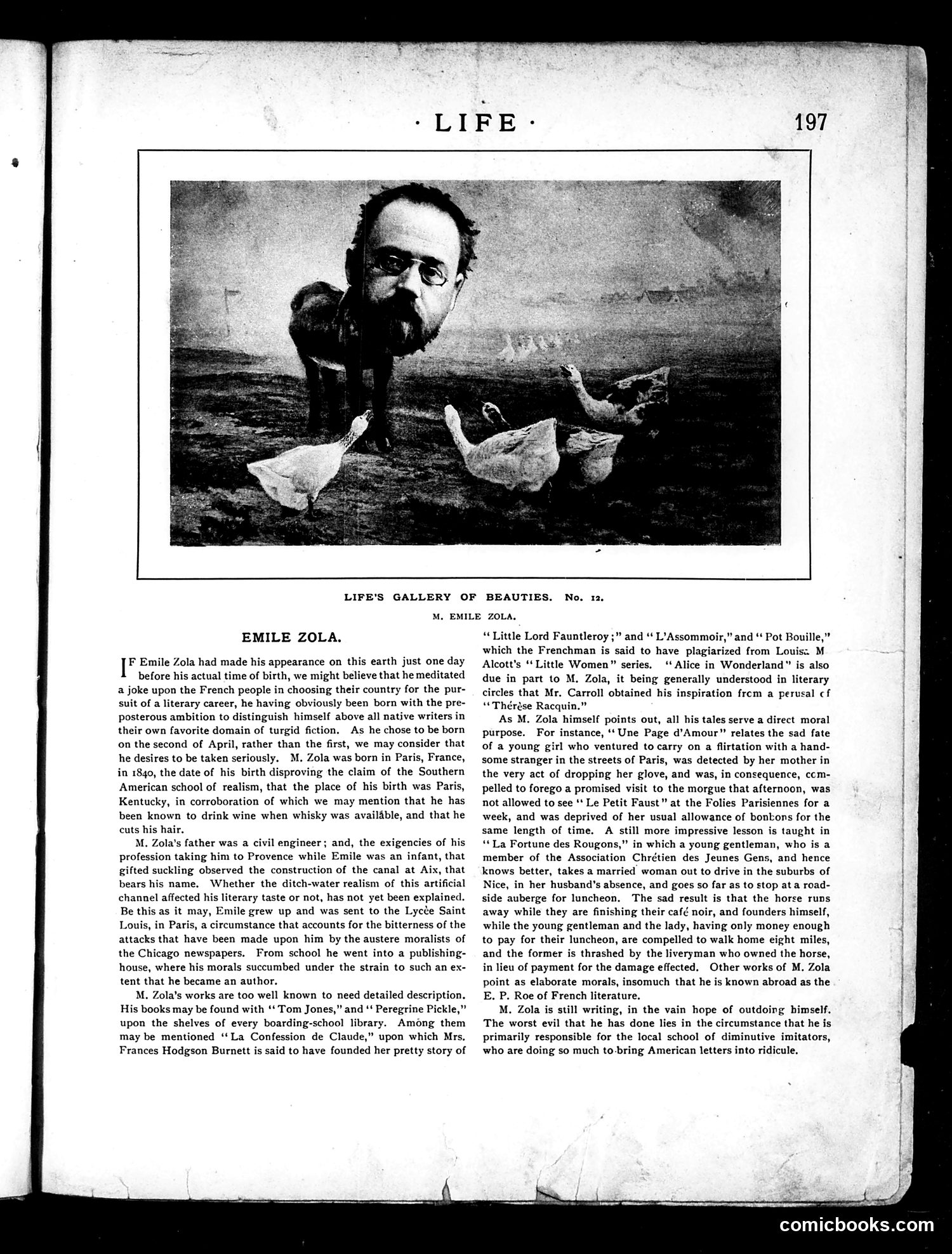
This page features a caricatured portrait of **Émile Zola**, the French novelist, depicted with an exaggerated large head and beard, positioned among chickens or poultry in a barren landscape. The accompanying text explains Zola's biography and literary significance, noting his naturalistic works and their controversial reputations. The satirical image appears to mock Zola's serious intellectual pretensions by placing his oversized head among farm animals—a visual joke suggesting deflation of his grandiose self-image or pretentiousness. The caricature is part of "Life's Gallery of Beauties" (No. 12), which used humorous visual distortion to critique public figures. The juxtaposition of the dignified literary figure with barnyard creatures creates the satirical contrast typical of *Life* magazine's approach to mocking prominent personalities of the era.
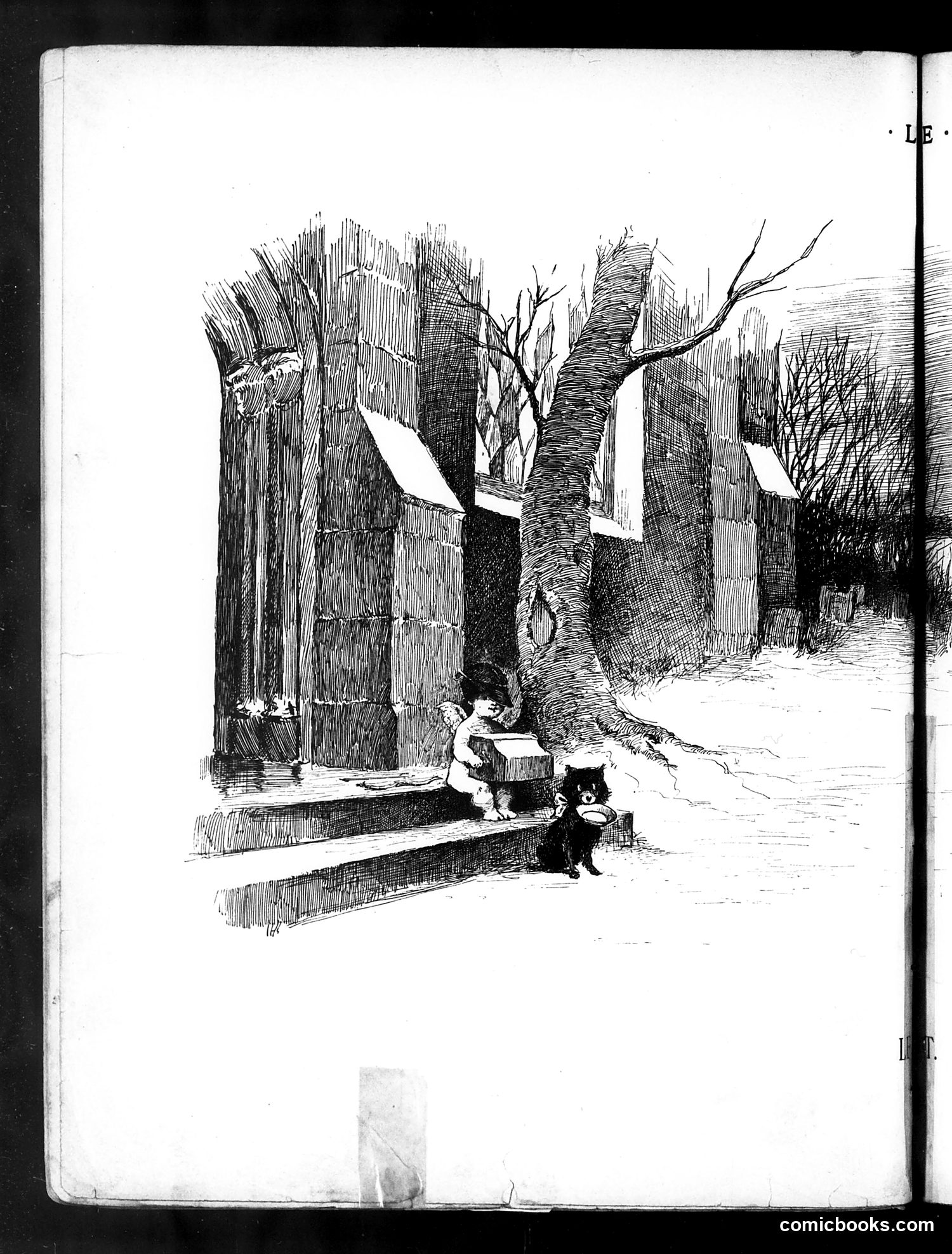
This page contains a single pen-and-ink illustration showing two cats near the base of large trees with bare branches. The scene appears to be set in winter or late autumn, with snow on the ground and minimal foliage. Without accompanying text or caption visible on this page, the specific satirical or political meaning is unclear. The image could represent a fable or animal story common to Life magazine's humorous content, but I cannot definitively identify what social or political commentary—if any—the cats are meant to convey. The artistic style is consistent with early-to-mid 20th century magazine illustration. More context from surrounding pages would be needed to explain any intended satire.
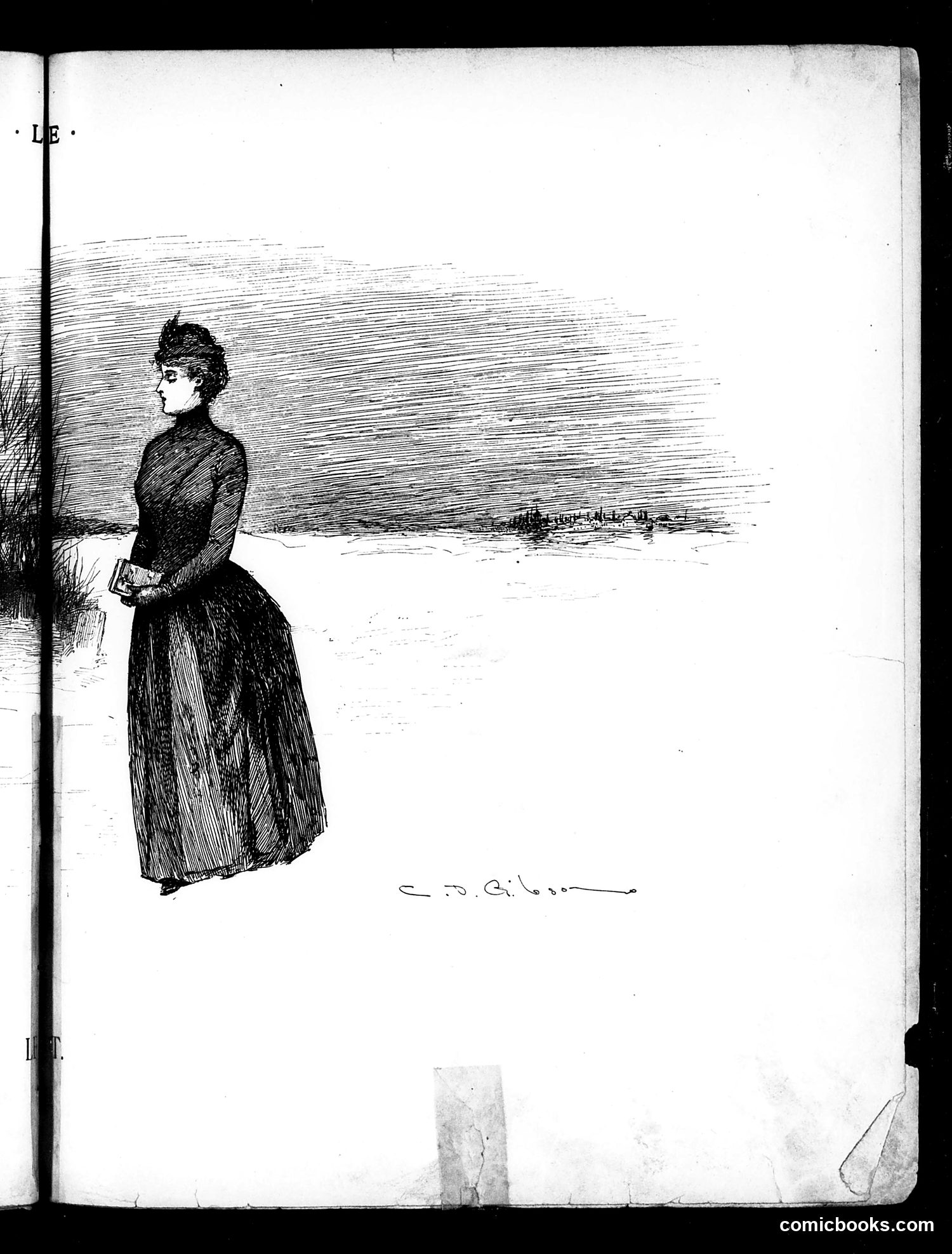
This appears to be a sketch from Life magazine showing a fashionably dressed woman in late 19th-century attire, standing alone by a body of water or shore. She wears a dark, fitted jacket with a full skirt and holds what appears to be a book or small object. The signature at the bottom is partially legible but unclear. Without additional context text visible on the page, the specific satirical point is difficult to determine with certainty. The image could commentary on women's fashion, leisure activities, or social customs of the era, but the exact subject and joke cannot be definitively identified from the visual alone. The page appears to be primarily illustrative rather than text-heavy.
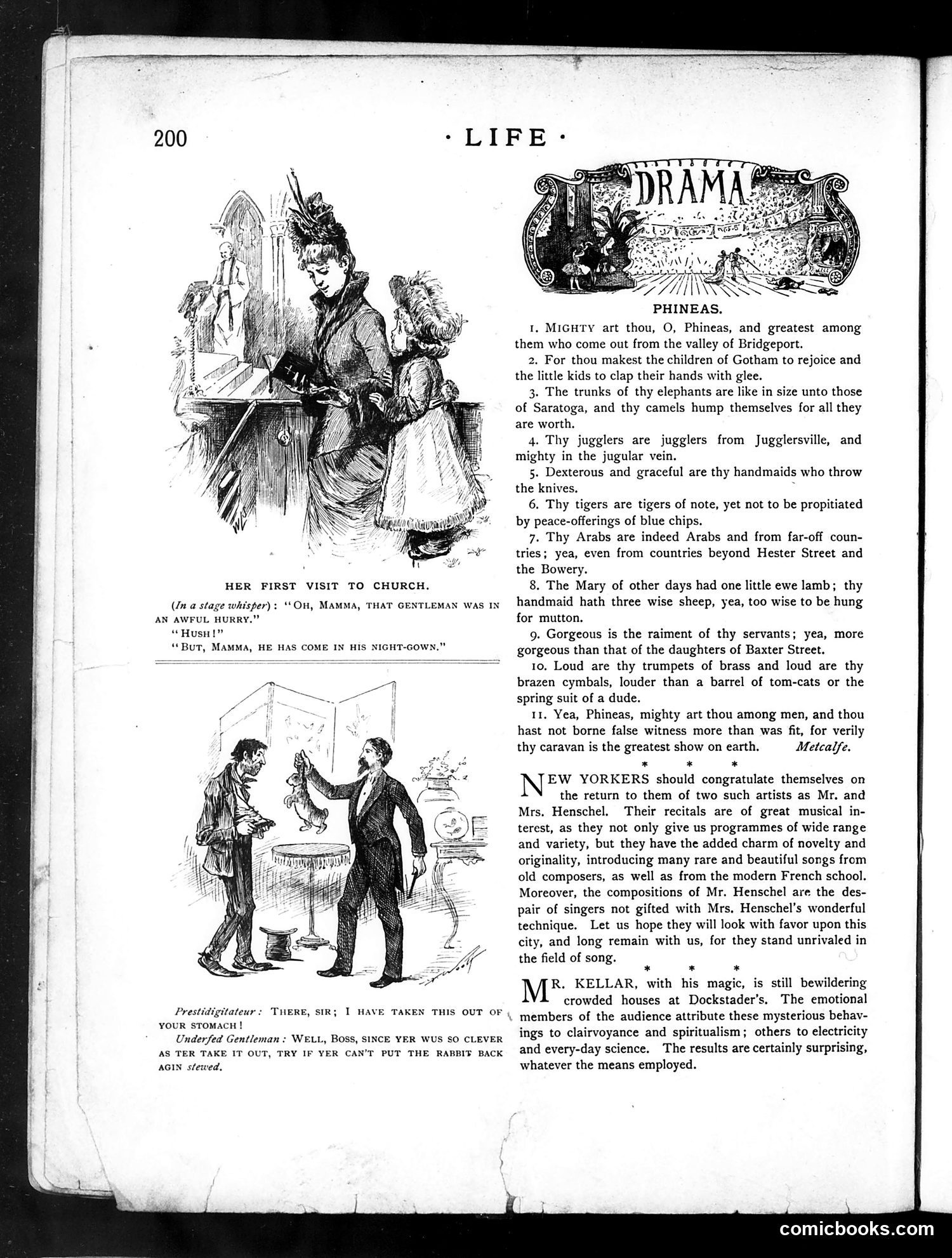
This page contains three distinct satirical pieces: **"Her First Visit to Church"**: A child's innocent misunderstanding—she mistakes a priest in vestments for a man in a nightgown hurrying away, poking fun at religious formality and children's literalism. **"Prestidigitateur" cartoon**: A magician claims to have extracted something from a starving man's stomach. The underfed gentleman, in broken English, sarcastically asks the magician to put "the rabbit back agin stewed"—mocking both the magician's trick and implying he's so desperately hungry he'd eat anything, even a rabbit. **"Phineas" section**: A mock-biblical tribute to P.T. Barnum (appears likely, given references to his circus: elephants, camels, jugglers, tigers, Arabs, and "the greatest show on earth"). The language parodies the King James Bible to humorously glorify Barnum's showmanship and elaborate attractions. The page satirizes fraud, poverty, and consumer spectacle through humor and exaggeration.
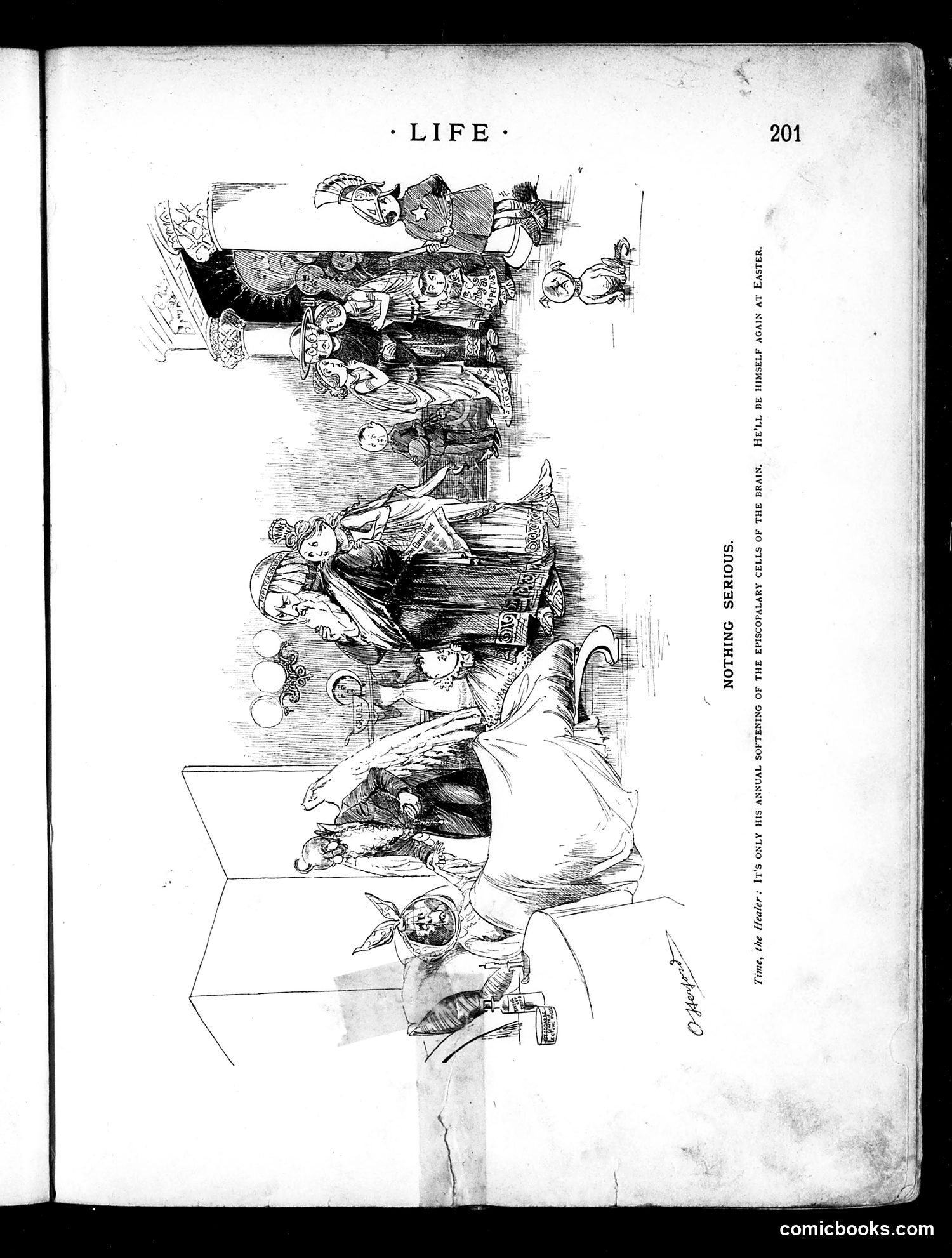
This Life magazine cartoon satirizes Easter celebrations among wealthy New York society. The title suggests the festivities are trivial ("nothing serious"), while the image depicts elaborate, ostentatious displays: fashionable women in expensive Easter bonnets and finery, children in fine clothes, and ornate carriages. The satire targets the excess and materialism of upper-class Easter observance—the holiday reduced to a fashion show and display of wealth rather than religious significance. The composition, viewed sideways on the page, emphasizes the parade-like spectacle of fashionable society parading their status. This mocks the gap between Easter's spiritual meaning and its practice among the wealthy elite as purely a social and sartorial event. The cartoon reflects period critique of American consumer culture and class disparities.
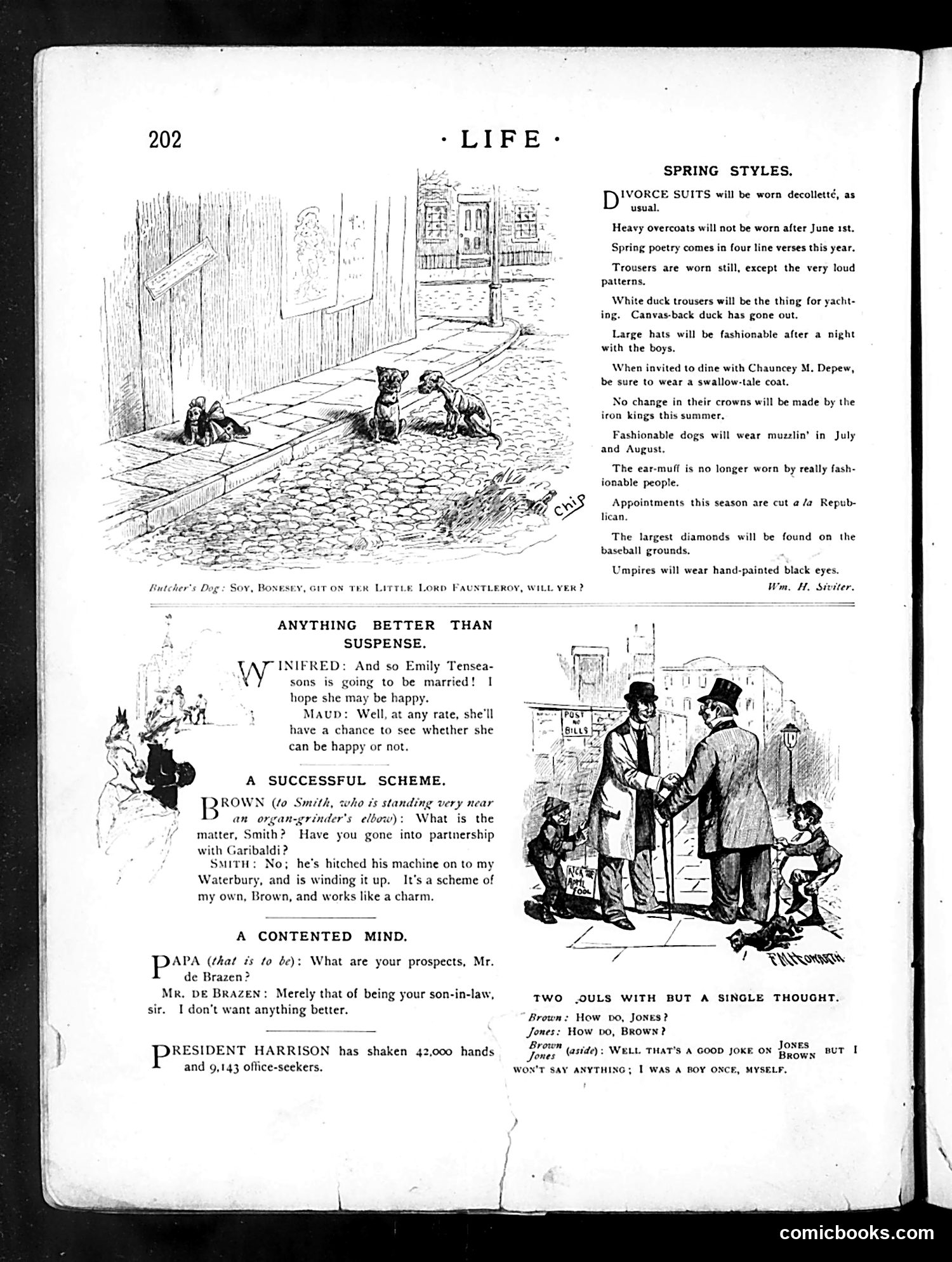
This page contains several short satirical pieces typical of *Life*'s humor. The main cartoons mock social pretension and hypocrisy: **"Spring Styles"** is a fashion-advice column that parodies society reporting by mixing genuine fashion notes with absurd predictions—divorce suits worn "decolletté," fashionable dogs in muzzles, umpires with "hand-painted black eyes." It satirizes both the frivolity of fashion commentary and contemporary social issues (frequent divorces, rowdy social behavior). **The short dialogues** ridicule self-interested suitors and obliviousness: Mr. de Brazen wants only to marry for money; Smith's organ-grinder scheme is petty scheming; Winifred's friend finds grim humor in marriage as a "test" of happiness. **"Two Souls with but a Single Thought"** shows two men bonding over a joke at someone's expense—the humor lies in their conspiratorial complicity and refusal to explain themselves. The page's overall tone is gentle mockery of American social climbers, fortune-hunters, and the absurdities of fashionable society during the Gilded Age.
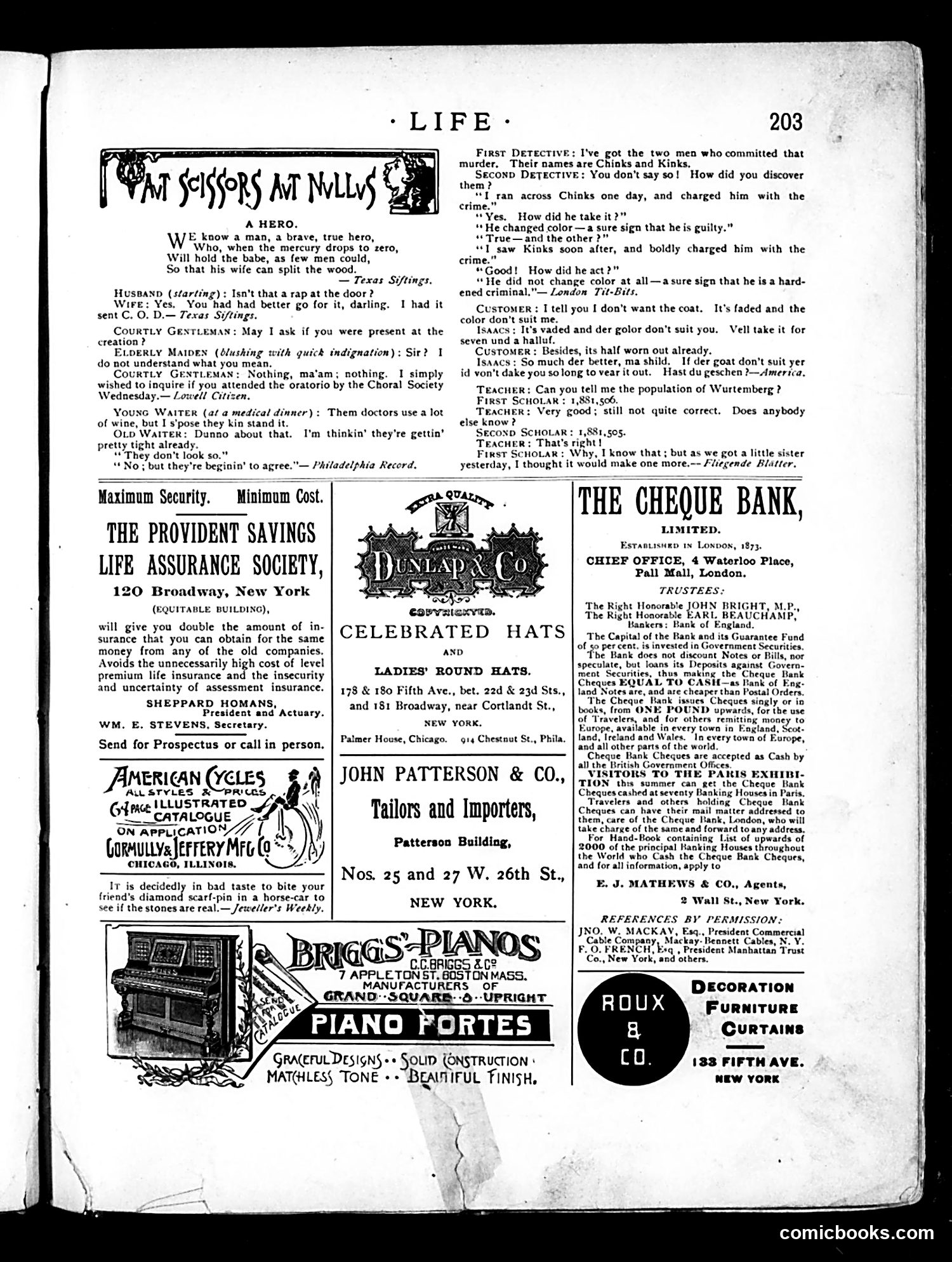
This page features brief humorous anecdotes typical of late-19th-century Life magazine's satirical style. The main cartoon titled "Scissors at Nully" mocks a certain "hero"—a man who holds a baby while his wife chops firewood, rather than doing it himself. The satire critiques either domestic role-reversal or masculine passivity, depending on the intended audience's view. The other jokes scattered throughout ridicule domestic life and pretense: a courtly gentleman insults an elderly woman by asking if she attended the creation; doctors drink too much at dinners; Irish immigrants ("Isaac") employ fractured English in a clothing shop. One dialogue satirizes ethnic stereotyping through detectives investigating crime suspects "Chinks and Kinks." The remainder is advertising for financial services, pianos, bicycles, and clothing—standard Life magazine content of the era. The page reflects period humor often dependent on class, ethnic, and gender stereotypes now considered offensive.
This is a primarily **advertising page**, not a political cartoon. It contains no satirical content or social commentary that would require historical context for modern readers. The page showcases typical late-19th-century commercial advertisements: a women's clothing boutique (Red Fern) offering mail-order service to those unable to visit New York; musical instruments (Aeolian Harps); a wrinkle-removal product (Cestus); bicycles (Victor Cycles); printing ink; dictionaries (Webster's); cigarettes (Kimball's); fine china (Haviland); and food products (Liebig's Extract of Meat). **One small visual element** appears in the Victor Cycles ad: an illustration of a bicycle deliberately printed sideways with a note explaining the designer thought it might "catch your eye"—an early example of attention-grabbing advertising design, not satire. The advertisements reflect consumer goods marketed to middle/upper-class readers, particularly women, in the 1880s-1890s.
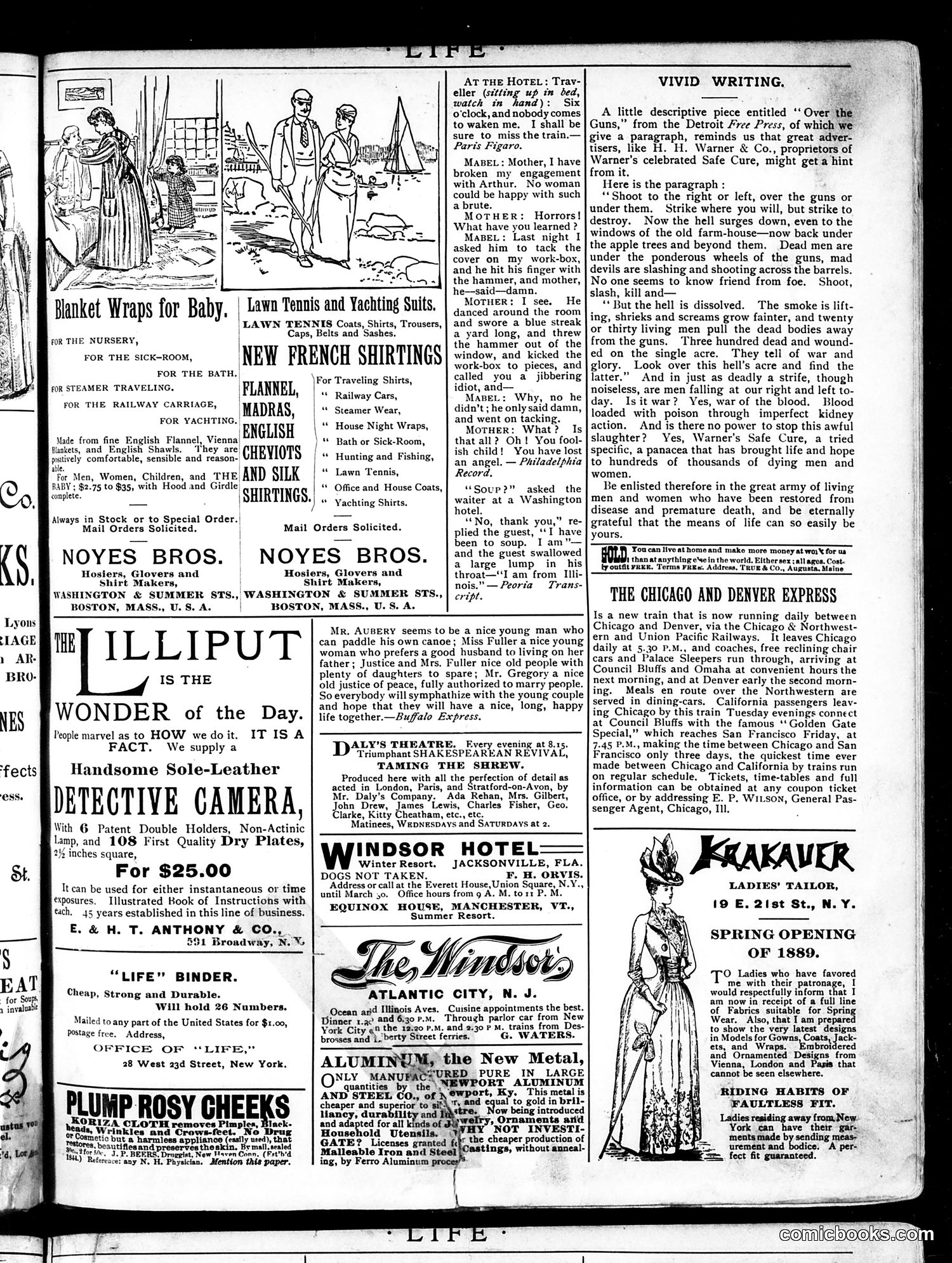
This page is primarily **advertising** with brief humorous anecdotes scattered throughout—typical of Life magazine's format at this time (appears to be late 1880s based on the spring opening reference). The main cartoon/comic text consists of three short jokes: 1. **"At the Hotel"**: A traveler worries about missing his train because no one wakes him. 2. **"Mabel's Broken Engagement"**: A daughter tells her mother she's ended her engagement because her fiancé Arthur said "damn" after hitting his finger with a hammer. The joke's satire targets Victorian prudishness—the mother initially assumes scandalous behavior, but the mild profanity itself is the "crime." This mocks excessive moral sensitivity of upper-class society. 3. **"Soup in Washington"**: A guest from Illinois refuses soup, cryptically suggesting he "has been to soup" and "is" soup—likely a political joke about Washington's murky, corrupt dealings ("soup" suggesting something unsavory), though the exact reference remains unclear. The page is predominantly filled with clothing advertisements (Noyes Bros., French shirtings, cameras, binders) targeting affluent readers.
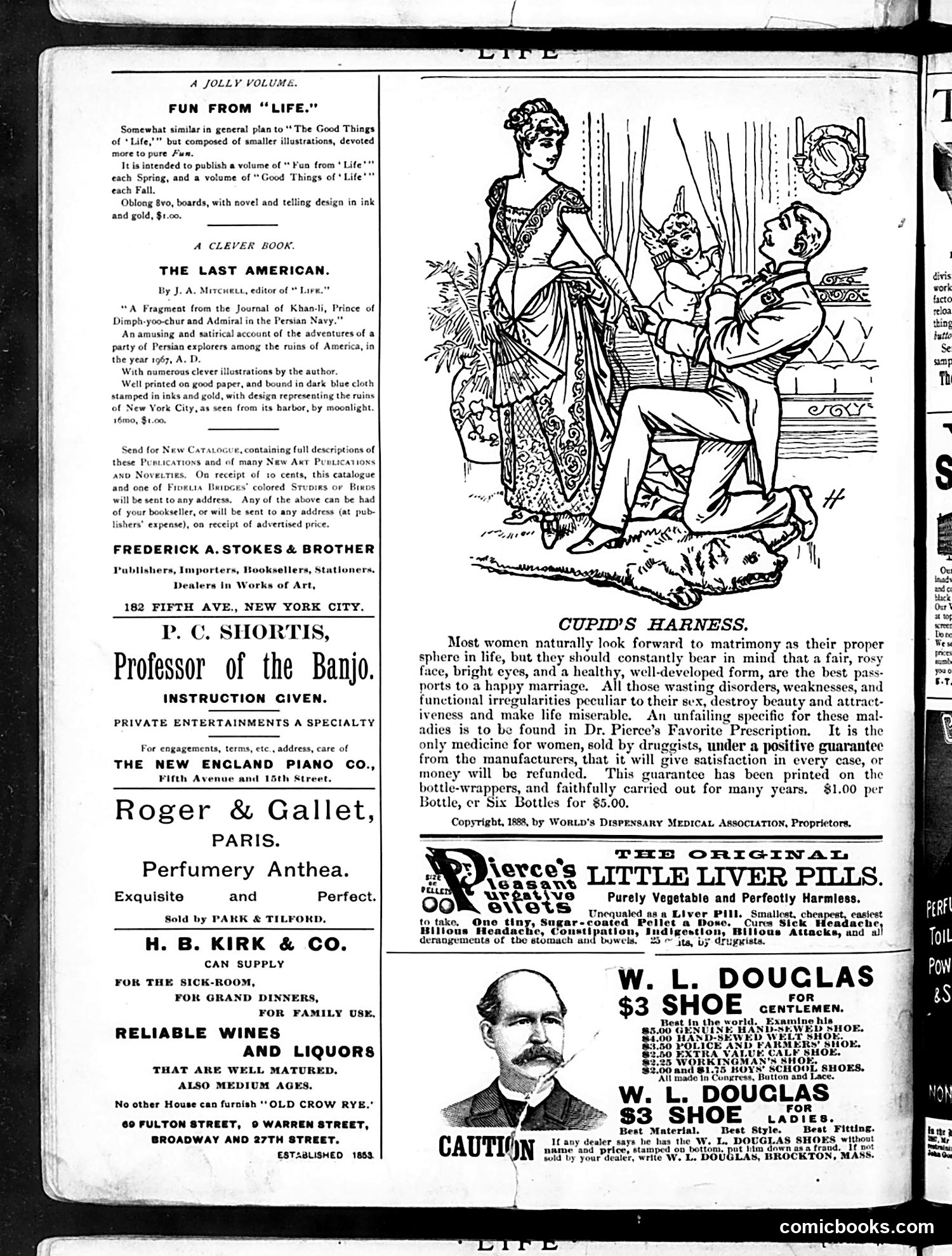
This is primarily an **advertising page** from Life magazine (circa 1888, based on the copyright notice). The only actual editorial content is the cartoon titled "Cupid's Harness," which depicts a woman with children and cherubs, accompanying an advertisement for Dr. Pierce's Favorite Prescription—a patent medicine marketed to women. **The "satire"** is unsubtle by modern standards: the cartoon ironically frames matrimony and motherhood as women's "proper sphere," while the adjacent ad promises to preserve female beauty and "destroy" menstrual disorders so women remain attractive to husbands. The term "harness" itself suggests women are constrained by domestic life. The page is otherwise **book advertisements** (including a dystopian novel, "The Last American," imagining Persian explorers touring America's ruins in 1967) and **commercial ads** for pianos, perfume, wine, shoes, and patent medicines—typical of 19th-century magazine revenue models.
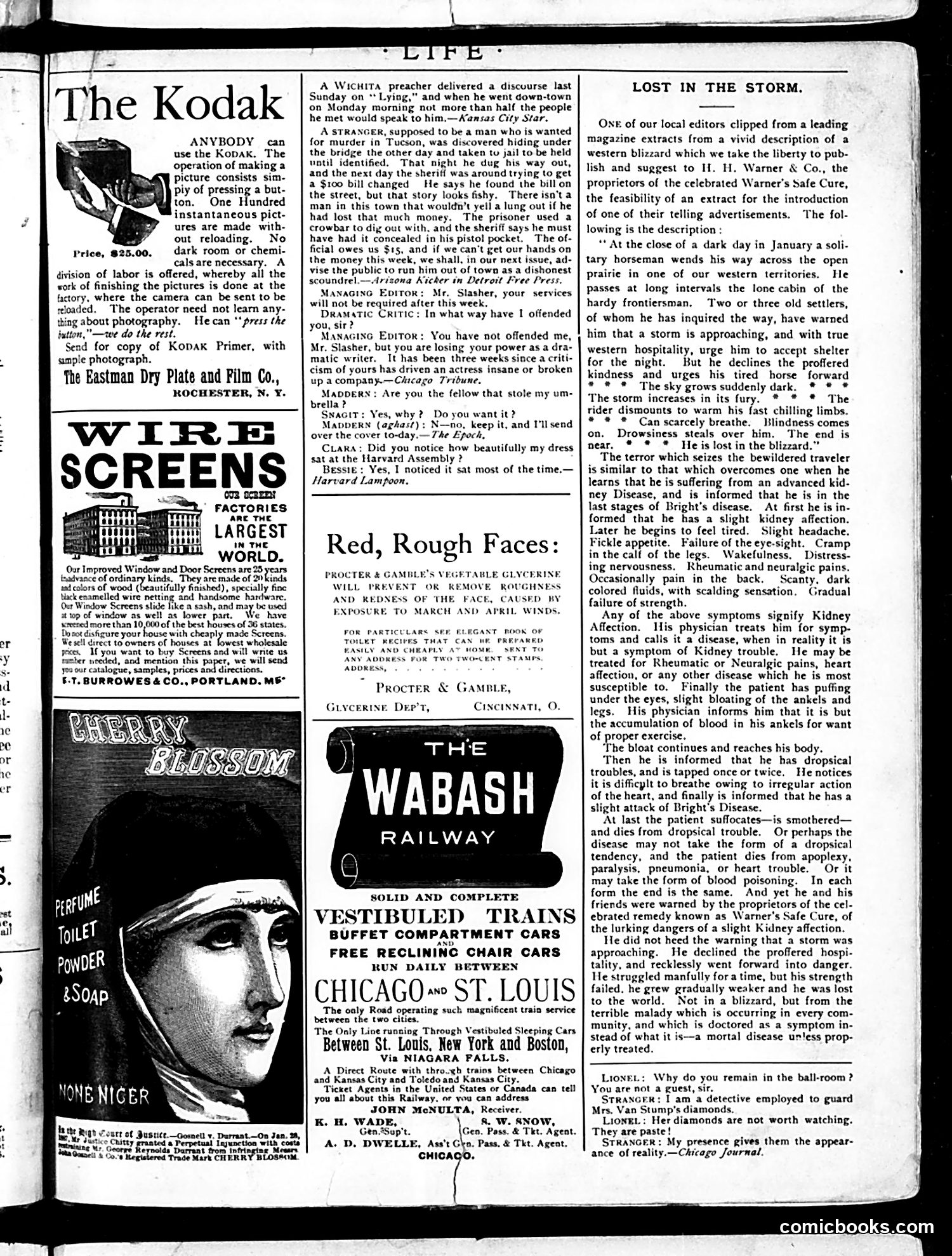
This page is primarily **advertising and humor shorts** rather than political cartoons. The humor pieces are brief anecdotes satirizing social hypocrisy and workplace absurdity: - A preacher lectures against lying; townspeople then avoid him—suggesting moral judgment is performative - A dramatic critic loses professional credibility when actresses stop going insane over his reviews—mocking theatrical excess and the critic's self-importance - A woman's dress "sat" (hung poorly) at a fancy event despite her pride in it—gentle mockery of vanity The advertisements dominate: Kodak cameras (emphasizing simplicity for amateurs), window screens, the Wabash Railway, and Procter & Gamble glycerine for facial roughness. **For modern readers:** These are throwaway gags from ~1890s-1900s Life magazine—witty but slight observations about social pretension, professional vanity, and everyday ironies. The humor relies on recognition of specific institutions (Harvard assemblies, theatrical criticism) rather than political commentary. It's essentially early magazine filler entertainment.
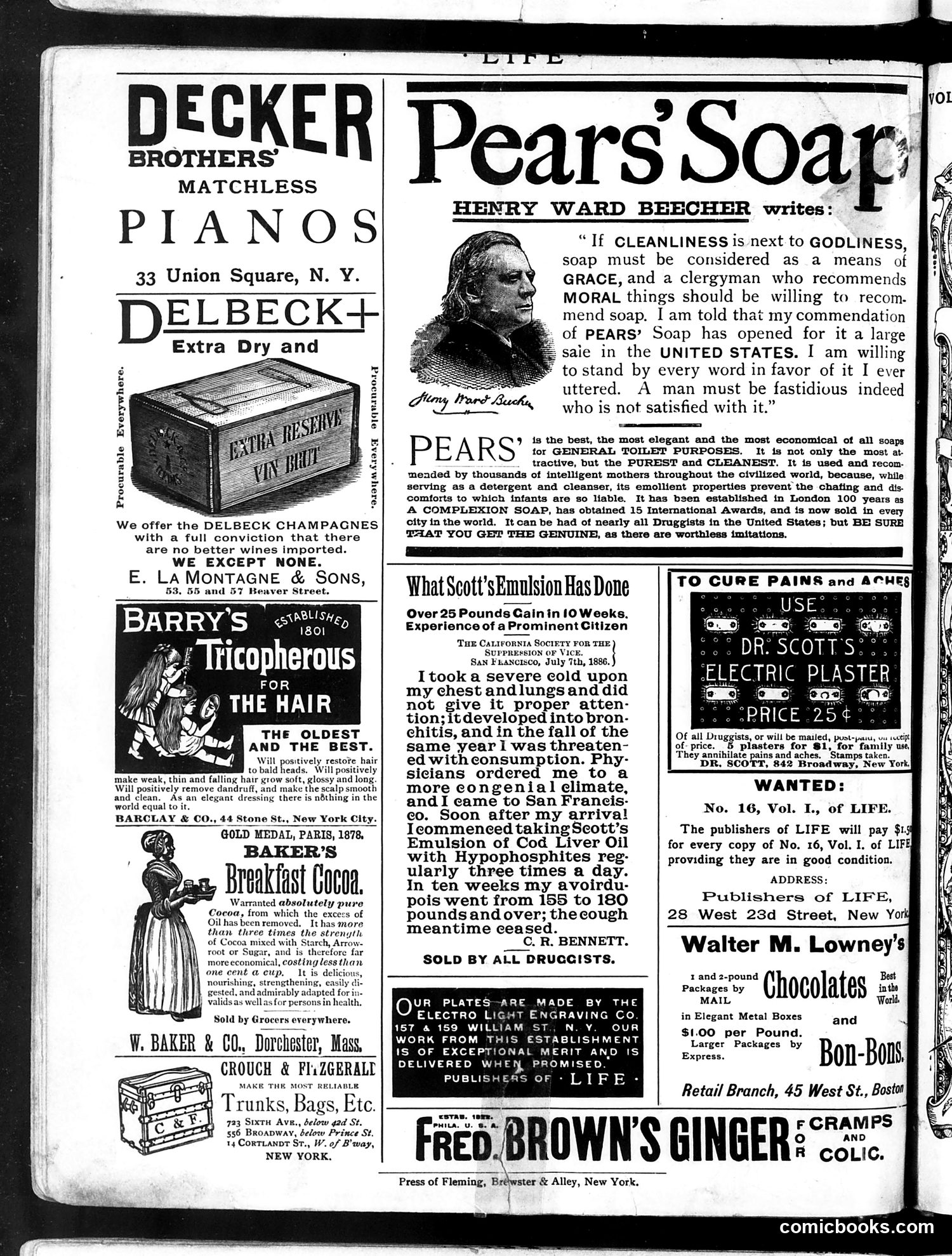
This page is primarily **advertising**, not satire or editorial content. It features testimonial endorsements from prominent figures to sell consumer products—a common late-19th-century marketing tactic. The most notable element is **Henry Ward Beecher's endorsement of Pears' Soap**. Beecher was a famous Brooklyn minister and moral authority of his era. His endorsement equates cleanliness with godliness and moral virtue, lending religious legitimacy to soap sales. This reflects the period's marketing strategy of using respected public figures to validate products. The page also includes testimonials for Scott's Emulsion (a cod liver oil supplement) and various other goods (pianos, cocoa, hair products, trunks). The Scott's testimonial even cites a specific weight gain (155 to 180 pounds) to convince readers of efficacy. For modern readers, this shows how 19th-century advertising relied on celebrity endorsement and moral/health claims that would be considered exaggerated or false by today's standards.