
Life, 1889-04-04 · page 8 of 20
Life — April 4, 1889 — page 8: what you’re looking at
What you’re looking at
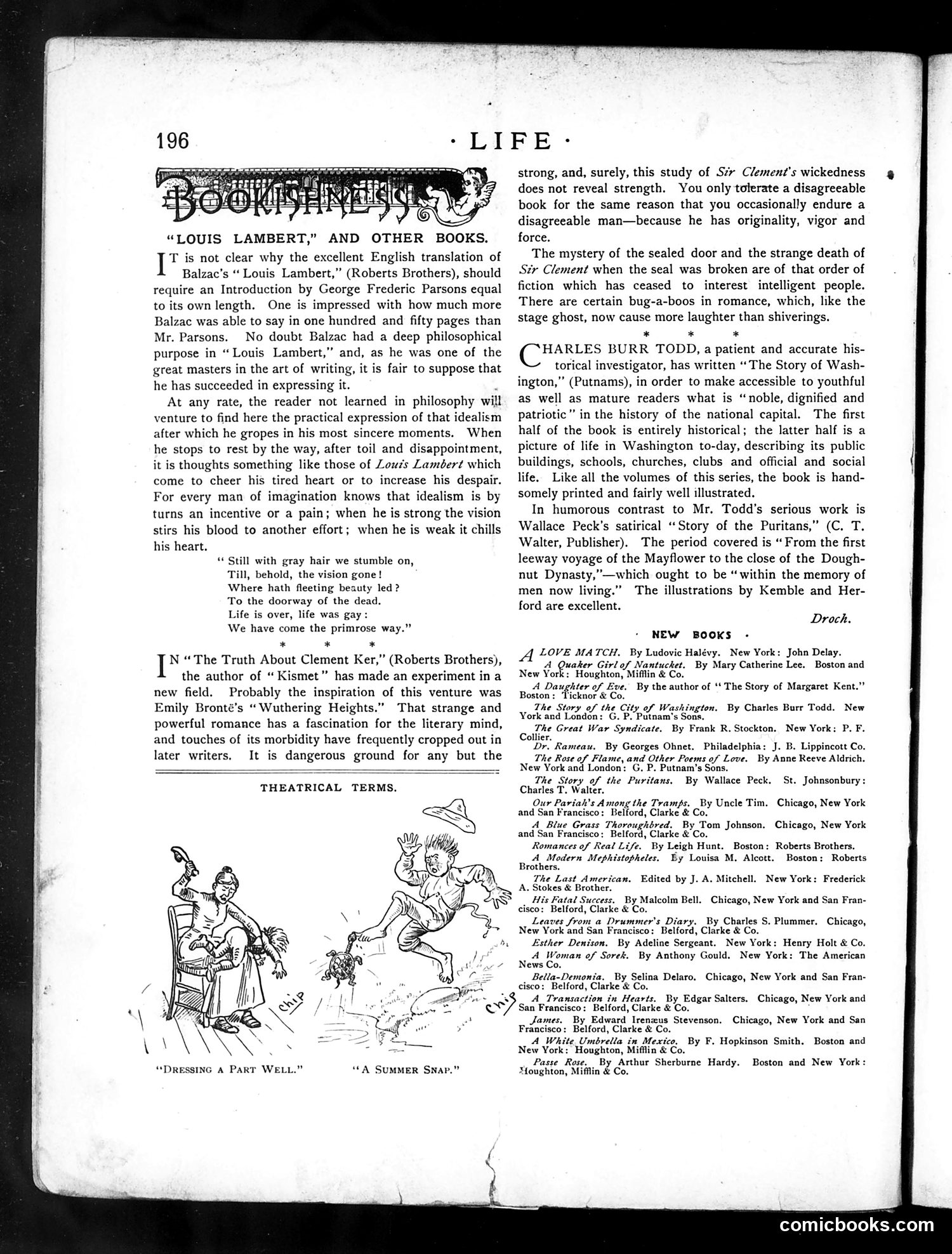
This page contains book reviews and literary criticism rather than political cartoons. The main content discusses "Louis Lambert" by Balzac and works by Charles Burr Todd and Wallace Peck. Two small theatrical illustrations appear at the bottom labeled "Dressing a Part Well" and "A Summer Snap"—these are humorous sketches about theatrical costume and behavior, not political satire. They depict exaggerated character types common to stage comedy of the era. The page functions as a literary section of *Life* magazine, reviewing contemporary books and offering theatrical commentary. The illustrations provide light, generic humor rather than commentary on specific political figures or events. Without additional context about these particular works' cultural significance, the specific satirical points are unclear to modern readers.
📄 Transcribed text from this page (OCR, searchable)
Machine-transcribed from the original scan — historical spelling and the odd misread are preserved.
‘LIFE: “LOUIS LAMBERT,” AND OTHER BOOKS. T is not clear why the excellent English translation of Balzac’s “ Louis Lambert,” (Roberts Brothers), should require an Introduction by George Frederic Parsons equal to its own length. One is impressed with how much more Balzac was able to say in one hundred and fifty pages than Mr. Parsons. No doubt Balzac had a deep philosophical purpose in “Louis Lambert,” and, as he was one of the great masters in the art of writing, it is fair to suppose that he has succeeded in expressing it. At any rate, the reader not learned in philosophy will venture to find here the practical expression of that idealism after which he gropes in his most sincere moments. When he stops to rest by the way, after toil and disappointment, it is thoughts something like those of Louis Lambert which come to cheer his tired heart or to increase his despair. For every man of imagination knows that idealism is by turns an incentive or a pain; when he is strong the vision stirs his blood to another effort; when he is weak it chills his heart. “Still with gray hair we stumble on, Till, behold, the vision gone! Where hath fleeting beauty led? To the doorway of the dead. Life is over, life was gay: We have come the primrose way.” * * * [* “The Truth About Clement Ker,” (Roberts Brothers), the author of “ Kismet” has made an experiment in a new field. Probably the inspiration of this venture was Emily Bronté’s “Wuthering Heights.” That strange and powerful romance has a fascination for the literary mind, and touches of its morbidity have frequently cropped out in later writers. It is dangerous ground for any but the THEATRICAL TERMS. ee A Transaction in Hearts. YY San Francisco: Belford, Clarke & Co. “DRESSING A PART WELL.” “A SUMMER Snap.” strong, and, surely, this study of Sev Clement's wickedness does not reveal strength. You only tolerate a disagreeable book for the same reason that you occasionally endure a disagreeable man—because he has originality, vigor and force. The mystery of the sealed door and the strange death of Str Clement when the seal was broken are of that order of fiction which has ceased to interest intelligent people. There are certain bug-a-boos in romance, which, like the stage ghost, now cause more laughter than shiverings. * * * HARLES BURR TODD, a patient and accurate his- torical investigator, has written “The Story of Wash- ington,” (Putnams), in order to make accessible to youthful as well as mature readers what is “noble, dignified and patriotic” in the history of the national capital. The first half of the book is entirely historical; the latter half is a picture of life in Washington to-day, describing its public buildings, schools, churches, clubs and official and social life. Like all the volumes of this series, the book is hand- somely printed and fairly well illustrated. In humorous contrast to Mr. Todd's serious work is Wallace Peck’s satirical “Story of the Puritans,” (C. T. Walter, Publisher). The period covered is “From the first leeway voyage of the Mayflower to the close of the Dough- nut Dynasty,”—which ought to be “within the memory of men now living.” The illustrations by Kemble and Her- ford are excellent. Droch. NEW BOOKS - (A LOVE MATCH. By Ludovic Halévy. New York: John Delay. A Quaker Girl of Nantucket. By Mary Catherine Lee. Boston and New York: Houghton, Mifflin & Co. A Daughter of Eve. By the author of ‘‘ The Story of Margaret Kent.” Boston: Ticknor & Co. The Story of the City of Washington. By Charles Burr Todd. New York and Londen 6. B Putnam's Some if cogie Great War Syndicate. By Frank R, Stockton. ‘collier. Dr. Rameau. By Georges Ohnet, Philadelphia: J. B. Lippincott Co. The Rose of Flame, and Other Poems of Love. By Anne Reeve Aldrich. New York and London’: G, P. Putnam’s Sons. The Story of the Puritans, By Wallace Peck. Charles T, Walter. Our Pariah’s Among the Tramps. _By Uncle Tim. Chicago, New York and San Francisco: Belford, Clarke & Co. A_ Blue Grass Thoroughbred. By Tom Johnson. and San Francisco: Belford, Clarke & Co. Romances of Real Life. By Leigh Hunt. A Modern Mephistopheles. By Louisa M. Alcott. Brothers. The Last American. A, Stokes & Brother. His Fatal Success. By Malcolm Bell. cisco: Belford, Clarke & Co. Leaves from a Drummer's Diary. By Charles S, Plummer. New York and San Francisco: Belford, Clarke & Co. Esther Denison. By Adeline Sergeant. New York: Henry Holt & Co. A Woman of Sorek. By Anthony Gould. New York: The American News Co, Bella-Demonia, By Selina Delaro. cisco: Belford, Clarke & Co. New York: P. F. St. Johnsonbury : Chicago, New York Boston: Roberts Brothers. Boston: Roberts Edited by J. A. Mitchell. New York: Frederick Chicago, New York and San Fran- Chicago, Chicago, New York and San Fran- By Edgar Salters. Chicago, New York and James. By Edward Irenzus Stevenson. Chicago, New York and San Francisco: Belford, Clarke & Co. A White Umbrella in Mexico. New York: Houghton, Mifflin & Co. Passe Rose. By Arthur Sherburne Hardy. Houghton, Mifflin & Co. By F. Hopkinson Smith. Boston and Boston and New York: comicbooks.com