
Life, 1889-04-04 · page 6 of 20
Life — April 4, 1889 — page 6: what you’re looking at
What you’re looking at
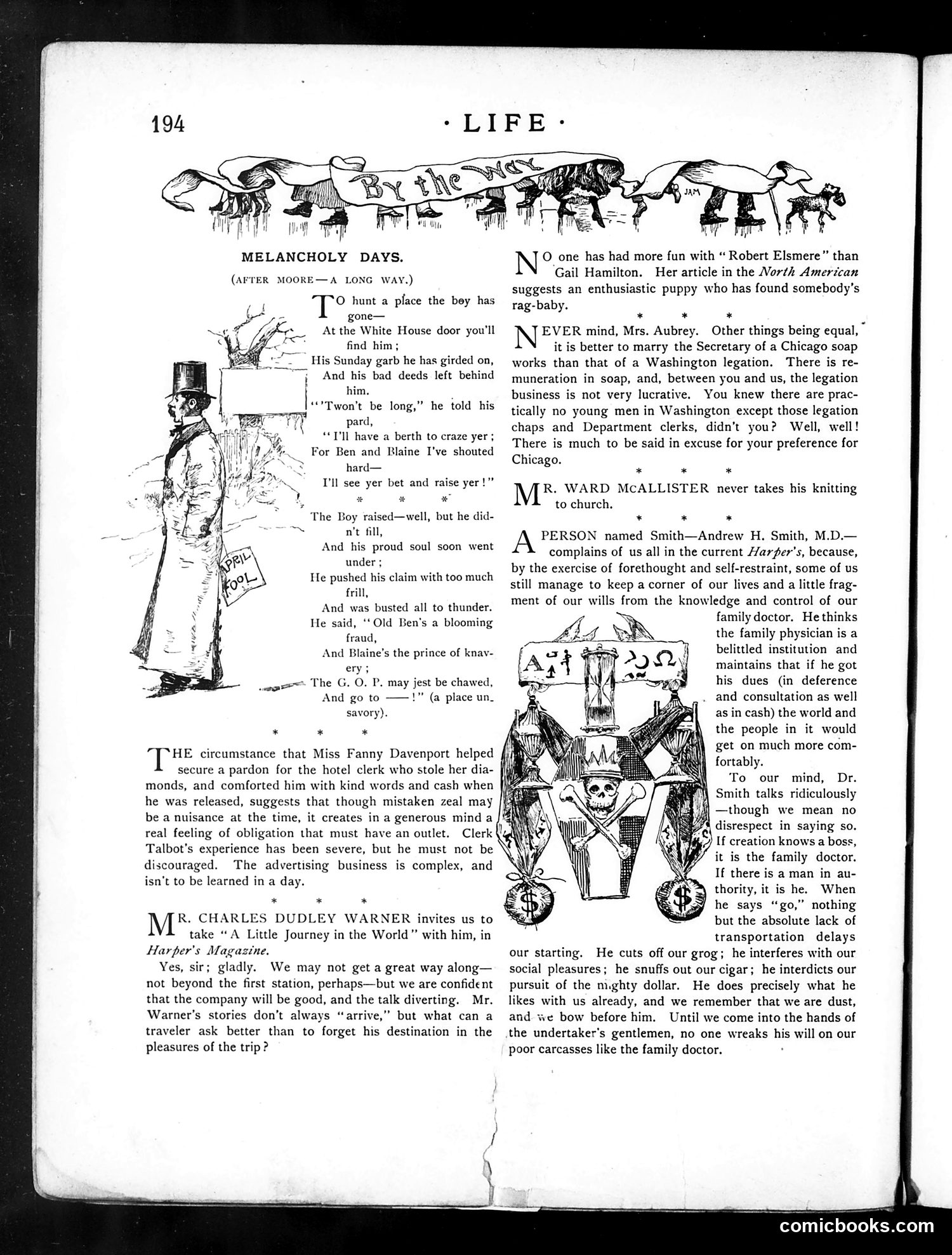
The main cartoon, titled "Melancholy Days (After Moore—A Long Way)," depicts a sad figure in formal dress leaning against a post. The accompanying poem tells of a boy who left home, never to return, suggesting themes of loss and disappointment. This appears to be a literary parody or commentary, possibly referencing Thomas Moore's poetry about melancholy subjects. The right column contains social commentary rather than political satire, mocking specific individuals: "Robert Elmere" (likely a literary character), a Dr. Andrew H. Smith (criticized for excessive medical authority), and comments on Chicago business culture versus Washington legation life. The tone is humorous, contemporary gossip rather than serious political critique.
📄 Transcribed text from this page (OCR, searchable)
Machine-transcribed from the original scan — historical spelling and the odd misread are preserved.
MELANCHOLY DAYS. (AFTER MOORE—A LONG WAY.) T° hunt a place the bey has gone— At the White House door you'll find him; His Sunday garb he has girded on, And his bad deeds left behind him, Twon't be long,” he told his pard, “T'll have a berth to craze yer; For Ben and Blaine I've shouted hard— I'll see yer bet and raise yer!” | |. ry The Boy raised—well, but he did- = n't fill, And his proud soul soon went under ; He pushed his claim with too much frill, And was busted all to thunder. He said, ‘‘Old Ben's a blooming fraud, And Blaine’s the prince of knav- ery; wepee= The G. O. P. may jest be chawed, And go to ——!" (a place un_ savory). * * * ‘TCHE circumstance that Miss Fanny Davenport helped \ secure a pardon for the hotel clerk who stole her dia- monds, and comforted him with kind words and cash when he was released, suggests that though mistaken zeal may be a nuisance at the time, it creates in a generous mind a real feeling of obligation that must have an outlet. Clerk Talbot's experience has been severe, but he must not be discouraged. The advertising business is complex, and isn't to be learned in a day. * * * R. CHARLES DUDLEY WARNER invites us to take “A Little Journey in the World” with him, in Harper's Magazine. Yes, sir; gladly. We may not get a great way along— not beyond the first station, perhaps—but we are confident that the company will be good, and the talk diverting. Mr. Warner's stories don’t always “arrive,” but what can a traveler ask better than to forget his destination in the pleasures of the trip? O one has had more fun with “ Robert Elsmere” than Gail Hamilton. Her article in the North American suggests an enthusiastic puppy who has found somebody's rag-baby. . . . EVER mind, Mrs. Aubrey. Other things being equal,” it is better to marry the Secretary of a Chicago soap works than that of a Washington legation. There is re- muneration in soap, and, between you and us, the legation business is not very lucrative. You knew there are prac- tically no young men in Washington except those legation chaps and Department clerks, didn’t you? Well, well! There is much to be said in excuse for your preference for Chicago. * * * R. WARD MCALLISTER never takes his knitting to church, * * * PERSON named Smith—Andrew H. Smith, M.D.— complains of us all in the current Harfer's, because, by the exercise of forethought and self-restraint, some of us still manage to keep a corner of our lives and a little frag- ment of our wills from the knowledge and control of our family doctor. He thinks the family physician is a belittled institution and maintains that if he got his dues (in deference and consultation as well as in cash) the world and the people in it would get on much more com- fortably. To our mind, Dr. Smith talks ridiculously —though we mean no disrespect in saying so. If creation knows a boss, it is the family doctor. If there is a man in au- thority, it is he. When he says “go,” nothing but the absolute lack of transportation delays our starting. He cuts off our grog; he interferes with our social pleasures; he snuffs out our cigar; he interdicts our pursuit of the m.ghty dollar. He does precisely what he likes with us already, and we remember that we are dust, and we bow before him. Until we come into the hands of the undertaker's gentlemen, no one wreaks his will on our poor carcasses like the family doctor. ; comicbooks.com