
Life, 1889-04-04 · page 9 of 20
Life — April 4, 1889 — page 9: what you’re looking at
What you’re looking at
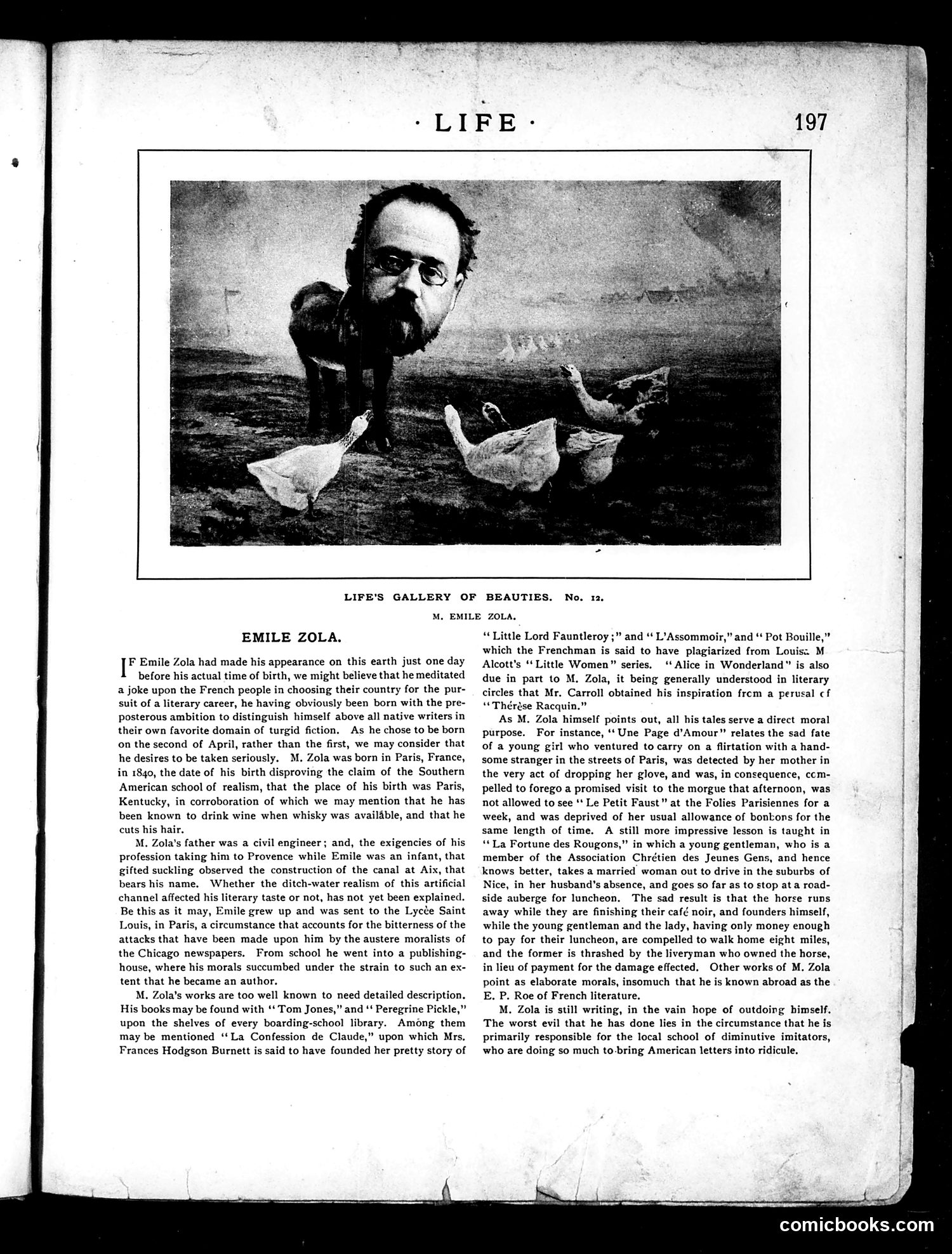
This page features a caricatured portrait of **Émile Zola**, the French novelist, depicted with an exaggerated large head and beard, positioned among chickens or poultry in a barren landscape. The accompanying text explains Zola's biography and literary significance, noting his naturalistic works and their controversial reputations. The satirical image appears to mock Zola's serious intellectual pretensions by placing his oversized head among farm animals—a visual joke suggesting deflation of his grandiose self-image or pretentiousness. The caricature is part of "Life's Gallery of Beauties" (No. 12), which used humorous visual distortion to critique public figures. The juxtaposition of the dignified literary figure with barnyard creatures creates the satirical contrast typical of *Life* magazine's approach to mocking prominent personalities of the era.
📄 Transcribed text from this page (OCR, searchable)
Machine-transcribed from the original scan — historical spelling and the odd misread are preserved.
LIFE’S GALLERY OF BEAUTIES. No. 12. M, EMILE ZOLA, EMILE ZOLA. [F Emile Zota had made his appearance on this earth just one day before his actual time of birth, we might believe that he meditated a joke upon the French people in choosing their country for the pur- suit of a literary career, he having obviously been born with the pre- posterous ambition to distinguish himself above all native writers in their own favorite domain of turgid fiction. As he chose to be born on the second of April, rather than the first, we may consider that he desires to be taken seriously. M. Zola was born in Paris, France, in 1840, the date of his birth disproving the claim of the Southern American school of realism, that the place of his birth was Paris, Kentucky, in corroboration of which we may mention that he has been known to drink wine when whisky was available, and that he cuts his hair. M. Zola’s father was a civil engineer; and, the exigencies of his profession taking him to Provence while Emile was an infant, that gifted suckling observed the construction of the canal at Aix, that bears his name. Whether the ditch-water realism of this artificial channel affected his literary taste or not, has not yet been explained. Be this as it may, Emile grew up and was sent to the Lycée Saint Louis, in Paris, a circumstance that accounts for the bitterness of the attacks that have been made upon him by the austere moralists of the Chicago newspapers. From school he went into a publishing- house, where his morals succumbed under the strain to such an ex- tent that he became an author. M. Zola’s works are too well known to need detailed description. His books may be found with ‘ Tom Jones,” and “' Peregrine Pickle,” upon the shelves of every boarding-school library. Among them may be mentioned “La Confession de Claude,” upon which Mrs. Frances Hodgson Burnett is said to have founded her pretty story of “Little Lord Fauntleroy ;” and ‘‘ L’Assommoir,” and ‘‘ Pot Bouille,” which the Frenchman is said to have plagiarized from Louisz. M Alcott's ‘Little Women” series. ‘‘ Alice in Wonderland” is also due in part to M. Zola, it being generally understood in literary circles that Mr. Carroll obtained his inspiration frem a perusal cf “Therese Racquin.” As M. Zola himself points out, all his tales serve a direct moral purpose. For instance, ‘‘ Une Page d’Amour” relates the sad fate of a young girl who ventured to carry on a flirtation with a hand- some stranger in the streets of Paris, was detected by her mother in the very act of dropping her glove, and was, in consequence, ccm- pelled to forego a promised visit to the morgue that afternoon, was not allowed to see ‘‘ Le Petit Faust” at the Folies Parisiennes for a week, and was deprived of her usual allowance of bonkons for the same length of time. A still more impressive lesson is taught in ‘La Fortune des Rougons,” in which a young gentleman, who is a member of the Association Chrétien des Jeunes Gens, and hence knows better, takes a married woman out to drive in the suburbs of Nice, in her husband's absence, and goes so far as to stop at a road- side auberge for luncheon. The sad result is that the horse runs away while they are finishing their café noir, and founders himself, while the young gentleman and the lady, having only money enough to pay for their luncheon, are compelled to walk home eight miles, and the former is thrashed by the liveryman who owned the horse, in lieu of payment for the damage effected. Other works of M. Zola point as elaborate morals, insomuch that he is known abroad as the E. P. Roe of French literature. M. Zola is still writing, in the vain hope of outdoing himself. The worst evil that he has done lies in the circumstance that he is primarily responsible for the local school of diminutive imitators, who are doing so much to-bring American letters into ridicule. comicbooks.com