
Life, 1889-04-04 · page 4 of 20
Life — April 4, 1889 — page 4: what you’re looking at
What you’re looking at
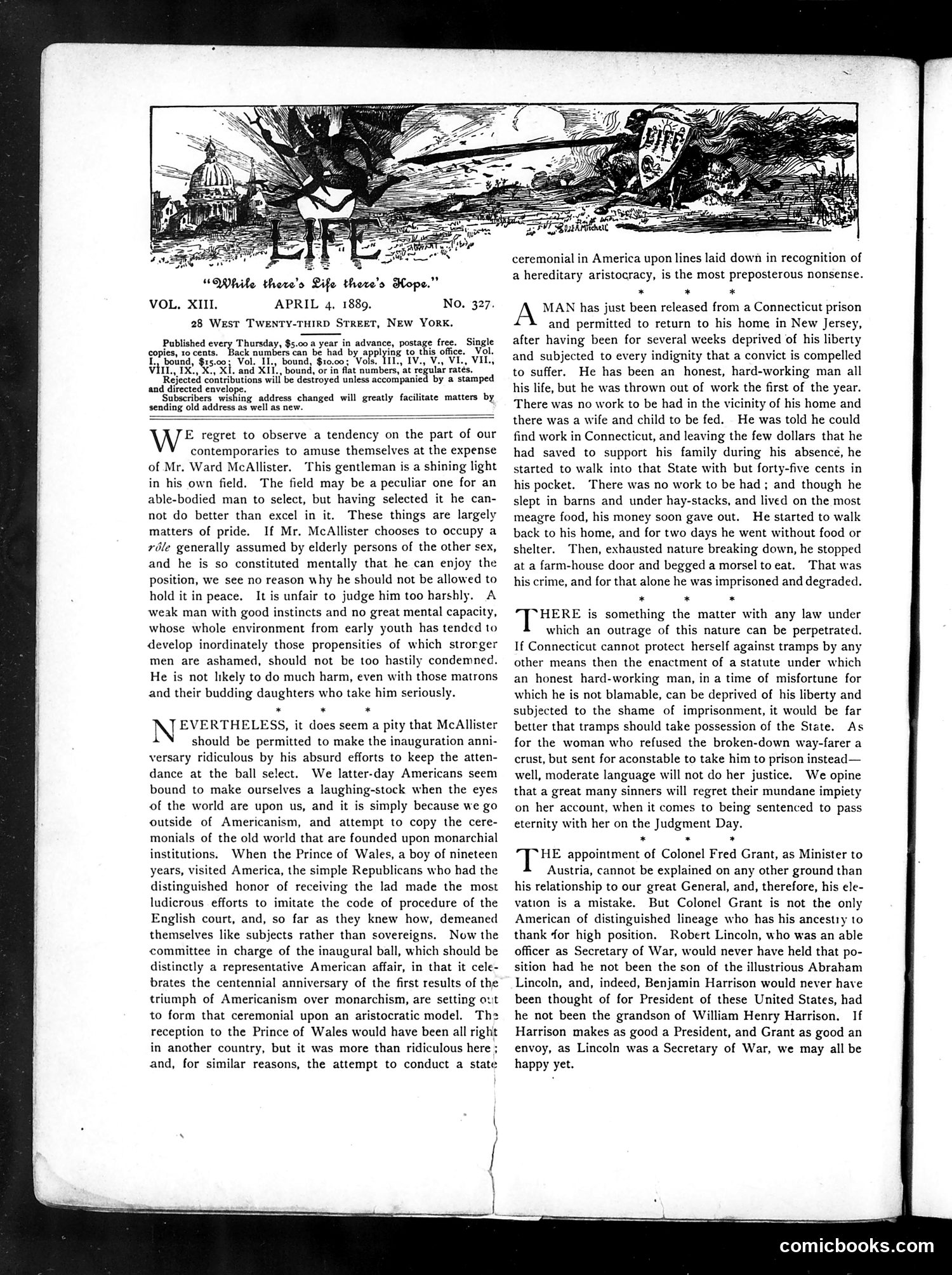
The masthead cartoon depicts a skeletal death figure overlooking a landscape with a domed building (likely the Capitol), with the caption "While there's Life there's Hope." The page's editorial content attacks **William McAllister**, a gentleman whom the editors accuse of using his social position to mock and ridicule others—particularly targeting "Mr. Walt McAllister" for his "absurd efforts" at maintaining aristocratic pretensions in America. The text also criticizes the upcoming inaugural ball ceremonies copying old-world monarchical traditions, arguing such imitation is ridiculous for a Republic. Finally, the editors express skepticism about **Colonel Fred Grant's** appointment as Minister to Austria, suggesting it results from his family connections (son of President Ulysses S. Grant) rather than merit—contrasting it unfavorably with Lincoln's meritocratic appointments.
📄 Transcribed text from this page (OCR, searchable)
Machine-transcribed from the original scan — historical spelling and the odd misread are preserved.
VOL, XIII. APRIL 4, 1889. 28 West TWENTY-THIRD STREET, NEw YORK. Published every Thursday, $5.00 a year in advance, postage free. Single copies, ro cents. Back numbers can be had by applying t9 this office. Vol. bound, $15.00; Vol. II., bound, $10.00; Vol IV., V., VI., VIL, vin “Xi. and XIT., bound, or in flat numbers, at regular rates. Rejected contributions by a stamped and directed envelo} tubscribers wishing address changed will greatly facilitate matters by sending old address as well as new. be destroyed unless accompanie WE. regret to observe a tenileney on the part of our contemporaries to amuse themselves at the expense of Mr. Ward McAllister. This gentleman is a shining light in his own field. The field may be a peculiar one for an able-bodied man to select, but having selected it he can- not do better than excel in it. These things are largely matters of pride. If Mr. McAllister chooses to occupy a véle generally assumed by elderly persons of the other sex, and he is so constituted mentally that he can enjoy the position, we see no reason why he should not be allowed to hold it in peace. It is unfair to judge him too harshly. A weak man with good instincts and no great mental capacity, whose whole environment from early youth has tended to develop inordinately those propensities of which stronger men are ashamed, should not be too hastily condemned. He is not likely to do much harm, even with those matrons and their budding daughters who take him seriously. * * * N EVERTHELESS, it does seem a pity that McAllister should be permitted to make the inauguration anni- versary ridiculous by his absurd efforts to keep the atten- dance at the ball select. We latter-day Americans seem bound to make ourselves a laughing-stock when the eyes of the world are upon us, and it is simply because we go outside of Americanism, and attempt to copy the cere- monials of the old world that are founded upon monarchial institutions. When the Prince of Wales, a boy of nineteen years, visited America, the simple Republicans who had the distinguished honor of receiving the lad made the most ludicrous efforts to imitate the code of procedure of the English court, and, so far as they knew how, demeaned themselves like subjects rather than sovereigns. Now the committee in charge of the inaugural ball, which should be distinctly a representative American affair, in that it cele- brates the centennial anniversary of the first results of the triumph of Americanism over monarchism, are setting out to form that ceremonial upon an aristocratic model. Th2 reception to the Prince of Wales would have been all right in another country, but it was more than ridiculous here ; and, for similar reasons, the attempt to conduct a state ceremonial in America upon lines laid down in recognition of a hereditary aristocracy, is the most preposterous nonsense. * * * A MAN has just been released from a Connecticut prison and permitted to return to his home in New Jersey, after having been for several weeks deprived of his liberty and subjected to every indignity that a convict is compelled to suffer. He has been an honest, hard-working man all his life, but he was thrown out of work the first of the year. There was no work to be had in the vicinity of his home and there was a wife and child to be fed. He was told he could find work in Connecticut, and leaving the few dollars that he had saved to support his family during his absence, he started to walk into that State with but forty-five cents in his pocket. There was no work to be had; and though he slept in barns and under hay-stacks, and lived on the most meagre food, his money soon gave out. He started to walk back to his home, and for two days he went without food or shelter. Then, exhausted nature breaking down, he stopped at a farm-house door and begged a morsel to eat. That was his crime, and for that alone he was imprisoned and degraded. * * * “THERE is something the matter with any law under which an outrage of this nature can be perpetrated. If Connecticut cannot protect herself against tramps by any other means then the enactment of a statute under which an honest hard-working man, in a time of misfortune for which he is not blamable, can be deprived of his liberty and subjected to the shame of imprisonment, it would be far better that tramps should take possession of the State. As for the woman who refused the broken-down way-farer a crust, but sent for aconstable to take him to prison instead— well, moderate language will not do her justice. We opine that a great many sinners will regret their mundane impiety on her account, when it comes to being sentenced to pass eternity with her on the Judgment Day. * * . es appointment of Colonel Fred Grant, as Minister to Austria, cannot be explained on any other ground than his relationship to our great General, and, therefore, his ele- vation is a mistake. But Colonel Grant is not the only American of distinguished lineage who has his ancestiy to thank for high position. Robert Lincoln, who was an able officer as Secretary of War, would never have held that po- sition had he not been the son of the illustrious Abraham Lincoln, and, indeed, Benjamin Harrison would never have been thought of for President of these United States, had he not been the grandson of William Henry Harrison. If Harrison makes as good a President, and Grant as good an envoy, as Lincoln was a Secretary of War, we may all be happy yet. comicbooks.com