A complete issue · 42 pages · 1887
Life — December 8, 1887
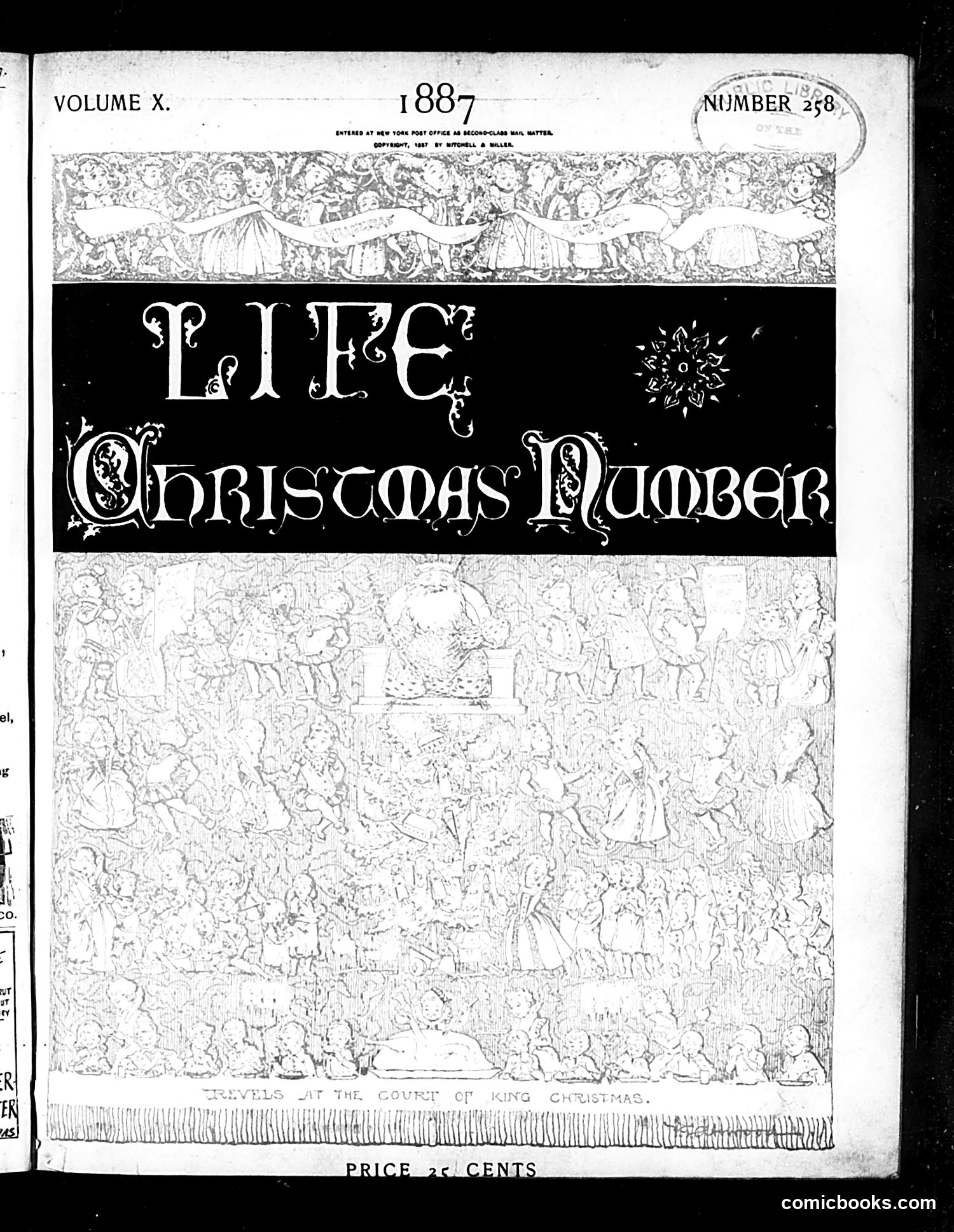
This is the cover of Life magazine's 1887 Christmas issue (Volume X, Number 268). The title "The Christmas Number" appears in ornate Victorian lettering against a black band. The main illustration depicts "Revels at the Court of King Christmas"—a densely detailed engraving showing a crowded medieval or fairy-tale court scene. Numerous figures in period costume appear to be celebrating and feasting in a fantastical Christmas celebration. The intricate linework is characteristic of late-19th-century wood-engraving style. Rather than political satire, this appears to be holiday-themed entertainment content typical of Life's seasonal special issues, offering readers festive illustration and presumably stories. The price of 25 cents is noted at the bottom.
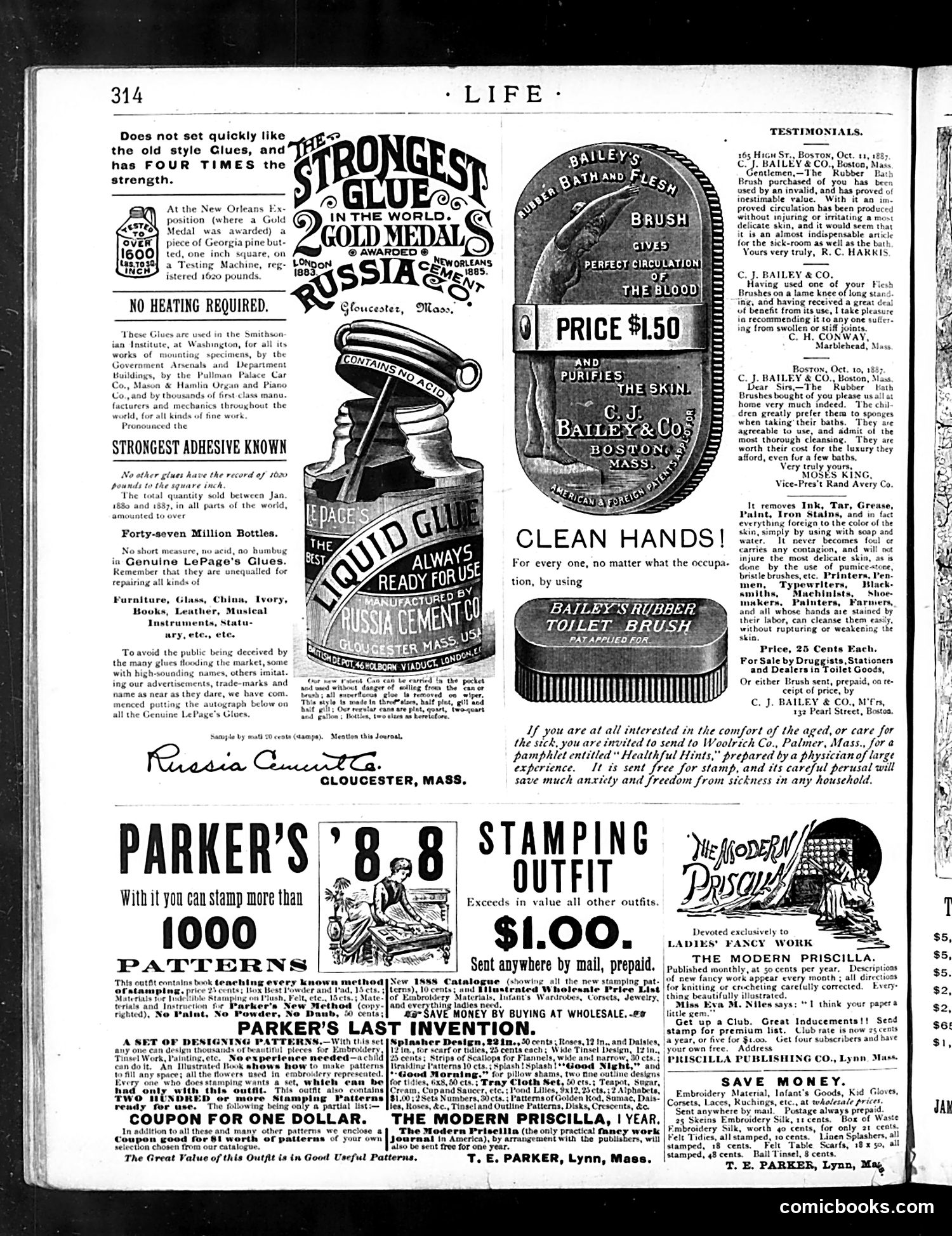
This page is **primarily advertisements** with no discernible political cartoons or satirical content targeting specific figures or events. The ads feature: - **Russia Cement Co.** glue products (top left) - **Bailey's Bath and Flesh Brush** (center) - **Parker's '8-8' stamping outfit** (bottom left) - **The Modern Priscilla** magazine subscription (bottom right) The only potentially humorous element is the **Russia Cement** ad's emphasis on "NO HEATING REQUIRED" and claims of being "the strongest adhesive known"—typical exaggerated product claims common in early 20th-century advertising. There are no identifiable caricatures, political references, or satirical commentary visible. This appears to be a standard advertising page from *Life* magazine, likely from the 1910s era.
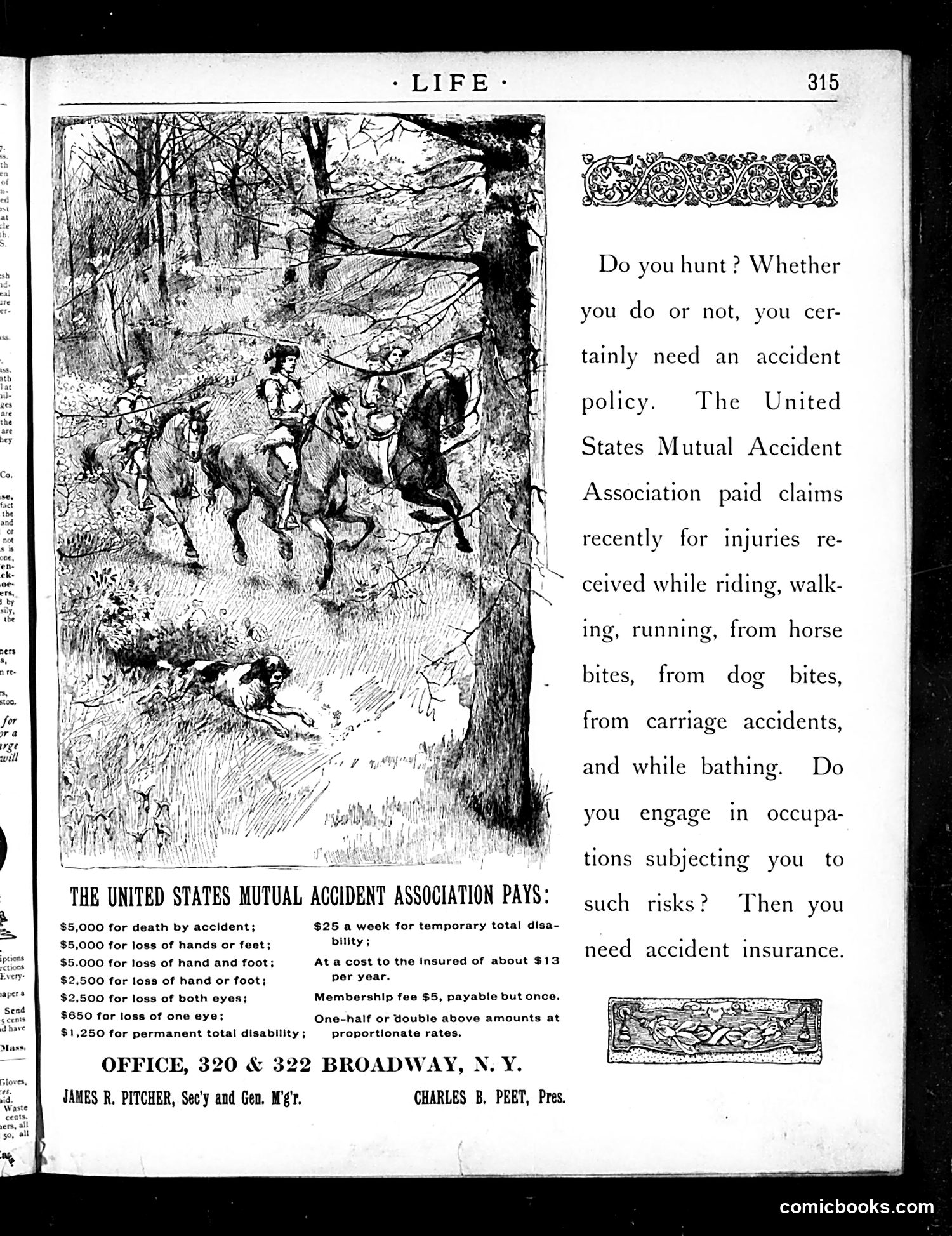
This page is primarily **advertising** for the United States Mutual Accident Association, an early insurance company. The sketch depicts a hunting scene with riders on horseback, illustrating the outdoor activities the insurance covers. The ad targets affluent readers engaged in leisure activities—hunting, riding, bathing—that carried accident risks. It lists specific payouts: $5,000 for accidental death, $25/week for temporary disability, and amounts for various injuries including loss of limbs or eyes. The membership fee was about $13 annually. The accompanying text humorously frames accident insurance as essential for anyone engaging in risky pursuits, using the hunting scene as a relatable example of danger. This reflects late 19th/early 20th-century American insurance marketing aimed at middle and upper-class readers of *Life* magazine.
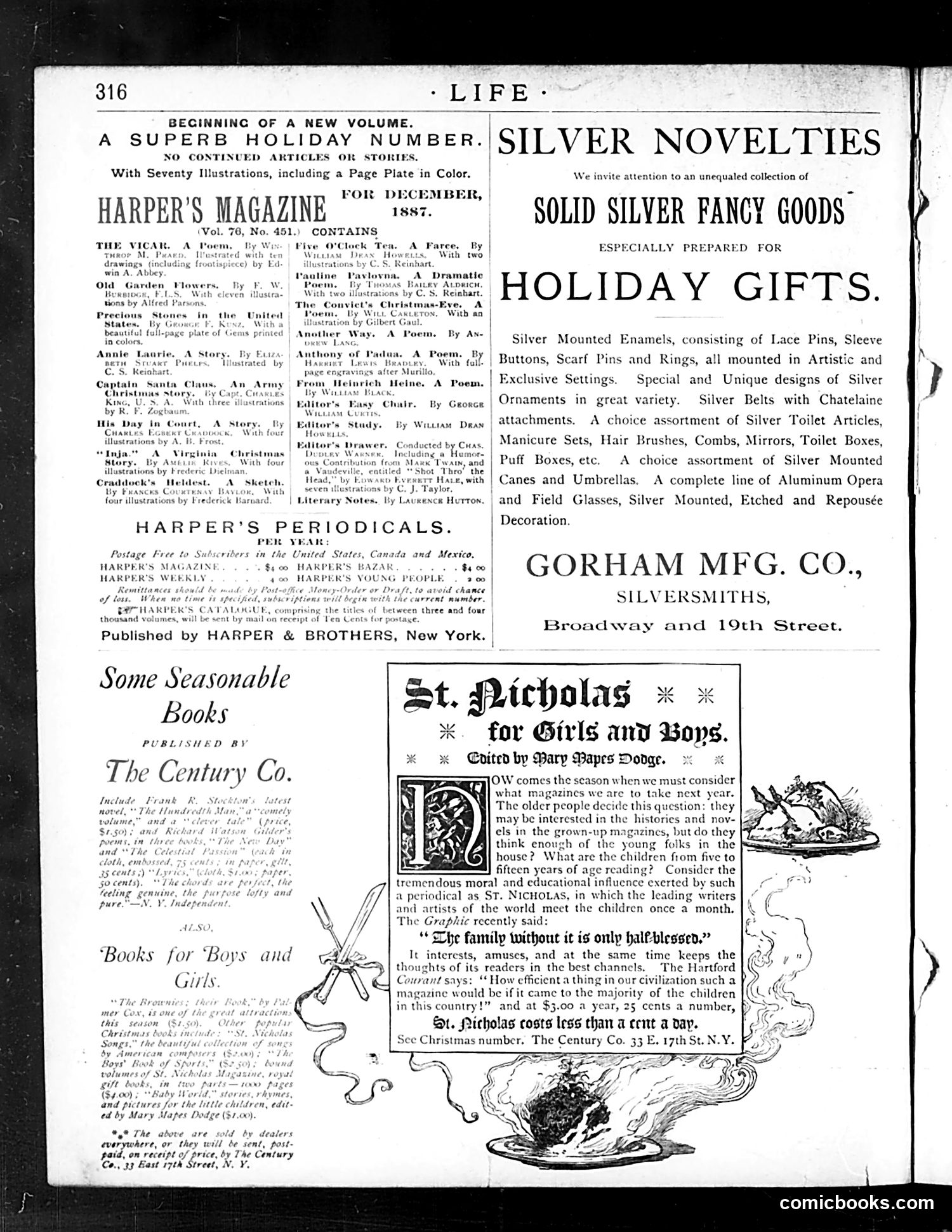
This page is primarily **advertising and editorial content**, not political satire. The left side promotes Harper's Magazine (December 1887 issue) and books from The Century Co. The right side features advertisements for Gorham Mfg. Co.'s silver goods and an advertisement for *St. Nicholas* magazine for children. The only illustrative element is a decorative drawing accompanying the *St. Nicholas* ad—appearing to show a cherub or child figure with what looks like a horn or trumpet amid clouds and foliage. This is ornamental rather than satirical. The text emphasizes *St. Nicholas* as an educational periodical endorsed by prominent writers and artists, positioned as suitable reading for children. There is **no political cartoon or social satire** on this page—it's a commercial publication page from the 1880s.
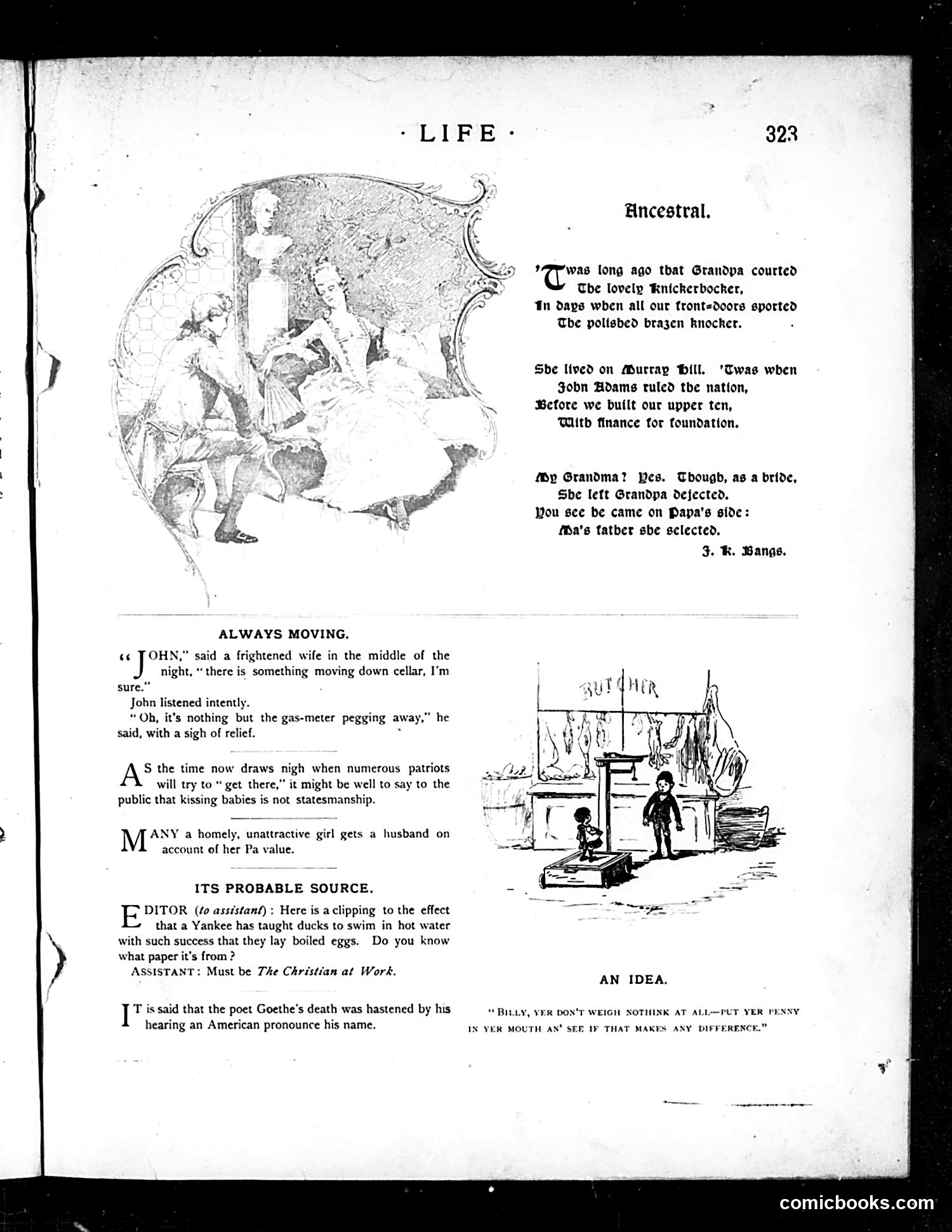
This page contains three unrelated satirical items typical of Life's format: 1. **"Ancestral"** - A poem by J. K. Bangs about a woman (the "lovely Knickerbocker") who lived on Murray Hill when John Adams ruled, establishing upper-class genealogical pretension as comedy. 2. **"Always Moving"** - A brief joke about a wife hearing noises in the cellar; the husband's relief that it's merely a gas-meter suggests anxiety about domestic burglary or intrusion, reflecting turn-of-century urban safety concerns. 3. **"Its Probable Source"** and **"An Idea"** - Short items mocking journalism and offering observations on domestic life. The illustration shows a domestic scene, likely supporting one of these sketches. The content reflects Life's typical mix of light domestic humor and social commentary aimed at middle-class readers.
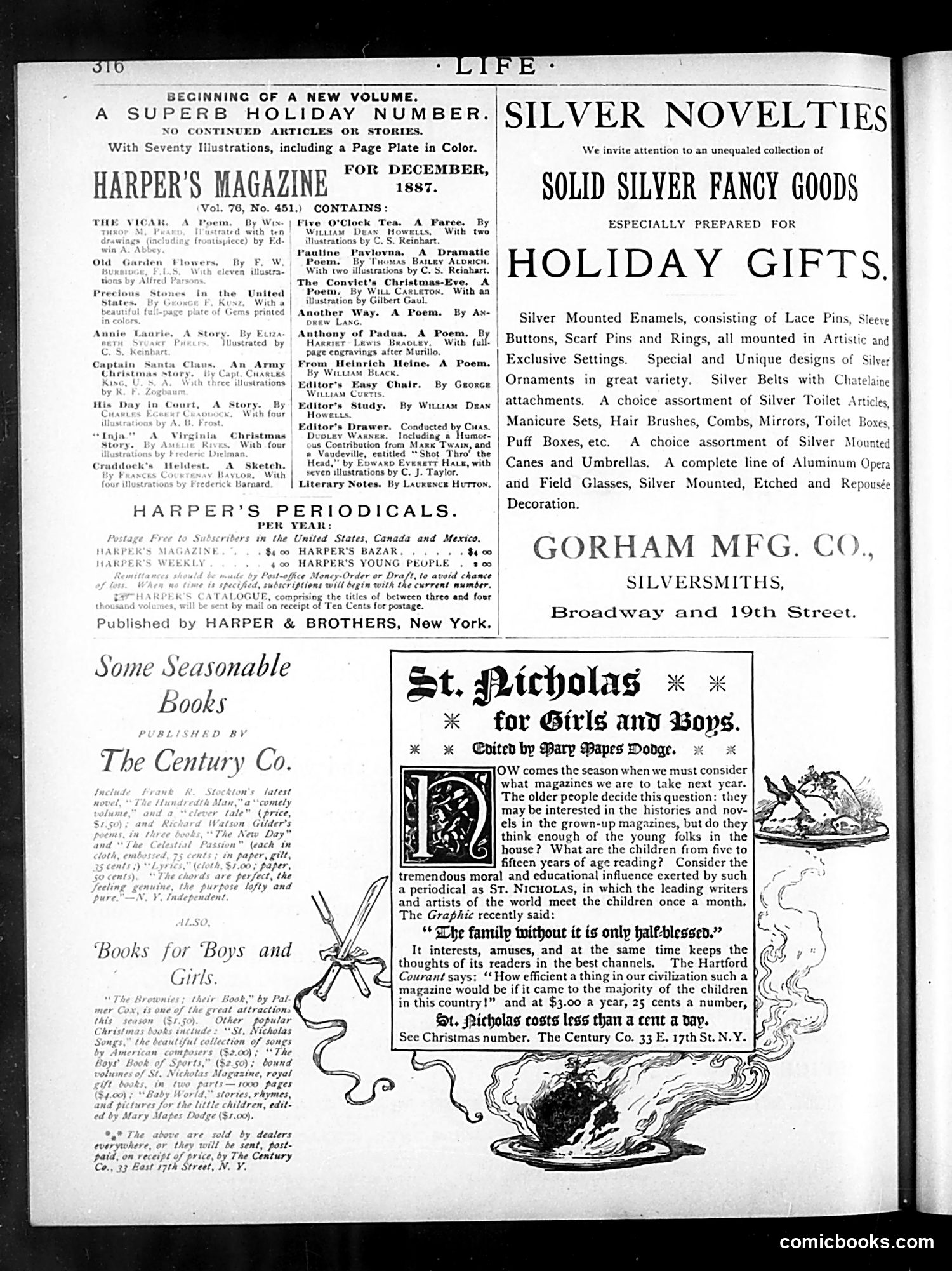
This page is primarily **advertising content** from December 1887's Harper's Magazine. The main visual element is a decorative illustration for *St. Nicholas* magazine, featuring ornamental scrollwork and a cherub or child figure emerging from clouds/smoke. The *St. Nicholas* advertisement emphasizes the magazine's moral and educational value for children, quoting the *Graphic*: "The family without it is only half blessed." It positions the publication as a superior alternative to other children's magazines, costing less than a cent per day. The other content consists of book and periodical advertisements from Harper & Brothers and The Century Co., promoting holiday gift options. This page reflects late-19th-century marketing strategies targeting middle-class families during the Christmas season.
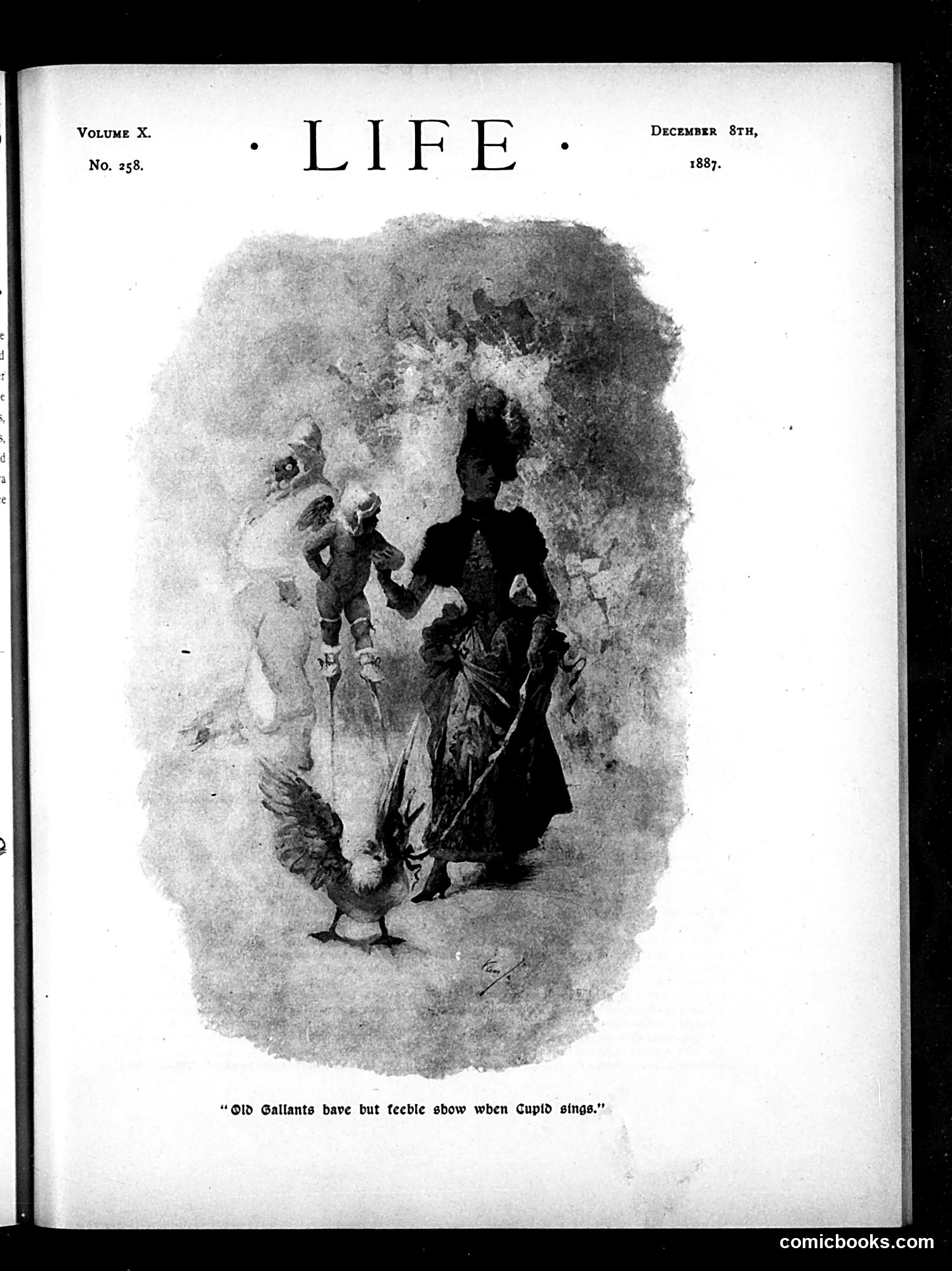
This satirical illustration depicts a woman in Victorian dress with a rooster displaying its tail feathers. The caption reads: "Old Gallante have but feeble above when Cupid sings." The cartoon appears to be a romantic or courtship satire, though the specific reference is unclear without additional context. The rooster likely functions as a symbol of male vanity or amorous display, while the woman represents a romantic interest. The implication seems to be commentary on male courtship behavior—perhaps mocking men who boast or "strut" during romantic pursuits, or suggesting that even confident suitors become timid when genuine romantic feelings emerge. The somewhat archaic phrasing of the caption makes the precise meaning difficult for modern readers to determine with certainty.
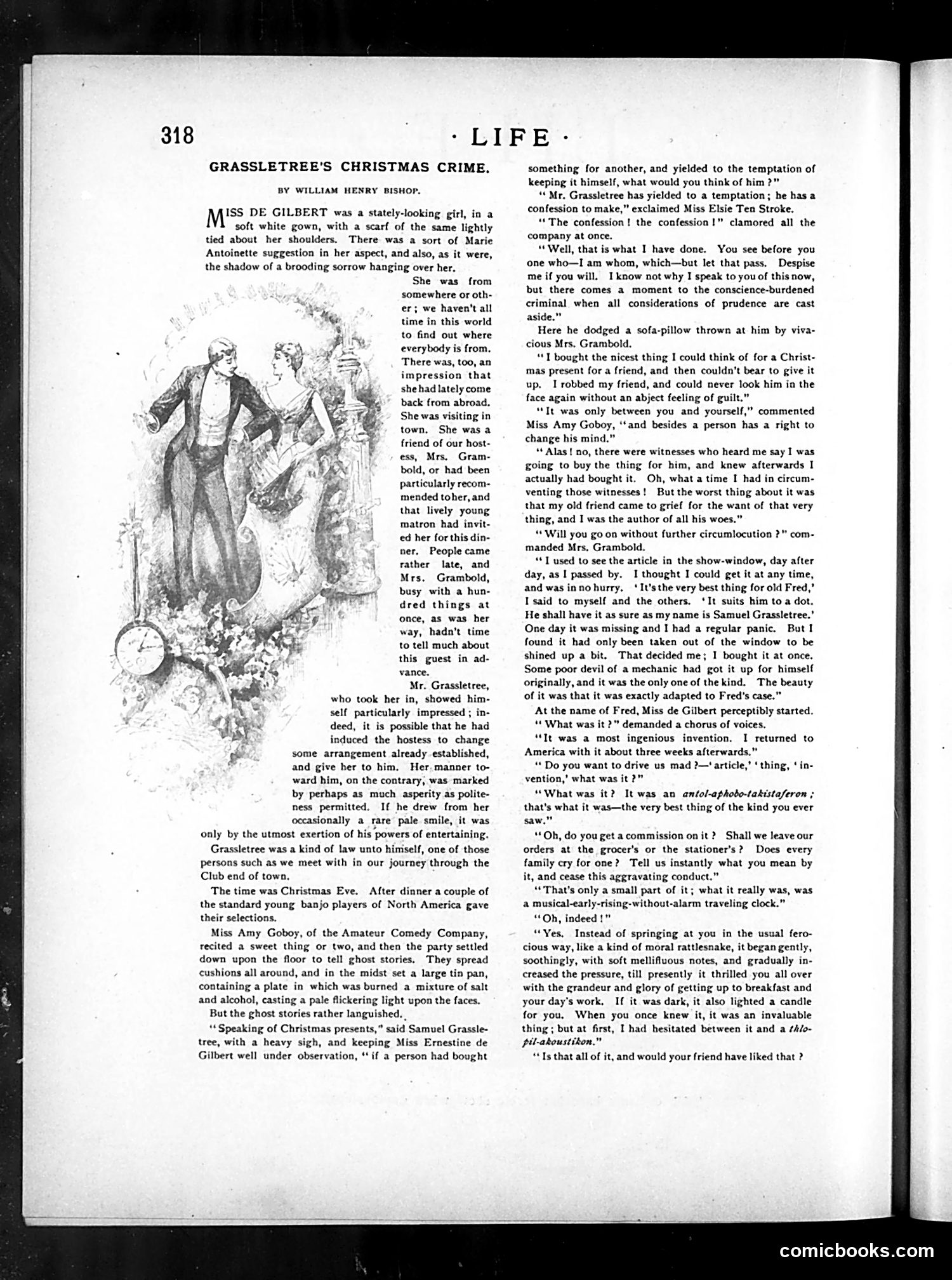
This page contains a story (not a political cartoon) titled "Grassletree's Christmas Crime" by William Henry Bishop. The narrative concerns Miss de Gilbert, a visiting young woman, and Mr. Grassletree, a wealthy host who becomes infatuated with her. The plot involves Grassletree purchasing an expensive musical clock as a Christmas gift for a friend, but then impulsively giving it to Miss de Gilbert instead. His confession to this theft creates social awkwardness. The story appears to satirize genteel Victorian social hypocrisy—how wealthy men rationalize selfish impulses through moral justifications, and how Christmas gift-giving can reveal character flaws beneath polished surfaces. The accompanying illustration shows period-appropriate holiday gathering scenes.
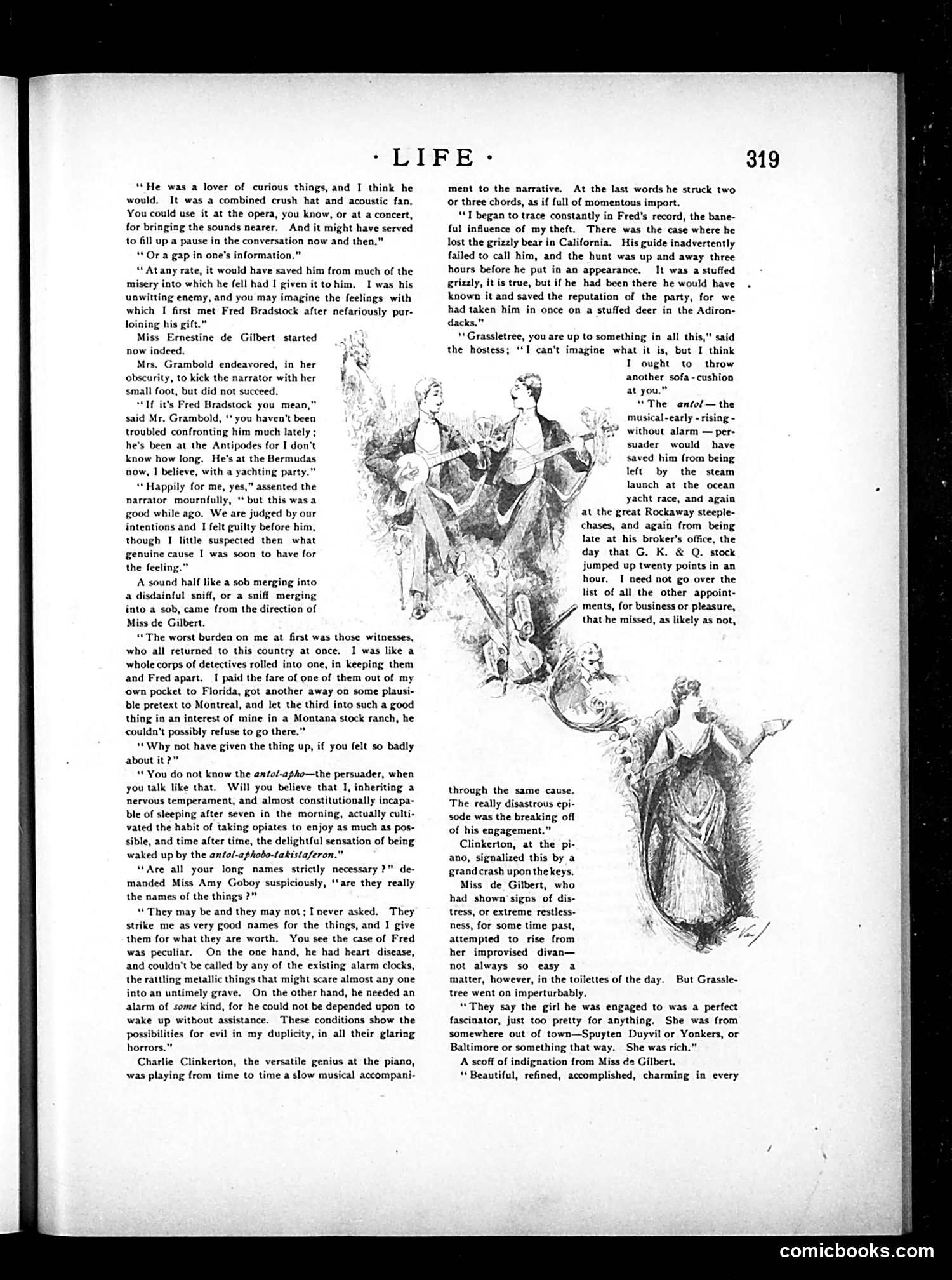
This page contains a serialized story with an accompanying illustration rather than political satire. The text discusses social observations about naming conventions and personal character—specifically debating whether formal names are necessary and discussing someone's temperament and habits (sleeping late, taking opium). The illustration shows three figures in what appears to be a social gathering or conversation scene, drawn in the period's characteristic sketch style. The content appears to be literary rather than satirical. Without additional context identifying the story's title, author, or characters, I cannot determine specific historical references or social commentary the narrative might contain. The discussion of opium use suggests this was published in an era when such references appeared casually in mainstream publications.
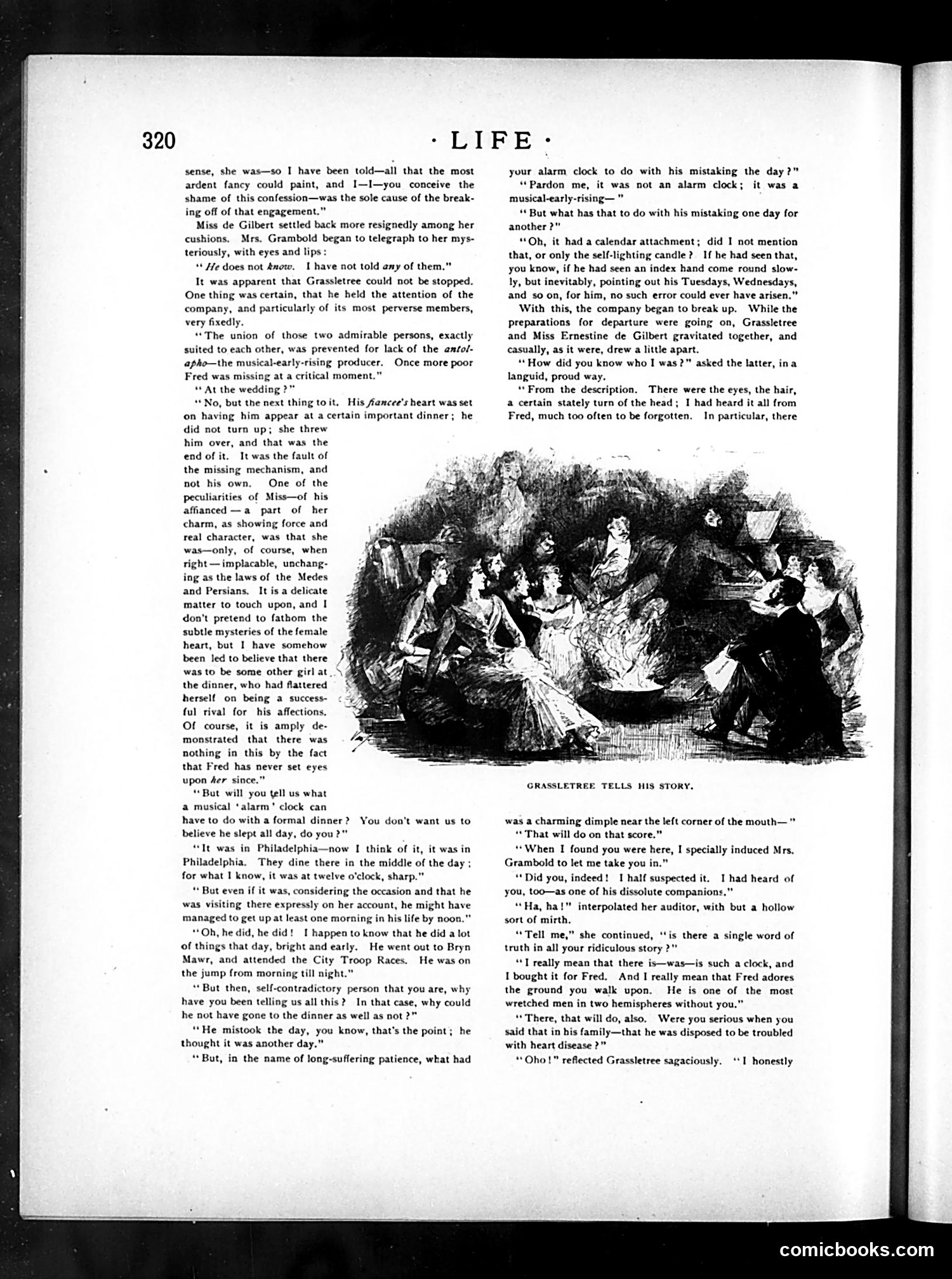
This page contains a literary excerpt rather than political satire or cartoons. The text discusses a dinner party incident involving characters named Miss de Gilbert, Fred, and Grassletree. The central illustration shows "GRASSLETREE TELLS HIS STORY"—a social gathering where a character explains a misunderstanding about a missed formal dinner in Philadelphia. The humor is social rather than political: Grassletree defends himself by explaining he attended the City Trooping Races instead, and the dialogue satirizes Victorian-era social etiquette and the absurdity of formal dinner expectations. The illustration depicts a drawing-room scene typical of period literature. This appears to be serialized fiction commentary rather than political cartoons, focusing on domestic social comedy.
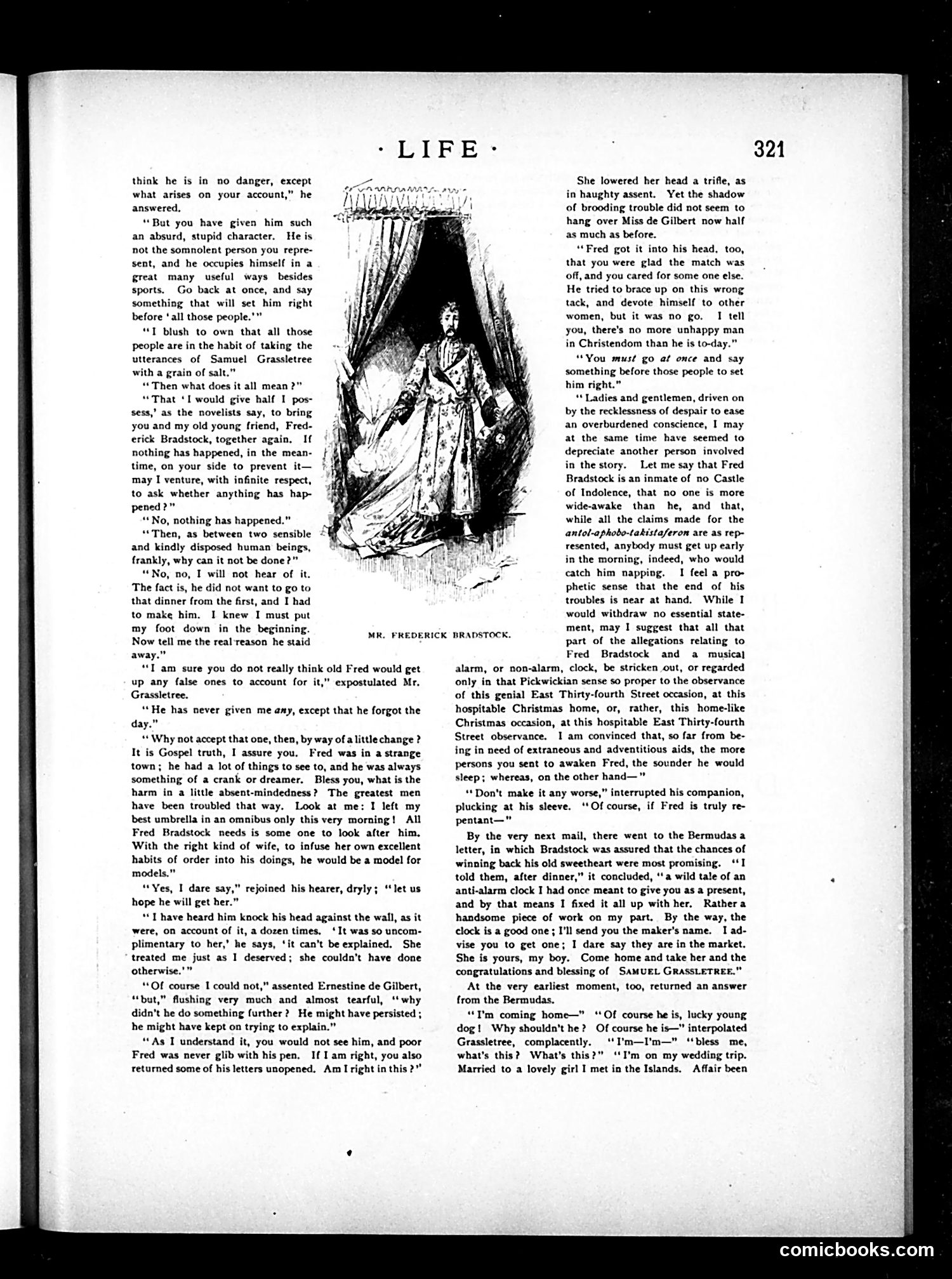
This page contains narrative fiction—a serialized story about romantic entanglement between Frederick Bradstock and Ernestine de Gilbert. The illustration shows a woman (likely Ernestine) in Victorian dress, seated pensively. The plot concerns a broken engagement. Samuel Grassletree attempts to mediate between the estranged couple, revealing that Fred's absence from a dinner was merely absent-mindedness, not indifference. Ernestine, initially proud and dismissive, softens when learning Fred is "the most unhappy man in Christendom." The satire appears aimed at Victorian courtship conventions: the wounded pride, the refusal to see each other, the unopened letters, and the elaborate social performance required to reconcile. Grassletree's pragmatic argument—that even great men are absent-minded—gently mocks the theatrical drama both parties have constructed around a simple misunderstanding. This is character-driven domestic comedy rather than political satire, typical of *Life*'s serialized fiction content.
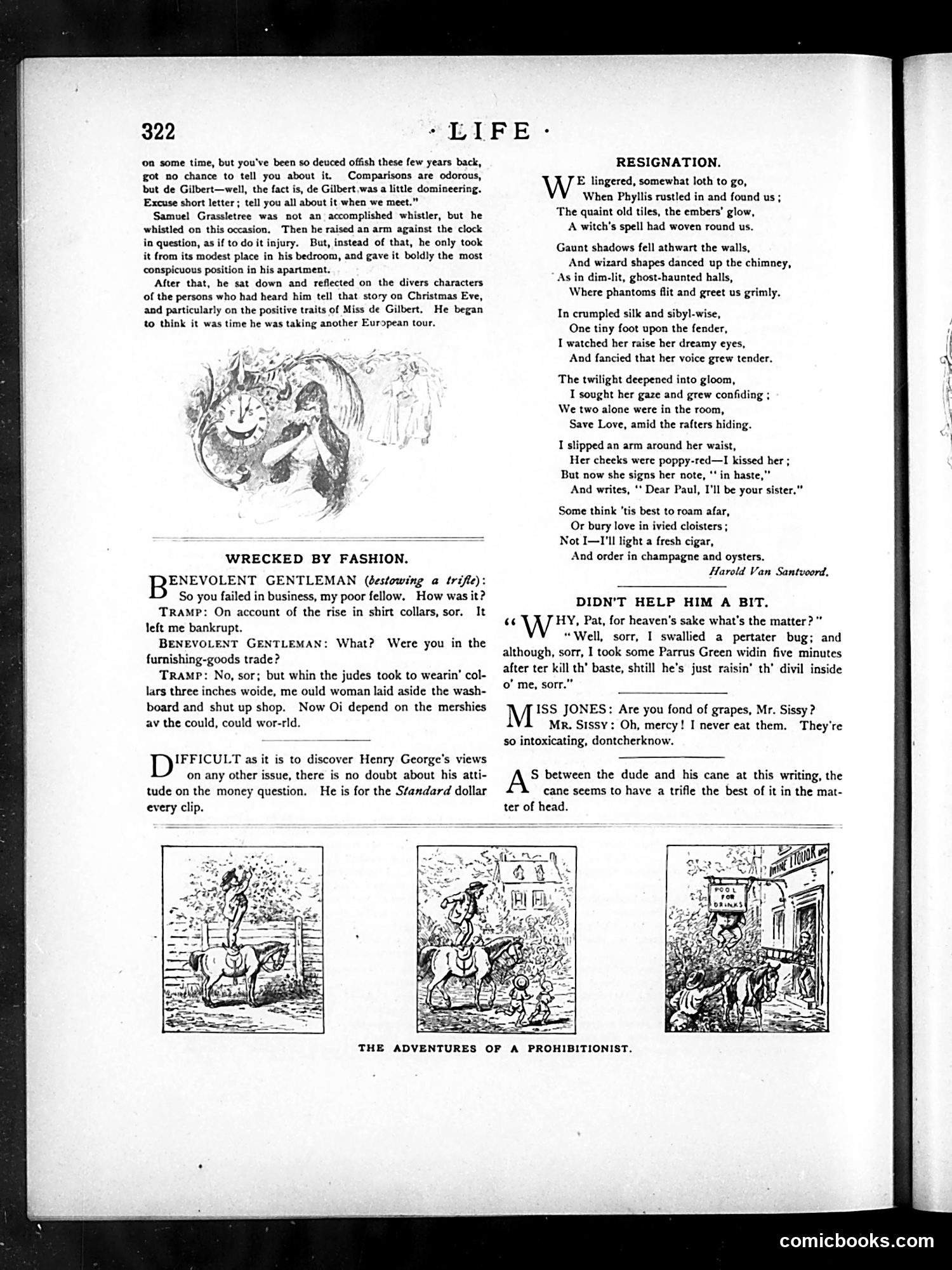
This page from *Life* magazine contains several distinct satirical pieces: **"Wrecked by Fashion"** mocks economic consequences of fashion trends. An Irish tramp explains his laundry business collapsed because judges adopted high starched collars (three inches wide), eliminating his wife's washing work. The satire targets how arbitrary fashion dictates can devastate working-class livelihoods. **"Didn't Help Him a Bit"** features two Irish-dialect jokes: one about a man who swallowed a potato bug and took Paris Green (pesticide) to kill it, and another where "Mr. Sissy" absurdly claims grapes are "intoxicating" to avoid eating them—mocking pretentious affectation. **A brief quip about dudes and canes** suggests the cane-carrying "dude" (fashionable idler) lacks intelligence ("the best of it in the matter of head"). **Three woodcut illustrations** labeled "The Adventures of a Prohibitionist" show a mounted man in various comic situations, likely satirizing anti-alcohol crusaders. The page reflects *Life's* humor targeting fashion excess, class pretension, and social movements of the era.
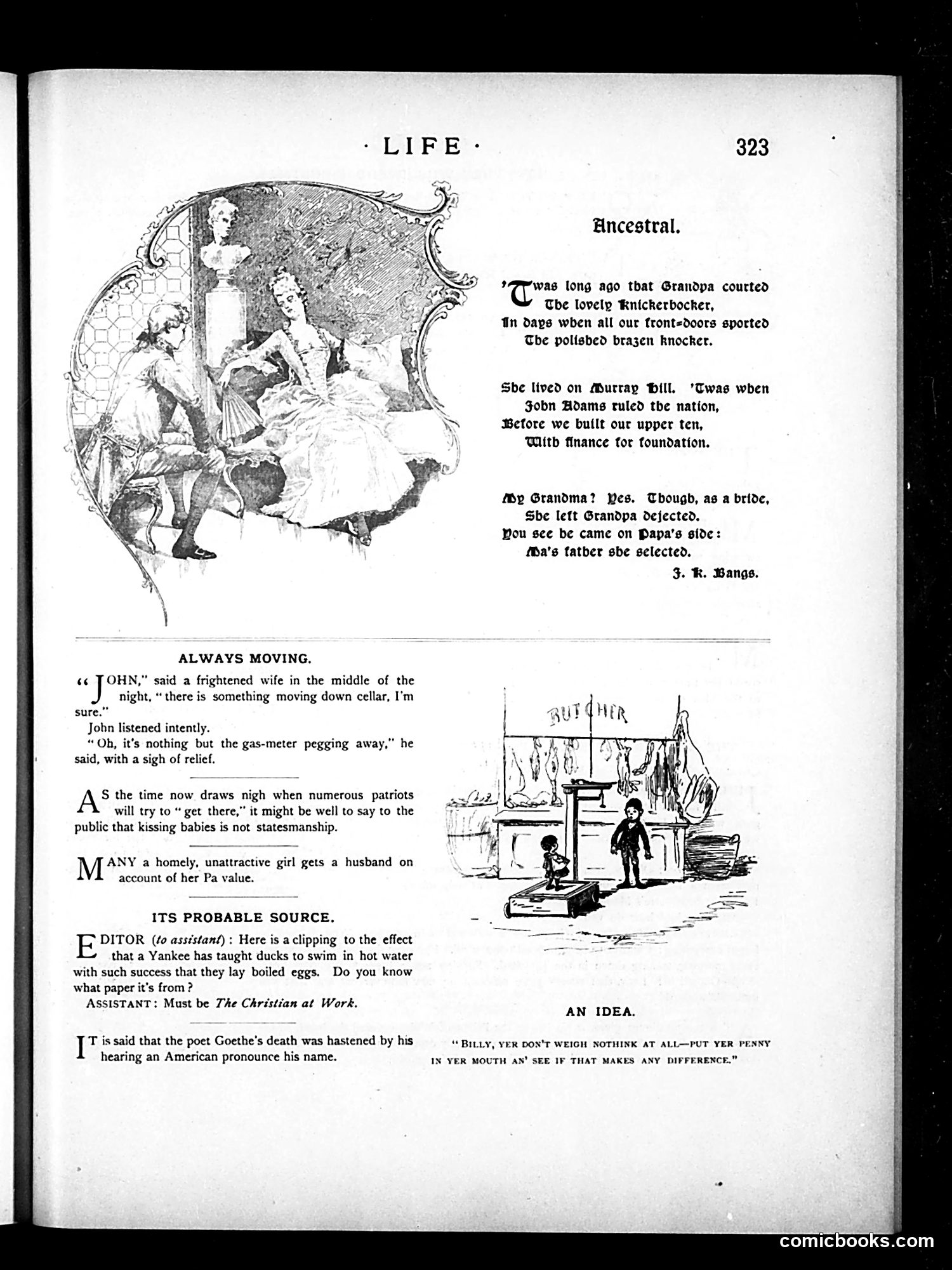
This satirical page contains several brief humor pieces typical of early 20th-century *Life* magazine: **"Always Moving"** jokes about a wife's alarm at cellar noise—relieved when her husband identifies it as merely a gas meter. The humor is domestic and gentle. **The Political Jab** mocks politicians who court public favor by kissing babies, calling this not genuine statesmanship—likely referencing campaign tactics of the era. **"Its Probable Source"** satirizes sensationalist newspaper reporting through an editor and assistant discussing an absurd story about ducks laying boiled eggs. The joke: attributing it to *The Christian at Work*, suggesting that publication prints implausible stories. **"Ancestral"** is a poem (credited to J.R. Bangs) mocking pretentious family histories—Grandpa lost his bride to her father's superior social standing on Manhattan's prestigious Murray Hill. **"An Idea"** shows two figures discussing a weighing scale, making a joke about weight and currency (a penny). All pieces reflect *Life*'s satirical focus on contemporary American social manners and pretensions.
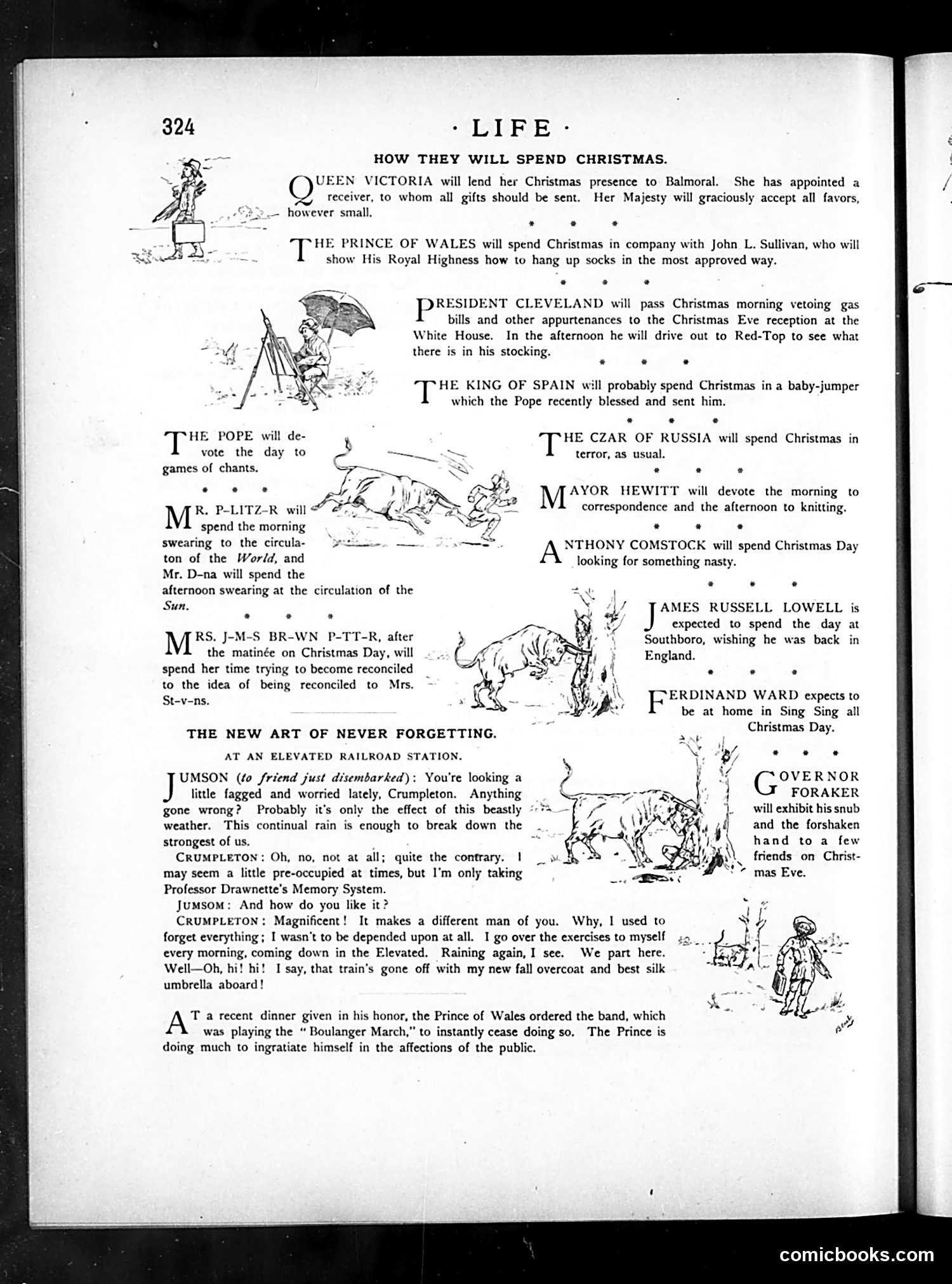
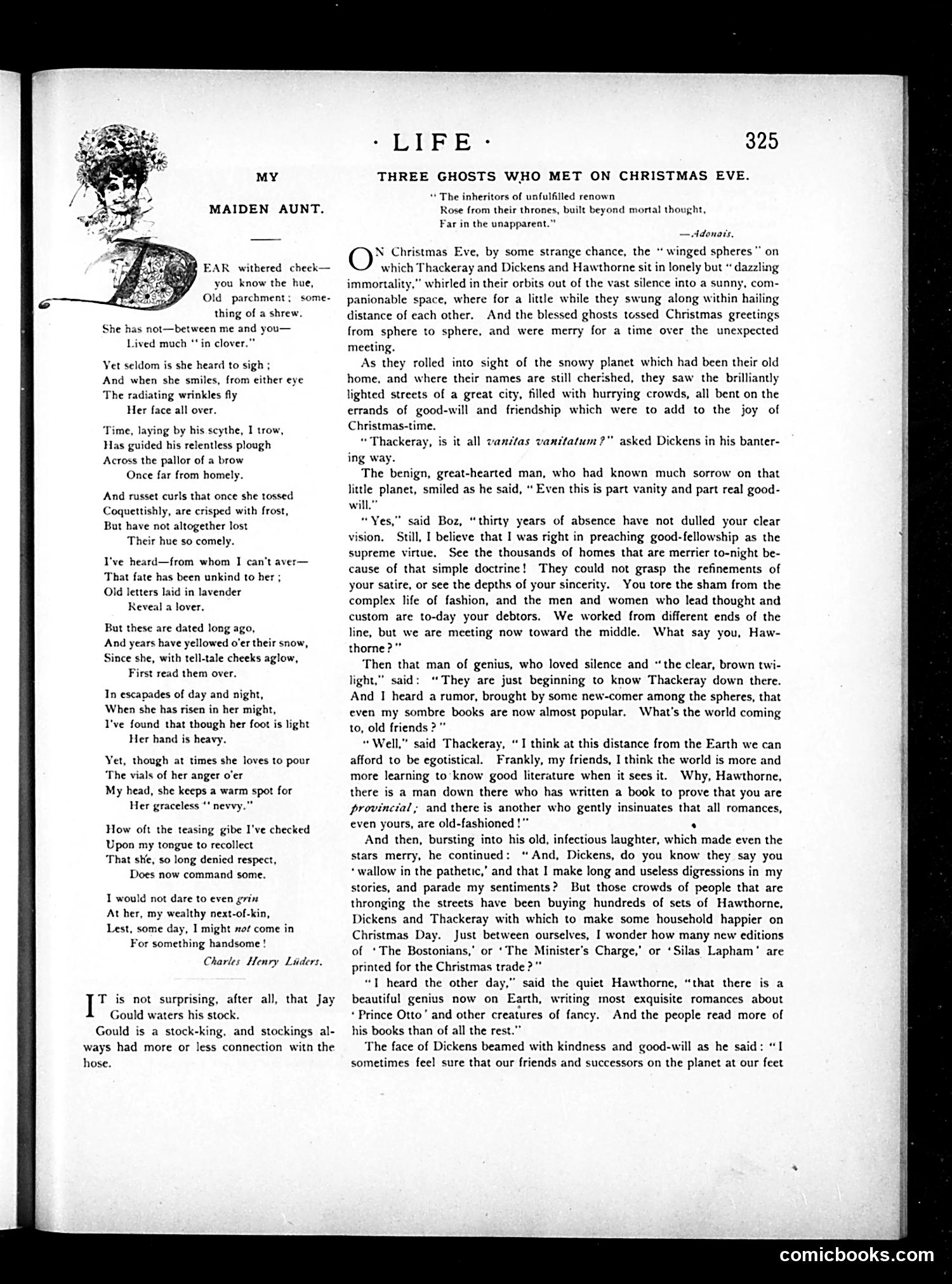
This is a sentimental literary piece featuring three deceased authors—**Thackeray, Dickens, and Hawthorne**—conversing as ghosts on Christmas Eve. They observe Earth from the afterlife and discuss their legacies. The piece celebrates how their works have influenced society: Dickens's emphasis on "good-fellowship" has made homes merrier; Thackeray's satirical exposure of sham in high society has changed behavior among the fashionable elite; even Hawthorne's "sombre books" have become popular. This reflects **19th-century reverence for literature as a moral force**. The conversation serves as homage to these writers' cultural impact—suggesting their ideas continue shaping human behavior and Christmas sentiment on Earth. It's essentially fan fiction about dead literary giants whose influence transcends mortality.
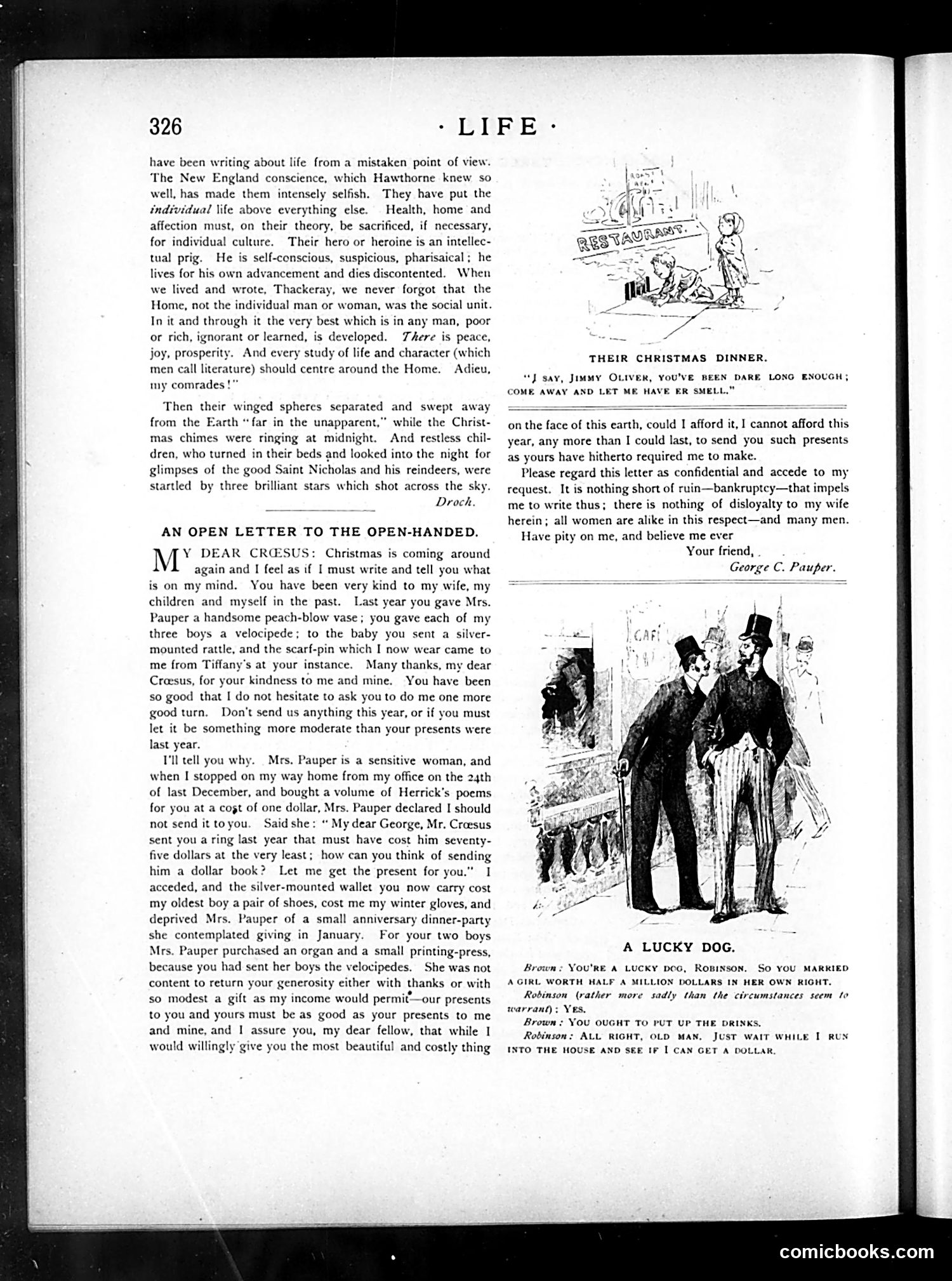
This page contains two satirical pieces mocking middle-class anxieties around wealth and social obligation. **"An Open Letter to the Open-Handed"** features a fictional letter from "George C. Pauper" to a wealthy man called "Croesus" (classical reference to an ancient king symbolizing extreme wealth). Pauper begs his rich patron *not* to send expensive gifts, as the obligation to reciprocate with equally lavish presents is bankrupting his family. His wife spent money meant for shoes and gloves to buy Croesus an expensive wallet in response to his previous gifts. The satire targets the competitive status anxiety of the middle class—how generosity creates a crushing cycle of obligation. **"A Lucky Dog"** (bottom cartoon) shows gentlemen in top hats discussing a dog who married a wealthy woman. The joke plays on the notion that marrying money is itself a "lucky" social transaction, treating matrimony as a financial arrangement rather than romantic union. Both pieces satirize how money and social positioning dominated Victorian life, even poisoning acts of kindness and personal relationships.
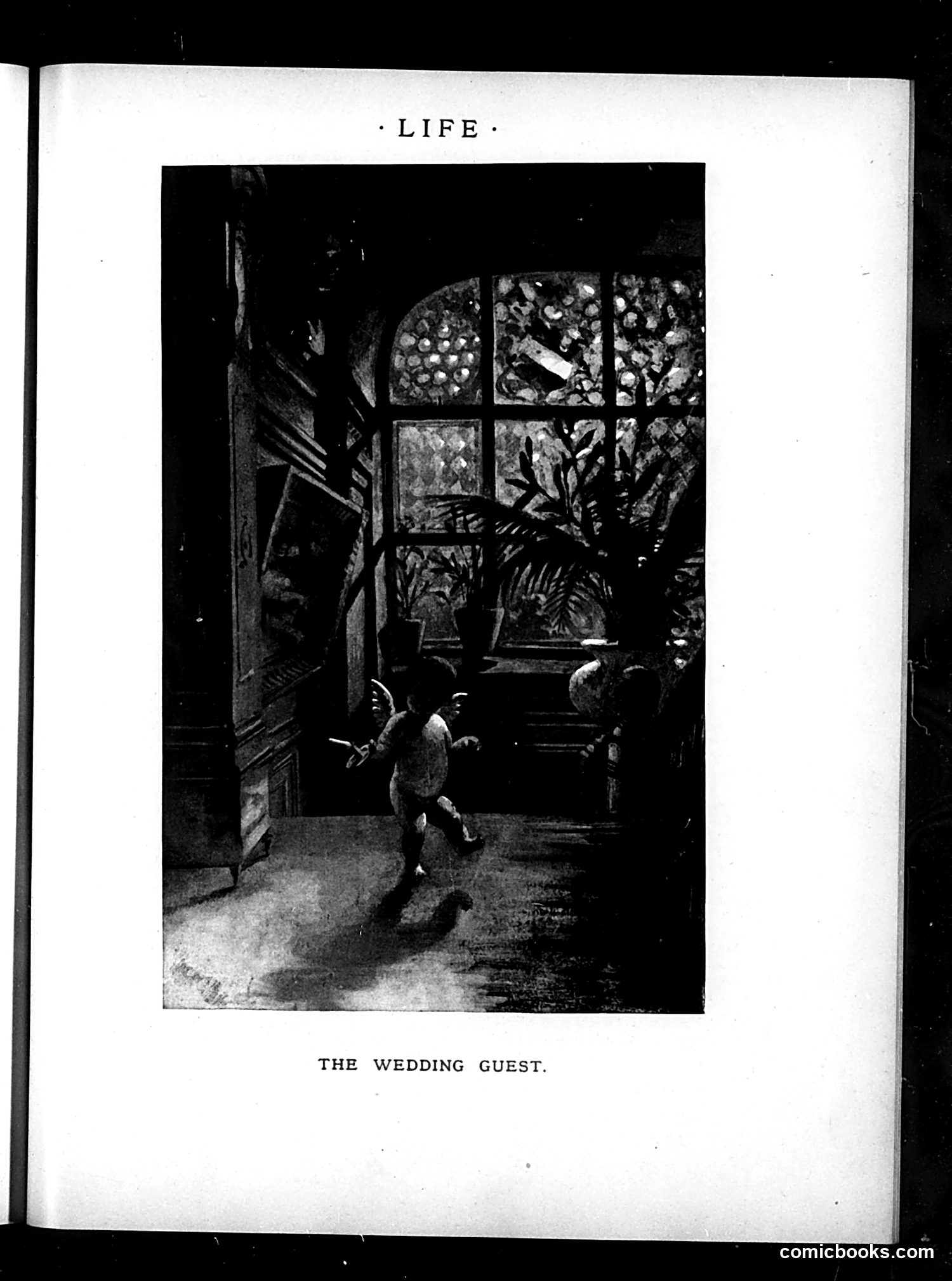
This illustration shows a figure peering through a window at what appears to be an indoor garden party or wedding reception. The image is rendered in stark black and white with dramatic shadows. The caption "THE WEDDING GUEST" suggests satirical commentary, likely about someone uninvited or unwelcome observing a social event from outside. The voyeuristic composition—looking through a grid of windowpanes—emphasizes the figure's exclusion from the interior gathering. Without additional context about the publication date or specific figures, the precise satirical target remains unclear. However, the composition and title suggest commentary on social class, exclusion, or perhaps an unwanted observer at an important social occasion. The dramatic lighting and compositional choices emphasize themes of separation and outsider status.
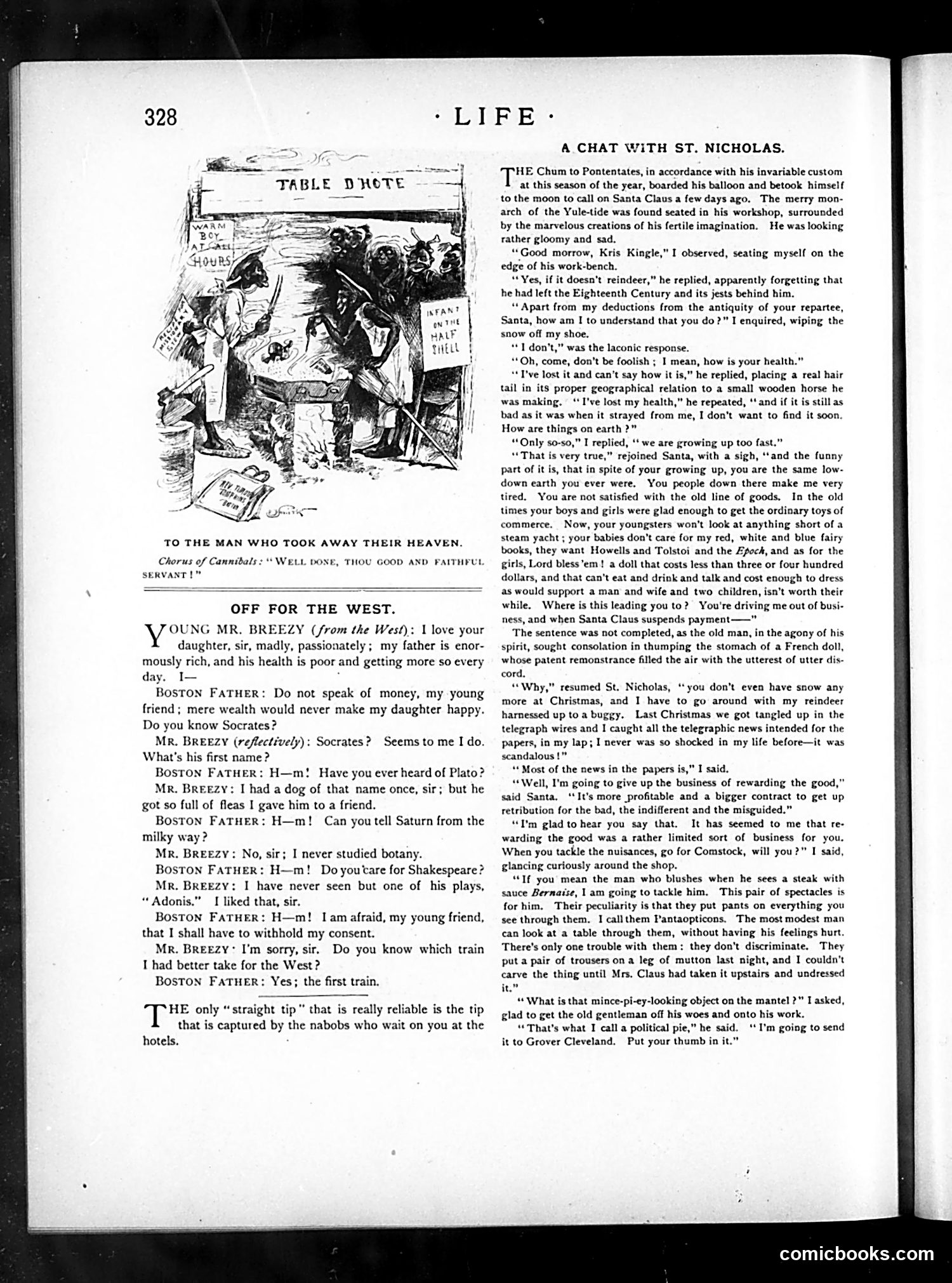
This page contains two unrelated satirical pieces typical of *Life* magazine's humor: **Top cartoon** ("Table d'Hôte"): A dark colonial-era image showing cannibals praising "the man who took away their heaven"—likely satirizing missionaries or colonial powers who disrupted indigenous cultures while claiming moral superiority. **"Off for the West"** dialogue: A Boston father interrogates a wealthy Western suitor seeking his daughter's hand. The joke: the father tests the man's education (Socrates, Plato, Shakespeare) to ensure he's worthy, but the suitor reveals profound ignorance—confusing philosophers with pets and plays with "Adonis." Rather than reject him for being uncultured, the father rejects him for being a Westerner, suggesting regional prejudice. The suitor's easy escape to "the West" implies the father's snobbery has limits. **"A Chat with St. Nicholas"**: Santa complains that modern children are spoiled and materialistic—demanding steam yachts and expensive dolls instead of simple toys—threatening his business model. This reflects genuine Gilded Age anxieties about consumer culture and children's changing values.
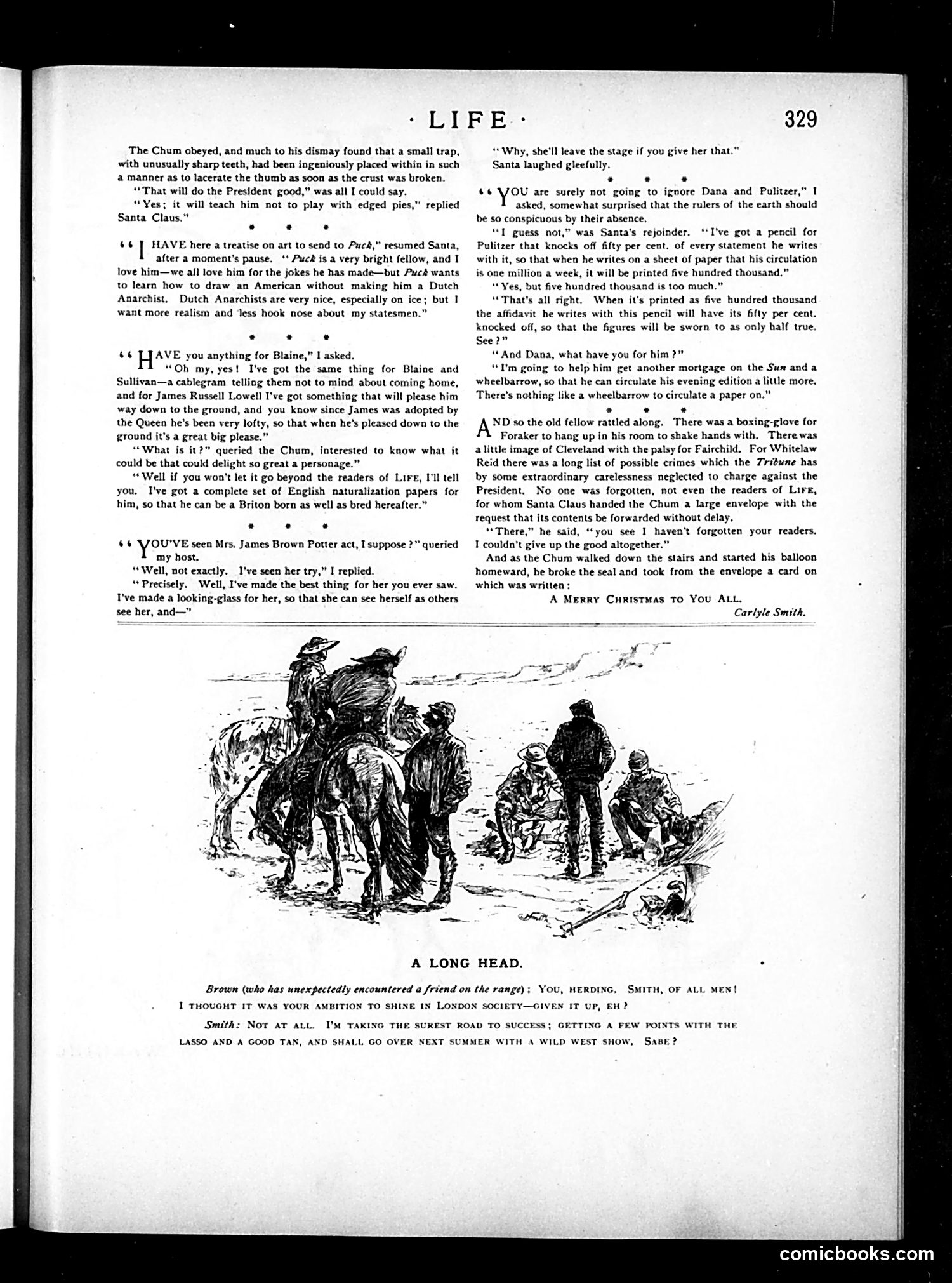
This page presents Santa Claus distributing satirical "gifts" to prominent American figures of the era. The cartoon at bottom ("A Long Head") depicts Brown encountering Smith on the range, discussing ambitions for London society versus Western success. The main text mocks public figures through gift suggestions: - **President** (likely Chester Arthur): a trap to teach him restraint - **Puck magazine**: instruction in drawing Americans without antisemitic caricatures ("hook nose") - **James G. Blaine**: told to stay away - **James Russell Lowell**: English naturalization papers (mocking his aristocratic pretensions after Queen Victoria's favor) - **Mrs. James Brown Potter**: a mirror (implying she lacks self-awareness as an actress) - **Pulitzer**: a pencil that reduces circulation claims by 50% (satirizing exaggerated circulation numbers) - **Dana** (likely of the *Sun*): a wheelbarrow for distribution The satire targets journalistic dishonesty, political vanity, and social pretension among the era's elite.
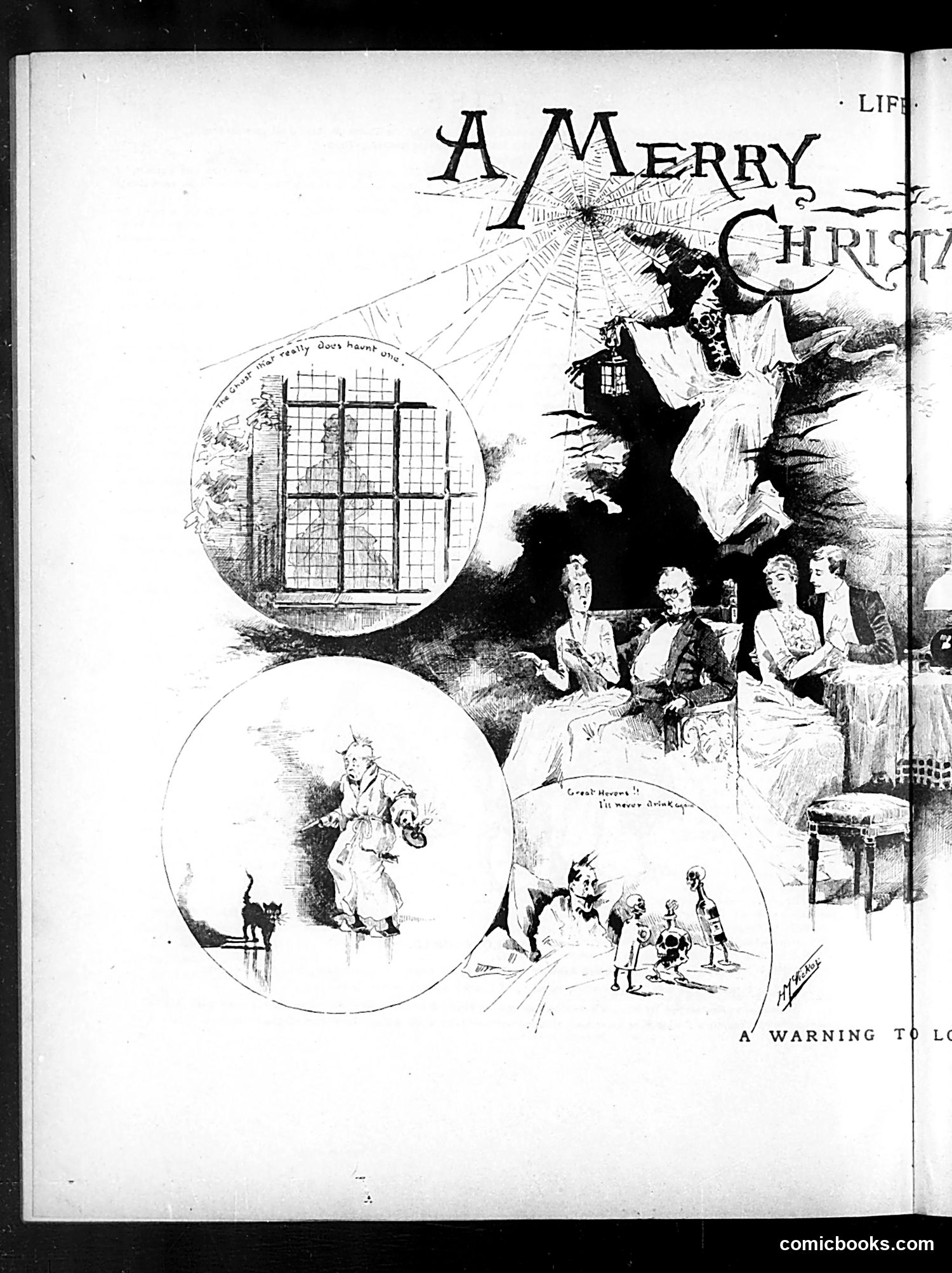
This appears to be a Christmas-themed satirical illustration from *Life* magazine. The page shows supernatural/ghostly scenes arranged in circular vignettes, likely referencing *A Christmas Carol* by Dickens—a common literary touchstone for Victorian-era social commentary. The main image depicts a woman in a haunted house confronted by spectral figures, while below, separate scenes show what appear to be warnings or moral lessons (one figure with a small black animal, another with children). The caption "A Warning to Loafers" suggests the satire targets idle or unemployed men, using Christmas ghost imagery as moral instruction—typical of *Life*'s approach to social criticism. The illustration style and composition mock both pretentious supernatural tales and middle-class moralizing about work and virtue, though specific figures remain unclear.
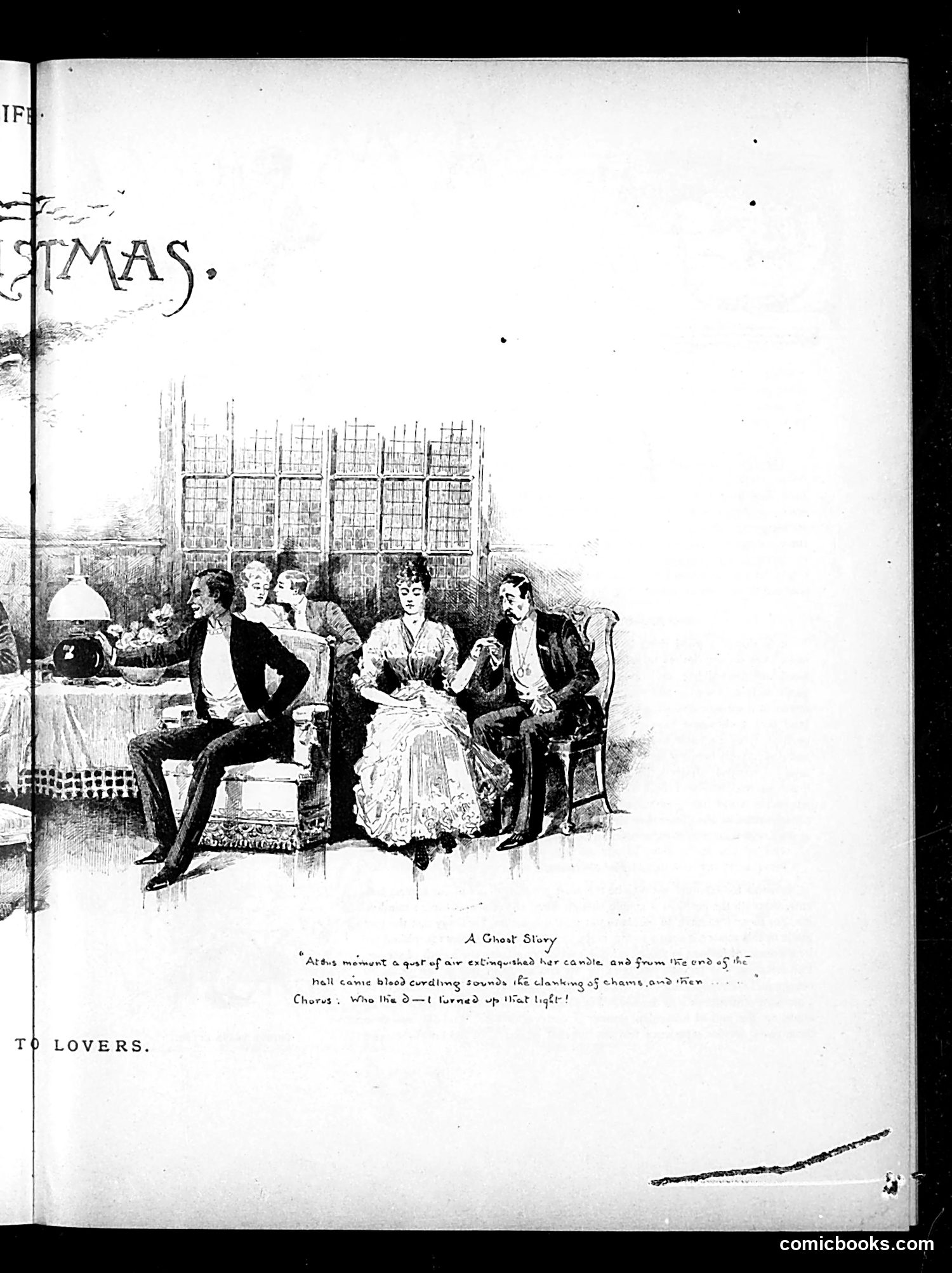
This page contains a satirical illustration titled "A Ghost Story" depicting a parlor scene with five Victorian-era figures reacting to supernatural disturbances. The sketch shows people seated indoors while mysterious sounds—"blood curdling sounds," "clanking of chains"—occur offstage, with the chorus asking "Who the D— turned up that light?" The satire appears to mock Gothic horror conventions popular in Victorian literature and theatrical productions. The joke centers on the anticlimax: rather than a genuinely terrifying ghost, the supernatural mystery is resolved by mundane electric lighting, suggesting that modern technology (electric lights) dispels both literal and figurative darkness—including the theatrical/literary mystique of ghost stories themselves. The heading "TO LOVERS" at bottom suggests this appears in a section of *Life* magazine addressing romantic or domestic audiences, likely positioning the satire as genteel humor for educated readers familiar with Gothic genre tropes.
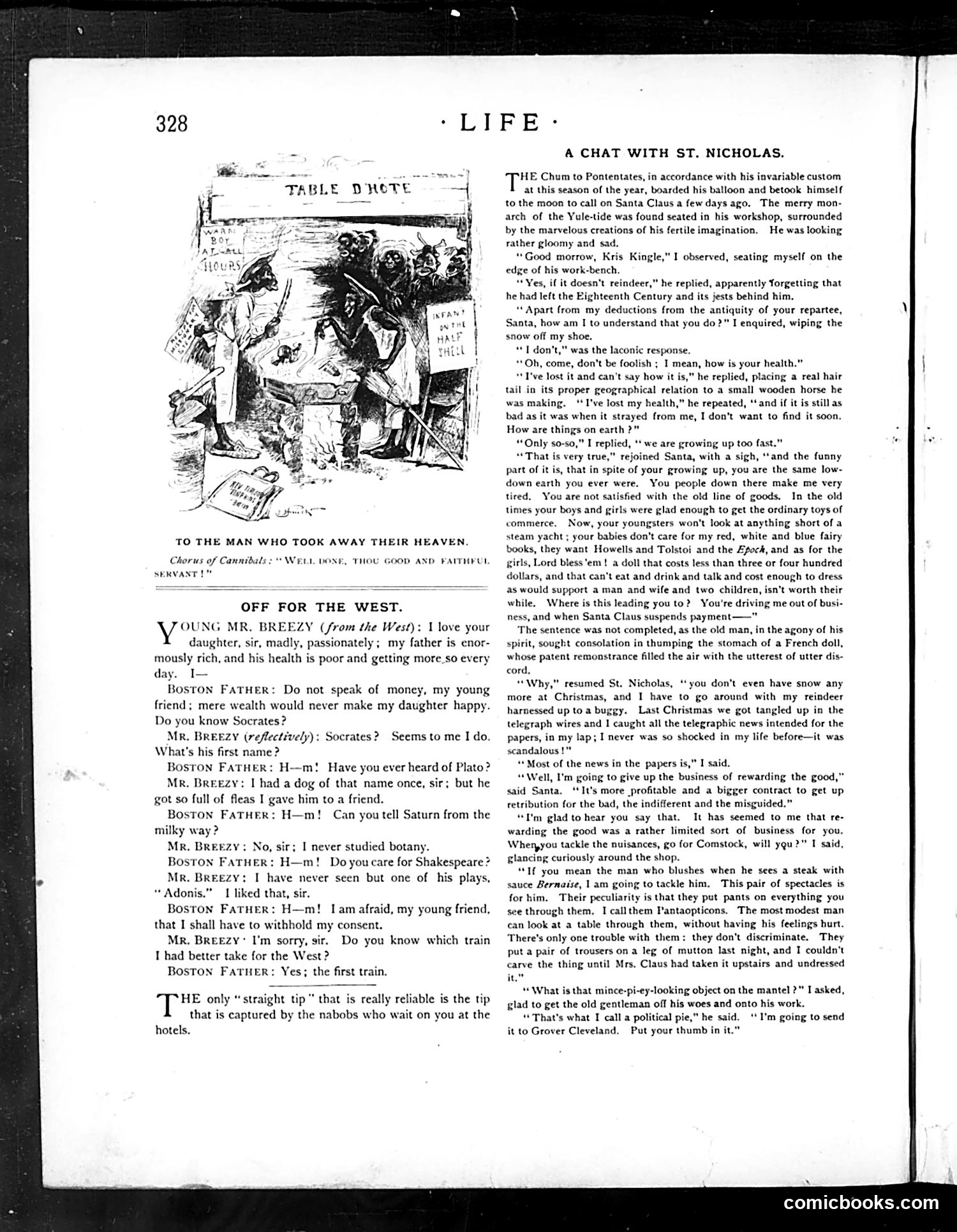
This page contains two separate satirical pieces from *Life* magazine: **"Off for the West"** mocks a wealthy but intellectually vapid young man seeking to marry a Boston intellectual's daughter. Mr. Breezy cannot answer basic questions about philosophy (Socrates, Plato), astronomy (Saturn), or literature (Shakespeare), revealing the emptiness of nouveau riche Western wealth. The Boston Father rightfully rejects him, exposing the satire's class anxiety: money alone cannot substitute for education and culture. **"A Chat with St. Nicholas"** presents Santa Claus complaining that American children have become materialistic and ungrateful. They demand expensive luxury goods (steam yachts, elaborate dolls) rather than simple toys, driving Santa toward bankruptcy. This reflects Gilded Age anxieties about consumer excess and moral decline among the young, blaming materialism for corrupting traditional American values. Both pieces critique wealth without virtue or restraint.
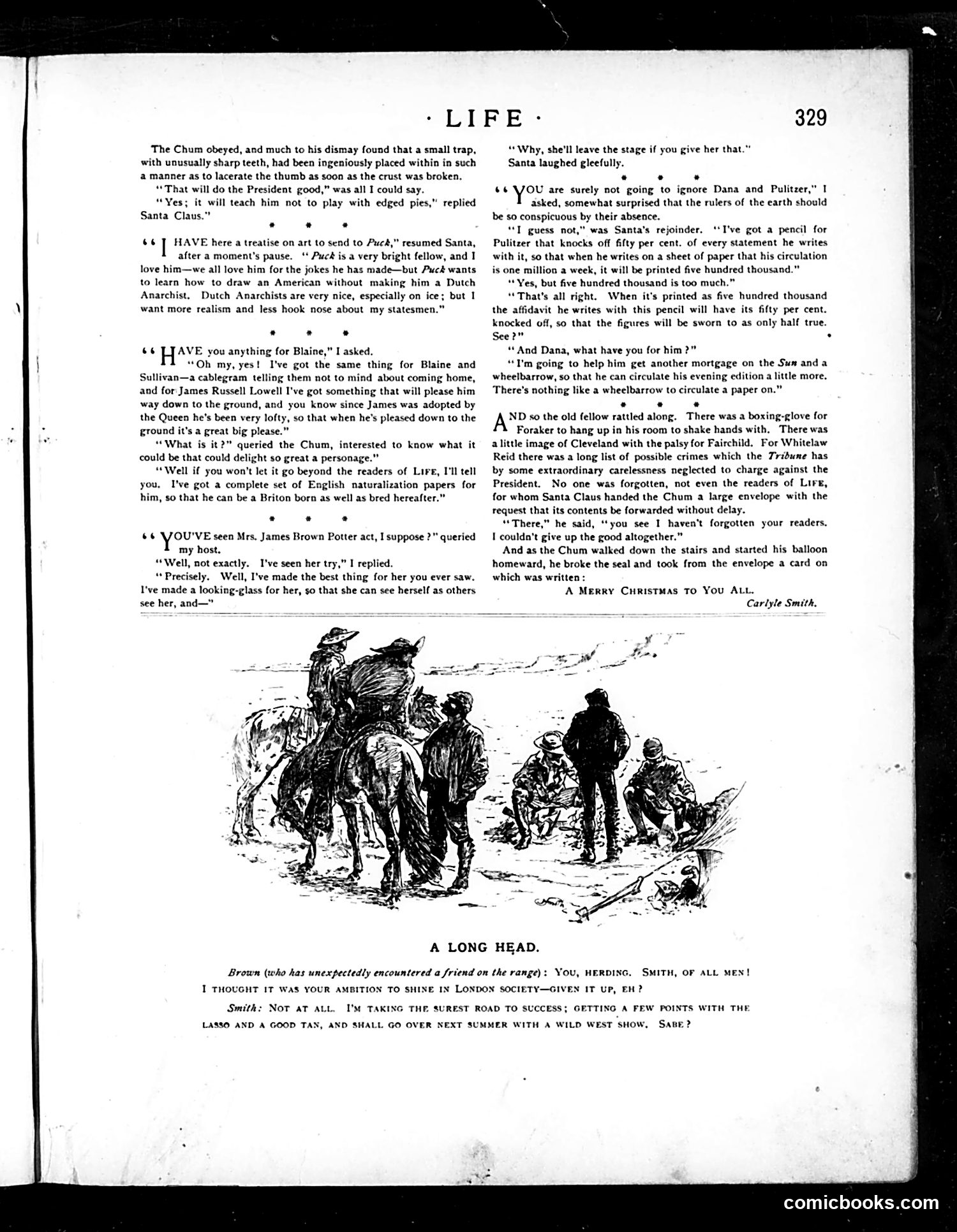
This is a Christmas-themed satirical piece targeting prominent late-19th-century American political and media figures. Santa Claus delivers mock "gifts" that mock each person's perceived flaws: **Key targets include:** - **The President** (likely Cleveland): A trap symbolizing consequences for rash decisions - **Pulitzer and Dana**: Newspaper editors mocked for exaggerating circulation figures; the magic pencil that reduces claims by 50% satirizes their inflated reporting - **Blaine and Sullivan**: Told not to return home (unclear specific reference) - **James Russell Lowell**: Criticized for becoming too British/aristocratic after being "adopted by the Queen" - **Mrs. James Brown Potter**: An actress given a mirror, suggesting her performances are poor - **Foraker**: A boxing glove for "shaking hands," likely referencing corrupt patronage - **Whitelaw Reid**: The Tribune criticized for ignoring presidential crimes The cartoon's bottom panel shows frontier/Western figures, possibly illustrating one of the gift scenarios. The satire's point: mocking media dishonesty, political corruption, and affected pretension among America's elite.
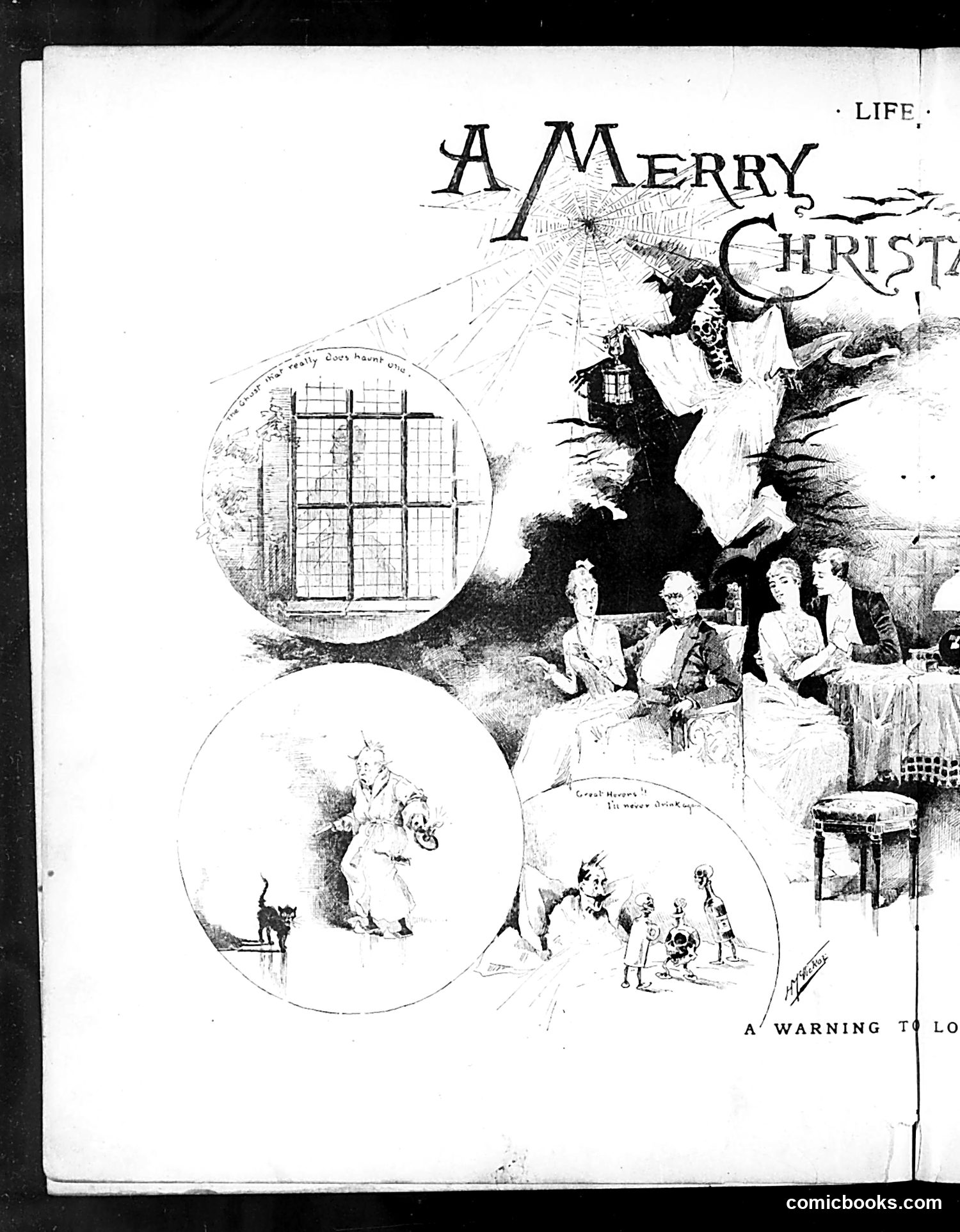
This is a Christmas-themed satirical page featuring multiple vignettes in circular frames. The title "A Merry Christmas" appears at top, with "A Warning to Lo[vers]" partially visible at bottom. The page depicts various Victorian-era domestic scenes: people dining together, a figure in winter clothing with a cat, and children playing. The circular frame design was a common compositional device in period illustration. Without clearer image resolution and full OCR text, the specific satirical targets are difficult to identify with certainty. The "warning" reference suggests social commentary, likely about holiday conduct or domestic situations. The style is consistent with 1880s-1890s *Life* magazine's mix of social observation and gentle morality-focused humor aimed at middle-class readers.
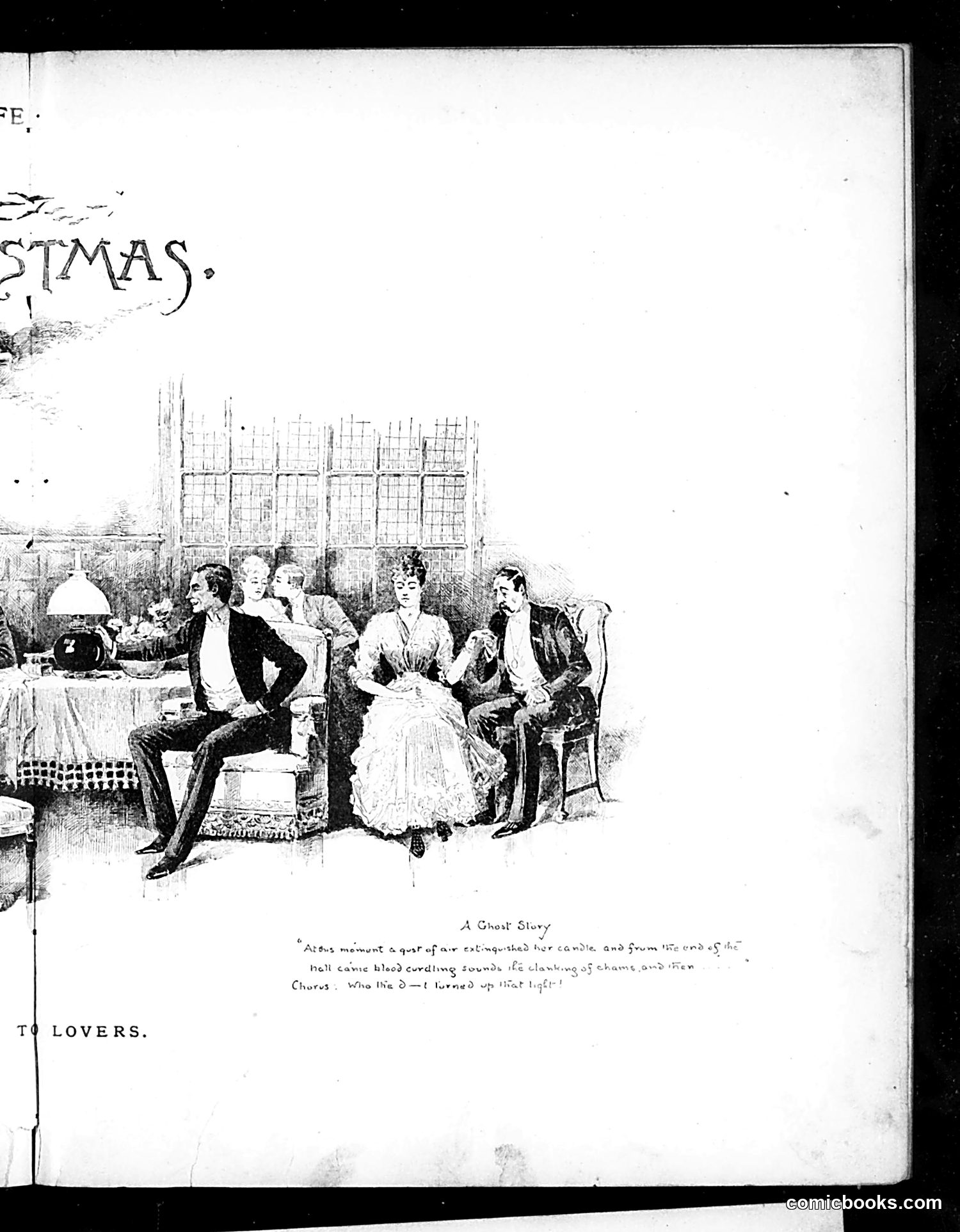
This page appears to be from Life magazine's Christmas or holiday section (indicated by "STMAS" at top, likely "Christmas"). The illustration depicts a Victorian-era parlor scene with five well-dressed people gathered indoors, with large windows behind them. The caption reads "A Ghost Story," suggesting this is a humorous domestic scene, likely playing on the popular Victorian tradition of ghost stories told during holiday gatherings. The OCR text is too degraded to read clearly, but the illustration appears to satirize genteel society's fascination with supernatural tales—a common subject for satirical commentary in the era. The page footer references "TO LOVERS," suggesting this may be part of a broader satirical piece about courtship or romantic encounters. Without clearer text, the specific social commentary remains unclear, but it likely mocks Victorian sensibilities around entertainment and socializing.
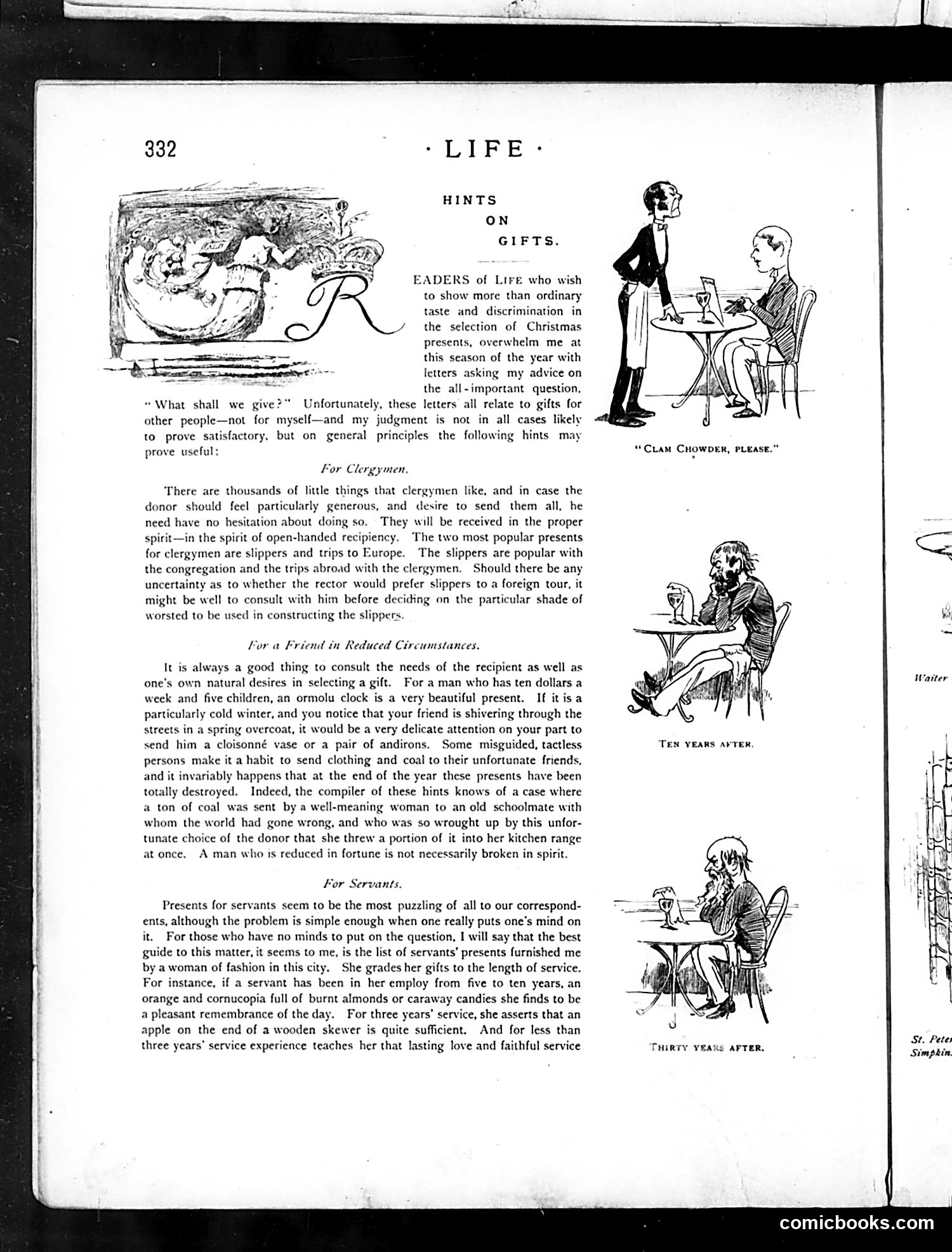
This is a satirical advice column about Christmas gift-giving, using humor to critique class attitudes and social pretension. The author mocks wealthy readers who ask for gift advice while revealing their own cluelessness about others' circumstances. The satire targets: **For Clergymen**: Jabs at both clergy (eager to accept expensive trips abroad) and congregations (who prefer practical slippers). **For Friends in Reduced Circumstances**: Viciously satirizes tone-deaf wealthy donors who give *ornamental* gifts (ormolu clocks, cloisonné vases) to struggling people, rather than useful ones like coal or clothing. The anecdote about a woman throwing coal into her kitchen range mocks both the donor's insensitivity and the recipient's pride. **For Servants**: The cruelest section—a "woman of fashion" grades servant gifts by tenure: burnt almonds after 5-10 years, an apple on a skewer after 3 years. This reveals callous indifference to servant welfare, presented as normal practice. The illustrations show these gift scenarios. The entire piece satirizes class blindness and performative generosity among the wealthy.
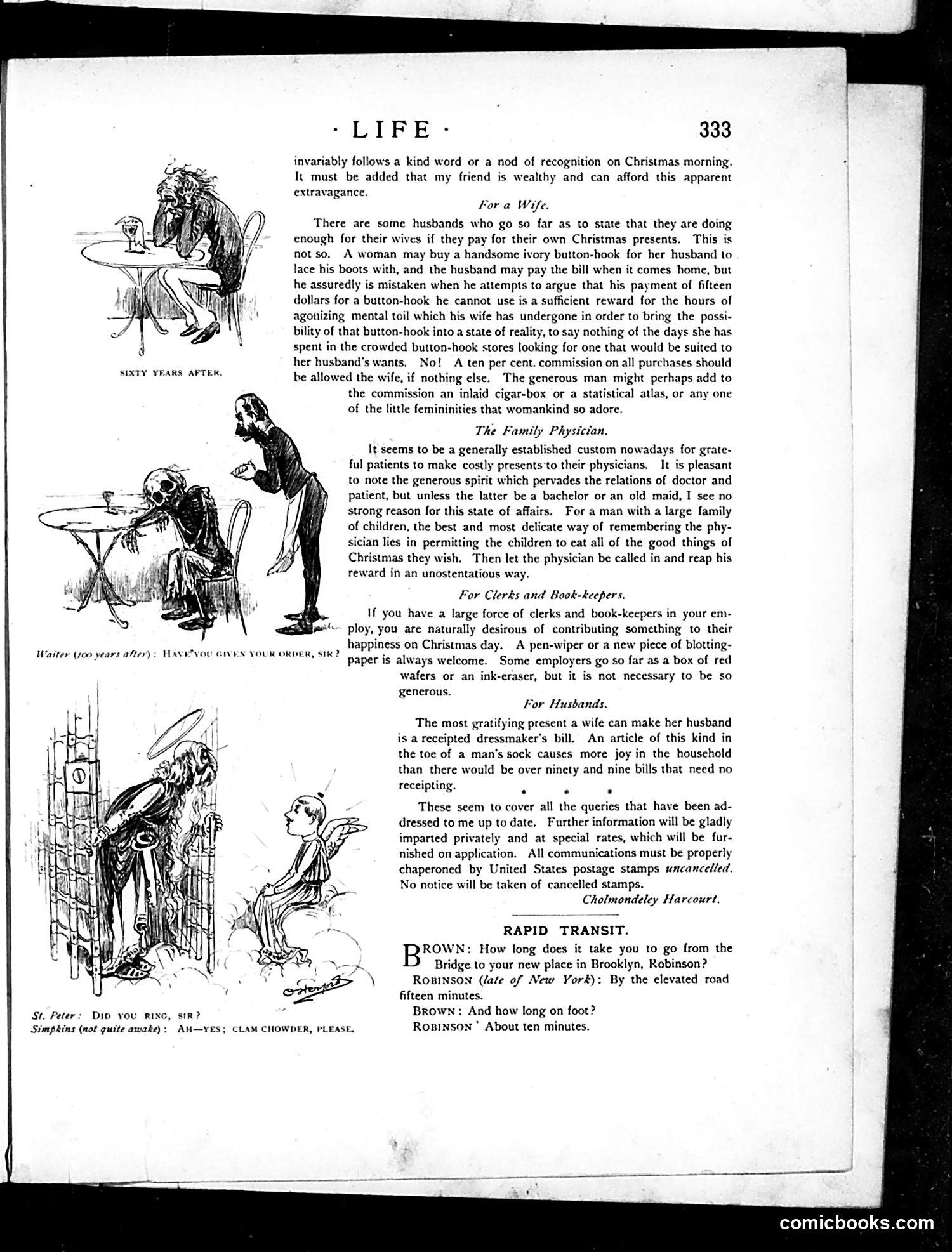
This page from *Life* magazine contains humor essays about appropriate Christmas gifts for different social relationships. The author (Cholmondeley Harcourt) satirizes both excessive generosity and stingy behavior among the wealthy. The main targets are husbands who believe paying for wives' gifts suffices as their own present, and those who give cheap token gifts to employees. The satire mocks middle-class anxieties about proper etiquette: wives deserve compensation for shopping effort, doctors should receive payment only from bachelors (working fathers have other obligations), and clerks should accept minimal gifts like pen-wipers. The cartoons (four sketched scenes) illustrate these scenarios with exaggerated domestic and social interactions. The "Rapid Transit" joke at bottom is unrelated—a pun about travel times to Brooklyn. The humor assumes readers recognize class-specific gift-giving conventions of the era, where proper generosity signaled social status.
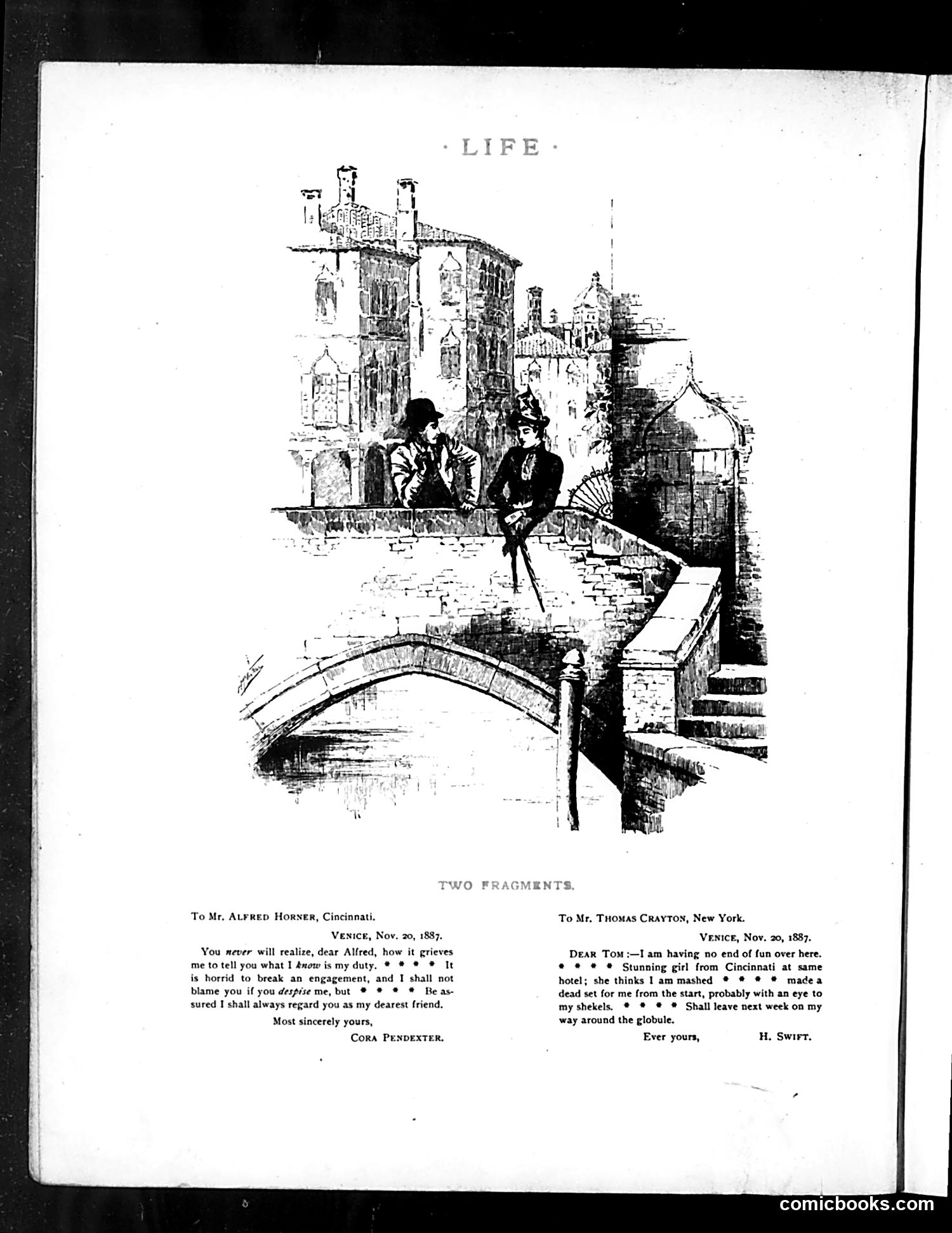
This page presents a satirical commentary on romantic duplicity. Two letters, both dated the same day from Venice, reveal a coordinated deception: **The Setup:** A woman (Cora Pendexter) writes to a Cincinnati man (Alfred Horner) breaking their engagement with tearful regrets. Simultaneously, a man (H. Swift) writes to a New York contact (Thomas Crayton) boasting about seducing that same Cincinnati girl—dismissing her as a fortune-hunter ("shekels") while he toys with her affections before leaving. **The Satire:** The "fragments" expose how both parties manipulate each other under false pretenses. The woman feigns heartbreak while the man treats romance as sport and conquest. The parallel letters—showing identical hypocrisy from both genders—mock Victorian courtship rituals and the performative dishonesty underlying romantic relationships. The illustration depicts figures on a Venetian bridge, a romantic setting that contrasts ironically with the cynical letters below.
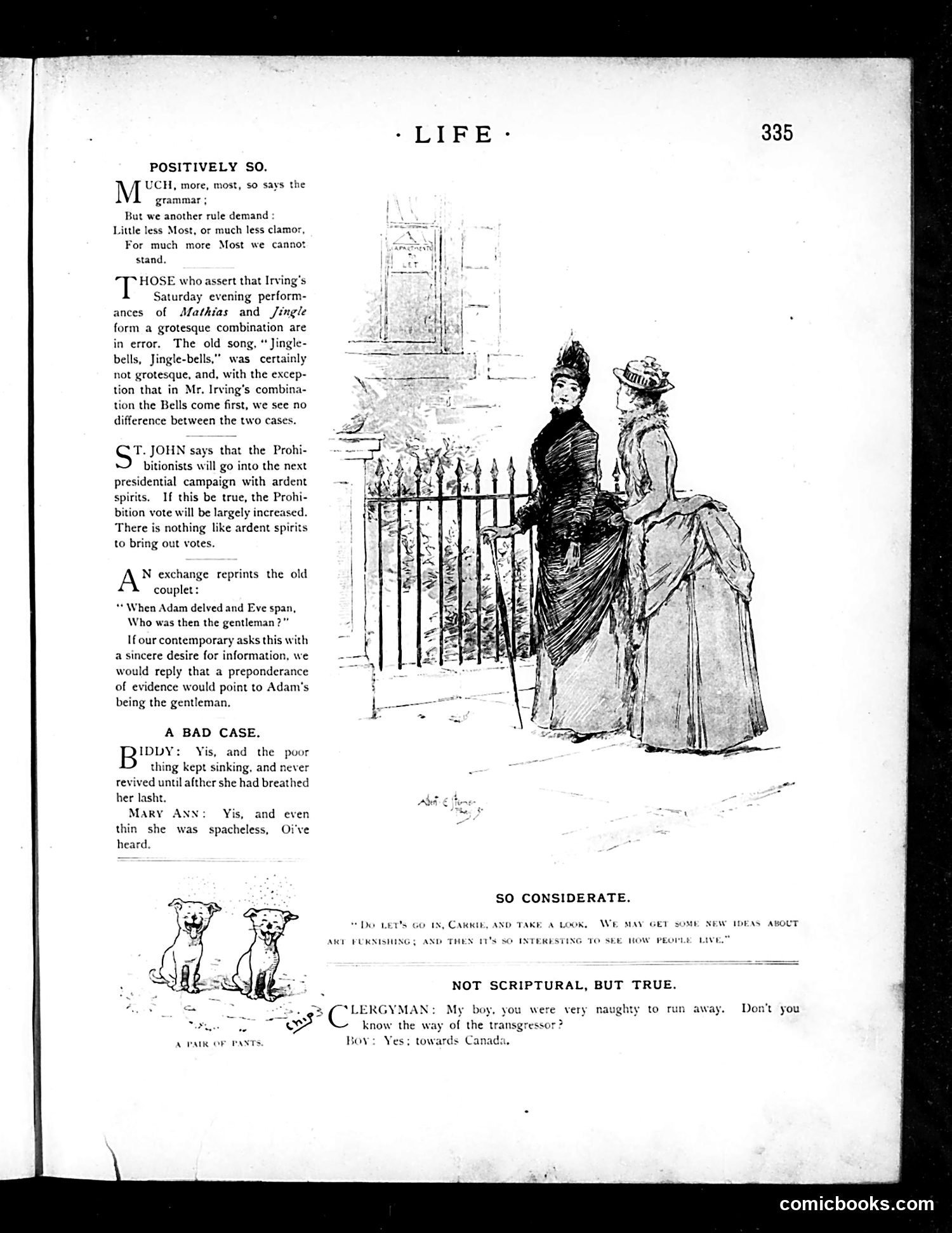
This page contains several brief satirical pieces typical of *Life* magazine's humor: **Main cartoon**: Shows two well-dressed women viewing a modest home's interior, commenting on "art furnishing" and observing "how people live"—satirizing upper-class voyeurism and condescension toward working-class domesticity. **References**: - "Irving's Saturday evening performances" likely alludes to Henry Irving, a famous actor, and the absurdity of pairing serious dramatic roles with "Jingle Bells" - The Prohibition reference mocks the irony of Prohibitionists using "ardent spirits" (alcohol) to energize campaign efforts - "Adam delved and Eve span" quotes medieval class commentary, satirizing pretensions about gentlemanly origins - The final joke about the "way of the transgressor" plays on biblical phrasing while having a boy cheekily answer "towards Canada"—likely referencing Canadian emigration as escape The page exemplifies *Life*'s brand of light social satire targeting pretension, hypocrisy, and absurdity in contemporary American life.
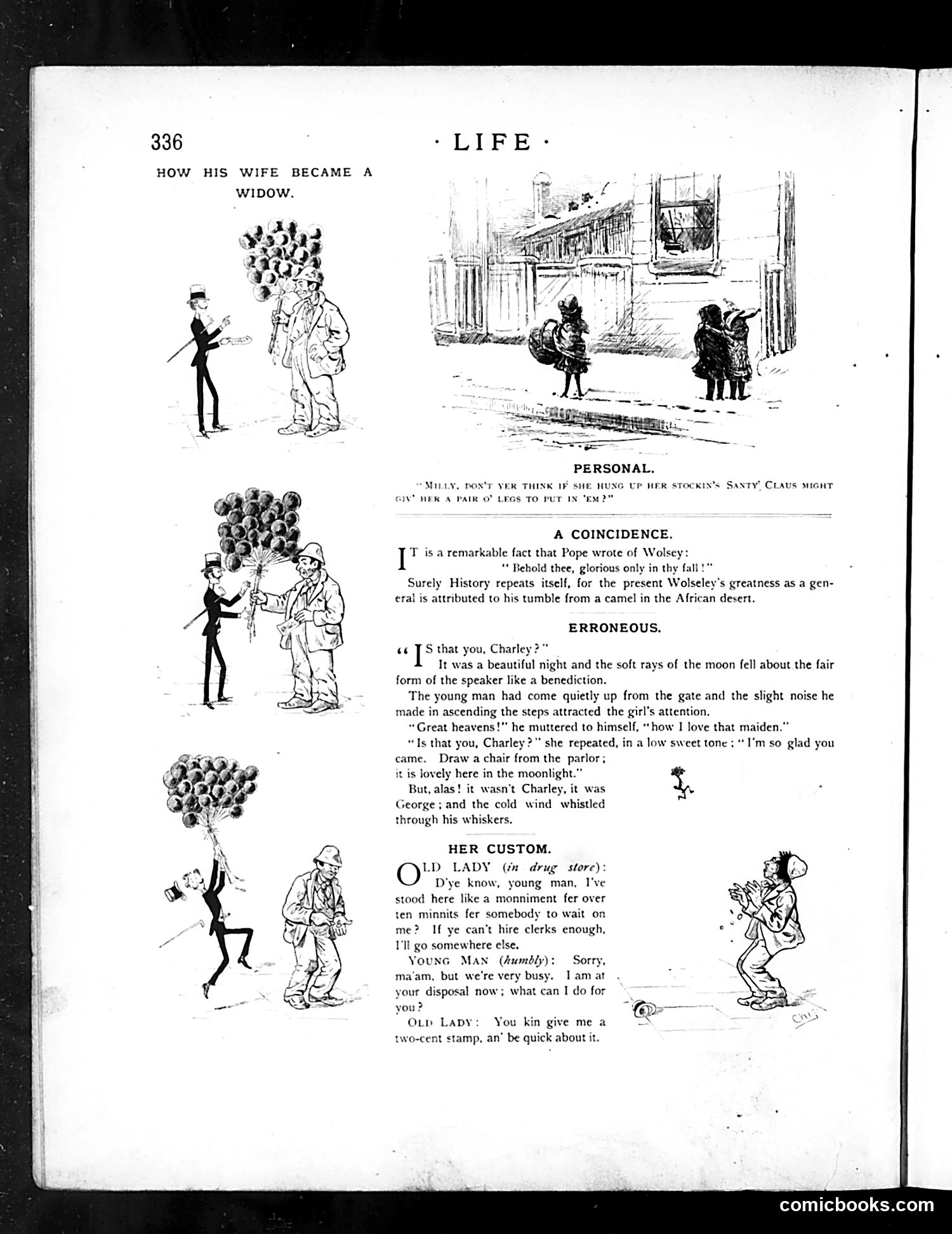
This page contains several unrelated humor pieces typical of Life's format: **"How His Wife Became a Widow"** (top left): Sequential cartoons show a man repeatedly offering a large bouquet of flowers to a woman, who finally accepts—the joke being the absurdly oversized flowers suggest his romantic gesture literally kills him. **"A Coincidence"**: A brief joke referencing General Wolseley's military reputation, comparing him to Alexander Pope's line about the Earl of Wolsey. The humor suggests Wolseley's greatness comes from falling off a camel in Africa. **"Erroneous"**: A romantic misunderstanding where a woman waiting in moonlight believes her visitor is "Charley" but it's actually "George"—the punchline being the cold wind through "his whiskers" suggests an unattractive alternative suitor. **"Her Custom"**: A drug store scene mocking an impatient elderly customer who complains about slow service for ten minutes, then demands only a two-cent stamp—satirizing unreasonable customer behavior and entitlement. The page exemplifies early 20th-century American satirical humor targeting everyday social situations.
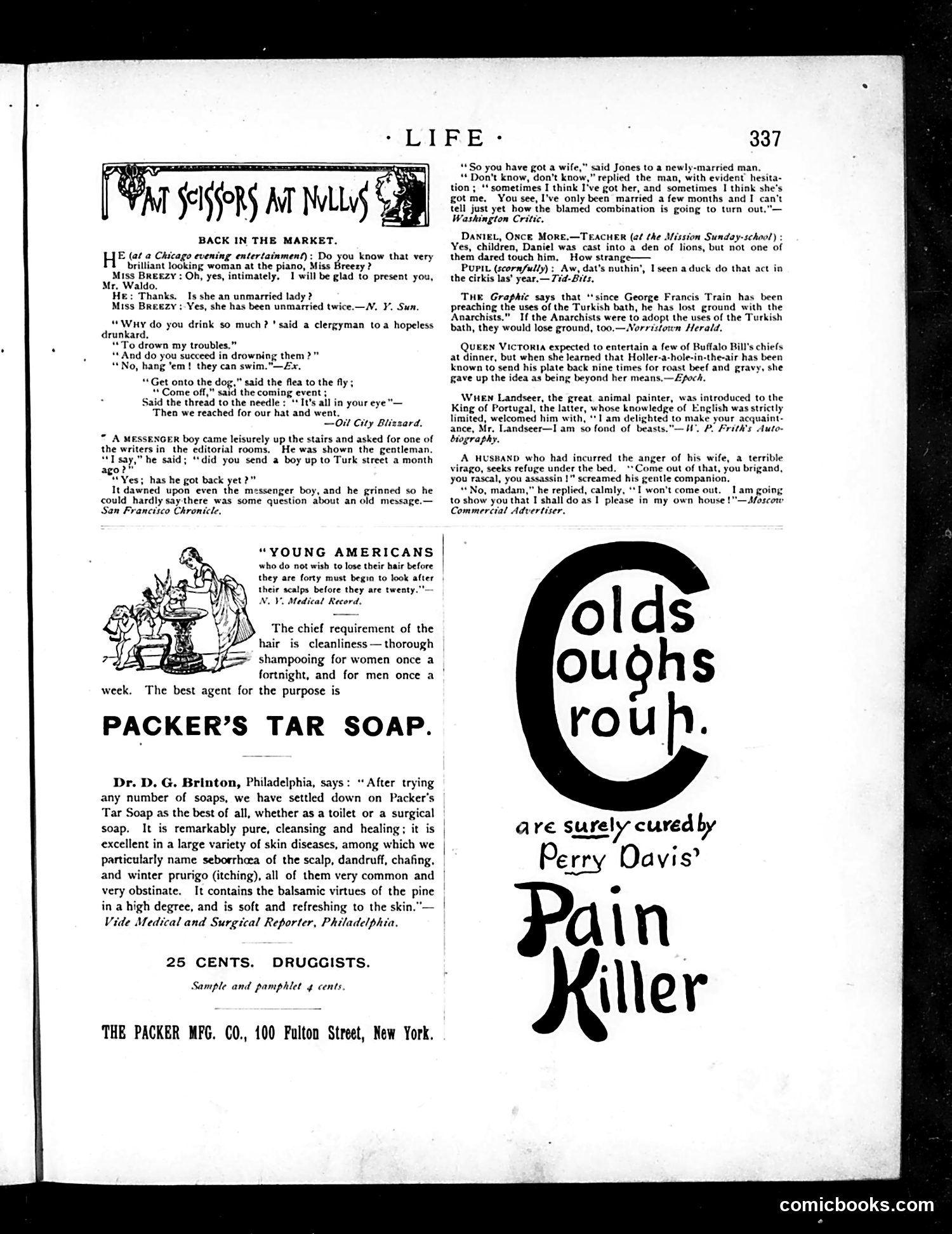
This page is primarily **humor columns and advertisements** from Life magazine's satirical section. The jokes are brief one-liners reflecting period anxieties: **"Back in the Market"** jokes mock divorce and marital uncertainty—a woman who's been "unmarried twice" (suggesting divorce), and a newly-married man unsure whether he or his wife controls the relationship. **Other humor** includes: a drunk trying to "drown troubles" (the troubles swim back), and oblique references to contemporary figures like George Francis Train (mentioned for preaching Turkish baths) and Buffalo Bill's Native American performers entertaining British society—highlighting cultural collision humor. **The page is dominated by two advertisements**: Packer's Tar Soap (claiming hair-loss prevention and treating scalp diseases) and Perry Davis' Pain Killer (a patent medicine). The content reflects turn-of-the-century anxieties about modern marriage, aging, and folk remedies marketed as scientific solutions.
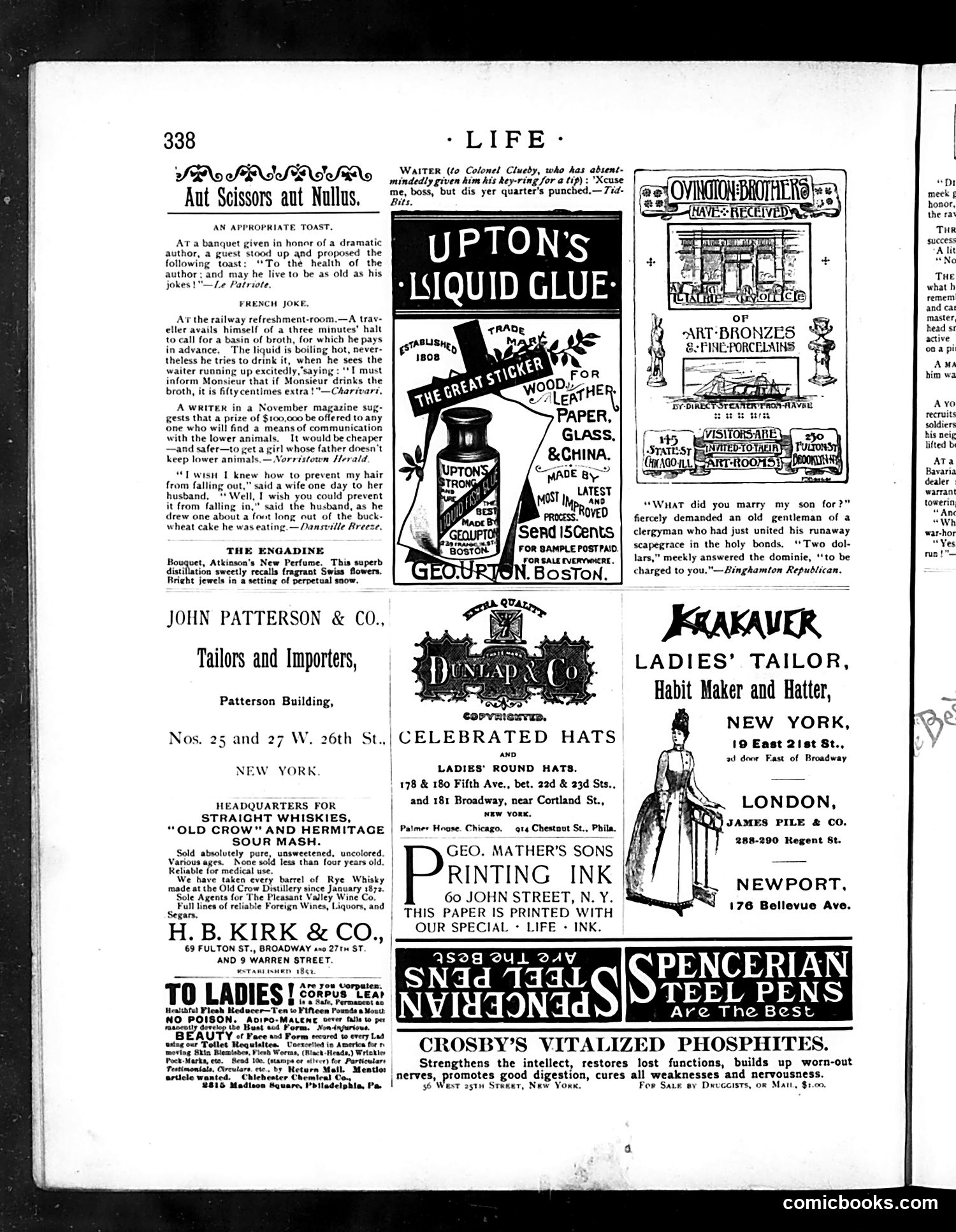
This is primarily an **advertising page** from Life magazine, with several brief humorous anecdotes interspersed among commercial notices. The page's **jokes and toasts** are short, disconnected pieces typical of the era's light humor: - A waiter receives a key-ring as a tip instead of money - A dramatic author is toasted with wishes he live as long as his jokes (implying they're old) - A traveler trying to drink hot broth is told it costs extra if consumed - A husband makes a hair-in-pancake joke to his wife These represent **mild, domestic satire** common to 19th-century humor magazines—no specific political figures or major social commentary appear. The bulk of the page features **period advertisements**: whiskey, tailors, printing ink, ladies' fashion items, perfume, and patent medicines (notably "Vitalized Phosphites" and weight-reduction products). **No significant political cartoons or caricatures appear**—this is essentially a filler/advertising page with generic period humor.
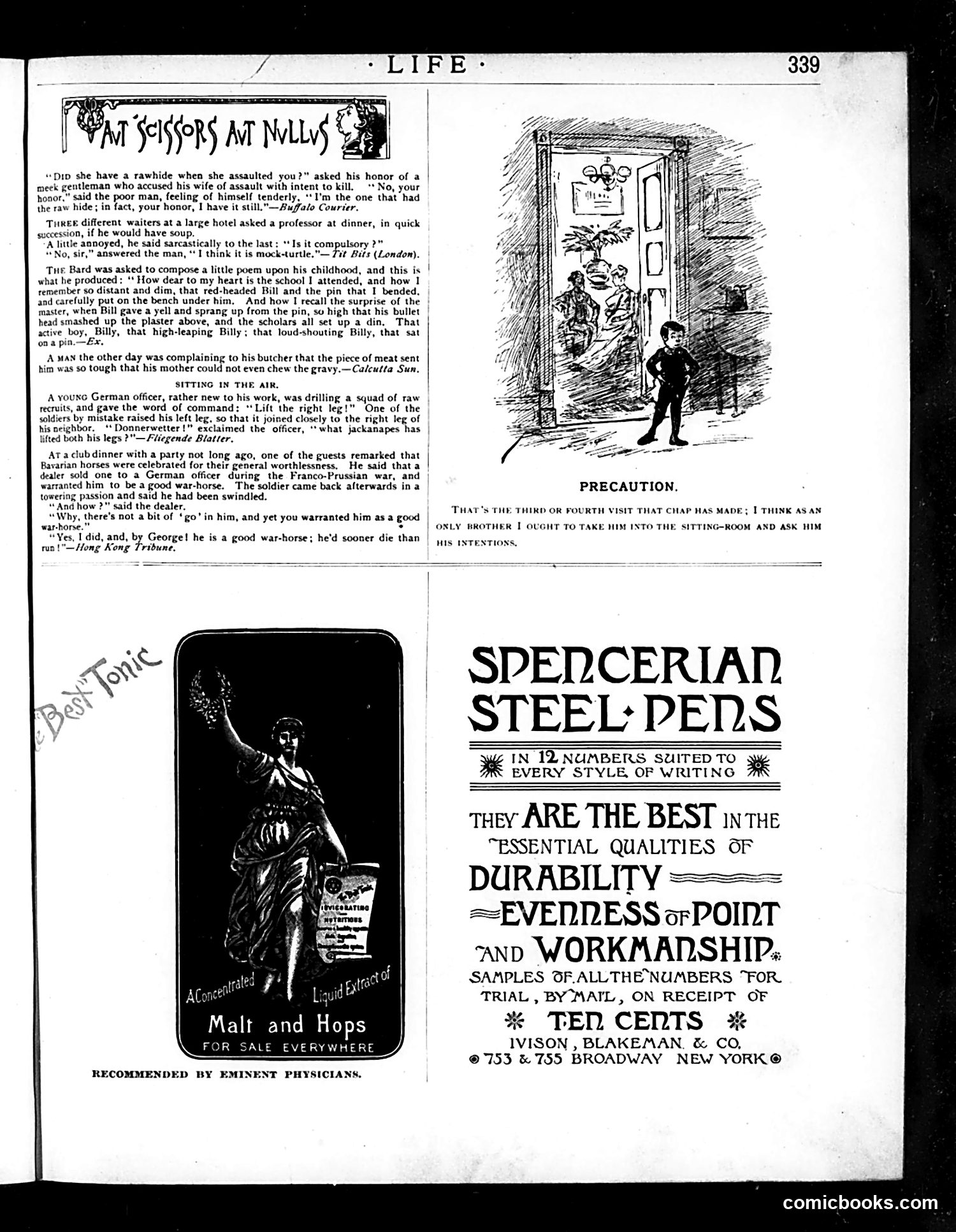
This page from *Life* magazine consists primarily of **humorous anecdotes** rather than political cartoons. The jokes satirize everyday situations: a wife's assault leaving a husband injured; waiters repeatedly offering soup; a schoolboy's prank with a pin injuring himself; tough meat; military confusion; and a horse's cowardice disguised as loyalty. The single **cartoon titled "Precaution"** shows a man observing another visitor and wondering if he should ask about his "intentions"—a Victorian-era reference to courtship. The humor relies on the social convention that a young man visiting repeatedly signals romantic intent. The page also includes two **period advertisements**: one for malt and hops tonic (endorsed by physicians) and one for Spencerian steel pens. These ads were typical commercial content mixed with editorial material in early *Life* issues. The overall tone reflects genteel, middle-class humor popular in the late 19th century.
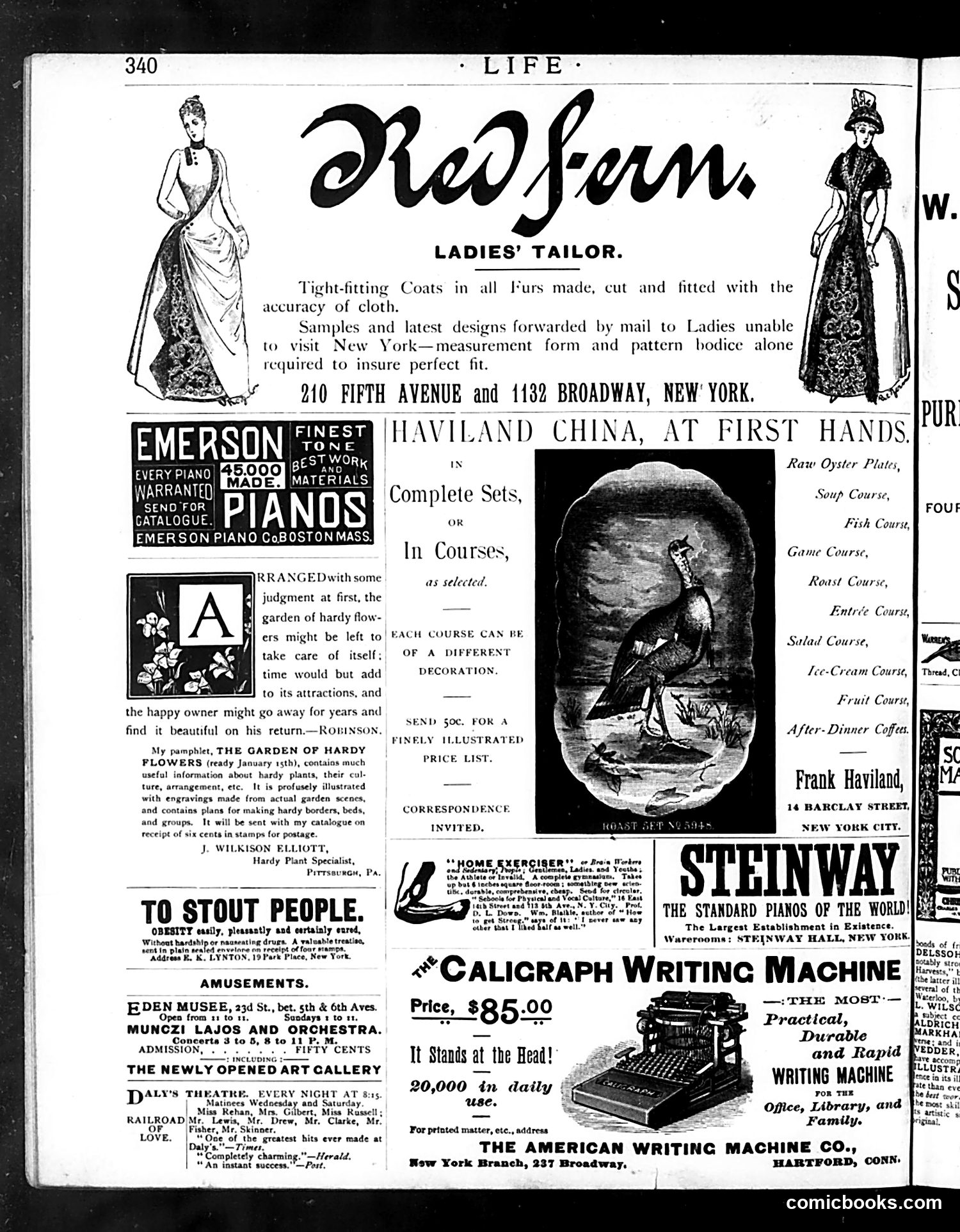
This is primarily an **advertising page** from Life magazine, not a political cartoon. The page contains commercial advertisements typical of the era, including: - **Red Fern Ladies' Tailor**: A custom tailoring service offering tight-fitting coats, with mail-order services for out-of-town clients - **Emerson Pianos**: A piano manufacturer emphasizing quality materials - **Hardy Flowers guide**: Gardening literature from a plant specialist - **Obesity cure**: A dubious weight-loss product (typical of the period) - **Theater listings**: Including Daly's Theatre productions The center features an **engraving of a bird** (appears to be from Haviland China advertising) advertising dinnerware sets with themed courses. Additional ads promote Steinway pianos, the Caligraph typewriter, and Frank Haviland china. The **small decorative initial letter** with flowers discusses garden arrangement philosophy. There is **no political satire or cartoon content** on this page—it represents standard commercial messaging from the late 19th or early 20th century.
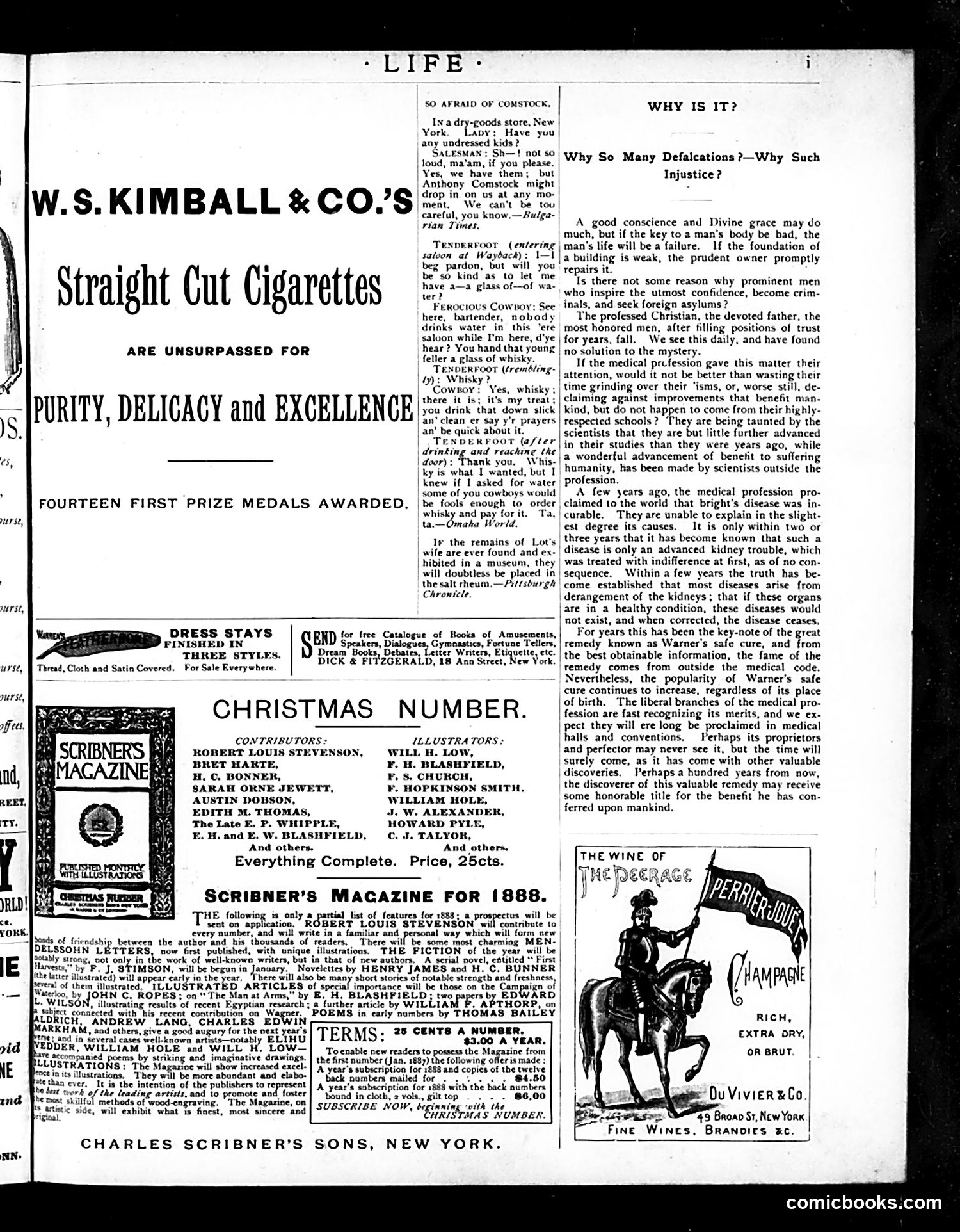
This page contains **advertisements and comedic brief items** rather than a political cartoon. The humor appears in two short jokes: 1. **"So Afraid of Comstock"**: References Anthony Comstock, the real historical figure who led America's anti-obscenity campaigns. The joke shows a dry-goods clerk nervously whispering about "undressed kids" (mannequins), terrified Comstock might catch them selling them. This satirizes Comstock's aggressive censorship efforts and the absurdity of his influence on everyday commerce. 2. **The Tenderfoot/Cowboy joke**: A greenhorn asks for water in a saloon; a "Ferocious Cowboy" bullies him into drinking whisky instead. The joke's twist: the tenderfoot reveals he actually *wanted* the whisky but knew reverse psychology would work on the rowdy cowboy. The remainder is **advertising** for cigarettes, dress stays, and Scribner's Magazine's Christmas issue featuring major literary contributors (Stevenson, Harte, James).
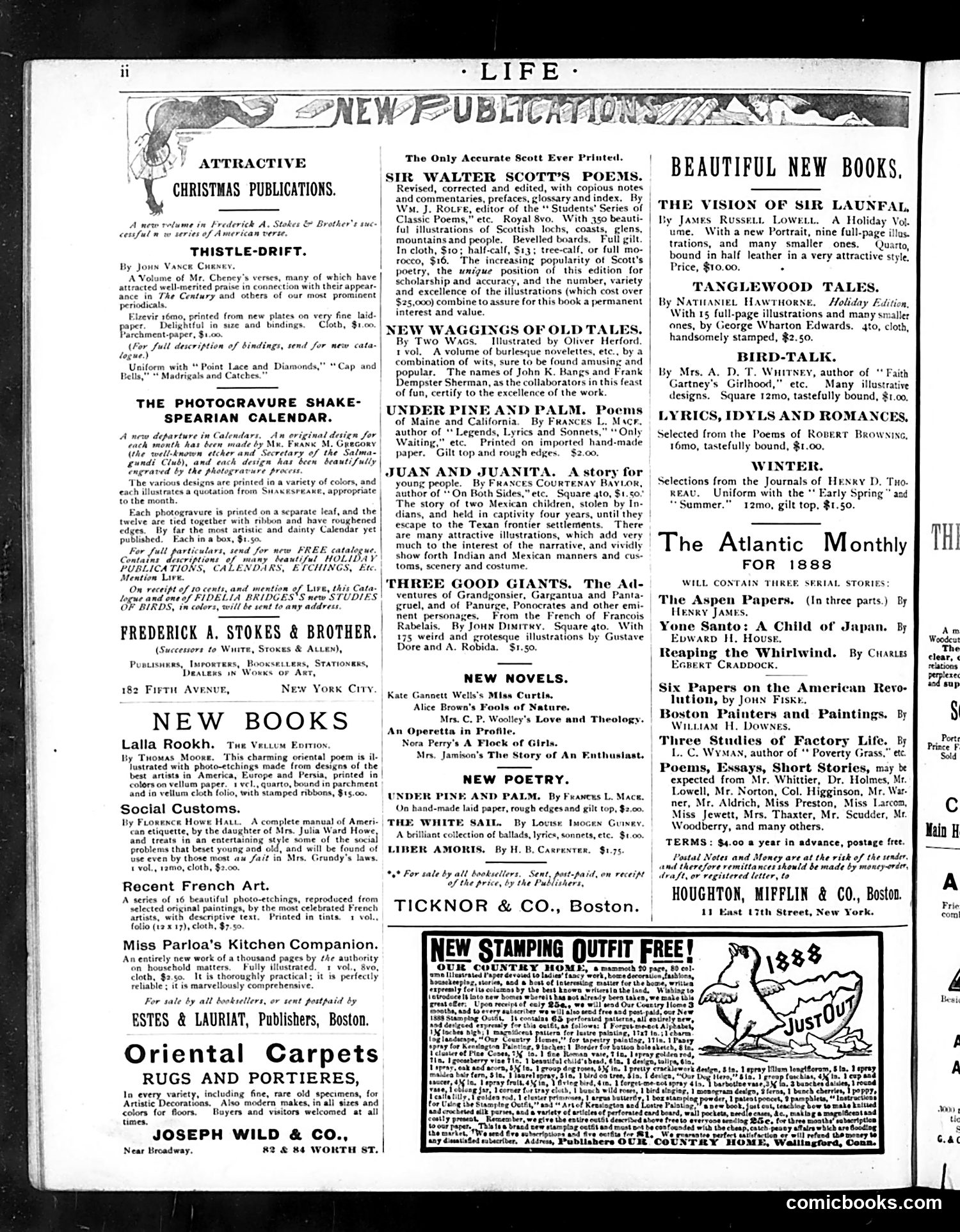
This is primarily a **book advertisement page**, not a political cartoon page. It showcases new holiday publications and books from American publishers like Frederick A. Stokes & Brother and Ticknor & Co. The content reflects late 19th-century literary tastes: lavishly illustrated editions of classic poetry (Scott, Moore), etiquette manuals, art collections, and cookbooks. Notable items include a photogravure Shakespeare calendar and an ornate edition of *Lalla Rookh* priced at $15.00—expensive for the era. The single notable visual element is a small advertisement at bottom-right for a "New Stamping Outfit Free" from "Our Country Home," a promotional giveaway typical of 1880s magazines. **The page's interest today is historical**: it documents what affluent Americans read, how books were marketed as luxury goods, and publishing standards of the Gilded Age. There is no satire or political commentary present.
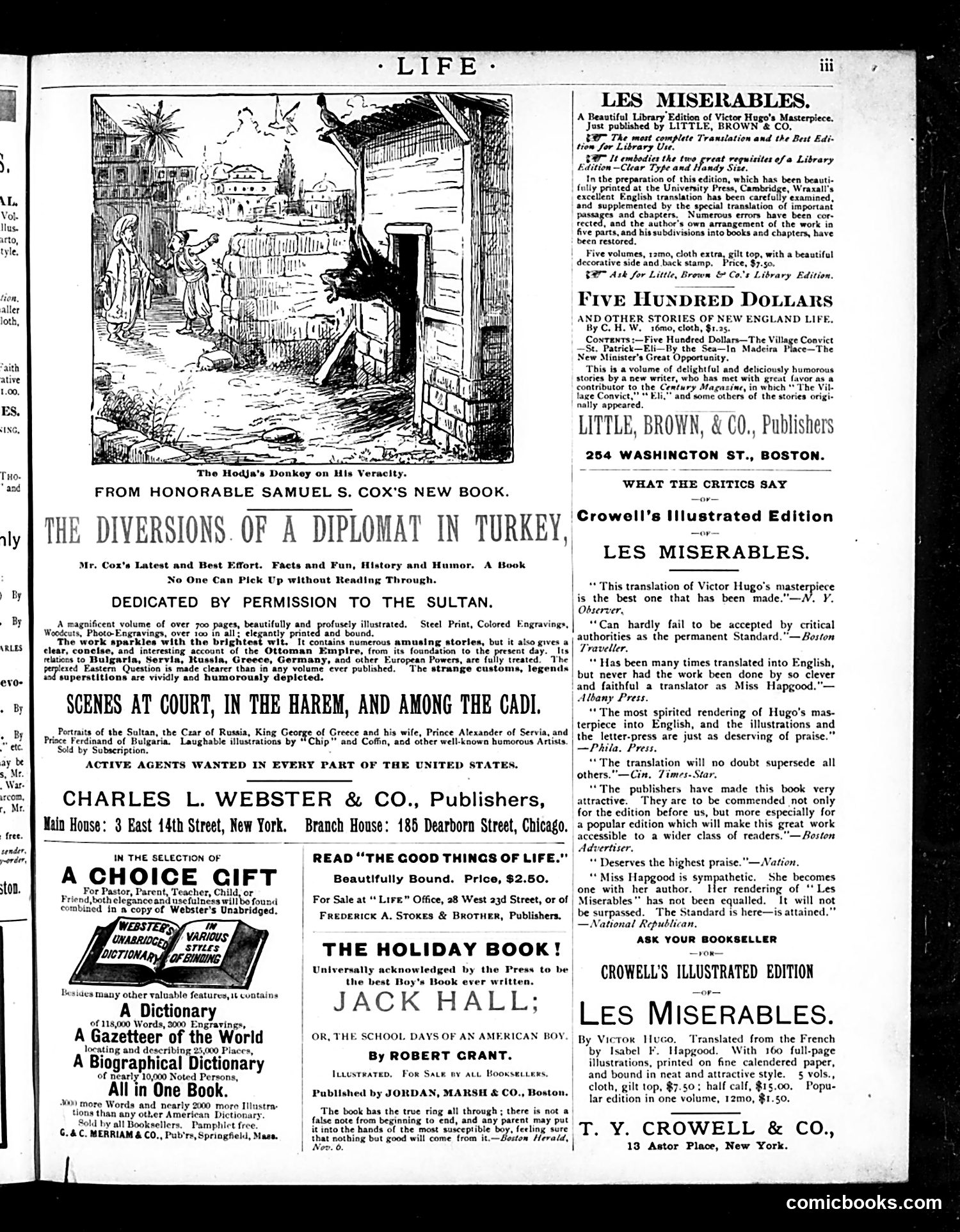
This page is primarily **advertising and book announcements**, typical of Life magazine's commercial content. The main satirical cartoon shows "The Hodja's Donkey on His Veracity"—a reference to Turkish folk tales about a witty character known for playing with truth. The cartoon illustrates Samuel S. Cox's book *The Diversions of a Diplomat in Turkey*, which advertises itself as containing "Facts and Fun, History and Humor" about the Ottoman Empire. The satire appears gentle: Cox presents diplomatic observation of Turkey (then a major geopolitical concern) wrapped in humor and anecdotes. The page also advertises *Les Misérables* in a new English translation and various gift books including *Jack Hall*—typical holiday publishing fare. The overall tone reflects 19th-century American interest in orientalist subjects and Turkish culture as exotic, amusing material for educated readers.
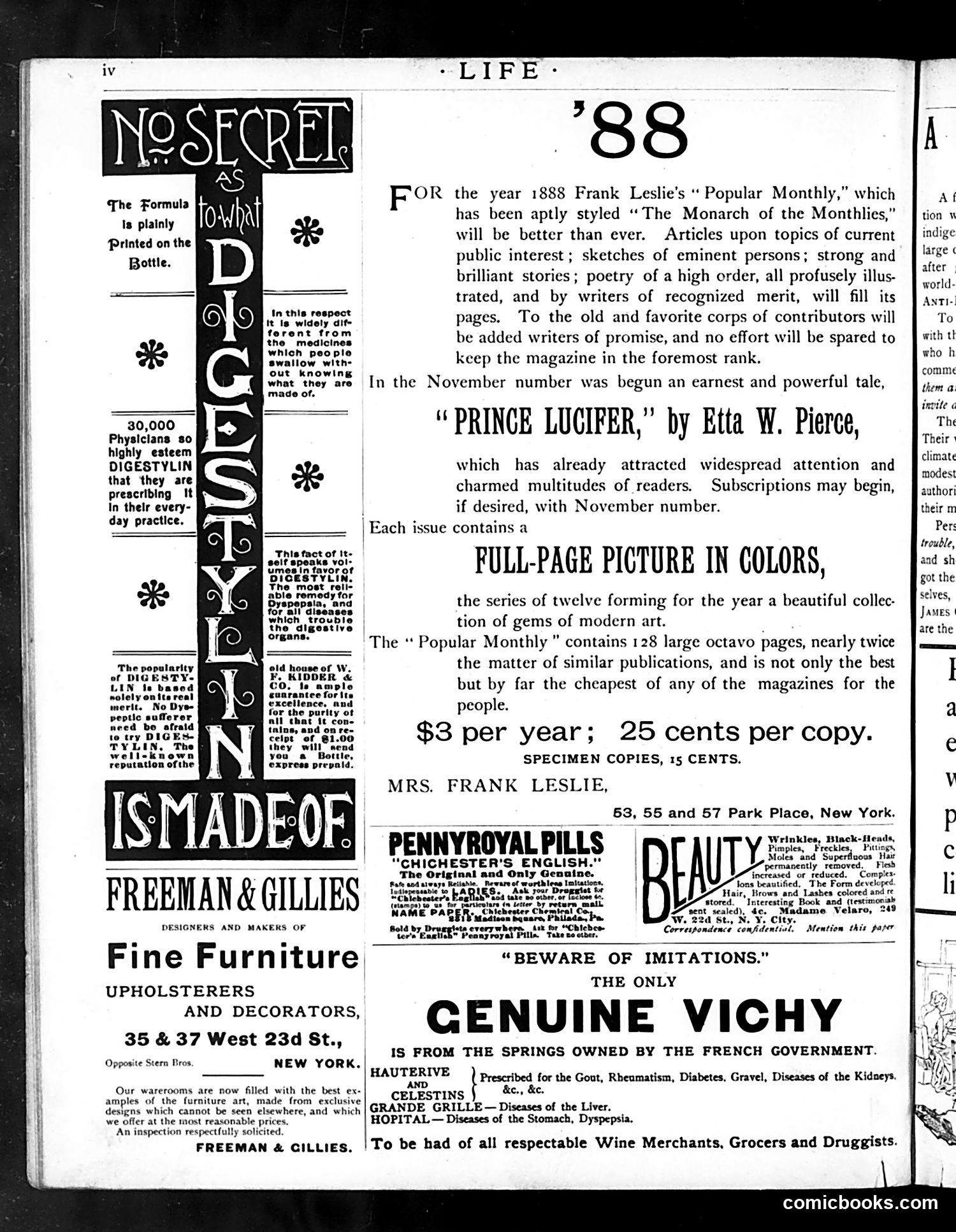
This page contains **no political cartoon**—it is primarily advertising and magazine promotion. The main content announces Frank Leslie's "Popular Monthly" magazine for 1888, touting its status as "The Monarch of the Monthlies." It advertises a serialized story, "Prince Lucifer" by Etta W. Pierce, and promises full-page color illustrations monthly. The surrounding advertisements are typical of the era: patent medicines (Digestylin for dyspepsia, Chichesters pills), furniture dealers, and mineral water (Vichy). The medicine ads notably feature no ingredients or evidence—they simply claim efficacy, reflecting the largely unregulated pharmaceutical market of the 1880s. The only satirical element is implicit in the left margin's text mocking "No Secret" patent medicines, which notes that 30,000 physicians prescribe them while people don't know what's in them—a subtle critique of medical quackery common in this period.
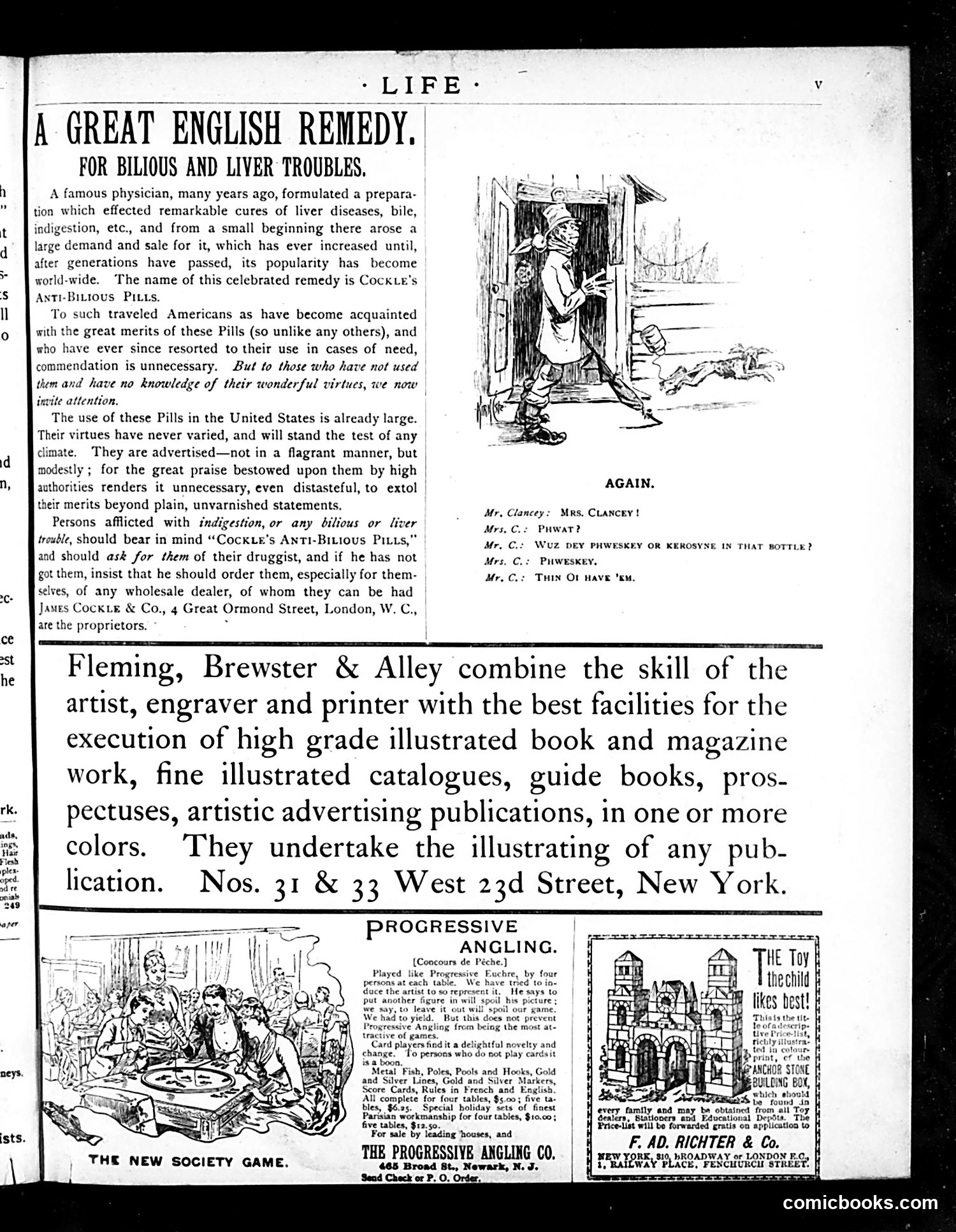
This page is primarily **advertising**, not satire or political commentary. The dominant content includes: 1. **Cocke's Anti-Bilious Pills advertisement** — a patent medicine ad claiming a famous English physician's formula cures liver disease and indigestion. The text emphasizes the remedy's long popularity and worldwide reputation, addressing skeptical American readers unfamiliar with it. 2. **Small comic sketch titled "AGAIN"** — shows a domestic scene where Mr. and Mrs. Clancey discuss a bottle's contents. Mr. C. asks if it's "phweskey or kerosyne," suggesting Irish working-class characters (indicated by the dialect spelling "phw-"). The humor appears to concern whether the bottle contains whiskey or something dangerous/inedible. 3. **Three additional product advertisements** for Fleming, Brewster & Alley (printing services), "The Toy the Child Likes Best" (building blocks), and Progressive Angling (a parlor game). The page reflects late-19th/early-20th century Life magazine's mix of light humor and commercial announcements, with no deeper political or social satire evident.
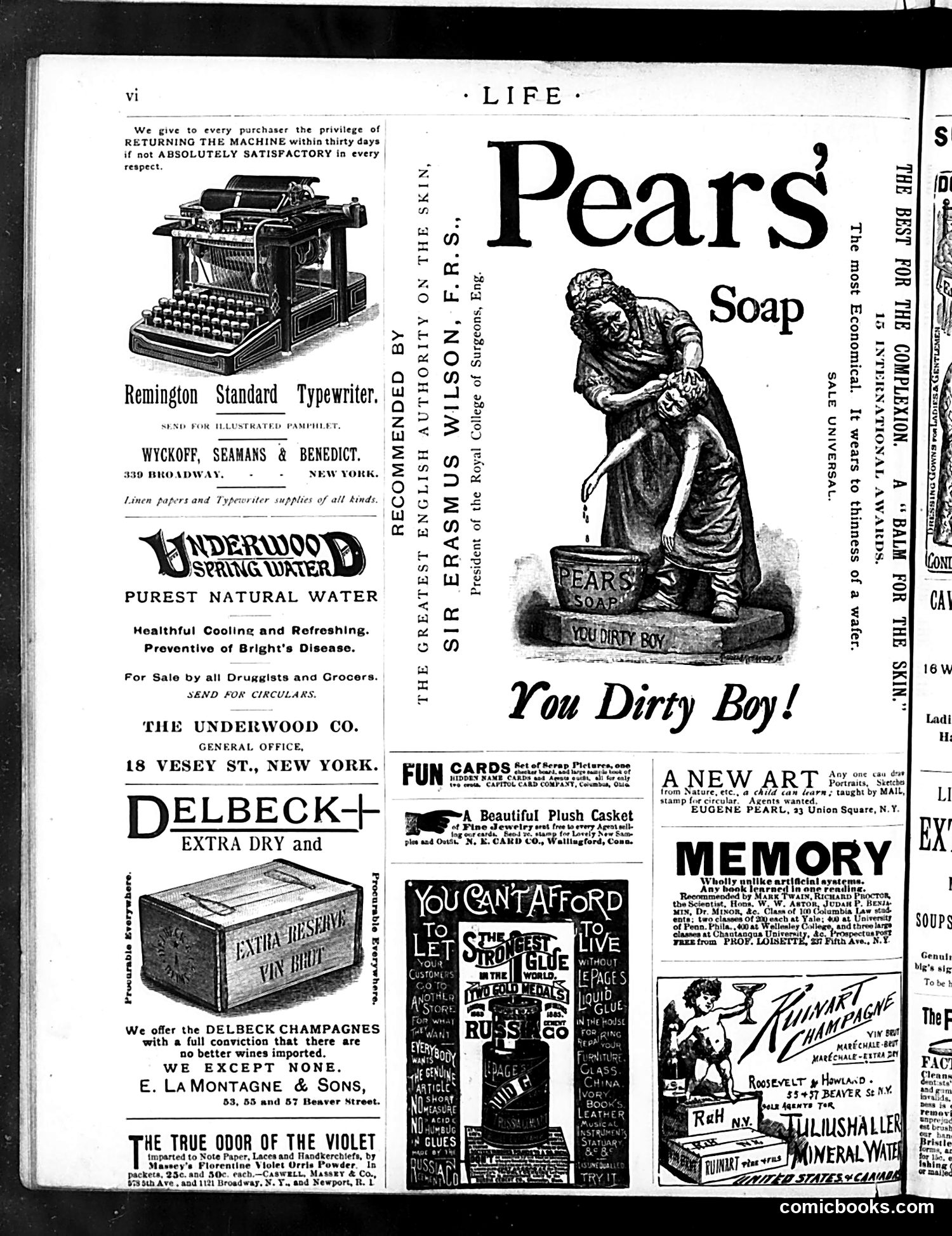
This page is primarily **advertising content** rather than political satire. The dominant image is a large commercial advertisement for Pears' Soap featuring the famous "You Dirty Boy!" slogan. The ad shows a caricatured figure (likely meant to represent a working-class or street child) washing with Pears' Soap. The humor and sales pitch rely on the contrast between dirt and cleanliness—a common Victorian advertising trope. The product endorsement references "Sir Erasmus Wilson, F.R.S." (a real 19th-century dermatologist), lending medical authority to claims about skin health. The surrounding page contains various other period advertisements: typewriters, champagne, spring water, caskets, and other consumer goods typical of Life magazine's revenue model. There is **no political cartoon** on this page—it is fundamentally a commercial publication page using humor and social messaging to sell products to middle and upper-class readers.
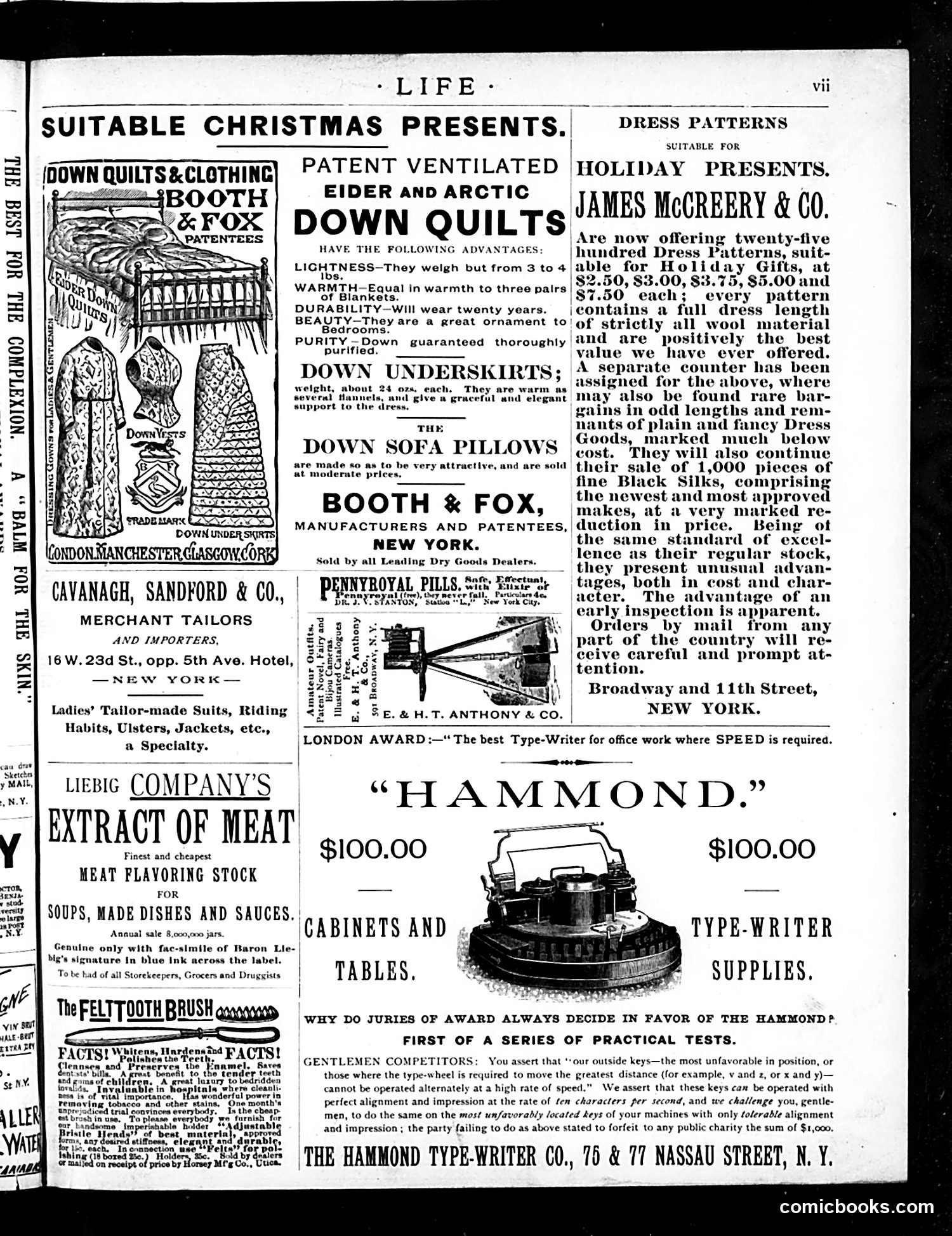
This is primarily an **advertising page** from Life magazine, not a satirical cartoon. It features Victorian-era Christmas gift advertisements including: - Down quilts and clothing from Booth & Fox - Dress patterns from James McCreery & Co. - A merchant tailor service (Cavanagh, Sandford & Co.) - Liebig's meat extract - A "Felt Tooth Brush" - A Hammond typewriter ($100) The Hammond typewriter ad includes a small illustration of the machine and a competitive "practical test" challenge to rival typewriter manufacturers, claiming superior speed and alignment on difficult keys. There is **no political satire** visible on this page. The content reflects late 19th-century consumer goods marketed for holiday shopping. The Hammond challenge represents typical commercial competition of the era, not social commentary.