
Life, 1887-12-08 · page 10 of 42
Life — December 8, 1887 — page 10: what you’re looking at
What you’re looking at
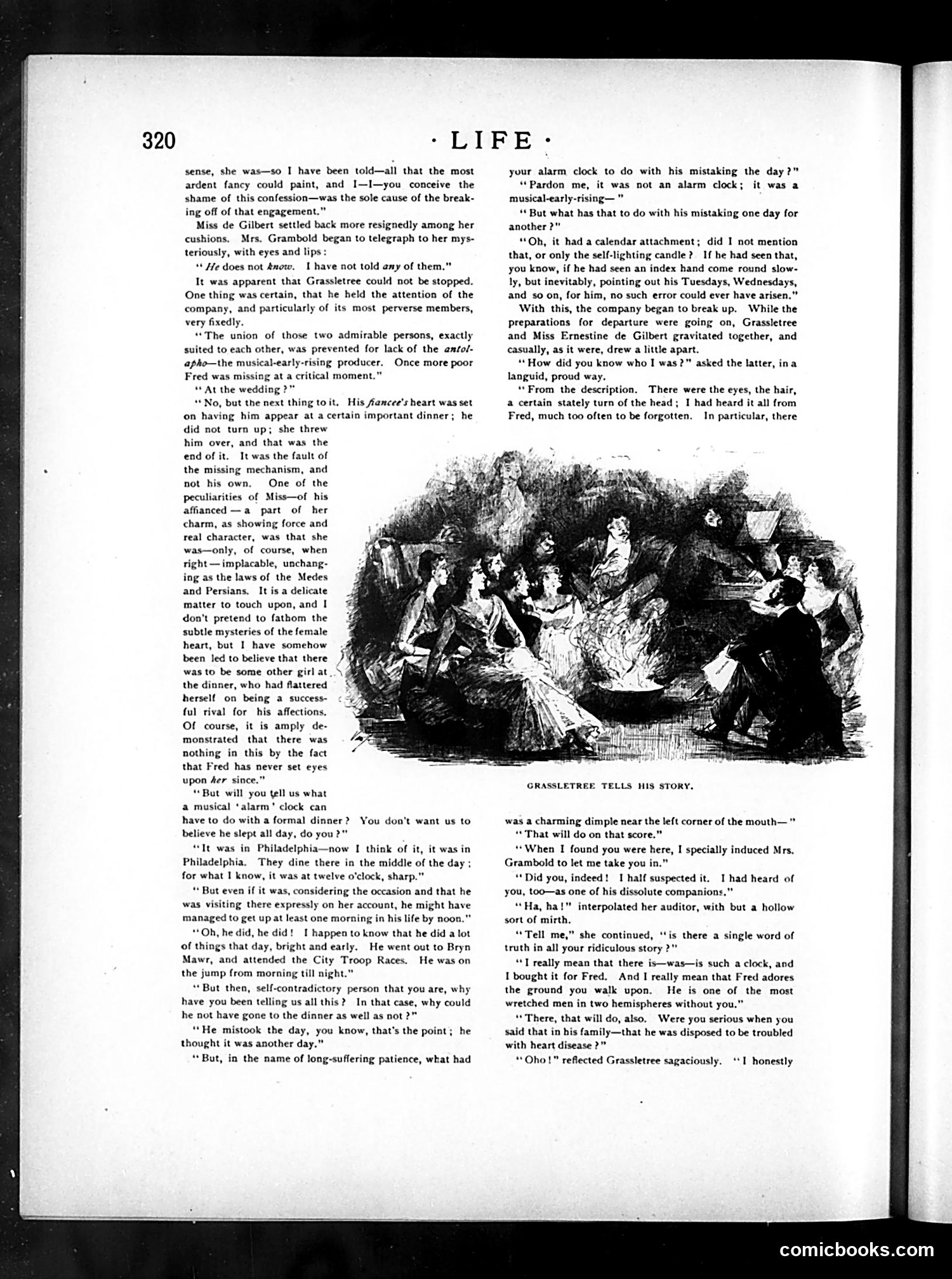
This page contains a literary excerpt rather than political satire or cartoons. The text discusses a dinner party incident involving characters named Miss de Gilbert, Fred, and Grassletree. The central illustration shows "GRASSLETREE TELLS HIS STORY"—a social gathering where a character explains a misunderstanding about a missed formal dinner in Philadelphia. The humor is social rather than political: Grassletree defends himself by explaining he attended the City Trooping Races instead, and the dialogue satirizes Victorian-era social etiquette and the absurdity of formal dinner expectations. The illustration depicts a drawing-room scene typical of period literature. This appears to be serialized fiction commentary rather than political cartoons, focusing on domestic social comedy.
📄 Transcribed text from this page (OCR, searchable)
Machine-transcribed from the original scan — historical spelling and the odd misread are preserved.
- LIFE: sense, she was—so I have been told—all that the most ardent fancy could paint, and I—I—you conceive the shame of this confession—was the sole cause of the break- ing off of that engagement.” Miss de Gilbert settled back more resignedly among her cushions. Mrs. Grambold began to telegraph to her mys- teriously, with eyes and lips: “ He does not Anow, [have not told any of them." It was apparent that Grassletree could not be stopped. One thing was certain, that he held the attention of the company, and particularly of its most perverse members, very fixedly. “The union of those two admirable persons, exactly suited to each other, was prevented for lack of the antol- apho—the musical-early-rising producer. Once more poor Fred was missing at a critical moment.” * At the wedding ?” “No, but the next thing toit. His flancee's heart was set on having him appear at a certain important dinner; he did not turn up; she threw him over, and that was the end of it. It was the fault of the missing mechanism, and not his own, One of the peculiarities of Miss—of his affianced —a part of her charm, as showing force and real character, was that she was—only, of course, when right — implacable, unchang- ing as the laws of the Medes and Persians. It is a delicate matter to touch upon, and | don't pretend to fathom the subtle mysteries of the female heart, but I have somehow 4M been led to believe that there Qt was to be some other girl at. the dinner, who had flattered herself on being a success- ful rival for his affections. Of course, it is amply de- monstrated that there was nothing in this by the fact that Fred has never set eyes upon fer since.” “But will you (ell us what a musical ‘alarm’ clock can have to do with a formal dinner? You don't want us to believe he slept all day, do you ?" “It was in Philadelphia—now I think of it, it was in Philadelphia, They dine there in the middle of the day ; for what I know, it was at twelve o'clock, sharp.” ‘ But even if it was, considering the occasion and that he was visiting there expressly on her account, he might have managed to get up at least one morning in his life by noon." “Oh, he did, he did! I happen to know that he did a lot of things that day, bright and early. He went out to Bryn Mawr, and attended the City Troop Races. He was on the jump from morning till night." “But then, self-contradictory person that you are, why have you been telling us all this? In that case, why could he not have gone to the dinner as well as not 2” “He mistook the day, you know, that's the point; he thought it was another day.” “But, in the name of long-suffering patience, what had your alarm clock to do with his mistaking the day?” “Pardon me, it was not an alarm clock; it was a musical-early-rising— " “« But what has that to do with his mistaking one day for another ?" “Oh, it had a calendar attachment; did I not mention that, or only the self-lighting candle? If he had seen that, you know, if he had seen an index hand come round slow- ly, but inevitably, pointing out his Tuesdays, Wednesdays, and so on, for him, no such error could ever have arisen.” With this, the company began to break up. While the preparations for departure were going on, Grassletree and Miss Ernestine de Gilbert gravitated together, and casually, as it were, drew a little apart. “How did you know who I was?” asked the latter, ina languid, proud way. “From the description, There were the eyes, the hair, a certain stately turn of the head; I had heard it all from Fred, much too often to be forgotten. In particular, there GRASSLETREE TELLS HIS STORY, was a charming dimple near the left corner of the mouth—” ** That will do on that score,” **When I found you were here, I specially induced Mrs. Grambold to let me take you in.” “*Did you, indeed! I half suspected it. I had heard of you, too—as one of his dissolute companions,” “Ha, ha!" interpolated her auditor, with but a hollow sort of mirth. “Tell me,” she continued, ‘tis there a single word of truth in all your ridiculous story “I really mean that there is—was—is such a clock, and I bought it for Fred. And I really mean that Fred adores the ground you walk upon. He is one of the most wretched men in two hemispheres without you.” “* There, that will do, also. Were you serious when you said that in his family—that he was disposed to be troubled with heart disease ?” Oho!" reflected Grassletree sagaciously. ‘I honestly comicbooks.com