
A complete issue · 16 pages · 1886
Life — September 30, 1886
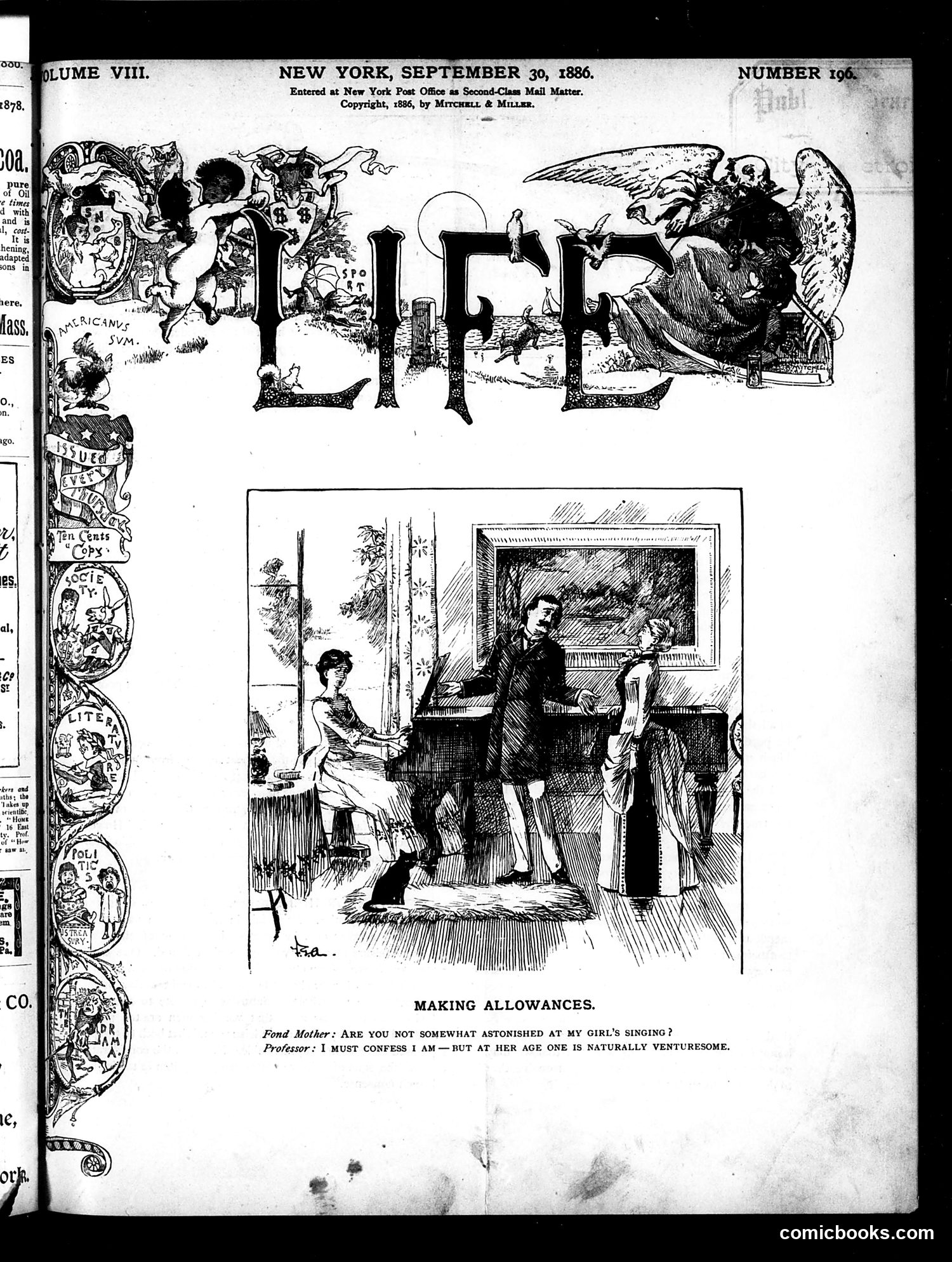
This cartoon satirizes parental indulgence. A fond mother expresses astonishment at her daughter's singing, while the father confesses he must acknowledge the girl's age excuses her lack of talent—implying young ladies are expected to be "naturally venturesome" (bold or forward) regardless of ability. The humor targets Victorian parenting conventions: wealthy parents tolerated poor performances from daughters, excusing mediocrity based on youth or gender rather than demanding actual skill. The father's admission that he's "confessing" suggests this parental rationalization was widely recognized as absurd self-deception. The cartoon mocks how social status and family pride override honest assessment of a child's abilities.
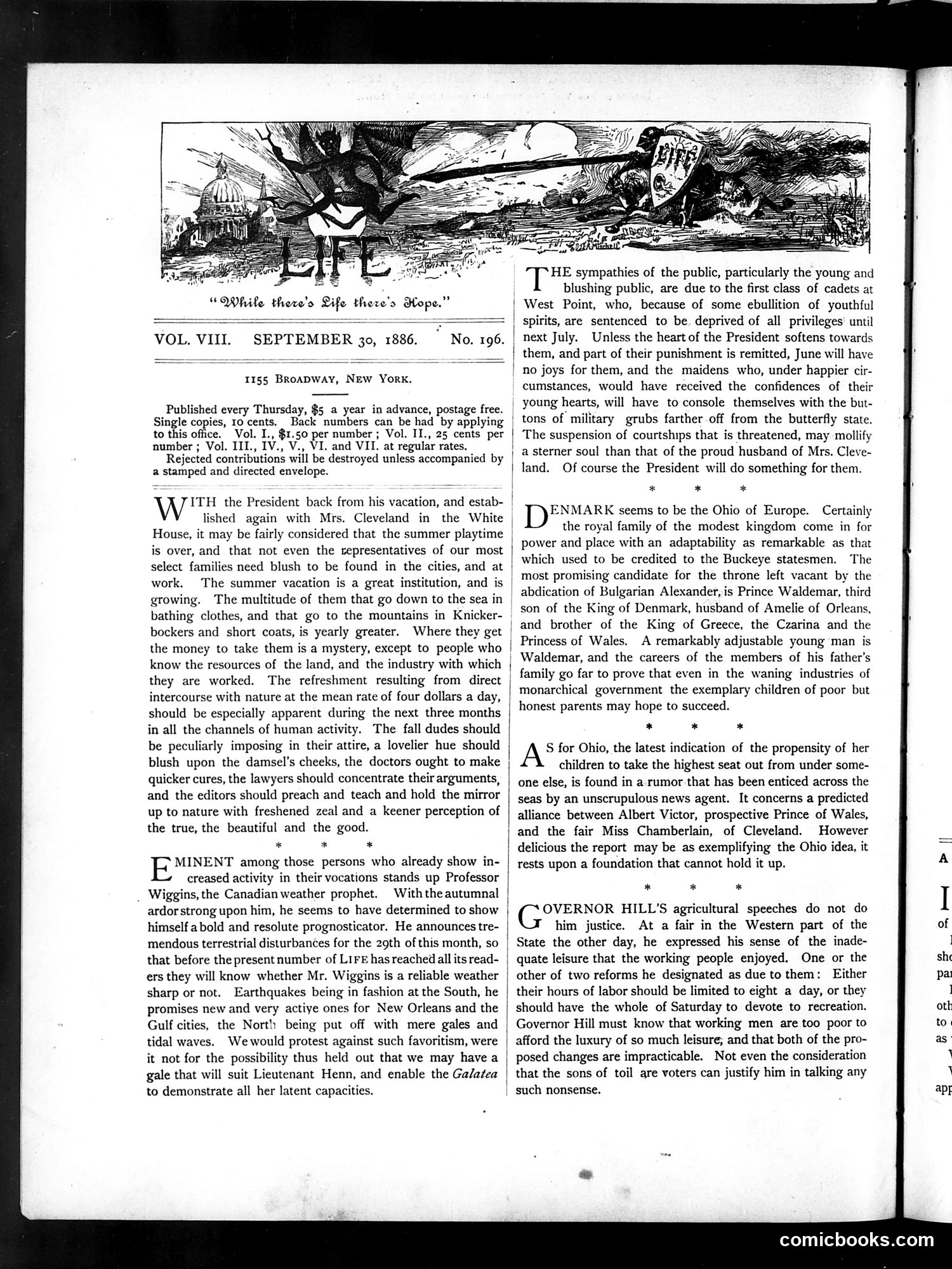
The page's main cartoon depicts a figure labeled "While there's Life there's Hope," showing what appears to be a skeletal or death-like personification alongside architectural imagery (possibly the Capitol building). The exact satirical target is unclear from the image quality. The text discusses President Cleveland's return from vacation and criticism of West Point cadets' punishment—specifically their loss of privileges and the sympathy they receive from the public. The editors argue cadets deserve stricter discipline. Additional commentary addresses European royal succession (Denmark and potential Prince of Wales connections) and Governor Hill's agricultural speeches about labor reform—mocking his suggestion that working people could afford leisure time. The overall tone is characteristic of 1880s *Life*: mixing political critique with social commentary through sardonic editorializing.
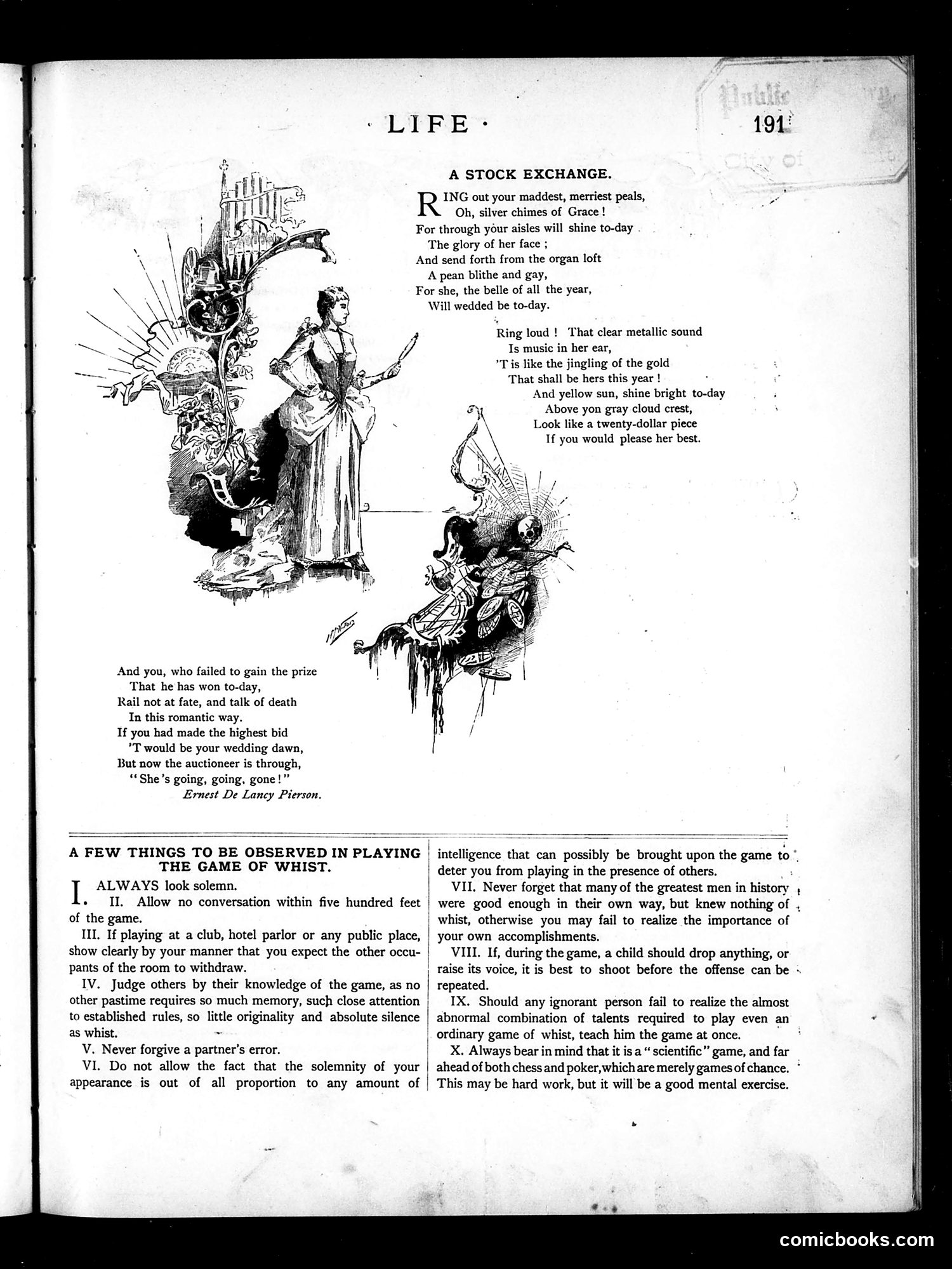
This cartoon satirizes marriage as a commercial transaction, specifically comparing a wedding to stock market speculation. The central female figure represents a bride being auctioned off to the highest bidder, depicted alongside symbols of wealth (money bags, financial instruments). The poem's language equates the bride to a commodity—"a twenty-dollar piece"—while the winning bidder appears as a grotesque caricatured figure, suggesting the ugliness of mercenary marriage. The satirical point: wealthy but undesirable men could "purchase" beautiful wives through financial superiority, reducing matrimony to a financial exchange rather than romantic partnership. This reflects Gilded Age anxieties about marriages motivated by money rather than genuine affection—a common theme in turn-of-the-century American satire.
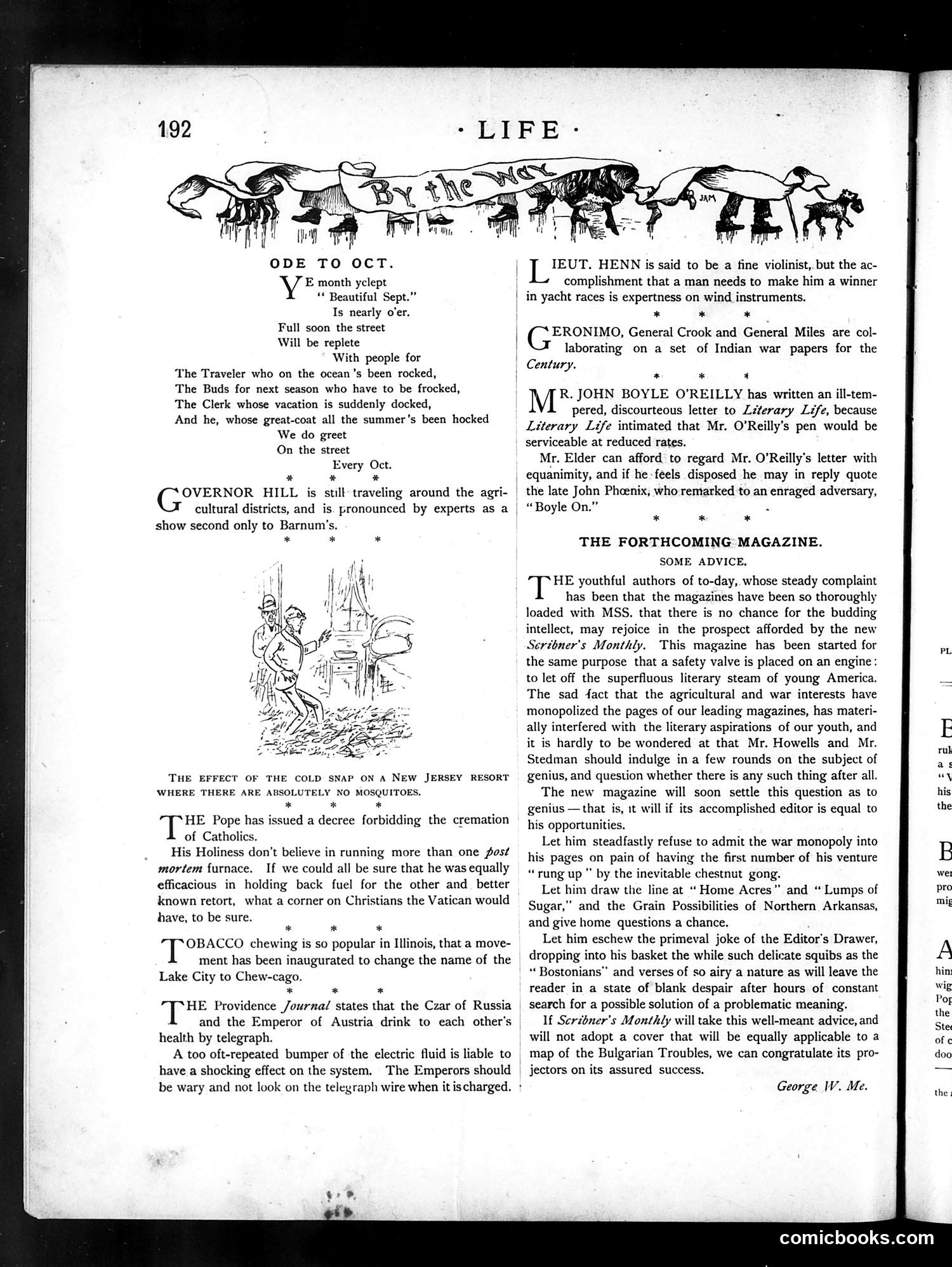
The visible cartoon depicts "The effect of the cold snap on a New Jersey resort where there are absolutely no mosquitoes." It shows a figure appearing to be frozen or encased in ice, likely illustrating the satirical point that while extreme cold eliminates the mosquito problem at seaside resorts, the trade-off—freezing temperatures making the resort unusable—defeats the purpose. The text portions discuss Governor Hill's agricultural expertise, mention of various public figures like Lieut. Henn (violinist) and Mr. John Boyle O'Reilly, and commentary on forthcoming magazines, particularly *Scribner's Monthly*. The editorial argues for editorial independence from war coverage monopolizing magazine pages, advocating for agricultural and humor content instead. The humor relies on obvious irony about solving one problem by creating an worse one.
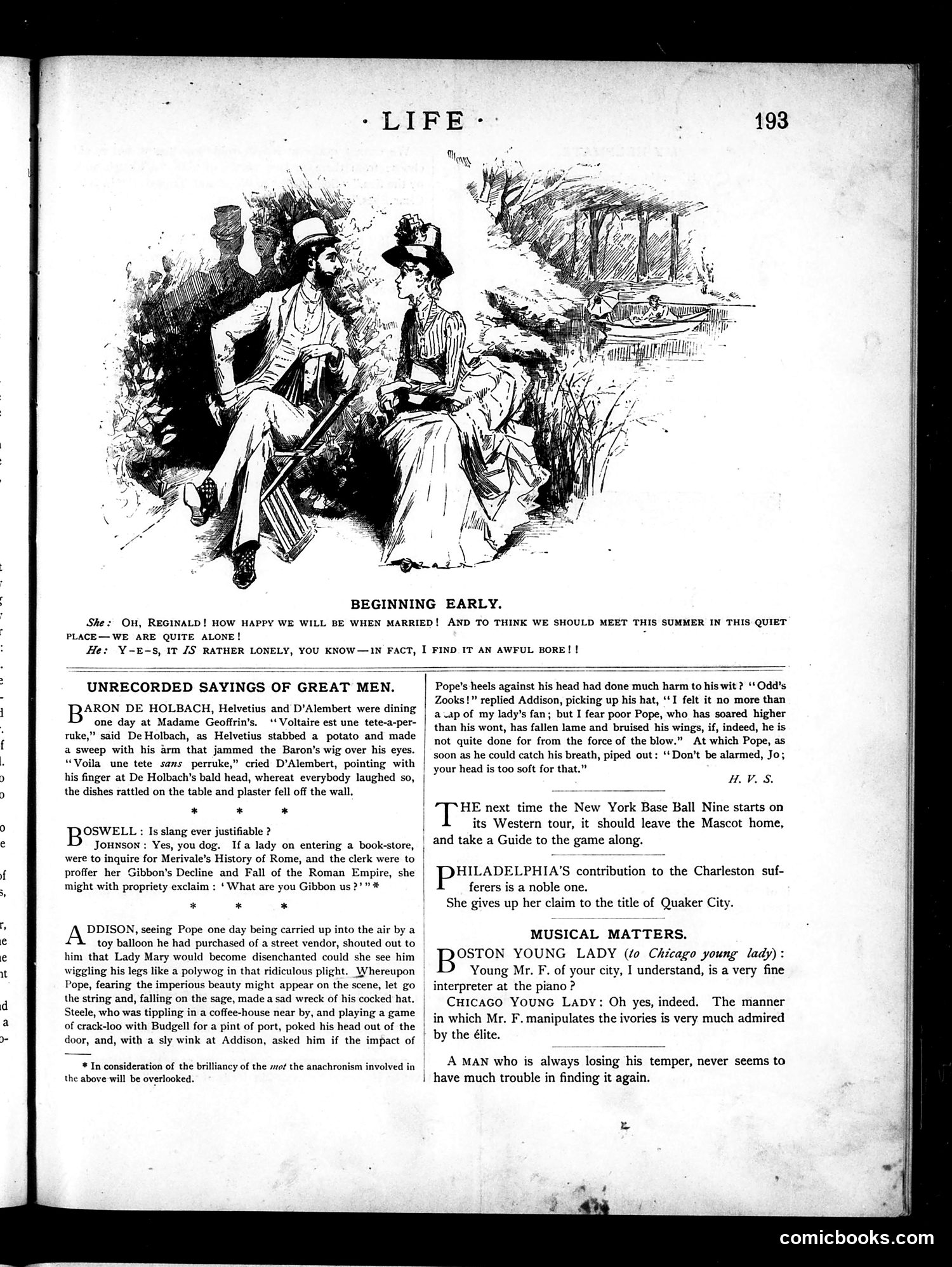
The main cartoon, titled "Beginning Early," depicts a couple discussing marriage plans. The woman expresses excitement about a summer wedding in a quiet location, while the man responds dismissively, calling it "rather lovely" but "an awful bore." This satirizes the common gender divide in wedding enthusiasm—a perennial joke about women's eagerness for marriage ceremonies versus men's reluctance and indifference. Below are various humorous anecdotes and observations, including references to Pope Leo XIII, literary classics, and social commentary. The "Unrecorded Sayings of Great Men" section offers satirical takes on historical figures, while "Musical Matters" pokes fun at social pretensions around classical music appreciation in cities like Boston and Chicago.
This page contains literary criticism and humorous anecdotes rather than political cartoons. The main content includes: **"My Helpmate"** - A poem by Frank Roe Batchelder satirizing domestic expectations, where the speaker contrasts a husband's willingness to learn practical skills versus society's demands on wives. **Review of Arlo Bates's poetry** - Critical analysis of his verses, noting his delicate style lacks rhythm and "swing." **Humorous short pieces** - Including "A Sufficient Reason" (about Sunday School attendance) and "Paradoxical" (a joke about a mule's contradictory nature). The page reflects late-19th century *Life* magazine's satirical approach to social commentary through literature and wit rather than visual cartoons. The domestic satire subtly critiques gender role expectations of the era.
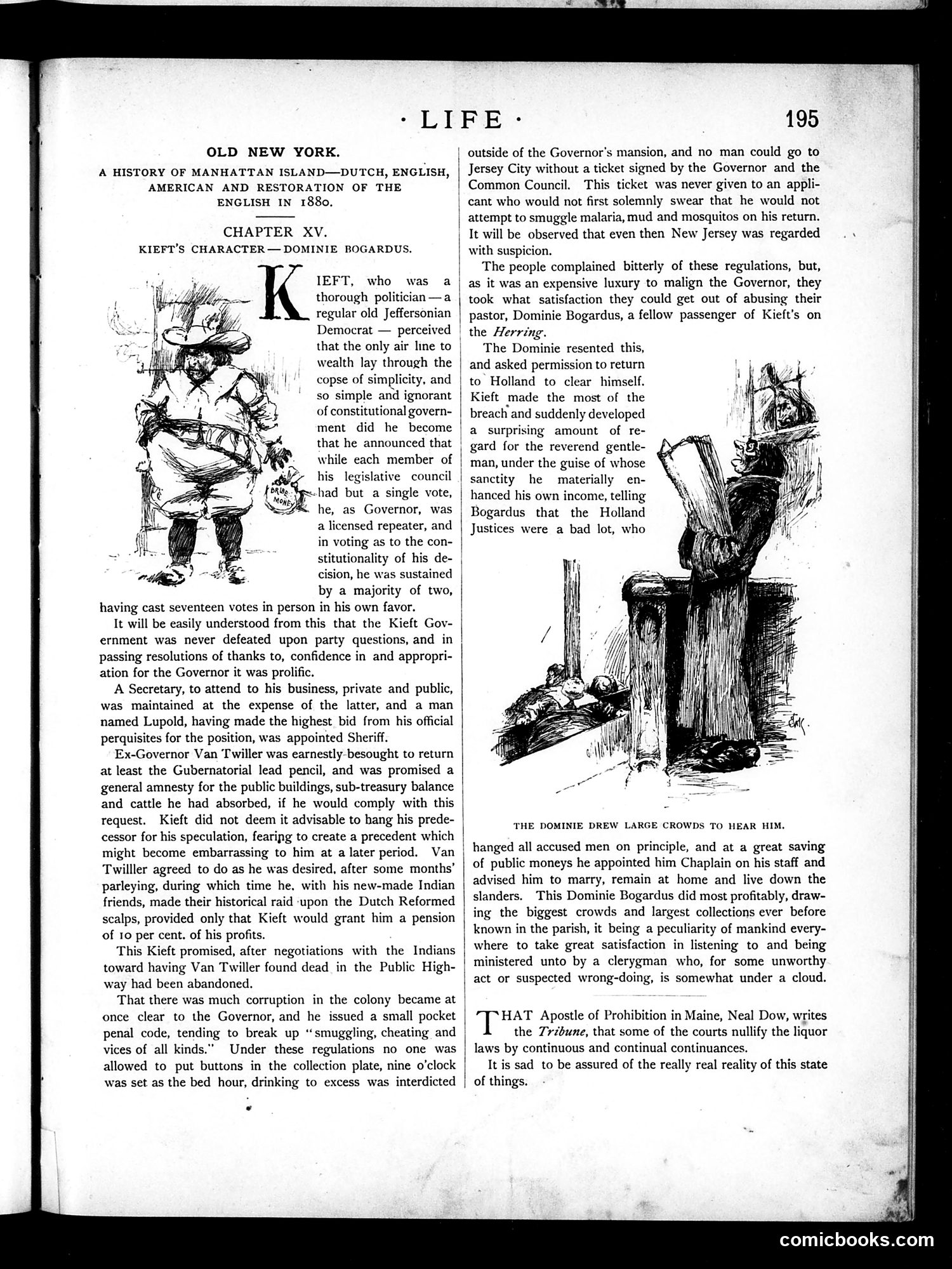
This page from Life magazine's "Old New York" historical series discusses Governor Kieft's colonial administration. The accompanying illustrations satirize Kieft as a bumbling, corrupt politician through exaggerated caricature—depicting him as rotund and ridiculous. The text describes Kieft's incompetence: he controlled his legislature through a single vote, issued petty regulations (banning buttons, controlling drinking hours), and made money through corrupt appointments. The satire criticizes his arbitrary governance and hypocrisy—he claimed simplicity while enriching himself through official positions. The final illustration showing crowds gathering suggests Kieft's popularity despite (or because of) his absurdity. The passage positions him as a cautionary historical example of governmental corruption and constitutional overreach in colonial America.
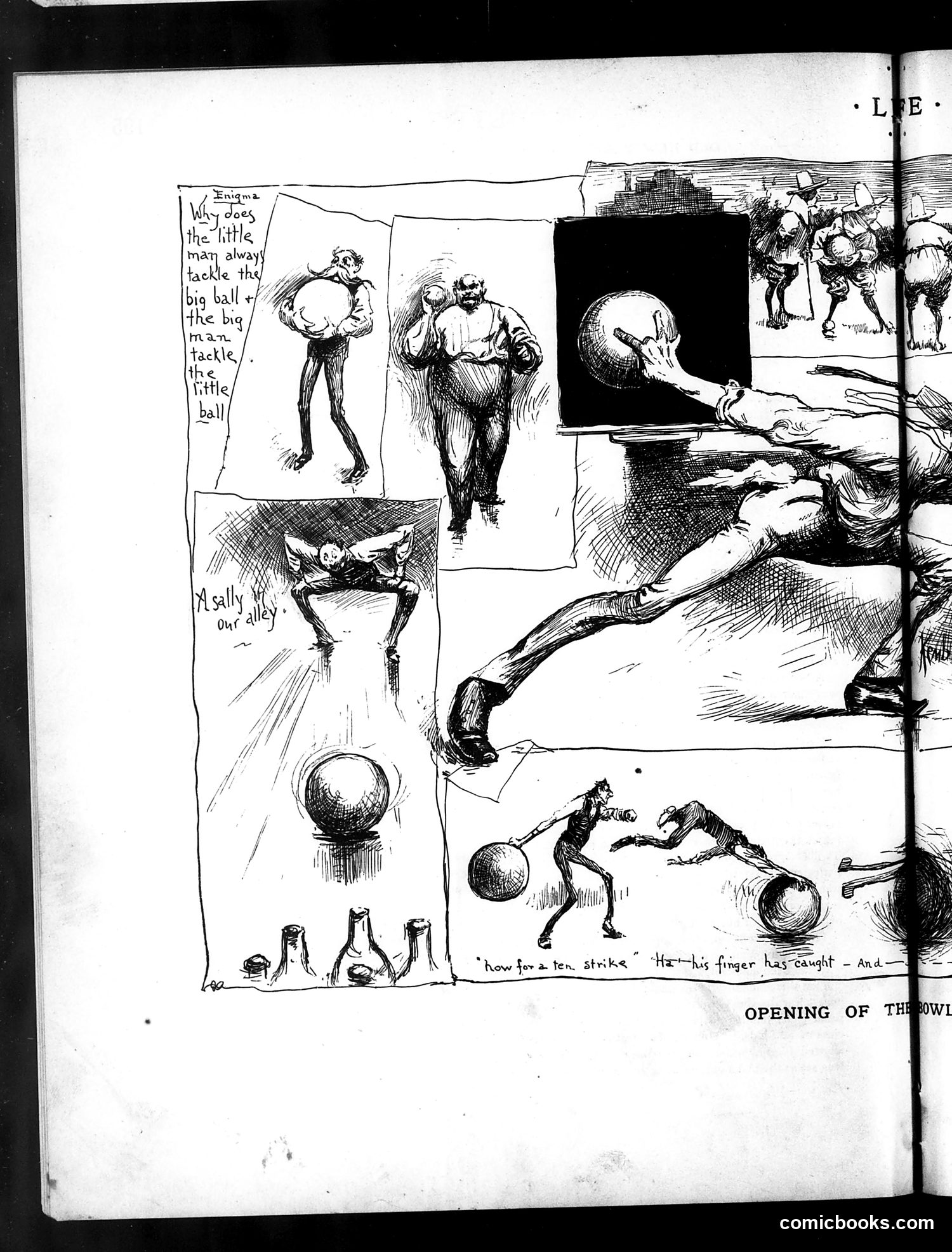
This page depicts a satirical sequence about American football, specifically tackling techniques. The left column shows an "enigma": "Why does the little man always tackle the big ball and the big man tackle the little ball?" The sequence illustrates this paradox through exaggerated drawings of players in various tackling positions with spheres (the ball). The caption "A salty cry alley" appears to reference spectator behavior or commentary. The bottom panels show a "ten strike" reference and mention "his finger has caught," depicting dynamic game action. The page title "OPENING OF THE OWL" likely refers to a sports publication or section. Without clearer historical context, the specific target of satire remains unclear, though the humor derives from football's physical absurdities and player sizing mismatches.
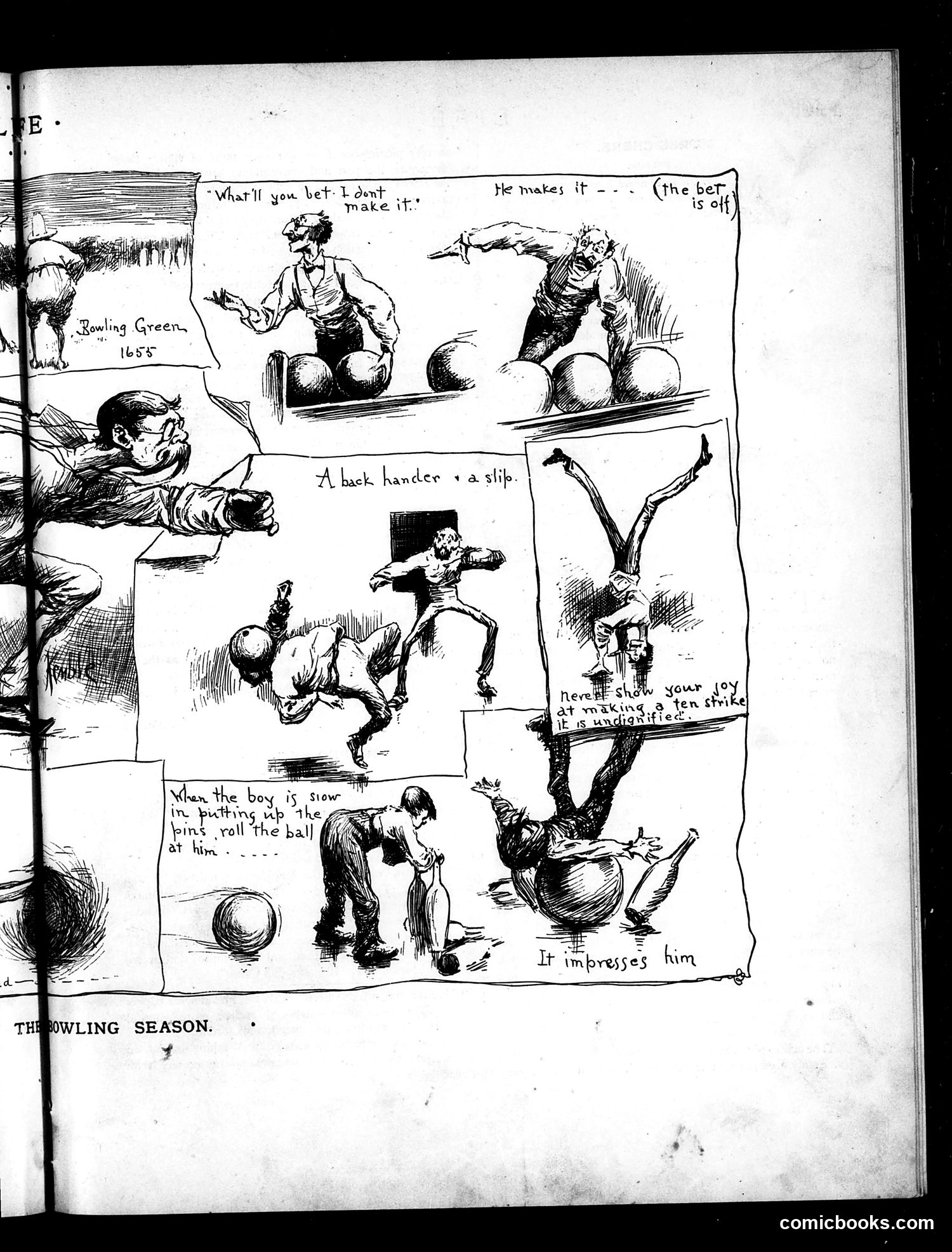
This page depicts lawn bowling, a popular Victorian-era recreational sport. The sequential cartoon panels illustrate the game's mechanics and social dynamics: **The Setup:** A player makes a bet about bowling skill ("What'll you bet I don't make it"). The opponent accepts the wager. **The Action:** Panels show various bowling techniques—a "back hander" with a slip, dramatic body positions during play, and an upside-down tumble suggesting either athletic exertion or comic failure. **The Satire:** The cartoon pokes fun at bowling's competitive nature and the physical contortions players adopt while trying to impress onlookers or win bets. The exaggerated poses mock both the sport's seriousness and players' theatrical attempts to appear skillful. The date "1865" and title indicate this documents a leisure activity popular in Civil War-era America.
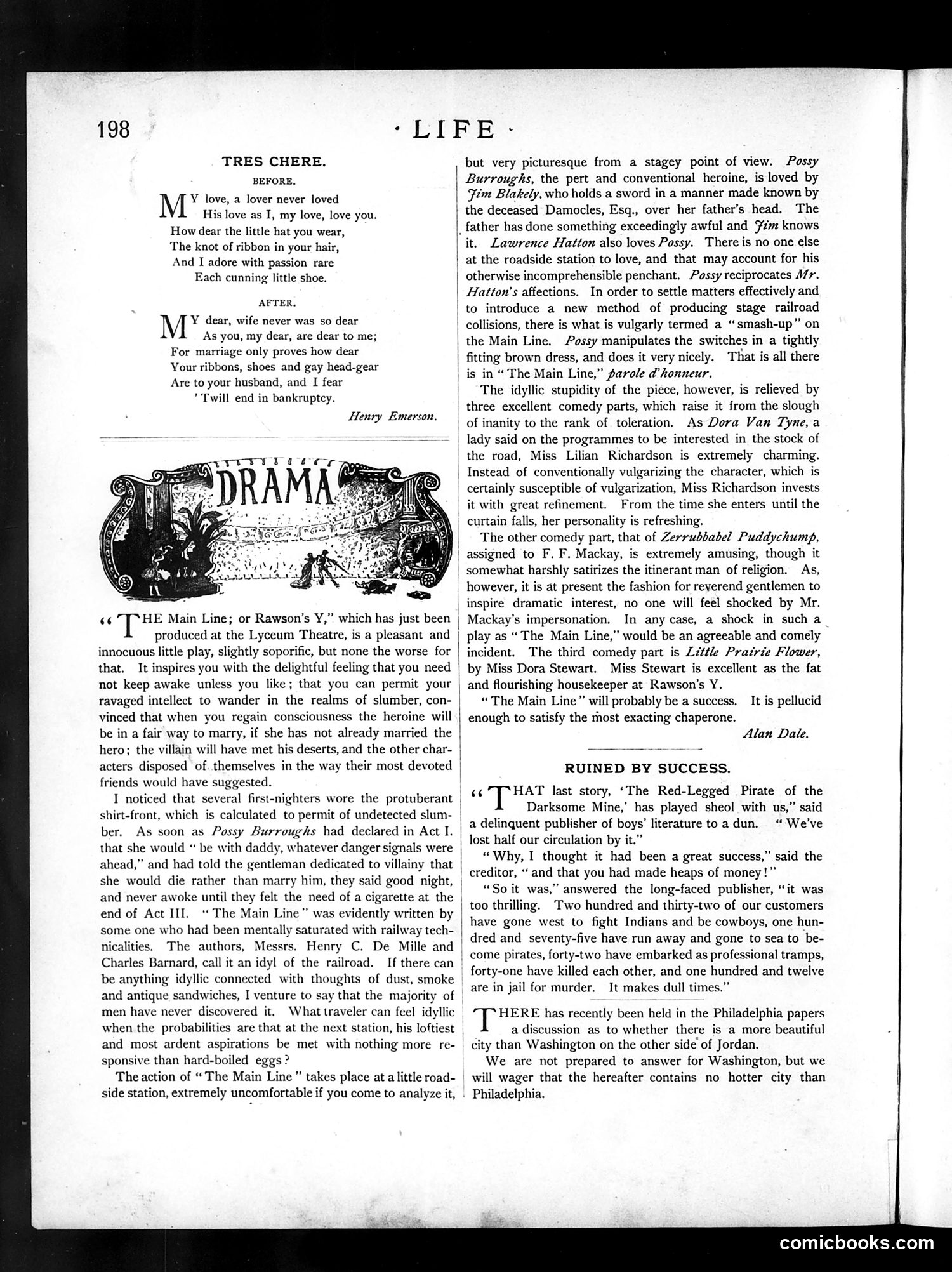
This page contains theatrical reviews from *Life* magazine (page 198). The main content discusses "The Main Line; or Rawson's Y," a comedy play at the Lyceum Theatre. The review criticizes the plot as somewhat tired but praises its comedy elements and the performances of actresses Lilian Richardson and Dora Van Dyne. A secondary review covers "Zerubbabel Puddychump," noting it satirizes itinerant preachers—apparently controversial enough that the review jokes about reverend gentlemen now avoiding dramatic depictions of clergy. The page includes poetry ("Tres Chere") and a section titled "Ruined by Success" discussing how one publisher's sensational book became too successful, causing customers to emigrate westward. No political cartoons are visible; this is primarily theatrical and literary criticism.
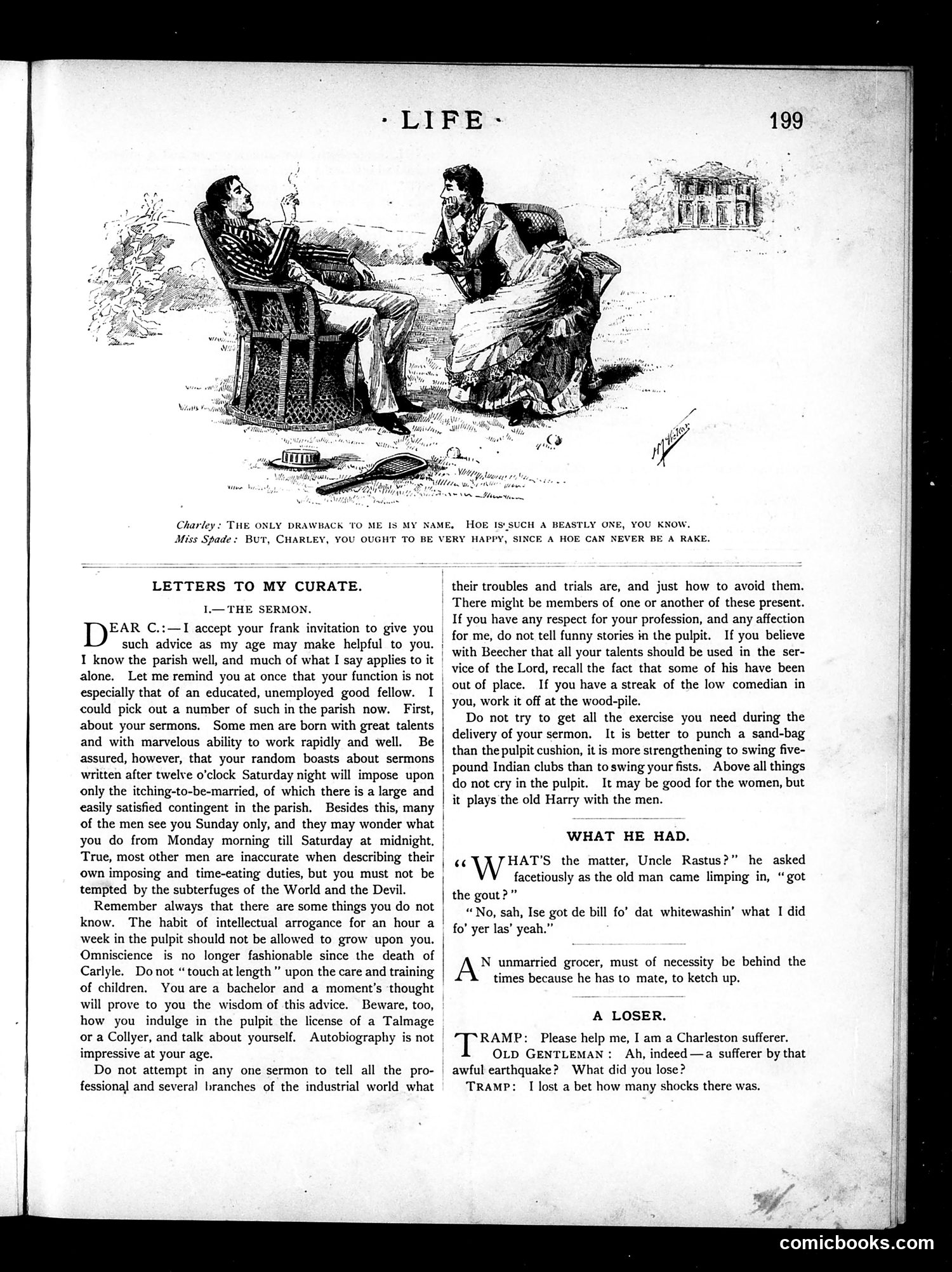
## The Cartoon The top illustration depicts two men in conversation—one named Charley complaining his name is "beastly," while Miss Spade responds that he should be happy since "a hoe can never be a rake." This is a simple pun-based joke playing on surnames: a "hoe" and "rake" are both garden tools, with "rake" also meaning a dissolute man. The humor relies on wordplay rather than political or social commentary. ## The Text Content The page contains three satirical advice pieces and anecdotes: 1. **"Letters to My Curate"** — advice to a clergyman about sermon-writing, cautioning against intellectual arrogance, autobiographical tangents, and inappropriate humor 2. **"What He Had"** — a brief dialogue with dialect humor involving an African American character and unpaid whitewashing debts 3. **"A Loser"** — a Charleston earthquake joke where a tramp lost a bet rather than property The content reflects early-to-mid 20th century sensibilities, including casual racial stereotyping in the dialect humor.
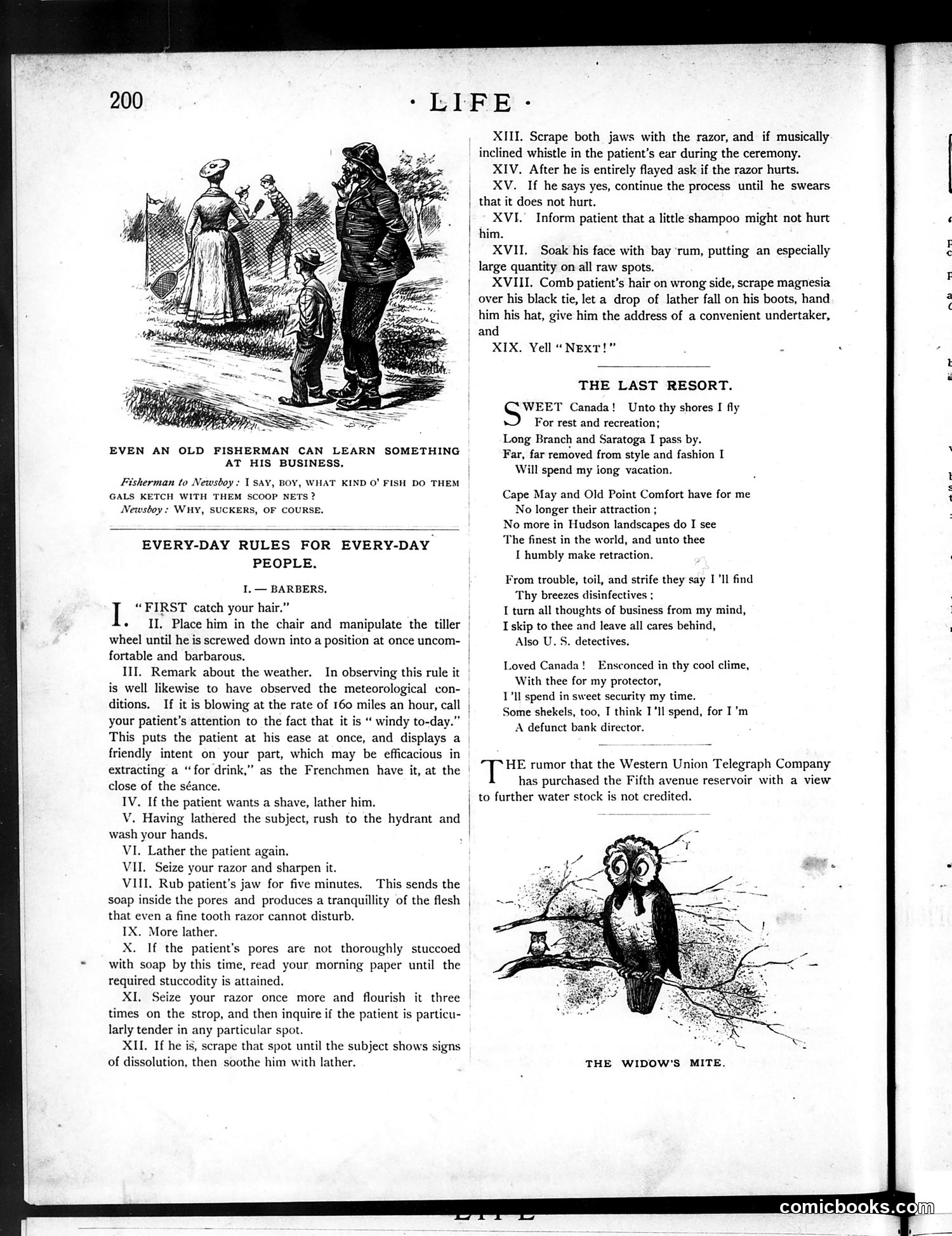
This page contains two satirical pieces from *Life* magazine: **"Every-Day Rules for Barbers"** mocks incompetent barbershop practices through exaggerated instructions. The humor targets barbers who: scrape customers raw, repeatedly re-lather (suggesting laziness or incompetence), make awkward small talk about weather, and injure patrons while asking if it hurts. The final joke—directing a maimed customer to an undertaker—represents the ultimate failure. This satirizes the era's widespread complaints about poor barbershop service. **"The Last Resort"** is a humorous poem about a wealthy person fleeing to Canada to escape both social obligations ("style and fashion," expensive resorts like Saratoga) and legal troubles ("U.S. detectives"). The punchline reveals he's "a defunct bank director"—someone who mismanaged or embezzled from a bank and is now hiding from authorities. This reflects Gilded Age banking scandals and financial crime. Both pieces use exaggeration and wordplay typical of *Life*'s satirical approach to contemporary American life.
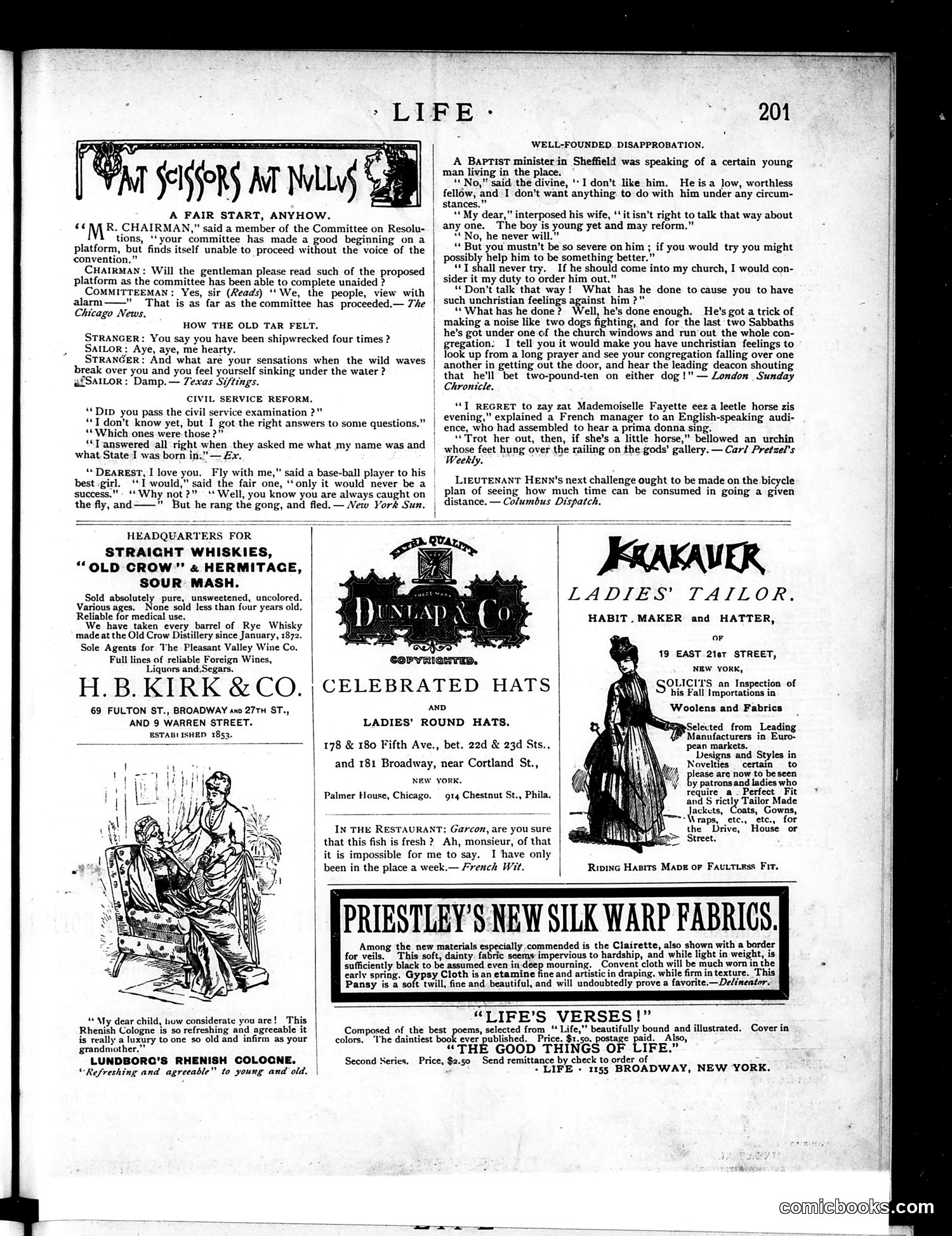
This page from *Life* magazine (a 19th-century satirical publication) contains several brief humorous anecdotes rather than political cartoons: **"A Fair Start, Anyhow"** mocks political party conventions, suggesting that platform-writing committees are so incompetent they can only agree on the vague opening phrase "We, the people, view with alarm——" before getting stuck. **"How the Old Tar Felt"** and other short jokes are simple puns and wordplay with no satirical intent—they're just lighthearted humor about sailors, civil service exams, and baseball. **"Well-Founded Disapprobation"** satirizes religious hypocrisy: a Baptist minister claims moral authority while refusing to help a troubled young man, then is comically revealed to dislike him merely because the boy mimicked dog-fighting sounds outside church, disrupting services. The page is otherwise filled with period advertisements (whiskey, hats, tailoring services, fabric). No major political figures or events are referenced—this is general satirical content mocking human folly, bureaucratic incompetence, and clerical sanctimoniousness.
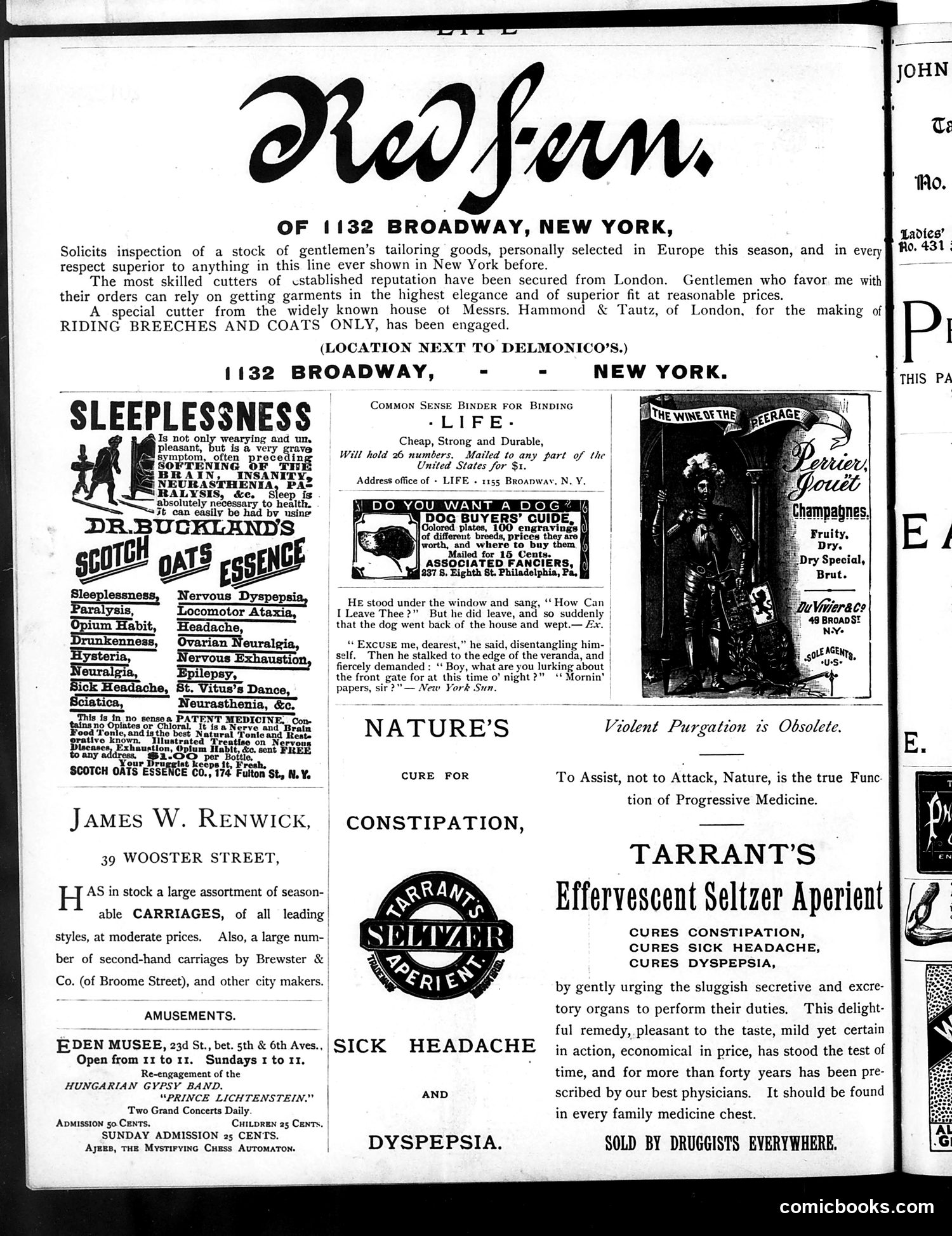
This is primarily an **advertising page** rather than a satirical cartoon page. The content consists almost entirely of commercial advertisements and business notices typical of late 19th-century publications. The page includes ads for: - **Red Fern tailoring** (1132 Broadway) — high-end men's clothing with cutters imported from London - **Dr. Buckland's Scotch Oats Essence** — a patent medicine claiming to cure sleeplessness, paralysis, and nervous conditions - **Tarrant's Effervescent Seltzer Aperient** — a digestive remedy for constipation and dyspepsia - **James W. Renwick's carriage business** - Various other services The **small illustrated anecdote** (middle-right) about a man singing under a window and a dog is a humorous vignette rather than political satire—a common feature in Life magazine. The page reflects the era's medical quackery and patent medicine culture, though modern readers would recognize these remedies as ineffective by today's standards. No political figures or specific satire are evident.
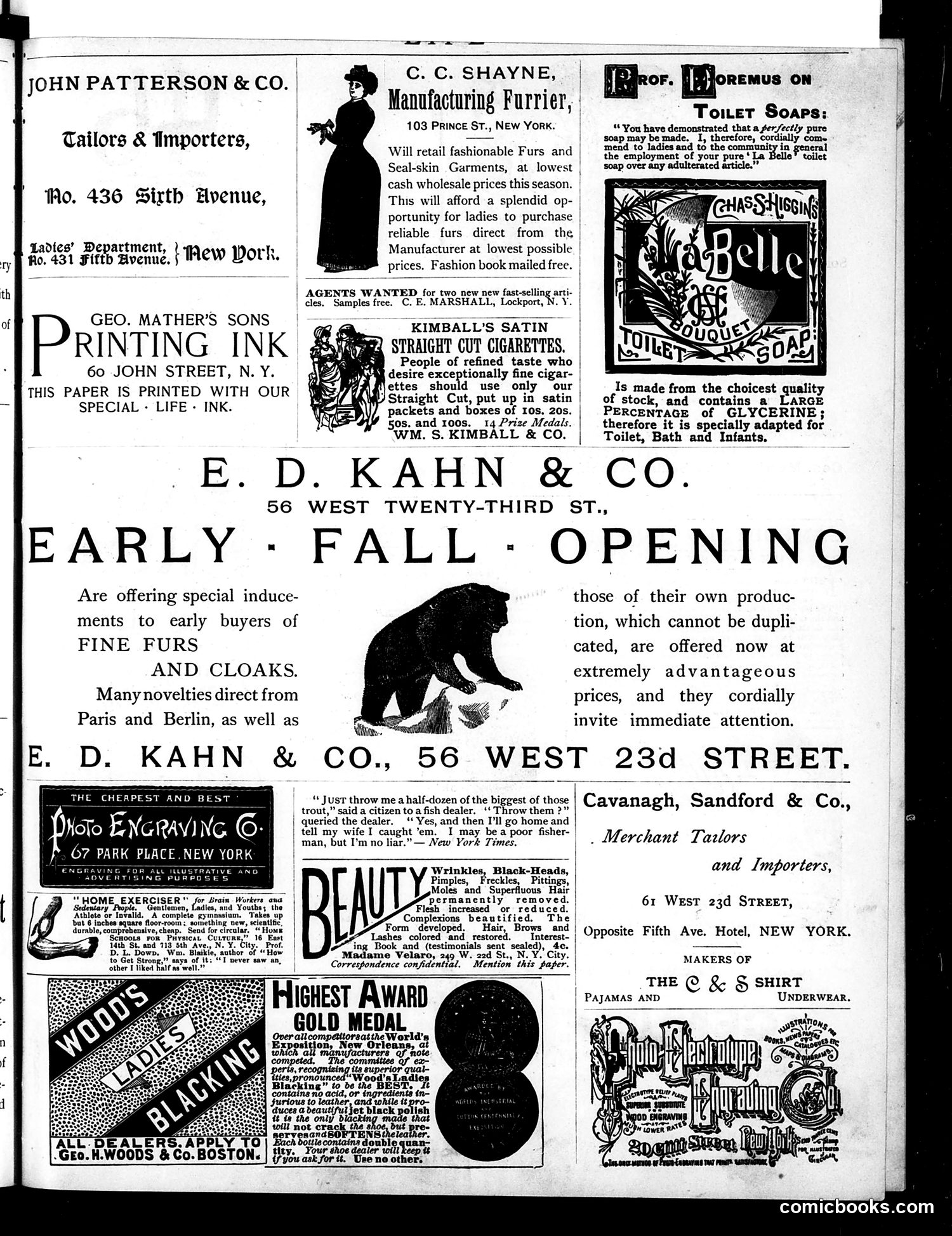
This is primarily a **commercial advertising page** from an early Life magazine, not a satirical or editorial cartoon page. The dominant content consists of product advertisements for late 19th-century merchants and manufacturers. The single **joke/cartoon** present is a brief anecdote (center-left) from the *New York Times* about a man instructing a fishmonger to throw large trout so he can tell his wife he caught them himself—a humorous commentary on male vanity and dishonesty. It's a throwaway joke, not political satire. The advertisements promote period goods: furs, tailoring, cigarettes, printing ink, soap, photo engraving, beauty treatments (wrinkle removal, hair restoration), and blacking/shoe polish. The "Beauty" ad prominently features treatments for complexion and superfluous hair removal—reflecting era-specific cosmetic concerns. The page reflects **Gilded Age consumer culture** and gender expectations (many ads target women's appearance and household management). There is **no apparent political or social satire** on this particular page.
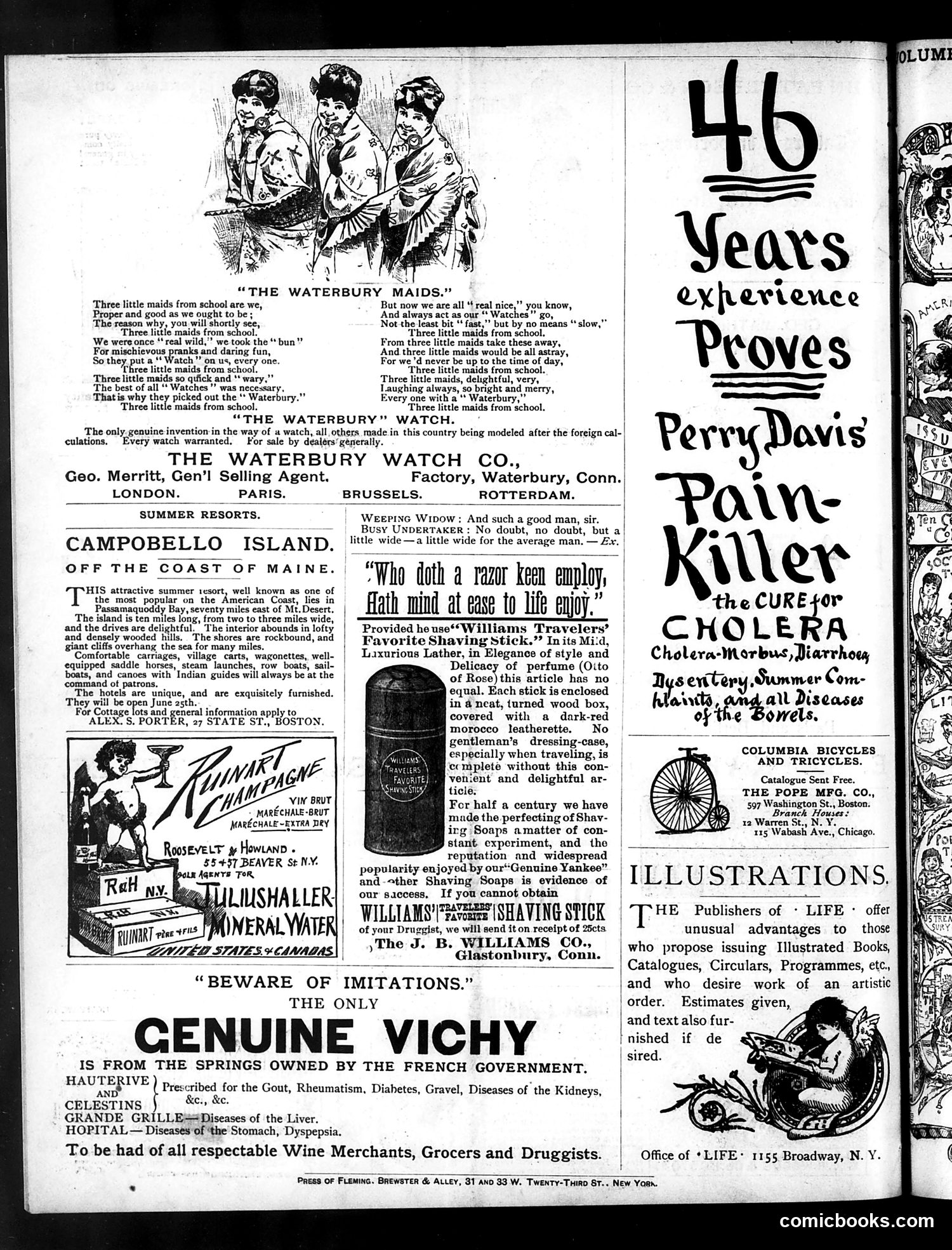
This page is primarily **advertising**, featuring a parody of Gilbert & Sullivan's "Three Little Maids from School" (from *The Mikado*). The satirical song promotes **Waterbury watches** by humorously claiming three formerly "wild" schoolgirls became perfectly behaved and punctual once they owned Waterbury timepieces. The joke is that the watches are so reliable they literally civilized these mischievous children—the watch brand controls their behavior ("always act as our 'Watches' go"). The text emphasizes Waterbury's reliability and American manufacturing ("the only genuine invention...all others made in this country being modeled after the foreign calculations"). The rest of the page contains various period advertisements: mineral water, shaving products, summer resort accommodations, and bicycles. There's also a small cartoon of a "weeping widow" and undertaker making a grim pun about the deceased's width. **Context for modern readers**: This relies on familiarity with the famous Gilbert & Sullivan operetta to make its advertising pitch clever.