
Life, 1886-09-30 · page 7 of 16
Life — September 30, 1886 — page 7: what you’re looking at
What you’re looking at
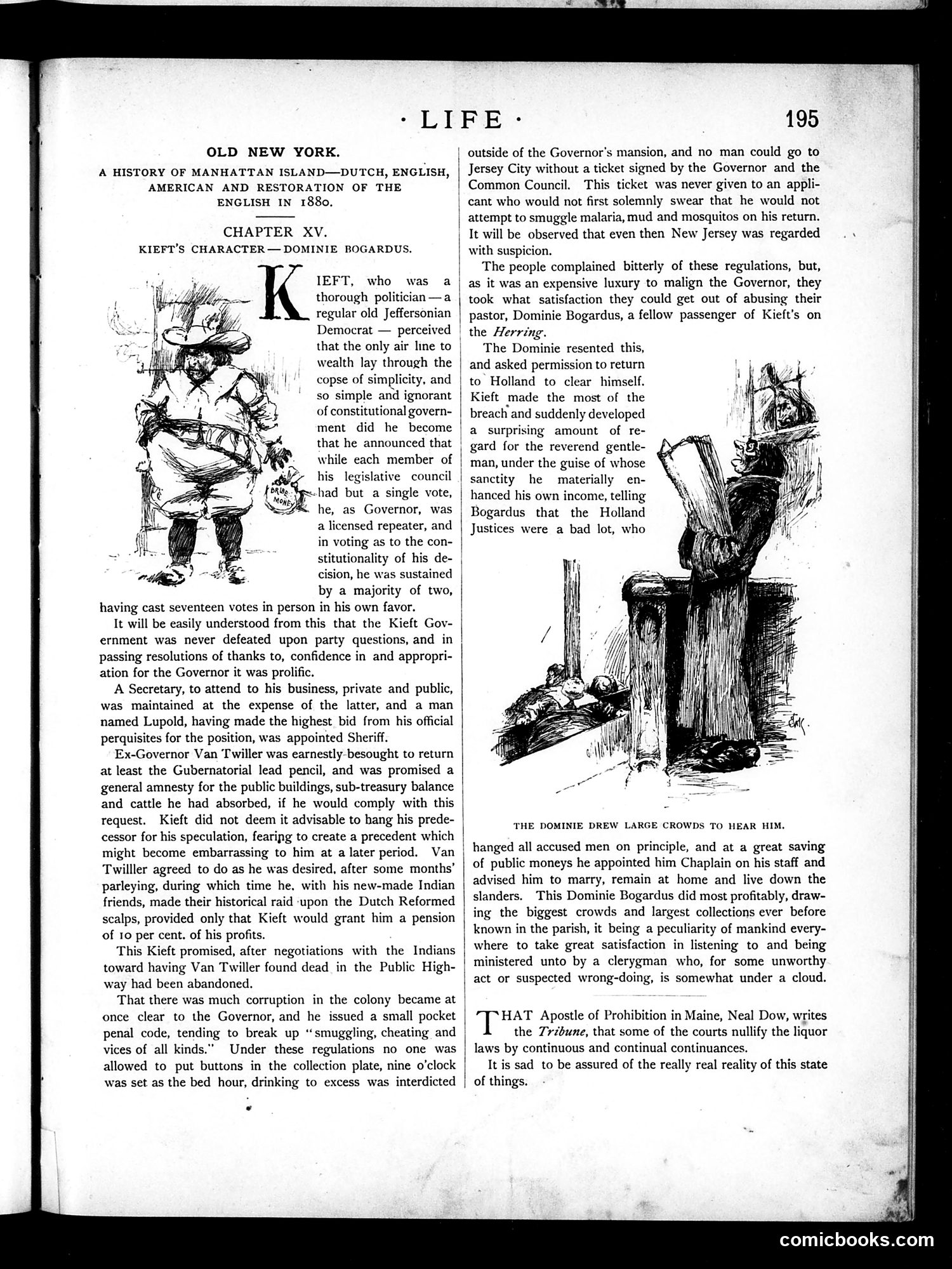
This page from Life magazine's "Old New York" historical series discusses Governor Kieft's colonial administration. The accompanying illustrations satirize Kieft as a bumbling, corrupt politician through exaggerated caricature—depicting him as rotund and ridiculous. The text describes Kieft's incompetence: he controlled his legislature through a single vote, issued petty regulations (banning buttons, controlling drinking hours), and made money through corrupt appointments. The satire criticizes his arbitrary governance and hypocrisy—he claimed simplicity while enriching himself through official positions. The final illustration showing crowds gathering suggests Kieft's popularity despite (or because of) his absurdity. The passage positions him as a cautionary historical example of governmental corruption and constitutional overreach in colonial America.
📄 Transcribed text from this page (OCR, searchable)
Machine-transcribed from the original scan — historical spelling and the odd misread are preserved.
OLD NEW YORK. | A HISTORY OF MANHATTAN ISLAND—DUTCH, ENGLISH, | AMERICAN AND RESTORATION OF THE ENGLISH IN 1880, CHAPTER XV. KIEFT’S CHARACTER— DOMINIE BOGARDUS. IEFT, who a} thorough politician —a | regular old Jeffersonian Democrat — perceived that the only air line to | wealth lay through the copse of simplicity, and | so simple and ignorant of constitutional govern- ment did he become | that he announced that | while each member of his legislative council had but a single vote, he, as Governor, was a licensed repeater, and in voting as to the con- stitutionality of his de- | cision, he was sustained by a majority of two, having cast seventeen votes in person in his own favor. It will be easily understood from this that the Kieft Gov- ernment was never defeated upon party questions, and in passing resolutions of thanks to, confidence in and appropri- ation for the Governor it was prolific. A Secretary, to attend to his business, private and public, was maintained at the expense of the latter, and a man named Lupold, having made the highest bid from his official perquisites for the position, was appointed Sheriff. Ex-Governor Van Twiller was earnestly-besought to return at least the Gubernatorial lead pencil, and was promised a general amnesty for the public buildings, sub-treasury balance and cattle he had absorbed, if he would comply with this request. Kieft did not deem it advisable to hang his prede- cessor for his speculation, fearipg to create a precedent which might become embarrassing to him at a later period. Van | Twilller agreed to do as he was desired, after some months’ parleying, during which time he. with his new-made Indian friends, made their historical raid upon the Dutch Reformed. scalps, provided only that Kieft would grant him a pension of 10 per cent. of his profits. This Kieft promised, after negotiations with the Indians toward having Van Twiller found dead in the Public High- | way had been abandoned. That there was much corruption in the colony became at | once clear to the Governor, and he issued a small pocket penal code, tending to break up “smuggling, cheating and vices of all kinds.” Under these regulations no one was allowed to put buttons in the collection plate, nine o’clock was oa Common Council. | cant who would not first solemnly swear that he would not was set as the bed hour, drinking to excess was interdicted . FE: 195 outside of the Governor's mansion, and no man could go to Jersey City without a ticket signed by the Governor and the This ticket was never given to an appli- attempt to smuggle malaria, mud and mosquitos on his return. | It will be observed that even then New Jersey was regarded with suspicion. The people complained bitterly of these regulations, but, as it was an expensive luxury to malign the Governor, they took what satisfaction they could get out of abusing their | pastor, Dominie Bogardus, a fellow passenger of Kieft’s on the Herring. The Dominie resented this, and asked permission to return to Holland to clear himself. | Kieft made the most of the breach and suddenly developed a surprising amount of re- gard for the reverend gentle- man, under the guise of whose sanctity he materially en- hanced his own income, telling Bogardus that the Holland Justices were a bad lot, who THE DOMINIE DREW LARGE CROWDS TO HEAR HIM. hanged all accused men on principle, and at a great saving of public moneys he appointed him Chaplain on his staff and advised him to marry, remain at home and live down the slanders. This Dominie Bogardus did most profitably, draw- ing the biggest crowds and largest collections ever before known in the parish, it being a peculiarity of mankind every- where to take great satisfaction in listening to and being ministered unto by a clerygman who, for some unworthy | act or suspected wrong-doing, is somewhat under a cloud. HAT Apostle of Prohibition in Maine, Neal Dow, writes the 7rzbune, that some of the courts nullify the liquor laws by continuous and continual continuances. It is sad to be assured of the really real reality of this state of things. comicbooks.com