
Life, 1886-09-30 · page 10 of 16
Life — September 30, 1886 — page 10: what you’re looking at
What you’re looking at
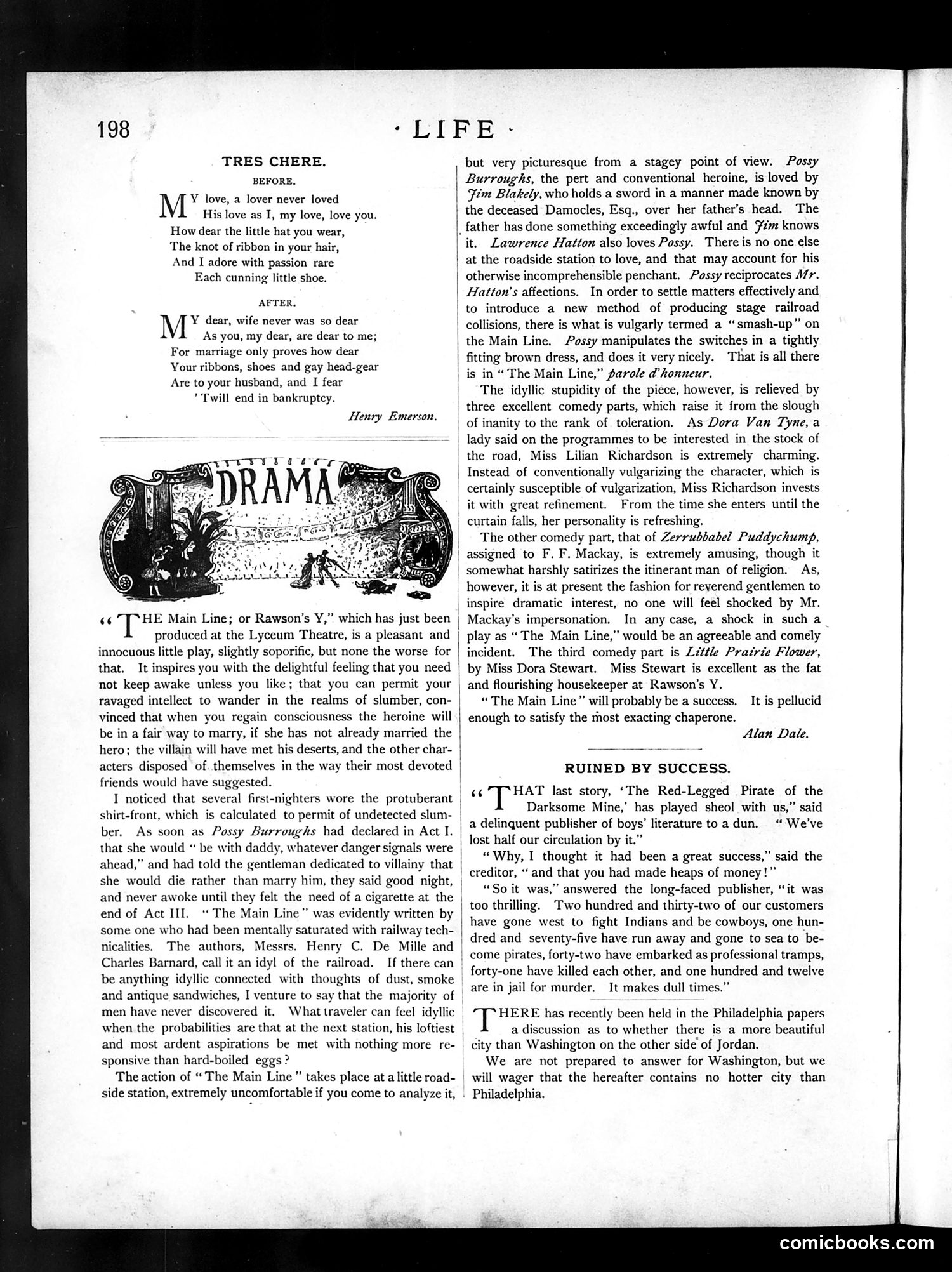
This page contains theatrical reviews from *Life* magazine (page 198). The main content discusses "The Main Line; or Rawson's Y," a comedy play at the Lyceum Theatre. The review criticizes the plot as somewhat tired but praises its comedy elements and the performances of actresses Lilian Richardson and Dora Van Dyne. A secondary review covers "Zerubbabel Puddychump," noting it satirizes itinerant preachers—apparently controversial enough that the review jokes about reverend gentlemen now avoiding dramatic depictions of clergy. The page includes poetry ("Tres Chere") and a section titled "Ruined by Success" discussing how one publisher's sensational book became too successful, causing customers to emigrate westward. No political cartoons are visible; this is primarily theatrical and literary criticism.
📄 Transcribed text from this page (OCR, searchable)
Machine-transcribed from the original scan — historical spelling and the odd misread are preserved.
*LIFE- TRES CHERE, BEFORE, M Y love, a lover never loved His love as I, my love, love you. How dear the little hat you wear, The knot of ribbon in your hair, And I adore with passion rare Each cunning little shoe. AFTER, Y dear, wife never was so dear As you, my dear, are dear to me; For marriage only proves how dear Your ribbons, shoes and gay head-gear Are to your husband, and I fear ’ Twill end in bankruptcy. Henry Emerson, ‘“ HE Main Line; or Rawson's Y,” which has just been | produced at the Lyceum Theatre, is a pleasant and | innocuous little play, slightly soporific, but none the worse for | that. It inspires you with the delightful feeling that you need | not keep awake unless you like; that you can permit your | ravaged intellect to wander in the realms of slumber, con- | vinced that when you regain consciousness the heroine will | be in a fair way to marry, if she has not already married the | hero; the villain will have met his deserts, and the other char- | acters disposed of. themselves in the way their most devoted friends would have suggested. I noticed that several first-nighters wore the protuberant shirt-front, which is calculated to permit of undetected slum- ber. As soon as Possy Burroughs had declared in Act I. that she would “ be with daddy, whatever danger signals were | ahead,” and had told the gentleman dedicated to villainy that she would die rather than marry him, they said good night, and never awoke until they felt the need of a cigarette at the end of Act III. ‘The Main Line” was evidently written by some one who had been mentally saturated with railway tech- nicalities. The authors, Messrs. Henry C. De Mille and Charles Barnard, call it an idyl of the railroad. If there can be anything idyllic connected with thoughts of dust, smoke and antique sandwiches, I venture to say that the majority of men have never discovered it. What traveler can feel idyllic when the probabilities are that at the next station, his loftiest and most ardent aspirations be met with nothing more re- sponsive than hard-boiled eggs ? The action of “The Main Line ” takes place at a little road- side station, extremely uncomfortable if you come to analyze it, but very picturesque from a stagey point of view. Possy Burroughs, the pert and conventional heroine, is loved by Jim Blakely, who holds a sword in a manner made known by | the deceased Damocles, Esq., over her father’s head. The _ father has done something exceedingly awful and 72m knows it. Lawrence Hatton also loves Possy. There is no one else at the roadside station to love, and that may account for his otherwise incomprehensible penchant. Possy reciprocates Mr. Hatton's affections. In order to settle matters effectively and to introduce a new method of producing stage railroad collisions, there is what is vulgarly termed a “smash-up” on the Main Line. Possy manipulates the switches in a tightly fitting brown dress, and does it very nicely. That is all there is in “ The Main Line,” parole a’honneur. The idyllic stupidity of the piece, however, is relieved by three excellent comedy parts, which raise it from the slough of inanity to the rank of toleration. As Dora Van Tyne, a lady said on the programmes to be interested in the stock of the road, Miss Lilian Richardson is extremely charming. Instead of conventionally vulgarizing the character, which is certainly susceptible of vulgarization, Miss Richardson invests it with great refinement. From the time she enters until the curtain falls, her personality is refreshing. The other comedy part, that of Zerrubbabel Puddychump, assigned to F. F. Mackay, is extremely amusing, though it somewhat harshly satirizes the itinerant man of religion. As, however, it is at present the fashion for reverend gentlemen to inspire dramatic interest, no one will feel shocked by Mr. Mackay's impersonation. In any case, a shock in such a play as “ The Main Line,” would be an agreeable and comely incident. The third comedy part is Little Prairie Flower, by Miss Dora Stewart. Miss Stewart is excellent as the fat and flourishing housekeeper at Rawson's Y. “ The Main Line” will probably be a success. enough to satisfy the rhost exacting chaperone. It is pellucid Alan Dale. RUINED BY SUCCESS. “cc HAT last story, ‘The Red-Legged Pirate of the Darksome Mine,’ has played sheol with us,” said a delinquent publisher of boys’ literature toa dun. “We've lost half our circulation by it.” “Why, I thought it had been a great success,” said the | creditor, ‘and that you had made heaps of money!" “So it was,” answered the long-faced publisher, “it was too thrilling. Two hundred and thirty-two of our customers have gone west to fight Indians and be cowboys, one hun- dred and seventy-five have run away and gone to sea to be- come pirates, forty-two have embarked as professional tramps, forty-one have killed each other, and one hundred and twelve are in jail for murder. It makes dull times.” HERE has recently been held in the Philadelphia papers a discussion as to whether there is a more beautiful city than Washington on the other side of Jordan. We are not prepared to answer for Washington, but we will wager that the hereafter contains no hotter city than Philadelphia. comicbooks.com