
Life, 1886-09-30 · page 6 of 16
Life — September 30, 1886 — page 6: what you’re looking at
What you’re looking at
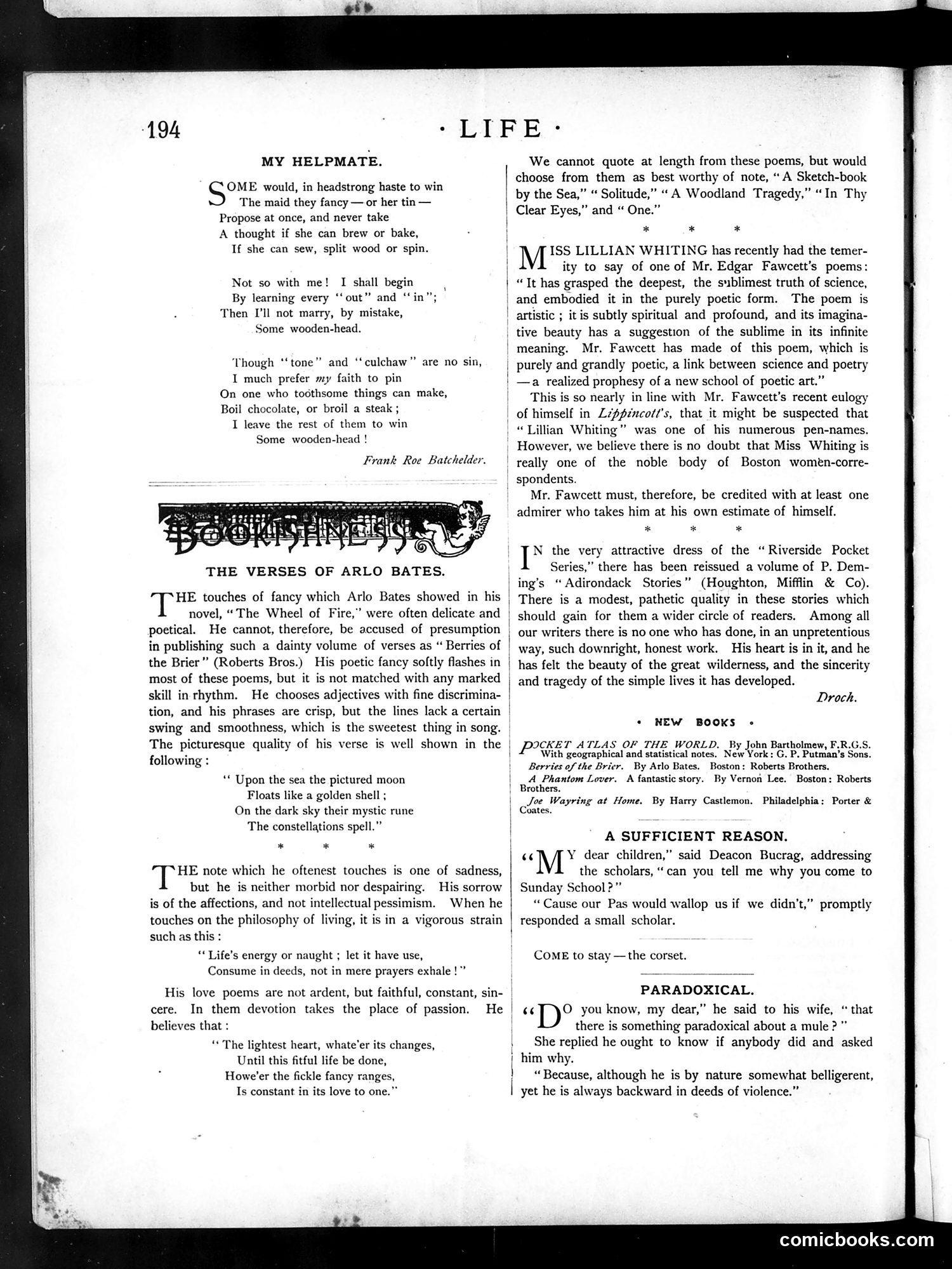
This page contains literary criticism and humorous anecdotes rather than political cartoons. The main content includes: **"My Helpmate"** - A poem by Frank Roe Batchelder satirizing domestic expectations, where the speaker contrasts a husband's willingness to learn practical skills versus society's demands on wives. **Review of Arlo Bates's poetry** - Critical analysis of his verses, noting his delicate style lacks rhythm and "swing." **Humorous short pieces** - Including "A Sufficient Reason" (about Sunday School attendance) and "Paradoxical" (a joke about a mule's contradictory nature). The page reflects late-19th century *Life* magazine's satirical approach to social commentary through literature and wit rather than visual cartoons. The domestic satire subtly critiques gender role expectations of the era.
📄 Transcribed text from this page (OCR, searchable)
Machine-transcribed from the original scan — historical spelling and the odd misread are preserved.
> ETF E.* MY HELPMATE. OME would, in headstrong haste to win The maid they fancy —or her tin — Propose at once, and never take A thought if she can brew or bake, If she can sew, split wood or spin. Not so with me! I shall begin By learning every “out” and “in”; Then I’ll not marry, by mistake, Some wooden-head. ‘Though ‘‘tone” and ‘‘culchaw” are no sin, I much prefer my faith to pin On one who toothsome things can make, Boil chocolate, or broil a steak ; I leave the rest of them to win Some wooden-head ! Frank Roe Batchelder, THE VERSES OF ARLO BATES. HE touches of fancy which Arlo Bates showed in his novel, “The Wheel of Fire,” were often delicate and poetical. He cannot, therefore, be accused of presumption in publishing such a dainty volume of verses as “ Berries of the Brier” (Roberts Bros.) His poetic fancy softly flashes in most of these poems, but it is not matched with any marked skill in rhythm. He chooses adjectives with fine discrimina- tion, and his phrases are crisp, but the lines lack a certain | swing and smoothness, which is the sweetest thing in song. The picturesque quality of his verse is well shown in the following : ‘* Upon the sea the pictured moon Floats like a golden shell ; On the dark sky their mystic rune The constellations spell.” * * * HE note which he oftenest touches is one of sadness, but he is neither morbid nor despairing. His sorrow is of the affections, and not intellectual pessimism. When he touches on the philosophy of living, it is in a vigorous strain such as this : “Life's energy or naught ; let it have use, Consume in deeds, not in mere prayers exhale !”” His love poems are not ardent, but faithful, constant, sin- cere. In them devotion takes the place of passion. He believes that : “The lightest heart, whate'er its changes, Until this fitful life be done, Howe'er the fickle fancy ranges, Is constant in its love to one.” | should gain for them a wider circle of readers. We cannot quote at length from these poems, but would choose from them as best worthy of note, “A Sketch-book by the Sea,” “ Solitude,” “A Woodland Tragedy,” “In Thy Clear Eyes,” and “ One.” * * * ISS LILLIAN WHITING has recently had the temer- ity to say of one of Mr. Edgar Fawcett’s poems: “Tt has grasped the deepest, the sublimest truth of science, | and embodied it in the purely poetic form. The poem is artistic ; it is subtly spiritual and profound, and its imagina- tive beauty has a suggestion of the sublime in its infinite meaning. Mr. Fawcett has made of this poem, which is purely and grandly poetic, a link between science and poetry | —a realized prophesy of a new school of poetic art.” This is so nearly in line with Mr. Fawcett’s recent eulogy of himself in Z¢fAzncott’s, that it might be suspected that “Lillian Whiting” was one of his numerous pen-names. However, we believe there is no doubt that Miss Whiting is really one of the noble body of Boston women-corre- spondents. Mr. Fawcett must, therefore, be credited with at least one admirer who takes him at his own estimate of himself. * * * I NV the very attractive dress of the “Riverside Pocket Series,” there has been reissued a volume of P. Dem- ing’s “Adirondack Stories” (Houghton, Mifflin & Co). There is a modest, pathetic quality in these stories which Among all our writers there is no one who has done, in an unpretentious | way, such downright, honest work. His heart is in it, and he has felt the beauty of the great wilderness, and the sincerity and tragedy of the simple lives it has developed. Droch. * NEW BOOKS - POCKET ATLAS OF THE WORLD, By John Bartholmew, F:R.G.S. With geographical and statistical notes. NewYork: G. P, Putman’s Sons. Berries of the Brier. By Arlo Bates. Boston: Roberts Brothers. A Phantom Lover. A fantastic story. By Vernon Lee. Boston: Roberts | Brothers. Joe Wayring at Home. By Harry Castlemon. Philadelphia: Porter & | Coates. A SUFFICIENT REASON. “ Y dear children,” said Deacon Bucrag, addressing the scholars, “can you tell me why you come to Sunday School?” “Cause our Pas would wallop us if we didn’t,” promptly responded a small scholar. COME to stay — the corset. PARADOXICAL. 73 O you know, my dear,” he said to his wife, “that there is something paradoxical about a mule?” She replied he ought to know if anybody did and asked him why. “Because, although he is by nature somewhat belligerent, yet he is always backward in deeds of violence.” comicbooks.com