
A complete issue · 16 pages · 1886
Life — July 8, 1886
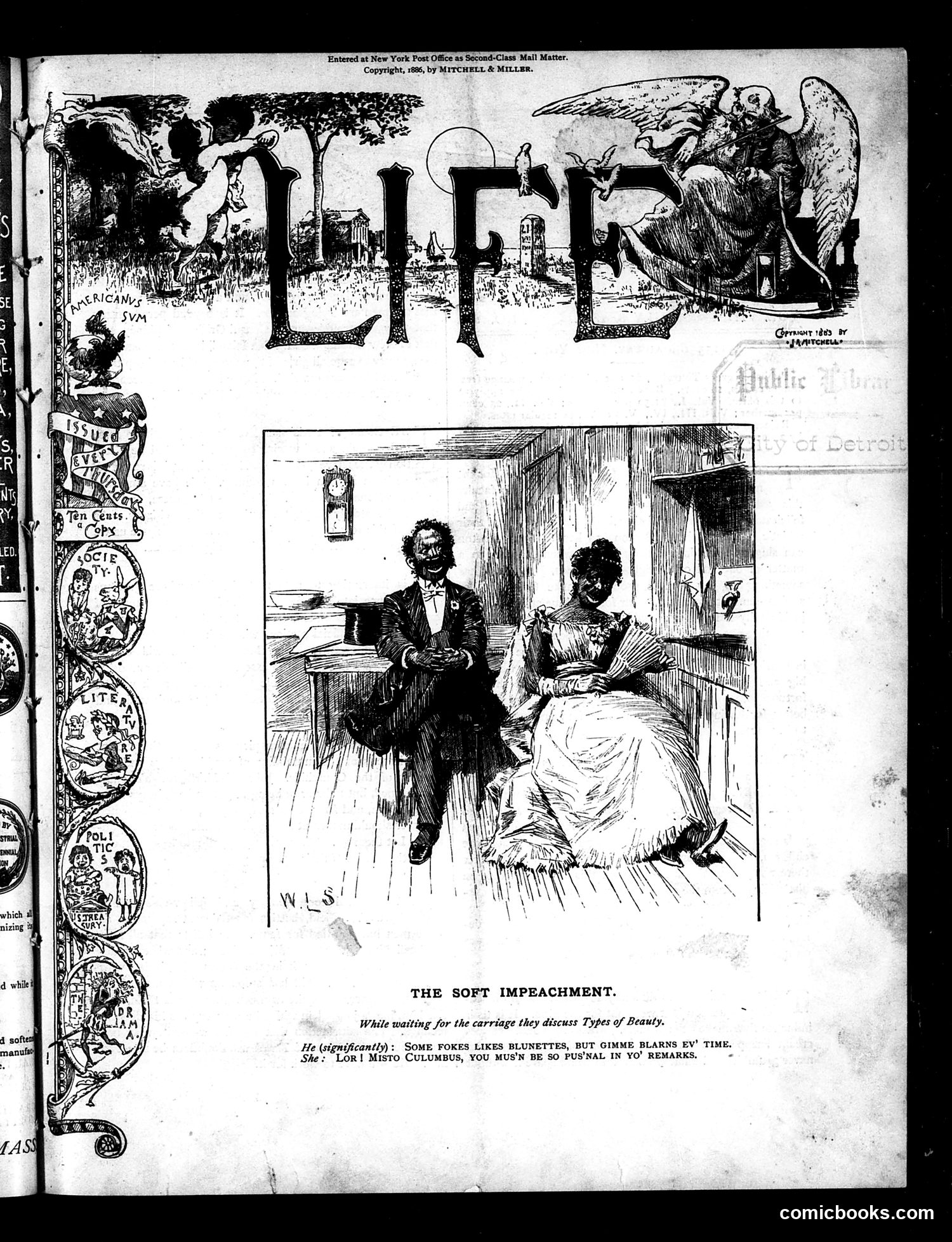
This cartoon satirizes a gentleman's complaint about his wife's beauty standards. While waiting for their carriage, he indignantly protests that she criticizes his appearance, saying some men like "blunettes" (brunettes) but she insists he must be "po'lite" in his remarks—implying he should compliment her looks regardless. The satire targets the Victorian-era double standard: women could openly judge men's appearance and manners, but men were expected to remain deferential and complimentary toward women without complaint. The title "soft impeachment" suggests a mild accusation or reproach—she's gently (or not-so-gently) criticizing his failure to flatter her sufficiently. It's social commentary on domestic gender dynamics and courtship etiquette of the era.
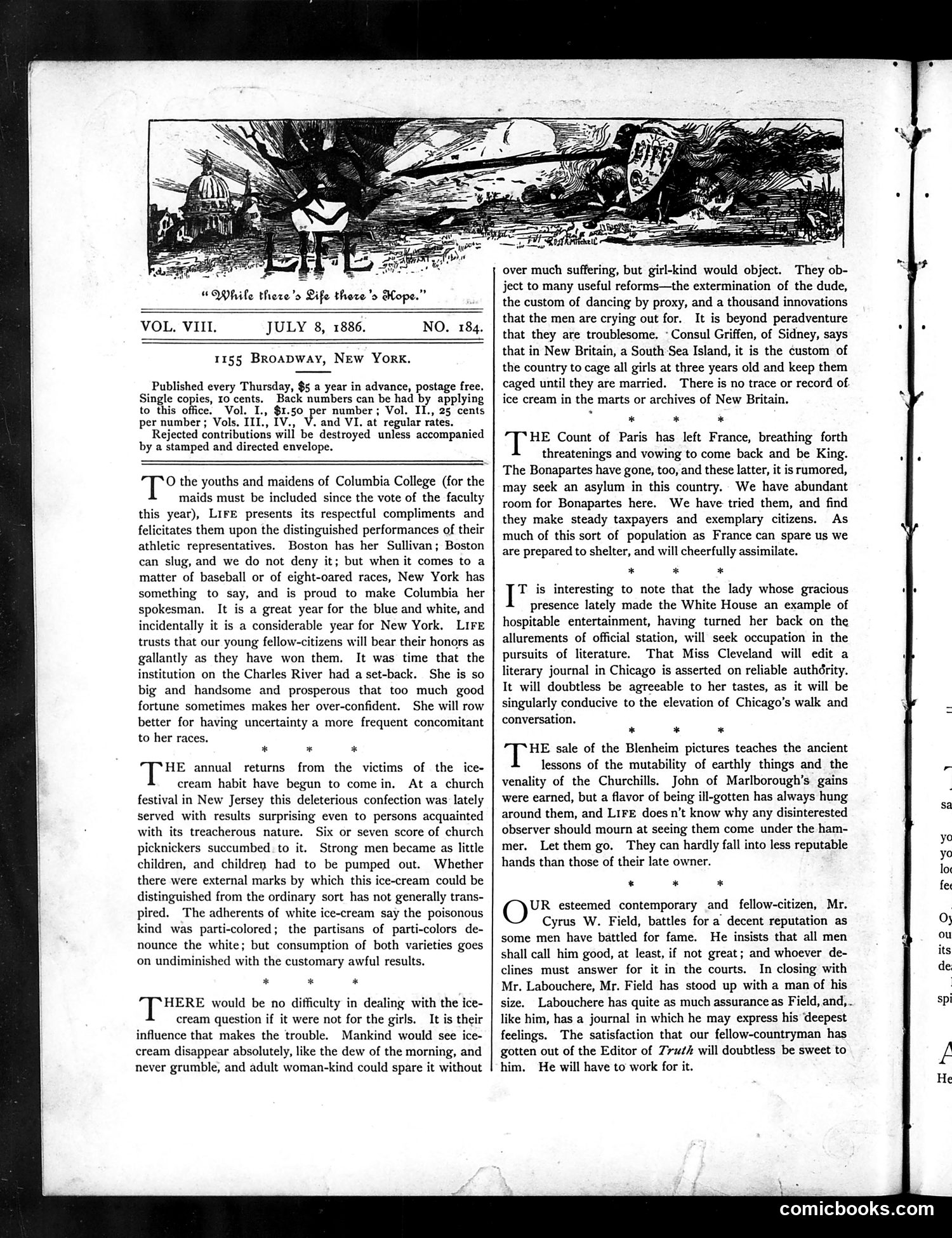
The masthead illustration depicts a dramatic nighttime scene with what appears to be a comet or celestial phenomenon over a cityscape (possibly including a notable dome, suggesting Washington D.C. or similar). The exact reference is unclear from the image alone. The textual content focuses on social commentary rather than political cartooning: Columbia College's baseball team, ice cream consumption among women (presented as a social problem), the Count of Paris and Bonapartes seeking asylum in America, Miss Cleveland's literary pursuits, art market speculation regarding Blenheim paintings, and local journalist Cyrus W. Field. The satire targets women's independence and changing social customs rather than partisan politics. No specific identifiable caricatures of named political figures appear on this page.
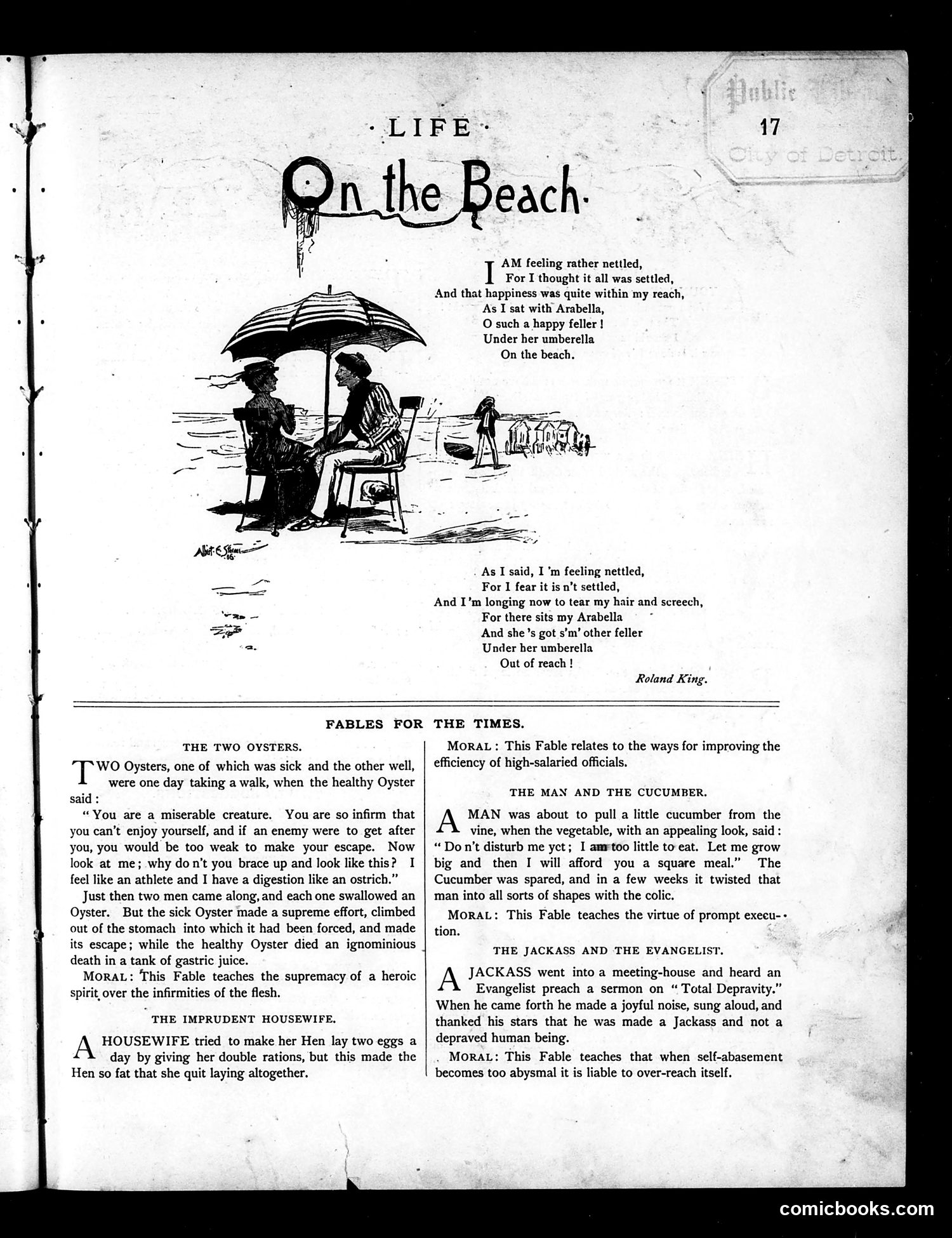
**"On the Beach"** (top): A poem by Roland King depicts a man enjoying a romantic moment with a woman named Arabella under an umbrella at the beach. The conceit is that his contentment is disrupted when another couple arrives—specifically another man with Arabella. The satire mocks the fragility of male satisfaction and the social anxiety of public spaces where romantic situations can be upended by unwanted third parties. **"Fables for the Times"** (bottom): Four brief satirical fables with morals critique various behaviors: officials' inefficiency, overeager self-help, excessive religious zeal, and overindulgence. These are general social commentary rather than references to specific figures or events, targeting universal human foibles and contemporary social trends.
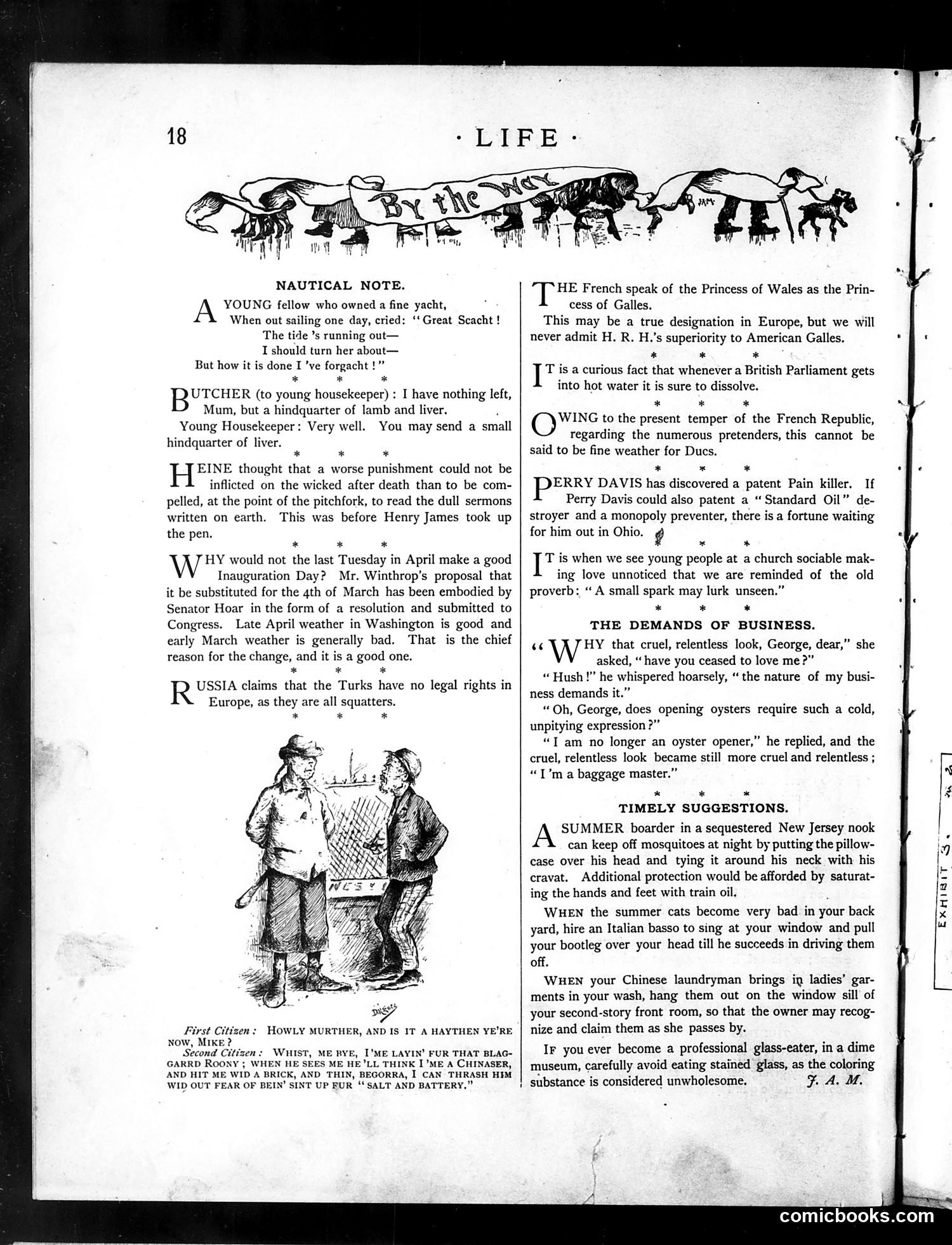
This page contains satirical notes and commentary rather than a single cartoon. The main illustration shows two working-class men in conversation, captioned as "First Citizen" and "Second Citizen," discussing political grievances in dialect. The "Nautical Note" opening mocks a young sailor's complaint about naval life. Other brief items satirize contemporary issues: French claims about Welsh royalty, British Parliament's tendency to dissolve during controversy, and French political instability. The longest piece, "The Demands of Business," presents a cynical dialogue between George and a woman about his cruel, emotionless demeanor—apparently justified by professional necessity as an oyster opener or baggage master. The final section offers humorous practical advice for summer problems (mosquitoes, cats, laundry). The overall tone is satirical commentary on class, politics, and social absurdities of the period.
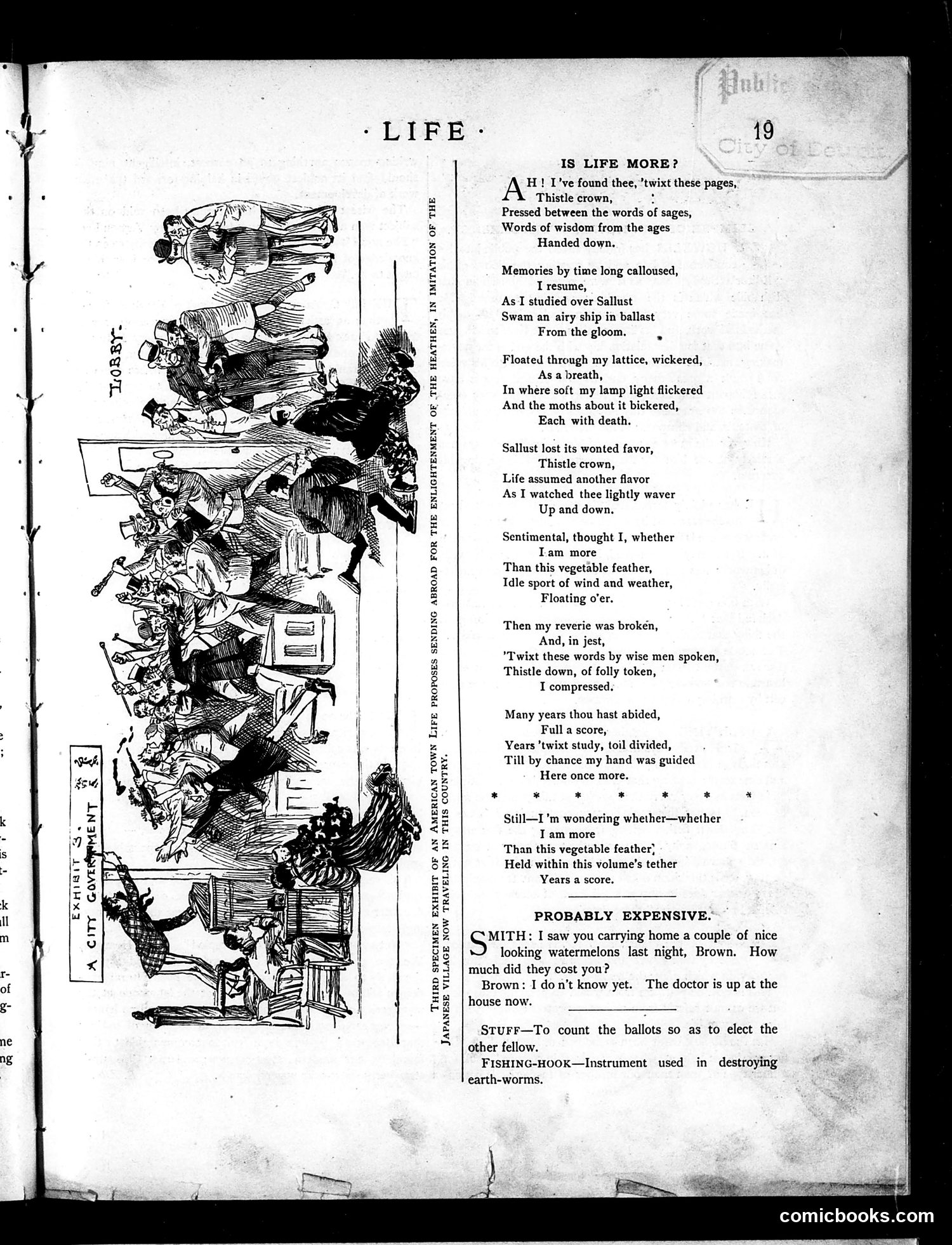
This page contains a philosophical poem titled "IS LIFE MORE?" alongside a satirical illustration labeled "A CITY GOSSIP." The poem contemplates whether human existence transcends mere physical existence, using metaphors of thistle crowns and floating feathers. The illustration depicts a chaotic social scene with multiple figures engaged in gossip and idle activity—consistent with the "city gossip" theme. The figures appear to represent various social types engaged in frivolous pursuits. Below the poem is a brief humorous dialogue ("PROBABLY EXPENSIVE") between Smith and Brown discussing watermelons and medical costs, followed by dictionary-style definitions of "STUFF" and "FISHING-HOOK." The page primarily juxtaposes philosophical reflection with satirical commentary on urban social behavior and shallow conversation—a typical Life magazine approach to social criticism through humor and contrast.
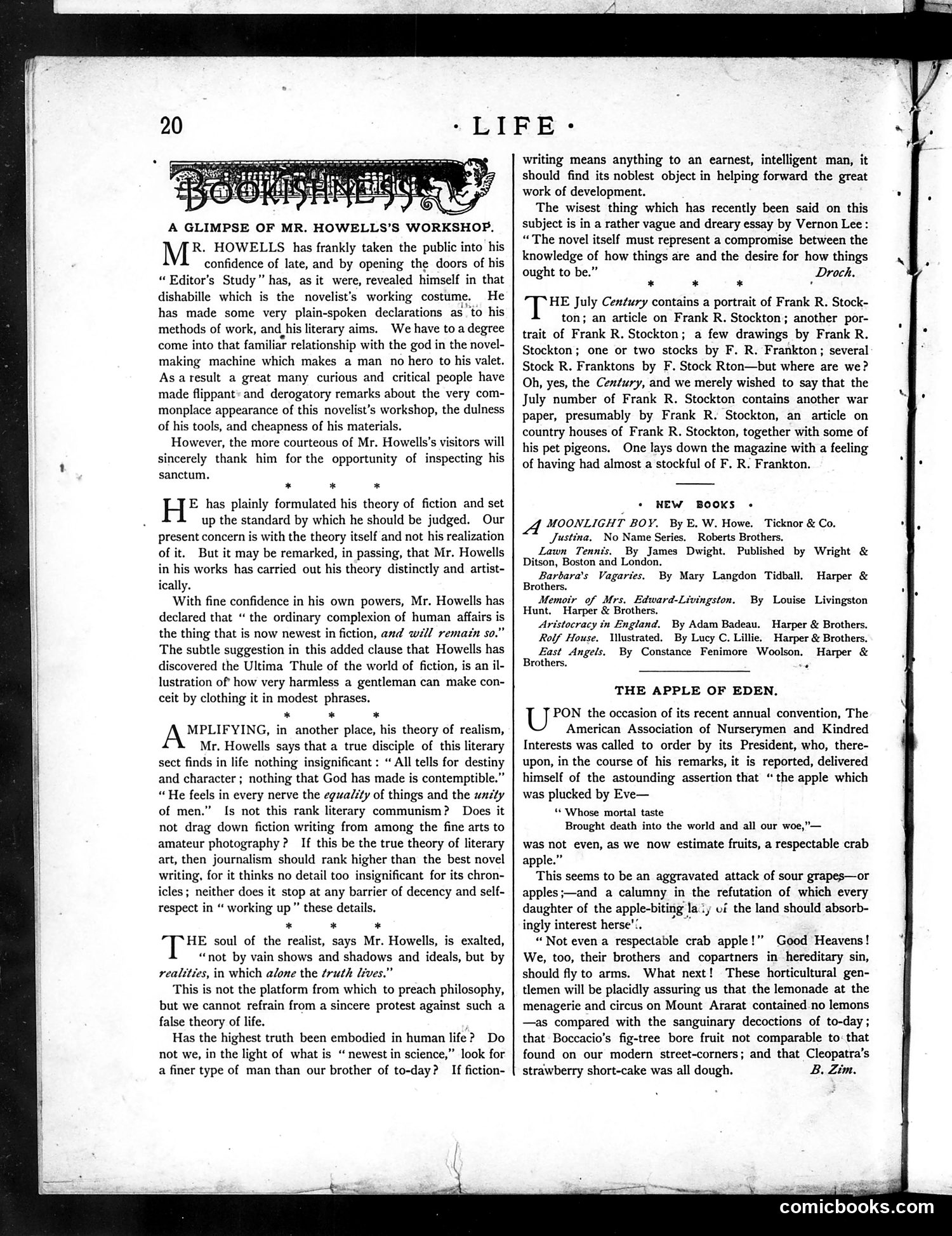
This page contains literary criticism and book reviews rather than political cartoons. The main content discusses **William Dean Howells**, a prominent American novelist and editor, examining his literary theories about realism and fiction-writing. The "Bookshelf" section critiques Howells's workshop methods and his assertion that "the ordinary complexion of human affairs is the thing that is now newest in fiction, and will remain so." The author challenges what he views as an oversimplified literary philosophy. The page concludes with a humorous piece titled "The Apple of Eden," where an author sarcastically defends the humble crab apple against literary pretensions—likely mocking overly precious or affected writing styles. No political cartoons appear on this page.
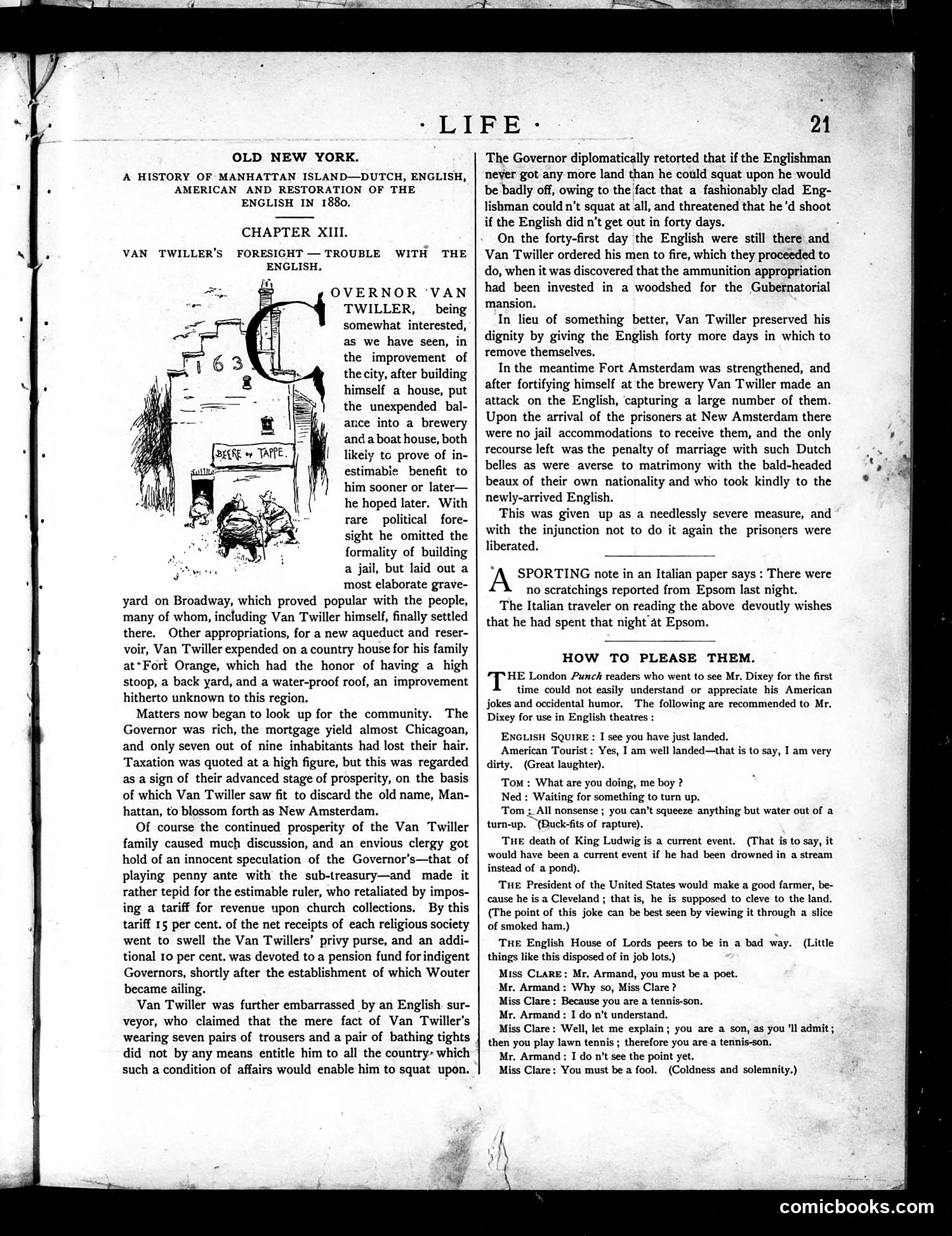
This page combines historical narrative with humor. The left column describes Governor Van Twiller's governance of New Amsterdam (early New York) during Dutch colonial rule, including conflict with English forces and his somewhat bumbling administration. The cartoon illustration shows a rotund figure labeled "1663" near a building marked "BEER" and "TAVERN"—likely depicting Van Twiller himself, characterized as fond of leisure and drink rather than effective governance. The right section, "How to Please Them," presents jokes about English tourists visiting London theaters, playing on stereotypes about American tourists' directness, vocabulary differences, and unfamiliarity with tennis. The humor relies on transatlantic cultural misunderstandings typical of early 20th-century American satire.
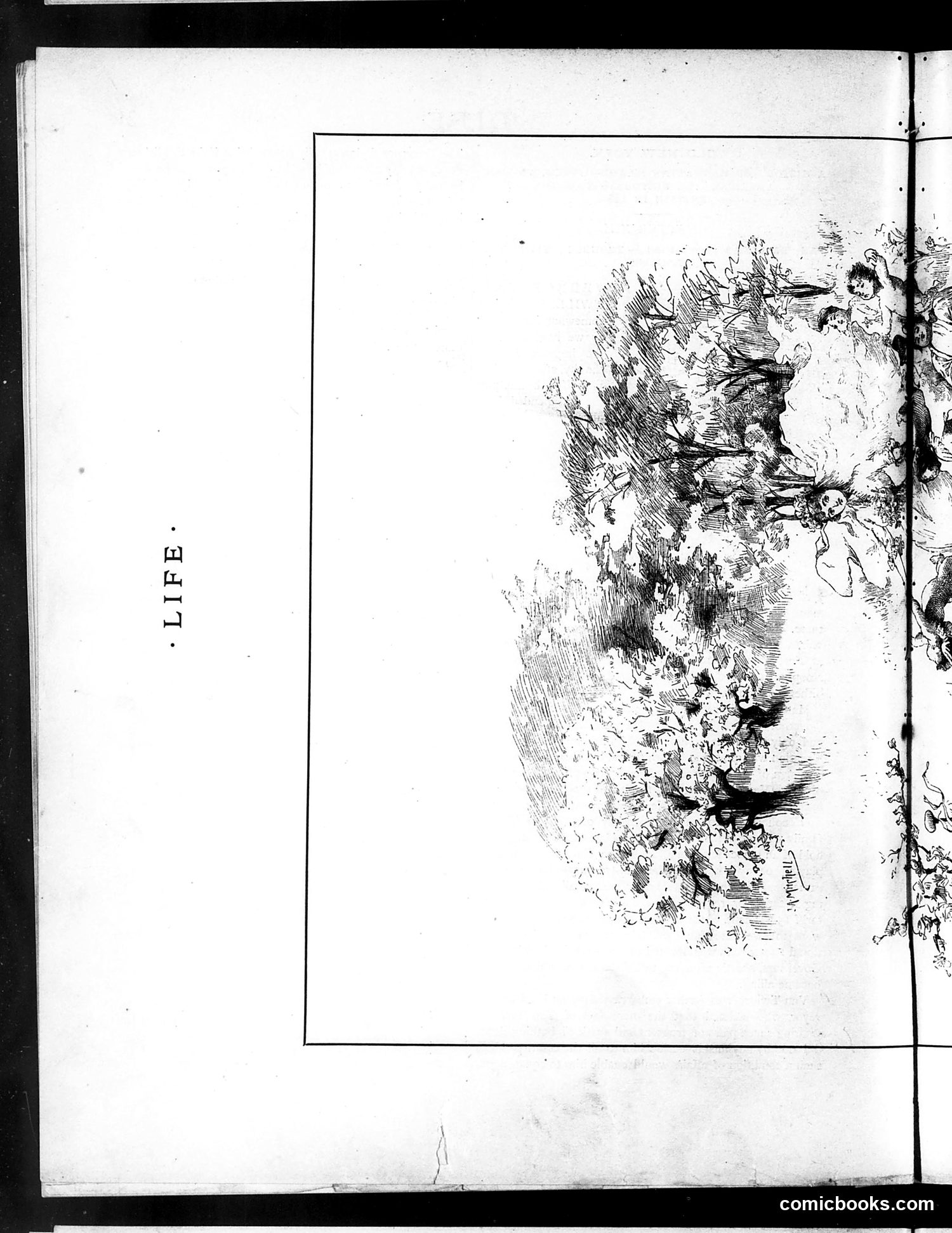
This appears to be a title page or section divider from *Life* magazine, marked simply "LIFE" on the left side. The right side contains an engraving-style illustration that is difficult to parse clearly due to its sketch quality and the image's age/condition. The illustration appears to show multiple figures in what seems to be a crowded or chaotic scene, rendered in crosshatching typical of 19th-century satirical prints. Without clearer visibility of specific details, facial features, or accompanying captions, I cannot confidently identify the particular figures, political figures, or social commentary this illustration intends to convey. The style suggests contemporary social or political satire, but determining the specific subject and joke would require either higher image resolution or additional contextual information from surrounding pages.
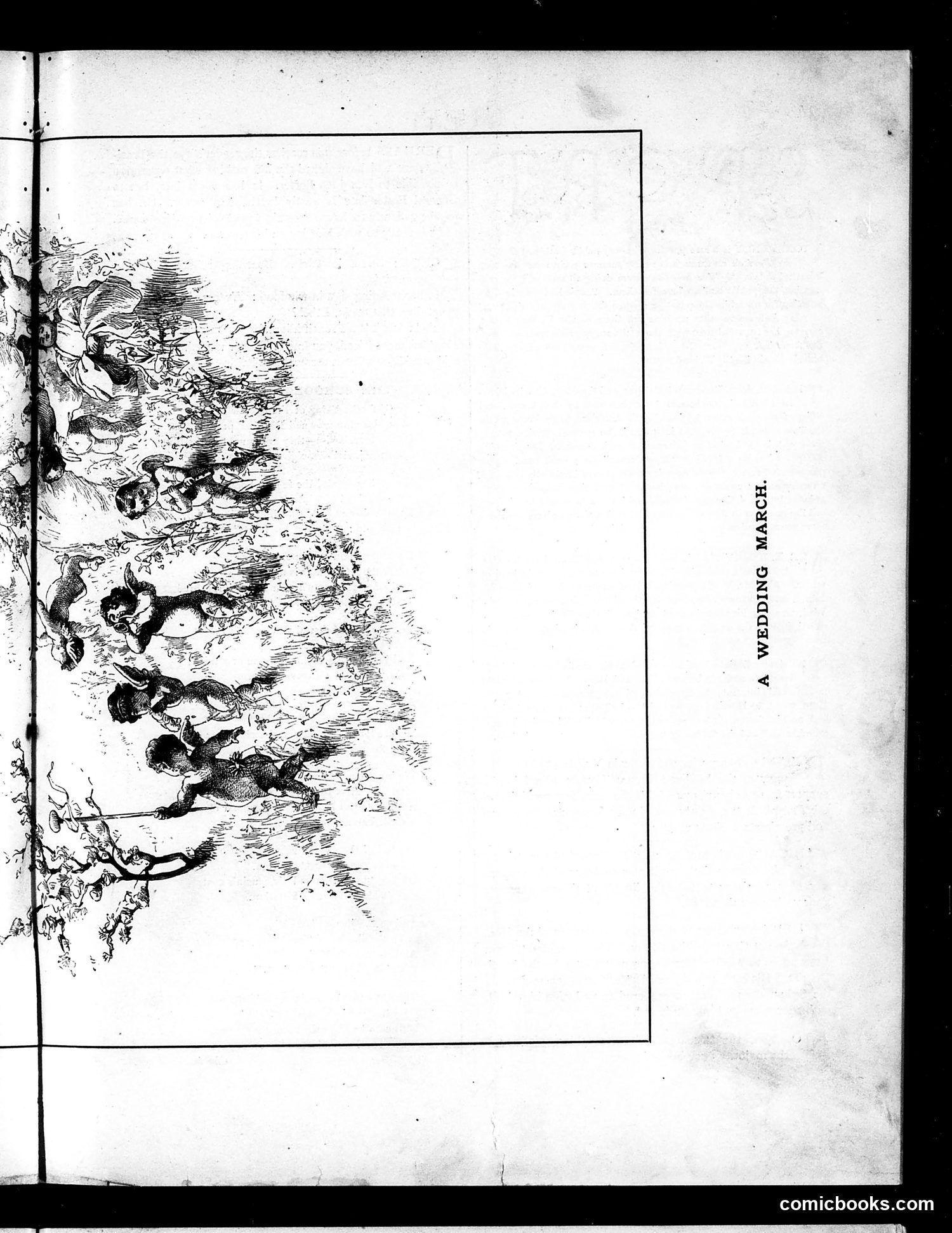
This page shows an illustration titled "A Wedding March" depicting what appears to be a formal wedding procession or ceremony scene. The engraving shows multiple figures in period dress arranged in a compositional scene, rendered in the detailed cross-hatching style typical of 19th-century satirical illustrations. However, without additional context from surrounding pages or clearer text identifying the specific individuals caricatured, I cannot definitively explain which political figures or social commentary this particular cartoon satirizes. The title suggests it uses marriage or wedding imagery as metaphor for some contemporary political alliance or union, a common satirical device in Life magazine. The specific parties, events, or individuals involved remain unclear from this image alone.
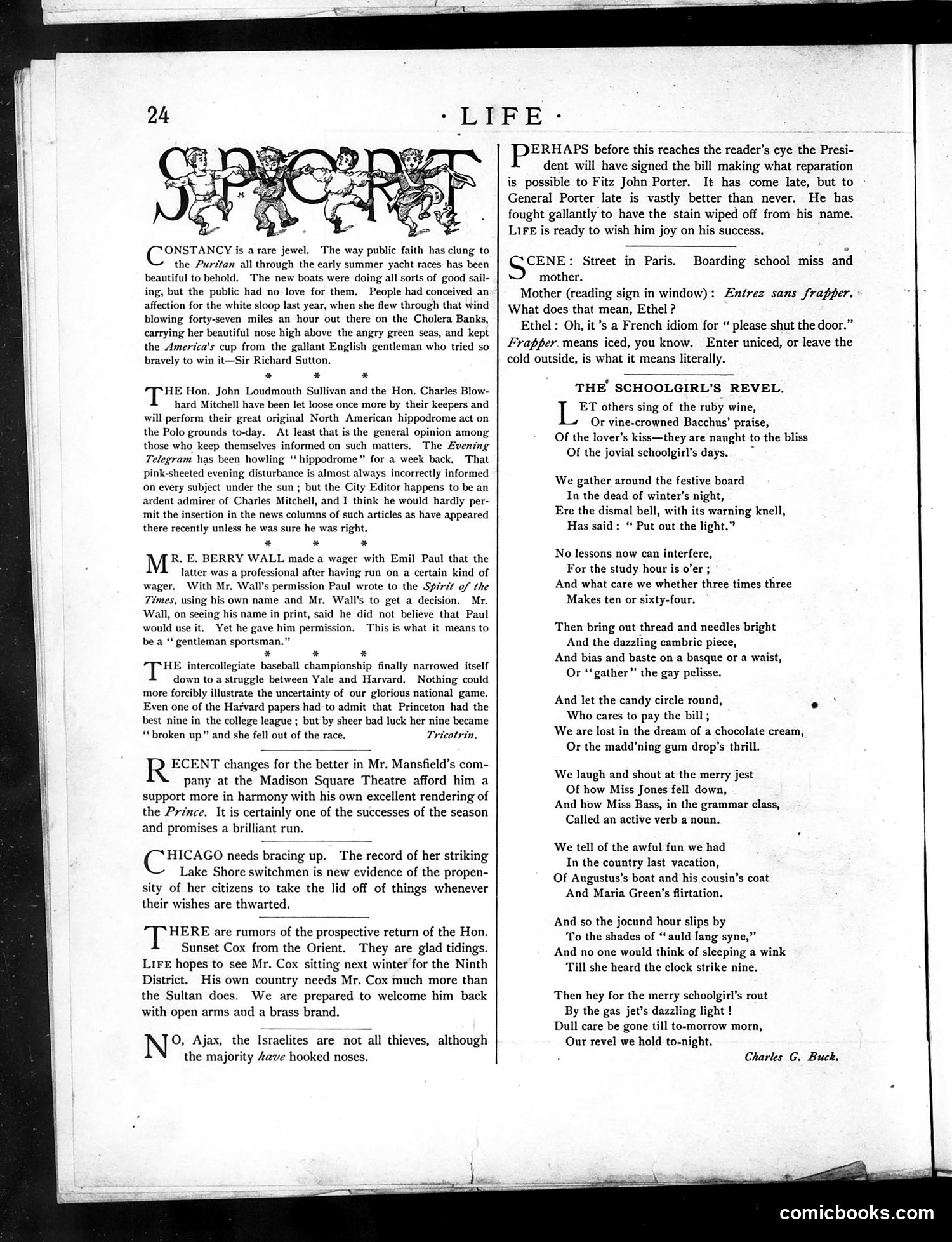
This page from *Life* magazine contains several brief satirical commentary pieces typical of the publication's format: **The yacht-racing item** mocks public sentiment: the American public irrationally favored the "Puritan" yacht simply from habit and loyalty, despite other boats performing better. The satire critiques fickle public opinion. **The Sullivan-Mitchell piece** references two boxers scheduled to fight at Polo Grounds, with veiled skepticism about whether it's a legitimate match or a staged "hippodrome" (fixed spectacle). The dig at the *Evening Telegram* for unreliable reporting adds media criticism. **The Mansfield theater note** and brief mentions of baseball (Yale-Harvard), Chicago labor unrest, and politician Sunset Cox's rumored return are typical short-form observations. **The visual humor** at bottom plays on language: a French boarding-school sign "Entrez sans frapper" (enter without knocking) is humorously mistranslated as "please shut the door"—a joke about Americans' poor French. Overall, the page reflects *Life*'s role as a sophisticated urban magazine critiquing public gullibility, media dishonesty, and social pretension through wit rather than explicit political argument.
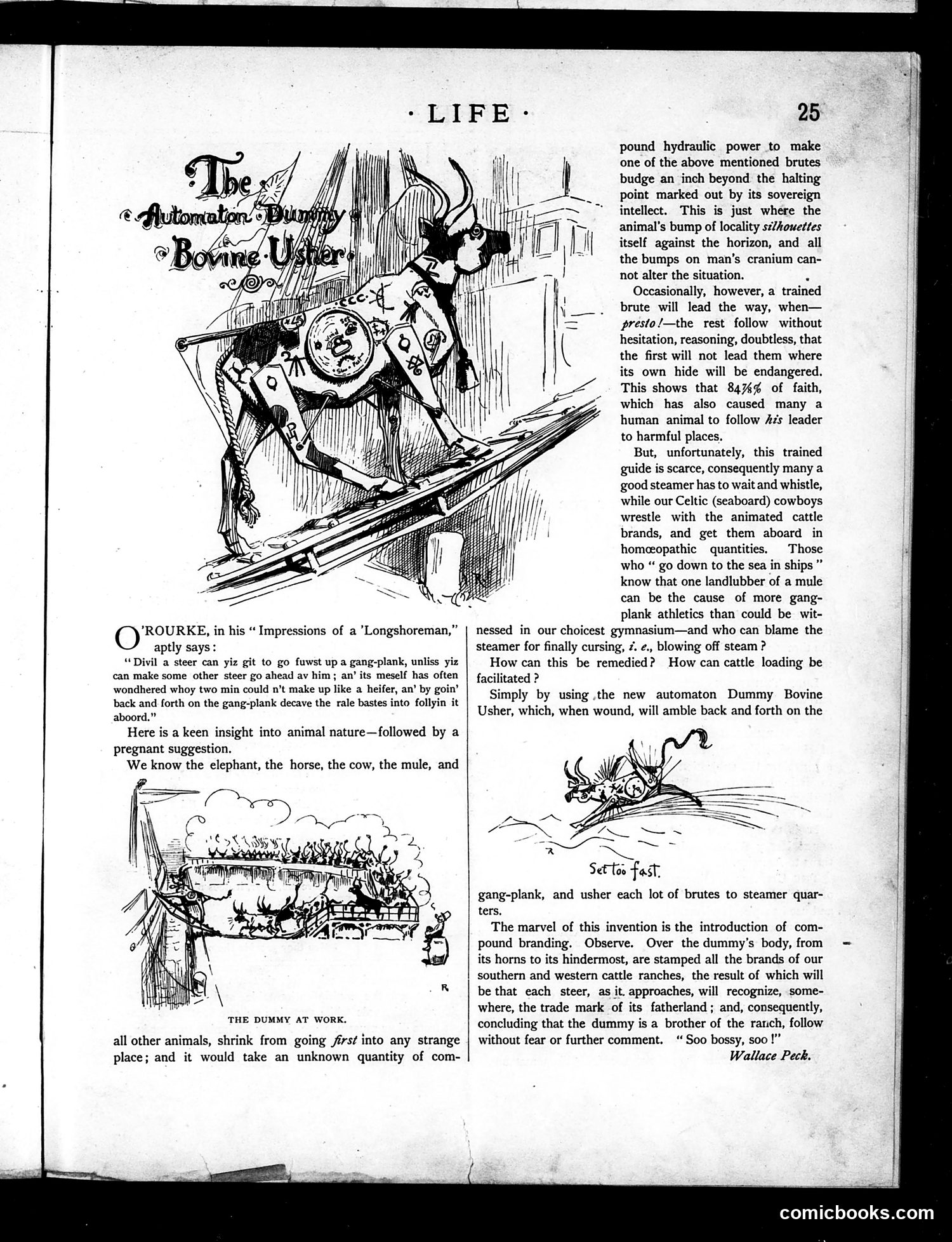
This satirical piece mocks the practical problem of loading cattle onto ships—steers refuse to board gang-planks first, causing costly delays at ports. The article proposes an absurd solution: a mechanical dummy cow branded with all Western and Southern cattle ranch marks, which would amble back and forth to lead real cattle aboard by making them recognize it as a "brother of the ranch." The satire targets both the frustrating inefficiency of cattle loading and the era's faith in mechanical automation as a solution to every problem. The cartoon illustrations show the dummy in action. The Irish longshoreman's observation opens the piece, establishing the genuine animal-behavior problem before proposing this ridiculous gadget—poking fun at inventors who overcomplicate simple issues with unnecessary machinery. Wallace Peck (the credited author) suggests that animals follow leaders instinctively, so a branded dummy would exploit this trait absurdly.
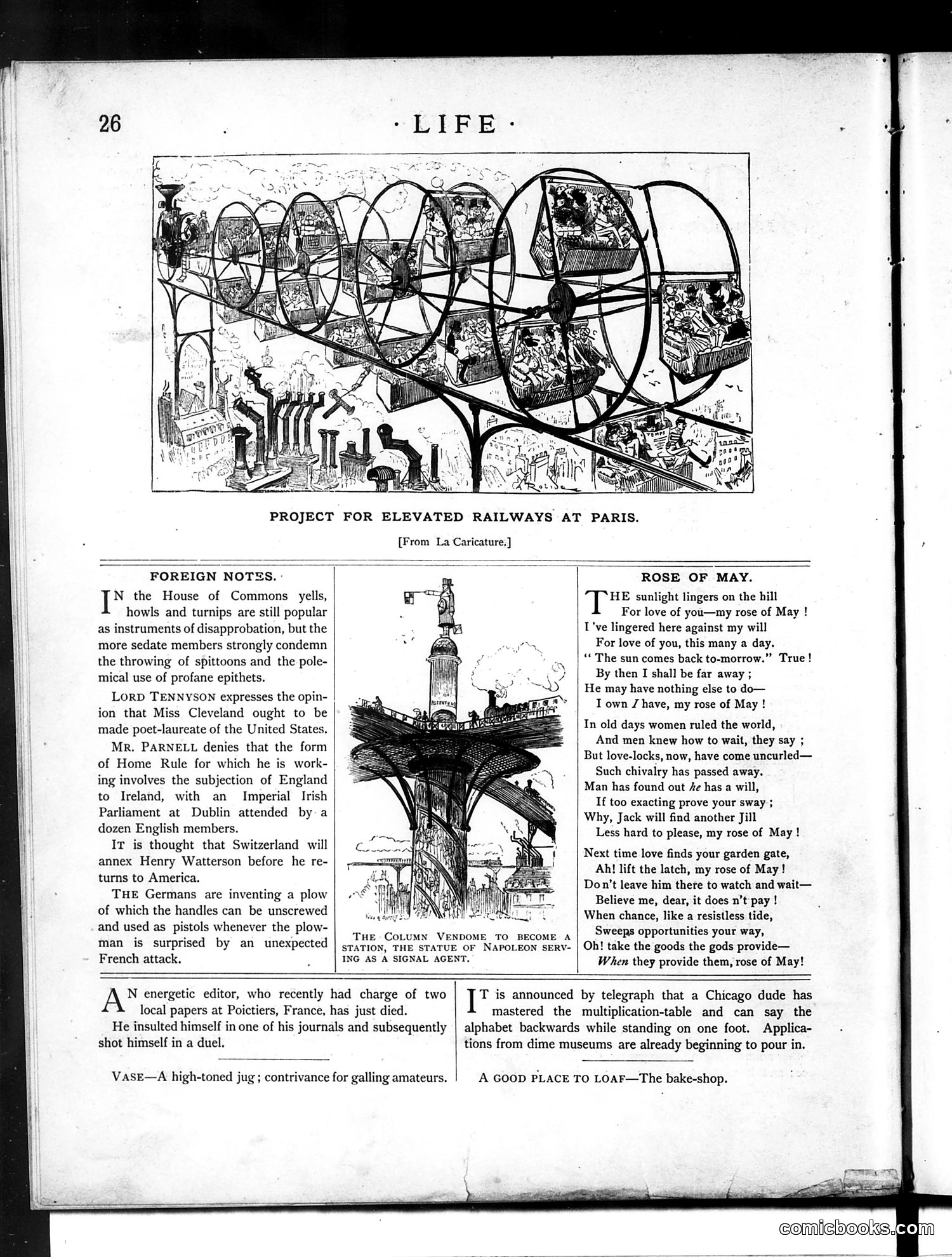
This page from *Life* magazine contains: **Top Cartoon**: A satirical French design (credited to *La Caricature*) depicting an absurdly complex elevated railway system sprawling over Paris. The joke mocks over-ambitious urban planning—the tangled, impractical maze of tracks suggests Parisian infrastructure proposals were chaotically conceived. **"Foreign Notes"**: Brief satirical jabs at contemporary figures and events: - British Parliament's crude conduct (throwing objects) - Lord Tennyson's opinion on American poet laureate - Irish politician Parnell defending Home Rule - German weapon innovation (plow-handles as pistols) - A French editor who died in a duel after self-insult **"Rose of May"**: A sentimental poem about unrequited love, where the speaker warns a woman not to be too difficult or her suitor will leave her—reflecting Victorian-era gender attitudes. **Bottom Notes**: Humorous brief jokes, including a jab at a "Chicago dude" for mastering basic arithmetic—mocking both Midwestern pretension and dime-museum spectacles. The page blends political commentary with light humor typical of 1880s American satirical magazines.
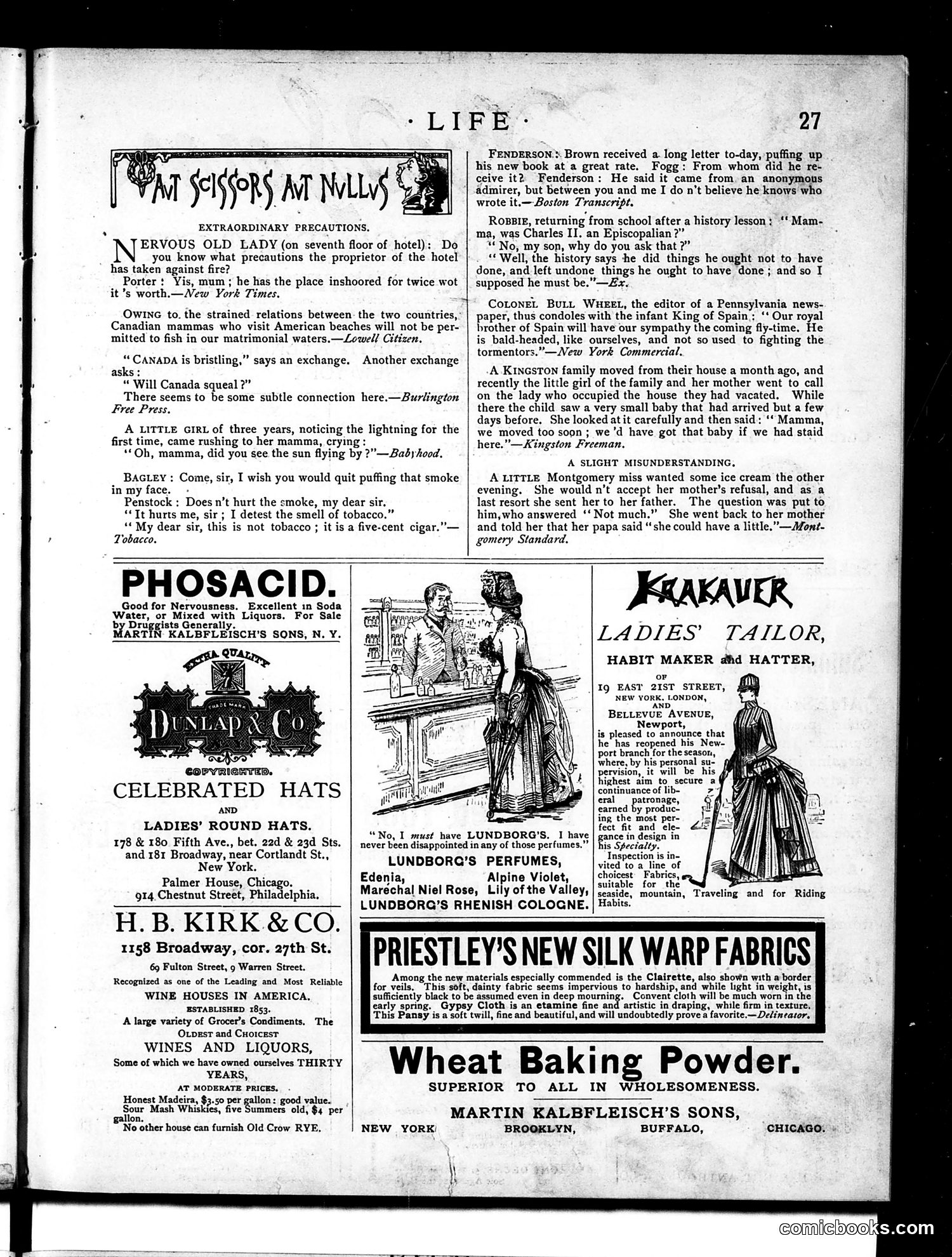
This page is primarily **humorous anecdotes and advertisements** from an American satirical magazine. The cartoon section titled "Extraordinary Precautions" contains brief jokes: 1. **"Nervous Old Lady"**: Satirizes insurance fraud—a hotel owner insures his building for twice its value, implying he might profit from fire rather than prevent it. 2. **Canada references**: Light political humor about strained U.S.-Canadian relations, with a joke about Canadian mothers being excluded from "matrimonial waters" (marriage prospects). 3. **Tobacco joke**: A man tries passing off a cheap cigar as non-tobacco to avoid criticism from someone who dislikes smoking. The remaining content includes brief witty observations about children's logic and misunderstandings, typical of period humor magazines. **The bulk of the page is advertisements** for hats, perfumes, clothing tailoring, baking powder, and other commercial products—standard for Life magazine's revenue model.
This is an advertisement page from *Life* magazine, not a political cartoon. It contains no satire or editorial commentary—it's a collection of late-19th-century commercial advertisements and one small joke. The only humorous item is a brief "Mr. Faintheart" comic at center, where a young man nervously asks a woman if it's safe to propose to her father, and she replies that yes, it's safe because her father has gout (suggesting he's incapacitated and won't react violently). This is a mild joke about courtship anxiety and domestic violence expectations in that era. The rest consists of ads for clothing tailors (Redfern & Sons), digestive remedies (Tarrant's seltzer for constipation), dress fabrics, camera equipment, patent medicines (Lactated Food for infants, Nieder-Selters mineral water), and shaving products—typical consumer goods marketed to middle and upper-class readers of the period.
This is primarily an **advertising page** with one brief humorous item. The main content is a short joke titled "HE WAS A BOODLE," playing on a double meaning of the word "boodle." The boy uses it to mean a husband who "catches" (wins over) his sister repeatedly—a pun on the slang term "boodle," which in 19th-century American usage referred to money obtained through graft or bribery, or more broadly to a worthless person. The joke's humor relies on the innocent misunderstanding: the sister likely meant "boodle" colloquially (perhaps as slang for an attractive or desirable husband), but the boy interprets it literally as someone who repeatedly "catches" or wins her affection. The rest of the page consists of period fashion and retail advertisements for clothing, tailoring, trunks, toiletries, and amusements—typical content for a magazine of this era. No political commentary or significant social satire is present on this particular page.
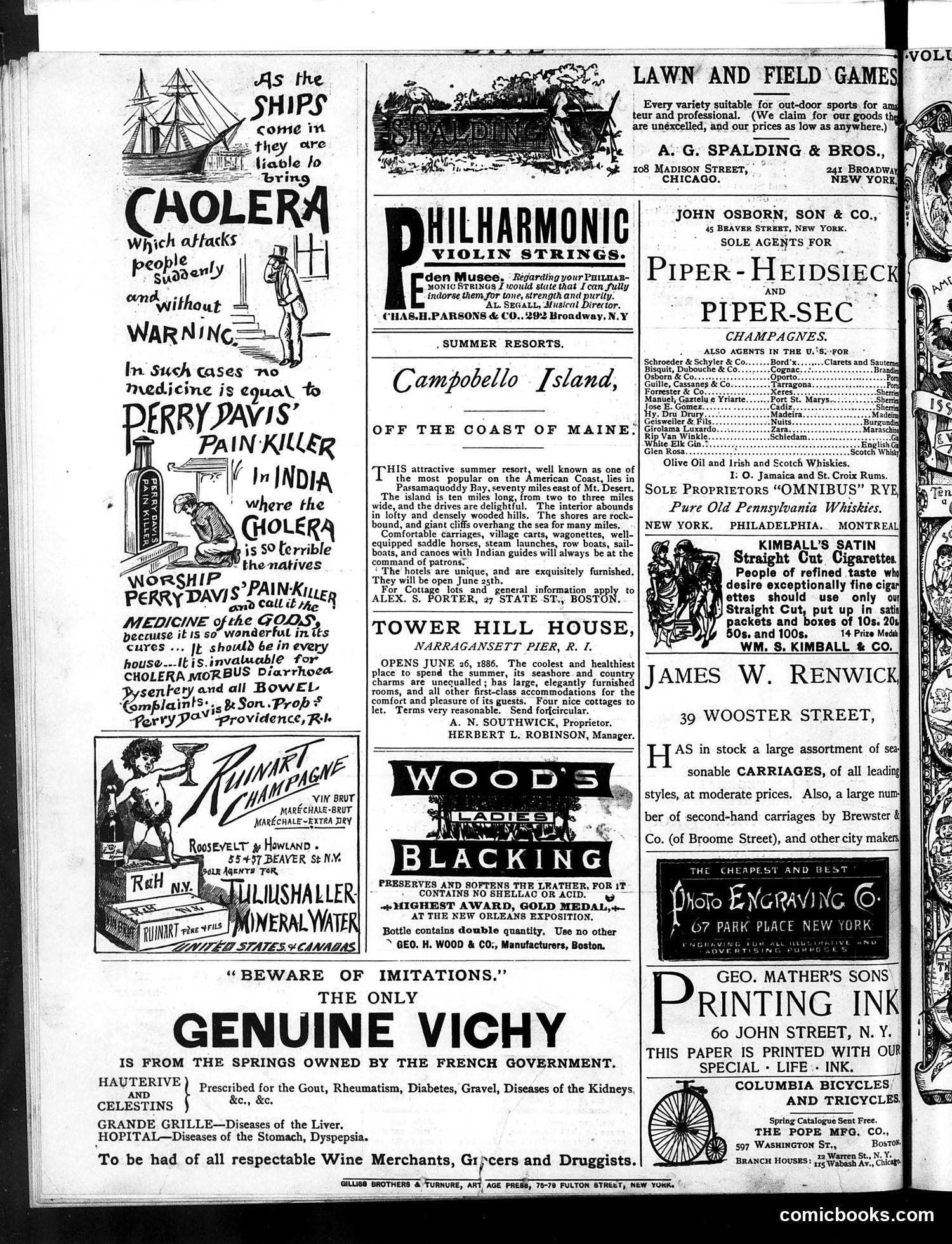
This page is primarily **advertising**, not satirical content. However, the left side features a notable **Perry Davis's Pain Killer advertisement** using colonial-era imagery and racist messaging. The ad depicts a ship and sailors, framing cholera as an "Indian" disease, with text worshipping Perry Davis's product as a cure-all. This reflects 19th-century medical quackery and orientalist fears—positioning the remedy as essential protection against exotic "Oriental" diseases. The rhetoric ("the natives worship") and graphics emphasize European superiority and fear of foreign illness. The remainder features genteel advertisements for sporting goods (Spalding), champagne, violin strings, summer resorts, carriages, and other luxury items targeting wealthy readers. These ads reveal the magazine's affluent audience and period consumer culture. The satirical *Life* magazine typically mocked society, but this particular page showcases its advertising revenue model and contemporary prejudices.