
Life, 1886-07-08 · page 7 of 16
Life — July 8, 1886 — page 7: what you’re looking at
What you’re looking at
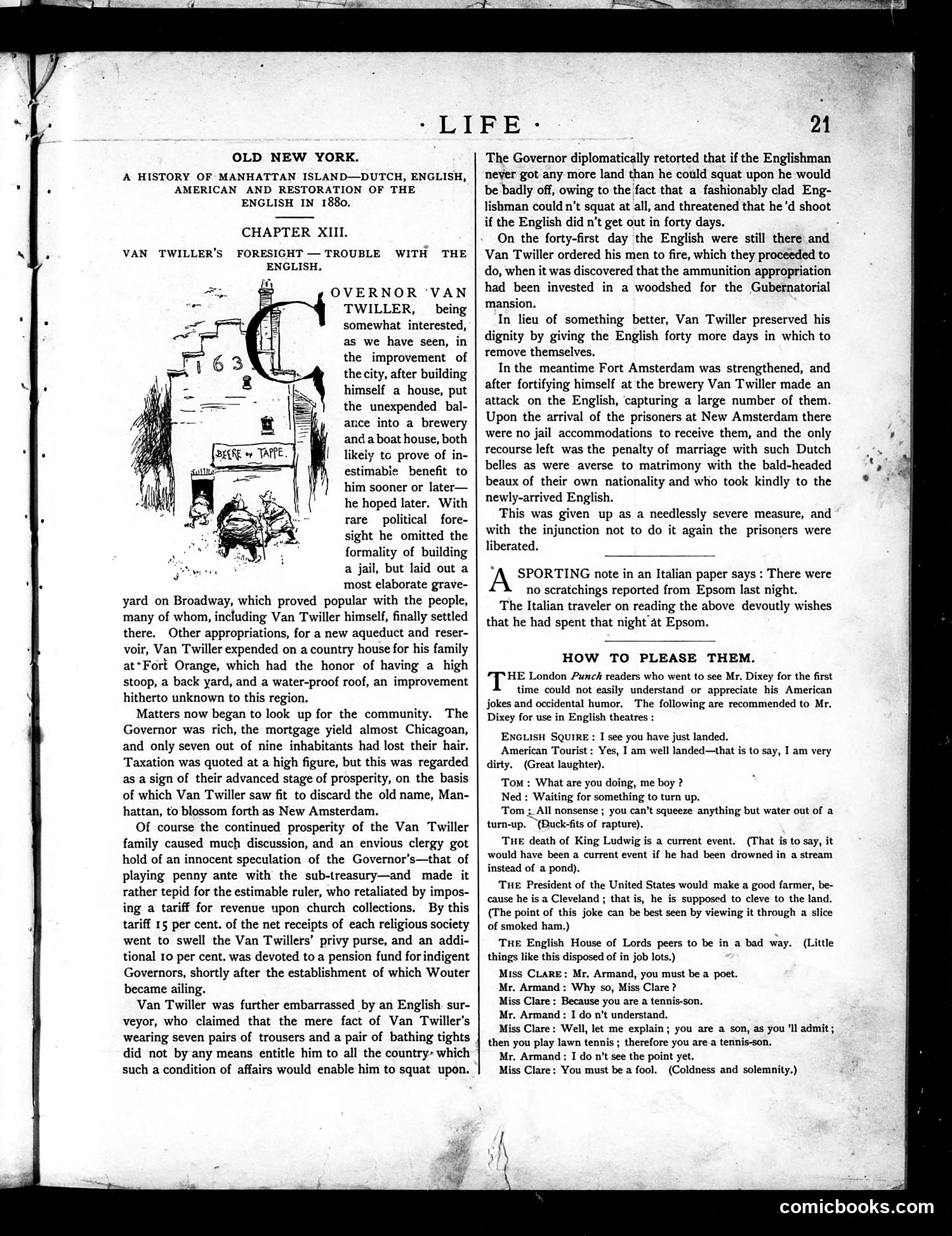
This page combines historical narrative with humor. The left column describes Governor Van Twiller's governance of New Amsterdam (early New York) during Dutch colonial rule, including conflict with English forces and his somewhat bumbling administration. The cartoon illustration shows a rotund figure labeled "1663" near a building marked "BEER" and "TAVERN"—likely depicting Van Twiller himself, characterized as fond of leisure and drink rather than effective governance. The right section, "How to Please Them," presents jokes about English tourists visiting London theaters, playing on stereotypes about American tourists' directness, vocabulary differences, and unfamiliarity with tennis. The humor relies on transatlantic cultural misunderstandings typical of early 20th-century American satire.
📄 Transcribed text from this page (OCR, searchable)
Machine-transcribed from the original scan — historical spelling and the odd misread are preserved.
EEE: OLD NEW YORK. A HISTORY OF MANHATTAN ISLAND—DUTCH, ENGLISH, AMERICAN AND RESTORATION OF THE ENGLISH IN 1880. CHAPTER XIII. VAN TWILLER'S FORESIGHT — TROUBLE WITH THE ENGLISH. OVERNOR ‘VAN TWILLER, _ being somewhat interested, as we have seen, in the improvement of the city, after building himself a house, put the unexpended bal- ance into a brewery and a boat house, both likely to prove of in- estimabie benefit to him sooner or later— he hoped later. With rare political fore- sight he omitted the formality of building a jail, but laid out a most elaborate grave- yard on Broadway, which proved popular with the people, many of whom, including Van Twiller himself, finally settled there. Other appropriations, for a new aqueduct and reser- voir, Van Twiller expended on a country house for his family at*Fort Orange, which had the honor of having a high stoop, a back yard, and a water-proof roof, an improvement hitherto unknown to this region. Matters now began to look up for the community. The Governor was rich, the mortgage yield almost Chicagoan, and only seven out of nine inhabitants had lost their hair. Taxation was quoted at a high figure, but this was regarded as a sign of their advanced stage of prosperity, on the basis of which Van Twiller saw fit to discard the old name, Man- hattan, to blossom forth as New Amsterdam. Of course the continued prosperity of the Van Twiller family caused much discussion, and an envious clergy got hold of an innocent speculation of the Governor’s—that of playing penny ante with the sub-treasury—and made it rather tepid for the estimable ruler, who retaliated by impos- ing a tariff for revenue upon church collections. By this tariff 15 per cent. of the net receipts of each religious society went to swell the Van Twillers’ privy purse, and an addi- tional 10 per cent. was devoted to a pension fund for indigent Governors, shortly after the establishment of which Wouter became ailing. Van Twiller was further embarrassed by an English. sur- veyor, who claimed that the mere fact of Van Twiller’s wearing seven pairs of trousers and a pair of bathing tights did not by any means entitle him to all the country* which such a condition of affairs would enable him to squat upon. 21 The Governor diplomatically retorted that if the Englishman neyer got any more land than he could squat upon he would be badly off, owing to the fact that a fashionably clad Eng- lishman could n’t squat at all, and threatened that he’d shoot if the English did n’t get out in forty days. On the forty-first day the English were still there and Van Twiller ordered his men to fire, which they proceeded to do, when it was discovered that the ammunition appropriation had been invested in a woodshed for the Gubernatorial mansion. In lieu of something better, Van Twiller preserved his dignity by giving the English forty more days in which to remove themselves. In the meantime Fort Amsterdam was strengthened, and after fortifying himself at the brewery Van Twiller made an attack on the English, capturing a large number of them. Upon the arrival of the prisoners at New Amsterdam there were no jail accommodations to receive them, and the only recourse left was the penalty of marriage with such Dutch belles as were averse to matrimony with the bald-headed beaux of their own nationality and who took kindly to the newly-arrived English. This was given up as a needlessly severe measure, and with the injunction not to do it again the prisoners were liberated. A SPORTING note in an Italian paper says : There were no scratchings reported from Epsom last night. The Italian traveler on reading the above devoutly wishes that he had spent that night at Epsom. HOW TO PLEASE THEM. HE London Punch readers who went to see Mr. Dixey for the first time could not easily understand or appreciate his American jokes and occidental humor. The following are recommended to Mr. Dixey for use in English theatres : ENGLISH SQuIRE : I see you have just landed. American Tourist : Yes, I am well landed—that is to say, I am very dirty. (Great laughter). Tom : What are you doing, me boy ? Ned : Waiting for something to turn up. Tom ;_All nonsense ; you can’t squeeze anything but water out of a turn-up. (Buck-fits of rapture). THE death of King Ludwig is a current event. (That is to say, it would have been a current event if he had been drowned in a stream instead of a pond). THE President of the United States would make a good farmer, be- cause he is a Cleveland ; that is, he is supposed to cleve to the land. (The point of this joke can be best seen by viewing it through a slice of smoked ham.) THE English House of Lords peers to be in a bad way. things like this disposed of in job lots.) Miss CLARE: Mr. Armand, you must be a poet. Mr. Armand: Why so, Miss Clare ? Miss Clare : Because you are a tennis-son. Mr. Armand: I do n’t understand. Miss Clare: Well, let me explain; you are a son, as you'll admit; then you play lawn tennis ; therefore you are.a tennis-son, Mr. Armand : I do n't see the point yet. Miss Clare: You must be a fool. (Coldness and solemnity.) (Little comicbooks.com