
Life, 1886-07-08 · page 3 of 16
Life — July 8, 1886 — page 3: what you’re looking at
What you’re looking at
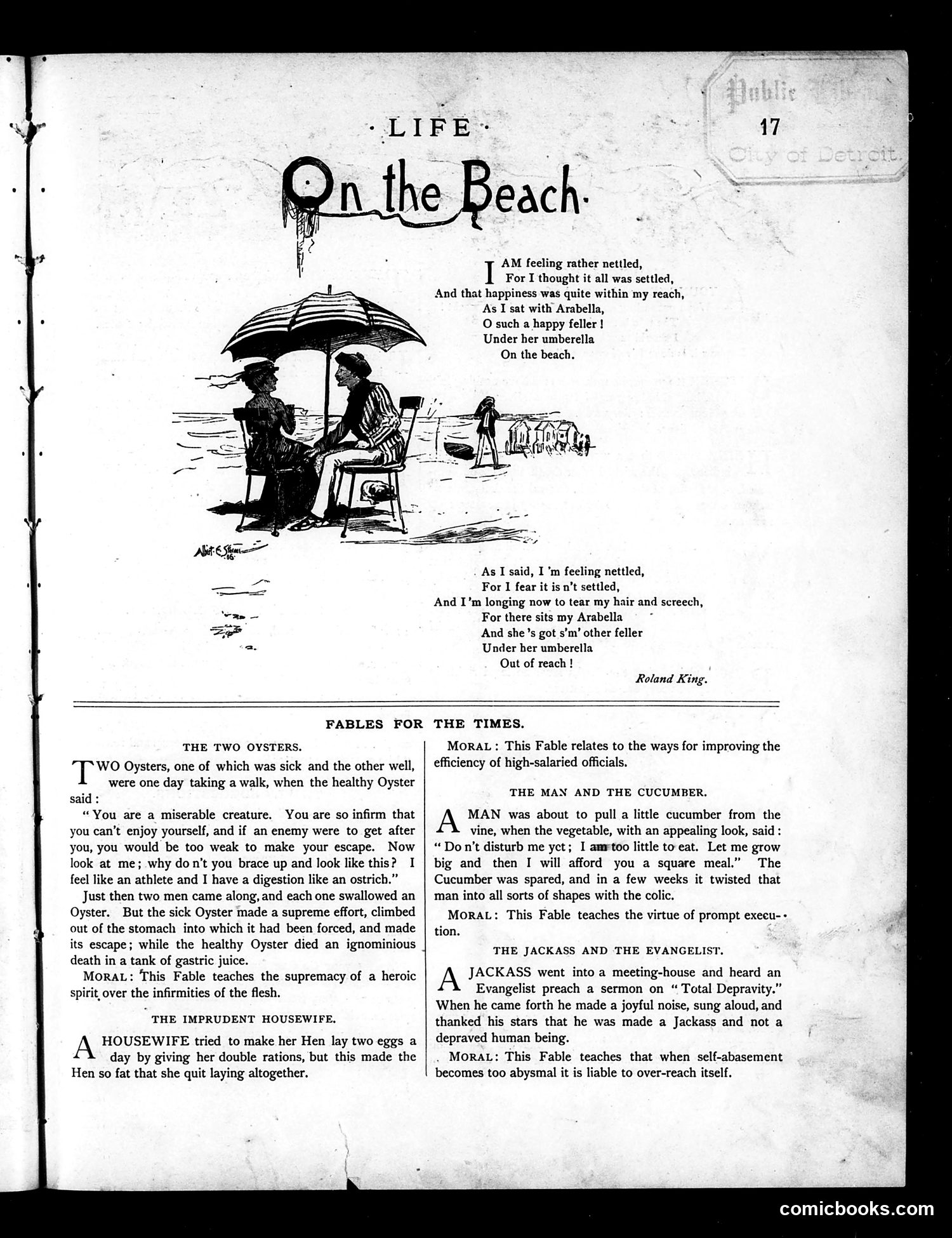
**"On the Beach"** (top): A poem by Roland King depicts a man enjoying a romantic moment with a woman named Arabella under an umbrella at the beach. The conceit is that his contentment is disrupted when another couple arrives—specifically another man with Arabella. The satire mocks the fragility of male satisfaction and the social anxiety of public spaces where romantic situations can be upended by unwanted third parties. **"Fables for the Times"** (bottom): Four brief satirical fables with morals critique various behaviors: officials' inefficiency, overeager self-help, excessive religious zeal, and overindulgence. These are general social commentary rather than references to specific figures or events, targeting universal human foibles and contemporary social trends.
📄 Transcribed text from this page (OCR, searchable)
Machine-transcribed from the original scan — historical spelling and the odd misread are preserved.
AM feeling rather nettled, For I thought it all was settled, And that happiness was quite within my reach, As I sat with Arabella, O such a happy feller ! Under her umberella On the beach, As I said, I''m feeling nettled, For I fear it is n't settled, And I’m longing now to tear my hair and screech, For there sits my Arabella And she’s got s’m’ other feller Under her umberella Out of reach ! Roland King. FABLES FOR THE TIMES. THE TWO OYSTERS. Ts Oysters, one of which was sick and the other well, were one day taking a walk, when the healthy Oyster said : “You are a miserable creature. You are so infirm that you can’t enjoy yourself, and if an enemy were to get after you, you would be too weak to make your escape. Now look at me; why don’t you brace up and look like this? I feel like an athlete and I have a digestion like an ostrich.” Just then two men came along, and each one swallowed an Oyster. But the sick Oyster made a supreme effort, climbed out of the stomach into which it had been forced, and made its escape; while the healthy Oyster died an ignominious death in a tank of gastric juice. Mora: This Fable teaches the supremacy of a heroic spirit, over the infirmities of the flesh. THE IMPRUDENT HOUSEWIFE. HOUSEWIFE tried to make her Hen lay two eggs a day by giving her double rations, but this made the Hen so fat that she quit laying altogether. MorAL: This Fable relates to the ways for improving the efficiency of high-salaried officials. THE MAN AND THE CUCUMBER. MAN was about to pull a little cucumber from the vine, when the vegetable, with an appealing look, said: “Don't disturb me yct; I amptoo little to eat. Let me grow big and then I will afford you a square meal.” The Cucumber was spared, and in a few weeks it twisted that man into all sorts of shapes with the colic. MorRAL: This Fable teaches the virtue of prompt execu-- tion. THE JACKASS AND THE EVANGELIST. JACKASS went into a meeting-house and heard an Evangelist preach a sermon on “ Total Depravity.” When he came forth he made a joyful noise, sung aloud, and thanked his stars that he was made a Jackass and not a depraved human being. . MorAt: This Fable teaches that when self-abasement becomes too abysmal it is liable to over-reach itself. comicbooks.com