
Life, 1886-07-08 · page 6 of 16
Life — July 8, 1886 — page 6: what you’re looking at
What you’re looking at
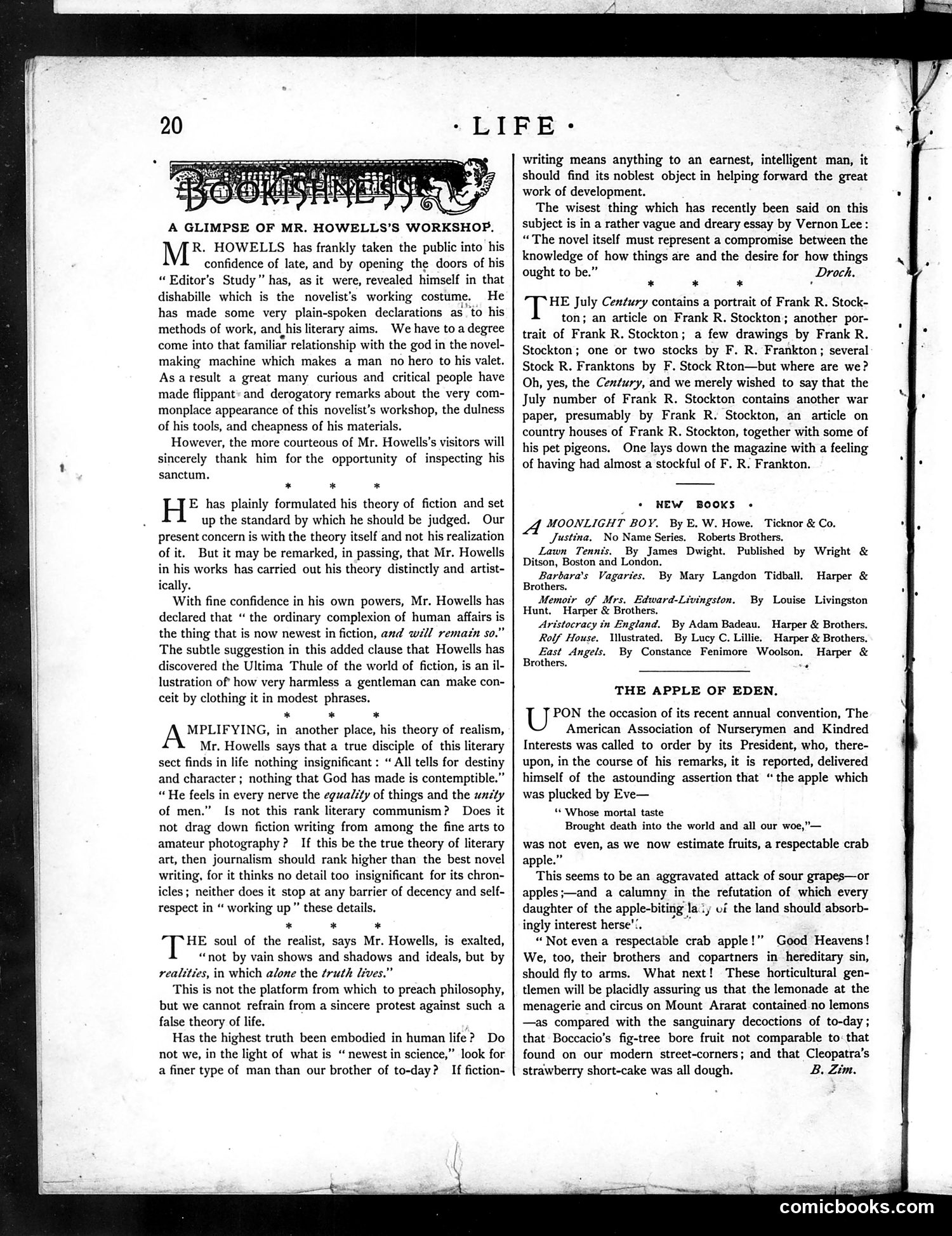
This page contains literary criticism and book reviews rather than political cartoons. The main content discusses **William Dean Howells**, a prominent American novelist and editor, examining his literary theories about realism and fiction-writing. The "Bookshelf" section critiques Howells's workshop methods and his assertion that "the ordinary complexion of human affairs is the thing that is now newest in fiction, and will remain so." The author challenges what he views as an oversimplified literary philosophy. The page concludes with a humorous piece titled "The Apple of Eden," where an author sarcastically defends the humble crab apple against literary pretensions—likely mocking overly precious or affected writing styles. No political cartoons appear on this page.
📄 Transcribed text from this page (OCR, searchable)
Machine-transcribed from the original scan — historical spelling and the odd misread are preserved.
- LIFE: A GLIMPSE OF MR. HOWELLS’S WORKSHOP. R. HOWELLS has frankly taken the public into his confidence of late, and by opening the doors of his “ Editor’s Study” has, as it were, revealed himself in that dishabille which is the novelist’s working costume. He has made some very plain-spoken declarations as ‘to his methods of work, and his literary aims. We have to a degree come into that familiar relationship with the god in the novel- making machine which makes a man no hero to his valet. Asaresult a great many curious and critical people have made flippant’ and derogatory remarks about the very com- monplace appearance of this novelist’s workshop, the dulness of his tools, and cheapness of his materials. However, the more courteous of Mr. Howells’s visitors will sincerely thank him for the opportunity of inspecting his sanctum, * * * E has plainly formulated his theory of fiction and set up the standard by which he should be judged. Our present concern is with the theory itself and not his realization of it. But it may be remarked, in passing, that Mr. Howells in his works has carried out his theory distinctly and artist- ically. With fine confidence in his own powers, Mr. Howells has declared that “ the ordinary complexion of human affairs is the thing that is now newest in fiction, and will remain so.” The subtle suggestion in this added clause that Howells has discovered the Ultima Thule of the world of fiction, is an il- lustration of how very harmless a gentleman can make con- ceit by clothing it in modest phrases. * * * MPLIFYING, in another place, his theory of realism, Mr. Howells says that a true disciple of this literary sect finds in life nothing insignificant : “ All tells for destiny and character ; nothing that God has made is contemptible.” “He feels in every nerve the egua/ity of things and the unity of men.” Is not this rank literary communism? Does it not drag down fiction writing from among the fine arts to amateur photography? If this be the true theory of literary art, then journalism should rank higher than the best novel writing, for it thinks no detail too insignificant for its chron- icles; neither does it stop at any barrier of decency and self- respect in “ working up” these details. * * * HE soul of the realist, says Mr. Howells, is exalted, “not by vain shows and shadows and ideals, but by realities, in which alone the truth lives.” This is not the platform from which to preach philosophy, but we cannot refrain from a sincere protest against such a false theory of life. Has the highest truth been embodied in human life? Do not we, in the light of what is “ newest in science,” look for a finer type of man than our brother of to-day? If fiction- writing means anything to an earnest, intelligent man, it should find its noblest object in helping forward the great work of development. The wisest thing which has recently been said on this subject is in a rather vague and dreary essay by Vernon Lee: “The novel itself must represent a compromise between the knowledge of how things are and the desire for how things ought to be.” Droch. * * * ° HE July Century contains a portrait of Frank R. Stock- ton; an article on Frank R. Stockton; another por- trait of Frank R. Stockton; a few drawings by Frank R. Stockton; one or two stocks by F. R. Frankton; several Stock R. Franktons by F. Stock Rton—but where are we? Oh, yes, the Century, and we merely wished to say that the July number of Frank R. Stockton contains another war paper, presumably by Frank R. Stockton, an article on country houses of Frank R. Stockton, together with some of his pet pigeons. One lays down the magazine with a feeling of having had almost a stockful of F. R. Frankton. NEW BOOKS ~- MOONLIGHT BOY. By E,W. Howe. Ticknor & Co. Justina, No Name Series, Roberts Brothers. Lawn Tennis. By James Dwight. Published by Wright & Ditson, Boston and London, Barbara's Vagaries. By Mary Langdon Tidball. Brothers. Memoir of Mrs. Edward-Livingston. Hunt. Harper & Brothers. Aristocracy in England. By Adam Badeau. Harper & Brothers. Rolf House. Mlustrated, By Lucy C. Lillie. Harper & Brothers. East Angels. By Constance Fenimore Woolson. Harper & Brothers. . Harper & By Louise Livingston THE APPLE OF EDEN. PON the occasion of its recent annual convention, The American Association of Nurserymen and Kindred Interests was called to order by its President, who, there- upon, in the course of his remarks, it is reported, delivered himself of the astounding assertion that “the apple which was plucked by Eve— “Whose mortal taste Brought death into the world and all our woe,”— was not even, as we now estimate fruits, a respectable crab apple.” This seems to be an aggravated attack of sour grapes—or apples ;—and a calumny in the refutation of which every daughter of the apple-biting jacy vf the land should absorb- ingly interest herse'‘. ; “Not even a respectable crab apple!” Good Heavens! We, too, their brothers and copartners in hereditary sin, should fly to arms. What next! These horticultural gen- tlemen will be placidly assuring us that the lemonade at the menagerie and circus on Mount Ararat contained no lemons —as compared with the sanguinary decoctions of to-day; that Boccacio’s fig-tree bore fruit not comparable to: that found on our modern street-corners; and that Cleopatra’s strawberry short-cake was all dough. B. Zim. comicbooks.com