
Life, 1886-07-08 · page 2 of 16
Life — July 8, 1886 — page 2: what you’re looking at
What you’re looking at
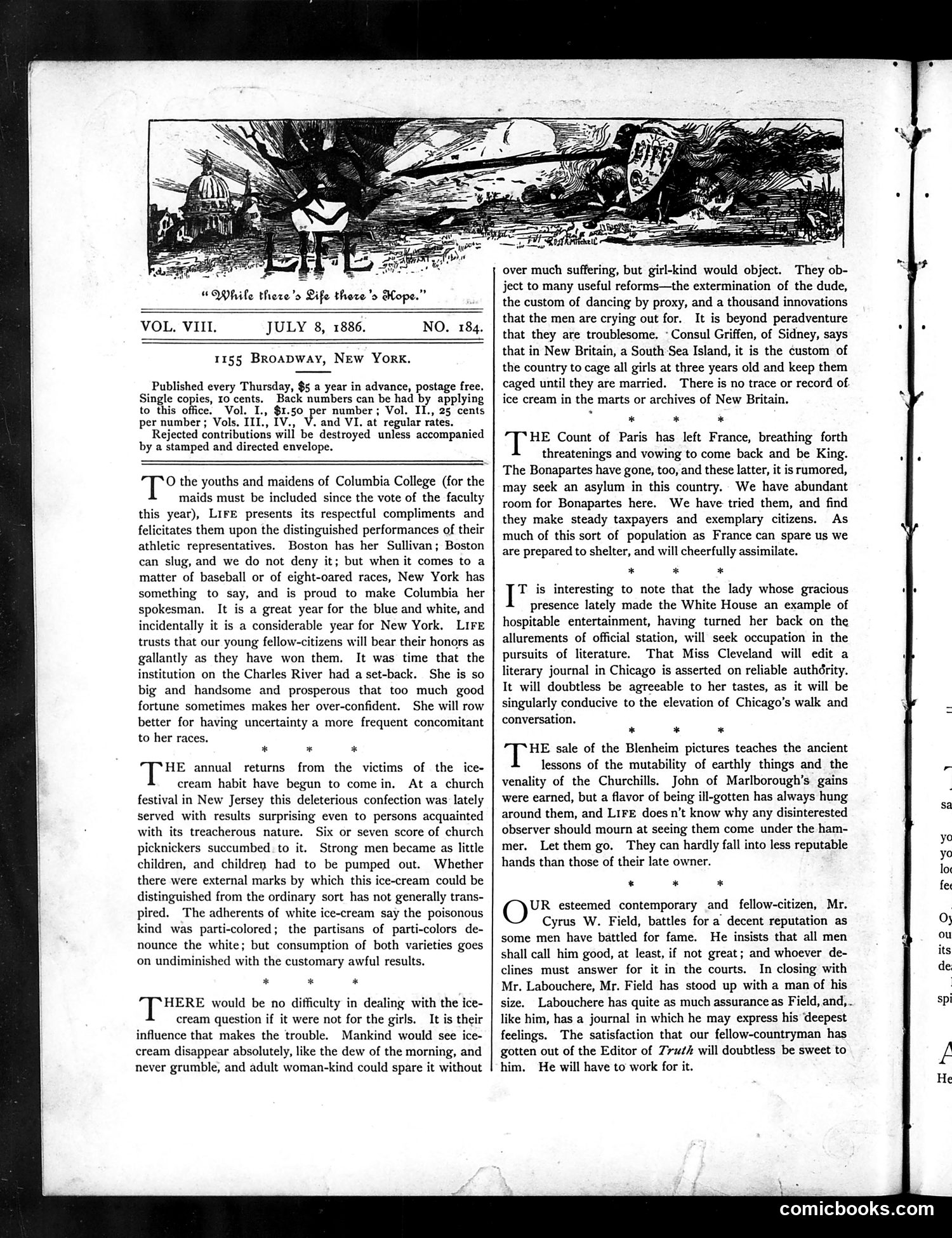
The masthead illustration depicts a dramatic nighttime scene with what appears to be a comet or celestial phenomenon over a cityscape (possibly including a notable dome, suggesting Washington D.C. or similar). The exact reference is unclear from the image alone. The textual content focuses on social commentary rather than political cartooning: Columbia College's baseball team, ice cream consumption among women (presented as a social problem), the Count of Paris and Bonapartes seeking asylum in America, Miss Cleveland's literary pursuits, art market speculation regarding Blenheim paintings, and local journalist Cyrus W. Field. The satire targets women's independence and changing social customs rather than partisan politics. No specific identifiable caricatures of named political figures appear on this page.
📄 Transcribed text from this page (OCR, searchable)
Machine-transcribed from the original scan — historical spelling and the odd misread are preserved.
“While there's Life there 's Mope.” VOL. VIII. JULY 8, 1886. NO. 184. 1155 Broapway, New York. Published every Thursday, $5 a year in advance, postage free, Single copies, 10 cents. Back numbers can be had by applying to this office. Vol. I., $1.50 per number; Vol. II., 25 cents per number ; Vols, III., IV., ¥ and VI. at regular rates. Rejected contributions will be destroyed unless accompanied by a stamped and directed envelope. O the youths and maidens of Columbia College (for the maids must be included since the vote of the faculty this year), LIFE presents its respectful compliments and felicitates them upon the distinguished performances of their athletic representatives. Boston has her Sullivan; Boston can slug, and we do not deny it; but when it comes to a matter of baseball or of eight-oared races, New York has something to say, and is proud to make Columbia her spokesman. It is a great year for the blue and white, and incidentally it is a considerable year for New York. LIFE trusts that our young fellow-citizens will bear their honors as gallantly as they have won them. It was time that the institution on the Charles River had a set-back. She is so big and handsome and prosperous that too much good fortune sometimes makes her over-confident. She will row better for having uncertainty a more frequent concomitant to her races. * * * HE annual returns from the victims of the ice- cream habit have begun to comein, At a church festival in New Jersey this deleterious confection was lately served with results surprising even to persons acquainted with its treacherous nature. Six or seven score of church picknickers succumbed to it. Strong men became as little children, and children had to be pumped out. Whether there were external marks by which this ice-cream could be distinguished from the ordinary sort has not generally trans- pired. The adherents of white ice-cream say the poisonous kind was parti-colored; the partisans of parti-colors de- nounce the white; but consumption of both varieties goes on undiminished with the customary awful results. * * * HERE would be no difficulty in dealing with the ice- cream question if it were not for the girls. It is their influence that makes the trouble. Mankind would see ice- cream disappear absolutely, like the dew of the morning, and never grumble, and adult woman-kind could spare it without over much suffering, but girl-kind would object. They ob- ject to many useful reforms—the extermination of the dude, the custom of dancing by proxy, and a thousand innovations that the men are crying out for. It is beyond peradventure that they are troublesome. * Consul Griffen, of Sidney, says that in New Britain, a South Sea Island, it is the custom of the country to cage all girls at three years old and keep them caged until they are married. There is no trace or record of. ice cream in the marts or archives of New Britain. * * * HE Count of Paris has left France, breathing forth threatenings and vowing to come back and be King. The Bonapartes have gone, too, and these latter, it is rumored, may seek an asylum in this country. We have abundant room for Bonapartes here. We have tried them, and find they make steady taxpayers and exemplary citizens. As much of this sort of population as France can spare us we are prepared to shelter, and will cheerfully assimilate. * * * T is interesting to note that the lady whose gracious presence lately made the White House an example of hospitable entertainment, having turned her back on the allurements of official station, will seek occupation in the pursuits of literature. That Miss Cleveland will edit a literary journal in Chicago is asserted on reliable authdrity. It will doubtless be agreeable to her tastes, as it will be singularly conducive to the elevation of Chicago’s walk and conversation. * * * HE sale of the Blenheim pictures teaches the ancient lessons of the mutability of earthly things and the venality of the Churchills. John of Marlborough’s gains were earned, but a flavor of being ill-gotten has always hung around them, and LIFE does n’t know why any disinterested observer should mourn at seeing them come under the ham- mer. Let them go. They can hardly fall into less reputable hands than those of their late owner. * * * UR esteemed contemporary and fellow-citizen, Mr. Cyrus W. Field, battles for a decent reputation as some men have battled for fame. He insists that all men shall call him good, at least, if not great; and whoever de- clines must answer for it in the courts. In closing with Mr. Labouchere, Mr. Field has stood up with a man of his size. Labouchere has quite as much assurance as Field, and, . like him, has a journal in which he may express his ‘deepest feelings. The satisfaction that our fellow-countryman has gotten out of the Editor of Zruth will doubtless be sweet to him. He will have to work for it. comicbooks.com