
A complete issue · 16 pages · 1886
Life — February 4, 1886
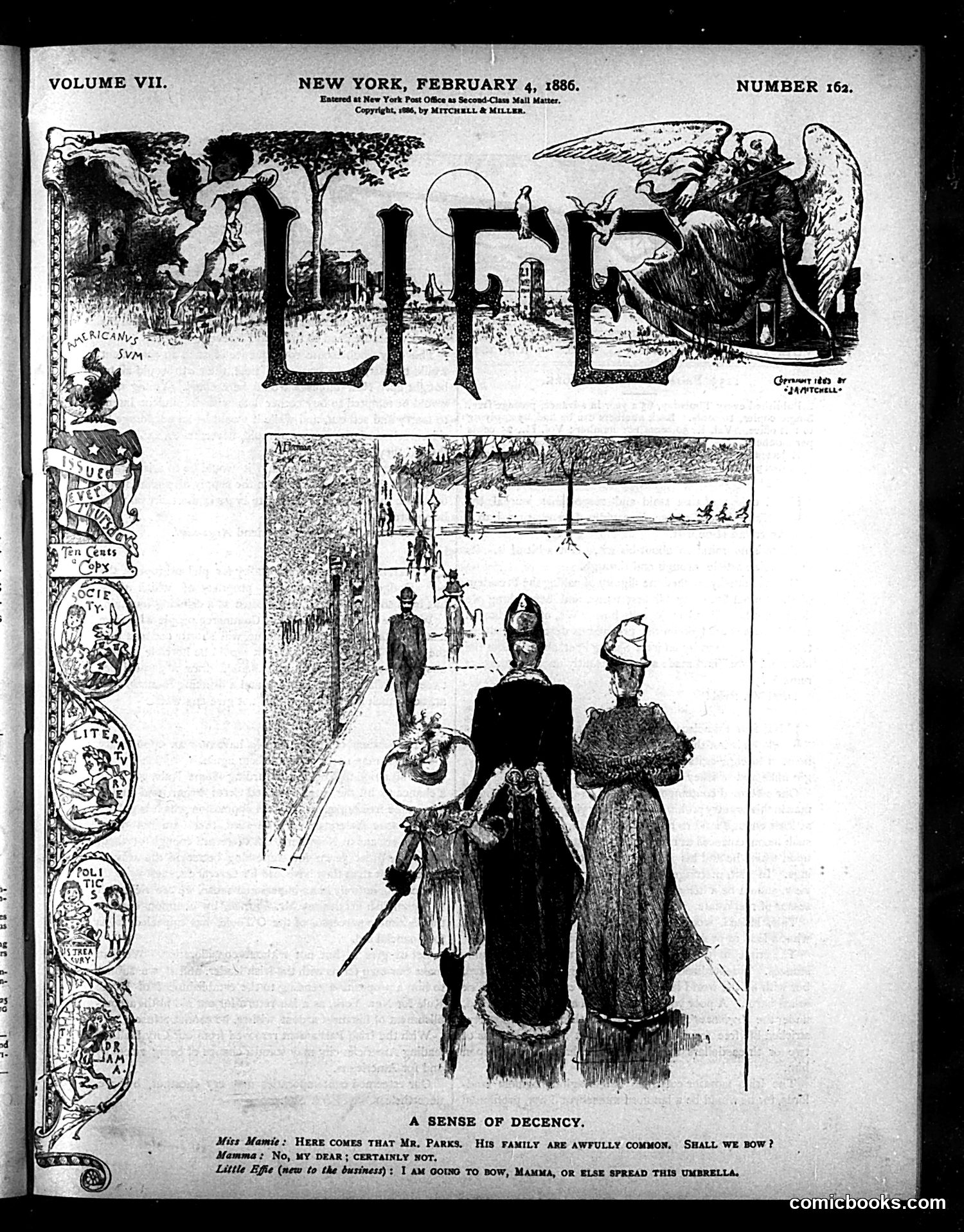
This cartoon satirizes class pretension and social hypocrisy. A wealthy woman (identified as "Miss Mamie") walks with her child and companion past what appears to be a poor or working-class neighborhood. The dialogue reveals the satire: **Miss Mamie** claims Mr. Parks' family is "awfully common" and asks "shall we bow?" **Mamma** responds they certainly won't—such people are beneath acknowledgment. **Little Edith** innocently observes she's "going to bow, Mamma, or else spread this umbrella"—suggesting she'll use the umbrella as protection, implying the poor are dirty or diseased. The joke mocks upper-class snobbery: the wealthy woman simultaneously judges others as "common" while displaying crude, indecent behavior through her child's blunt contempt. The irony critiques how the wealthy equate social status with actual morality or decency.
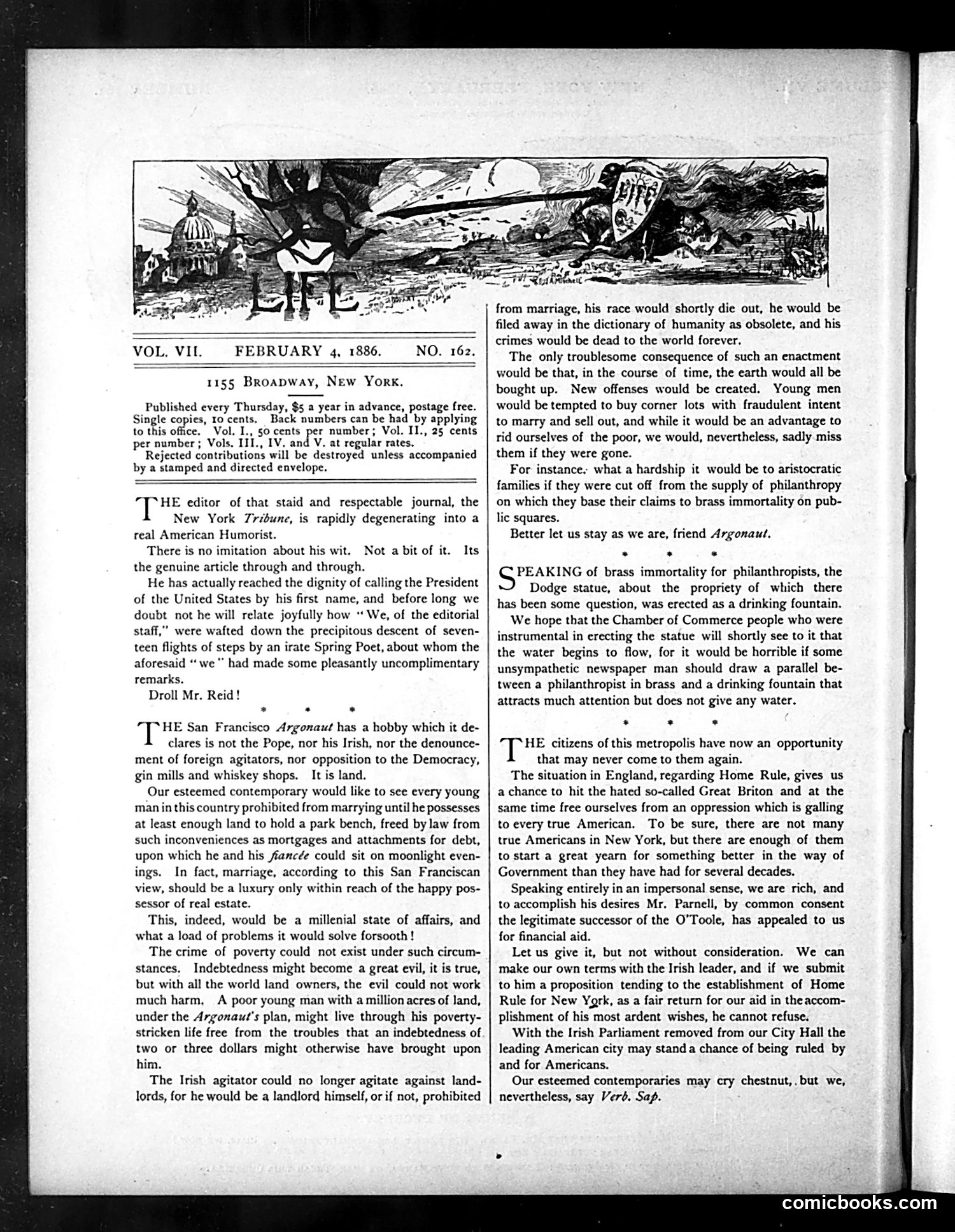
The masthead cartoon depicts Death as a skeletal figure overlooking a nightmarish landscape with a city and graveyard. It's an ironic visual for a humor magazine. The editorials satirize proposals by San Francisco's *Argonaut* newspaper. One mocks a scheme allowing poor young men to acquire land and mortgages, arguing this would create aristocratic families and eliminate poverty—presented as absurdly utopian. Another ridicules the *Argonaut's* advocacy for Irish Home Rule and establishing American cities under Irish governance. The editors use heavy sarcasm: "Droll Mr. Reid!" and "Verily, Sap." They're lampooning what they see as naive, impractical social engineering and Irish-American political ambitions of the era, while defending American exceptionalism against foreign influence.
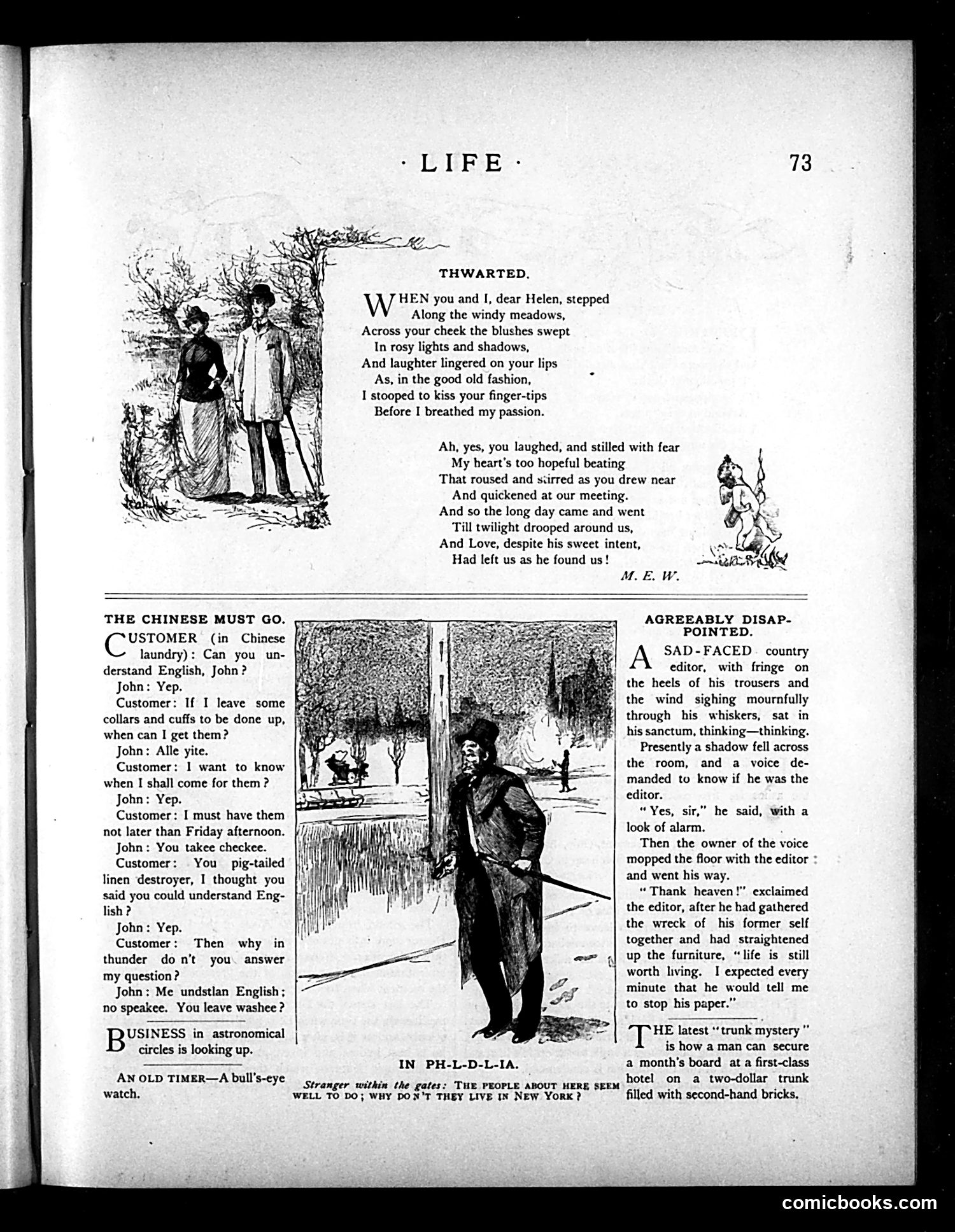
This page contains three distinct humor pieces from *Life* magazine: **"Thwarted"** (top): A romantic poem by M.E.W. about a failed courtship in windy meadows, where the narrator's passionate advances were interrupted by the beloved's fear and hesitation—a sentimental comedy about romantic miscommunication. **"The Chinese Must Go"** (bottom left): A satirical dialogue mocking a Chinese laundry customer and worker's mutual incomprehension. The humor relies on stereotypical "broken English" and cultural misunderstanding—typical of period-specific racial humor reflecting anti-Chinese attitudes of the era. **"Agreeably Disappointed"** (right): A brief anecdote about a melancholic newspaper editor unexpectedly cheered by an unexpected visitor, finding his life "still worth living." **"In Ph-ld-l-ia"** (center): A captioned illustration about city life, likely Philadelphia, with social commentary about boarding arrangements.
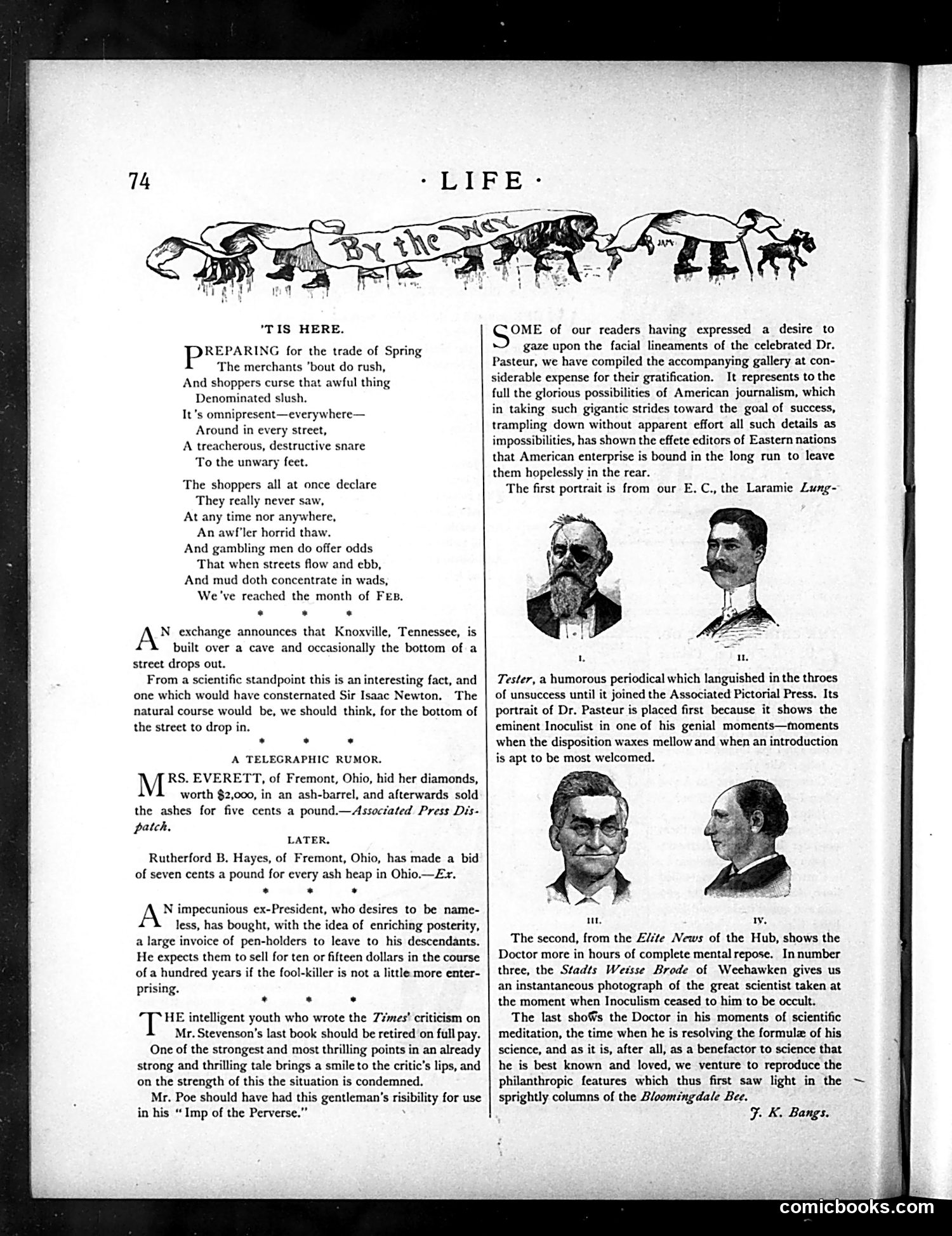
This page features four portrait sketches of **Louis Pasteur**, the celebrated French scientist, labeled I through IV. The accompanying text explains that *Life* compiled these portraits "at considerable expense" to satisfy reader curiosity about Pasteur's facial features, showcasing "American journalism" taking "gigantic strides toward the goal of success." The portraits are sourced from various publications: the *Laramie Longhorn*, the *Elite News*, the *Stadt Weisheit*, and the *Bloomingdale Bee*—appearing to be satirical regional newspapers. The satire mocks American media's obsessive interest in celebrity appearances and its competitive rush to publish portraits of famous figures, even relying on dubious provincial sources.
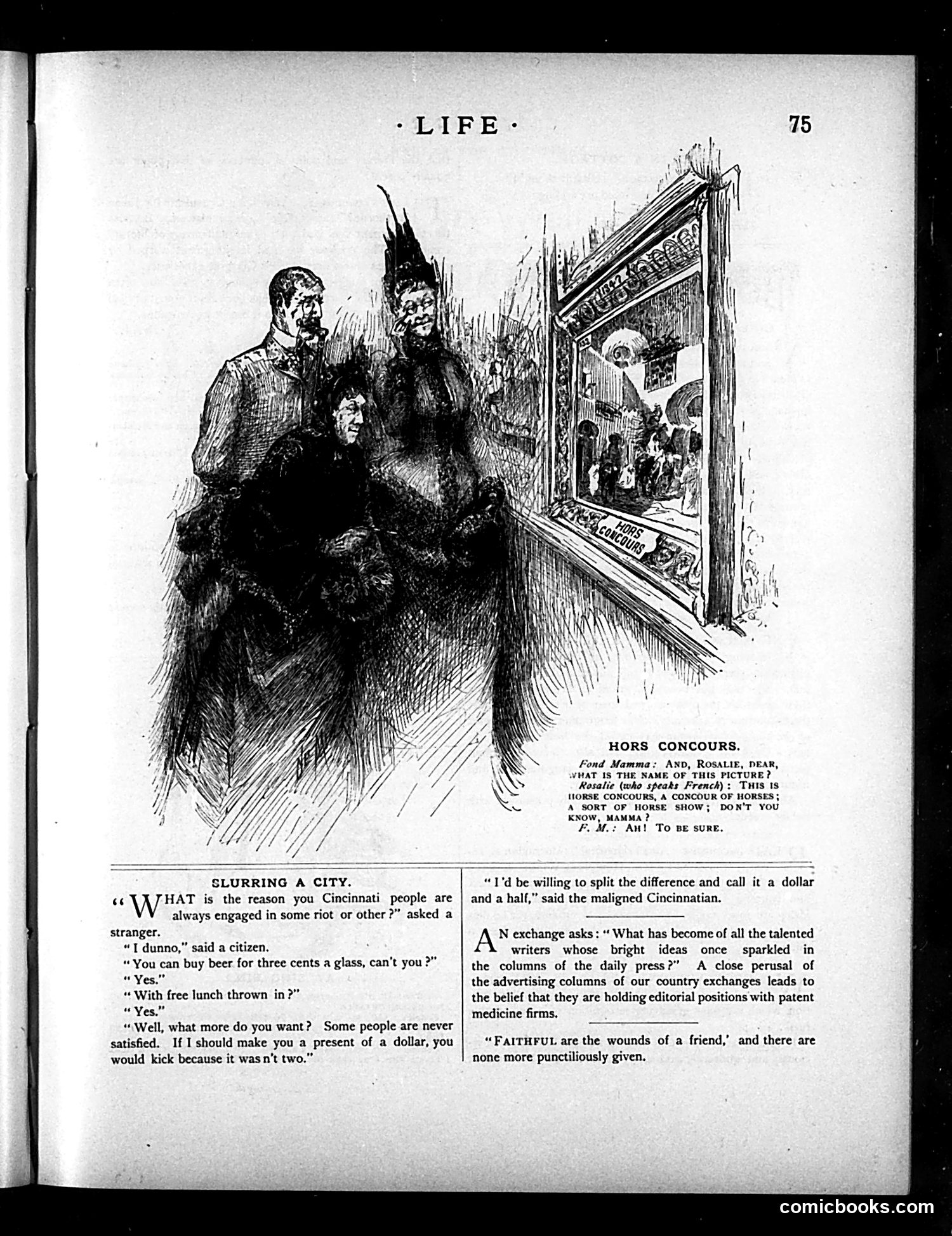
The top cartoon, titled "Hors Concours" (French for "outside competition"), depicts well-dressed figures viewing a shop window display. The dialogue suggests confusion about what artwork they're observing—one character asks what the picture's name is, with the response that it's a "concours of horses" (horse show). The satire appears to mock either pretentious art appreciation or the difficulty distinguishing between fine art and commercial displays. Below, "Slurring a City" presents a dialogue where a stranger questions Cincinnati residents about constant rioting. The citizen's responses escalate absurdly—cheap beer, free lunches—suggesting satirical commentary on either Cincinnati's actual reputation for civil unrest or stereotypes about working-class urban discontent. The final exchange mocks unreasonable consumer demands and entitlement. The page also includes brief quoted observations about talented newspaper writers now in advertising.
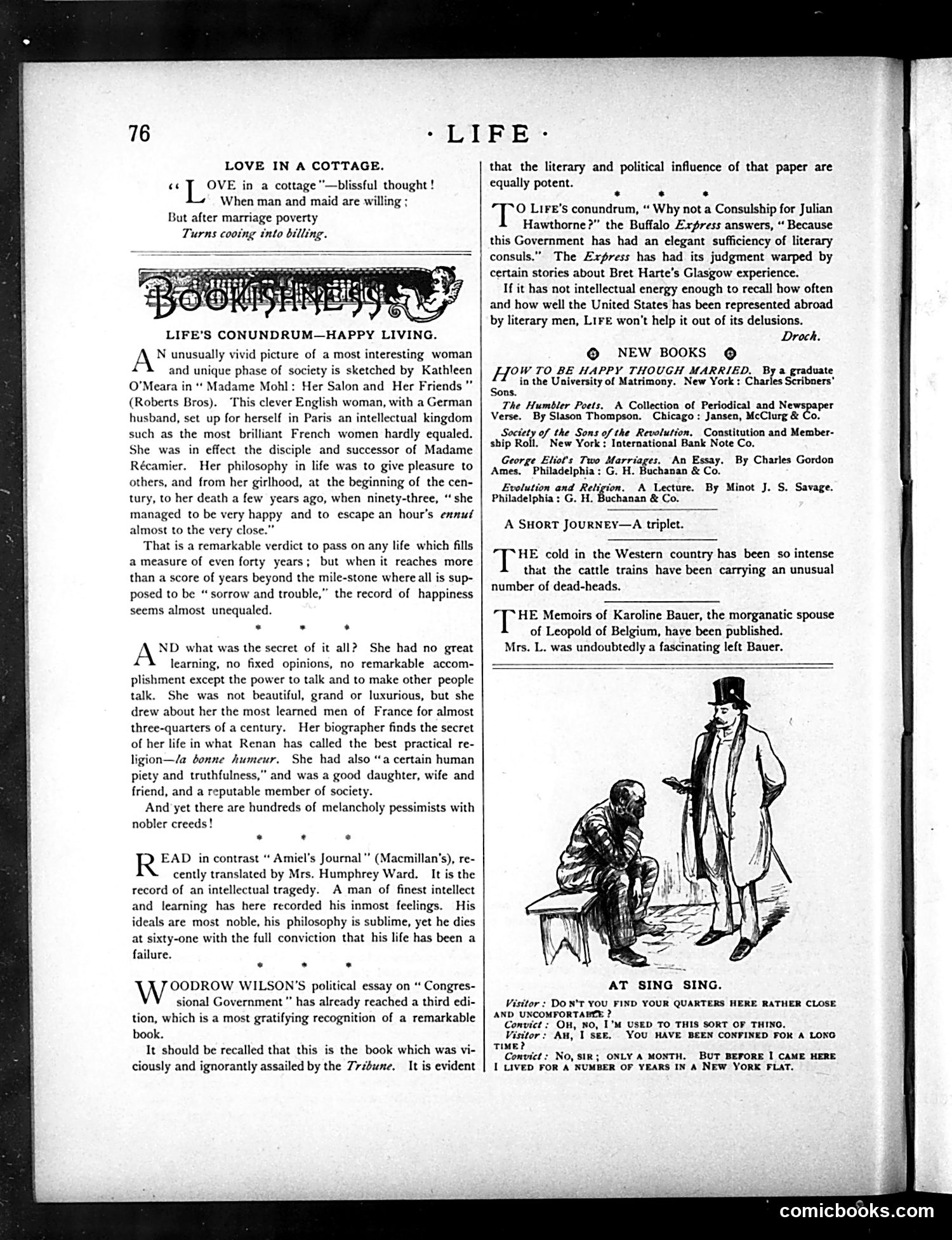
This cartoon depicts a dialogue between two men at Sing Sing prison (a major New York correctional facility). The well-dressed visitor questions the inmate about his cramped quarters, noting he's been confined for a long time. The inmate replies he lived in a similar New York flat for years before imprisonment—suggesting that poverty-level tenement housing in the city was as confining and uncomfortable as prison. The satire critiques New York's slum conditions by equating them with incarceration. The joke's dark implication is that the poor already lived in prison-like circumstances, so actual imprisonment represents little change in their living conditions. This reflects Progressive Era concerns about urban housing and class inequality.
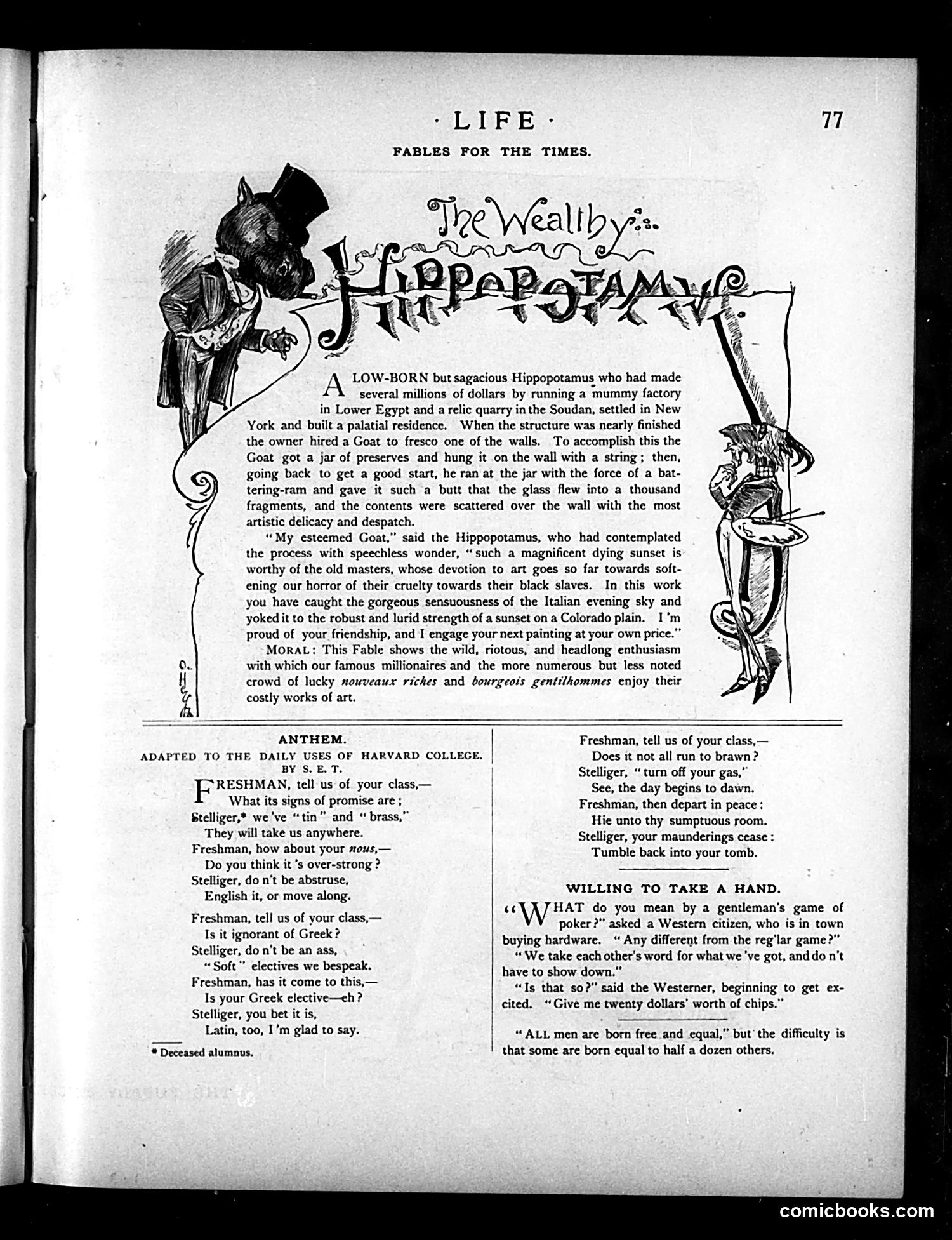
This fable satirizes the nouveau riche and their ostentatious spending habits. A hippopotamus character, having made millions through business ventures (a mummy factory and quarry), hires an artist to fresco his newly-built mansion. The hippopotamus then destroys the work with a jar of preserves—an absurd act of vandalism. The moral critiques "wild, riotous, and headlong enthusiasm" of wealthy nouveaux riches and bourgeois gentlemen who spend lavishly on art without understanding or appreciating it. The satire targets the nouveau riche class's wasteful, destructive relationship with culture and fine art—spending fortunes on masterworks only to ruin them through ignorance and carelessness.
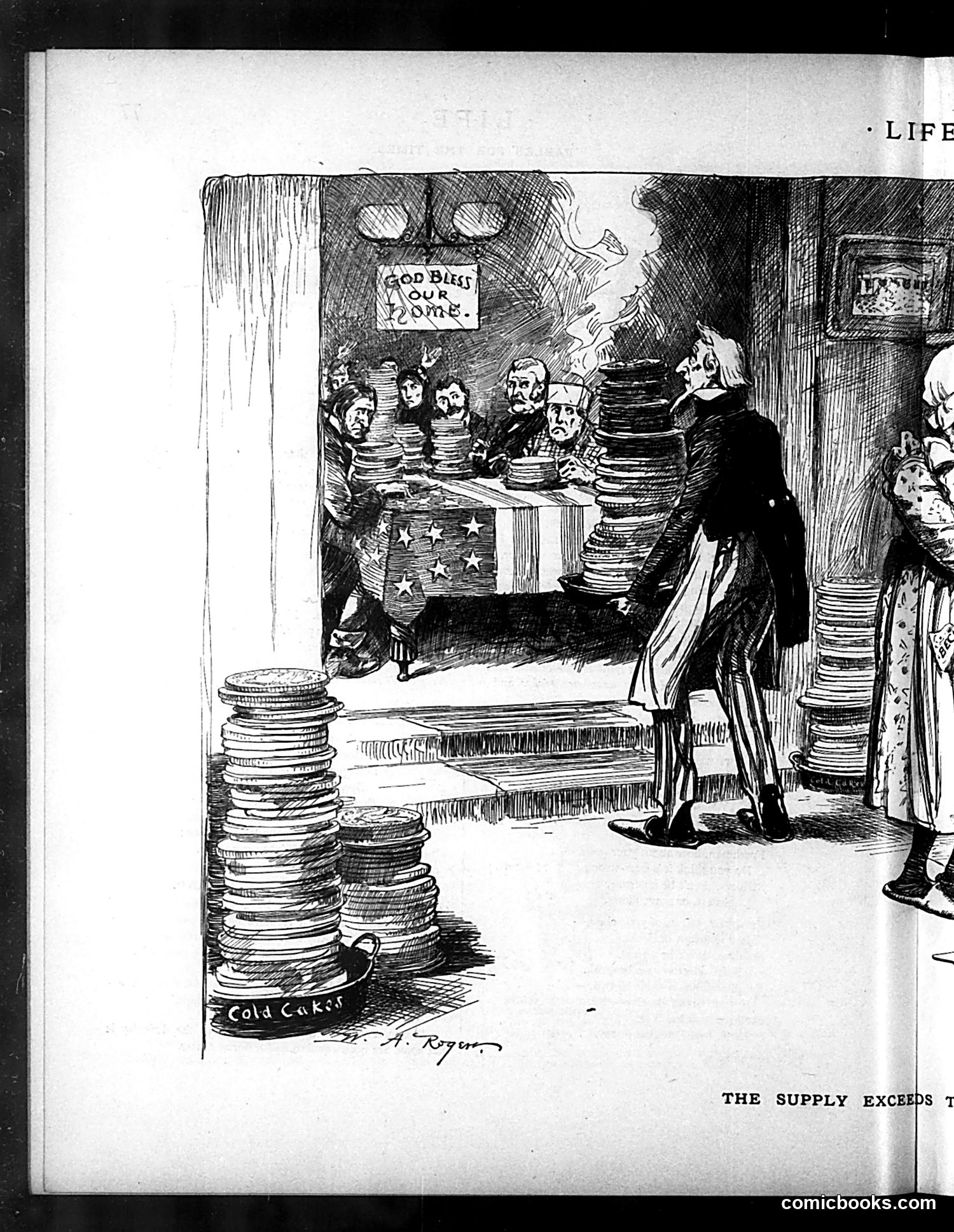
This cartoon satirizes **food supply issues**, likely from WWI or the 1920s era (based on the "LIFE" masthead style). The central image shows a formal government or official meeting where figures sit around a table beneath a sign reading "GOD BLESS OUR HOME." In stark contrast, the foreground displays enormous stacked piles labeled "COLD CAKES"—a visual metaphor for surplus food that has gone stale or unsold. The satire critiques the disconnect between official declarations of domestic blessing and the actual problem of **food waste or oversupply amid potential scarcity**. The title fragment "THE SUPPLY EXCEEDS T[HE DEMAND]" confirms this interpretation. The cartoon uses the ironic juxtaposition of patriotic rhetoric against practical economic failure to mock government inefficiency in food distribution or management during a period of rationing concerns.
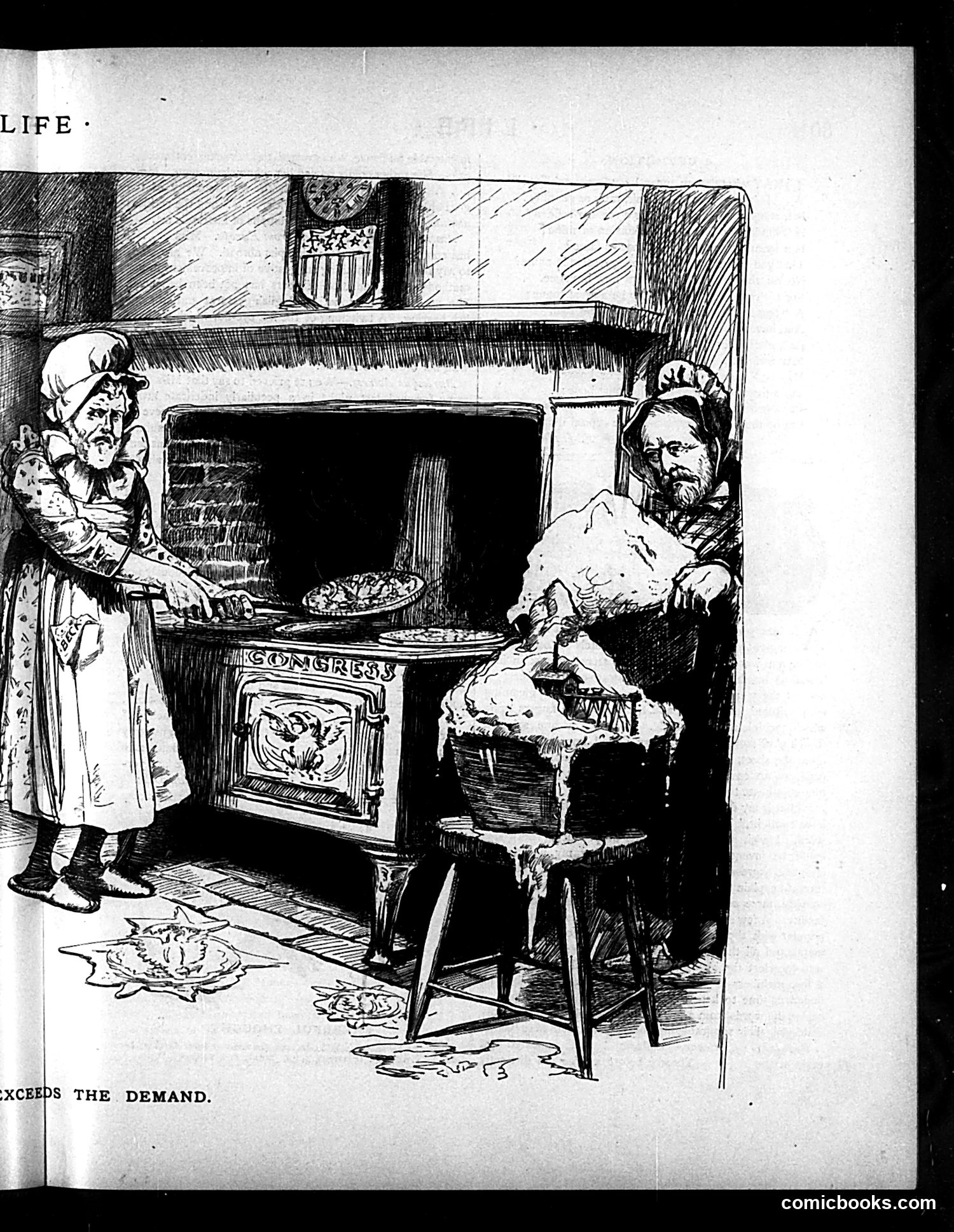
This political cartoon depicts a kitchen scene where a woman (likely representing a wife or homemaker) presents an oversized roasted bird or meat to two men seated at a table. The caption reads "EXCEEDS THE DEMAND," suggesting the meal is excessively large for the diners' needs. The "CONGRESS" label visible on the stove indicates this is satirizing government spending or resource allocation. The cartoon likely critiques Congressional excess—perhaps overspending on projects or appropriations that exceed actual public needs. The domestic kitchen setting uses the metaphor of a housewife's cooking to mock legislators' wastefulness with taxpayer money, a common satirical device in early 20th-century American editorial cartooning.
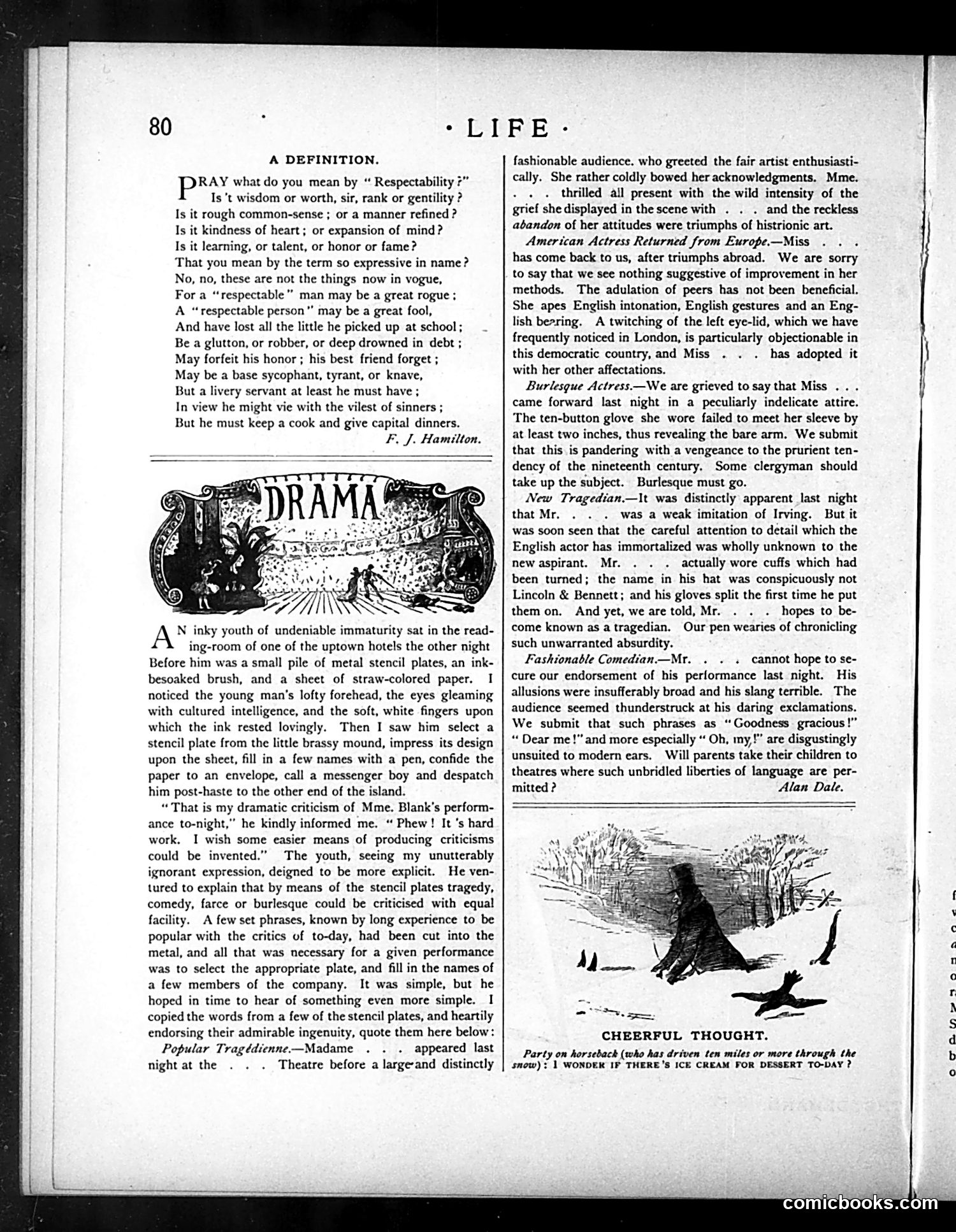
This page satirizes lazy theatrical criticism through two pieces: **"A Definition" (poem by F.J. Hamilton):** A sharp critique of "respectability" as a social concept. The author argues that true respectability—wisdom, honor, talent—has been replaced by mere *appearances*: owning servants, employing cooks, hosting fancy dinners. A person can be corrupt, foolish, or immoral but still achieve "respectability" through conspicuous consumption and social performance. This mocks 19th-century class pretension. **"Drama" section:** Satirizes theatrical critics who use standardized stencil plates with pre-written phrases to review performances without actually thinking. The critic simply fills in actress names and theatre details into templates praising or condemning performances identically. The quoted examples parody actual reviews—one fawning, one snobbish about an American actress "aping" English mannerisms. The satire targets both theatrical criticism's formulaic laziness and broader social hypocrisy where appearance matters more than substance.
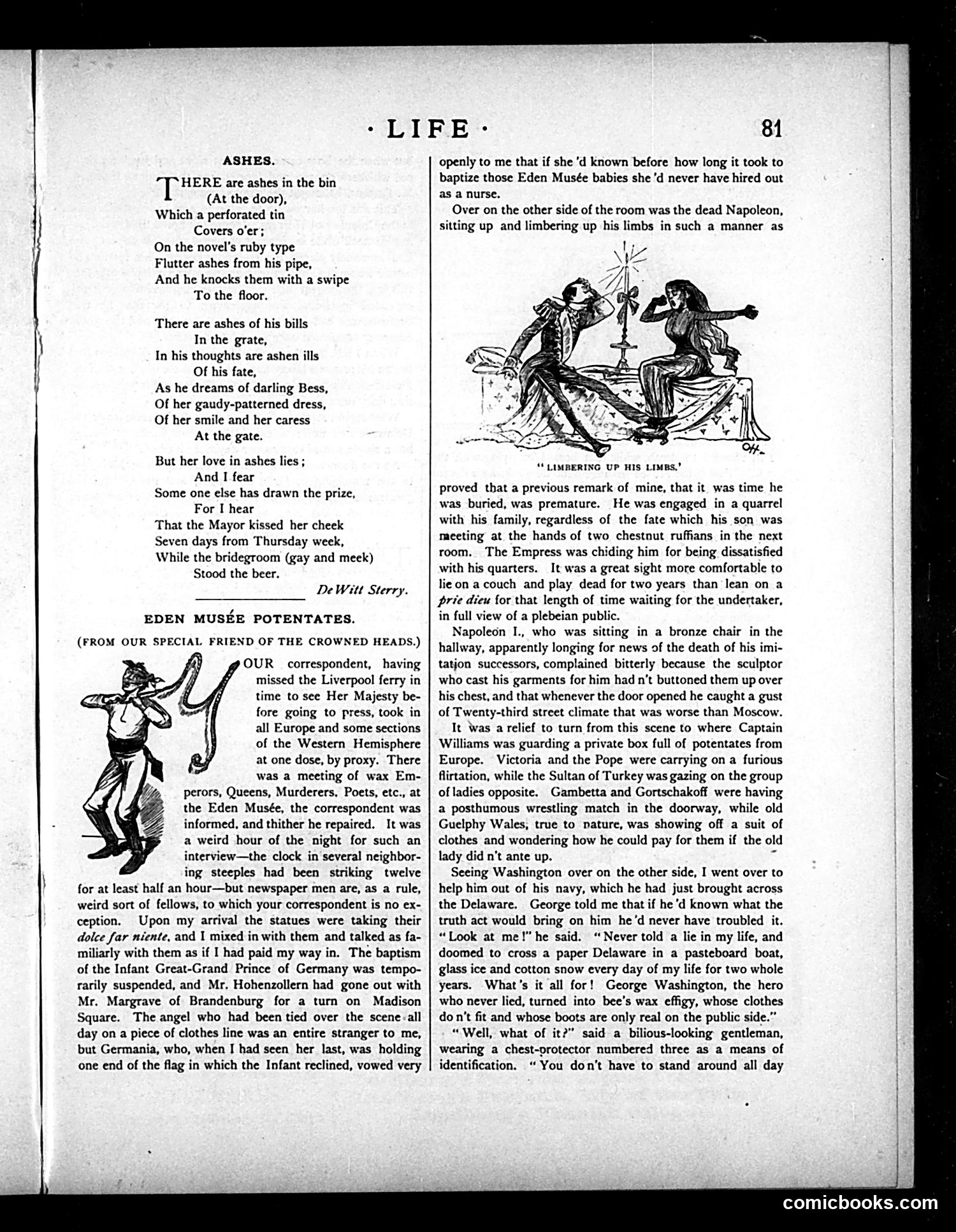
This article mocks the **Eden Musée**, a real New York wax museum featuring famous historical and contemporary figures. The satire portrays the wax figures as if they were alive and petty, revealing character flaws through their behavior. The figures referenced include **Napoleon** (complaining about ventilation and his ill-fitting clothes), **Queen Victoria** and **the Pope** (flirting frivolously), **the Sultan of Turkey**, European statesmen **Gambetta** and **Gortschakoff** (wrestling), and **George Washington**. The joke works on multiple levels: it humanizes these dignified historical/political figures by depicting them as vain, quarrelsome, and preoccupied with trivial concerns (drafts, clothing, gossip). The correspondent's casual, gossipy tone treats "crowned heads" and potentates—symbols of power and prestige—as mere wax dummies with mundane worries. This deflates their authority through humor, suggesting that beneath formal dignity, powerful people are petty and absurd.
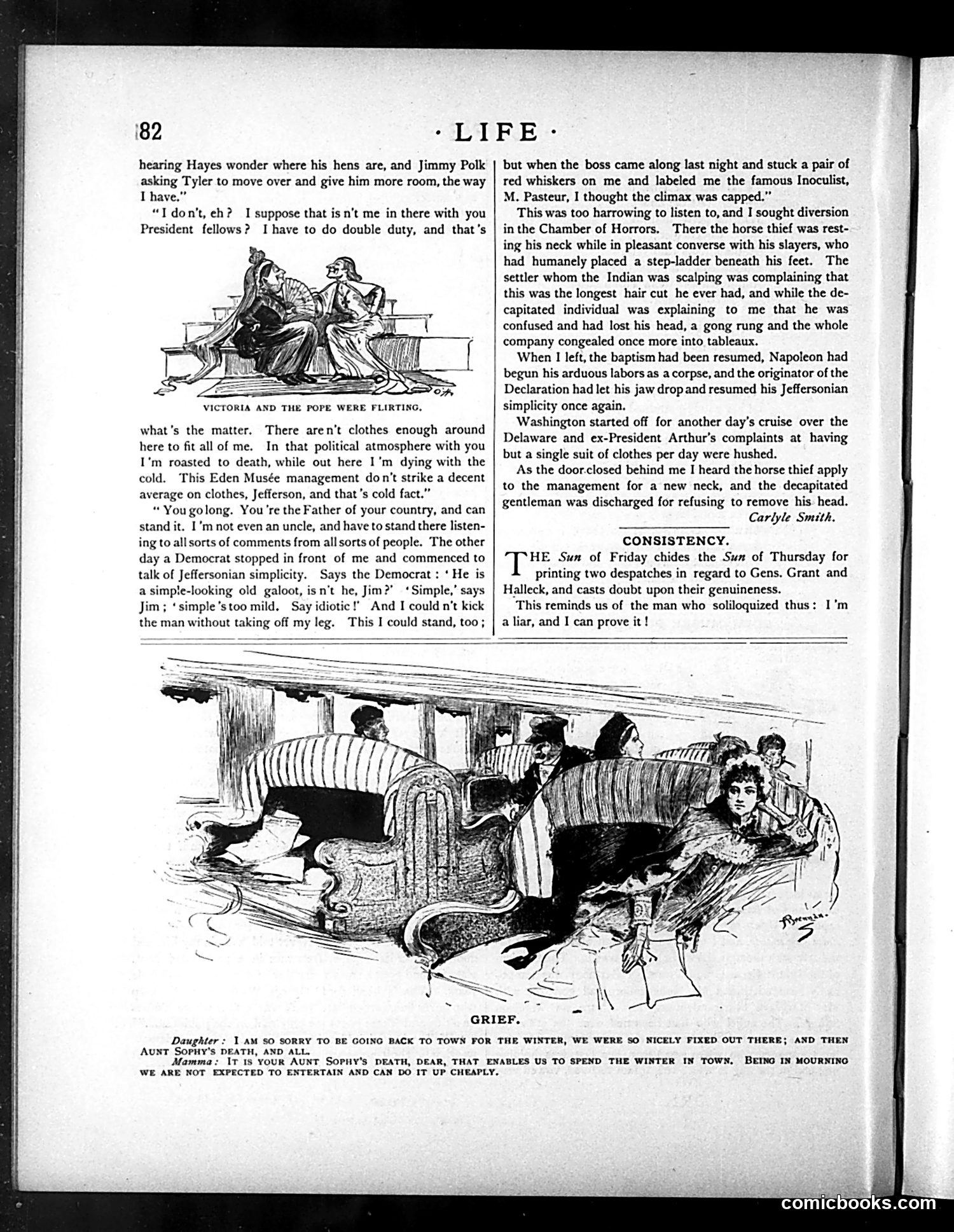
This page contains two satirical pieces mocking American politics and social hypocrisy. **Upper Section ("Victoria and the Pope Were Flirting"):** A dialogue set in what appears to be a wax museum (Eden Musée), featuring American historical/political figures—references to Presidents Hayes, Polk, Tyler, Jefferson, Washington, and Arthur. The satire ridicules politicians complaining about cramped conditions and indignities (one figure jokes about being labeled "M. Pasteur" by the boss). The joke critiques how these supposedly great men are reduced to static displays, uncomfortable and powerless—a metaphor for politicians' actual irrelevance or compromised positions. **Lower Section ("Grief"):** A brief comedic dialogue between a daughter and mother about mourning Aunt Sophy's death. The cruel punchline: the mother reveals they're actually *pleased* because the required mourning period saves money on entertaining guests during winter—exposing Victorian hypocrisy about grief and social obligation. Both pieces target pretension and moral dishonesty in American society.
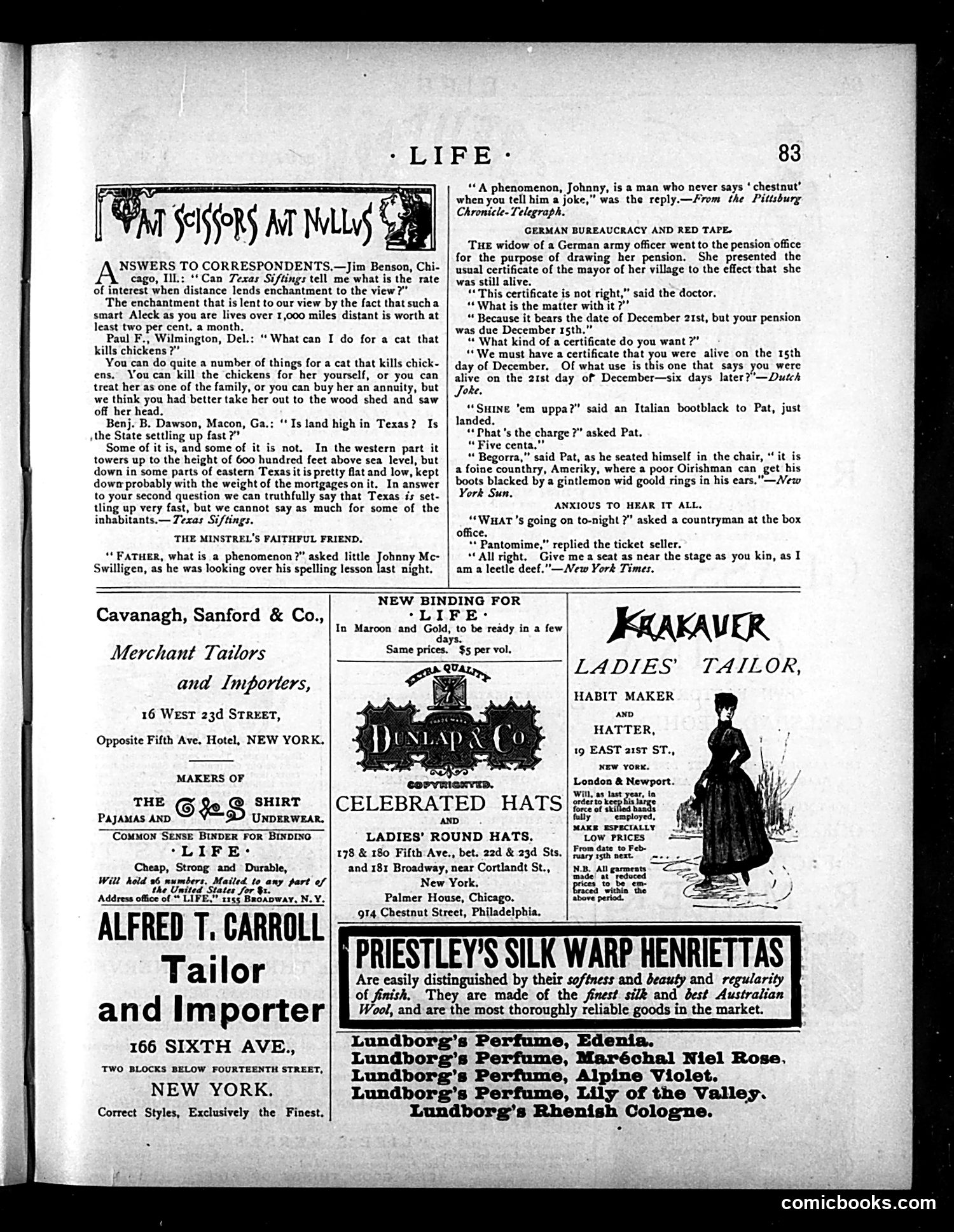
This page is primarily **advertising with interspersed humor columns** rather than political cartoons. The content includes: **"Answers to Correspondents"** — A humor column responding to readers' questions with satirical answers. Notable examples: - A sarcastic response to someone complaining about distance from a "smart Aleck" - Dark humor about solving a chicken-killing cat problem ("saw off her head") - A joke about Texas land and mortgages weighing down the state **Short joke pieces** including: - "The Minstrel's Faithful Friend" — defining a "phenomenon" as someone who doesn't call jokes "chestnuts" (old/overused) - "German Bureaucracy and Red Tape" — mocking rigid German bureaucratic red tape requiring exact dates for widow's pension - Ethnic humor involving Italian and Irish immigrants The satire targets **bureaucratic absurdity, rural American attitudes, and immigrant stereotypes** — common Life magazine themes of the era. The page is otherwise dominated by ads for tailors, hatmakers, and perfumes.
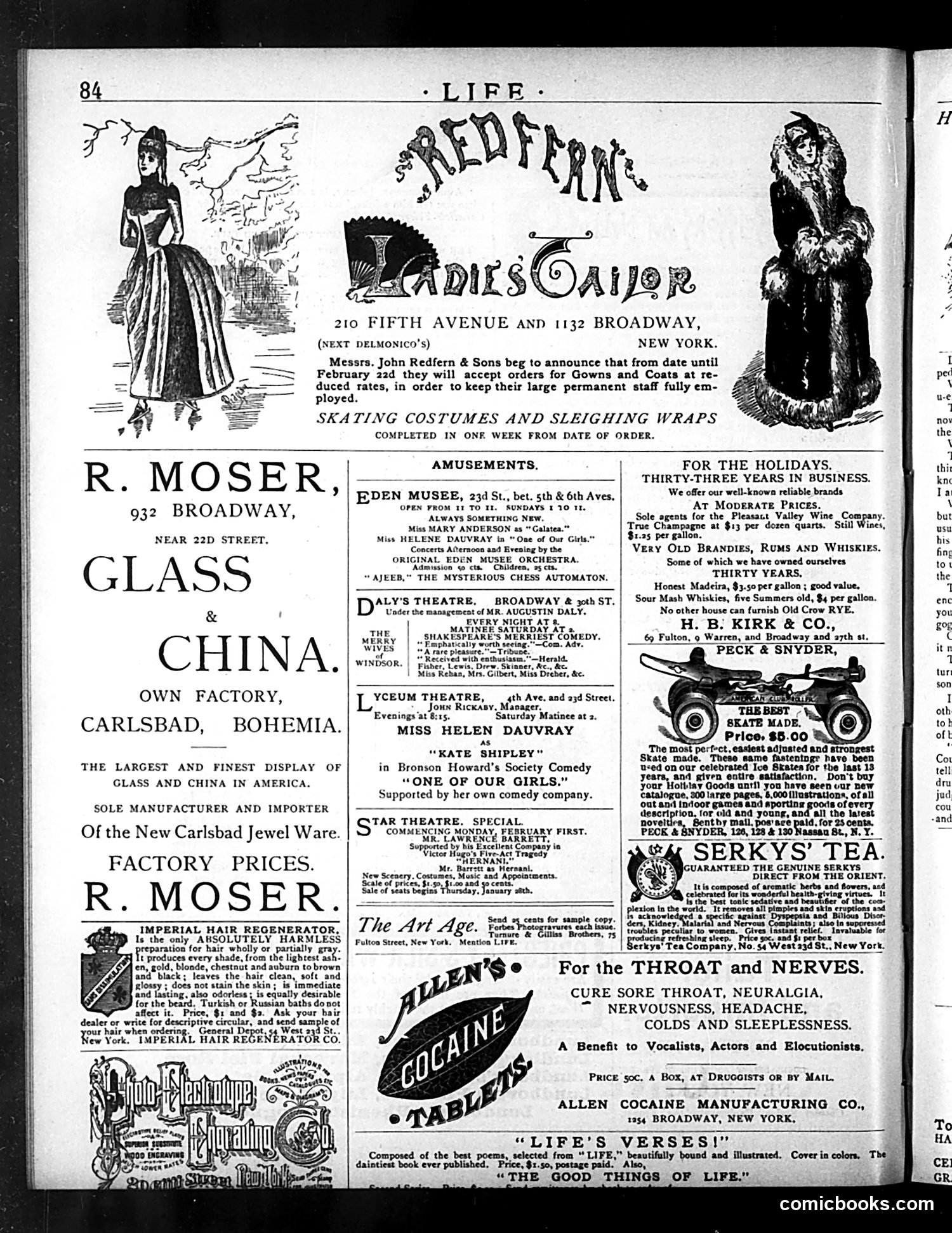
This page is predominantly **advertising**, not a satirical cartoon page. It's from *Life* magazine and showcases late 19th-century commercial notices typical of the era. Key advertisements include: **Fashion/Retail:** John Redfern (high-end women's clothing), glass and china importers from Bohemia **Entertainment:** Multiple theaters advertising shows featuring actress Helen Dauvray in comedies; Eden Musée (wax museum); a chess-playing automaton **Patent medicines:** The most notable—Allen Cocaine tablets, marketed for "sore throat, neuralgia, nervousness, headache, colds"—reflecting the legal status of cocaine in this period before regulation **Spirits/beverages:** Wine and whiskey merchants, ice skates, and "Serkys Tea" **Hair products:** Imperial Hair Regenerator (claiming to restore gray hair without staining skin) The page reveals commercial norms and consumer culture of the 1880s-1890s, including now-shocking pharmaceutical advertising and the prevalence of patent medicines.
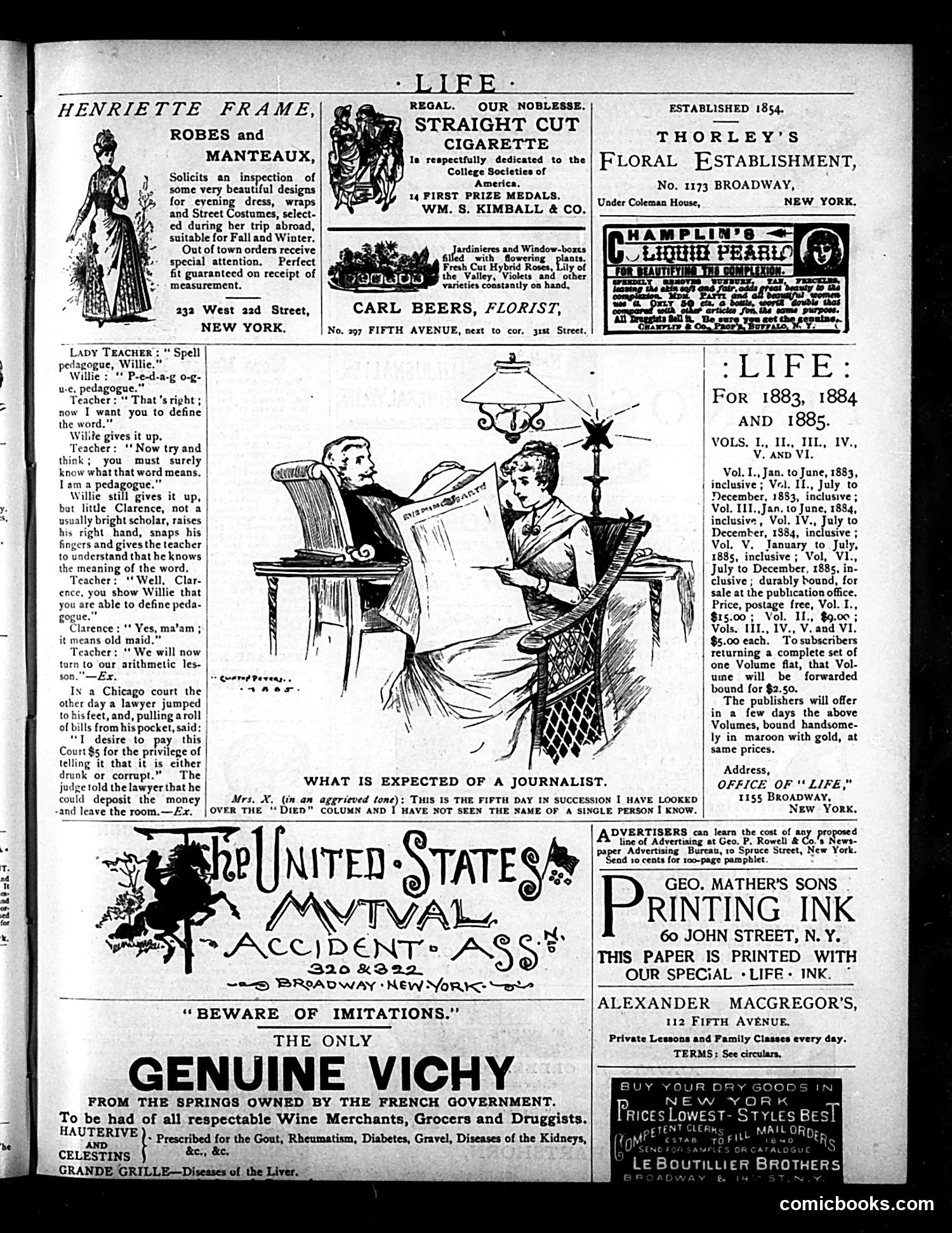
This is primarily an **advertising and humor page** from Life magazine (1880s). The main satirical cartoon is titled "WHAT IS EXPECTED OF A JOURNALIST," depicting a woman (Mrs. X) complaining to an editor that she's checked the death notices ("Died" column) for five consecutive days without recognizing any names. **The Satire:** The joke mocks the shallow social concerns of wealthy readers—Mrs. X reads the obituary section not for news, but to see if anyone in her social circle has died. Her disappointment that no one she knows has died reveals the vapid nature of high society's interest in newspapers. It's a jab at both elitist readers and the sensationalism of newspaper content. **Other Content:** The page includes a brief pedagogical humor piece about a schoolteacher defining "pedagogue," and court anecdotes. The remainder consists of period advertisements for clothing, cigarettes, florists, printing ink, mineral water, and other goods—typical of 19th-century magazine layout.
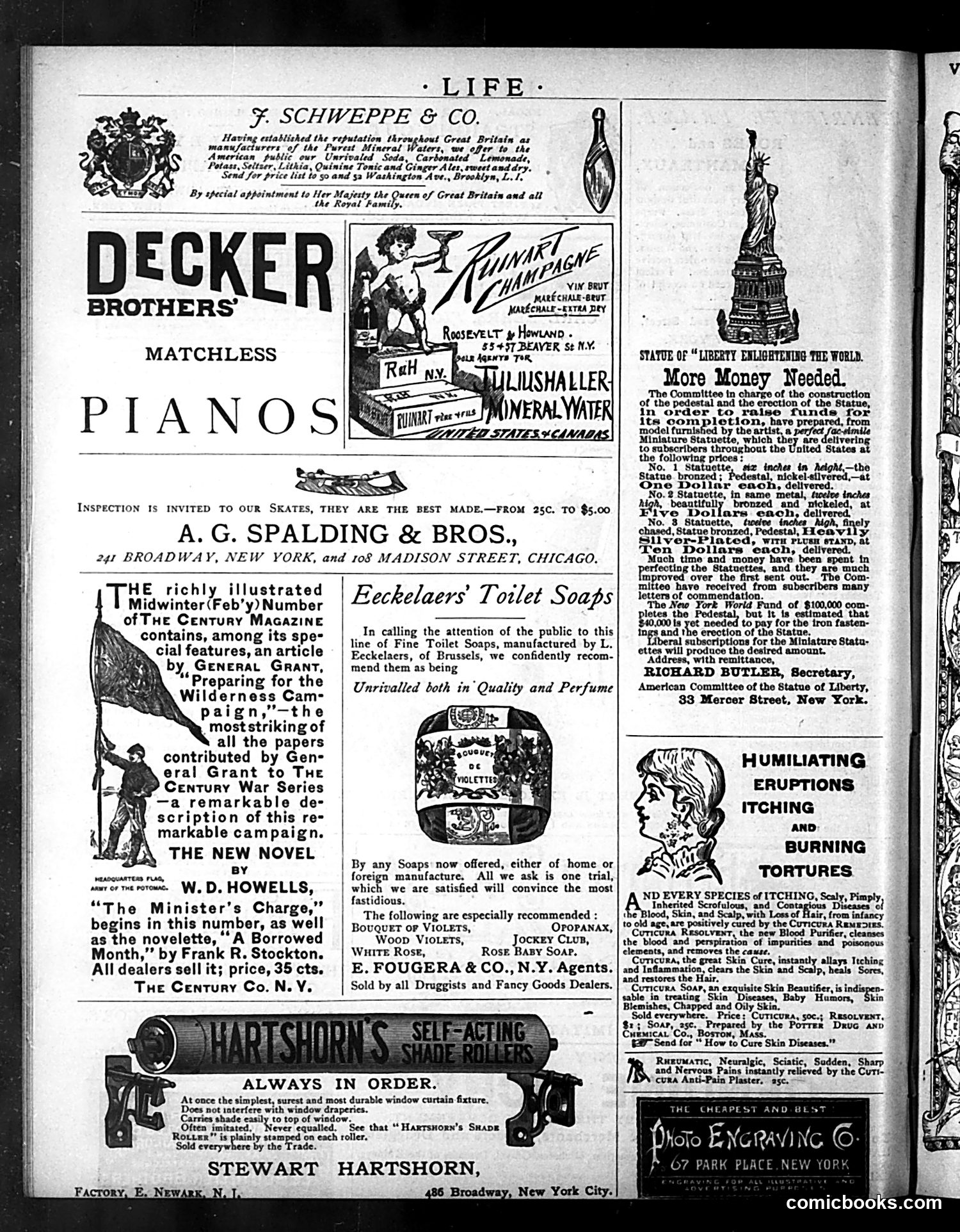
This page is primarily **advertising**, not political cartoons or satire. The main content includes: **Statue of Liberty Fundraising Campaign**: The prominent article discusses a committee collecting money to complete the Statue of Liberty's pedestal. They're selling miniature bronze statuettes at $1, $5, and $10 to raise approximately $100,000 needed. This reflects the historical effort in the 1880s to finance the statue's American base. **Product Advertisements**: The page features ads for: - Decker Brothers Pianos - A.G. Spalding & Bros. skates - Schweppe's mineral waters - Various toilet soaps and skin treatments (Cutticura, Ecckelaers) - Hartshorn's window shade fixtures - Century Magazine **Literary Content**: References to General Grant's Civil War memoir in *The Century* magazine and W.D. Howells' novel serialization. No political satire or caricature is present on this page—it's a straightforward mix of period advertising and editorial announcements typical of 1880s magazine layout.