
Life, 1886-02-04 · page 2 of 16
Life — February 4, 1886 — page 2: what you’re looking at
What you’re looking at
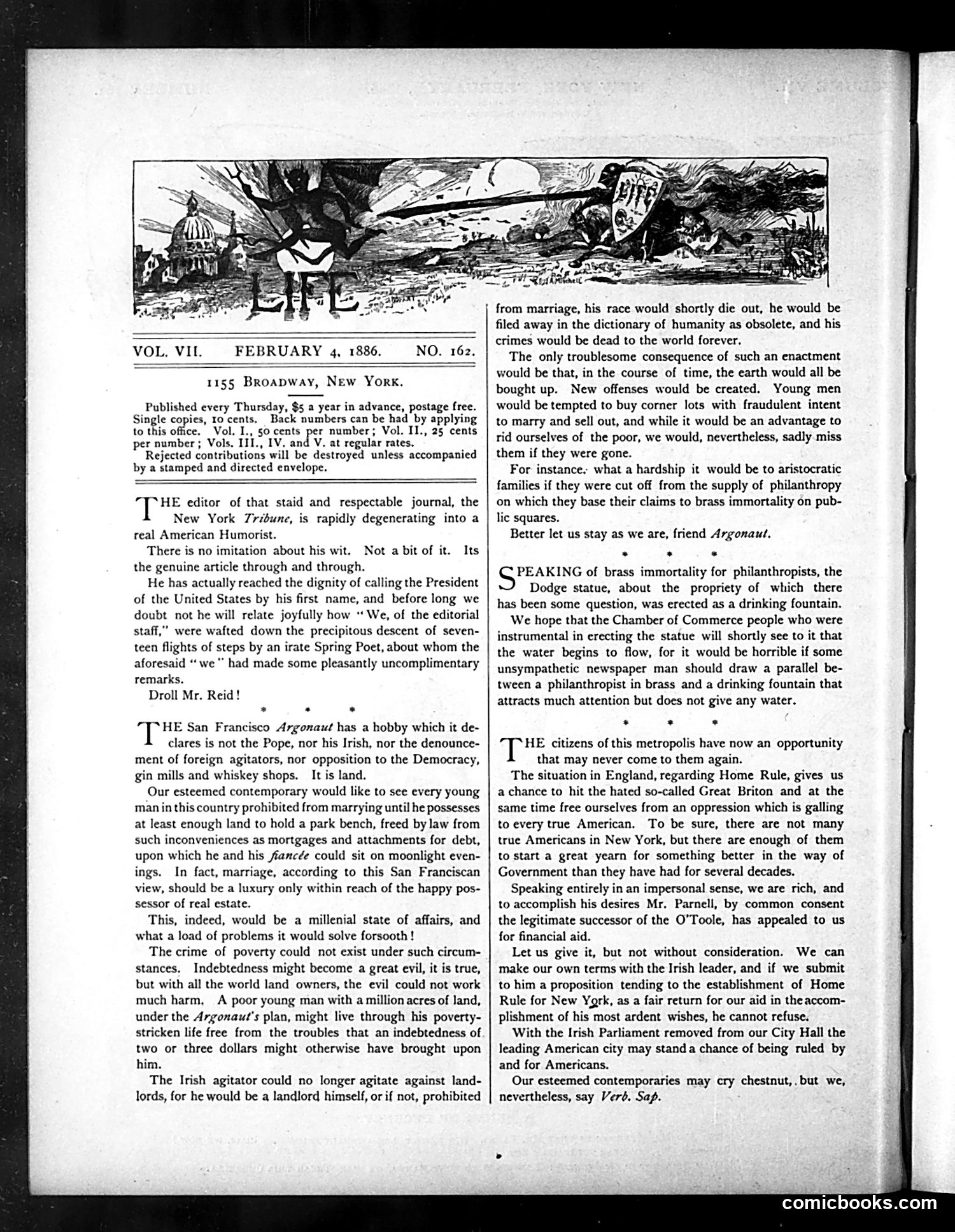
The masthead cartoon depicts Death as a skeletal figure overlooking a nightmarish landscape with a city and graveyard. It's an ironic visual for a humor magazine. The editorials satirize proposals by San Francisco's *Argonaut* newspaper. One mocks a scheme allowing poor young men to acquire land and mortgages, arguing this would create aristocratic families and eliminate poverty—presented as absurdly utopian. Another ridicules the *Argonaut's* advocacy for Irish Home Rule and establishing American cities under Irish governance. The editors use heavy sarcasm: "Droll Mr. Reid!" and "Verily, Sap." They're lampooning what they see as naive, impractical social engineering and Irish-American political ambitions of the era, while defending American exceptionalism against foreign influence.
📄 Transcribed text from this page (OCR, searchable)
Machine-transcribed from the original scan — historical spelling and the odd misread are preserved.
NO. 162. VOL. VII. FEBRUARY 4, 1886. 1155 Broapway, New York. Published every Thursday, $5 a year in advance, postage free. Single copies, ro cents, Back numbers can be had by applying to this ofice. Vol. I., 50 cents per number; Vol. II., 25 cents per number; Vols. III., IV. and V. at regular rates. Rejected contributions will be destroyed unless accompanied by a stamped and directed envelope. HE editor of that staid and respectable journal, the New York 7rzbune, is rapidly degenerating into a real American Humorist. There is no imitation about his wit. the genuine article through and through, He has actually reached the dignity of calling the President of the United States by his first name, and before long we doubt not he will relate joyfully how ‘We, of the editorial staff,” were wafted down the precipitous descent of seven- teen flights of steps by an irate Spring Poet, about whom the aforesaid “we had made some pleasantly uncomplimentary remarks. Droll Mr. Reid! Not a bit of it. Its * . . HE San Francisco Argonaut has a hobby which it de- clares is not the Pope, nor his Irish, nor the denounce- ment of foreign agitators, nor opposition to the Democracy, gin mills and whiskey shops. It is land. Our esteemed contemporary would like to see every young man in this country prohibited from marrying until he possesses at least enough land to hold a park bench, freed by law from such inconveniences as mortgages and attachments for debt, upon which he and his fiancée could sit on moonlight even- ings. In fact, marriage, according to this San Franciscan view, should be a luxury only within reach of the happy pos- sessor of real estate. This, indeed, would be a millenial state of affairs, and what a load of problems it would solve forsooth ! The crime of poverty could not exist under such circum- stances, Indebtedness might become a great evil, it is true, but with all the world land owners, the evil could not work much harm, A poor young man with a million acres of land, under the Argonaut's plan, might live through his poverty- stricken life free from the troubles that an indebtedness of two or three dollars might otherwise have brought upon him. The Irish agitator could no longer agitate against land- lords, for he would be a landlord himself, or if not, prohibited | from marriage, his race would shortly die out, he would be filed away in the dictionary of humanity as obsolete, and his crimes would be dead to the world forever. The only troublesome consequence of such an enactment would be that, in the course of time, the earth would all be bought up. New offenses would be created. Young men would be tempted to buy corner lots with fraudulent intent to marry and sell out, and while it would be an advantage to rid ourselves of the poor, we would, nevertheless, sadly miss them if they were gone. For instance, what a hardship it would be to aristocratic families if they were cut off from the supply of philanthropy on which they base their claims to brass immortality on pub- lic squares. Better let us stay as we are, friend Argonaut, . . . PEAKING of brass immortality for philanthropists, the Dodge statue, about the propriety of which there has been some question, was erected as a drinking fountain. We hope that the Chamber of Commerce people who were instrumental in erecting the statue will shortly see to it that the water begins to flow, for it would be horrible if some unsympathetic newspaper man should draw a parallel be- tween a philanthropist in brass and a drinking fountain that attracts much attention but does not give any water. . . . HE citizens of this metropolis have now an opportunity that may never come to them again. The situation in England, regarding Home Rule, gives us a chance to hit the hated so-called Great Briton and at the same time free ourselves from an oppression which is galling to every true American. To be sure, there are not many true Americans in New York, but there are enough of them to start a great yearn for something better in the way of Government than they have had for several decades. Speaking entirely in an impersonal sense, we are rich, and to accomplish his desires Mr. Parnell, by common consent the legitimate successor of the O'Toole, has appealed to us for financial aid. Let us give it, but not without consideration. We can make our own terms with the Irish leader, and if we submit to him a proposition tending to the establishment of Home Rule for New York, as a fair return for our aid in the accom- plishment of his most ardent wishes, he cannot refuse. With the Irish Parliament removed from our City Hall the leading American city may standa chance of being ruled by and for Americans. Our esteemed contemporaries may cry chestnut,.but we, nevertheless, say Verd. Sap. comicbooks.com