
Life, 1886-02-04 · page 11 of 16
Life — February 4, 1886 — page 11: what you’re looking at
What you’re looking at
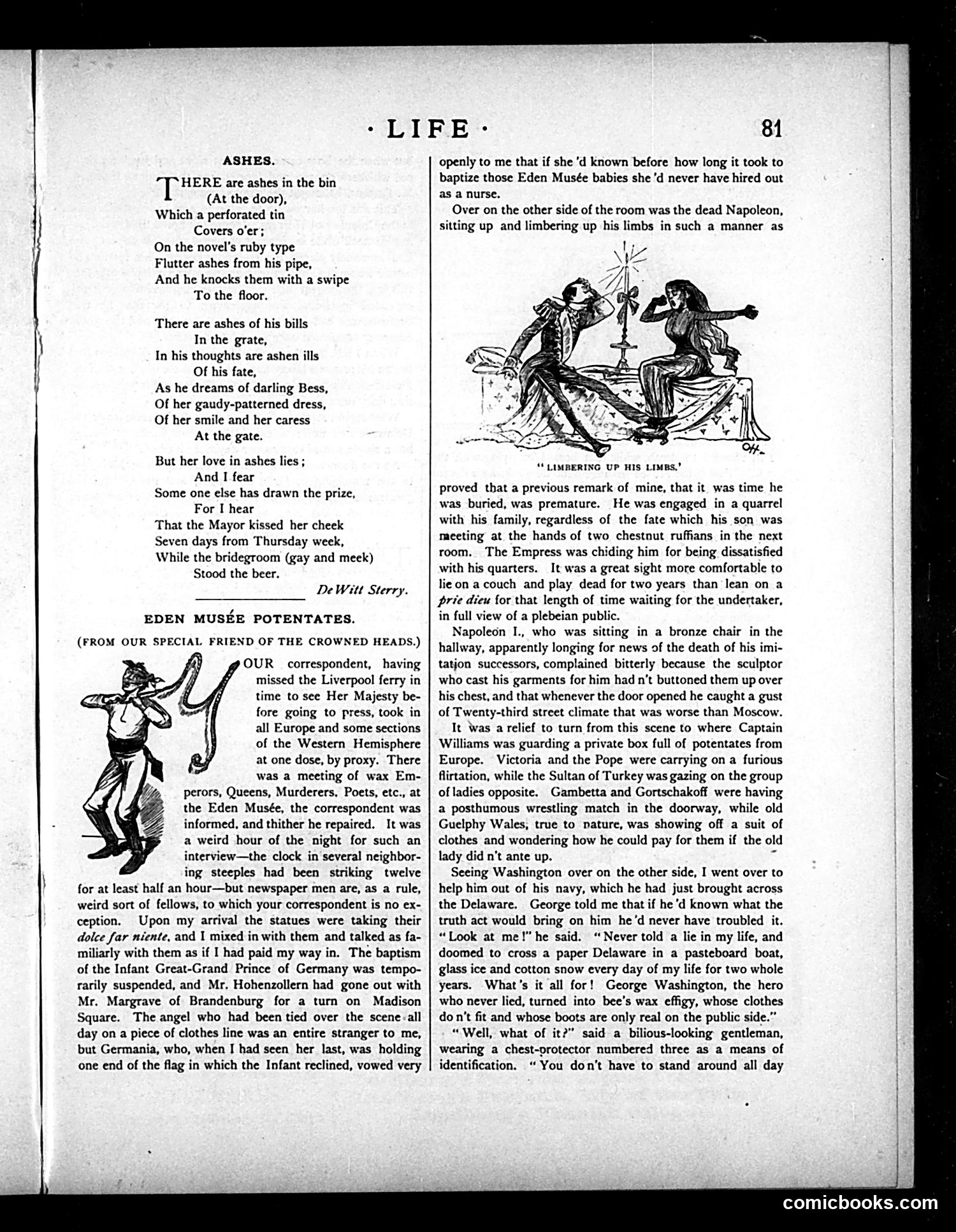
This article mocks the **Eden Musée**, a real New York wax museum featuring famous historical and contemporary figures. The satire portrays the wax figures as if they were alive and petty, revealing character flaws through their behavior. The figures referenced include **Napoleon** (complaining about ventilation and his ill-fitting clothes), **Queen Victoria** and **the Pope** (flirting frivolously), **the Sultan of Turkey**, European statesmen **Gambetta** and **Gortschakoff** (wrestling), and **George Washington**. The joke works on multiple levels: it humanizes these dignified historical/political figures by depicting them as vain, quarrelsome, and preoccupied with trivial concerns (drafts, clothing, gossip). The correspondent's casual, gossipy tone treats "crowned heads" and potentates—symbols of power and prestige—as mere wax dummies with mundane worries. This deflates their authority through humor, suggesting that beneath formal dignity, powerful people are petty and absurd.
📄 Transcribed text from this page (OCR, searchable)
Machine-transcribed from the original scan — historical spelling and the odd misread are preserved.
ASHES. HERE are ashes in the bin (At the door), Which a perforated tin Covers o'er; On the novel's ruby type Flutter ashes from his pipe, And he knocks them with a swipe To the floor. There are ashes of his bills In the grate, In his thoughts are ashen ills Of his fate, As he dreams of darling Bess, Of her gaudy-patterned dress, Of her smile and her caress At the gate. But her love in ashes lies ; And I fear Some one else has drawn the prize, For I hear That the Mayor kissed her cheek Seven days from Thursday week, While the bridegroom (gay and meek) Stood the beer. DeWitt Sterry. EDEN MUSEE POTENTATES. (FROM OUR SPECIAL FRIEND OF THE CROWNED HEADS.) g OUR correspondent, having 7 — missed the Liverpool ferry in time to see Her Majesty be- fore going to press, took in all Europe and some sections of the Western Hemisphere at one dose, by proxy. There was a meeting of wax Em- perors, Queens, Murderers. Poets, etc., at the Eden Musée, the correspondent was informed, and thither he repaired. It was a weird hour of the night for such an interview—the clock in several neighbor- ing steeples had been striking twelve for at least half an hour—but newspaper men are, as a rule, weird sort of fellows, to which your correspondent is no ex- ception. Upon my arrival the statues were taking their dolce far niente, and 1 mixed in with them and talked as fa- miliarly with them as if I had paid my way in. The baptism of the Infant Great-Grand Prince of Germany was tempo- rarily suspended, and Mr. Hohenzollern had gone out with Mr. Margrave of Brandenburg for a turn on Madison Square. The angel who had been tied over the scene-all day on a piece of clothes line was an entire stranger to me, but Germania, who, when I had seen her last, was holding one end of the flag in which the Infant reclined, vowed very LIFE: 81 openly to me that if she ‘d known before how long it took to baptize those Eden Musée babies she'd never have hired out as a nurse. Over on the other side of the room was the dead Napoleon, sitting up and limbering up his limbs in such a manner as “ LIMBERING UP HIS LIMBS,’ proved that a previous remark of mine, that it was time he was buried, was premature. He was engaged in a quarrel with his family, regardless of the fate which his son was meeting at the hands of two chestnut ruffians in the next room. The Empress was chiding him for being dissatisfied with his quarters. It was a great sight more comfortable to lieon a couch and play dead for two years than lean on a prie dieu for that length of time waiting for the undertaker, in full view of a plebeian public. Napoleon I., who was sitting in a bronze chair in the hallway, apparently longing for news of the death of his imi- tatjon successors, complained bitterly because the sculptor who cast his garments for him had n’t buttoned them up over his chest, and that whenever the door opened he caught a gust of Twenty-third street climate that was worse than Moscow. It was a relief to turn from this scene to where Captain Williams was guarding a private box full of potentates from Europe. Victoria and the Pope were carrying on a furious flirtation, while the Sultan of Turkey was gazing on the group of ladies opposite. Gambetta and Gortschakoff were having a posthumous wrestling match in the doorway, while old Guelphy Wales, true to nature, was showing off a suit of clothes and wondering how he could pay for them if the old lady did n't ante up. = Seeing Washington over on the other side, I went over to help him out of his navy, which he had just brought across the Delaware. George told me that if he’d known what the truth act would bring on him he’d never have troubled it. “Look at me!" he said. ‘Never told a lie in my life, and doomed to cross a paper Delaware in a pasteboard boat, glass ice and cotton snow every day of my life for two whole years. What’s it all for! George Washington, the hero who never lied, turned into bee’s wax effigy, whose clothes do n’t fit and whose boots are only real on the public side.” “Well, what of it?” said a bilious-looking gentleman, wearing a chest-protector numbered three as a means of identification. “You don’t have to stand around all day comicbooks.com