
Life, 1886-02-04 · page 6 of 16
Life — February 4, 1886 — page 6: what you’re looking at
What you’re looking at
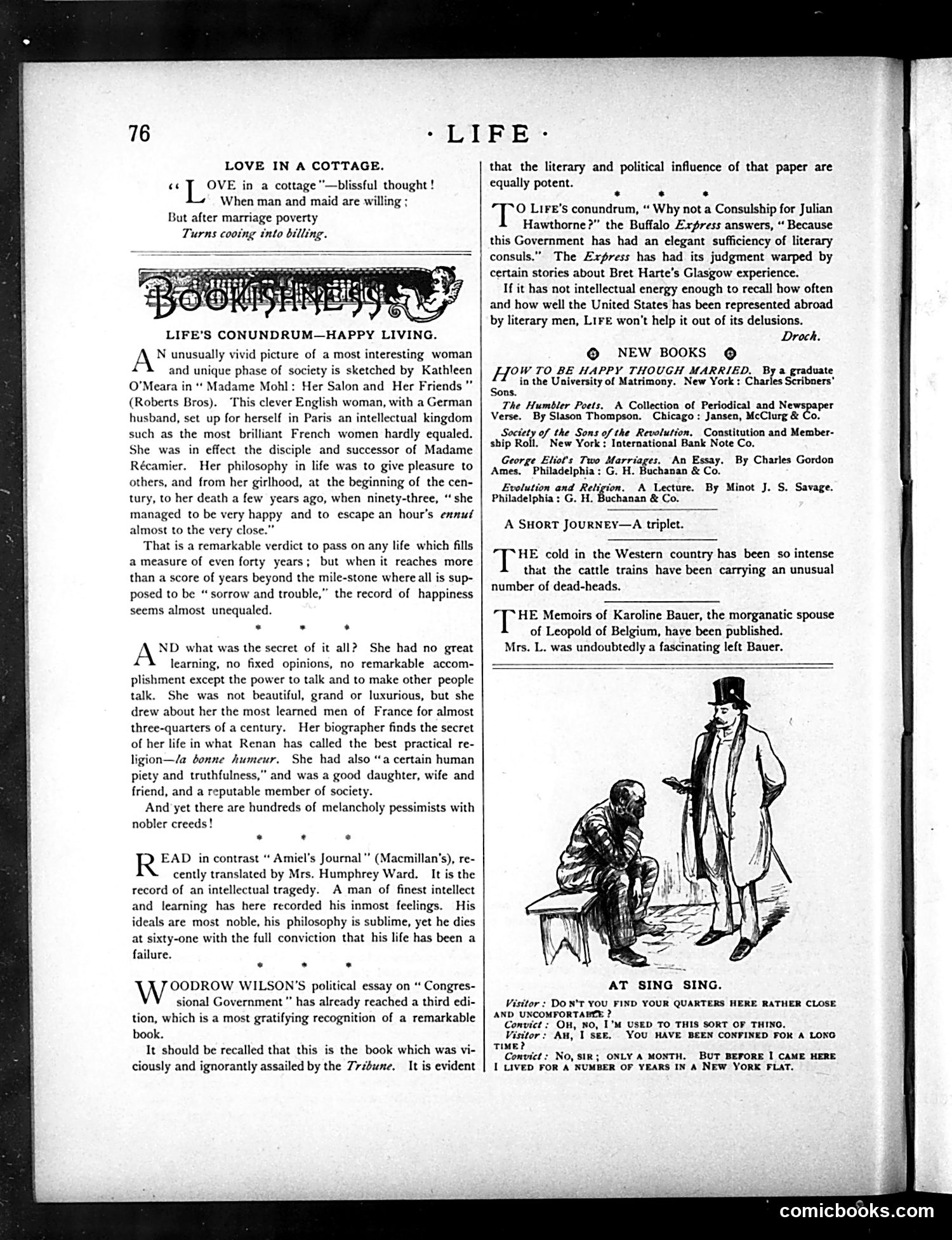
This cartoon depicts a dialogue between two men at Sing Sing prison (a major New York correctional facility). The well-dressed visitor questions the inmate about his cramped quarters, noting he's been confined for a long time. The inmate replies he lived in a similar New York flat for years before imprisonment—suggesting that poverty-level tenement housing in the city was as confining and uncomfortable as prison. The satire critiques New York's slum conditions by equating them with incarceration. The joke's dark implication is that the poor already lived in prison-like circumstances, so actual imprisonment represents little change in their living conditions. This reflects Progressive Era concerns about urban housing and class inequality.
📄 Transcribed text from this page (OCR, searchable)
Machine-transcribed from the original scan — historical spelling and the odd misread are preserved.
- LIFE: LOVE IN A COTTAGE. “ce OVE in a cottage "’—blissful thought ! When man and maid are willing ; But after marriage poverty Turns cooing into billing. LIFE’S CONUNDRUM—HAPPY LIVING. N unusually vivid picture of a most interesting woman and unique phase of society is sketched by Kathleen O'Meara in ** Madame Mohl: Her Salon and Her Friends” (Roberts Bros). jis clever English woman, with a German husband, set up for herself in Paris an intellectual kingdom such as the most brilliant French women hardly equaled. She was in effect the disciple and successor of Madame Récamier. Her philosophy in life was to give pleasure to others, and from her girlhood, at the beginning of the cen- tury, to her death a few years ago, when ninety-three, “she managed to be very happy and to escape an hour’s ennud almost to the very close.” That is a remarkable verdict to pass on any life which fills a measure of even forty years; but when it reaches more than a score of years beyond the mile-stone where all is sup- posed to be “sorrow and trouble,” the record of happiness seems almost unequaled. . . . ND what was the secret of it all? She had no great learning, no fixed opinions, no remarkable accom- plishment except the power to talk and to make other people talk. She was not beautiful, grand or luxurious, but she drew about her the most learned men of France for almost three-quarters of a century. Her biographer finds the secret of her life in what Renan has called the best practical re- ligion—/a bonne humeur. She had also “a certain human piety and truthfulness,” and was a good daughter, wife and friend, and a reputable member of society. And yet there are hundreds of melancholy pessimists with nobler creeds! * ' . EAD in contrast “ Amiel’s Journal” (Macmillan’s), re- cently translated by Mrs. Humphrey Ward. It is the record of an intellectual tragedy. A man of finest intellect and learning has here recorded his inmost feelings. His ideals are most noble, his philosophy is sublime, yet he dies at sixty-one with the full conviction that his life has been a failure. . . . OODROW WILSON'’S political essay on “ Congres- sional Government” has already reached a third edi- tion, which is a most gratifying recognition of a remarkable book. It should be recalled that this is the book which was vi- ciously and ignorantly assailed by the 7rzbune. It is evident that the literary and political influence of that paper are equally potent. . . . O LiFe’s conundrum, “ Why not a Consulship for Julian Hawthorne?” the Buffalo Express answers, “ Because this Government has had an elegant sufficiency of literary | consuls.” The Express has had its judgment warped by certain stories about Bret Harte’s Glasgow experience. If it has not intellectual energy enough to recall how often and how well the United States has been represented abroad by literary men, LIFE won't help it out of its delusions. Droch. © NEW BOOKS © (OW TO BE HAPPY THOUGH MARRIED. By a graduate in the University of Matrimony. New York: Charles Scribners’ Sons. The Humbler Poets. A Collection of Periodical and Newspaper Verse. By Slason Thompson. Chicago: Jansen, McClurg & Co. Society of the Sons of the Revolution. Constitution and Member- ship Roll. New York: International Bank Note Co. George Eliot's Two Marriages, An Essay. By Charles Gordon Ames. Philadelphia: G. H. Buchanan & Co. A Lecture. By Minot J. S. Savage. juchanan & Co. A SHORT JoURNEY—A triplet. Evolution and Religion. Philadelphia: G. H. HE cold in the Western country has been so intense that the cattle trains have been carrying an unusual number of dead-heads. ‘T HE Memoirs of Karoline Bauer, the morganatic spouse of Leopold of Belgium, have been published. Mrs. L. was undoubtedly a fascinating left Bauer. AT SING SING. Visitor : DON'T YOU FIND YOUR QUARTERS HERE RATHER CLOSE AND UNCOMFORTABTE ? Convict; OW, NO, I’M USED TO THIS SORT OF THING. Visitor: Aw, 1 see, YOU HAVE BEEN CONFINED FOX A LOXO Time? Convict: No, $1R; ONLY A MONTH. BUT BEFORE I CAME HERE I LIVED FOR A NUMBER OF YEARS IN A NEW YORK FLAT. comicbooks.com