
Life, 1886-02-04 · page 10 of 16
Life — February 4, 1886 — page 10: what you’re looking at
What you’re looking at
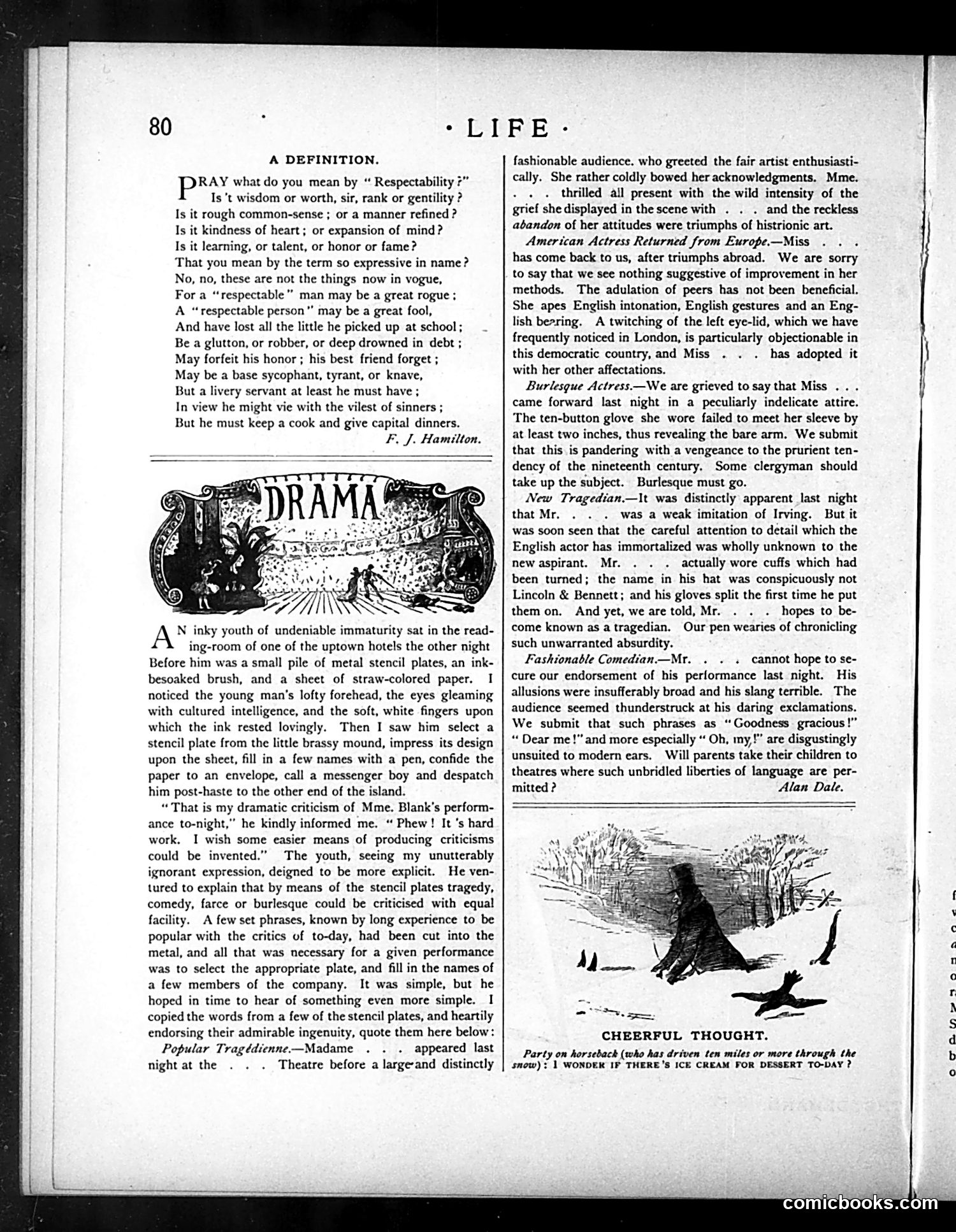
This page satirizes lazy theatrical criticism through two pieces: **"A Definition" (poem by F.J. Hamilton):** A sharp critique of "respectability" as a social concept. The author argues that true respectability—wisdom, honor, talent—has been replaced by mere *appearances*: owning servants, employing cooks, hosting fancy dinners. A person can be corrupt, foolish, or immoral but still achieve "respectability" through conspicuous consumption and social performance. This mocks 19th-century class pretension. **"Drama" section:** Satirizes theatrical critics who use standardized stencil plates with pre-written phrases to review performances without actually thinking. The critic simply fills in actress names and theatre details into templates praising or condemning performances identically. The quoted examples parody actual reviews—one fawning, one snobbish about an American actress "aping" English mannerisms. The satire targets both theatrical criticism's formulaic laziness and broader social hypocrisy where appearance matters more than substance.
📄 Transcribed text from this page (OCR, searchable)
Machine-transcribed from the original scan — historical spelling and the odd misread are preserved.
*LIFE- A DEFINITION. RAY what do you mean by “ Respectability 7” Is 't wisdom or worth, sir, rank or gentility ? Is it rough common-sense ; or a manner refined ? Is it kindness of heart; or expansion of mind? Is it learning, or talent, or honor or fame? That you mean by the term so expressive in name? No, no, these are not the things now in vogue, For a “respectable” man may be a great rogue ; A “respectable person" may be a great fool, And have lost all the little he picked up at school ; Be a glutton, or robber, or deep drowned in debt ; May forfeit his honor ; his best friend forget ; May be a base sycophant, tyrant, or knave, But a livery servant at least he must have ; In view he might vie with the vilest of sinners ; But he must keep a cook and give capital dinners. F. J. Hamilton. N inky youth of undeniable immaturity sat in the read- ing-room of one of the uptown hotels the other night Before him was a small pile of metal stencil plates, an ink- besoaked brush, and a sheet of straw-colored paper. I noticed the young man’s lofty forehead, the eyes gleaming with cultured intelligence, and the soft, white fingers upon which the ink rested lovingly. Then I saw him select a stencil plate from the little brassy mound, impress its design upon the sheet, fill in a few names with a pen, confide the paper to an envelope, call a messenger boy and despatch him post-haste to the other end of the island. “That is my dramatic criticism of Mme. Blank’s perform- ance to-night,” he kindly informed me. “ Phew! It 's hard work. I wish some easier means of producing criticisms could be invented.” The youth, seeing my unutterably ignorant expression, deigned to be more explicit. He ven- tured to explain that by means of the stencil plates tragedy, comedy, farce or burlesque could be criticised with equal facility. A few set phrases, known by long experience to be popular with the critics of to-day, had been cut into the metal, and all that was necessary for a given performance was to select the appropriate plate, and fill in the names of a few members of the company. It was simple, but he hoped in time to hear of something even more simple. I copied the words from a few of the stencil plates, and heartily endorsing their admirable ingenuity, quote them here below: Popular Tragédienne—Madame appeared last night at the Theatre before a largeand distinctly fashionable audience. who greeted the fair artist enthusiasti- cally. She rather coldly bowed her acknowledgments. Mme. thrilled all present with the wild intensity of the grief she displayed in the scene with . . . and the reckless abandon of her attitudes were triumphs of histrionic art. American Actress Returned from Europe.—Miss has come back to us, after triumphs abroad. We are sorry to say that we see nothing suggestive of improvement in her methods. The adulation of peers has not been beneficial. She apes English intonation, English gestures and an Eng- lish bearing. A twitching of the left eye-lid, which we have frequently noticed in London, is particularly objectionable in this democratic country, and Miss has adopted it with her other affectations. Burlesque Actress.—We are grieved to say that Miss . . . came forward last night in a peculiarly indelicate attire. The ten-button glove she wore failed to meet her sleeve by at least two inches, thus revealing the bare arm. We submit that this is pandering with a vengeance to the prurient ten- dency of the nineteenth century. Some clergyman should take up the subject. Burlesque must go. New Tragedian.—\t was distinctly apparent last night that Mr. . . . was a weak imitation of Irving. But it was soon seen that the careful attention to detail which the English actor has immortalized was wholly unknown to the new aspirant. Mr. actually wore cuffs which had been turned; the name in his hat was conspicuously not Lincoln & Bennett; and his gloves split the first time he put them on. And yet, we are told, Mr. hopes to be- come known as a tragedian. Our pen wearies of chronicling such unwarranted absurdity. Fashionable Comedtan.—Mr. cannot hope to se- cure our endorsement of his performance last night. His allusions were insufferably broad and his slang terrible. The audience seemed thunderstruck at his daring exclamations. We submit that such phrases as “Goodness gracious!” “ Dear me!” and more especially “Oh, my,!” are disgustingly unsuited to modern ears. Will parents take their children to theatres where such unbridled liberties of language are per- Alan Dale. CHEERFUL THOUGHT. Party on horseback (who has driven ten miles or more through the snow): 1 WONDER IF THERE'S ICE CREAM FOR DESSERT TO-DAY ? ele Otinite atatns« a...