
A complete issue · 16 pages · 1886
Life — January 21, 1886
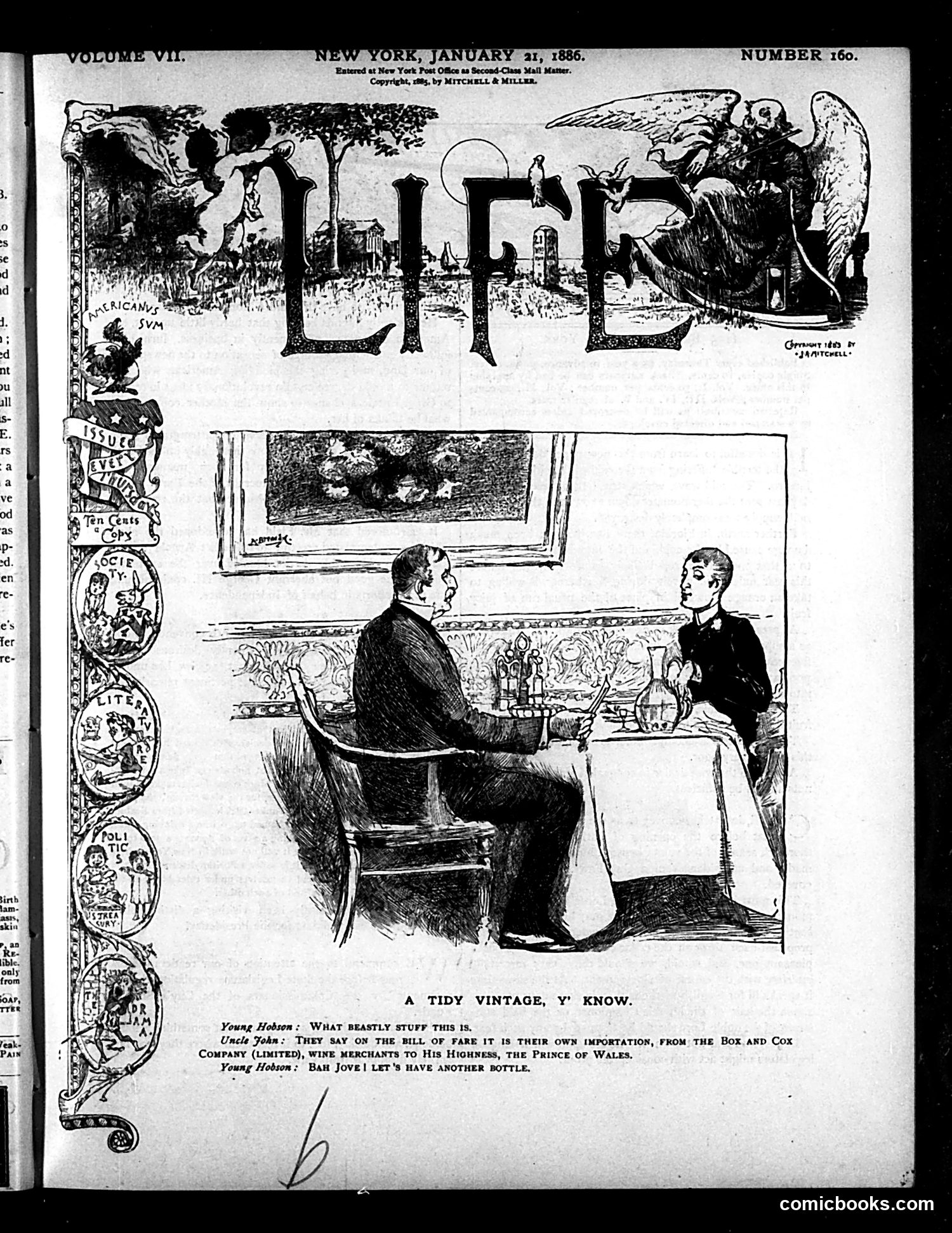
This satirical cartoon depicts two men at a restaurant table. The dialogue reveals the joke: Young Hobson complains about "beastly stuff" on the bill of fare, while Uncle John responds that items are "in their own importation, from the Box and Cox Company (Limited), Merchants to His Highness, the Prince of Wales." Young Hobson then suggests having "another bottle." The satire targets Victorian-era social pretension and name-dropping. By attributing ordinary restaurant fare to suppliers of the Prince of Wales, the cartoon mocks how merchants and establishments inflated their status through royal patronage. The punch line—ordering more wine despite complaints—suggests the young man cares more about appearing sophisticated than actual quality.
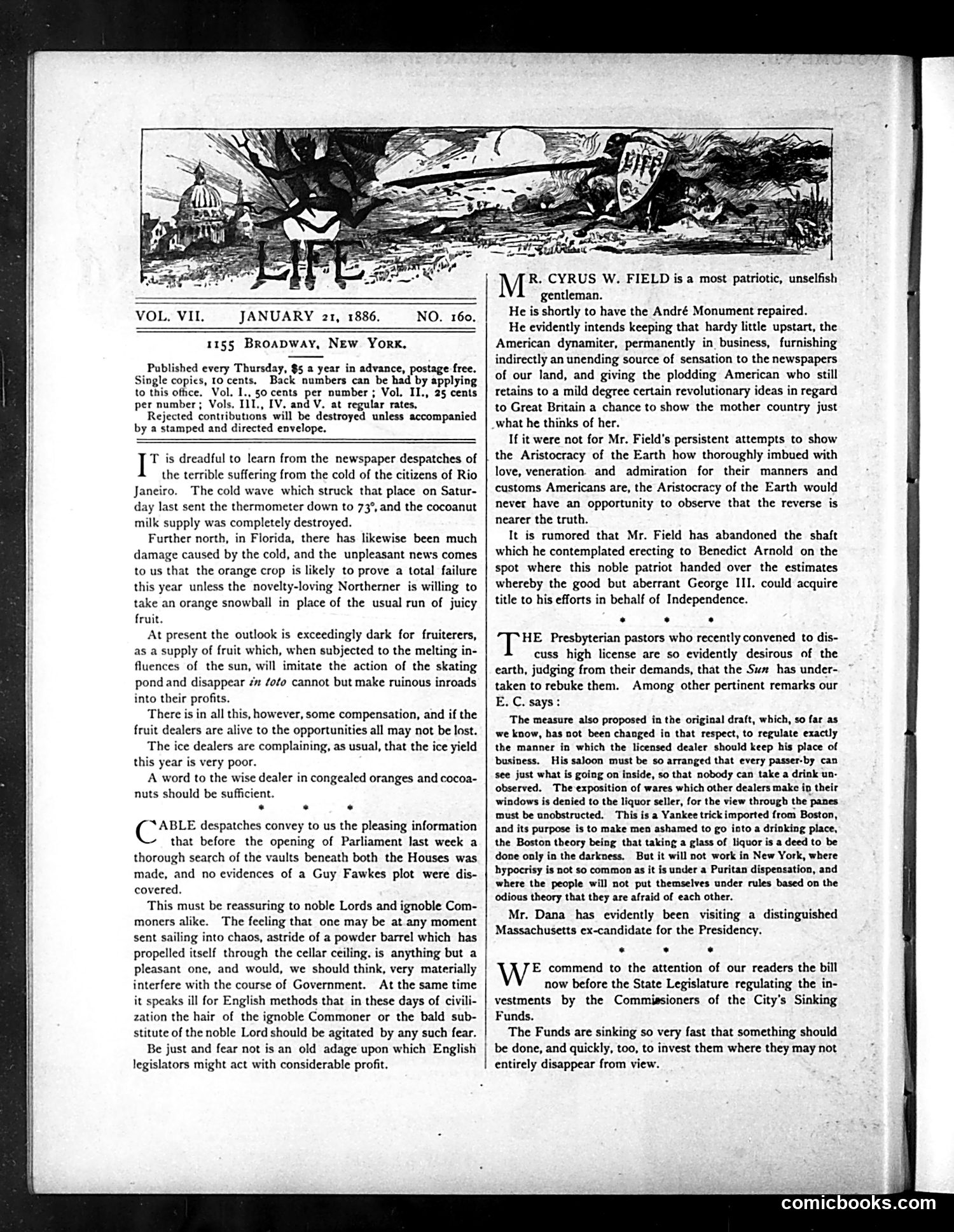
The top illustration appears to be a decorative header rather than political commentary—showing a nighttime landscape with moon and buildings. The text discusses **Cyrus W. Field**, praised as a patriotic gentleman planning to repair the André Monument. The piece satirizes the "Aristocracy of the Earth," suggesting Field's efforts reveal that American customs and democratic values are morally superior to British aristocratic pretension. Additional articles address Presbyterian pastors opposing liquor licenses and Massachusetts politics regarding Dana as a presidential candidate. The satire's point: Field's patriotic monument work demonstrates American virtue compared to corrupt European elitism—a common 19th-century American nationalist theme contrasting democratic values with aristocratic decadence.
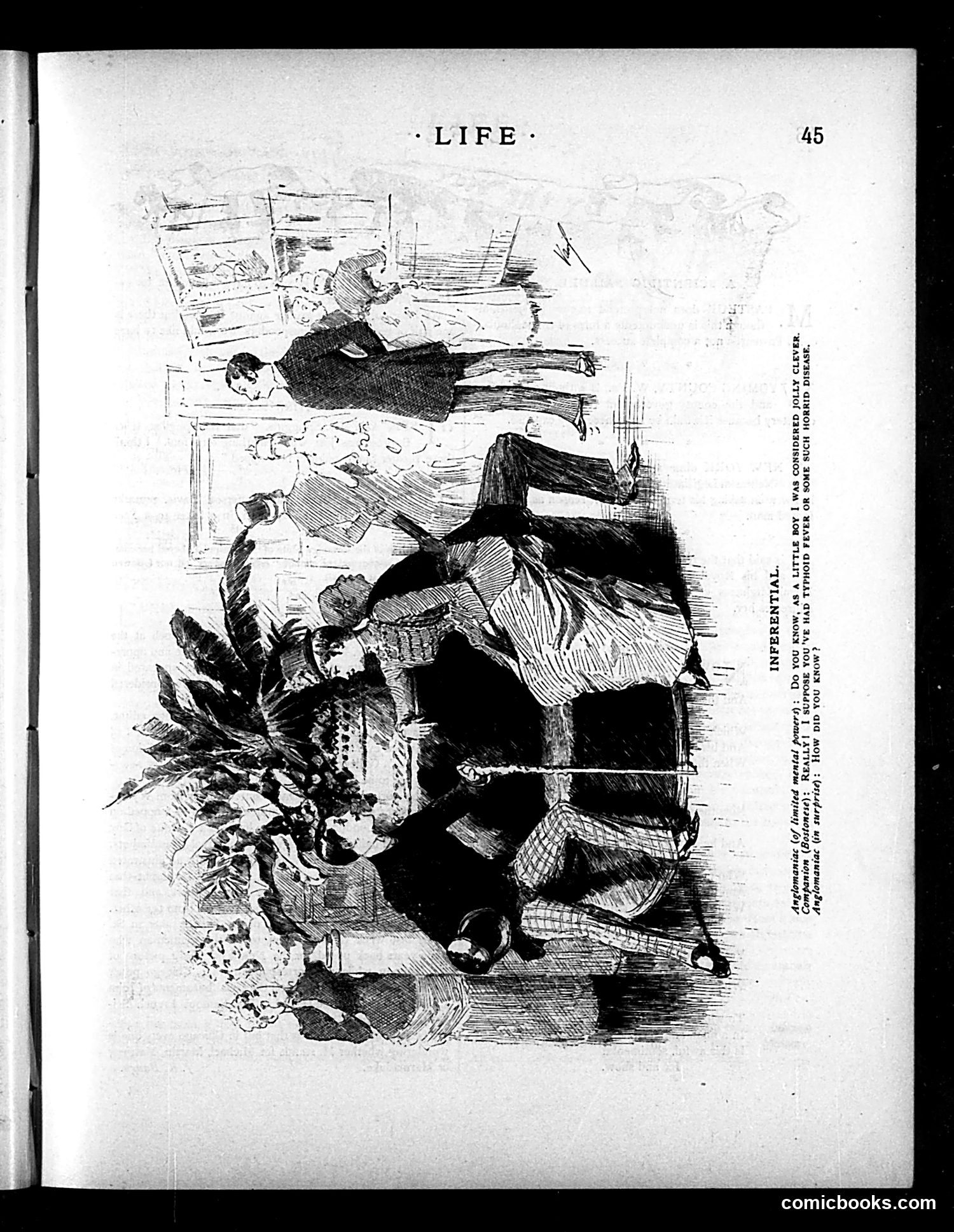
This appears to be a satirical illustration titled "IMPERIENTIAL" (or similar), though the OCR text is unclear. The sketch depicts figures in what seems to be a domestic or office setting, shown sideways/rotated on the page. The image quality and orientation make specific identification difficult, but the style suggests early 20th-century political satire. The composition includes multiple figures in period clothing arranged in a seemingly chaotic or absurd scene, typical of Life magazine's approach to mocking political figures or social situations. Without clearer text or caption legibility, I cannot confidently identify the specific political figures, events, or satirical point being made. The page appears to be editorial illustration rather than advertising, but the precise context and meaning remain unclear from this reproduction.
This page contains satirical commentary and a humorous poem rather than traditional political cartoons. The decorative header shows various animals in silhouette. **"A Scientific Failure"** mocks Louis Pasteur, the renowned French scientist, suggesting his rabies cure doesn't work completely and questioning his competence. **The "Snow Joke"** is a lengthy poem about winter and sledding, featuring wordplay and physical comedy typical of period humor. The right column contains gossipy items about public figures: John L. Sullivan (boxer known for expensive tastes), the Prince of Wales, and references to Pasteur again—this time sarcastically comparing him to famous rogues and criminals, questioning whether he's actually a "scientific gentleman." The final joke plays on confusion between "M. Pasteur" and similar-sounding names in Chicago, creating a pun on identity. The overall tone is irreverent mockery of scientific pretension and celebrity figures.
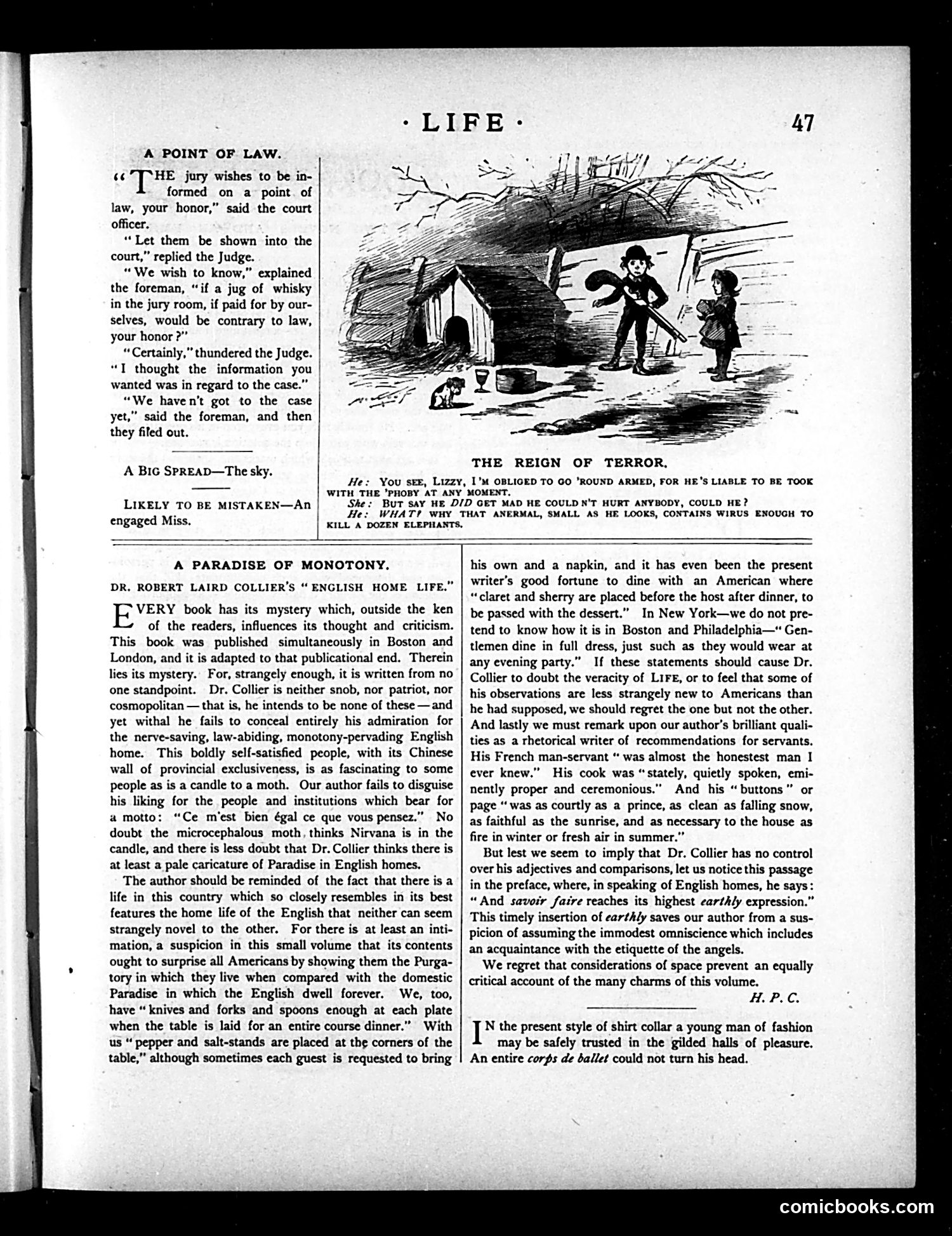
This cartoon satirizes child discipline methods of the era. The caption indicates a child (Lizzy) threatens violence with a toy gun against an adult (likely a servant or caretaker), creating comedic role-reversal: the child claims immunity from punishment because the weapon "contains wimps enough to kill a dozen elephants." The joke relies on Victorian anxiety about children's toys and unsupervised play. The "reign of terror" refers to the child's dominance over household adults—a reversal of expected authority. The cartoon mocks contemporary concerns about toy guns' corrupting influence on youth behavior and parental inability to maintain discipline. The surrounding text discusses English home life and social observations, providing context for this domestic satire about changing family hierarchies.
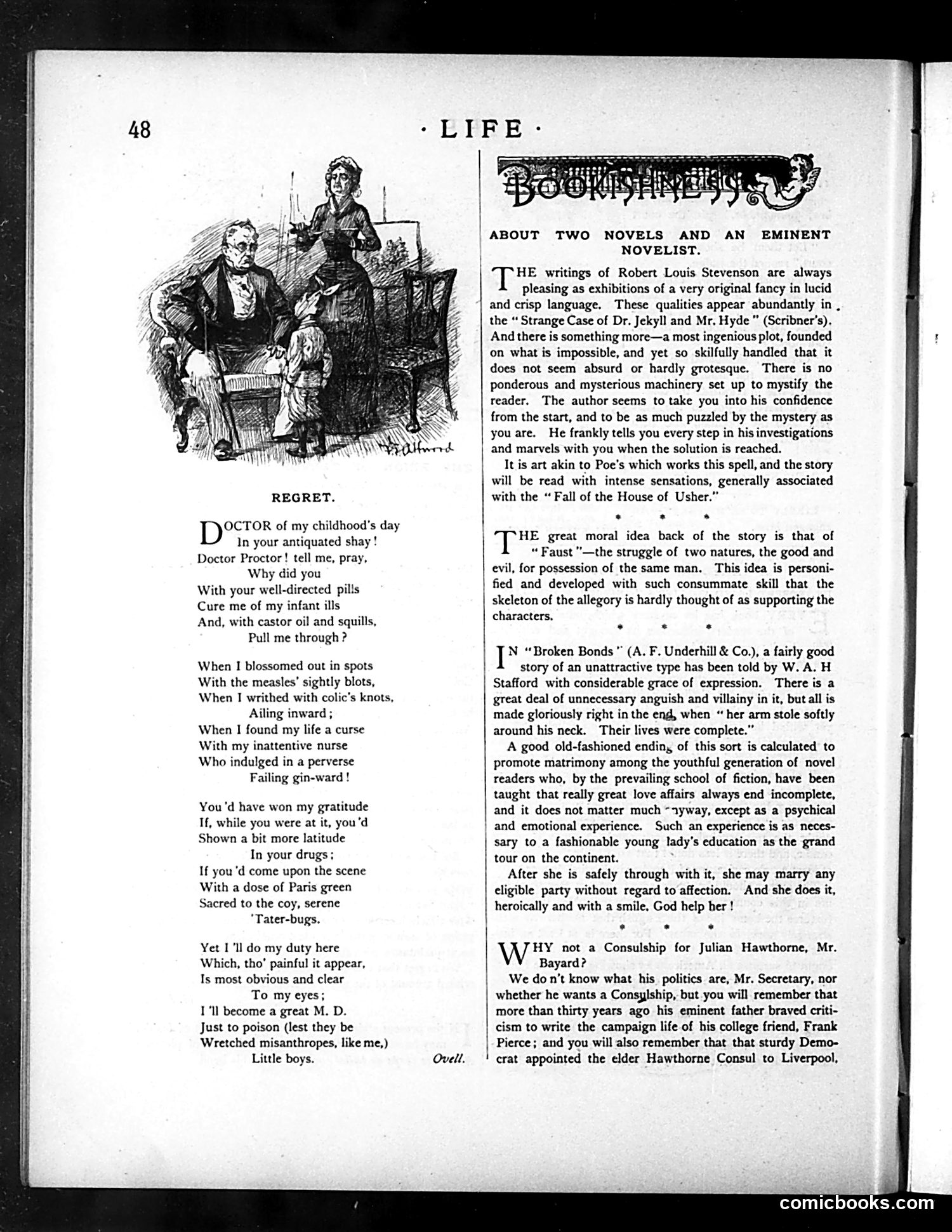
The left side features a satirical poem titled "Regret" by Orell, illustrated with a sketch showing two figures in what appears to be a doctor's office or study. The poem mockingly addresses a doctor from the speaker's childhood, expressing ironic gratitude for medical treatments that supposedly failed—the speaker lists childhood ailments (measles, colic) and a "perverse" nurse, then sarcastically suggests becoming a "great M.D." himself to "poison" people like the doctor did. The humor relies on mock-heroic complaint about incompetent medical care—a common Victorian satirical target. The accompanying sketch shows period dress and interior details consistent with 19th-century medical practice, suggesting this critiques contemporary medical practitioners through exaggerated complaint. The right side discusses literary reviews, not political satire.
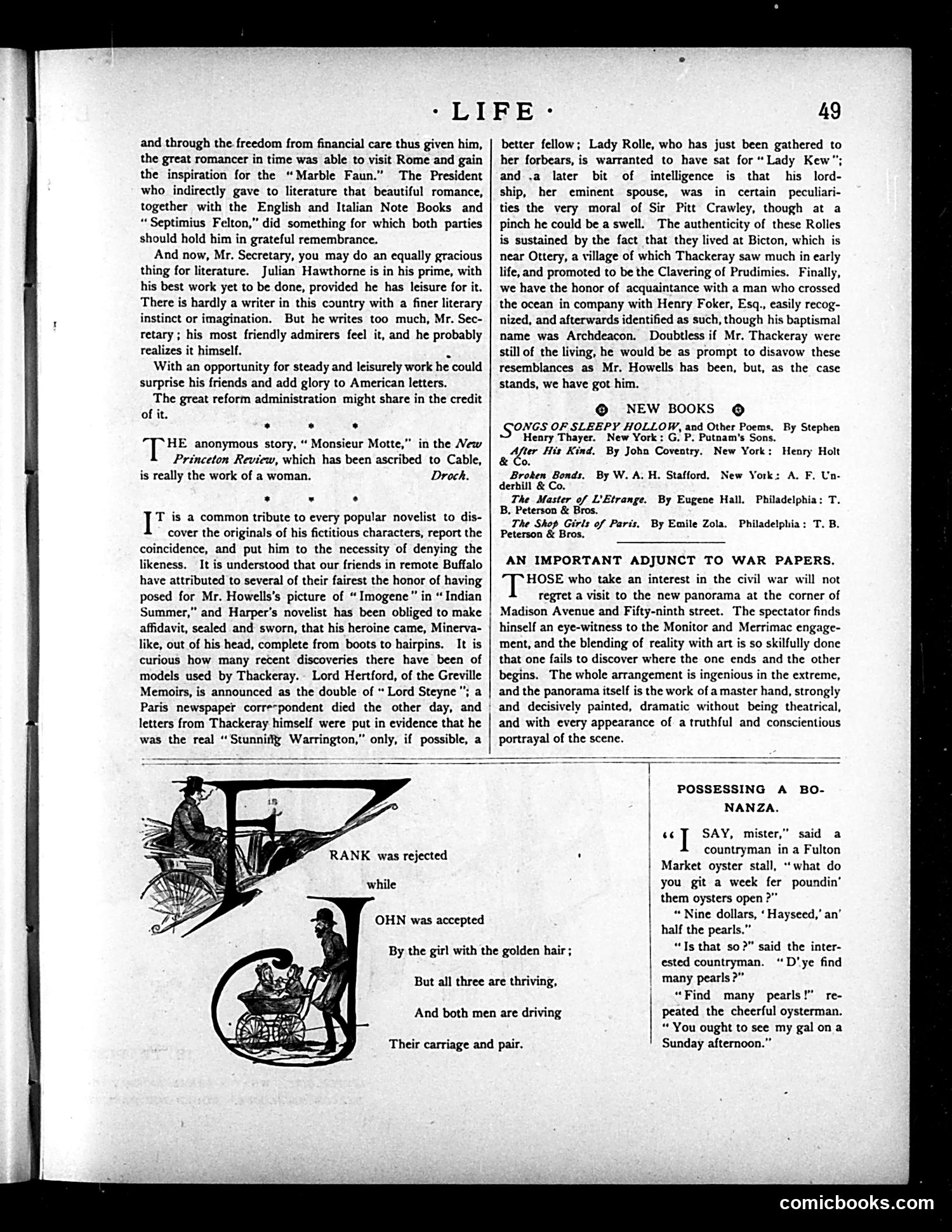
The page contains two main satirical illustrations with accompanying verse. The cartoons appear to use the names "Rank" and "John" to comment on acceptance and rejection—likely references to social or political figures of the period, though the specific identities are unclear without additional context. The verse contrasts "Rank" being "rejected" against "John" being "accepted / By the girl with the golden hair," suggesting romantic or political competition. The illustrations show figures in period carriages and domestic scenes. The bottom right contains an unrelated anecdote ("Possessing a Bo-Name") about oyster pricing at a Fulton Market stall—a humorous dialogue between a countryman and oysterman about pearl-finding. Without clearer historical context, the specific satirical targets remain uncertain.
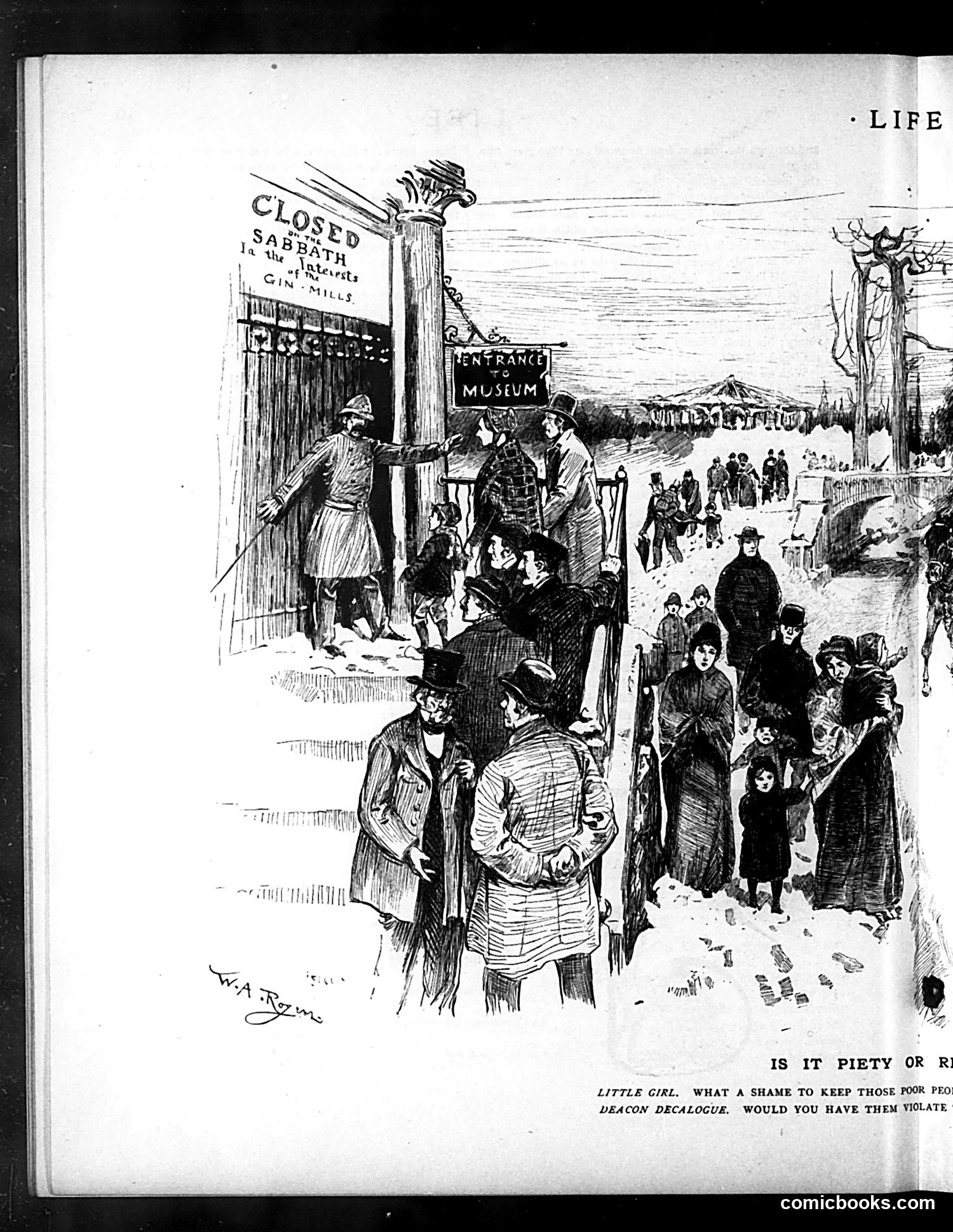
This is a satirical cartoon criticizing the closing of establishments on the Sabbath (Sunday). The sign reads "CLOSED SABBATH" at what appears to be an entertainment venue (possibly gin mills or similar businesses), with a "MUSEUM" sign also visible. The cartoon depicts poor people—women, children, and working-class individuals—crowded outside, apparently turned away from these establishments. The accompanying text ("LITTLE GIRL. WHAT A SHAME TO KEEP THOSE POOR PEOPLE...") suggests the satire targets religious hypocrisy: closing businesses supposedly for moral/religious reasons while effectively punishing the poor who had limited leisure time. The image critiques how Sabbath-closing laws, often justified as pious, actually restricted access to affordable entertainment and recreation for working-class families who had Sundays off.
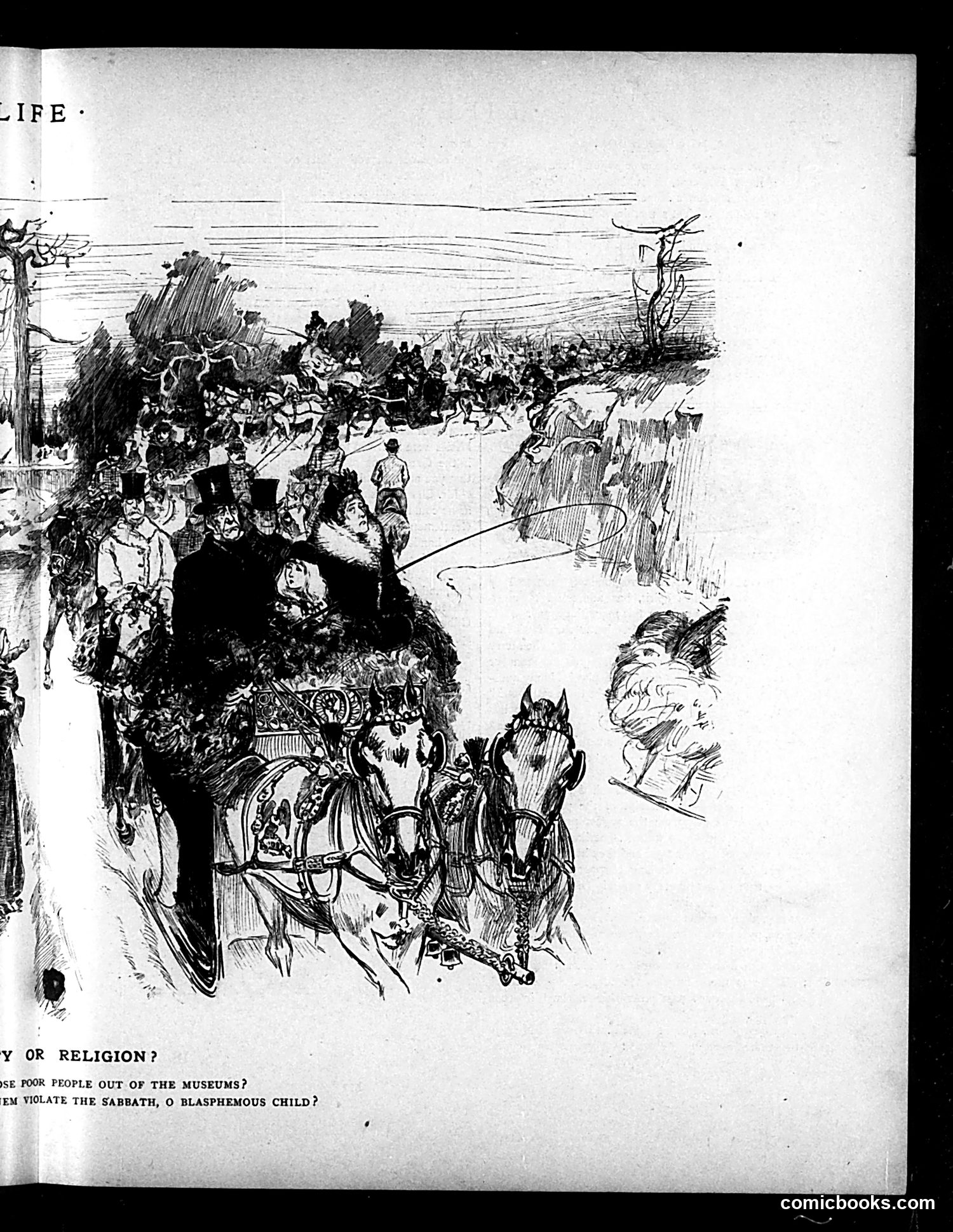
This appears to be a satirical illustration from *Life* magazine depicting a luxurious carriage procession. The visible text fragments reference religious controversy: "RELIGION?" and questions about "POOR PEOPLE OUT OF THE MUSEUMS?" and "VIOLATE THE SABBATH, O BLASPHEMOUS CHILD?" The cartoon seems to critique wealth inequality and hypocrisy. The ornate, heavily-decorated carriage with well-dressed passengers contrasts sharply with the common people visible in the background. The religious language suggests the satire targets the wealthy's selective piety—they observe religious rules while excluding poor people from museums and cultural institutions. The artistic style and composition emphasize the visual disparity between the privileged few in their elaborate conveyance and the masses around them, mocking what *Life* perceived as sanctimonious class divisions masked by religious propriety.
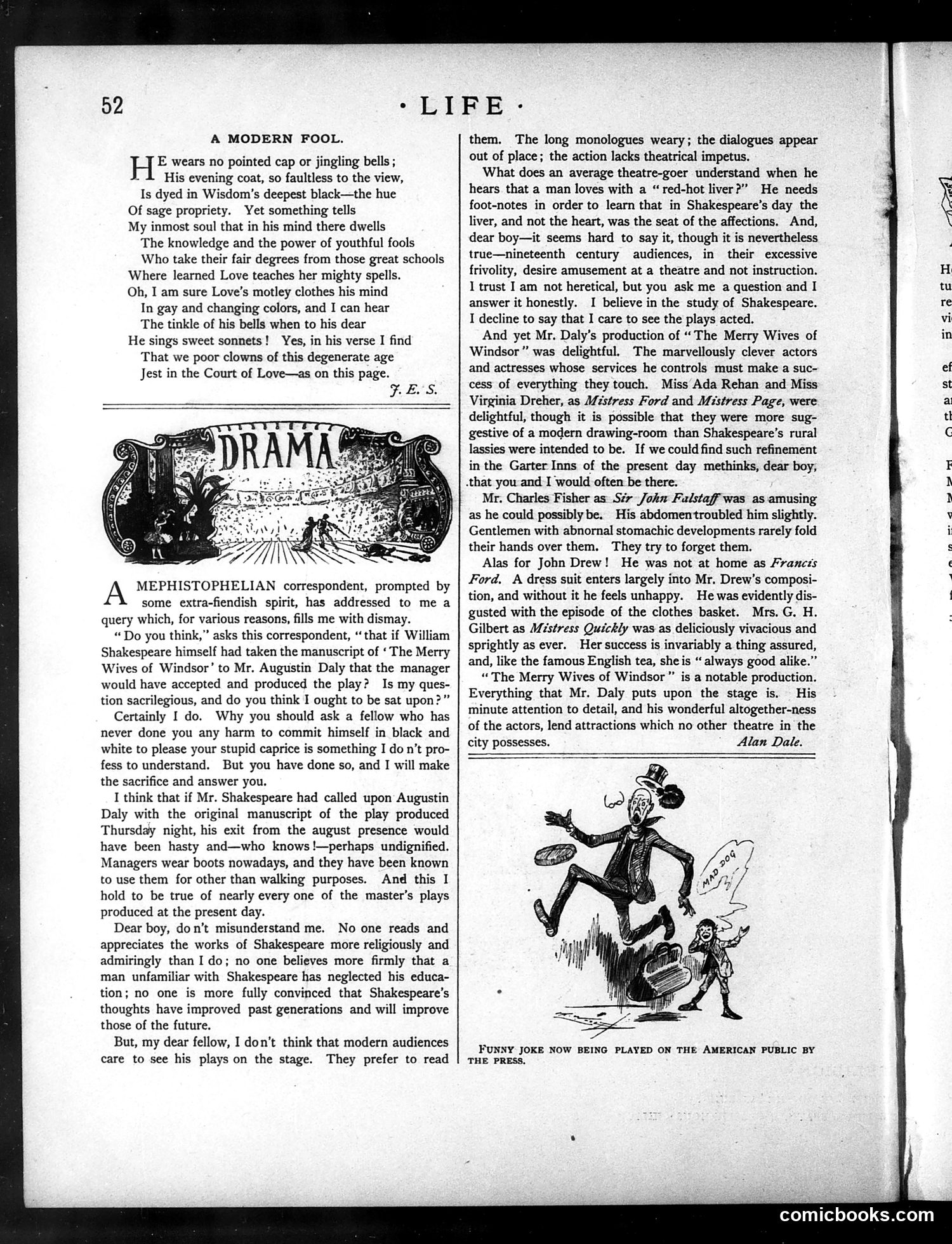
This page contains literary criticism of **Augustin Daly's theater production** of Shakespeare's "The Merry Wives of Windsor." The main cartoon (lower half) appears to show a comic figure juggling or performing—likely representing the contrast between Shakespeare's serious art and modern theatrical entertainment. The essay's central argument: while Shakespeare deserves scholarly respect, **modern 19th-century audiences find his plays tedious on stage**. The author criticizes lengthy monologues and archaic language (citing the example of "red-hot liver" needing footnotes to explain Renaissance medicine). Audiences prefer amusement to instruction. However, the author praises **Daly's specific production**, crediting talented actresses like Ada Rehan and Virginia Dreher, though noting they modernize the rural characters into refined drawing-room ladies rather than country inn-workers. The opening poem mocks a "modern fool" who hides romantic foolishness beneath respectable appearance—likely commenting on theatrical pretension or audiences' conflicted attitudes toward Shakespeare.
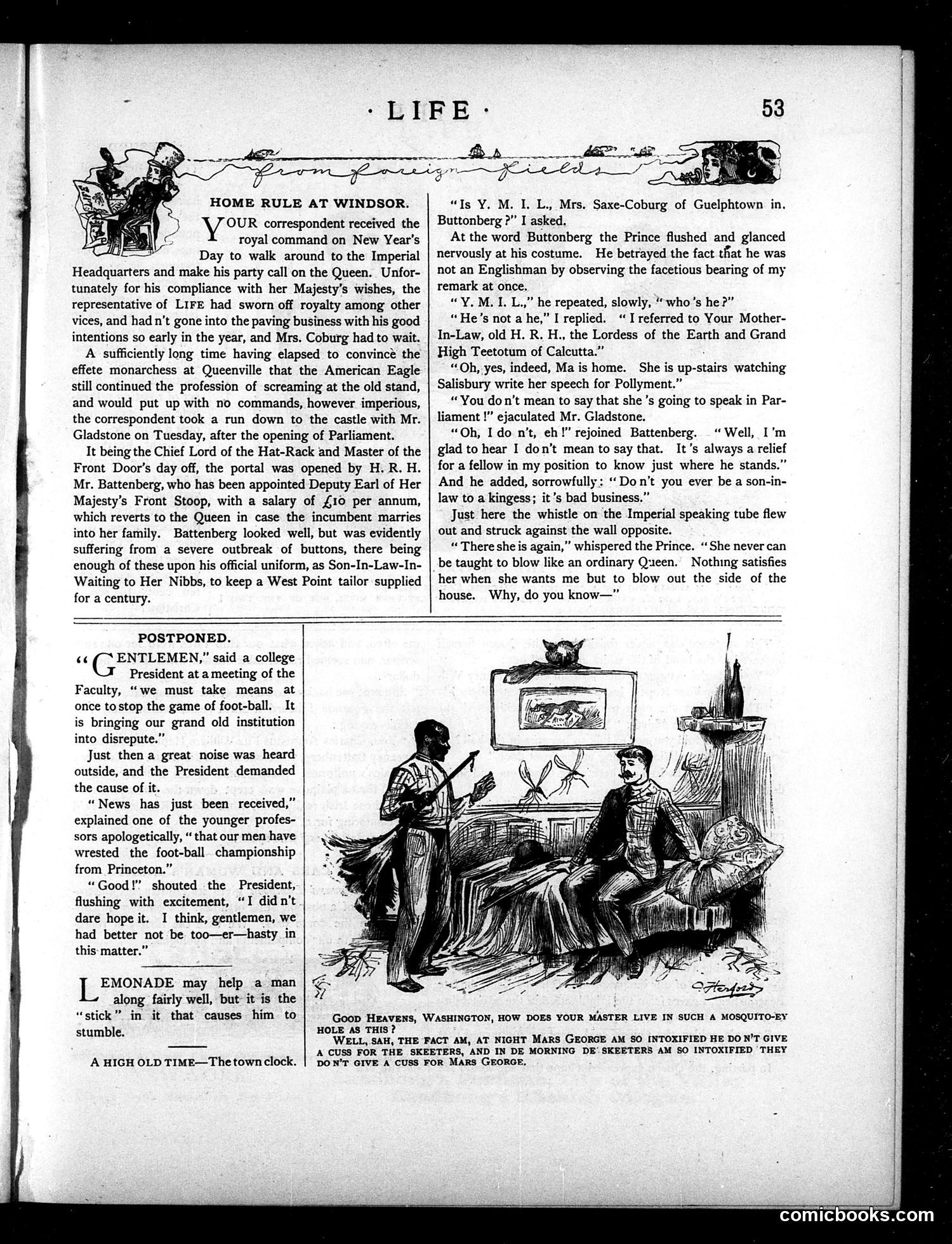
The main article mocks Queen Victoria ("Mrs. Coburg," "Your Nibbs") and her son-in-law Prince Henry of Battenberg, the correspondent's reluctant host. The satire targets: **The figures:** Victoria as an imperious monarch; Battenberg as a bumbling, overly-decorated foreign prince uncomfortable with American irreverence. **The jokes:** Renaming him "Buttonberg" for his excessive uniform buttons; calling Victoria "Lordess of the Earth"; suggesting she'll speak in Parliament; mocking his subservient "son-in-law" position via a speaking tube ("whistle"). **The point:** American satirical superiority over British monarchy—the correspondent refuses the Queen's summons, implying democratic American independence trumps royal command. The humor emphasizes British stuffiness versus American frankness. The secondary cartoons are unrelated jokes about college football hypocrisy and a racist dialect joke about a slave's master.
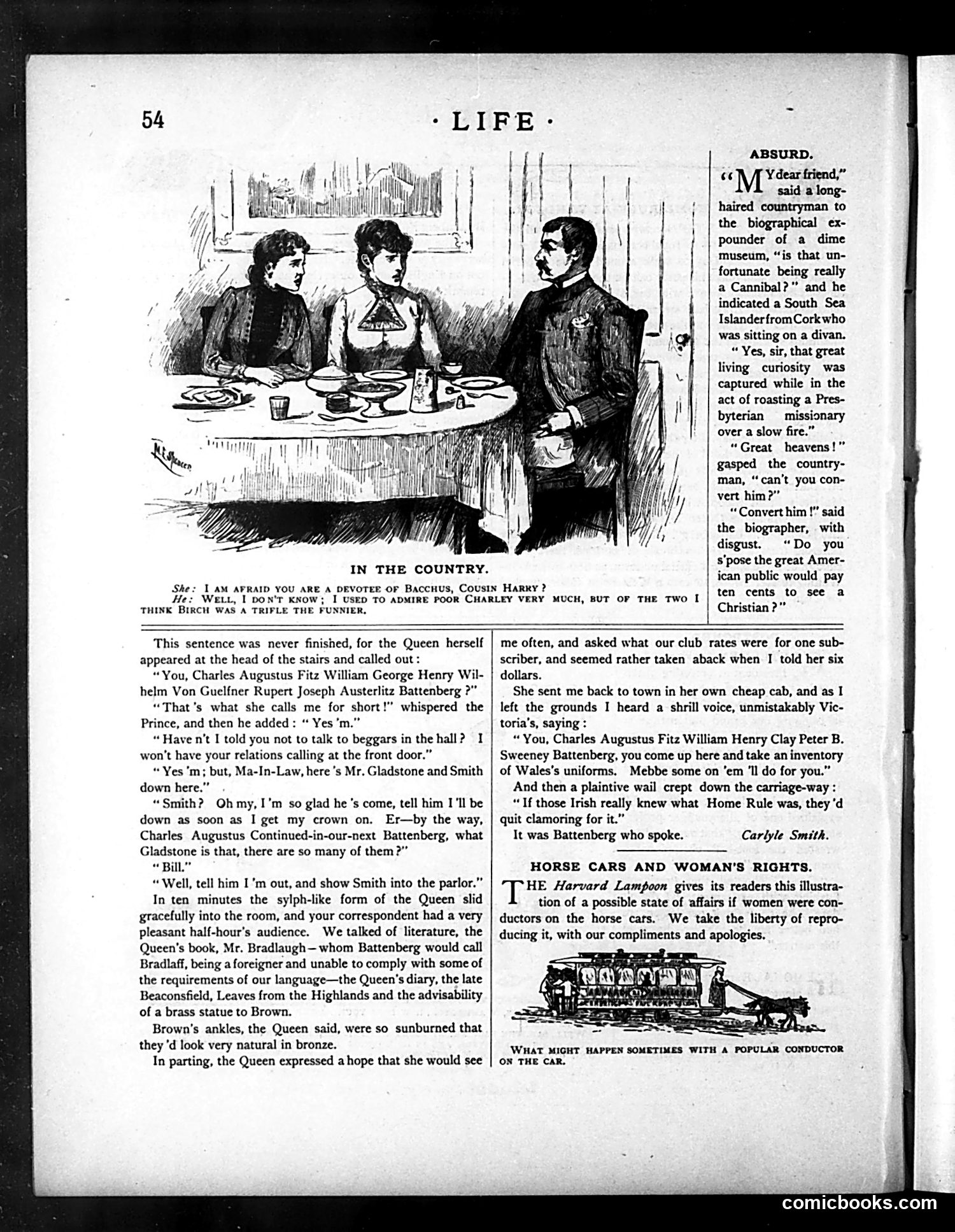
**Main Cartoon ("In the Country"):** A man and woman at dinner discuss whether their cousin Harry is a "devotee of Bacchus" (god of wine/drinking). The joke plays on classical allusion—the man deflects by claiming he admired "poor Charley" more, then adds "Birch was a trifle the funnier." This likely references competing figures of ridicule from the period, though the specific identities are unclear today. **"Absurd" Section:** A satirical anecdote mocking American entertainment and missionary zeal. A countryman asks a dime museum exhibitor whether a "cannibal" from the South Sea Islands can be converted to Christianity. The exhibitor replies that conversion would ruin him commercially—the American public won't pay ten cents to see a Christian. The satire targets both sensationalist entertainment and the hypocrisy of Christian missionary work. **Context:** This appears to be Victorian-era American satire (likely 1880s-90s based on references to Gladstone and Queen Victoria's husband).
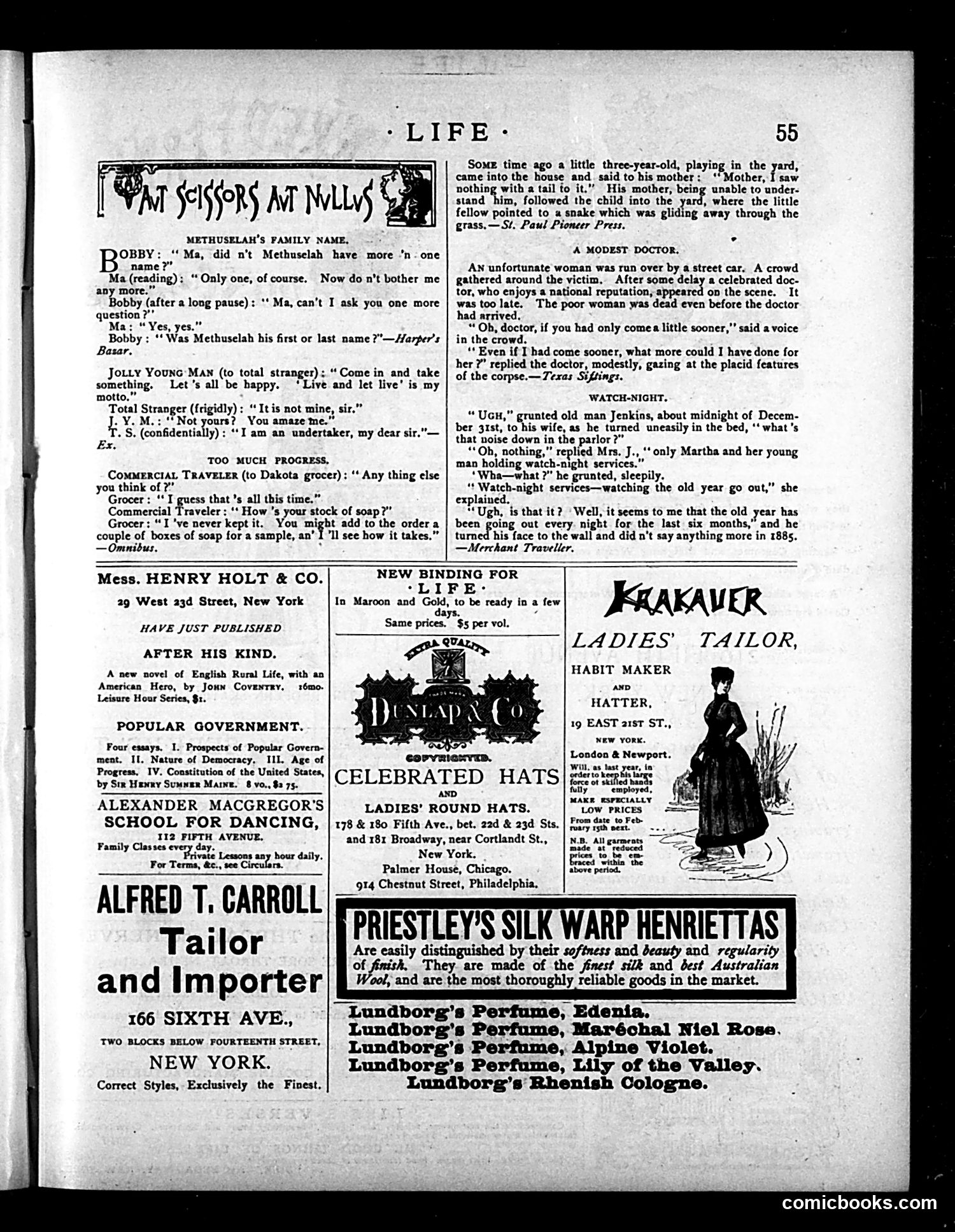
This page contains five brief humorous anecdotes typical of late-19th-century satirical magazines: 1. **"Methuselah's Family Name"**: A child's logical question exposes parental impatience—the boy asks whether Methuselah had a first or last name, revealing the absurdity of assuming a biblical figure had only one name. 2. **"Too Much Progress"**: A Dakota grocer refuses to stock soap, claiming he'll "see how it takes" with free samples first. The joke satirizes rural skepticism toward commercial progress and modern business practices. 3. **"A Modest Doctor"**: A celebrated physician arrives too late to save a street-car victim, then smugly insists he couldn't have helped anyway. The satire targets medical pretension and professional arrogance. 4. **"Watch-Night"**: An elderly man misunderstands "watch-night services" (New Year's Eve religious observances) as his daughter courting, grumbling that the old year "goes out every night." The remainder is advertising for books, tailors, dancing schools, and perfumes—typical of period magazines.
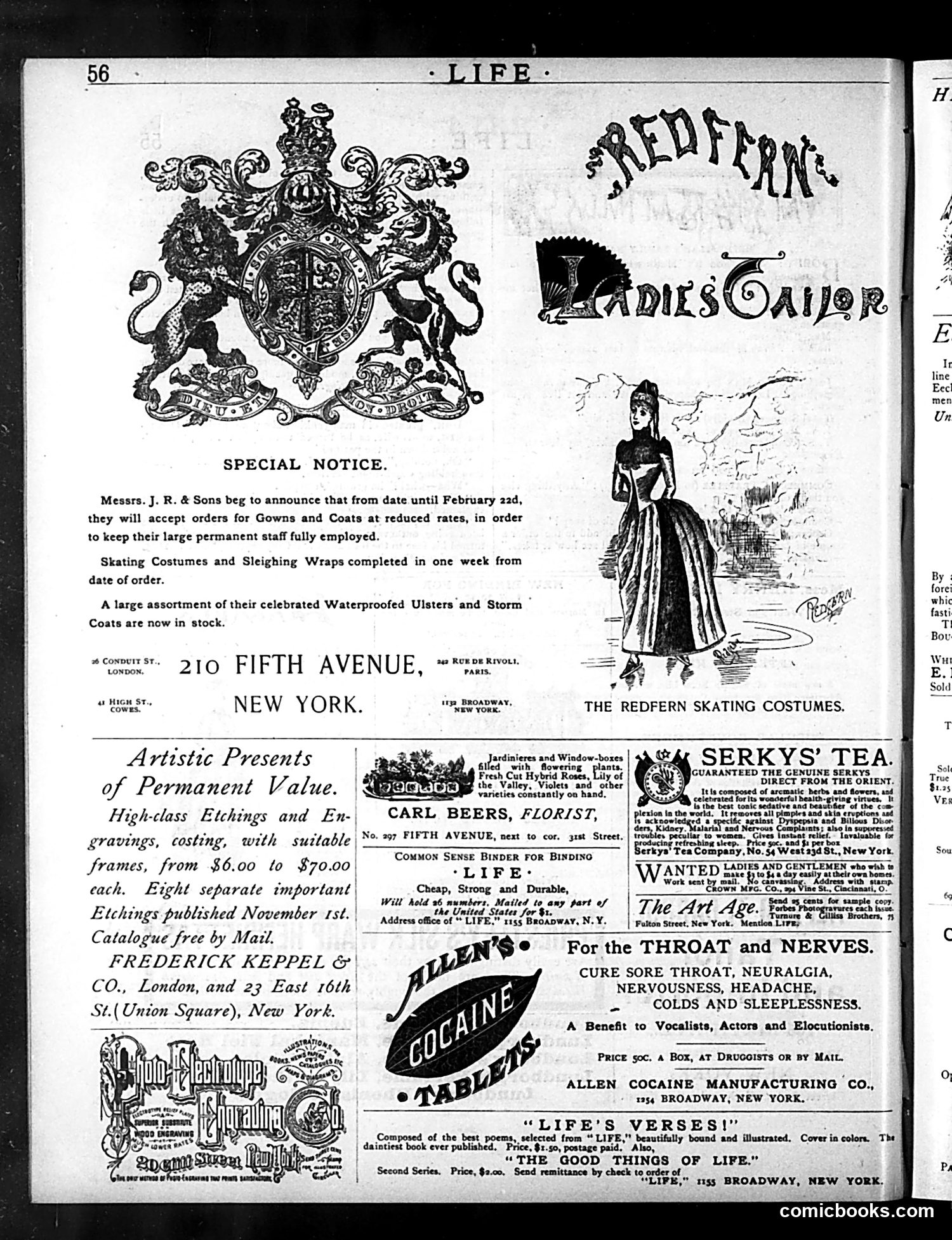
This is primarily an **advertising page** rather than satirical content. The page features: **Main Content:** - Advertisement for Redfern skating costumes (top right), showing a woman in Victorian-era ice skating attire - Special notice from J.R. & Sons announcing discounted gowns and coats until February 22nd to maintain their staff employment **Additional Advertisements:** - Carl Beers Florist - Frederick Keppel & Co. (fine etchings and engravings) - Allen's Cocaine Tablets (for sore throat, neuralgia, nervousness) - Serkys Tea - Common Sense Binder for binding - Life's Verses poetry books **Historical Context:** The cocaine advertisement is notably striking to modern readers—this reflects the pre-1914 era when cocaine was legally sold as a patent medicine before federal regulation. The page otherwise documents upper-class consumer goods and services typical of late-19th-century American life. No political satire or cartoon commentary is evident on this page.
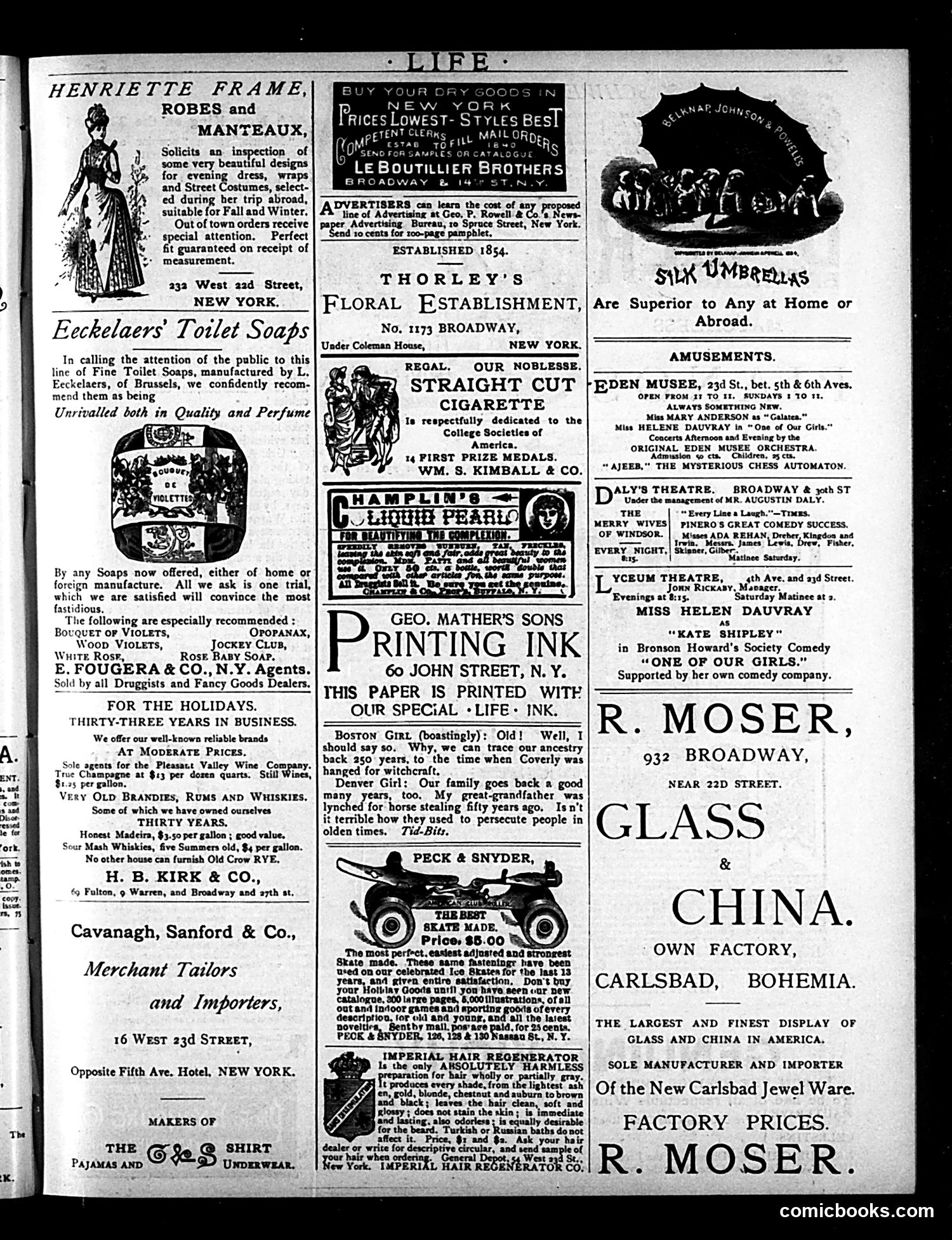
This is primarily an **advertising page** from Life magazine, circa late 1800s. The dominant content consists of commercial advertisements for clothing, soaps, wines, printing ink, and other goods typical of the era. The only **satirical cartoon** appears to be a brief joke labeled "Tid-Bits," depicting a conversation between a Boston Girl and Denver Girl. The Boston Girl boasts of ancestry dating back 250 years to someone hanged for witchcraft; the Denver Girl counters that her great-grandfather was hanged for horse stealing. The joke satirizes **American pretension about "old money" and established pedigree**—suggesting that both regions' ancestral claims are equally disreputable. It mocks the Boston elite's snobbish claims to superiority by revealing that Western ancestry is just as shameful, if not more so. This reflects broader late-19th-century tensions between Eastern establishment and Western frontier cultures in America.
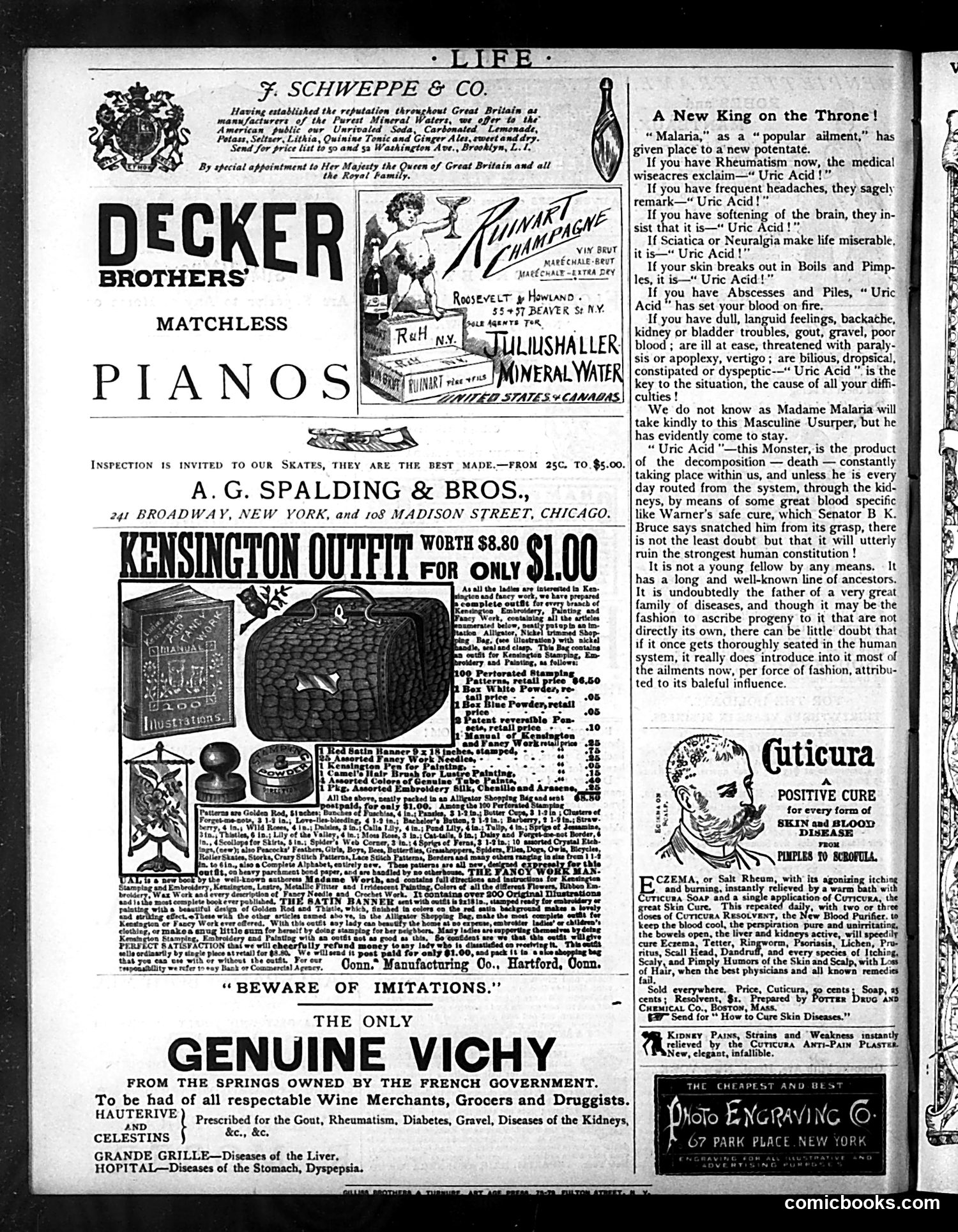
This page is primarily **advertisements** rather than editorial satire. However, there is one notable satirical piece: the article "A New King on the Throne!" This piece mocks the medical establishment's obsession with "Uric Acid" as a universal diagnosis. It's written as satire, comparing uric acid to a deposed ruler ("Madame Malaria") being replaced by a new medical fad. The author ridicules doctors who blame uric acid for virtually every ailment—headaches, boils, gout, mental decline, paralysis—suggesting this represents medical pseudoscience rather than legitimate diagnosis. The satire targets contemporary medical fashions and the gullibility of both physicians and patients. It's promotional content for Warner's Safe Cure, a patent medicine claiming to address these supposed uric acid problems. The surrounding advertisements (Decker pianos, Spalding sporting goods, Vichy water, Cuticura) represent typical patent medicine and consumer product pitches of the era.