
Life, 1886-01-21 · page 5 of 16
Life — January 21, 1886 — page 5: what you’re looking at
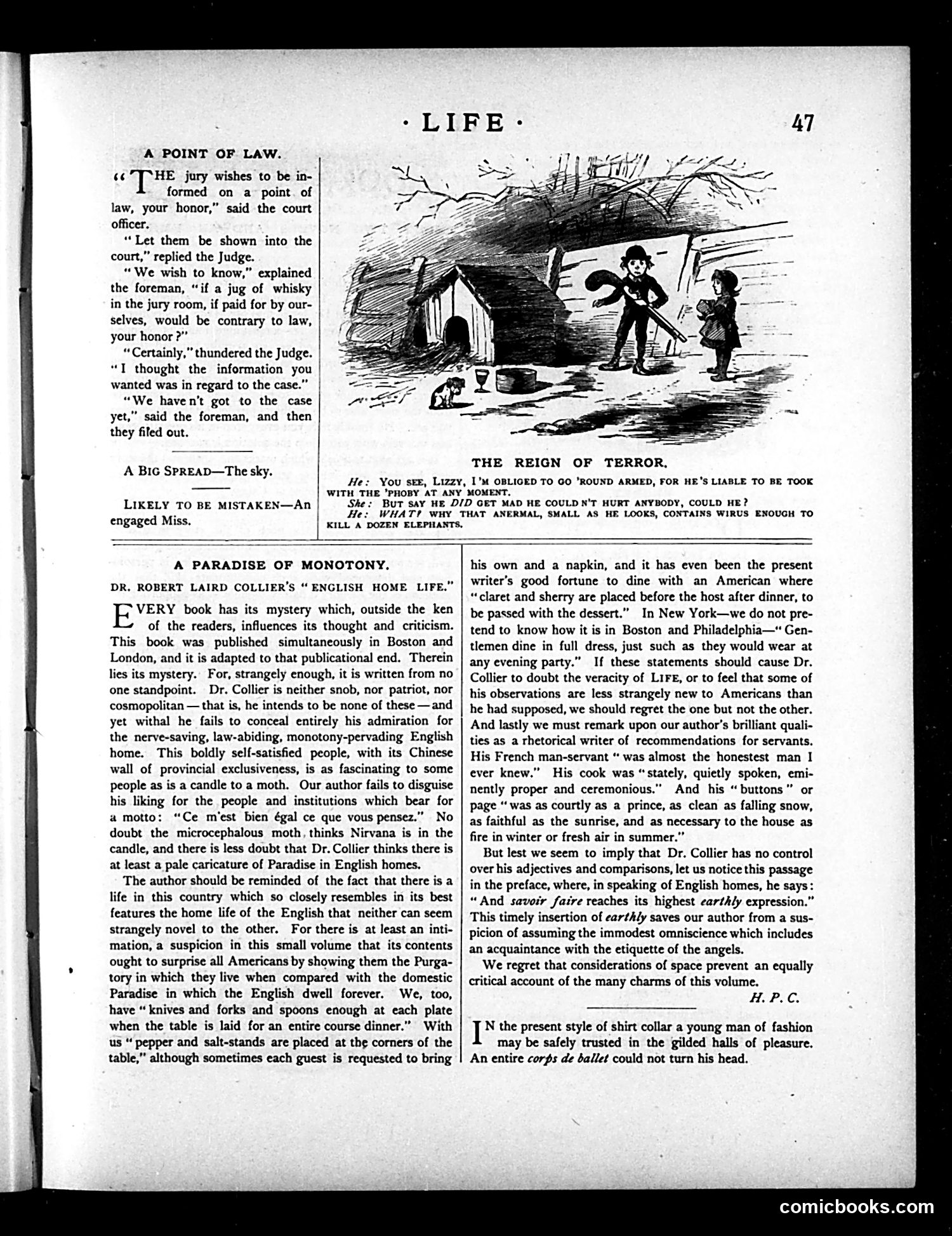
What you’re looking at
This cartoon satirizes child discipline methods of the era. The caption indicates a child (Lizzy) threatens violence with a toy gun against an adult (likely a servant or caretaker), creating comedic role-reversal: the child claims immunity from punishment because the weapon "contains wimps enough to kill a dozen elephants." The joke relies on Victorian anxiety about children's toys and unsupervised play. The "reign of terror" refers to the child's dominance over household adults—a reversal of expected authority. The cartoon mocks contemporary concerns about toy guns' corrupting influence on youth behavior and parental inability to maintain discipline. The surrounding text discusses English home life and social observations, providing context for this domestic satire about changing family hierarchies.
📄 Transcribed text from this page (OCR, searchable)
Machine-transcribed from the original scan — historical spelling and the odd misread are preserved.
A POINT OF LAW. 6c HE jury wishes to be in- formed on a point. of law, your honor,” said the court officer. “Let them be shown into the court,” replied the Judge. “We wish to know,” explained the foreman, “if a jug of whisky in the jury room, if paid for by our- selves, would be contrary to law, your honor ?” “Certainly,” thundered the Judge. “T thought the information you wanted was in regard to the case.” “We haven't got to the case yet,” said the foreman, and then they filed out. A BiG SPREAD—The sky. rs fe: LIKELY TO BE MISTAKEN—An engaged Miss. Hes WHAT? WHY Te mete Ly rin! THE REIGN OF TERROR, You sre, Lizzy, 1’M OBLIGED TO GO ’ROUND ARMED, FOR HE'S LIABLE TO BE TOOK WITH THE 'PHOBY AT ANY MOMENT. he: BuT SAY HE D/D GET MAD HE COULDN'T HURT ANYBODY, COULD HE? THAT ANERMAL, SMALL AS HE LOOKS, CONTAINS WIRUS ENOUGH TO KILL A DOZEN ELEPHANTS. A PARADISE OF MONOTONY., DR. ROBERT LAIRD COLLIER'S “ ENGLISH HOME LIFE. EVERY book has its mystery which, outside the ken of the readers, influences its thought and criticism. This book was published simultaneously in Boston and London, and it is adapted to that publicational end. Therein lies its mystery. For, strangely enough, it is written from no one standpoint. Dr. Collier is neither snob, nor patriot, nor cosmopolitan — that is, he intends to be none of these —and yet withal he fails to conceal entirely his admiration for the nerve-saving, law-abiding, monotony-pervading English home. This boldly self-satisfied people, with its Chinese wall of provincial exclusiveness, is as fascinating to some people as is a candle to a moth. Our author fails to disguise his liking for the people and institutions which bear for a motto: “Ce m’est bien égal ce que vous pensez.” No doubt the microcephalous moth, thinks Nirvana is in the candle, and there is less doubt that Dr. Collier thinks there is at least a pale caricature of Paradise in English homes. The author should be reminded of the fact that there is a life in this country which so closely resembles in its best features the home life of the English that neither can seem strangely novel to the other. For there is at least an inti- mation, a suspicion in this small volume that its contents ought to surprise all Americans by showing them the Purga- tory in which they live when compared with the domestic Paradise in which the English dwell forever. We, too, have “ knives and forks and spoons enough at each plate when the table is laid for an entire course dinner.” With us “ pepper and salt-stands are placed at the corners of the table,” although sometimes each guest is requested to bring his own and a napkin, and it has even been the present writer’s good fortune to dine with an American where “claret and sherry are placed before the host after dinner, to be passed with the dessert.” In New York—we do not pre- tend to know how it is in Boston and Philadelphia—“ Gen- tlemen dine in full dress, just such as they would wear at any evening party.” If these statements should cause Dr. Collier to doubt the veracity of LIFE, or to feel that some of his observations are less strangely new to Americans than he had supposed, we should regret the one but not the other. And lastly we must remark upon our author's brilliant quali- ties as a rhetorical writer of recommendations for servants. His French man-servant “ was almost the honestest man I ever knew.” His cook was “stately, quietly spoken, emi- nently proper and ceremonious.” And his “buttons” or page “was as courtly as a prince, as clean as falling snow, as faithful as the sunrise, and as necessary to the house as fire in winter or fresh air in summer.” But lest we seem to imply that Dr. Collier has no control over his adjectives and comparisons, let us notice this passage in the preface, where, in speaking of English homes, he says: “And savoir farre reaches its highest earthly expression.” This timely insertion of earthly saves our author from a sus- picion of assuming the immodest omniscience which includes an acquaintance with the etiquette of the angels. We regret that considerations of space prevent an equally critical account of the many charms of this volume. H.P.C. N the present style of shirt collar a young man of fashion may be safely trusted in the gilded halls of pleasure. An entire corps de ballet could not turn his head. comicbooks.com