
Life, 1886-01-21 · page 6 of 16
Life — January 21, 1886 — page 6: what you’re looking at
What you’re looking at
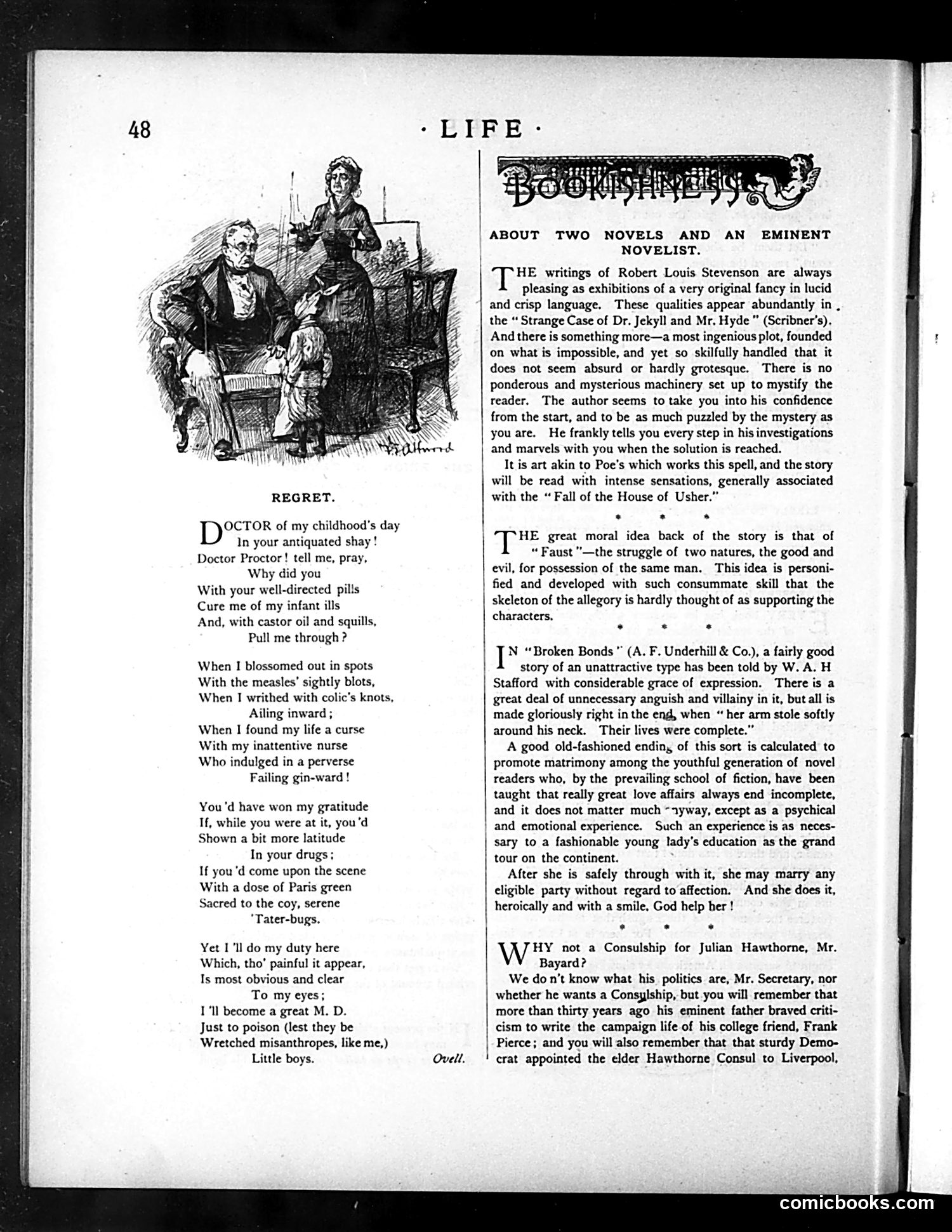
The left side features a satirical poem titled "Regret" by Orell, illustrated with a sketch showing two figures in what appears to be a doctor's office or study. The poem mockingly addresses a doctor from the speaker's childhood, expressing ironic gratitude for medical treatments that supposedly failed—the speaker lists childhood ailments (measles, colic) and a "perverse" nurse, then sarcastically suggests becoming a "great M.D." himself to "poison" people like the doctor did. The humor relies on mock-heroic complaint about incompetent medical care—a common Victorian satirical target. The accompanying sketch shows period dress and interior details consistent with 19th-century medical practice, suggesting this critiques contemporary medical practitioners through exaggerated complaint. The right side discusses literary reviews, not political satire.
📄 Transcribed text from this page (OCR, searchable)
Machine-transcribed from the original scan — historical spelling and the odd misread are preserved.
REGRET. OCTOR of my childhood’s day In your antiquated shay! Doctor Proctor! tell me, pray, Why did you With your well-directed pills Cure me of my infant ills And, with castor oil and squills, Pull me through ? When I blossomed out in spots With the measles’ sightly blots, When I writhed with colic’s knots, Ailing inward ; When I found my life a curse With my inattentive nurse Who indulged in a perverse Failing gin-ward ! You 'd have won my gratitude If, while you were at it, you'd Shown a bit more latitude In your drugs; If you ‘d come upon the scene With a dose of Paris green Sacred to the coy, serene ‘Tater-bugs. Yet I'll do my duty here Which, tho’ painful it appear, Is most obvious and clear To my eyes; I'll become a great M. D. Just to poison (lest they be Wretched misanthropes, like me,) Little boys. Ovell. ABOUT TWO NOVELS AND AN EMINENT NOVELIST. HE writings of Robert Louis Stevenson are always pleasing as exhibitions of a very original fancy in lucid and crisp language. These qualities appear abundantly in , the “ Strange Case of Dr. Jekyll and Mr. Hyde ” (Scribner’s), And there is something more—a most ingenious plot, founded on what is impossible, and yet so skilfully handled that it does not seem absurd or hardly grotesque. There is no ponderous and mysterious machinery set up to mystify the reader. The author seems to take you into his confidence from the start, and to be as much puzzled by the mystery as you are. He frankly tells you every step in his investigations and marvels with you when the solution is reached. It is art akin to Poe's which works this spell, and the story will be read with intense sensations, generally associated with the “Fall of the House of Usher.” . * . HE great moral idea back of the story is that of “ Faust "—the struggle of two natures, the good and evil, for possession of the same man. This idea is personi- | fied and developed with such consummate skill that the skeleton of the allegory is hardly thought of as supporting the characters. . * . I N “Broken Bonds” (A. F. Underhill & Co.), a fairly good story of an unattractive type has been told by W. A. H Stafford with considerable grace of expression. There is a great deal of unnecessary anguish and villainy in it, but all is made gloriously right in the end, when “ her arm stole softly around his neck. Their lives were complete.” A good old-fashioned ending, of this sort is calculated to promote matrimony among the youthful generation of novel readers who, by the prevailing school of fiction, have been taught that really great love affairs always end incomplete, and it does not matter much ~1yway, except as a psychical | and emotional experience. Such an experience is as neces- sary to a fashionable young lady's education as the grand tour on the continent. After she is safely through with it, she may marry any eligible party without regard to affection. And she does it, heroically and with a smile, God help her! HY not a Consulship for Julian Hawthorne, Mr. Bayard? We do n’t know what his politics are, Mr. Secretary, nor whether he wants a Consylship, but you will remember that more than thirty years ago his eminent father braved criti- cism to write the campaign life of his college friend, Frank Pierce; and you will also remember that that sturdy Demo- ' crat appointed the elder Hawthorne Consul to Liverpool, comicbooks.com