
Life, 1886-01-21 · page 10 of 16
Life — January 21, 1886 — page 10: what you’re looking at
What you’re looking at
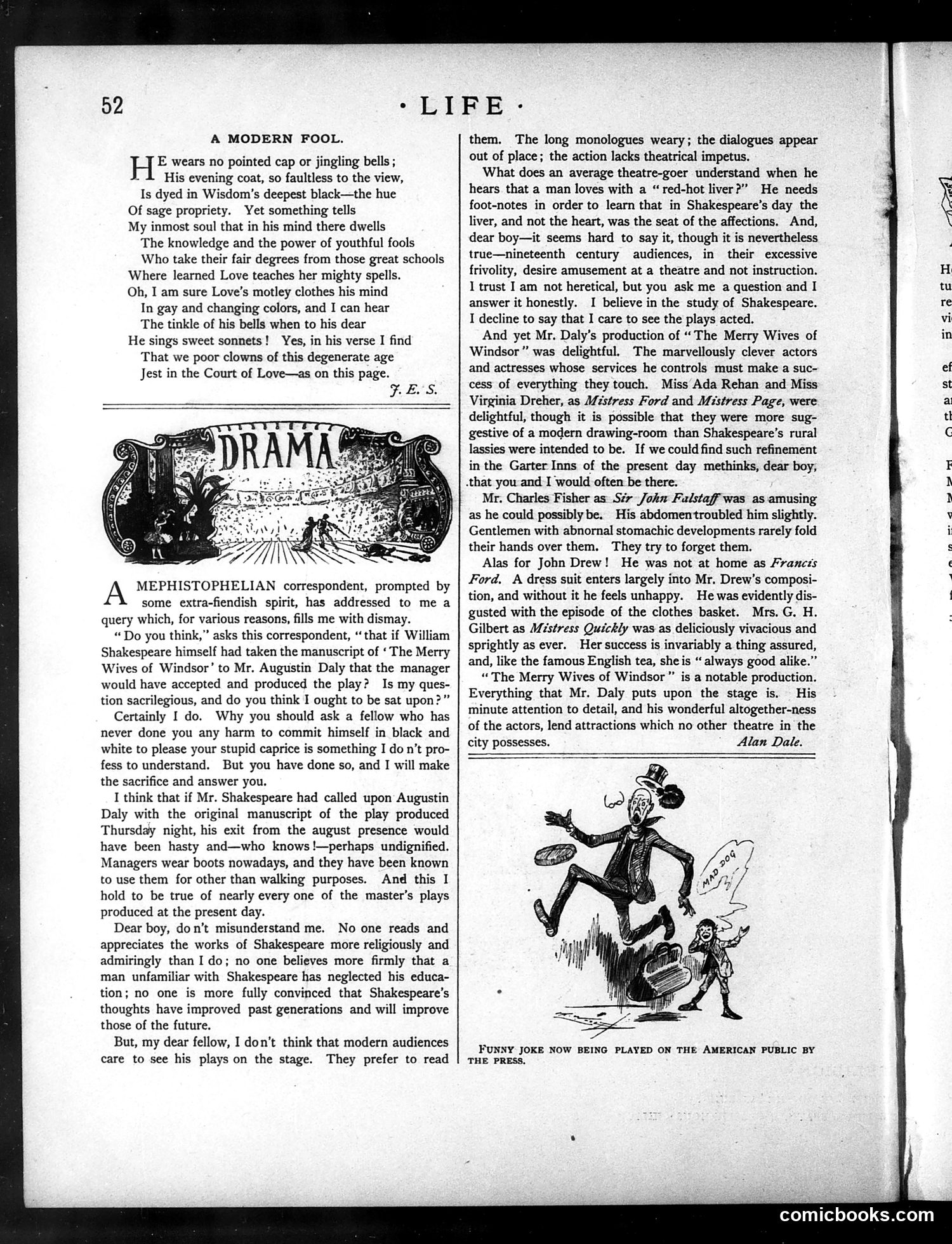
This page contains literary criticism of **Augustin Daly's theater production** of Shakespeare's "The Merry Wives of Windsor." The main cartoon (lower half) appears to show a comic figure juggling or performing—likely representing the contrast between Shakespeare's serious art and modern theatrical entertainment. The essay's central argument: while Shakespeare deserves scholarly respect, **modern 19th-century audiences find his plays tedious on stage**. The author criticizes lengthy monologues and archaic language (citing the example of "red-hot liver" needing footnotes to explain Renaissance medicine). Audiences prefer amusement to instruction. However, the author praises **Daly's specific production**, crediting talented actresses like Ada Rehan and Virginia Dreher, though noting they modernize the rural characters into refined drawing-room ladies rather than country inn-workers. The opening poem mocks a "modern fool" who hides romantic foolishness beneath respectable appearance—likely commenting on theatrical pretension or audiences' conflicted attitudes toward Shakespeare.
📄 Transcribed text from this page (OCR, searchable)
Machine-transcribed from the original scan — historical spelling and the odd misread are preserved.
"ETBE- A MODERN FOOL. E wears no pointed cap or jingling bells ; | L His evening coat, so faultless to the view, Is dyed in Wisdom’s deepest black—the hue Of sage propriety. Yet something tells My inmost soul that in his mind there dwells The knowledge and the power of youthful fools Who take their fair degrees from those great schools Where learned Love teaches her mighty spells. Oh, I am sure Love’s motley clothes his mind In gay and changing colors, and I can hear The tinkle of his bells when to his dear He sings sweet sonnets! Yes, in his verse I find That we poor clowns of this degenerate age Jest in the Court of Love—as on this page. MEPHISTOPHELIAN correspondent, prompted by some extra-fiendish spirit, has addressed to me a query which, for various reasons, fills me with dismay. “Do you think,” asks this correspondent, “that if William Shakespeare himself had taken the manuscript of ‘The Merry Wives of Windsor’ to Mr. Augustin Daly that the manager would have accepted and produced the play? Is my ques- tion sacrilegious, and do you think I ought to be sat upon?” Certainly I do. Why you should ask a fellow who has never done you any harm to commit himself in black and white to please your stupid caprice is something I do n’t pro- fess to understand. But you have done so, and I will make the sacrifice and answer you. I think that if Mr. Shakespeare had called upon Augustin Daly with the original manuscript of the play produced Thursday night, his exit from the august presence would have been hasty and—who knows !—perhaps undignified. Managers wear boots nowadays, and they have been known to use them for other than walking purposes. And this I hold to be true of nearly every one of the master’s plays produced at the present day. Dear boy, don’t misunderstand me. No one reads and appreciates the works of Shakespeare more religiously and admiringly than I do; no one believes more firmly that a man unfamiliar with Shakespeare has neglected his educa- tion; no one is more fully convinced that Shakespeare’s thoughts have improved past generations and will improve those of the future. But, my dear fellow, I don’t think that modern audiences care to see his plays on the stage. They prefer to read them. The long monologues weary; the dialogues appear out of place; the action lacks theatrical impetus. What does an average theatre-goer understand when he hears that a man loves with a “red-hot liver?” He needs foot-notes in order to learn that in Shakespeare’s day the liver, and not the heart, was the seat of the affections. And, dear boy—it seems hard to say it, though it is nevertheless true—nineteenth century audiences, in their excessive frivolity, desire amusement at a theatre and not instruction. I trust I am not heretical, but you ask me a question and I answer it honestly. I believe in the study of Shakespeare. I decline to say that I care to see the plays acted. And yet Mr. Daly’s production of “The Merry Wives of Windsor” was delightful. The marvellously clever actors and actresses whose services he controls must make a suc- cess of everything they touch. Miss Ada Rehan and Miss Virginia Dreher, as Mistress Ford and Mistress Page, were delightful, though it is possible that they were more sug- gestive of a modern drawing-room than Shakespeare’s rural lassies were intended to be. If we could find such refinement in the Garter Inns of the present day methinks, dear boy, .that you and I would often be there. Mr. Charles Fisher as. Str John Falstaff was as amusing as he could possibly be. His abdomentroubled him slightly. Gentlemen with abnornal stomachic developments rarely fold their hands over them. They try to forget them. Alas for John Drew! He was not at home as Frances Ford. A dress suit enters largely into Mr. Drew's composi- tion, and without it he feels unhappy. He was evidently dis- gusted with the episode of the clothes basket. Mrs. G. H. Gilbert as Mzstress Quickly was as deliciously vivacious and sprightly as ever. Her success is invariably a thing assured, and, like the famous English tea, she is “ always good alike.” “The Merry Wives of Windsor” is a notable production. Everything that Mr. Daly puts upon the stage is. His minute attention to detail, and his wonderful altogether-ness of the actors, lend attractions which no other theatre in the city possesses. Alan Dale. FUNNY JOKE NOW BEING PLAYED ON THE AMERICAN PUBLIC BY THE PRESS. comicbooks.com