
Life, 1886-01-21 · page 12 of 16
Life — January 21, 1886 — page 12: what you’re looking at
What you’re looking at
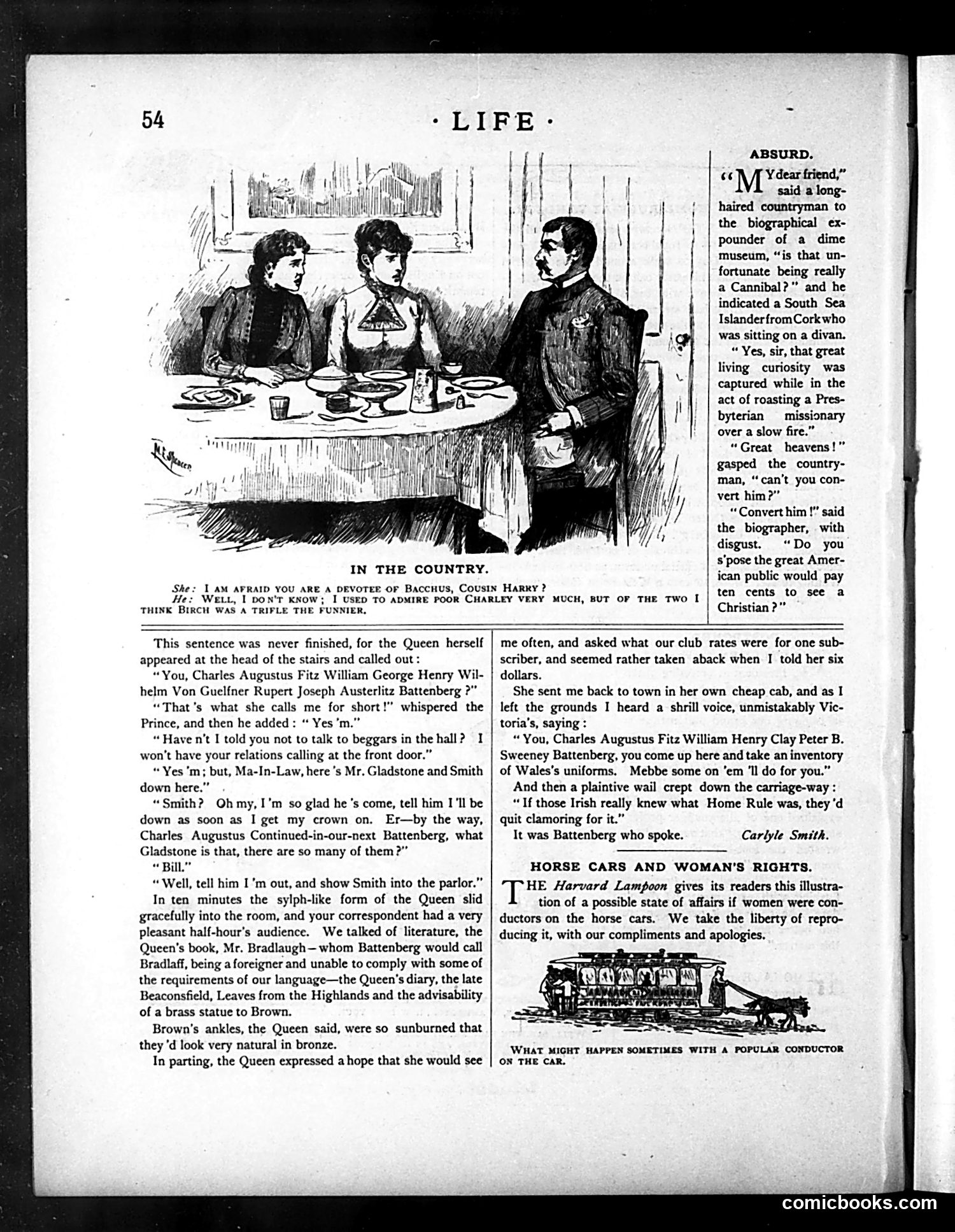
**Main Cartoon ("In the Country"):** A man and woman at dinner discuss whether their cousin Harry is a "devotee of Bacchus" (god of wine/drinking). The joke plays on classical allusion—the man deflects by claiming he admired "poor Charley" more, then adds "Birch was a trifle the funnier." This likely references competing figures of ridicule from the period, though the specific identities are unclear today. **"Absurd" Section:** A satirical anecdote mocking American entertainment and missionary zeal. A countryman asks a dime museum exhibitor whether a "cannibal" from the South Sea Islands can be converted to Christianity. The exhibitor replies that conversion would ruin him commercially—the American public won't pay ten cents to see a Christian. The satire targets both sensationalist entertainment and the hypocrisy of Christian missionary work. **Context:** This appears to be Victorian-era American satire (likely 1880s-90s based on references to Gladstone and Queen Victoria's husband).
📄 Transcribed text from this page (OCR, searchable)
Machine-transcribed from the original scan — historical spelling and the odd misread are preserved.
IN THE COUNTRY. She: I AM AFRAID YOU ARE A DEVOTEE OF BaccHus, Cousin Harry ? He: Wet, | pon’ Know; I USED TO ADMIRE POOR CHARLEY VERY MUCH, BUT OF THE Two I THINK BIRCH WAS A TRIFLE THE FUNNIER, ABSURD. T3 Ydear friend,” said a long- haired countryman to the biographical ex- pounder of a dime museum, “is that un- fortunate being really a Cannibal?” and he indicated a South Sea IslanderfromCork who was sitting on a divan. “ Yes, sir, that great living curiosity was captured while in the act of roasting a Pres- byterian missionary over a slow fire.” “Great heavens!” gasped the country- man, “can’t you con- vert him?” “Convert him !” said the biographer, with disgust. “Do you s'pose the great Amer- ican public would pay ten cents to see a Christian?” This sentence was never finished, for the Queen herself appeared at the head of the stairs and called out : “You, Charles Augustus Fitz William George Henry Wil- helm Von Guelfner Rupert Joseph Austerlitz Battenberg ?” “That's what she calls me for short!" whispered the Prince, and then he added : “ Yes ’m.” “ Have n't I told you not to talk to beggars in the hall? 1 won't have your relations calling at the front door.” “Yes 'm; but, Ma-In-Law, here's Mr. Gladstone and Smith down here.” “Smith? Oh my,I'm so glad he’s come, tell him I'll be down as soon as I get my crown on. Er—by the way, Charles Augustus Continued-in-our-next Battenberg, what Gladstone is that, there are so many of them?” “ Bill.” “Well, tell him I’m out, and show Smith into the parlor.” In ten minutes the sylph-like form of the Queen slid gracefully into the room, and your correspondent had a very pleasant half-hour’s audience. We talked of literature, the Queen's book, Mr. Bradlaugh— whom Battenberg would call Bradlaff, being a foreigner and unable to comply with some of the requirements of our language—the Queen's diary, the late Beaconsfield, Leaves from the Highlands and the advisability of a brass statue to Brown. Brown's ankles, the Queen said, were so sunburned that they 'd look very natural in bronze. In parting, the Queen expressed a hope that she would see me often, and asked what our club rates were for one sub- scriber, and seemed rather taken aback when I told her six dollars. She sent me back to town in her own cheap cab, and as I left the grounds I heard a shrill voice, unmistakably Vic- toria’s, saying : “You, Charles Augustus Fitz William Henry Clay Peter B. Sweeney Battenberg, you come up here and take an inventory of Wales's uniforms. Mebbe some on ’em ‘Il do for you.” And then a plaintive wail crept down the carriage-way : “If those Irish really knew what Home Rule was, they ‘d quit clamoring for it.” It was Battenberg who spoke. Carlyle Smith. HORSE CARS AND WOMAN'S RIGHTS. HE Harvard Lampoon gives its readers this illustra- tion of a possible state of affairs if women were con- ductors on the horse cars. We take the liberty of repro- ducing it, with our compliments and apologies. WHAT MIGHT HAPPEN SOMETIMES WITH A POPULAR CONDUCTOR ON THE CAR. comicbooks.com