
Life, 1886-01-21 · page 7 of 16
Life — January 21, 1886 — page 7: what you’re looking at
What you’re looking at
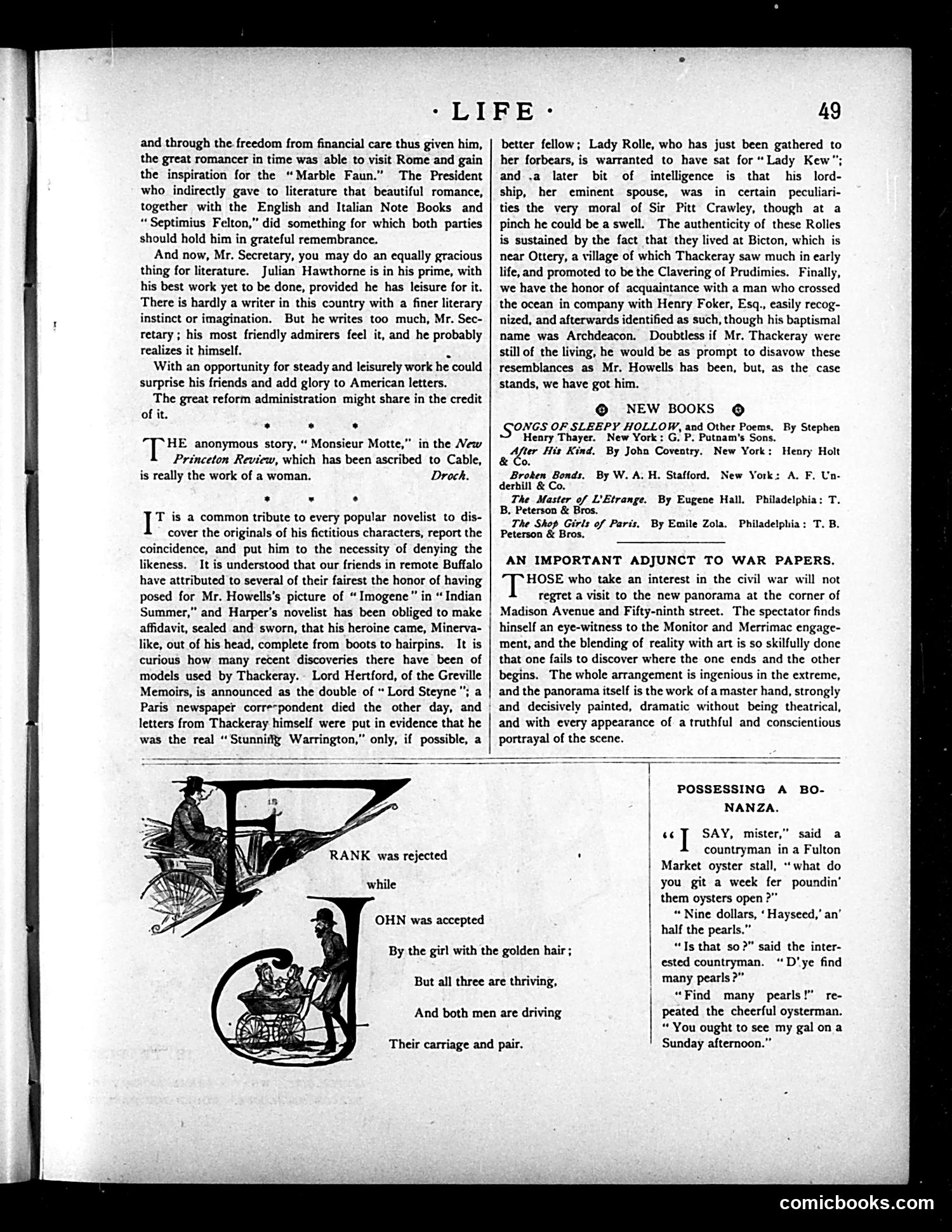
The page contains two main satirical illustrations with accompanying verse. The cartoons appear to use the names "Rank" and "John" to comment on acceptance and rejection—likely references to social or political figures of the period, though the specific identities are unclear without additional context. The verse contrasts "Rank" being "rejected" against "John" being "accepted / By the girl with the golden hair," suggesting romantic or political competition. The illustrations show figures in period carriages and domestic scenes. The bottom right contains an unrelated anecdote ("Possessing a Bo-Name") about oyster pricing at a Fulton Market stall—a humorous dialogue between a countryman and oysterman about pearl-finding. Without clearer historical context, the specific satirical targets remain uncertain.
📄 Transcribed text from this page (OCR, searchable)
Machine-transcribed from the original scan — historical spelling and the odd misread are preserved.
> LIFE: 49 and through the freedom from financial care thus given him, the great romancer in time was able to visit Rome and gain the inspiration for the “Marble Faun.” The President who indirectly gave to literature that beautiful romance, together with the English and Italian Note Books and “Septimius Felton,” did something for which both parties should hold him in grateful remembrance. And now, Mr. Secretary, you may do an equally gracious thing for literature. Julian Hawthorne is in his prime, with his best work yet to be done, provided he has leisure for it. There is hardly a writer in this country with a finer literary instinct or imagination. But he writes too much, Mr. Sec- retary ; his most friendly admirers feel it, and he probably realizes it himself. si With an opportunity for steady and leisurely work he could surprise his friends and add glory to American letters. The great reform administration might share in the credit of it. * . * Ee anonymous story, “ Monsieur Motte,” in the Mew Princeton Review, which has been ascribed to Cable, is really the work of a woman. Droch. * . * T is a common tribute to every popular novelist to dis- cover the originals of his fictitious characters, report the coincidence, and put him to the necessity of denying the likeness. It is understood that our friends in remote Buffalo have attributed to several of their fairest the honor of having posed for Mr. Howells’s picture of “Imogene” in “ Indian Summer,” and Harper’s novelist has been obliged to make affidavit, sealed and sworn, that his heroine came, Minerva- like, out of his head, complete from boots to hairpins. It is curious how many recent discoveries there have been of models used by Thackeray. Lord Hertford, of the Greville Memoirs, is announced as the double of “Lord Steyne"; a Paris newspaper correspondent died the other day, and | letters from Thackeray himself were put in evidence that he better fellow; Lady Rolle, who has just been gathered to her forbears, is warranted to have sat for “Lady Kew"; and .a later bit of intelligence is that his lord- ship, her eminent spouse, was in certain peculiari- ties the very moral of Sir Pitt Crawley, though at a pinch he could be a swell. The authenticity of these Rolles is sustained by the fact that they lived at Bicton, which is near Ottery, a village of which Thackeray saw much in early life, and promoted to be the Clavering of Prudimies. Finally, we have the honor of acquaintance with a man who crossed the ocean in company with Henry Foker, Esq., easily recog- nized, and afterwards identified as such, though his baptismal name was Archdeacon. Doubtless if Mr. Thackeray were still of the living, he would be as prompt to disavow these resemblances as Mr. Howells has been, but, as the case stands, we have got him. © NEW BOOKS © SONGS OF SLEEPY HOLLOW, and Other Poems. By Stephen Henry Thayer. New York: G. P. Putnam's Sons. ak” His Kind, By John Coventry. New York: Henry Holt 0. Broken Bonds, By W. A.H. Stafford, New York: A. F, Un- derhill & Co. The Master of L'Etrange. By Eugene Hall. Philadelphia: T. B, Peterson & Bros. The Shop Girls of Paris, By Emile Zola. Philadelphia: T. B. Peterson & Bros. AN IMPORTANT ADJUNCT TO WAR PAPERS. HOSE who take an interest in the civil war will not regret a visit to the new panorama at the corner of Madison Avenue and Fifty-ninth street. The spectator finds hinself an eye-witness to the Monitor and Merrimac engage- ment, and the blending of reality with art is so skilfully done that one fails to discover where the one ends and the other begins. The whole arrangement is ingenious in the extreme, and the panorama itself is the work of a master hand, strongly and decisively painted, dramatic without being theatrical, and with every appearance of a truthful and conscientious portrayal of the scene. OHN was accepted POSSESSING A BO- NANZA. “cc SAY, mister,” said a countryman in a Fulton | Market oyster stall, “what do | you git a week fer poundin’ them oysters open ?” “ Nine dollars, ‘ Hayseed,’ an’ | half the pearls,” “Ts that so?” said the inter- By the girl with the golden hair ; But all three are thriving, And both men are driving Their carriage and pair. ested countryman. “D'ye find | many pearls?” “Find many pearls!” re- peated the cheerful oysterman. “ You ought to see my gal ona Sunday afternoon.” comicbooks.com