
A complete issue · 16 pages · 1886
Life — January 14, 1886
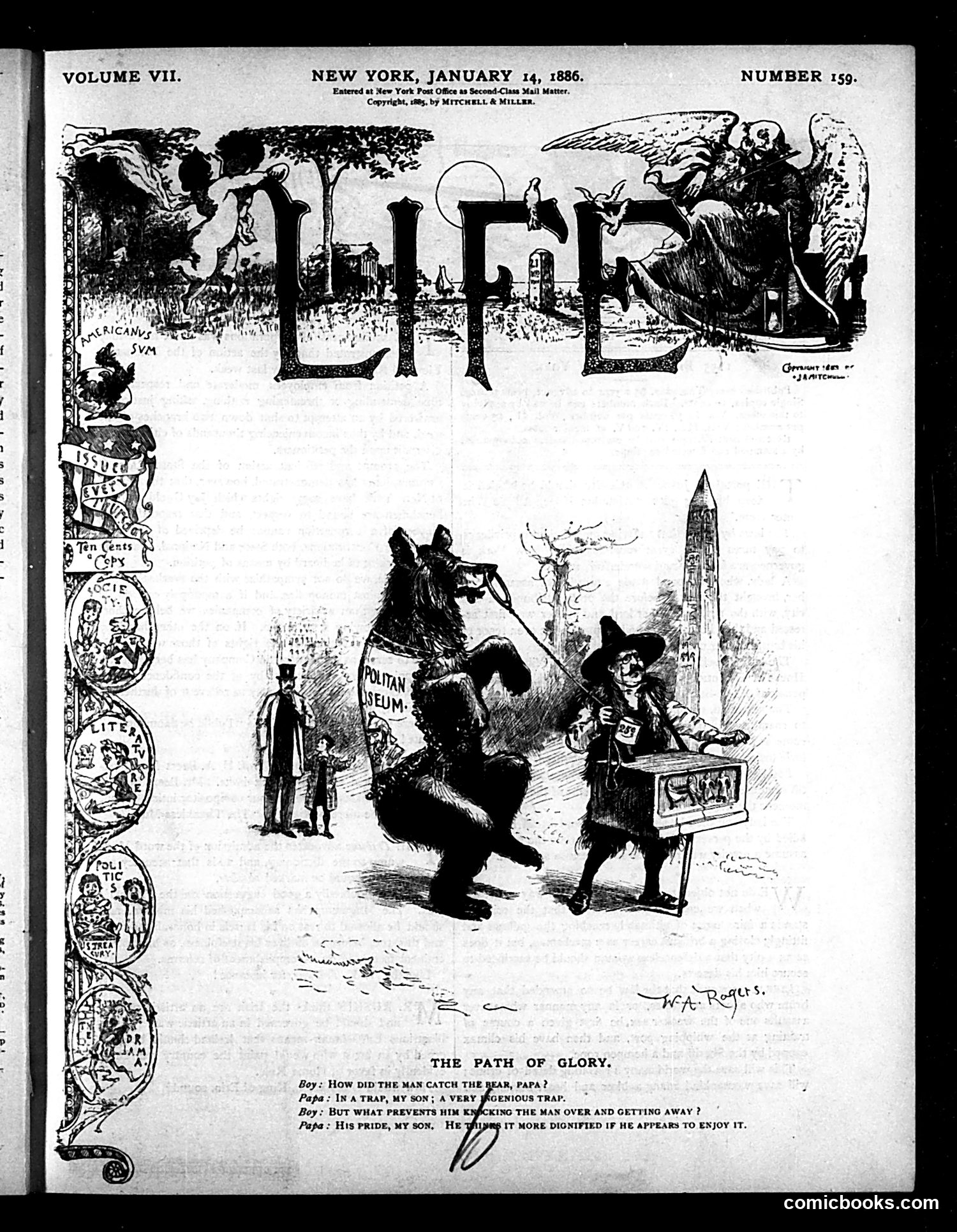
This cartoon satirizes how public figures achieve fame through undignified means. The central scene shows a man in a trap being caught by what appears to be a museum operator or showman, with the Washington Monument visible in the background—establishing a Washington D.C. political setting. The dialogue between father and son mocks masculine pride: the boy asks how the man was "caught," and the father explains it was "a trap, my son; a very ingenious trap." When the boy questions why the man doesn't escape, the father responds that pride prevents him from appearing to enjoy freedom—suggesting the trapped figure prioritizes dignity over actual liberation. The satire critiques how political ambition and vanity can make men willing prisoners of public spectacle.
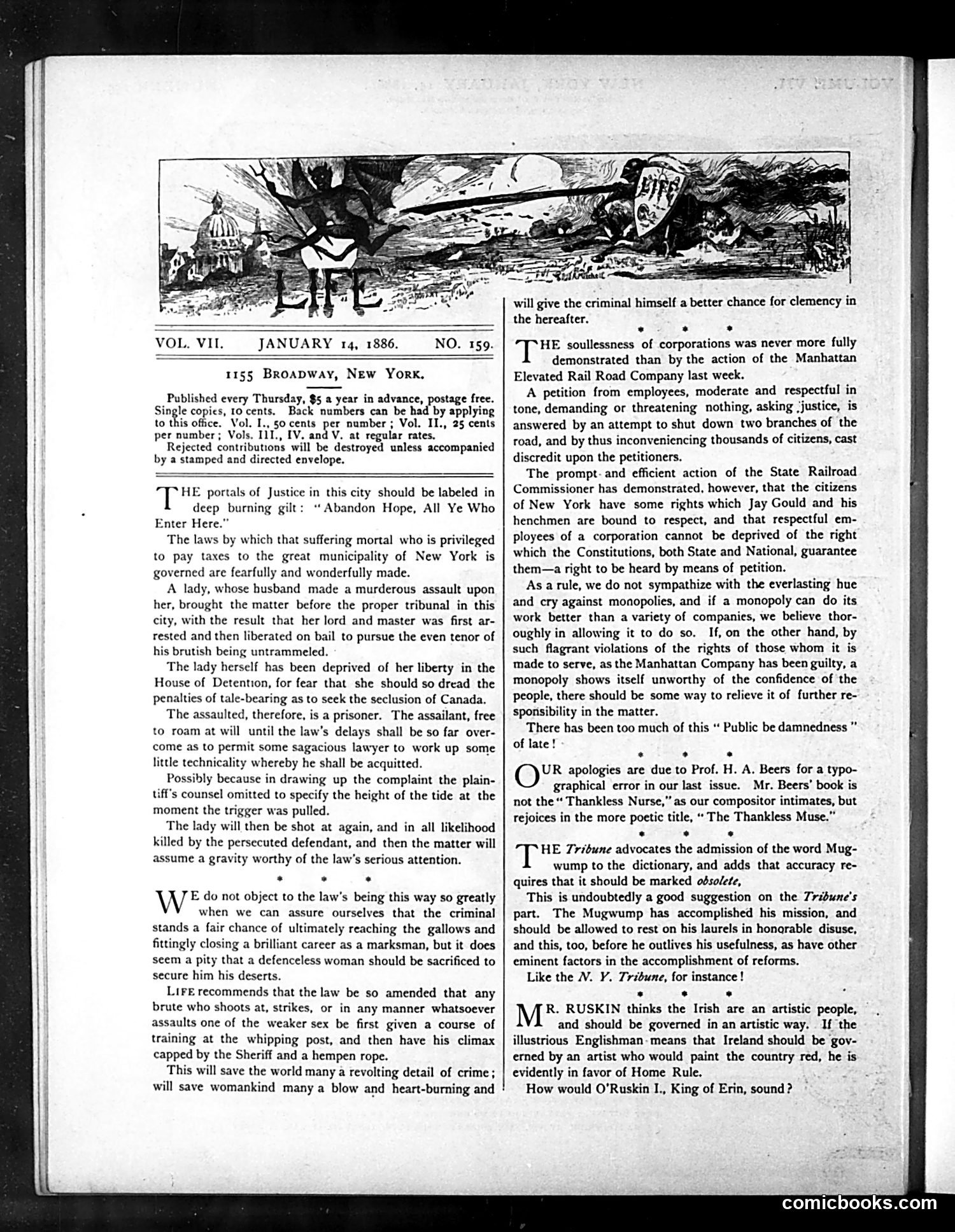
The page contains editorial commentary rather than a political cartoon. The illustrated header shows Justice with scales, but the main content discusses serious legal and corporate issues. The editorials critique: 1. **Manhattan Elevated Rail Road Company**: The company shut down two branches after employees petitioned for better working conditions, punishing workers for exercising their right to petition. 2. **Corporate power vs. individual rights**: The editors argue that monopolies like the rail company shouldn't deprive employees of constitutional protections simply because they work for corporations. 3. **A proposed law amendment**: The editors advocate for laws requiring brutal assault perpetrators to face capital punishment—suggesting execution would deter workplace violence. The tone is reform-minded, criticizing corporate abuse of power over working people.
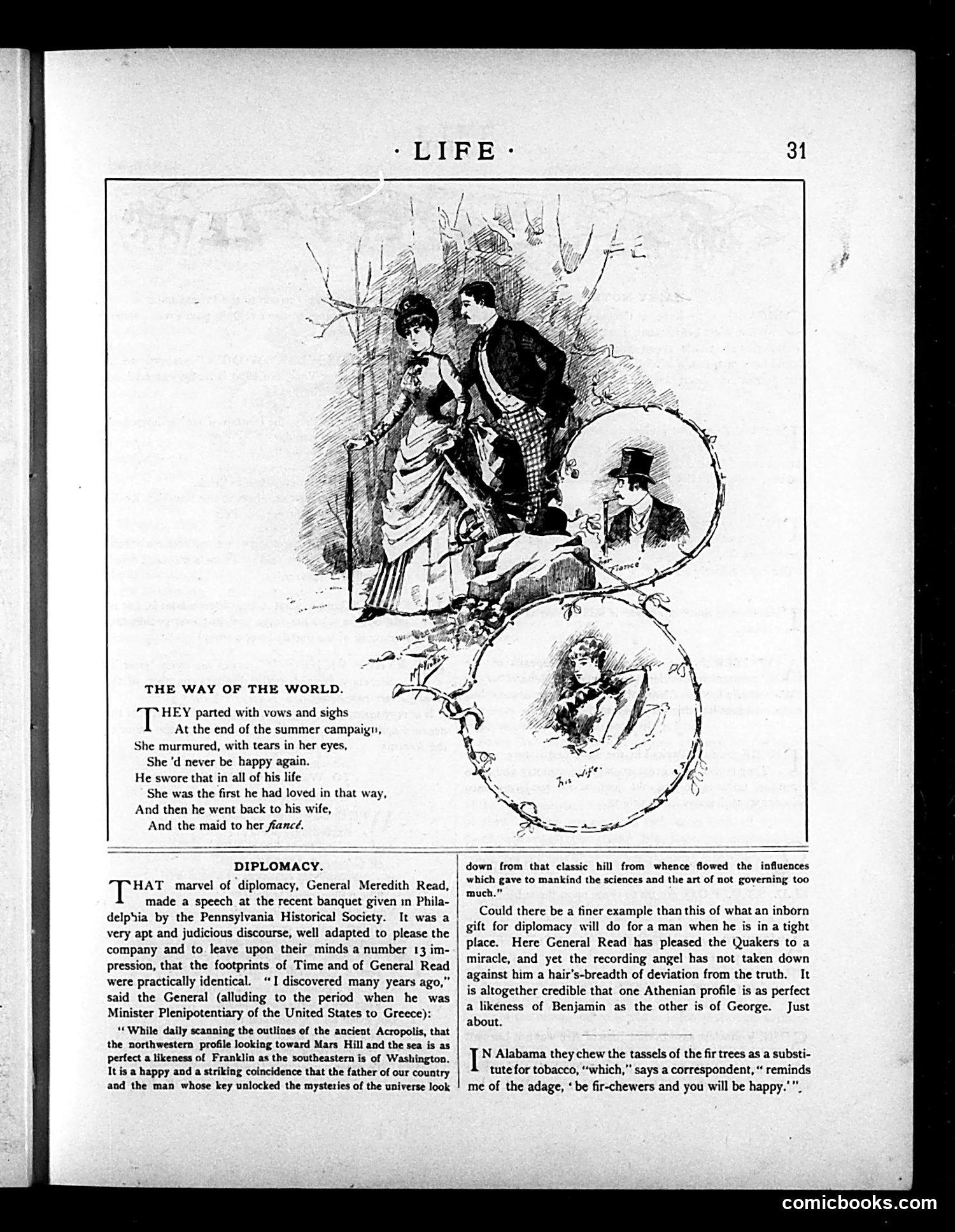
**"The Way of the World"** (top illustration) depicts a romantic scandal in Victorian style. A couple parts "with vows and sighs / At the end of the summer campaign," after which he returns to his wife while she's left with only memories. The circular vignettes show the man (top right, in top hat) and the woman (bottom) separately, illustrating their separation. The satire mocks the hypocrisy of upper-class affairs and their predictable, emotionally devastating conclusions. **"Diplomacy"** (bottom section) praises General Meredith Read's speech at a Philadelphia historical banquet, noting his profile resembles Benjamin Franklin's. The piece humorously celebrates his diplomatic skill while discussing his tenure as U.S. Minister to Greece, suggesting that good diplomacy can resolve even impossible situations.
The page is titled "By the Way" and contains a collection of brief satirical notes rather than traditional political cartoons. The decorative header shows silhouetted figures in various poses. The items mock contemporary public figures and institutions: Chicago's crematory ambitions, the Pope's charitable donations, a proposed "Home for Weary Women," horsemeat consumption in Paris, Bavarian drinking culture, John L. Sullivan's Hamlet misquote, and French naval matters. Other notes criticize newspaper standards, state legislators named Taylor, and philosophical pretension. The page concludes with a poem mocking W.D. Howells' poetry, suggesting his prose is superior but his verse is weak and prosaic. This represents Life's signature style: bite-sized social and political commentary targeting specific contemporaries through witty observation rather than elaborate visual satire.
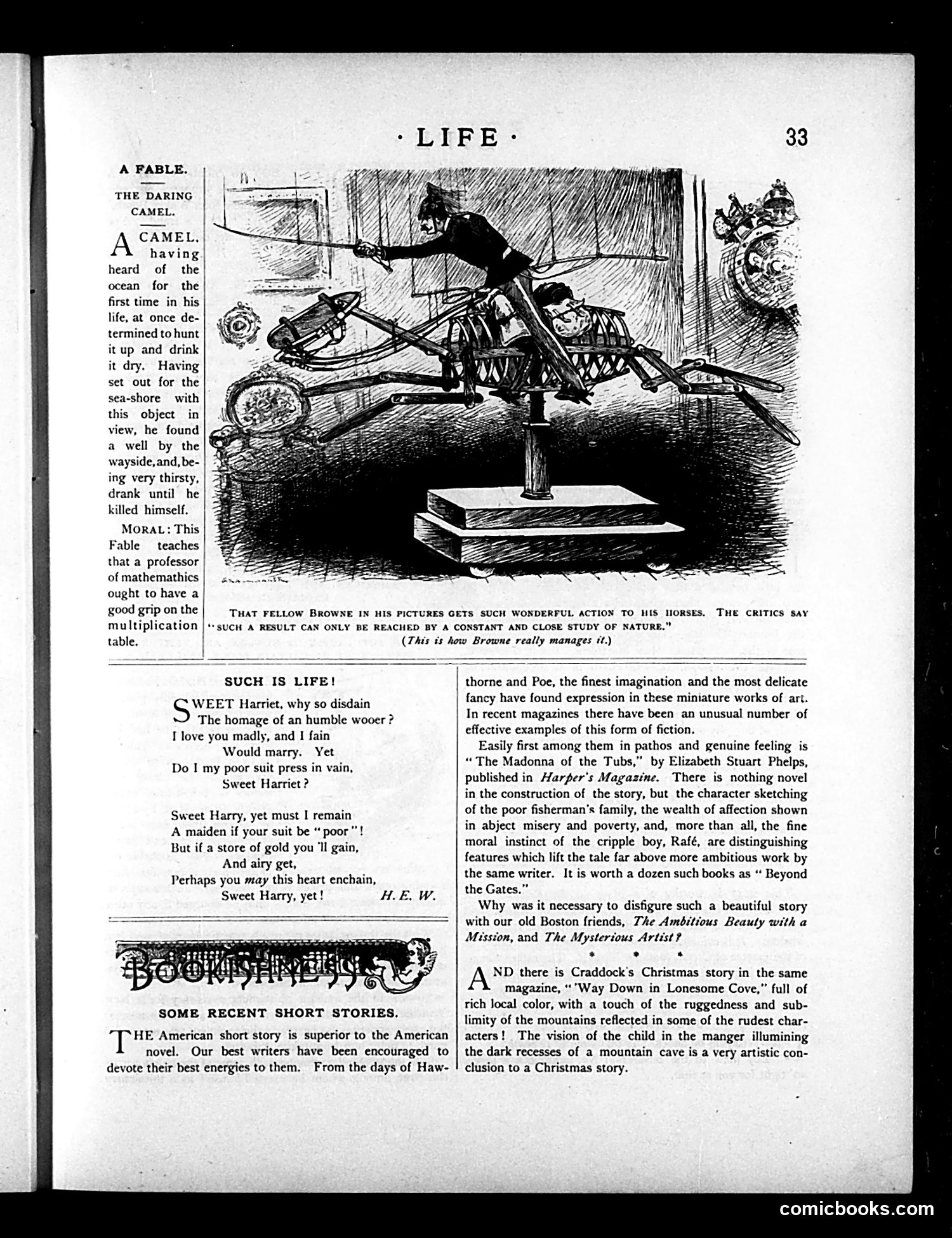
The main illustration depicts **"The Daring Camel,"** a fable about a camel who ventures to the ocean for the first time seeking to drink seawater, becomes excessively thirsty, and drinks until death. The moral warns that "a professor of mathematics ought to have a good grip on the multiplication table." The accompanying illustration shows a acrobatic performer (labeled "Browne") executing complex maneuvers on horses, captioned as demonstrating "wonderful action." This appears to celebrate the performer's skill and natural observation. Below, "Such Is Life!" is a sentimental poem addressed to "Sweet Harriet" about love, longing, and maintaining hope despite hardship—typical Victorian-era romantic verse. The page primarily contains literary and artistic content rather than political satire, focusing on fables, short story recommendations, and romantic poetry.
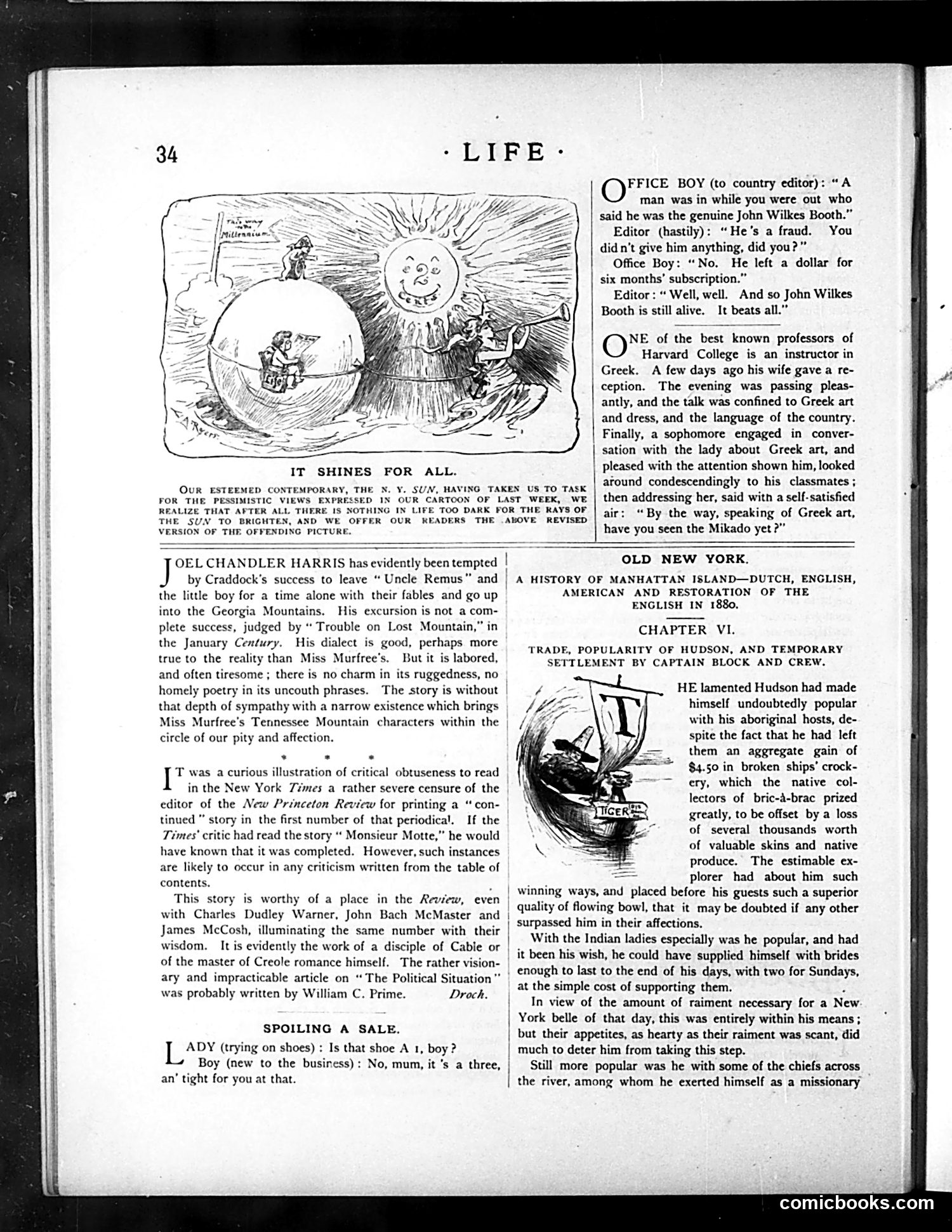
This cartoon satirizes the **N.Y. Sun newspaper's** claim to universal appeal. The image depicts a massive sun with a smiling face radiating light equally onto figures below—some wealthy (in a globe/dome), others poor or ordinary. The satire's point: the Sun's boast of serving "all" readers is hollow. Despite claiming to shine equally for everyone, newspapers inevitably favor certain audiences and viewpoints. The exaggerated, utopian imagery of impartial sunshine mocks the pretense that any commercial publication serves truly universal interests without bias. This reflects **Gilded Age criticism** of media monopolies and their misleading democratic rhetoric—a joke modern readers would recognize in discussions of media neutrality claims.
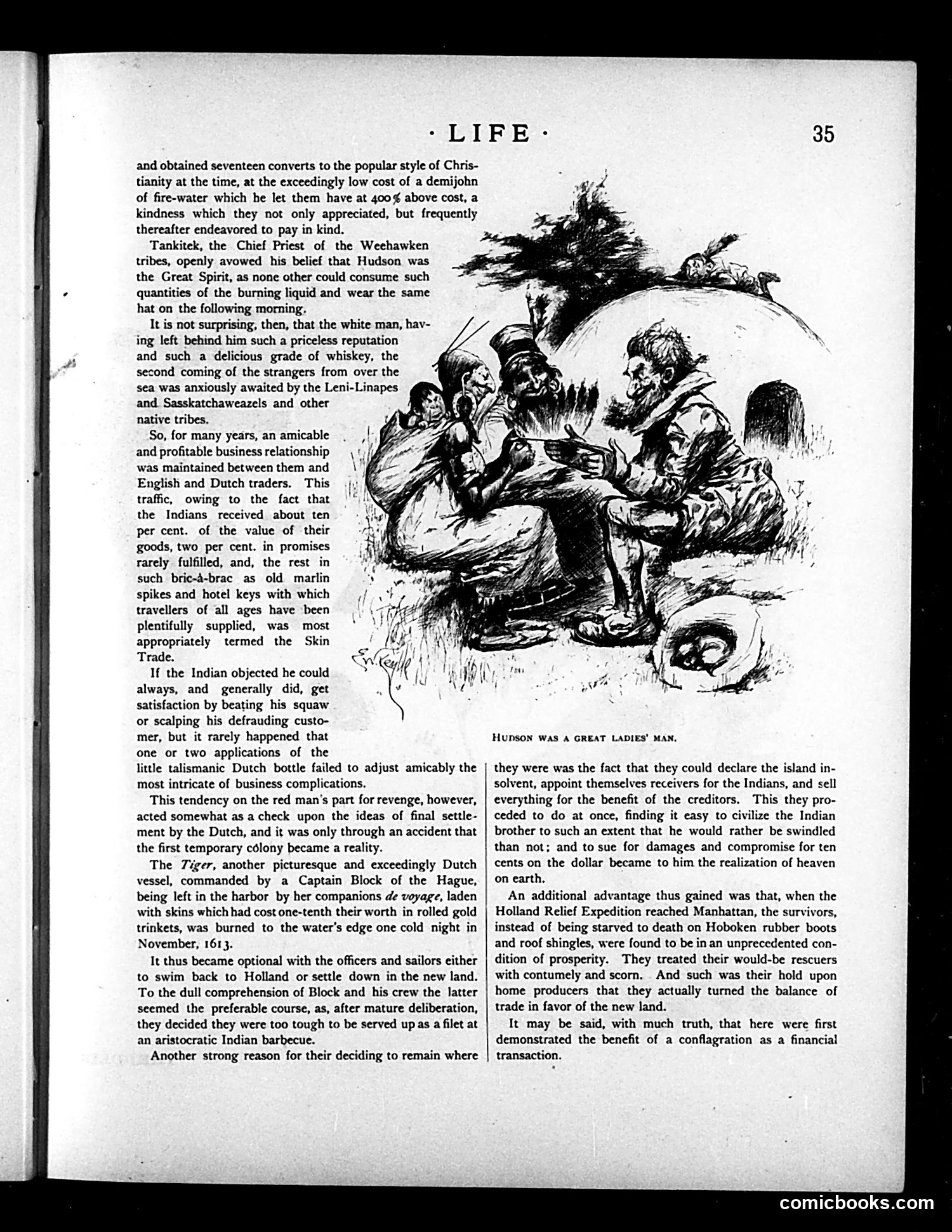
The illustration depicts a trading scene between European traders and Native Americans, captioned "HUDSON WAS A GREAT LADIES' MAN." The cartoon satirizes Henry Hudson's reputation and early colonial commerce. The image shows Hudson (center, in European dress) engaged in what appears to be fur trading or commercial exchange with Native Americans. The satire likely comments on Hudson's legendary charm ("ladies' man") being applied to conducting advantageous business dealings with Indigenous peoples—treating commercial negotiations as a form of seduction or manipulation. The accompanying text discusses how English and Dutch traders exploited Native Americans through unfair exchanges, paying only 10-15% of goods' value while distributing liquor and trinkets. The cartoon thus ironically mocks Hudson's reputation while the text critiques colonial commercial practices as fundamentally deceptive and exploitative.
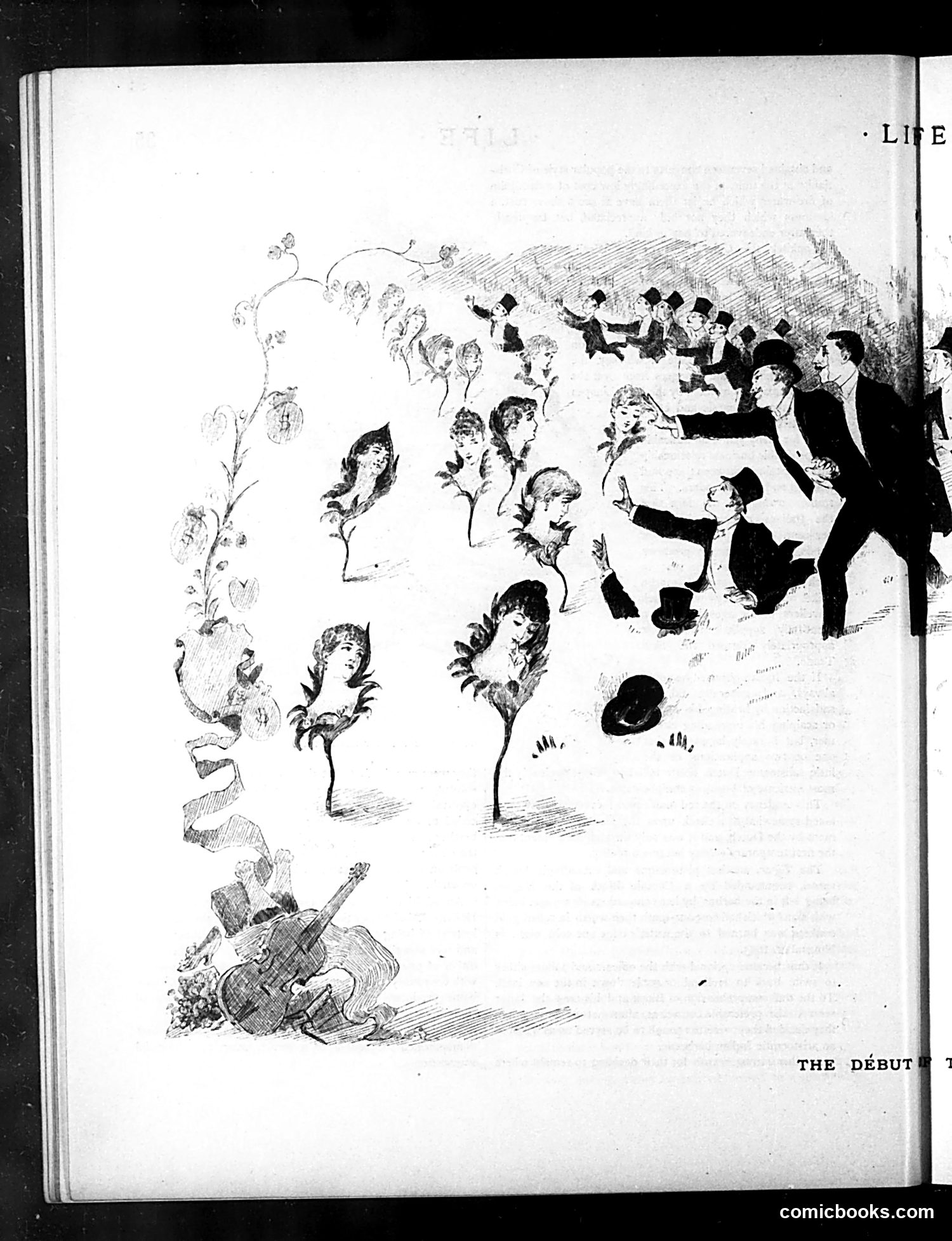
This satirical cartoon depicts a musical performance or recital, likely critiquing amateur or untalented musicians making their public debut. The image shows a musician with a violin at the bottom left, from which emerge stylized female heads growing like flowers on stems—a surreal visual metaphor suggesting the "blossoming" or "flowering" of musical talent. On the right, a crowd of well-dressed gentlemen in top hats watches with varied reactions, some pointing or gesturing dismissively. The contrast between the pretentious formality of the audience and the bizarre, unrealistic nature of the performance suggests satire about artistic pretension, perhaps mocking either the performer's delusions of grandeur or the audience's patronizing reception of inferior talent. The title "The Début" reinforces this critique of a performer's first professional appearance.
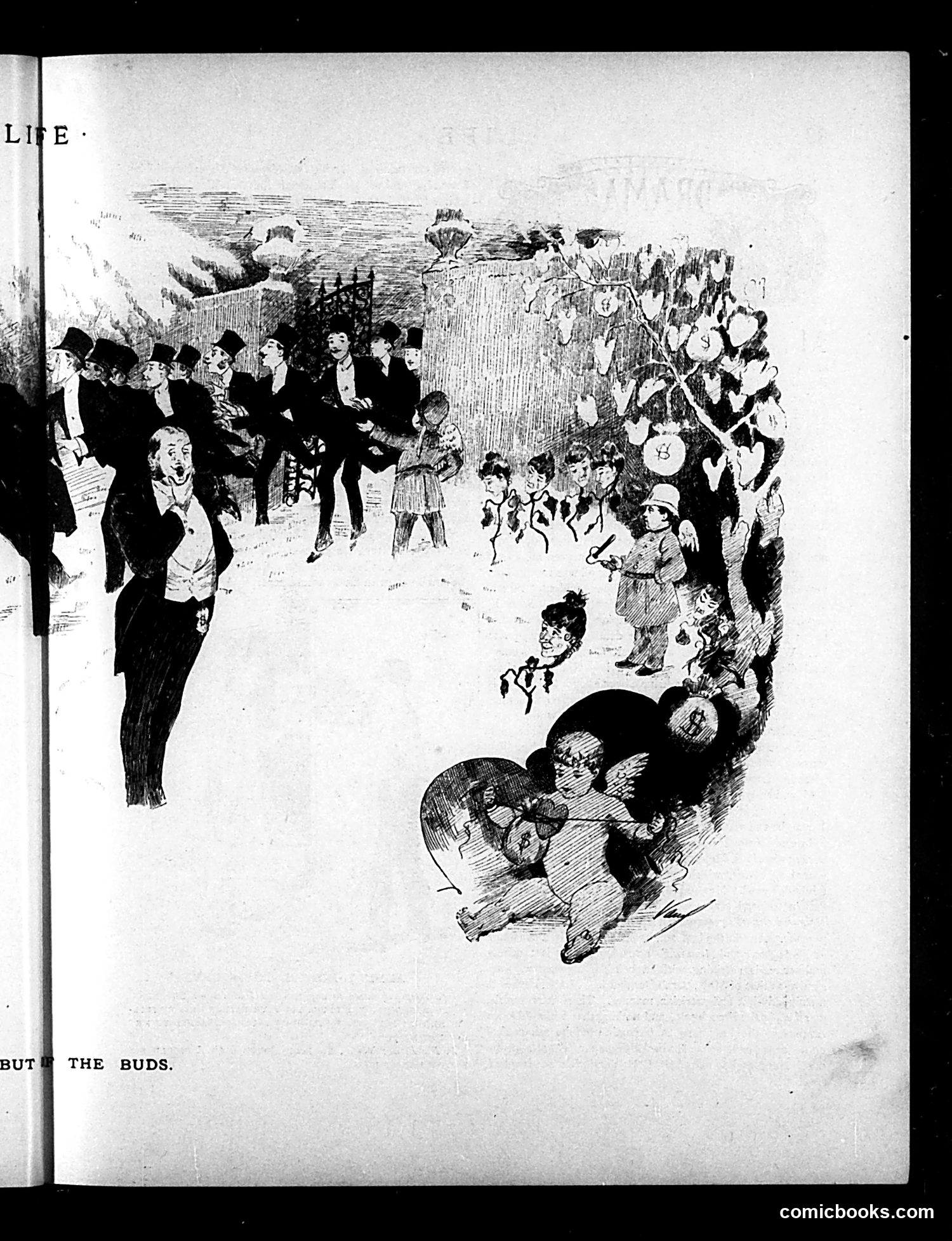
This satirical cartoon depicts what appears to be a formal garden party or social gathering of the upper classes (men in top hats and formal wear on the left) observing flowering plants. The title "But the Buds" suggests social commentary about youth or inexperience—likely satirizing how the wealthy class admires beauty or propriety in appearance while ignoring underlying issues. The cherub-like figures at the bottom right, rendered in a caricatured style, may represent children or "the buds" of society—suggesting critique of how young people are treated or viewed by the establishment. The contrast between the formal adult observers and the playful, chaotic figures below creates the satirical point, though the specific social critique remains somewhat unclear without additional historical context.
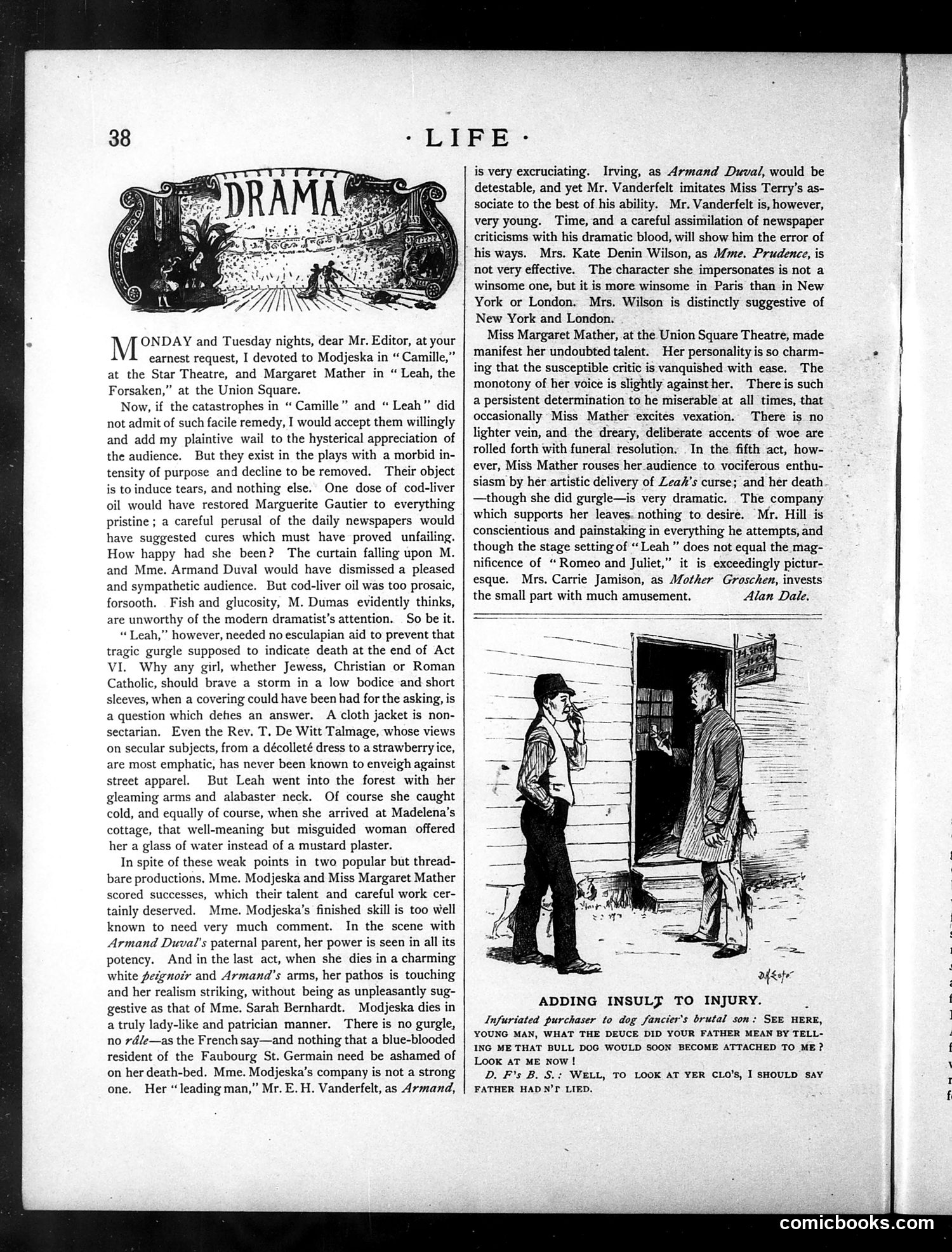
This page contains a theater review critiquing two popular stage productions: Modjeska in *Camille* and Margaret Mather in *Leah, the Forsaken*. The reviewer uses satirical humor to mock the melodramatic plots and overwrought stagecraft of these plays. The main joke targets the *absurd implausibility* of tragedy in these works. The reviewer sarcastically suggests that simple remedies—cod-liver oil, a cloth jacket, a mustard plaster—would have prevented the supposedly tragic deaths. The implicit critique: these plays manufacture emotional manipulation through contrived suffering rather than genuine dramatic necessity. The accompanying cartoon titled "ADDING INSULT TO INJURY" (below the text) depicts two working-class men in conversation, likely illustrating the contrast between theatrical melodrama and real-world practicality that the review emphasizes. The review praises the actresses' talent while dismissing the material as shallow—a common literary approach of mocking plays through praise of their performers.
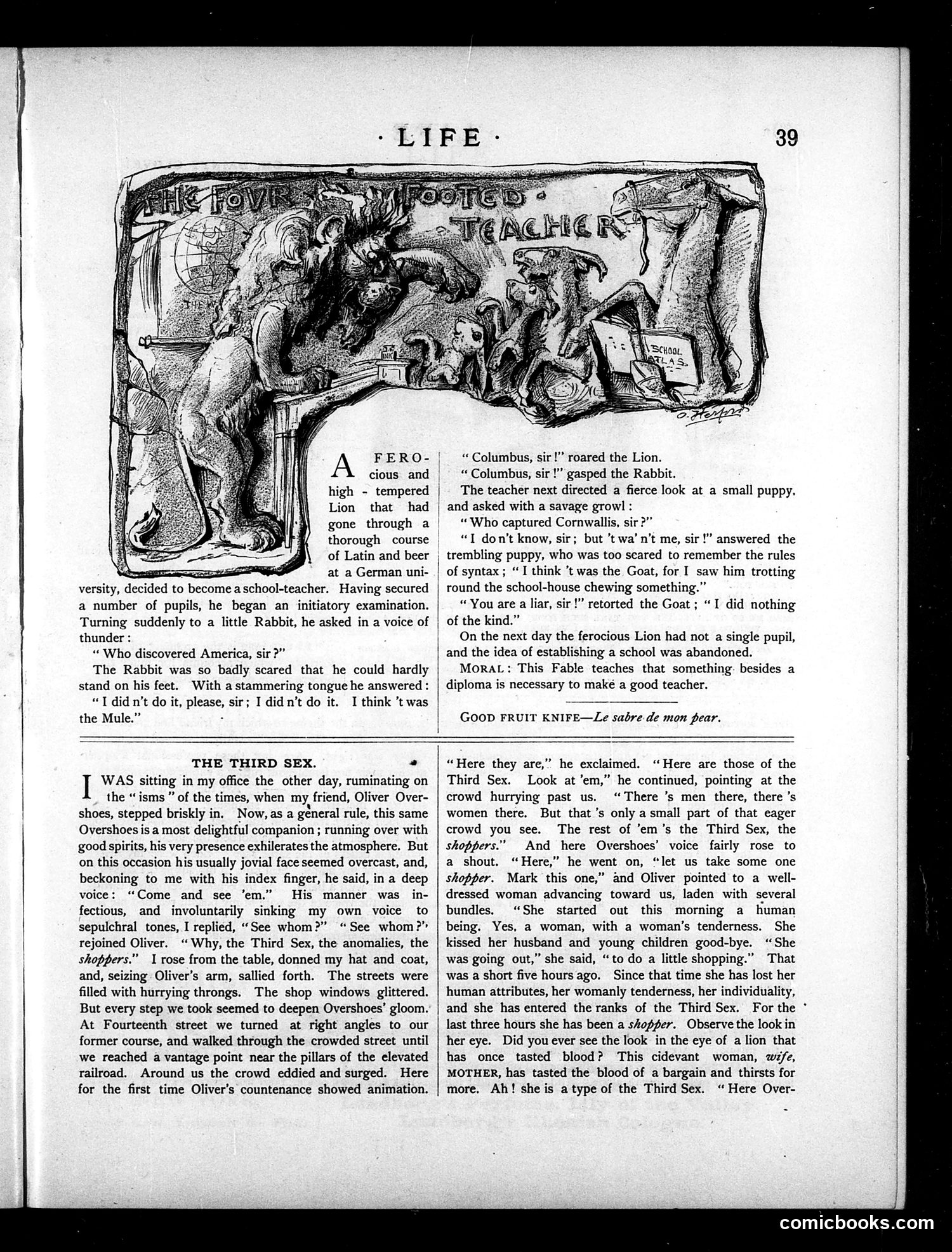
The top cartoon satirizes authoritarian teaching methods. A fierce Lion—educated but temperamentally unsuited—terrorizes animal pupils through intimidation rather than instruction. When asked about Columbus and Cornwallis, the frightened students panic and blame innocent classmates (a Goat, a Mule). The moral is direct: credentials alone don't make teachers; temperament matters. The bottom article mocks urban female shoppers as a distinct social category—"The Third Sex"—neither fully men nor women. A man observes that shopping transforms respectable wives and mothers into feral, bloodthirsty creatures, losing their humanity and individuality in pursuit of bargains. The satire targets both consumer culture's grip on women and contemporary anxiety about changing female social roles. The tone suggests disapproval of both shopping addiction and women's independent economic behavior.
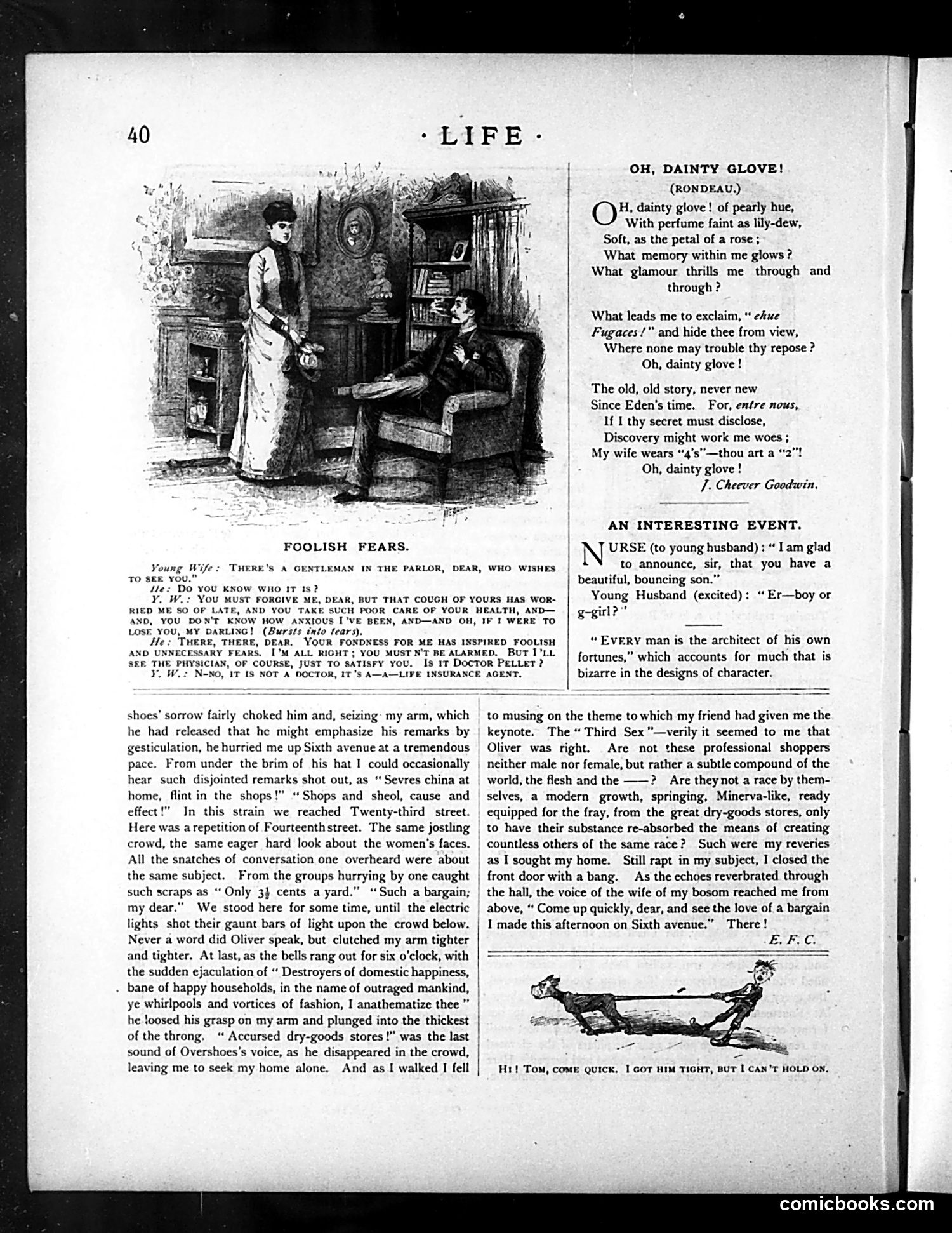
This page from *Life* (likely early 1900s) contains three satirical pieces about marriage and consumerism: **"Foolish Fears"** depicts a husband's anxiety about an unexpected male visitor—the humor lies in his wife's reassurance that it's merely a life insurance agent, not a romantic rival. The satire mocks husbands' insecurity and paranoia. **"Oh, Dainty Glove!"** is a sentimental poem with a punchline: the speaker's admiration for a woman's glove masks marital anxiety—his wife wears size "4's" (small gloves), suggesting she's unfaithful with another man wearing that size shoe. **"An Interesting Event"** satirizes a wife's overwrought concern about her husband's health, revealed when she admits her "doctor" is actually a *life insurance agent*—the joke being she's financially motivated rather than genuinely caring. The accompanying prose piece criticizes the "Third Sex"—professional female shoppers at department stores, depicted as neither fully male nor female, consumed by consumer culture and fashion obsession. The satire targets both women's shopping habits and emerging commercial culture.
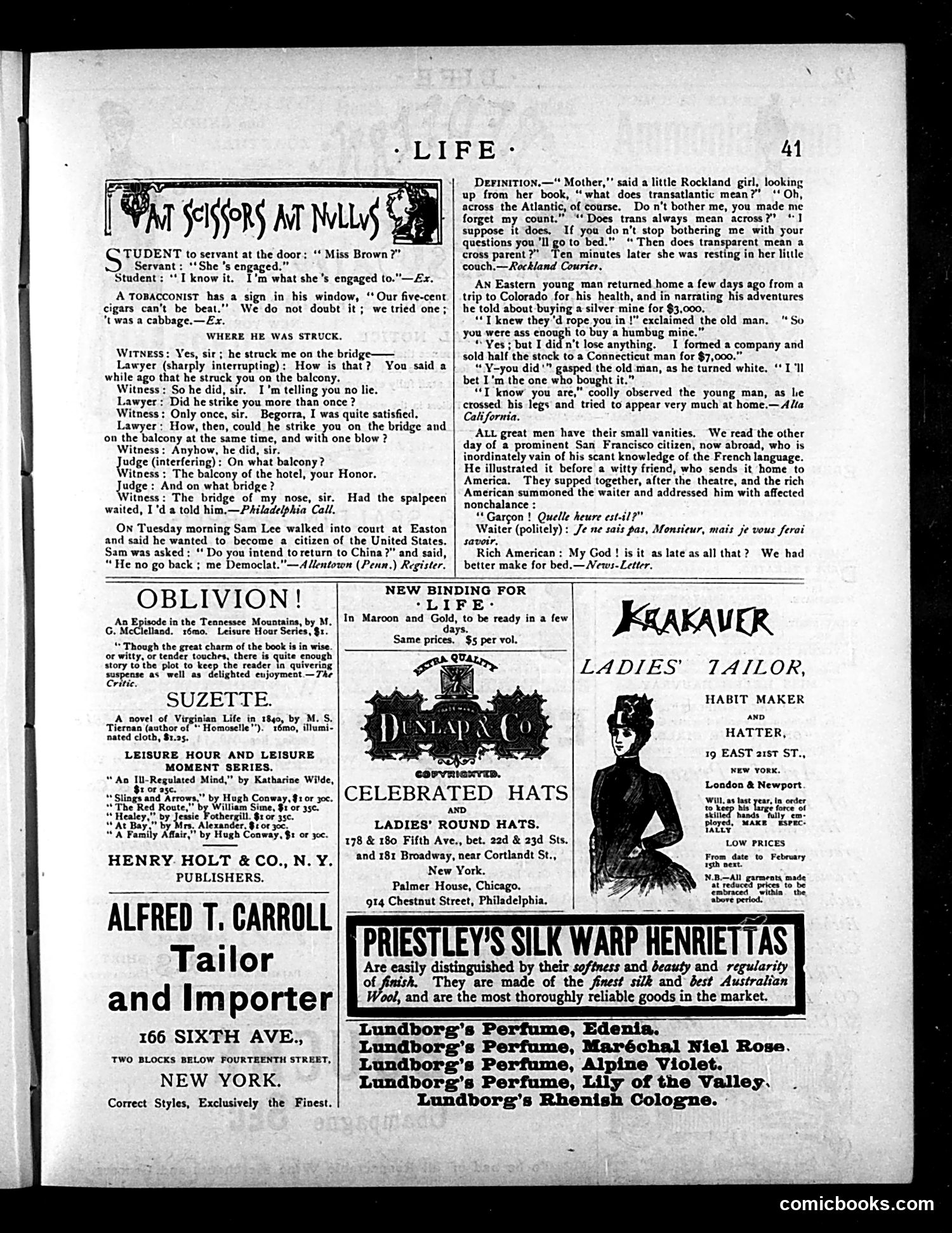
This page is primarily **advertisements and miscellaneous short jokes** rather than political cartoons requiring historical context. The humor pieces are genteel Victorian-era jokes typical of Life magazine's style: - A **student-servant exchange** about being engaged - A **tobacconist joke** mocking cheap cigars as tasting like cabbage - A **courtroom witness bit** where a lawyer catches contradictions in testimony about where someone was struck—revealed as a pun: the "bridge" is the witness's nose - A **naturalization joke** where a Chinese immigrant (rendered in dialect) says he won't return to China because "me Democrat"—satirizing both political affiliation and immigrant speech patterns - A **girl's logic joke** where she creates the pun "transparent" = "trans-parent" (cross parent) - A **Colorado mining scam anecdote** about the father unknowingly buying stock his son sold him - A **vanity joke** about a San Francisco businessman pretending French fluency to a waiter The page also advertises books, hats, perfume, and tailoring services. No significant political content is present.
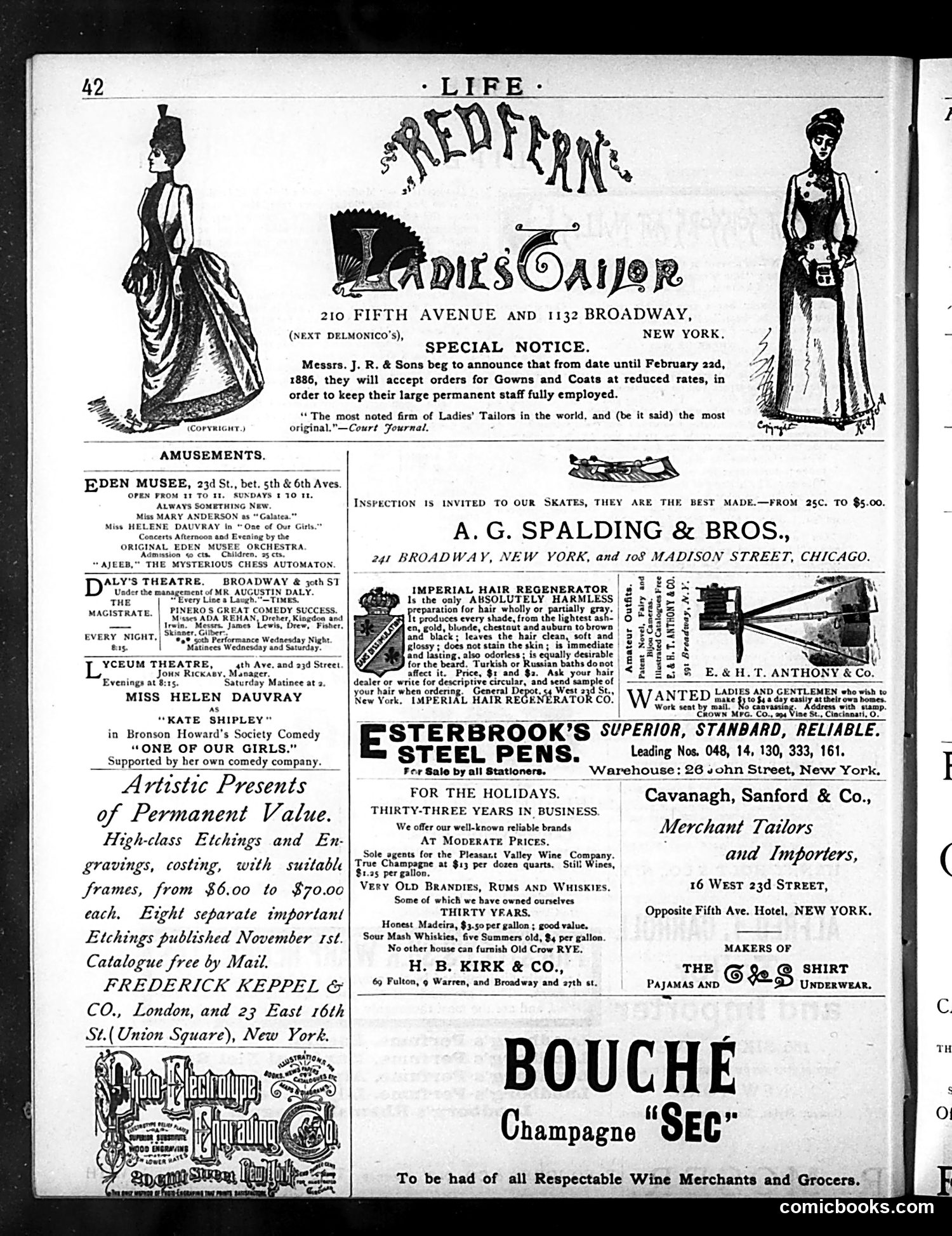
This page is primarily **advertising and notices** from Life magazine, circa 1886. Rather than containing political cartoons, it features: **Main Content:** A fashion advertisement for "Red Fern Ladies Tailor" (top center), showing two women in elaborate Victorian dress. The accompanying notice announces reduced rates on gowns and coats through February 22nd, 1886, to maintain their permanent staff. **Supporting Advertisements:** The page is filled with period commercial ads for theater performances, art etchings, hair regenerator products, steel pens, champagne, merchant tailors, and sporting goods—typical content for a wealthy urban audience. **Historical Context:** The "special notice" is notable as an early example of a business justifying discounts by claiming they needed to keep workers employed—suggesting economic pressures in the mid-1880s. The fashions and products advertised reflect Gilded Age luxury consumption. There are no political cartoons or satirical commentary visible on this particular page.
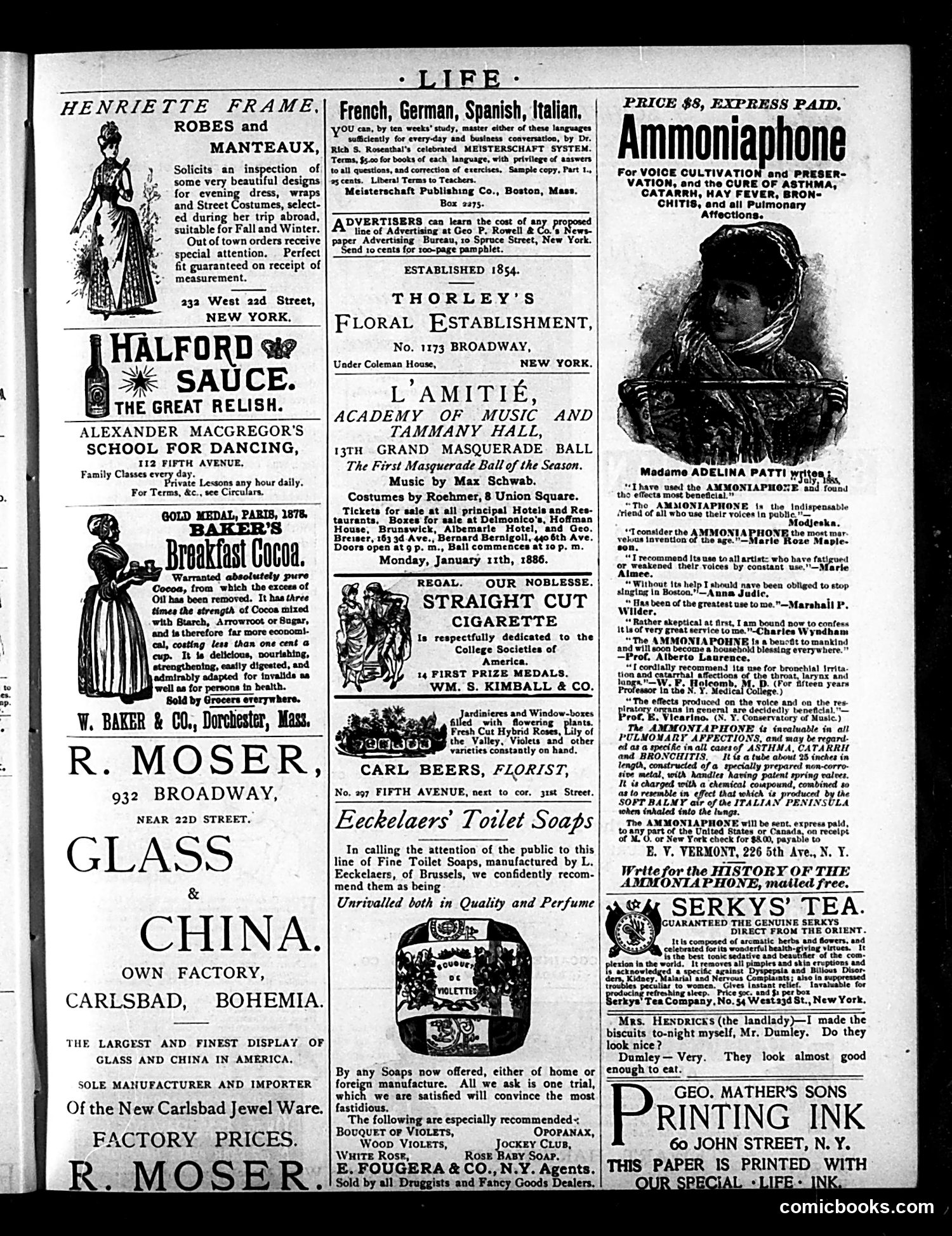
This is primarily an **advertising page** from the January 11, 1886 issue of *Life*, with minimal editorial content. The advertisements reflect late-19th-century New York consumer culture: dress designs, dancing schools, breakfast cocoa, glassware, florists, and language instruction via the "Meisterschaft System." The most notable element is an **Ammoniaphone advertisement** featuring a testimonial from Madame Adelina Patti (famous opera singer), claiming the device cultivates voice and cures respiratory ailments including asthma and bronchitis. This represents the era's promotion of dubious medical devices—a common scam of the period. The "L'Amitié" masquerade ball announcement references Tammany Hall, the notorious New York political machine, suggesting the venue's association with both elite society events and urban political power. The Straight Cut Cigarette ad's dedication to "College Societies of America" reveals how tobacco marketing targeted educated youth as status symbols. **Overall**: This page documents Victorian consumer anxieties (health, appearance, status) and the era's unregulated patent medicine/device industry.
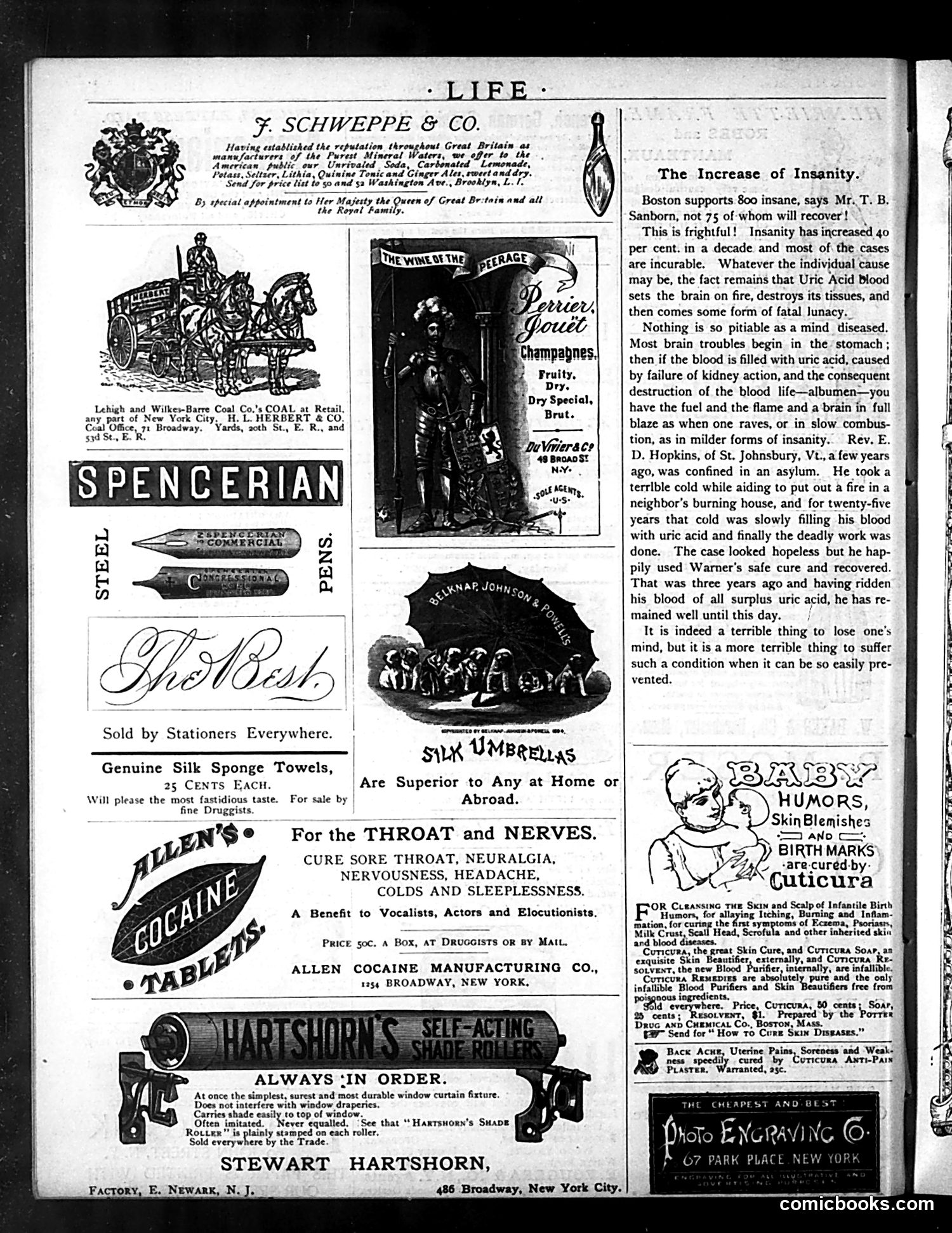
This page is primarily **advertisements** interspersed with one substantive article. The notable content is "The Increase of Insanity," which reflects period medical pseudoscience: it claims insanity stems from "uric acid blood" causing brain inflammation, resulting from kidney failure and poor digestion. The article cites a reverend cured by Warner's Safe Cure patent medicine. The ads reveal era-specific products: Allen Cocaine Tablets for throat/nerves (cocaine was legal, marketed medicinally), Cuticura remedies for skin conditions and birthmarks, and various home goods. These advertisements showcase the era's unregulated patent medicine industry and willingness to promote cocaine as therapeutic. The juxtaposition is darkly comic: Life magazine contextualizes a panic about rising insanity while simultaneously running ads for dubious "cures"—illustrating the magazine's satirical mission to expose contemporary absurdities and commercial exploitation.