
Life, 1886-01-14 · page 2 of 16
Life — January 14, 1886 — page 2: what you’re looking at
What you’re looking at
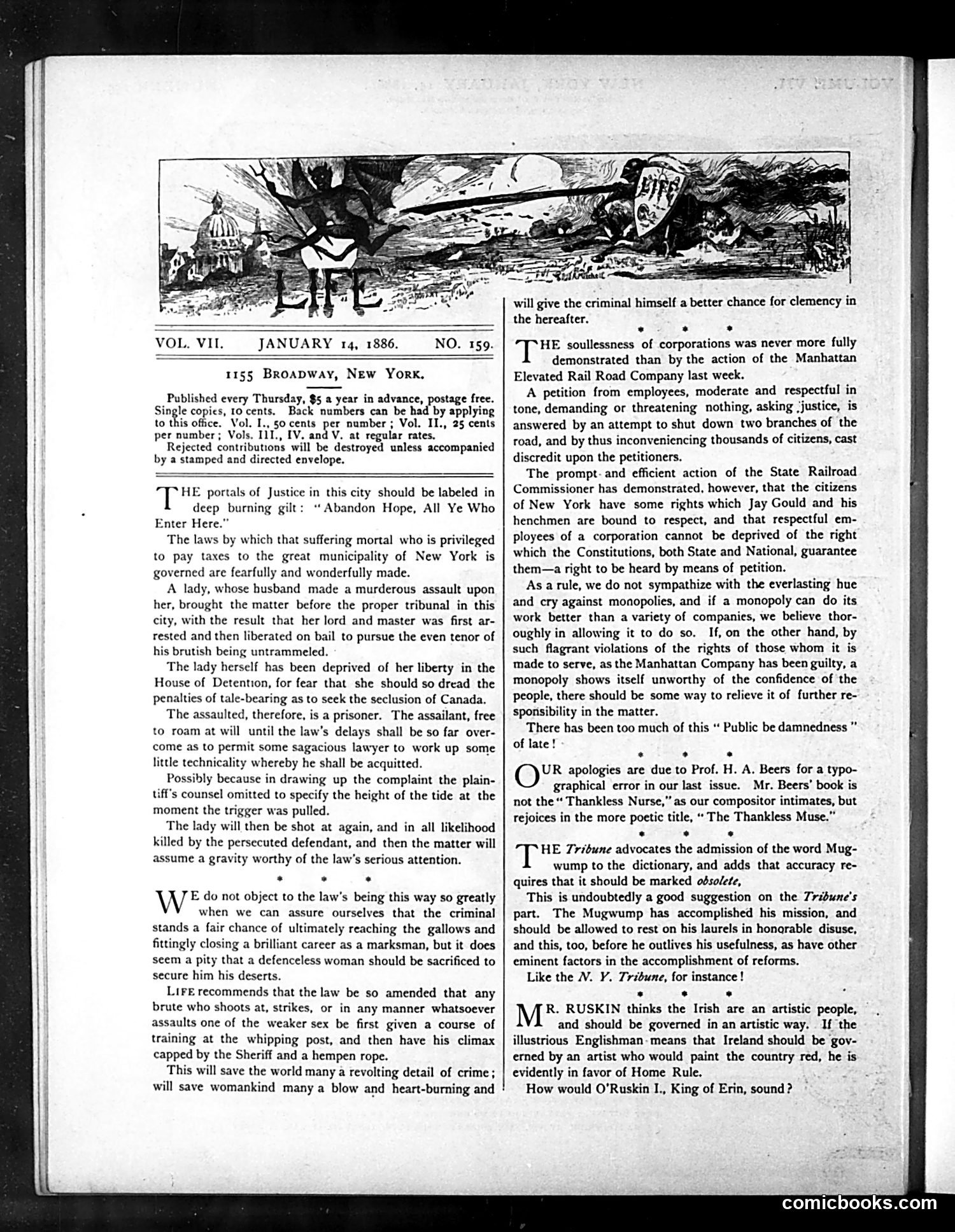
The page contains editorial commentary rather than a political cartoon. The illustrated header shows Justice with scales, but the main content discusses serious legal and corporate issues. The editorials critique: 1. **Manhattan Elevated Rail Road Company**: The company shut down two branches after employees petitioned for better working conditions, punishing workers for exercising their right to petition. 2. **Corporate power vs. individual rights**: The editors argue that monopolies like the rail company shouldn't deprive employees of constitutional protections simply because they work for corporations. 3. **A proposed law amendment**: The editors advocate for laws requiring brutal assault perpetrators to face capital punishment—suggesting execution would deter workplace violence. The tone is reform-minded, criticizing corporate abuse of power over working people.
📄 Transcribed text from this page (OCR, searchable)
Machine-transcribed from the original scan — historical spelling and the odd misread are preserved.
VOL. VII. JANUARY 14, 1886. NO. 159. 1155 Broapway, New York, Published every Thursday, $5 a year in advance, postage free. Single copies, 10 cents. Back numbers can be had by applying to this office. Vol. I., 50 cents per number ; Vol. II., 25 cents per number; Vols. IIT., IV, and V. at regular rates. Rejected contributions will be destroyed unless accompanied by a stamped and directed envelope. HE portals of Justice in this city should be labeled in deep burning gilt: “Abandon Hope, All Ye Who Enter Here.” The laws by which that suffering mortal who is privileged to pay taxes to the great municipality of New York is governed are fearfully and wonderfully made. A lady, whose husband made a murderous assault upon her, brought the matter before the proper tribunal in this city, with the result that her lord and master was first ar- rested and then liberated on bail to pursue the even tenor of his brutish being untrammeled. The lady herself has been deprived of her liberty in the House of Detention, for fear that she should so dread the penalties of tale-bearing as to seek the seclusion of Canada. The assaulted, therefore, is a prisoner. The assailant, free to roam at will until the law's delays shall be so far over- come as to permit some sagacious lawyer to work up some little technicality whereby he shall be acquitted. Possibly because in drawing up the complaint the plain- Uff’s counsel omitted to specify the height of the tide at the moment the trigger was pulled. The lady will then be shot at again, and in all likelihood killed by the persecuted defendant, and then the matter will assume a gravity worthy of the law's serious attention. WE do not object to the law's being this way so greatly when we can assure ourselves that the criminal stands a fair chance of ultimately reaching the gallows and fittingly closing a brilliant career as a marksman, but it does seem a pity that a defenceless woman should be sacrificed to secure him his deserts. LIFE recommends that the law be so amended that any brute who shoots at, strikes, or in any manner whatsoever assaults one of the weaker sex be first given a course of training at the whipping post, and then have his climax capped by the Sheriff and a hempen rope. This will save the world many a revolting detail of crime; will save womankind many a blow and heart-burning and ! will give the criminal himself a better chance for clemency in the hereafter. . * . “(see soullessness of corporations was never more fully demonstrated than by the action of the Manhattan Elevated Rail Road Company last week. A petition from employees, moderate and respectful in tone, demanding or threatening nothing, asking justice, is answered by an attempt to shut down two branches of the road, and by thus inconveniencing thousands of citizens, cast discredit upon the petitioners. The prompt. and efficient action of the State Railroad Commissioner has demonstrated, however, that the citizens of New York have some rights which Jay Gould and his henchmen are bound to respect, and that respectful em- ployees of a corporation cannot be deprived of the right which the Constitutions, both State and National, guarantee them—a right to be heard by means of petition. As a tule, we do not sympathize with the everlasting hue and cry against monopolies, and if a monopoly can do its work better than a variety of companies, we believe thor- oughly in allowing it to do so. If, on the other hand, by such flagrant violations of the rights of those whom it is made to serve, as the Manhattan Company has been guilty, a monopoly shows itself unworthy of the confidence of the people, there should be some way to relieve it of further re- sponsibility in the matter. There has been too much of this “ Public be damnedness ” of late! . ° . UR apologies are due to Prof. H. A. Beers for a typo- graphical error in our last issue. Mr. Beers’ book is not the “ Thankless Nurse,” as our compositor intimates, but rejoices in the more poetic title, “ The Thankless Muse.” . . . HE Tribune advocates the admission of the word Mug- wump to the dictionary, and adds that accuracy re- quires that it should be marked obsolete, This is undoubtedly a good suggestion on the Tribune's part. The Mugwump has accomplished his mission, and should be allowed to rest on his laurels in honarable disuse, and this, too, before he outlives his usefulness, as have other eminent factors in the accomplishment of reforms. Like the V. Y. Tribune, for instance! . . . R. RUSKIN thinks the Irish are an artistic people, and should be governed in an artistic way. If the illustrious Englishman-means that Ireland should be gov- erned by an artist who would paint the country red, he is evidently in favor of Home Rule. How would O’Ruskin I., King of Erin, sound? comicbooks.com