
Life, 1886-01-14 · page 6 of 16
Life — January 14, 1886 — page 6: what you’re looking at
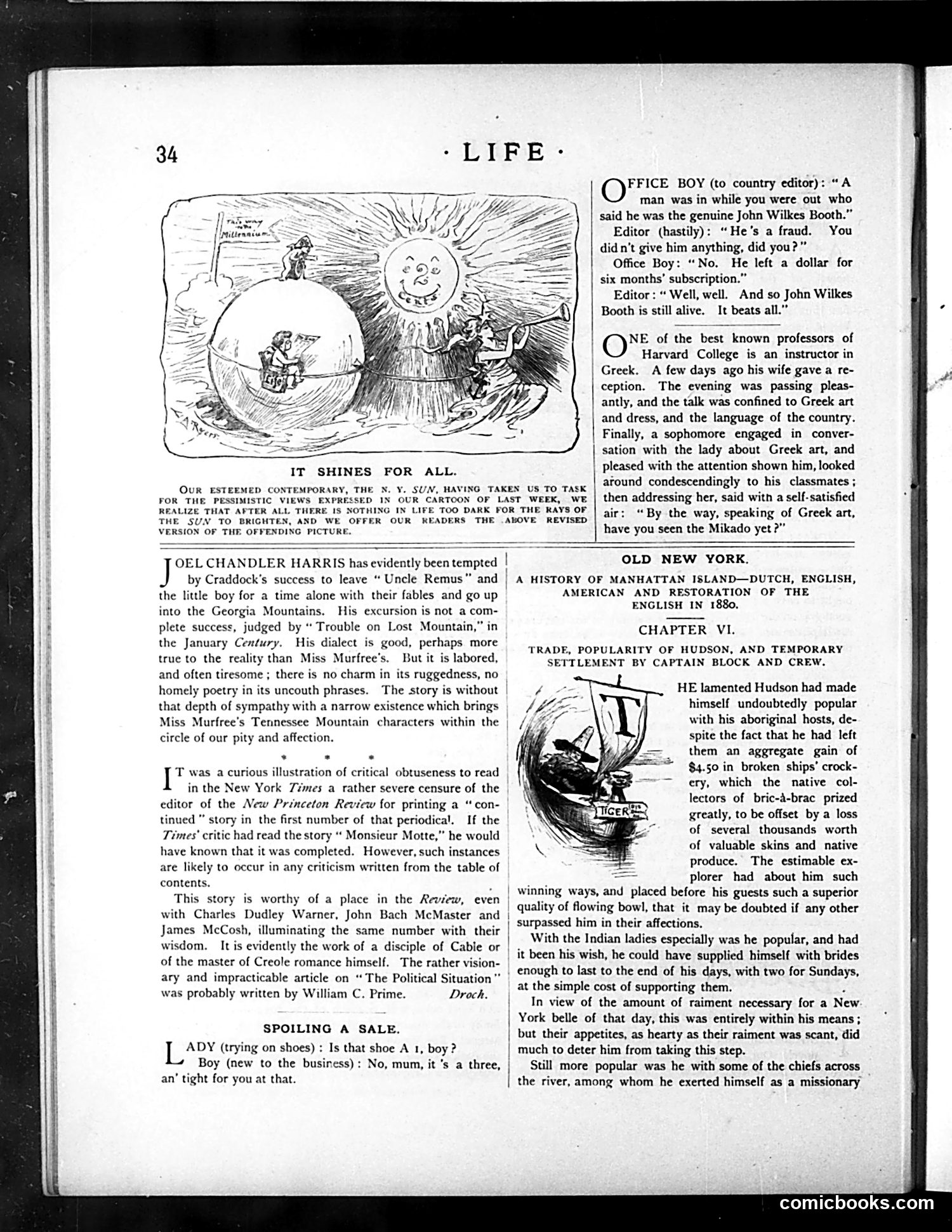
What you’re looking at
This cartoon satirizes the **N.Y. Sun newspaper's** claim to universal appeal. The image depicts a massive sun with a smiling face radiating light equally onto figures below—some wealthy (in a globe/dome), others poor or ordinary. The satire's point: the Sun's boast of serving "all" readers is hollow. Despite claiming to shine equally for everyone, newspapers inevitably favor certain audiences and viewpoints. The exaggerated, utopian imagery of impartial sunshine mocks the pretense that any commercial publication serves truly universal interests without bias. This reflects **Gilded Age criticism** of media monopolies and their misleading democratic rhetoric—a joke modern readers would recognize in discussions of media neutrality claims.
📄 Transcribed text from this page (OCR, searchable)
Machine-transcribed from the original scan — historical spelling and the odd misread are preserved.
FFICE BOY (to country editor) man was in while you were out who said he was the genuine John Wilkes Booth.” Editor (hastily): “He's a fraud. You didn’t give him anything, did you?” Office Boy: “No. He left a dollar for six months’ subscription.” Editor : “ Well, well. And so John Wilkes Booth is still alive. It beats all.” NE of the best known professors of Harvard College is an instructor in | Greek. A few days ago his wife gave a re- ception. The evening was passing pleas- antly, and the talk was confined to Greek art | and dress, and the language of the country. Finally, a sophomore engaged in conver- IT SHINES FOR ALL. Our ESTEEMED CON FOR THE PESSIMISTIC V! HING EMPORARY, THE N. Y. SUN, HAVING TAKEN US TO TASK PRESSED IN OUR CARTOON OF LAST WEEK, IN LIFE TOO DARK FOR THE RAYS OF sation with the lady about Greek art, and pleased with the attention shown him, looked around condescendingly to his classmates ; then addressing her, said witn a self-satisfied air: ‘By the way, speaking of Greek art, have you seen the Mikado yet ?” WE OEL CHANDLER HARRIS has evidently been tempted J by Craddock’s success to leave “ Uncle Remus” and the little boy for a time alone with their fables and go up into the Georgia Mountains. His excursion is not a com- plete success, judged by “ Trouble on Lost Mountain,” in the January Century. His dialect is good, perhaps more true to the reality than Miss Murfree’s. But it is labored, and often tiresome ; there is no charm in its ruggedness, no homely poetry in its uncouth phrases. that depth of sympathy with a narrow existence which brings Miss Murfree’s Tennessee Mountain characters within the | circle of our pity and affection. T was a curious illustration of critical obtuseness to read in the New York 7imes a rather severe censure of the editor of the New Princeton Review for printing a “ con- tinued ” story in the first number of that periodical. If the Times’ critic had read the story “‘ Monsieur Motte,” he would have known that it was completed. However, such instances are likely to occur in any criticism written from the table of contents. : This story is worthy of a place in the Review, even with Charles Dudley Warner, John Bach McMaster and James McCosh, illuminating the same number with their wisdom. It is evidently the work of a disciple of Cable or of the master of Creole romance himself. The rather vision- ary and impracticable article on “ The Political Situation” was probably written by William C. Prime. Droch. SPOILING A SALE, | Rags (trying on shoes) : Is that shoe A 1, boy ? Boy (new to the business): No, mum, it 's a three, an’ tight for you at that. The story is without | | OLD NEW YORK. | A HISTORY OF MANHATTAN ISLAND—DUTCH, ENGLISH, | AMERICAN AND RESTORATION OF THE ENGLISH IN 1880, CHAPTER VI. TRADE, POPULARITY OF HUDSON, AND TEMPORARY SETTLEMENT BY CAPTAIN BLOCK AND CREW. HE lamented Hudson had made himself undoubtedly popular with his aboriginal hosts, de- spite the fact that he had left them an aggregate gain of $4.50 in broken ships’ crock- ery, which the native col- lectors of bric-4-brac prized greatly, to be offset by a loss of several thousands worth of valuable skins and native produce. The estimable ex- plorer had about him such | winning ways, and placed before his guests such a superior | quality of flowing bowl, that it may be doubted if any other surpassed him in their affections. | | With the Indian ladies especially was he popular, and had it been his wish, he could have supplied himself with brides enough to last to the end of his days, with two for Sundays, at the simple cost of supporting them. és In view of the amount of raiment necessary for a New | York belle of that day, this was entirely within his means ; | but their appetites, as hearty as their raiment was scant, did | much to deter him from taking this step. | Still more popular was he with some of the chiefs across | the river, among whom he exerted himself as a missionary comicbooks.com