
Life, 1886-01-14 · page 5 of 16
Life — January 14, 1886 — page 5: what you’re looking at
What you’re looking at
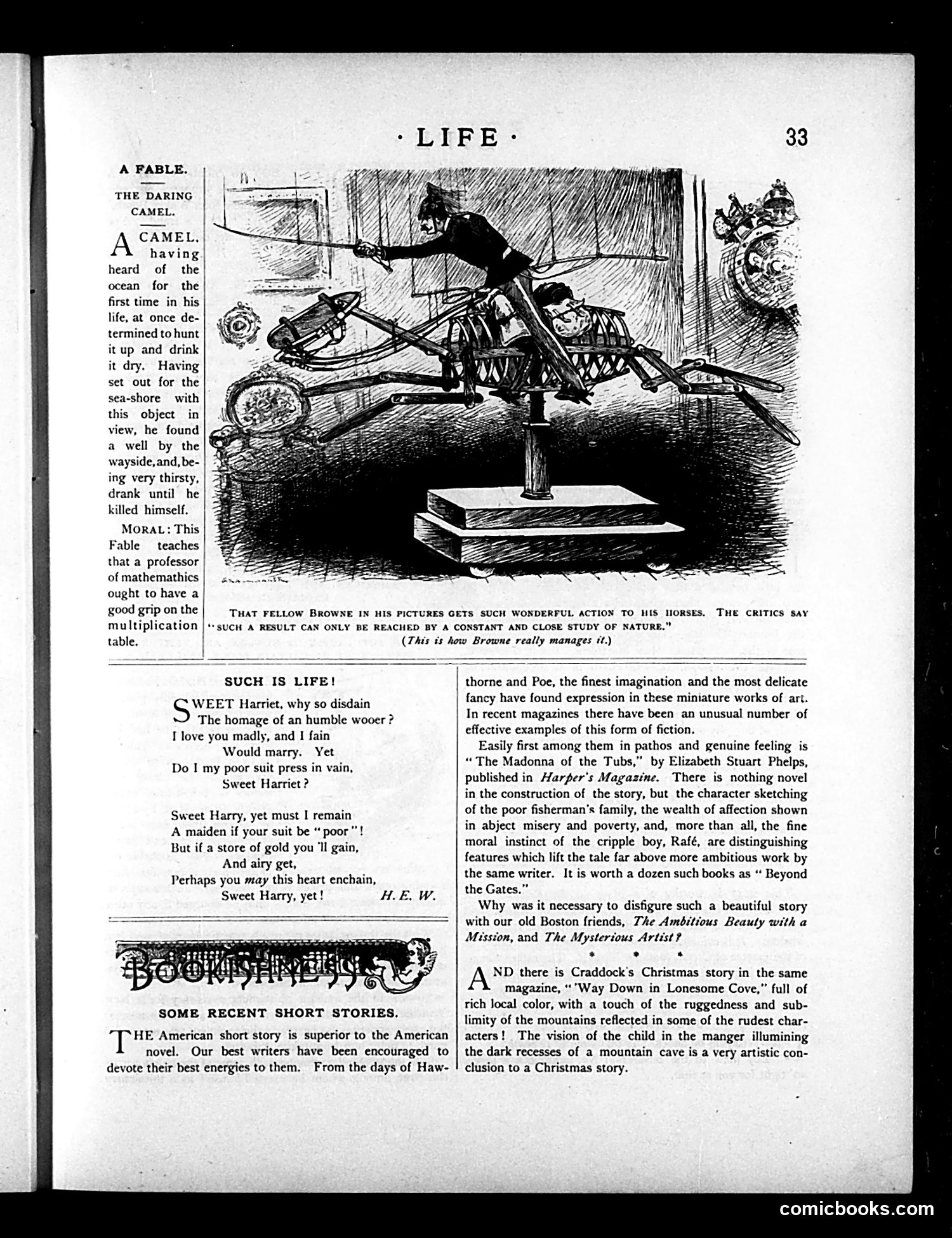
The main illustration depicts **"The Daring Camel,"** a fable about a camel who ventures to the ocean for the first time seeking to drink seawater, becomes excessively thirsty, and drinks until death. The moral warns that "a professor of mathematics ought to have a good grip on the multiplication table." The accompanying illustration shows a acrobatic performer (labeled "Browne") executing complex maneuvers on horses, captioned as demonstrating "wonderful action." This appears to celebrate the performer's skill and natural observation. Below, "Such Is Life!" is a sentimental poem addressed to "Sweet Harriet" about love, longing, and maintaining hope despite hardship—typical Victorian-era romantic verse. The page primarily contains literary and artistic content rather than political satire, focusing on fables, short story recommendations, and romantic poetry.
📄 Transcribed text from this page (OCR, searchable)
Machine-transcribed from the original scan — historical spelling and the odd misread are preserved.
A FABLE. THE DARING CAMEL. | i} CAMEL, | having] heard of the ocean for the first time in his life, at once de- termined to hunt it up and drink it dry. Having set out for the sea-shore with this object in view, he found a well by the wayside, and, be- ing very thirsty, drank until he killed himself. MoRAL: This Fable teaches that a professor of mathemathics ought to have a good grip on the multiplication table. | THAT FELLOW BROWNE IN HIS PICTURES GETS SUCH WONDERFUL ACTION TO HIS HORSES. THE CRITICS SAY ‘SUCH A RESULT CAN ONLY BE REACHED BY A CONSTANT AND CLOSE STUDY OF NATURE.” (This is how Browne really manages tt.) SUCH IS LIFE! WEET Harriet, why so disdain The homage of an humble wooer ? T love you madly, and I fain Would marry. Yet Do I my poor suit press in vain, Sweet Harriet? Sweet Harry, yet must I remain A maiden if your suit be “ poor”! But ifa store of gold you ‘Il gain, And airy get, Perhaps you may this heart enchain, Sweet Harry, yet! H.E. W. SOME RECENT SHORT STORIES. HE American short story is superior to the American novel. Our best writers have been encouraged to devote their best energies to them. From the days of Haw- thorne and Poe, the finest imagination and the most delicate fancy have found expression in these miniature works of art. In recent magazines there have been an unusual number of effective examples of this form of fiction. Easily first among them in pathos and genuine feeling is “The Madonna of the Tubs,” by Elizabeth Stuart Phelps, published in Harper's Magazine. There is nothing novel in the construction of the story, but the character sketching of the poor fisherman's family, the wealth of affection shown in abject misery and poverty, and, more than all, the fine moral instinct of the cripple boy, Rafé, are distinguishing features which lift the tale far above more ambitious work by the same writer. It is worth a dozen such books as “‘ Beyond the Gates.” Why was it necessary to disfigure such a beautiful story with our old Boston friends, The Ambitious Beauly with a Mission, and The Mysterious Artist? . . . ND there is Craddock’s Christmas story in the same magazine, "Way Down in Lonesome Cove,” full of rich local color, with a touch of the ruggedness and sub- limity of the mountains reflected in some of the rudest char- acters! The vision of the child in the manger illumining the dark recesses of a mountain cave is a very artistic con- clusion to a Christmas story. comicbooks.com