
Life, 1886-01-14 · page 10 of 16
Life — January 14, 1886 — page 10: what you’re looking at
What you’re looking at
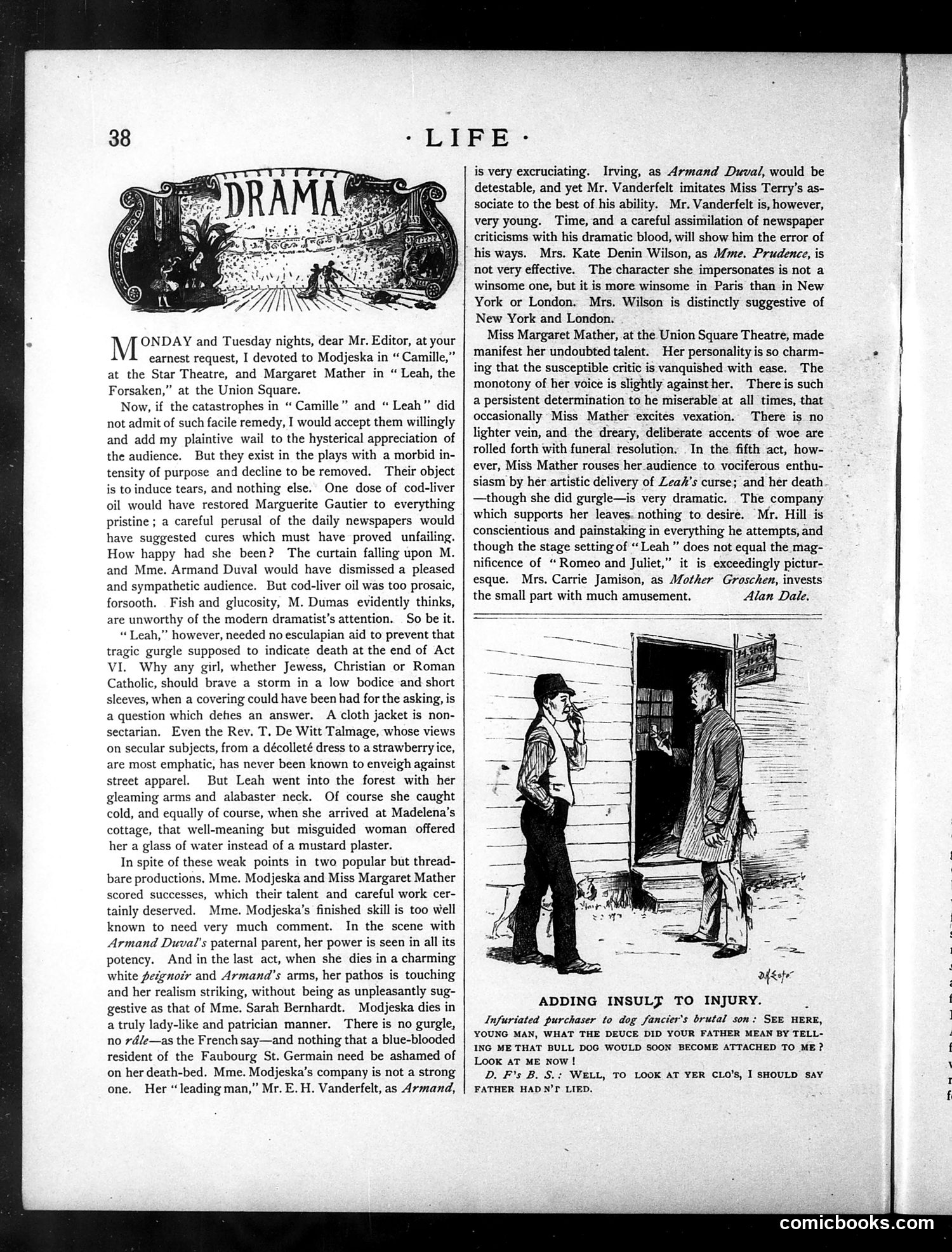
This page contains a theater review critiquing two popular stage productions: Modjeska in *Camille* and Margaret Mather in *Leah, the Forsaken*. The reviewer uses satirical humor to mock the melodramatic plots and overwrought stagecraft of these plays. The main joke targets the *absurd implausibility* of tragedy in these works. The reviewer sarcastically suggests that simple remedies—cod-liver oil, a cloth jacket, a mustard plaster—would have prevented the supposedly tragic deaths. The implicit critique: these plays manufacture emotional manipulation through contrived suffering rather than genuine dramatic necessity. The accompanying cartoon titled "ADDING INSULT TO INJURY" (below the text) depicts two working-class men in conversation, likely illustrating the contrast between theatrical melodrama and real-world practicality that the review emphasizes. The review praises the actresses' talent while dismissing the material as shallow—a common literary approach of mocking plays through praise of their performers.
📄 Transcribed text from this page (OCR, searchable)
Machine-transcribed from the original scan — historical spelling and the odd misread are preserved.
ONDAY and Tuesday nights, dear Mr. Editor, at your earnest request, I devoted to Modjeska in “ Camille,” at the Star Theatre, and Margaret Mather in “ Leah, the Forsaken,” at the Union Square. Now, if the catastrophes in “ Camille” and “ Leah” did not admit of such facile remedy, I would accept them willingly and add my plaintive wail to the hysterical appreciation of the audience. But they exist in the plays with a morbid in- tensity of purpose and decline to be removed. Their object is to induce tears, and nothing else. One dose of cod-liver oil would have restored Marguerite Gautier to everything pristine ; a careful perusal of the daily newspapers would have suggested cures which must have proved unfailing. How happy had she been? The curtain falling upon M. and Mme. Armand Duval would have dismissed a pleased and sympathetic audience. But cod-liver oil was too prosaic, forsooth. Fish and glucosity, M. Dumas evidently thinks, are unworthy of the modern dramatist’s attention. So be it. “Leah,” however, needed no esculapian aid to prevent that tragic gurgle supposed to indicate death at the end of Act VI. Why any girl, whether Jewess, Christian or Roman Catholic, should brave a storm in a low bodice and short sleeves, when a covering could have been had for the asking, is a question which dehes an answer. A cloth jacket is non- sectarian. Even the Rev. T, De Witt Talmage, whose views on secular subjects, from a décolleté dress to a strawberry ice, are most emphatic, has never been known to enveigh against street apparel. But Leah went into the forest with her gleaming arms and alabaster neck. Of course she caught cold, and equally of course, when she arrived at Madelena’s cottage, that well-meaning but misguided woman offered her a glass of water instead of a mustard plaster. In spite of these weak points in two popular but thread- bare productions, Mme. Modjeska and Miss Margaret Mather scored successes, which their talent and careful work cer- tainly deserved. Mme. Modjeska’s finished skill is too well known to need very much comment. In the scene with Armand Duvat's paternal parent, her power is seen in all its potency. And in the last act, when she dies in a charming white pedgnozr and Armana’s arms, her pathos is touching and her realism striking, without being as unpleasantly sug- gestive as that of Mme. Sarah Bernhardt. Modjeska dies in a truly lady-like and patrician manner. There is no gurgle, no rd/e—as the French say—and nothing that a blue-blooded resident of the Faubourg St. Germain need be ashamed of on her death-bed. Mme. Modjeska’s company is not a strong one. Her “leading man,” Mr. E. H. Vanderfelt, as Armand, “EEE = is very excruciating. Irving, as Armand Duval, would be detestable, and yet Mr. Vanderfelt imitates Miss Terry’s as- sociate to the best of his ability. Mr. Vanderfelt is, however, very young. Time, and a careful assimilation of newspaper criticisms with his dramatic blood, will show him the error of his ways. Mrs. Kate Denin Wilson, as Mme. Prudence, is not very effective. The character she impersonates is not a winsome one, but it is more winsome in Paris than in New York or London. Mrs. Wilson is distinctly suggestive of New York and London. Miss Margaret Mather, at the Union Square Theatre, made manifest her undoubted talent. Her personality is so charm- ing that the susceptible critic is vanquished with ease. The monotony of her voice is slightly againsther. There is such a persistent determination to he miserable at all times, that occasionally Miss Mather excites vexation. There is no lighter vein, and the dreary, deliberate accents of woe are rolled forth with funeral resolution. In the fifth act, how- ever, Miss Mather rouses her audience to vociferous enthu- siasm by her artistic delivery of Zeah’s curse; and her death —though she did gurgle—is very dramatic. The company which supports her leaves. nothing to desire. Mr. Hill is conscientious and painstaking in everything he attempts, and though the stage setting of “Leah ” does not equal the mag- nificence of “ Romeo and Juliet,” it is exceedingly pictur- esque. Mrs. Carrie Jamison, as Mother Groschen, invests the small part with much amusement. Alan Dale, D <efer ADDING INSULJ TO INJURY. Infuriated purchaser to dog fancier's brutal son: SEE HERE, YOUNG MAN, WHAT THE DEUCE DID YOUR FATHER MEAN BY TELL- ING ME THAT BULL DOG WOULD SOON BECOME ATTACHED TO ME? Loox aT ME Now! D. F's B. S.: WELL, TO LOOK AT YER CLO’S, I SHOULD SAY FATHER HADN'T LIED. comicbooks.com