
Life, 1886-01-14 · page 7 of 16
Life — January 14, 1886 — page 7: what you’re looking at
What you’re looking at
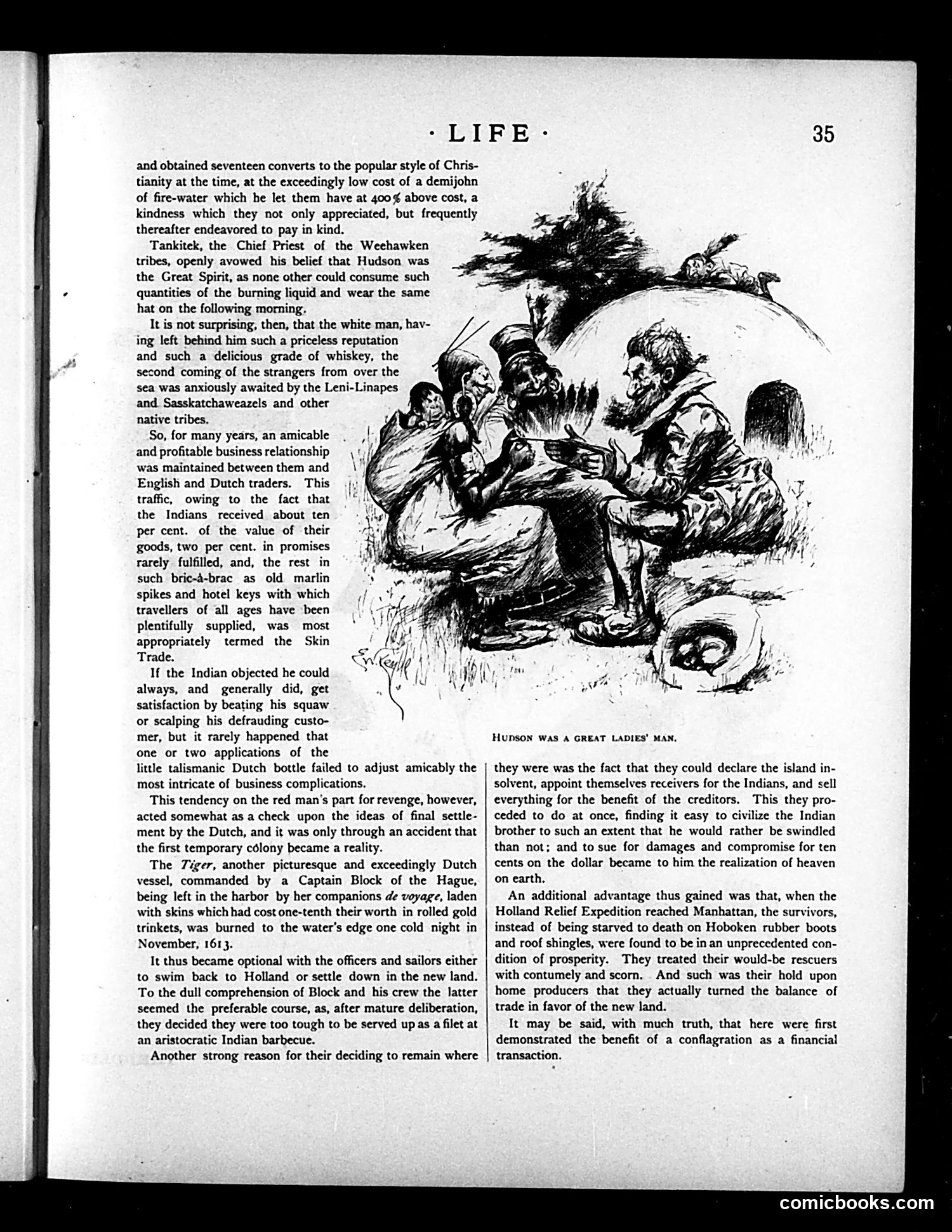
The illustration depicts a trading scene between European traders and Native Americans, captioned "HUDSON WAS A GREAT LADIES' MAN." The cartoon satirizes Henry Hudson's reputation and early colonial commerce. The image shows Hudson (center, in European dress) engaged in what appears to be fur trading or commercial exchange with Native Americans. The satire likely comments on Hudson's legendary charm ("ladies' man") being applied to conducting advantageous business dealings with Indigenous peoples—treating commercial negotiations as a form of seduction or manipulation. The accompanying text discusses how English and Dutch traders exploited Native Americans through unfair exchanges, paying only 10-15% of goods' value while distributing liquor and trinkets. The cartoon thus ironically mocks Hudson's reputation while the text critiques colonial commercial practices as fundamentally deceptive and exploitative.
📄 Transcribed text from this page (OCR, searchable)
Machine-transcribed from the original scan — historical spelling and the odd misread are preserved.
- LIFE: and obtained seventeen converts to the popular style of Chris- tianity at the time, at the exceedingly low cost of a demijohn of fire-water which he let them have at 400% above cost, a kindness which they not only appreciated, but frequently thereafter endeavored to pay in kind. Tankitek, the Chief Priest of the Weehawken tribes, openly avowed his belief that Hudson was the Great Spirit, as none other could consume such quantities of the burning liquid and wear the same hat on the following morning. It is not surprising, then, that the white man, hav- ing left behind him such a priceless reputation and such a delicious grade of whiskey, the second coming of the strangers from over the sea was anxiously awaited by the Leni-Linapes and. Sasskatchaweazels and other native tribes. So, for many years, an amicable and profitable business relationship was maintained between them and English and Dutch traders. This traffic, owing to the fact that the Indians received about ten per cent. of the value of their goods, two per cent. in promises rarely fulfilled, and, the rest in such bric-A-brac as old marlin spikes and hotel keys with which travellers of all ages have been plentifully supplied, was most appropriately termed the Skin Trade. If the Indian objected he could always, and generally did, get satisfaction by beating his squaw or scalping his defrauding custo- mer, but it rarely happened that one or two applications of the little talismanic Dutch bottle failed to adjust amicably the most intricate of business complications. This tendency on the red man’s part for revenge, however, acted somewhat as a check upon the ideas of final settle- ment by the Dutch, and it was only through an accident that the first temporary colony became a reality. The Tiger, another picturesque and exceedingly Dutch vessel, commanded by a Captain Block of the Hague, being left in the harbor by her companions de voyage, laden with skins which had cost one-tenth their worth in rolled gold trinkets, was burned to the water's edge one cold night in November, 1613. It thus became optional with the officers and sailors either to swim back to Holland or settle down in the new land. To the dull comprehension of Block and his crew the latter seemed the preferable course, as, after mature deliberation, they decided they were too tough to be served up as a filet at an aristocratic Indian barbecue. Another strong reason for their deciding to remain where HUDSON WAS A GREAT LADIES’ MAN, they were was the fact that they could declare the island in- solvent, appoint themselves receivers for the Indians, and sell everything for the benefit of the creditors. This they pro- ceded to do at once, finding it easy to civilize the Indian brother to such an extent that he would rather be swindled than not; and to sue for damages and compromise for ten cents on the dollar became to him the realization of heaven on earth. An additional advantage thus gained was that, when the Holland Relief Expedition reached Manhattan, the survivors, instead of being starved to death on Hoboken rubber boots and roof shingles, were found to be in an unprecedented con- dition of prosperity. They treated their would-be rescuers with contumely and scorn, And such was their hold upon home producers that they actually turned the balance of trade in favor of the new land. It may be said, with much truth, that here were first demonstrated the benefit of a conflagration as a financial transaction. comicbooks.com