
A complete issue · 19 pages · 1885
Life — December 24, 1885
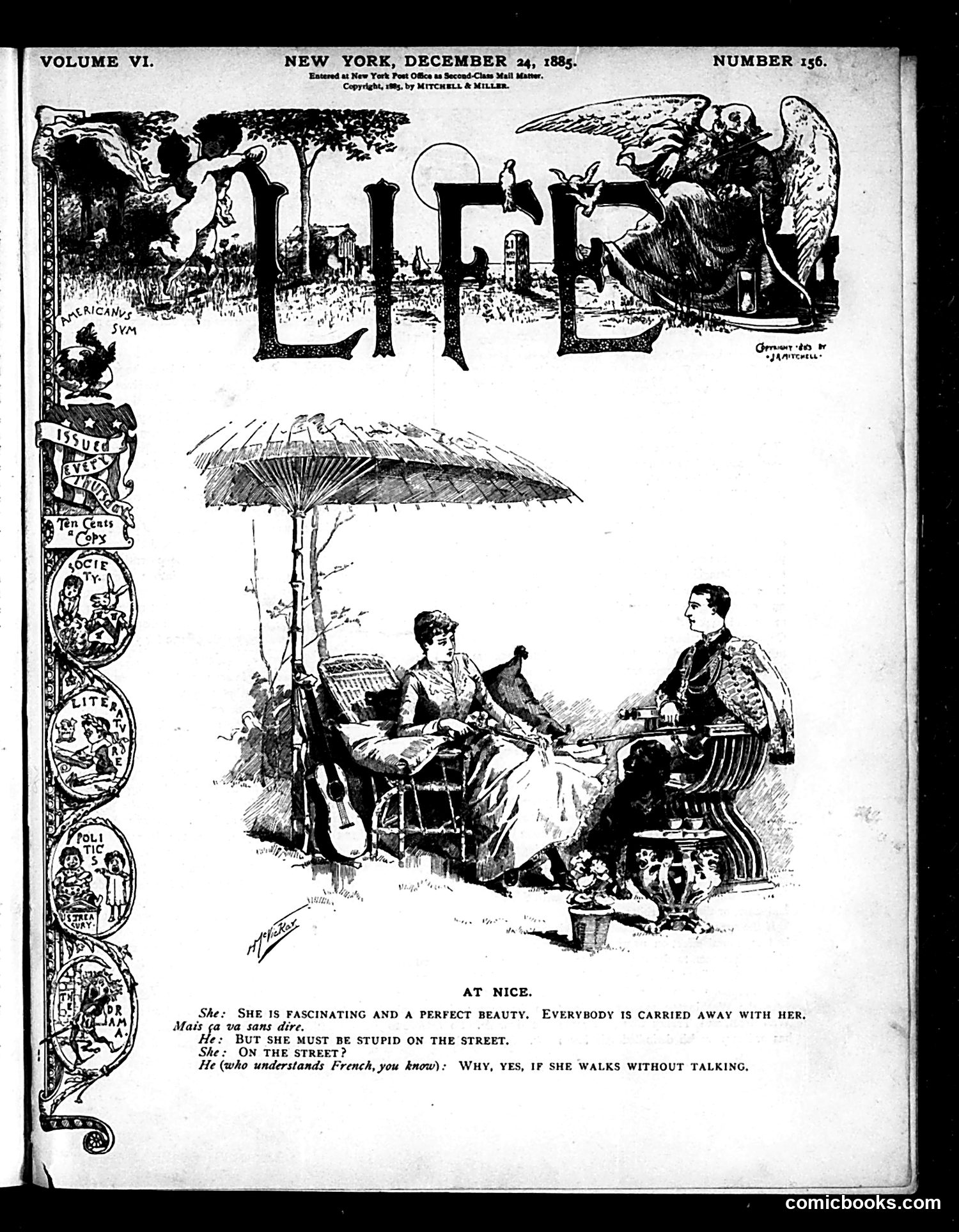
This is a humorous dialogue about a woman observed at Nice (the French Riviera resort). The joke relies on a gender stereotype: a male observer (apparently French-speaking) notes the woman is "fascinating and a perfect beauty" who "captivates" everyone. His companion counters that "she must be stupid on the street," questioning her intelligence. When asked why, the French-speaker delivers the punchline: "Why, yes, if she walks without talking"—implying that a woman who remains silent must be stupid, since women are stereotyped as incapable of shutting up. The satire mocks both misogynist assumptions about female intelligence and the cliché of talkative women. It's period humor playing on contemporary gender stereotypes for a wealthy, leisured audience.
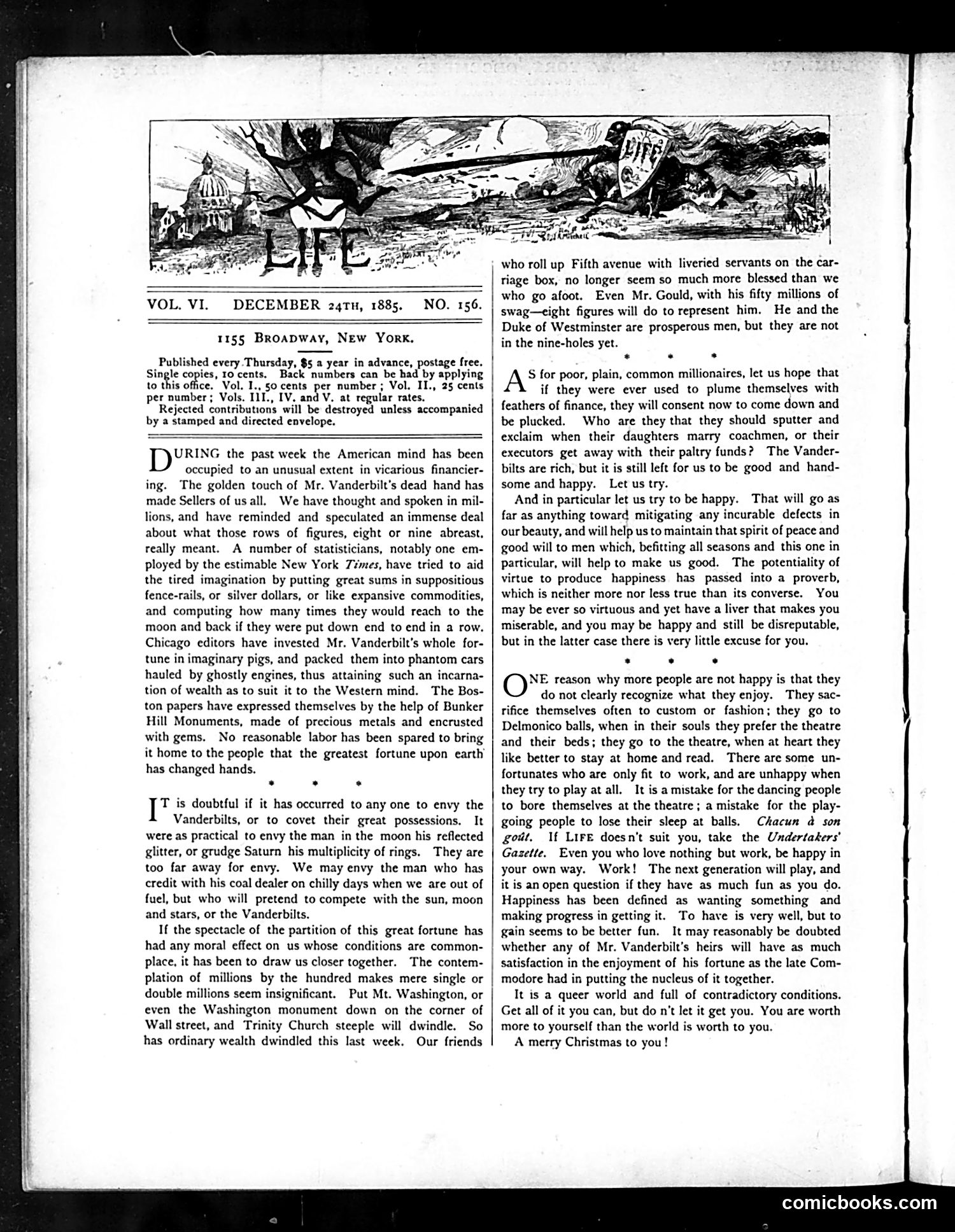
The masthead cartoon depicts "LIFE" as a classical figure overlooking a landscape with the Eiffel Tower visible—likely referencing the newly completed tower (finished 1889) or Paris as a symbol of culture and sophistication. The article discusses the Vanderbilt family's enormous wealth, recently increased through inheritance. The writer critiques how wealth creates envy and moral complications in society. Notably, the text mentions Mr. Vanderbilt's "dead hand" and references to "phantom cars" and "ghostly engines"—likely satirizing rumors about how the Vanderbilts' fortune was deployed or invested. The piece ultimately argues that happiness comes from purpose and work, not wealth alone—a moralistic message typical of the era's satirical approach to gilded-age excess.
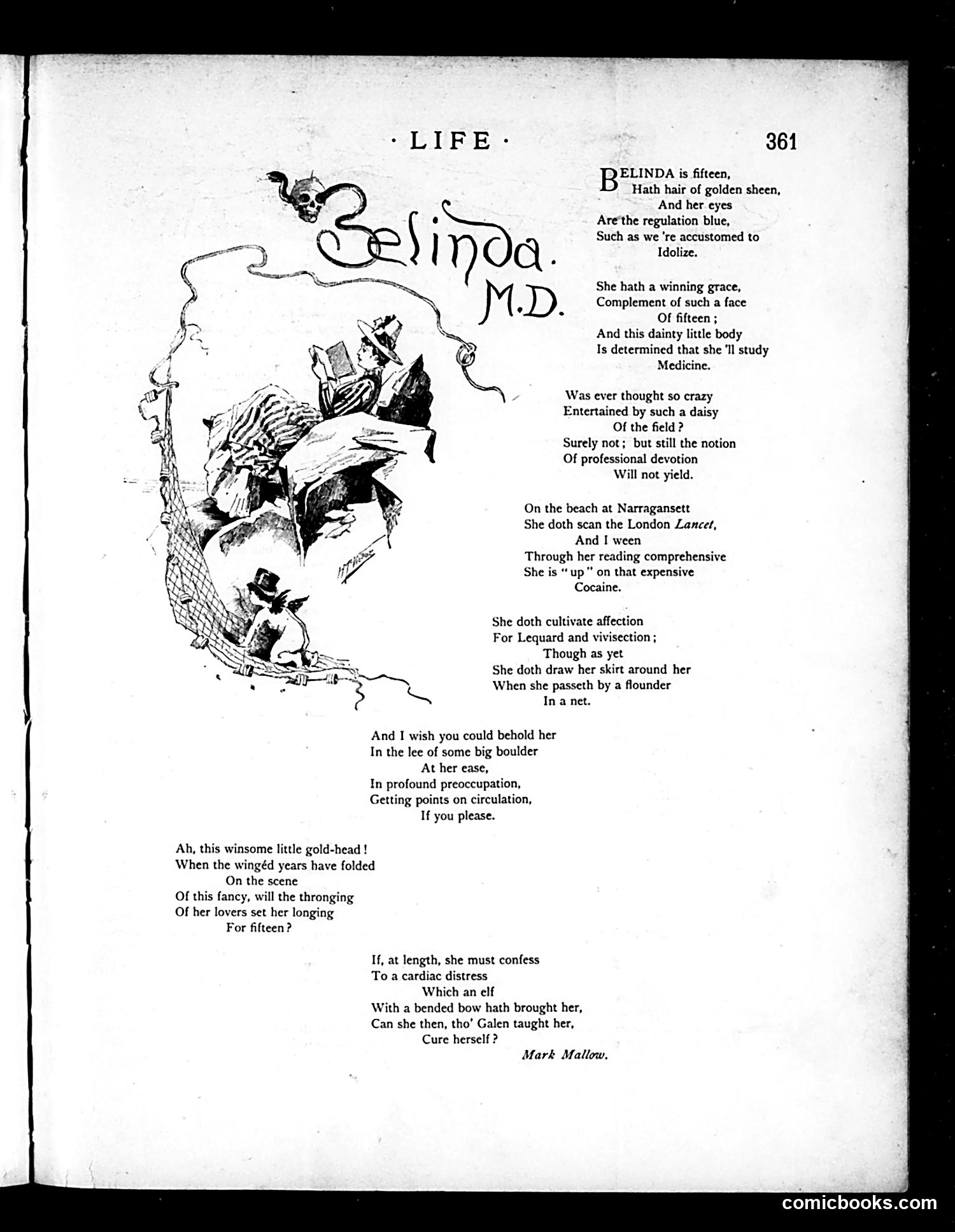
This satirical poem mocks a fifteen-year-old girl named Belinda who aspires to study medicine, a highly unconventional ambition for a woman in the early 20th century. The accompanying illustration depicts her surrounded by medical and scientific instruments in a whimsical, somewhat chaotic manner. The satire targets both Belinda's youth and gender, suggesting her professional ambitions are incompatible with feminine interests and romantic expectations. References to her "golden" hair, blue eyes, and concerns about future suitors mock the idea that a woman could seriously pursue medicine. The poem's conclusion questions whether she can overcome romantic distraction to actually complete her medical training, casting doubt on women's capacity for serious professional commitment.
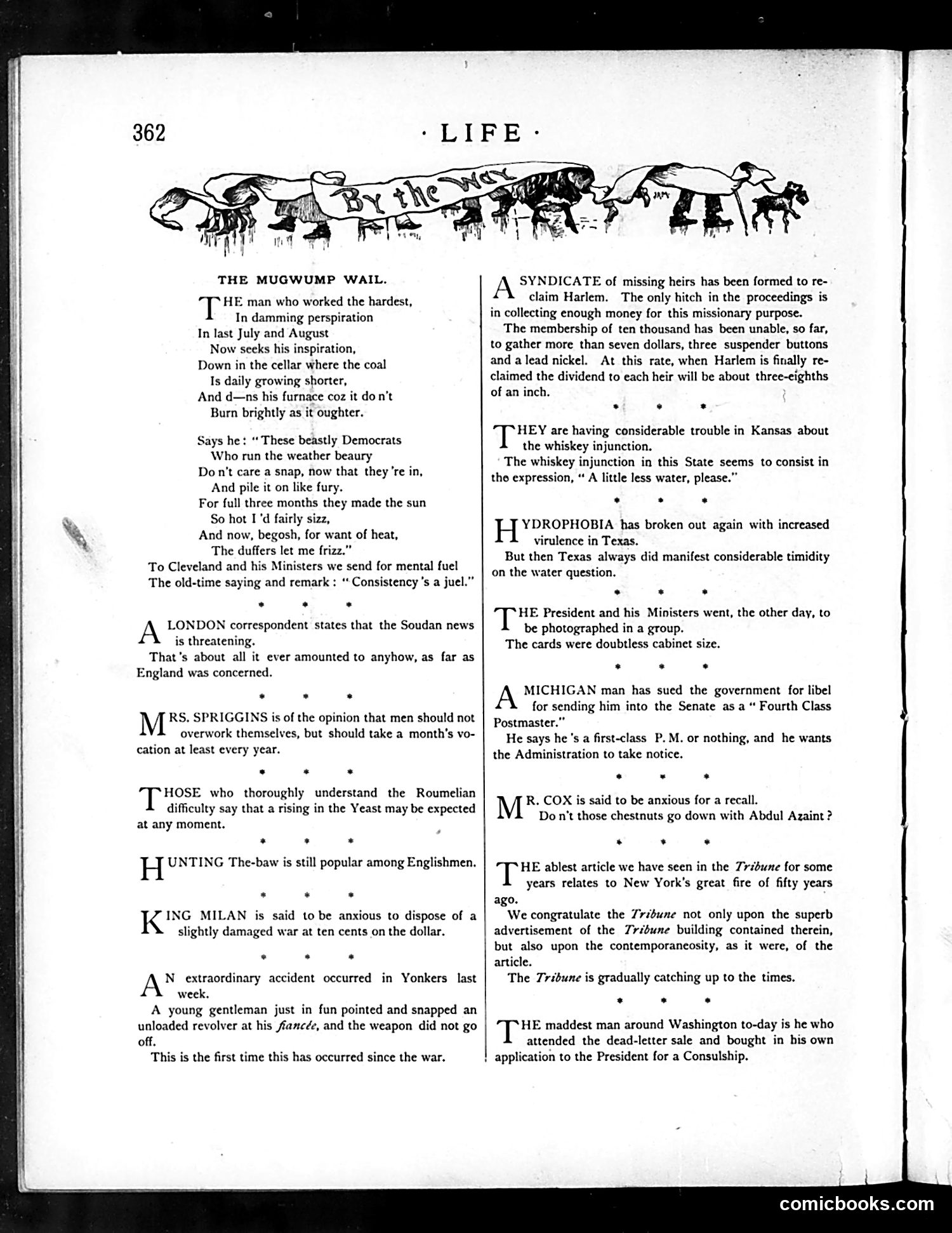
The page is primarily text-based commentary rather than cartoons. "The Mugwump Wail" is a satirical poem mocking the Mugwumps—Republicans who abandoned their party (likely during the 1884 election) over reform principles. The poem ridicules their self-righteous complaints about summer heat and political frustration, sarcastically comparing their "consistency" to fuel. The remaining brief items are satirical news-style quips targeting various contemporary figures and issues: a Soudan threat, Mrs. Spriggins's views on vacation, Roumanian difficulties, and a Michigan man suing the government. The tone is light mockery of politicians, bureaucracy, and public figures without identifying specific individuals clearly in the remaining items.
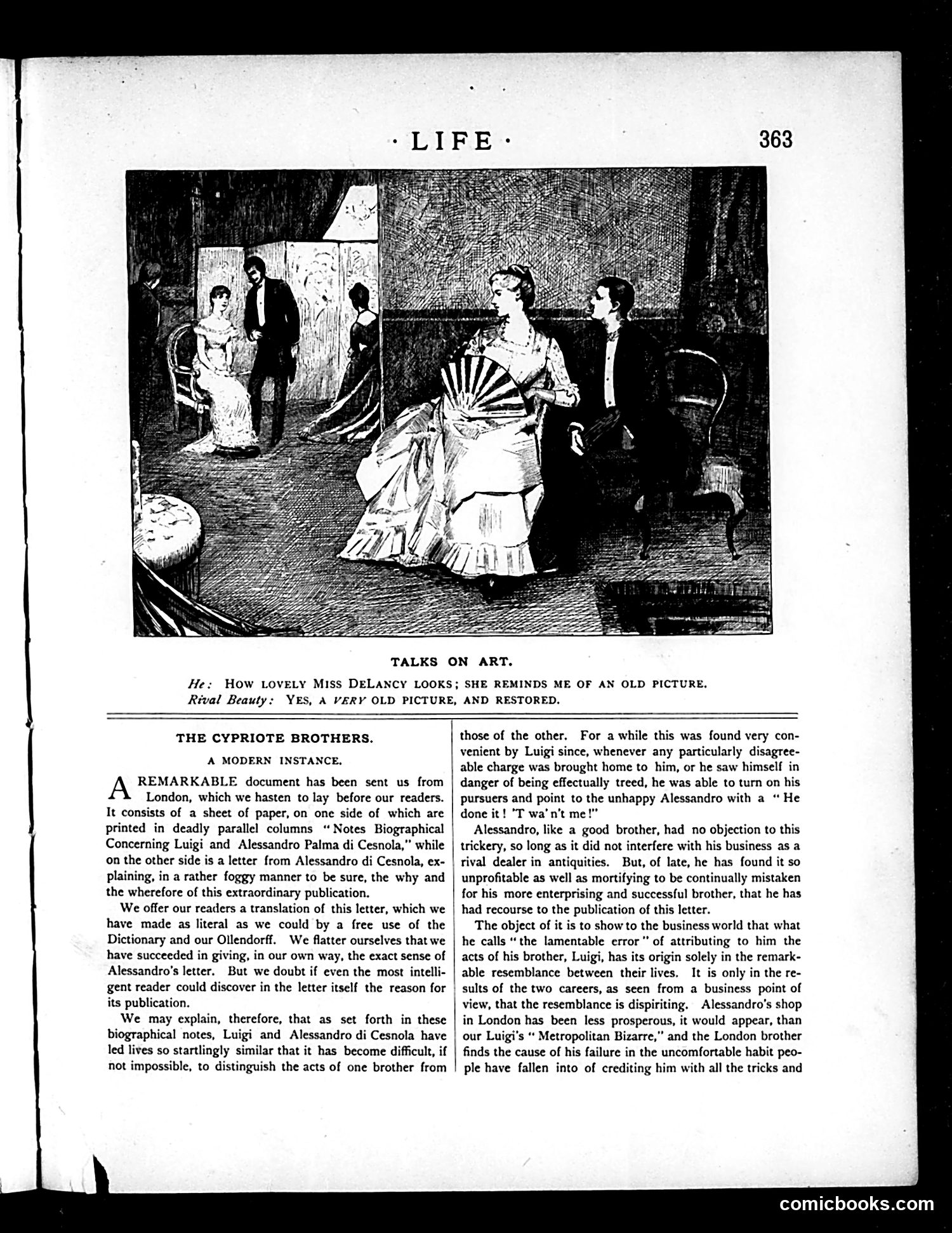
The cartoon depicts a social scene where a man compliments a woman's appearance, saying she resembles "an old picture." The woman replies dismissively that yes, it's "a very old picture, and restored." This is a joke about aging and cosmetic enhancement. The satire targets the woman's use of makeup, hair styling, or other beauty treatments to maintain a youthful appearance. The reference to a painting being "restored" suggests her face requires significant artificial work to appear presentable—comparing cosmetic enhancement to art restoration implies the original has deteriorated and requires professional intervention to look acceptable. The humor relies on the era's attitude toward women's vanity and appearance maintenance, presenting beauty treatments as deceptive artifice rather than legitimate self-care.
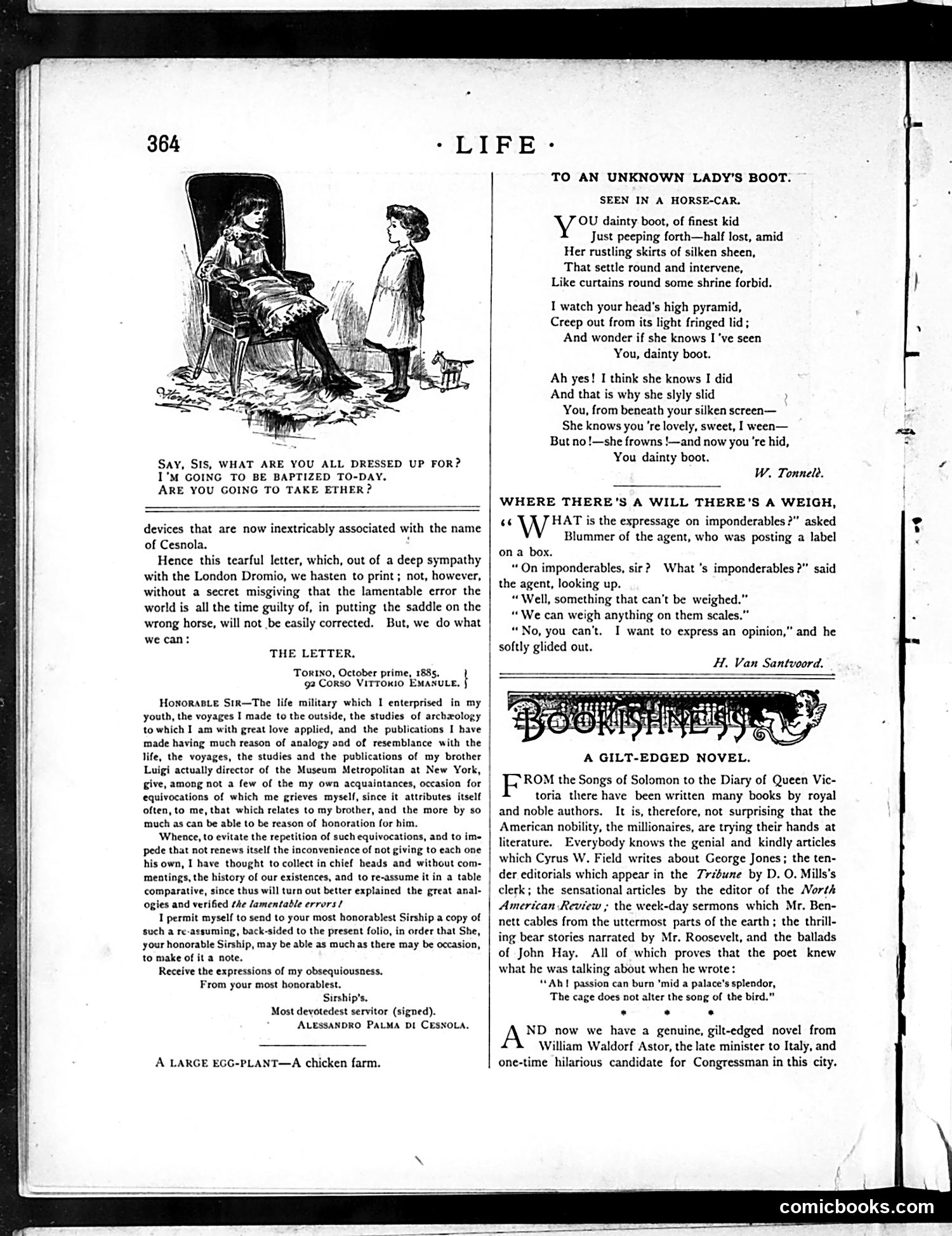
The top illustration shows a child asking an adult seated in a chair: "Say, sir, what are you all dressed up for? I'm going to be baptized to-day. Are you going to take entire?" This appears to be a simple joke about a child's misunderstanding of formal adult attire. The child assumes the well-dressed adult must be attending a baptism and asks if he'll participate ("take entire" likely meaning "take part"). The humor lies in the innocent misinterpretation—the child cannot fathom why else someone would dress formally. The page also contains poetry, letters, and book reviews typical of Life's satirical content, but these don't constitute political cartoons requiring historical context explanation.
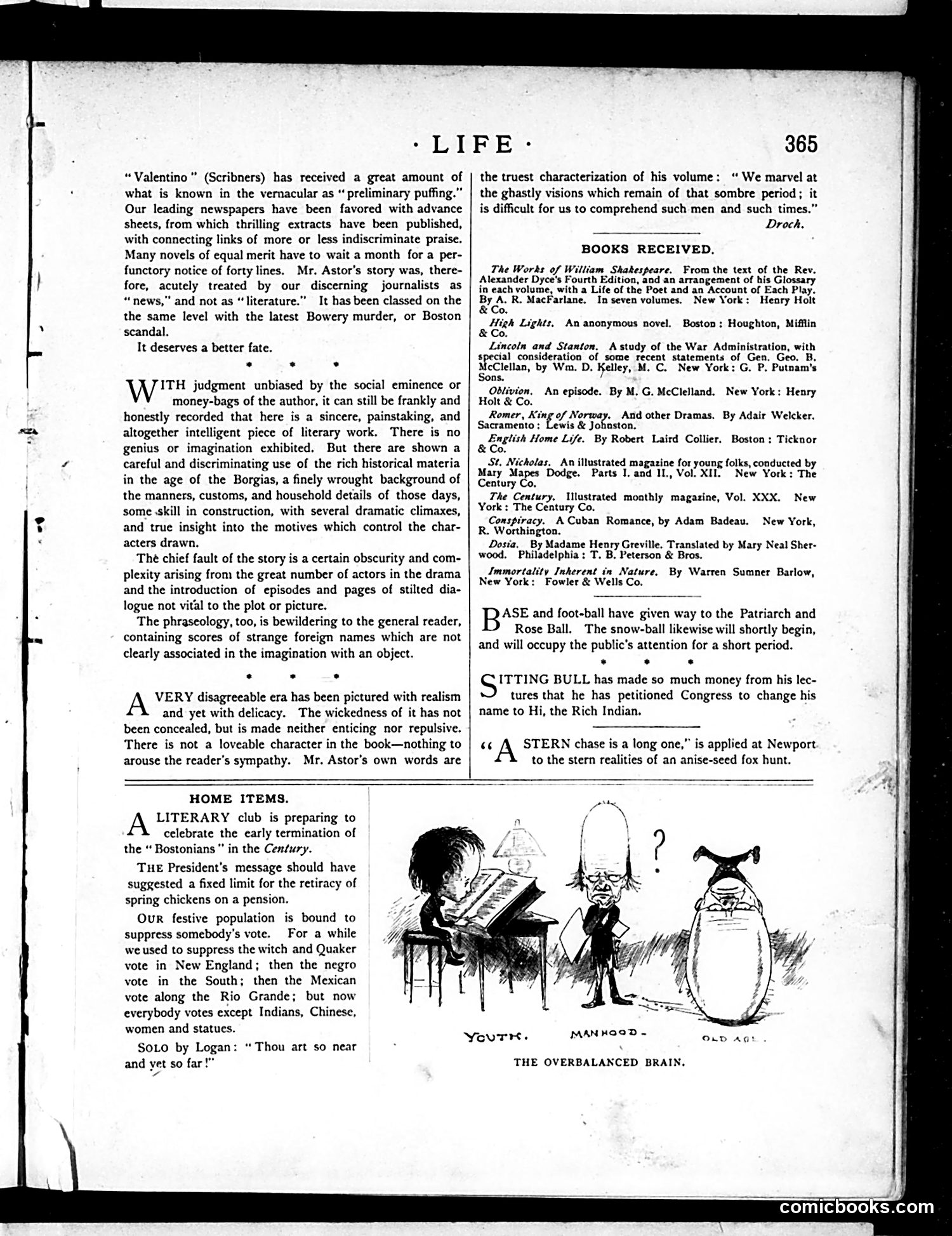
This cartoon satirizes the intellectual imbalance of different life stages. It depicts three figures labeled "Youth," "Manhood," and "Old Age," each with a disproportionately enlarged head balanced precariously on a tiny body or base. The satire suggests that each stage develops mental characteristics that become increasingly unstable: youth pursues intellectual pursuits (shown reading), manhood appears weighted down by excessive brain development, and old age tips dangerously—implying wisdom or mental decline creates physical instability. The overall message mocks how over-intellectualization at different life stages creates imbalance, making people figuratively and literally unstable. This reflects contemporary concerns about education, specialization, and whether excessive thinking produces practical problems rather than solutions.
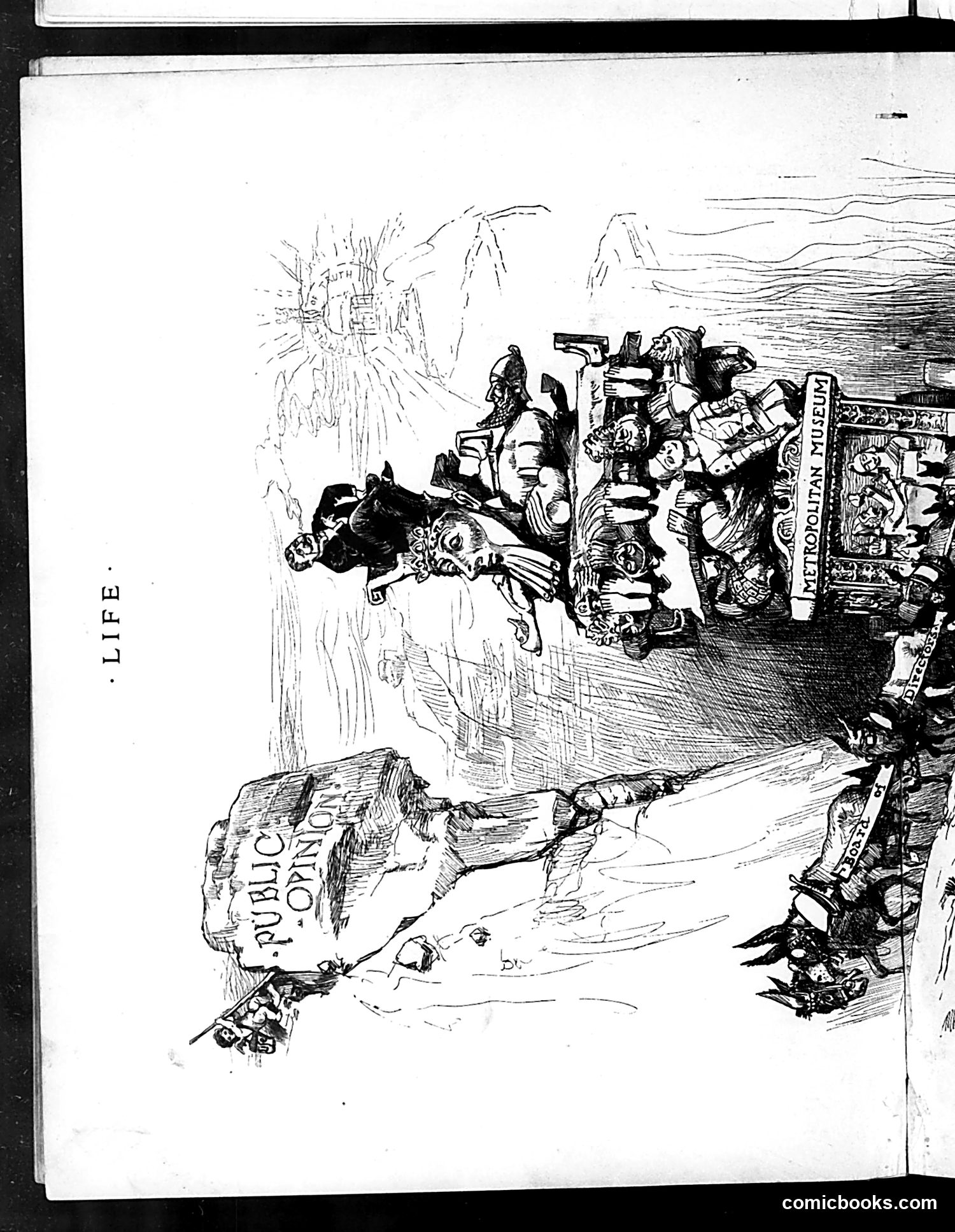
This appears to be a satirical cartoon from Life magazine showing a scene at what looks like the Metropolitan Museum (visible text on the right). The central figure appears to be a wealthy or prominent person being carried or supported by multiple attendants or servants in an exaggerated, undignified manner. On the left, there's a stone or monument labeled "PUBLIC OPINION," suggesting the cartoon contrasts public sentiment with the behavior of the elite figure being lavishly attended to. The satire likely criticizes how the wealthy or powerful are treated with excessive deference despite public disapproval, or mocks the gap between public opinion and actual treatment of the privileged classes. The specific identities of the figures remain unclear without additional context.
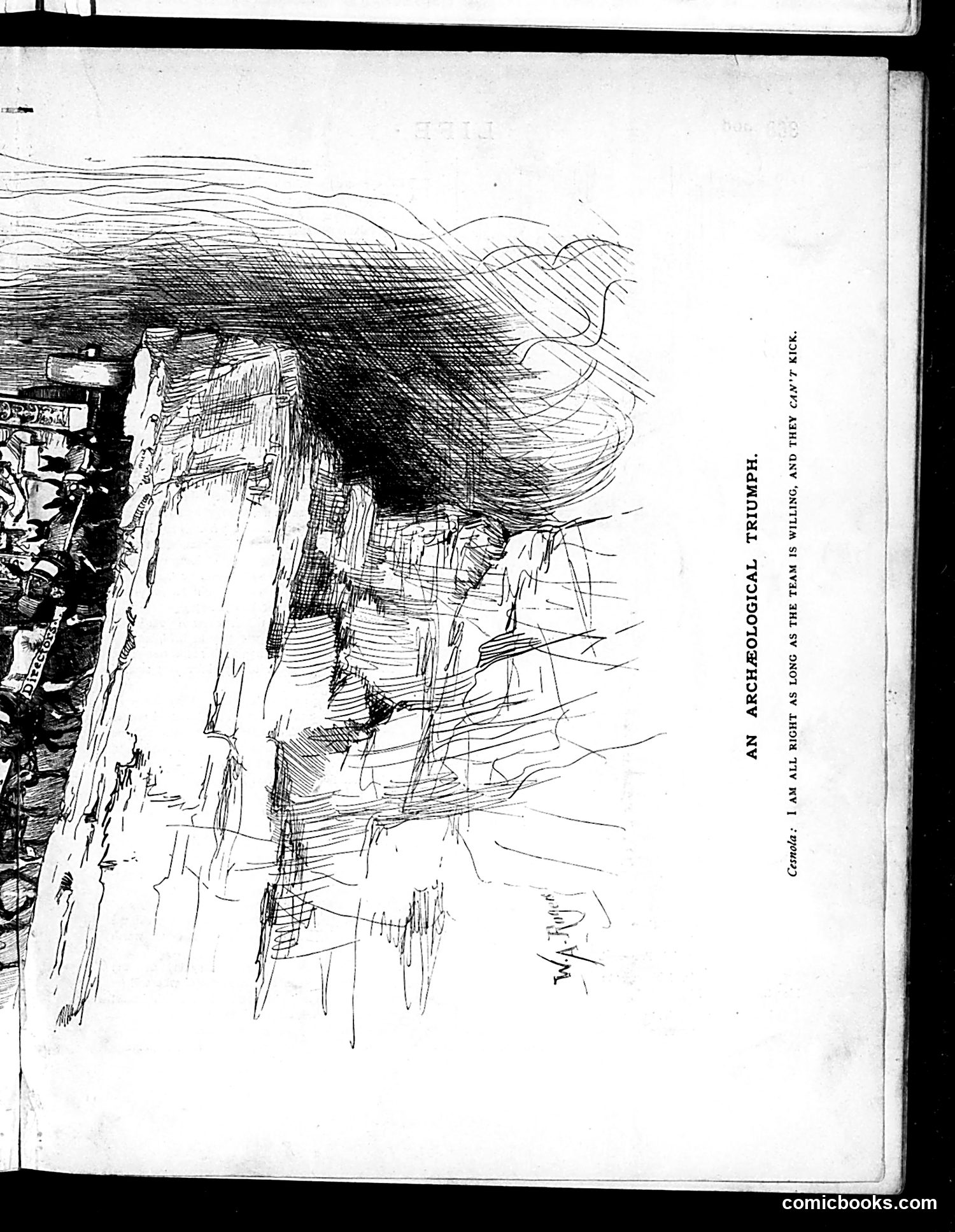
The caption reads "AN ARCHEOLOGICAL TRUMPET" with a subtitle stating "Cherub: I am all right as long as the team is willing and they carry it!" This appears to be a satirical sketch about archaeological discovery or excavation. The drawing shows what seems to be an excavated artifact or structure with detailed cross-hatching. The cherub (angel figure) commentary suggests humor about how an ancient object's value or functionality depends on external support—specifically "the team" carrying it. The satire likely mocks either overconfidence in fragile archaeological finds, the cooperative effort required for preservation, or perhaps the absurdity of assigning agency or satisfaction to inanimate objects. Without additional context about the specific historical moment, the precise target remains unclear, but it demonstrates *Life* magazine's characteristic blend of visual wit and wordplay commentary on contemporary or cultural concerns.
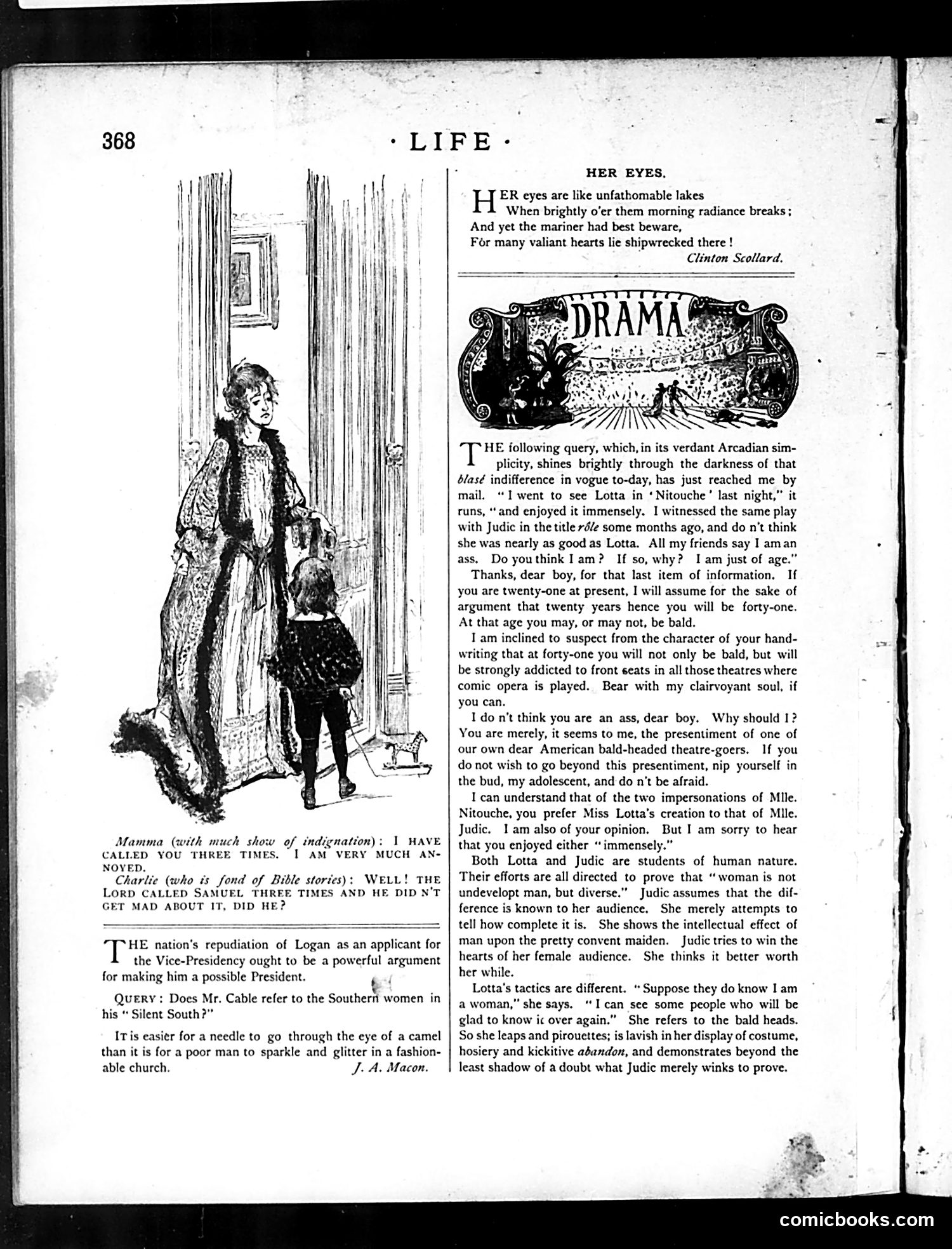
This page contains multiple unrelated items typical of Life's satirical format: **The cartoon** shows a mother scolding her son Charlie, who deflects her criticism by referencing the Bible story of Samuel—a child-humor joke about literal interpretation of scripture. **The political commentary** references Logan's rejection as Vice-Presidential candidate, suggesting this setback might paradoxically make him viable for President. **The main drama section** compares two stage actresses—Lotta and Judic—who both performed in "Nitouche." The writer uses this comparison to discuss contrasting performance styles: Judic appeals to intellect and wins female audiences through subtlety, while Lotta relies on physical display and spectacle to appeal to male theatergoers (described dismissively as "bald-headed theatre-goers"). The satire mocks both the correspondent's naïve theater criticism and, implicitly, the different tactics actresses employed to captivate audiences based on gender assumptions of the era.
This page contains theater reviews and a satirical Christmas dialogue. **The Theater Criticism** (top): Reviews comparing performances by actresses Judic and Lotta in "Nitouche"—a play about a soldier. The critic praises Lotta's youth and "wholesome mirth" while dismissing Judic as too "plump" and "matron-like" for the role, using backhanded compliments throughout. **"Father Christmas at Washington"** (main piece): A satirical dialogue between the narrator and "Father Christmas" (Santa Claus), presented as a down-on-his-luck personification. The satire targets the **change in presidential administrations**—Santa laments losing access to Republican Party corruption ("chimney racket," bribes disguised as "Stationery appropriation"). He now faces Cleveland's **Civil Service reform**, which eliminated patronage and cronyism. The joke: even Santa can't get bribes past the new honest administration and must pass civil service exams. This mocks both old-guard corruption and the reformist backlash against it.
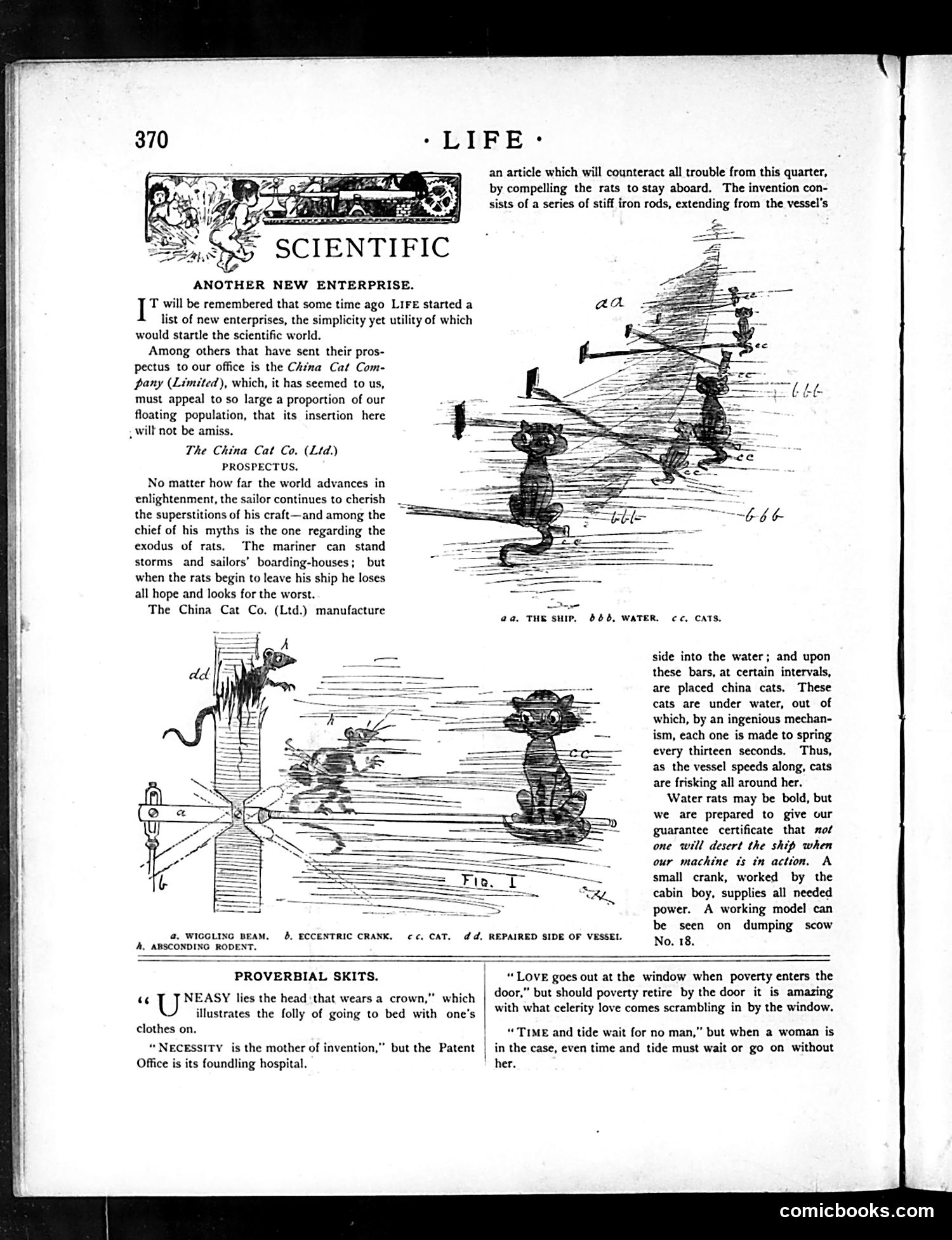
This page satirizes both seafaring superstitions and the absurdity of patent-office inventions. The "China Cat Co." proposes an elaborate mechanical device to prevent rats from abandoning ships—a superstition sailors believed predicted disaster. The invention consists of iron rods extending underwater from a ship's sides, with china cats mounted on them that spring up every thirteen seconds, supposedly frightening rats into staying aboard. Detailed technical drawings show the mechanism's components: wiggling beams, eccentric cranks, and submerged cats. The satire targets two things: sailors' irrational fears about rats as omens of doom, and the Patent Office's tendency to legitimize ridiculous contraptions. By presenting this absurd device with mock-serious technical language and diagrams, *Life* mocks both maritime folklore and the era's proliferation of dubious "innovations." The humor lies in the invention's utter impracticality—underwater mechanical cats would obviously not deter rats.
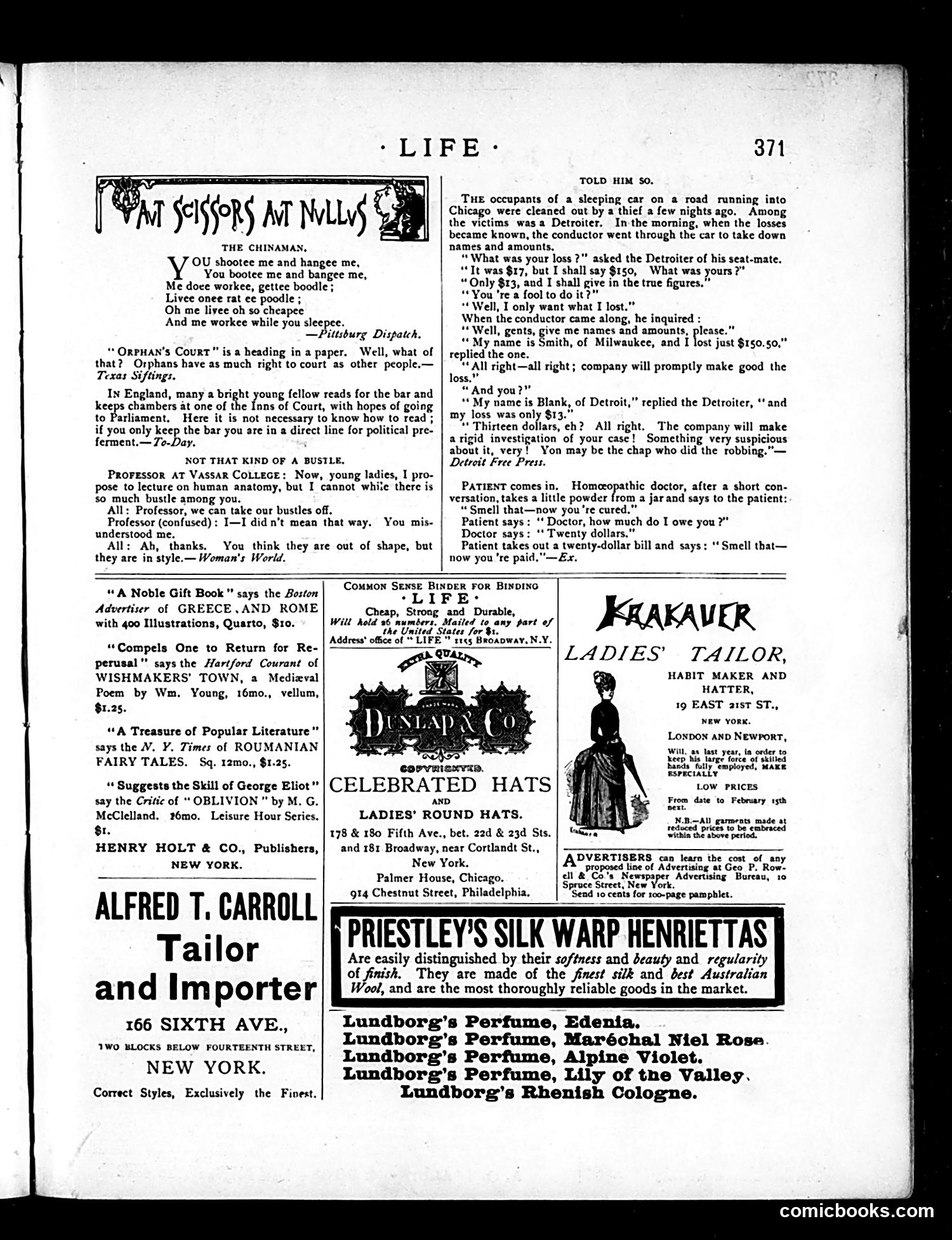
This page contains several short humorous pieces typical of Life's satirical format: **"I'm Scissors at Nulls"** presents a racist caricature of a Chinese laborer, using broken English ("Me doce workee") to mock immigrant workers. The "joke" suggests Chinese workers undercut wages while living cheaply. **"Orphan's Court"** is a pun on legal terminology, playing on the double meaning of "court." **"Not That Kind of Bustle"** satirizes Vassar College students who misinterpret a professor's complaint about classroom disruption as criticism of their fashionable bustles (garments). **"Told Him So"** mocks dishonesty: a Detroit passenger honestly reports his $13 loss while his Milwaukee neighbor inflates his loss to $150, then faces investigation as the suspected thief—a comeuppance joke. **"Patient Comes In"** ridicules homeopathic medicine through a deadpan exchange where a patient "pays" the doctor by letting him smell money. The page is otherwise filled with period advertisements for tailors, hatmakers, and books.
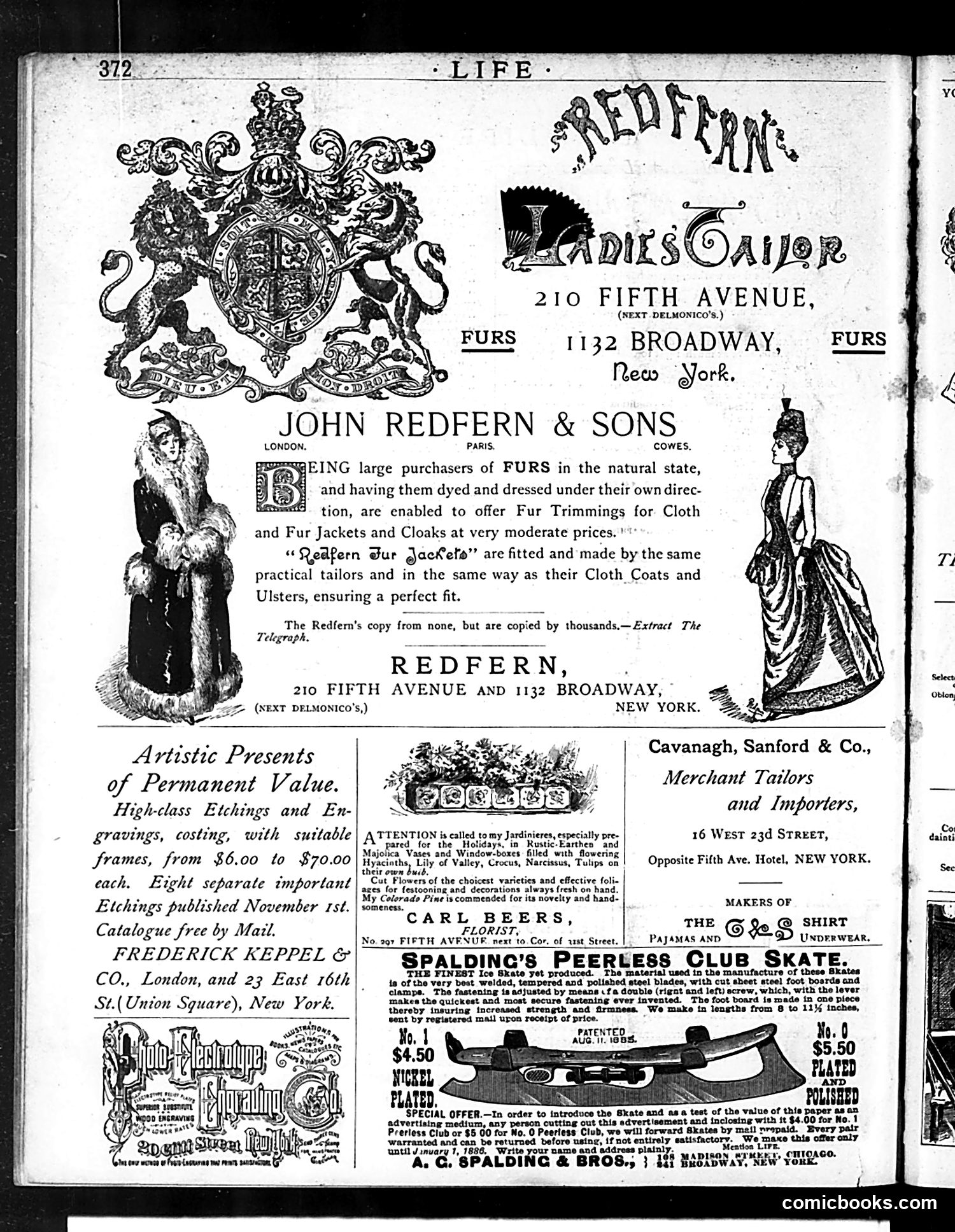
This page is primarily **advertising**, not satire or political content. It features luxury goods marketed to wealthy New York consumers circa 1885. The main advertisements include: **John Redfern & Sons** (top): A high-end London/Paris fur merchant boasting that their garments are "copied by thousands" — a backhanded compliment suggesting their designs are so desirable they're counterfeited. The illustrations show fashionable women in fur-trimmed coats. **Other luxury vendors** include a florist, merchant tailors, and Frederick Keppel (art etchings priced $6-$70 each). **Spalding's ice skates** (bottom): An advertisement offering discounted skates to Life readers as a marketing test, promising satisfaction or money-back. The page reflects Gilded Age consumer culture — expensive clothing, imported goods, and leisure items (ice skating) marketed to affluent urban readers. There is no evident political satire or social commentary; it's a straightforward commercial publication.
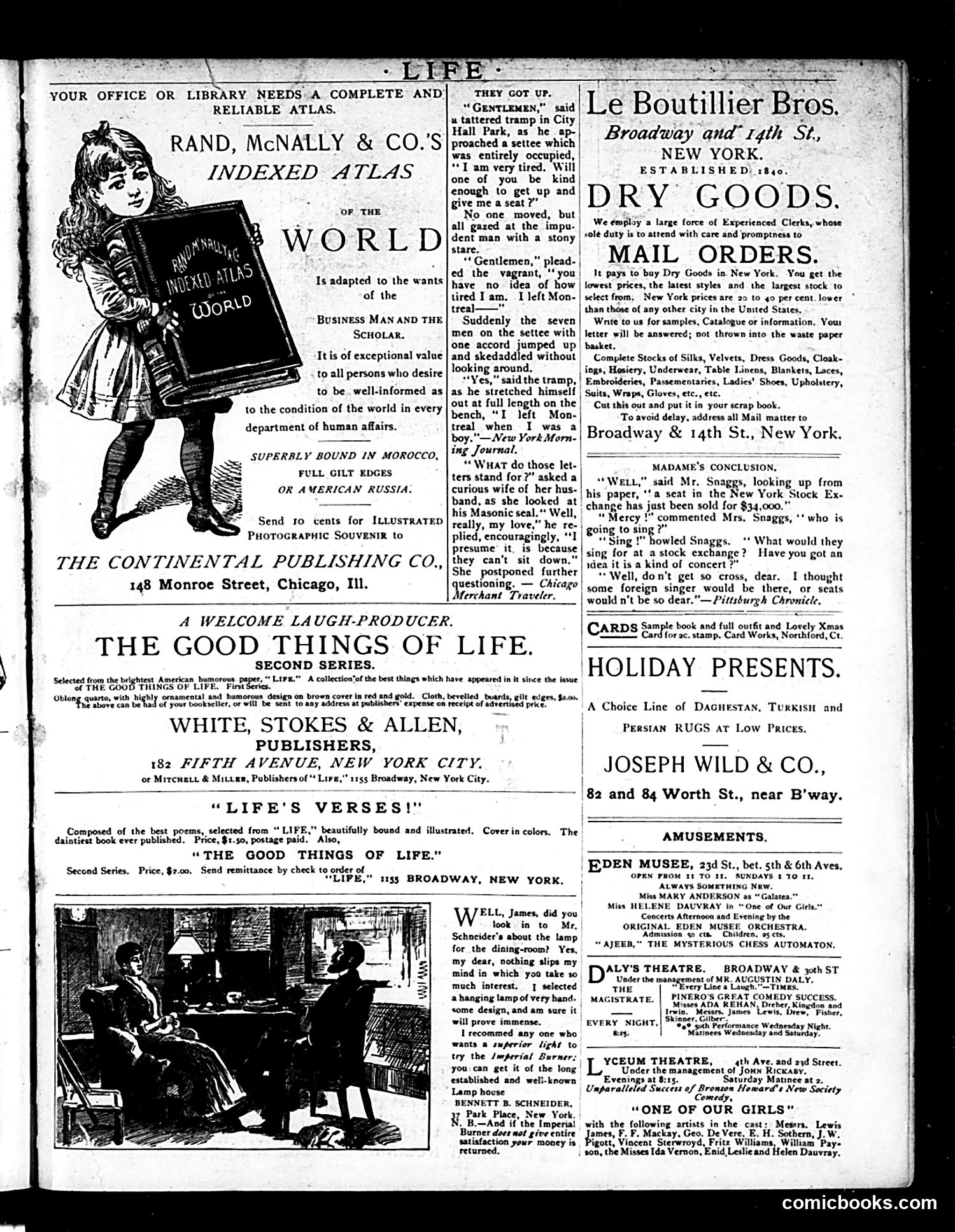
This page is primarily **advertising and promotional material** rather than political satire. However, it contains three brief humorous anecdotes: 1. **"They Got Up"**: A tramp approaches seven men on a park bench, claiming exhaustion from Montreal. When he mentions Montreal, all seven men immediately flee. The joke plays on anti-Canadian or anti-Montreal sentiment—the mention of that city is so off-putting it clears the bench instantly. 2. **"Masonic Seal Letters"**: A wife asks her husband what letters on his Masonic seal mean. He replies they stand for "they can't sit down"—a joke about Masonic rituals involving standing positions. 3. **"Madame's Conclusion"**: A wife misunderstands the New York Stock Exchange as a concert venue, asking who will sing there. Her husband scoffs at the confusion. These are light, domestic humor pieces typical of *Life* magazine's satirical approach. The page otherwise consists of advertisements for atlases, dry goods, rugs, and theater announcements from 1890s New York.
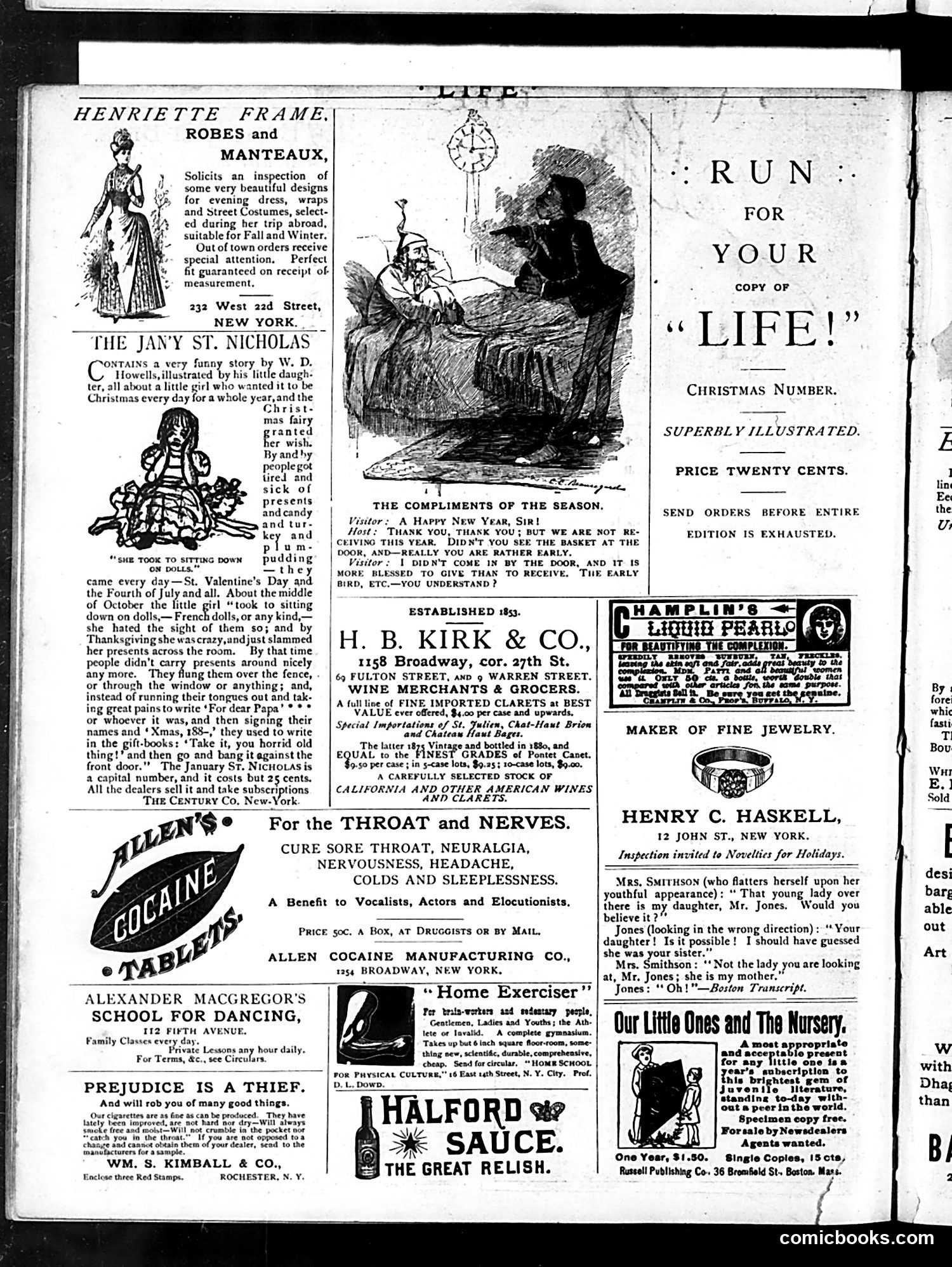
This is primarily an **advertising page** from Life's Christmas number, with one small editorial cartoon. The main cartoon ("The Compliments of the Season") shows a visitor arriving at a host's home on New Year's Day. The joke plays on social obligation: the visitor appears uninvited and overeager, while the host makes excuses about the timing being premature. This satirizes the ritualistic nature of New Year's calling—a Victorian social custom where people made formal visits on January 1st. The humor lies in the host's transparent reluctance masked by polite convention. The page is otherwise dominated by period advertisements: a dress shop, St. Nicholas magazine, Allen's Cocaine Tablets (a legitimate medicinal product at the time), a dancing school, and wine merchants. The cocaine advertisement notably advertises the drug for throat problems and "nervousness"—reflecting late-19th-century medical practice before cocaine's dangers were widely understood. The small story excerpt about Christmas wishes satirizes consumer excess through a child's perspective, suggesting even children grew weary of constant gift-giving.
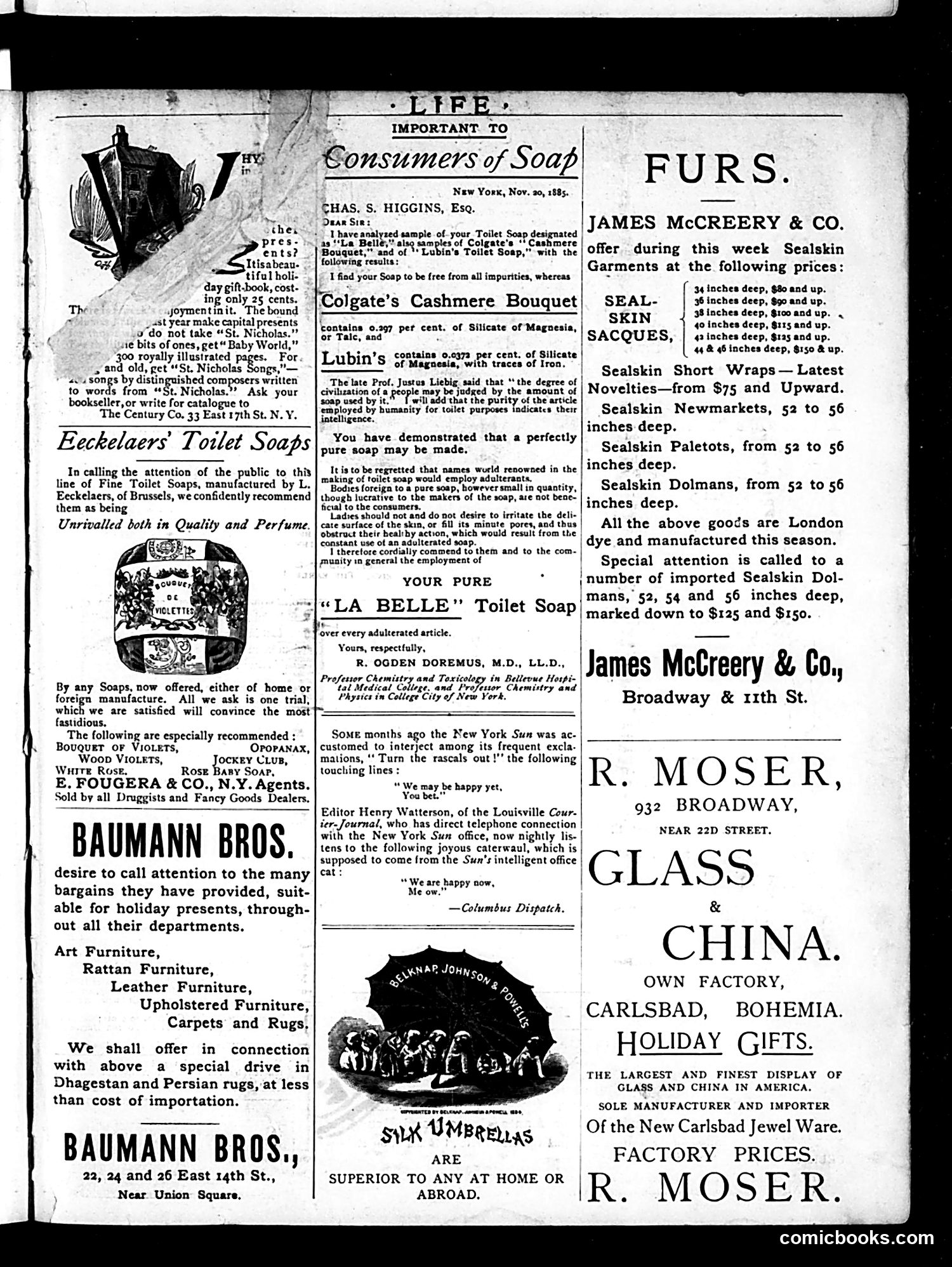
This page is primarily **advertisements** with minimal satirical content. The main items are: 1. **Soap advertisements**: Multiple toilet soap brands (Ecckelaers, Colgate, Lubin's, "La Belle") compete for consumers. A letter from Professor R. Ogden Doremus analyzes soaps, claiming "La Belle" is pure while competitors contain adulterants like silicate of magnesia—a common 19th-century concern about product purity. 2. **Furniture and goods ads**: Baumann Bros. advertises furniture, rugs, and holiday gifts. 3. **Minor satirical references**: A brief passage quotes the Louisville Courier-Journal editor joking about a phone conversation where someone says "Turn the rascals out!"—likely political mockery, though context is unclear. 4. **Fashion/fur advertisements**: James McCreery & Co. and R. Moser advertise sealskin garments and glassware. The page reflects 1885 consumer culture: product competition, purity concerns, and holiday shopping.
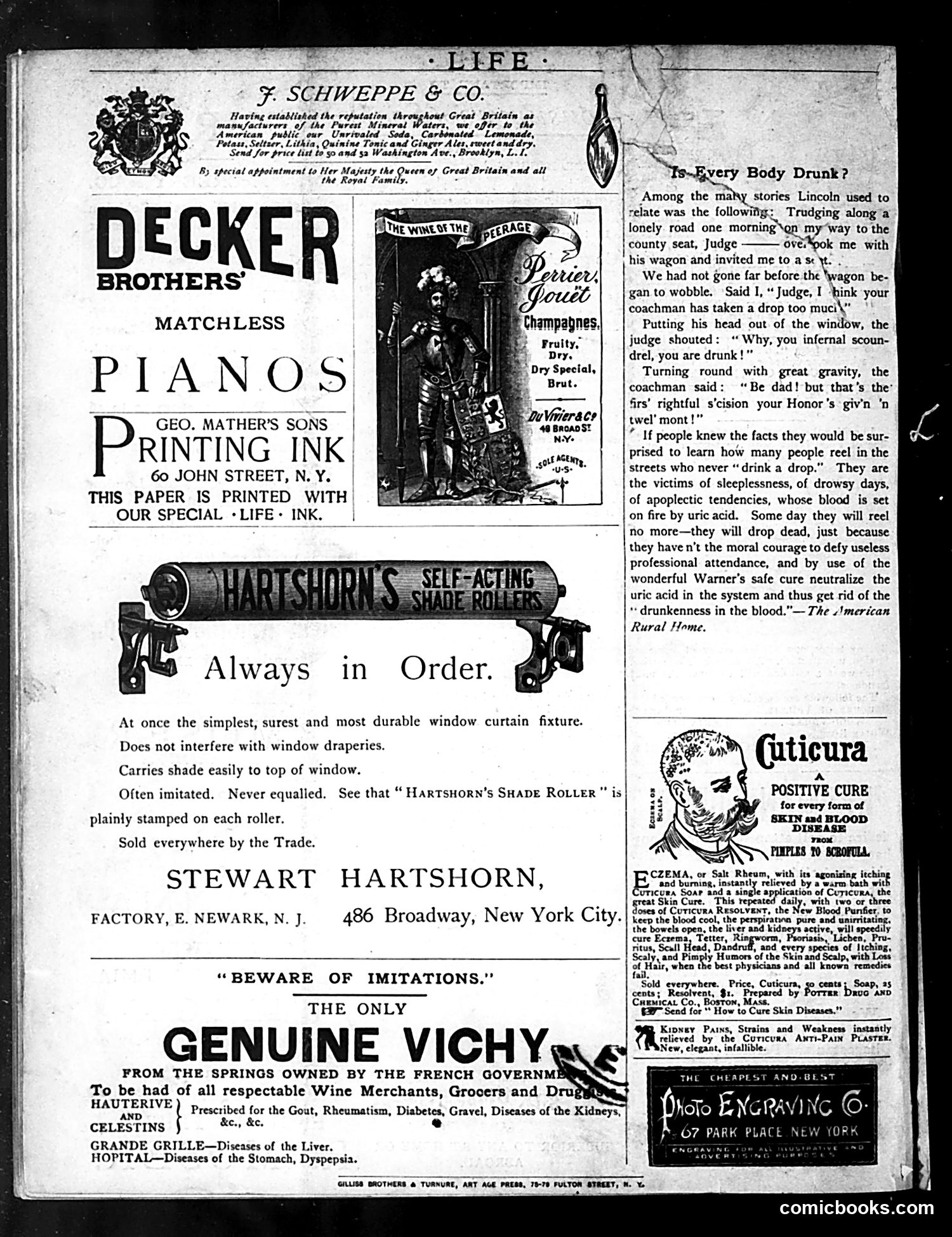
This page is primarily **advertisements** with one embedded humor piece. The main content is a Lincoln anecdote titled "Is Everybody Drunk?" that satirizes both intoxication and medical quackery. ## The Lincoln Story The joke presents Lincoln recounting an encounter where a judge's wagon wobbles, and Lincoln assumes the coachman is drunk. The coachman retorts that the judge has given him "the first rightful decision" in twelve months—a jab at judicial incompetence. ## The Satire's Point The accompanying editorial commentary subverts the joke's premise: it argues that many staggering, seemingly drunk people on streets are actually suffering from sleeplessness, poor health, or uric acid buildup—*not* alcohol. This sets up a pitch for "Warner's safe cure," a patent medicine claiming to neutralize uric acid and prevent death. **The real satire**: The piece mocks how readily people blame alcohol for obvious symptoms while promoting dubious medical "cures" as the actual solution. It's commentary on late-19th-century patent medicine marketing exploiting medical pseudoscience. The remaining content consists of period advertisements for pianos, window shades, mineral water, and skin remedies—typical commercial clutter of the era.
I can see this is a page from Life magazine, but the image quality is extremely poor—almost entirely black with only faint visible elements along the left margin showing partial text fragments and what appears to be a handwritten mark or signature. The main content area is not legible enough to identify specific cartoons, figures, caricatures, or their satirical meanings. To properly explain the political or social context and satire for a modern reader, I would need a clearer, higher-contrast version of this page. I cannot reliably identify the figures, references, or jokes without being able to read the text and see the illustrations clearly.