
Life, 1885-12-24 · page 2 of 19
Life — December 24, 1885 — page 2: what you’re looking at
What you’re looking at
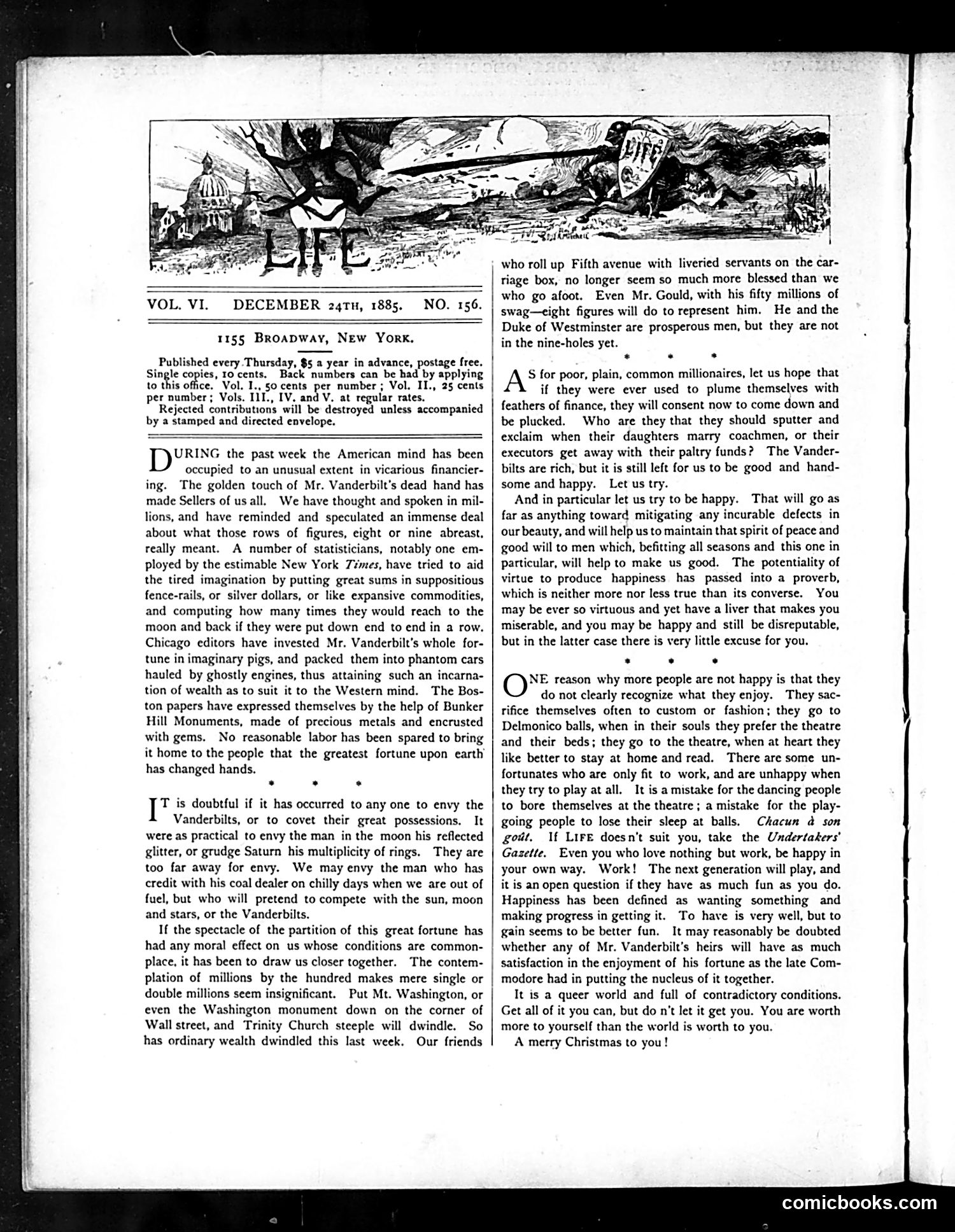
The masthead cartoon depicts "LIFE" as a classical figure overlooking a landscape with the Eiffel Tower visible—likely referencing the newly completed tower (finished 1889) or Paris as a symbol of culture and sophistication. The article discusses the Vanderbilt family's enormous wealth, recently increased through inheritance. The writer critiques how wealth creates envy and moral complications in society. Notably, the text mentions Mr. Vanderbilt's "dead hand" and references to "phantom cars" and "ghostly engines"—likely satirizing rumors about how the Vanderbilts' fortune was deployed or invested. The piece ultimately argues that happiness comes from purpose and work, not wealth alone—a moralistic message typical of the era's satirical approach to gilded-age excess.
📄 Transcribed text from this page (OCR, searchable)
Machine-transcribed from the original scan — historical spelling and the odd misread are preserved.
VOL. VI. DECEMBER 24TH, 1885. NO. 156. 1155 Broapway, New York. Published every Thursday, $5 a year in advance, postage free, Single copies, ro cents. Back numbers can be had by applying to this office. Vol. I., 50 cents per number ; Vol. II., 25 cents per number; Vols. I1I., IV, and V. at regular rates. Rejected contributions will be destroyed unless accompanied by a stamped and directed envelope. URING the past week the American mind has been occupied to an unusual extent in vicarious financier- ing. The golden touch of Mr. Vanderbilt's dead hand has made Sellers of us all. We have thought and spoken in mil- lions, and have reminded and speculated an immense deal about what those rows of figures, eight or nine abreast, really meant. A number of statisticians, notably one em- ployed by the estimable New York Zzmes, have tried to aid the tired imagination by putting great sums in suppositious fence-rails, or silver dollars, or like expansive commodities, and computing how many times they would reach to the moon and back if they were put down end to end in a row. Chicago editors have invested Mr. Vanderbilt’s whole for- tune in imaginary pigs, and packed them into phantom cars hauled by ghostly engines, thus attaining such an incarna- tion of wealth as to suit it to the Western mind. The Bos- ton papers have expressed themselves by the help of Bunker Hill Monuments, made of precious metals and encrusted with gems. No reasonable labor has been spared to bring it home to the people that the greatest fortune upon earth’ . * . has changed hands. I" is doubtful if it has occurred to any one to envy the Vanderbilts, or to covet their great possessions. It were as practical to envy the man in the moon his reflected glitter, or grudge Saturn his multiplicity of rings. They are too far away for envy. We may envy the man who has credit with his coal dealer on chilly days when we are out of fuel, but who will pretend to compete with the sun, moon and stars, or the Vanderbilts. If the spectacle of the partition of this great fortune has had any moral effect on us whose conditions are common- place, it has been to draw us closer together. The contem- plation of millions by the hundred makes mere single or double millions seem insignificant. Put Mt. Washington, or even the Washington monument down on the corner of Wall street, and Trinity Church steeple will dwindle. So has ordinary wealth dwindled this last week. Our friends who roll up Fifth avenue with liveried servants on the car- riage box, no longer seem so much more blessed than we who go afoot. Even Mr. Gould, with his fifty millions of swag—eight figures will do to represent him. He and the Duke of Westminster are prosperous men, but they are not | in the nine-holes yet. | . . * S for poor, plain, common millionaires, let us hope that if they were ever used to plume themselves with feathers of finance, they will consent now to come down and be plucked. Who are they that they should sputter and exclaim when their daughters marry coachmen, or their executors get away with their paltry funds? The Vander- bilts are rich, but it is still left for us to be good and hand- some and happy. Let us try. And in particular let us try to be happy. That will go as far as anything toward mitigating any incurable defects in our beauty, and will help us to maintain that spirit of peace and good will to men which, befitting all seasons and this one in particular, will help to make us good. The potentiality of virtue to produce happiness has passed into a proverb, which is neither more nor less true than its converse. You may be ever so virtuous and yet have a liver that makes you miserable, and you may be happy and still be disreputable, but in the latter case there is very little excuse for you. . . . NE reason why more people are not happy is that they do not clearly recognize what they enjoy. They sac- rifice themselves often to custom or fashion; they go to Delmonico balls, when in their souls they prefer the theatre and their beds; they go to the theatre, when at heart they like better to stay at home and read. There are some un- fortunates who are only fit to work, and are unhappy when they try to play at all. It is a mistake for the dancing people to bore themselves at the theatre; a mistake for the play- going people to lose their sleep at balls. Chacun d son gout, If LIFE doesn’t suit you, take the Undertakers' Gazette, Even you who love nothing but work, be happy in your own way. Work! The next generation will play, and it is an open question if they have as much fun as you do. Happiness has been defined as wanting something and making progress in getting it. To have is very well, but to gain seems to be better fun. It may reasonably be doubted | whether any of Mr. Vanderbilt’s heirs will have as much satisfaction in the enjoyment of his fortune as the late Com- modore had in putting the nucleus of it together. It is a queer world and full of contradictory conditions. Get all of it you can, but do n’t let it get you. You are worth more to yourself than the world is worth to you. A merry Christmas to you! comicbooks.com