
Life, 1885-12-24 · page 7 of 19
Life — December 24, 1885 — page 7: what you’re looking at
What you’re looking at
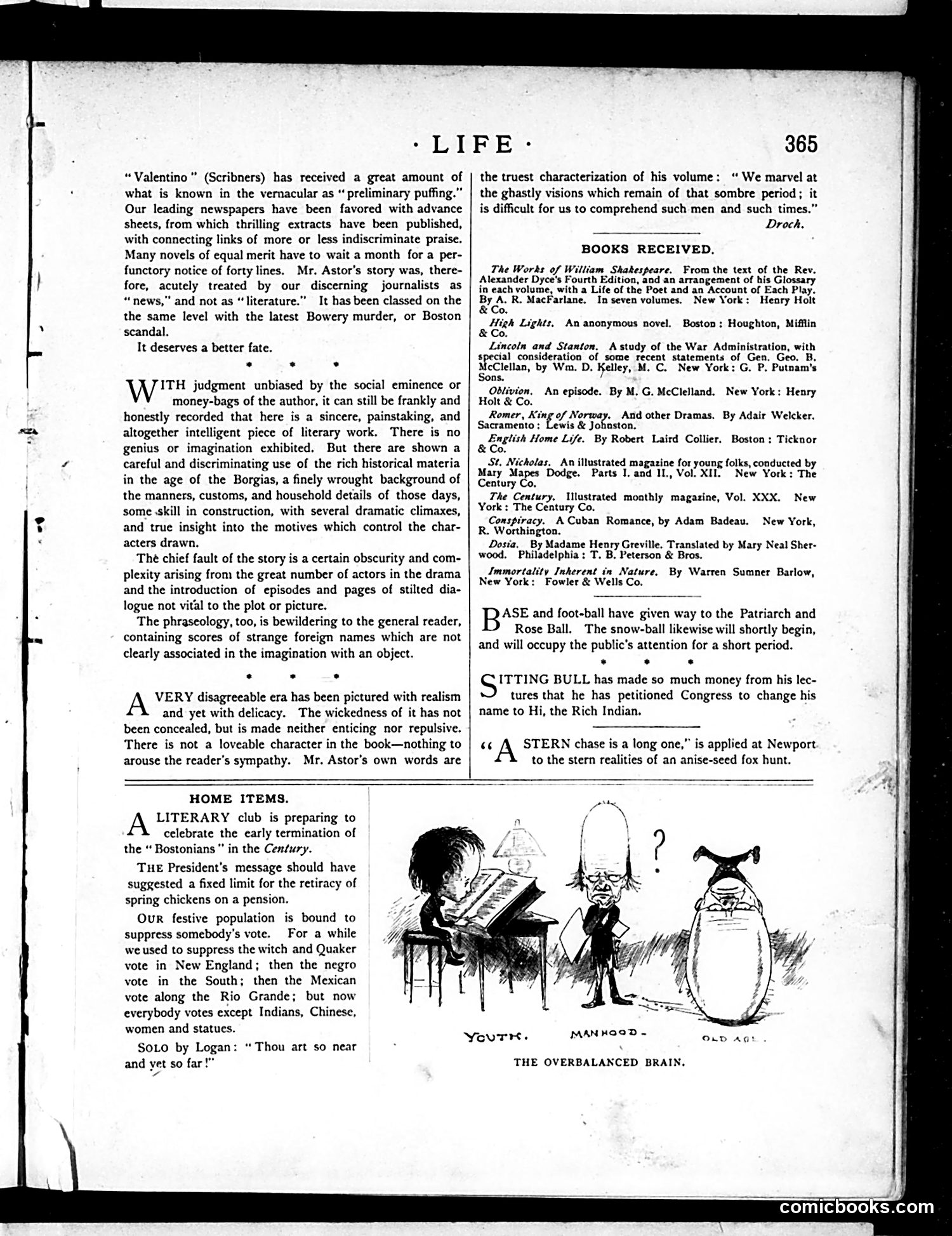
This cartoon satirizes the intellectual imbalance of different life stages. It depicts three figures labeled "Youth," "Manhood," and "Old Age," each with a disproportionately enlarged head balanced precariously on a tiny body or base. The satire suggests that each stage develops mental characteristics that become increasingly unstable: youth pursues intellectual pursuits (shown reading), manhood appears weighted down by excessive brain development, and old age tips dangerously—implying wisdom or mental decline creates physical instability. The overall message mocks how over-intellectualization at different life stages creates imbalance, making people figuratively and literally unstable. This reflects contemporary concerns about education, specialization, and whether excessive thinking produces practical problems rather than solutions.
📄 Transcribed text from this page (OCR, searchable)
Machine-transcribed from the original scan — historical spelling and the odd misread are preserved.
- LIFE: “Valentino” (Scribners) has received a great amount of what is known in the vernacular as “ preliminary puffing.” Our leading newspapers have been favored with advance sheets, from which thrilling extracts have been published, with connecting links of more or less indiscriminate praise. Many novels of equal merit have to wait a month for a per- functory notice of forty lines. Mr. Astor’s story was, there- fore, acutely treated by our discerning journalists as “news,” and not as “literature.” It has been classed on the the same level with the latest Bowery murder, or Boston scandal. It deserves a better fate. . . . ITH judgment unbiased by the social eminence or money-bags of the author, it can still be frankly and honestly recorded that here is a sincere, painstaking, and altogether intelligent piece of literary work. There is no genius or imagination exhibited. But there are shown a careful and discriminating use of the rich historical materia in the age of the Borgias, a finely wrought background of the manners, customs, and household details of those days, some skill in construction, with several dramatic climaxes, and true insight into the motives which control the char- acters drawn, The chief fault of the story is a certain obscurity and com- plexity arising from the great number of actors in the drama and the introduction of episodes and pages of stilted dia- logue not vital to the plot or picture. The phraseology, too, is bewildering to the general reader, containing scores of strange foreign names which are not clearly associated in the imagination with an object. . . . VERY disagreeable era has been pictured with realism and yet with delicacy. The wickedness of it has not been concealed, but is made neither enticing nor repulsive. There is not a loveable character in the book—nothing to arouse the reader's sympathy. Mr. Astor's own words are 365 the truest characterization of his volume: ‘“ We marvel at the ghastly visions which remain of that sombre period; it is difficult for us to comprehend such men and such times.” Droch. BOOKS RECEIVED, The Works of William Shakespeare. From the text of the Rev. Alexander Dyce's Fourth Edition, aod an arrangement of his Glossary in each volume, with a Life of the Poet and an Account of Each Play. fs R. MacFarlane. In seven volumes. New York: Henry Holt 0. a iith Lights, An anonymous novel. Boston : Houghton, Miflin 0. Lincoln and Stanton. A study of the War Administration, with ial consideration of some recent statements of Gen. Geo. B. icClellan, by Wm. D. Kelley, M. C. New York: G. P, Putnam's ns. Obdtivion, Holt & Co. Romer, Kin, of Nero And other Dramas. By Adair Welcker. Sacramento: Lewis & Johnston. ag inetiss Home Life. By Robert Laird Collier, Boston; Ticknor ‘0. An episode. By M, G. McClelland, New York: Henry St. Nicholas, An illustrated magazine for young folks, conducted by Mary Mapes Dodge. Parts I. and II., Vol. XII. New York: The Century Co. The Century, Mlustrated monthly magazine, Vol. XXX. New York : The Century Co. Conspiracy. A Cuban Romance, by Adam Badeau. R. Worthington. Dosia, By Madame Henry Greville, Translated by Mary Neal Sher- wood. Philadelphia : T. B. Peterson & Bros, Immortality Inherent in Nature. By Warren Sumner Barlow, New York: Fowler & Wells Co. New York, ASE and foot-ball have given way to the Patriarch and Rose Ball. The snow-ball likewise will shortly begin, and will occupy the public's attention for a short period. . . . ITTING BULL has made so much money from his lec- tures that he has petitioned Congress to change his name to Hi, the Rich Indian. 73 STERN chase is a long one,” is applied at Newport to the stern realities of an anise-seed fox hunt. HOME ITEMS. LITERARY club is preparing to celebrate the early termination of the “ Bostonians ” in the Century. THE President's message should have suggested a fixed limit for the retiracy of spring chickens on a pension. Our festive population is bound to suppress somebody's vote. For a while we used to suppress the witch and Quaker vote in New England; then the negro vote in the South; then the Mexican vote along the Rio Grande; but now everybody votes except Indians, Chinese, women and statues. SOLO by Logan: “Thou art so near and yet so far!” a te YouTr. MAN HOOD ~ THE OVERBALANCED BRAIN.