
Life, 1885-12-24 · page 10 of 19
Life — December 24, 1885 — page 10: what you’re looking at
What you’re looking at
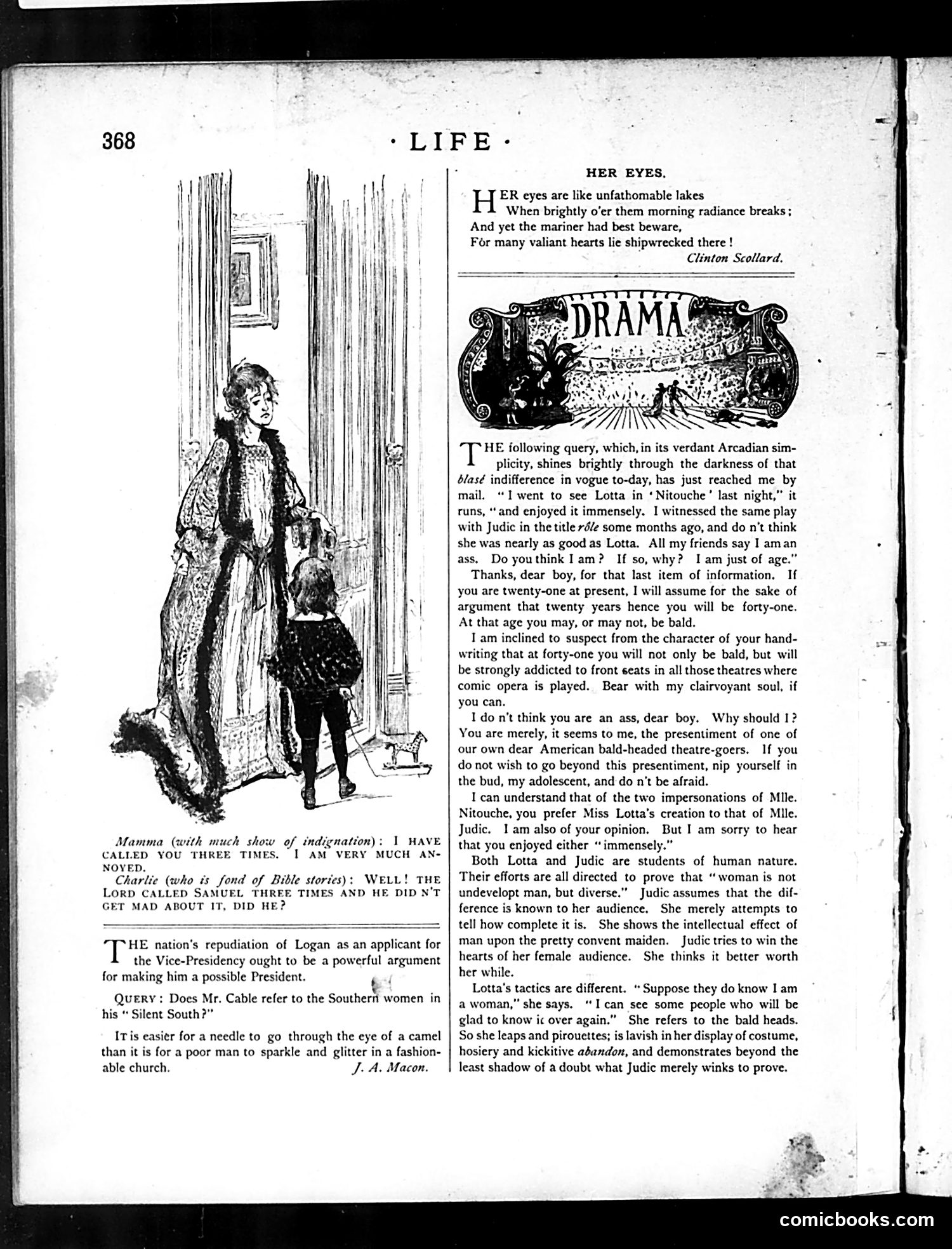
This page contains multiple unrelated items typical of Life's satirical format: **The cartoon** shows a mother scolding her son Charlie, who deflects her criticism by referencing the Bible story of Samuel—a child-humor joke about literal interpretation of scripture. **The political commentary** references Logan's rejection as Vice-Presidential candidate, suggesting this setback might paradoxically make him viable for President. **The main drama section** compares two stage actresses—Lotta and Judic—who both performed in "Nitouche." The writer uses this comparison to discuss contrasting performance styles: Judic appeals to intellect and wins female audiences through subtlety, while Lotta relies on physical display and spectacle to appeal to male theatergoers (described dismissively as "bald-headed theatre-goers"). The satire mocks both the correspondent's naïve theater criticism and, implicitly, the different tactics actresses employed to captivate audiences based on gender assumptions of the era.
📄 Transcribed text from this page (OCR, searchable)
Machine-transcribed from the original scan — historical spelling and the odd misread are preserved.
Mamma (with much show of indignation): 1 HAVE CALLED YOU THREE TIMES, I AM VERY MUCH AN- NOYED. Charlie (who és fond of Bible stories): WELL! THE LorD CALLED SAMUEL THREE TIMES AND HE DID N'T GET MAD ABOUT IT, DID HE? HE nation’s repudiation of Logan as an applicant for the Vice-Presidency ought to be a powerful argument for making him a possible President. ‘ Query: Does Mr. Cable refer to the Southern women in his “ Silent South?” Iris easier for a needle to go through the eye of a camel than it is for a poor man to sparkle and glitter in a fashion- able church. J. A. Macon. HER EYES. ER eyes are like unfathomable lakes When brightly o’er them morning radiance breaks ; And yet the mariner had best beware, For many valiant hearts lie shipwrecked there ! Clinton Scollard. HE following query, which, in its verdant Arcadian sim- plicity, shines brightly through the darkness of that dlasé indifference in vogue to-day, has just reached me by mail. “I went to see Lotta in ‘Nitouche’ last night,” it runs, “and enjoyed it immensely. I witnessed the same play with Judic in the title 76/e some months ago, and do n’t think she was nearly as good as Lotta. All my friends say I aman ass. Do youthink Iam? If so, why? I am just of age.” Thanks, dear boy, for that last item of information. If you are twenty-one at present, I will assume for the sake of argument that twenty years hence you will be forty-one. At that age you may, or may not, be bald. I am inclined to suspect from the character of your hand- writing that at forty-one you will not only be bald, but will be strongly addicted to front seats in all those theatres where comic opera is played. Bear with my clairvoyant soul, if you can. I do n't think you are an ass, dear boy. Why should I? You are merely, it seems to me, the presentiment of one of our own dear American bald-headed theatre-goers. If you do not wish to go beyond this presentiment, nip yourself in the bud, my adolescent, and do n't be afraid. I can understand that of the two impersonations of Mlle. Nitouche, you prefer Miss Lotta’s creation to that of Mile. Judic. 1 am also of your opinion. But I am sorry to hear that you enjoyed either “immensely.” Both Lotta and Judic are students of human nature. Their efforts are all directed to prove that “woman is not undevelopt man, but diverse.” Judic assumes that the dif- ference is known to her audience, She merely attempts to tell how complete it is. She shows the intellectual effect of man upon the pretty convent maiden. Judic tries to win the hearts of her female audience. She thinks it better worth her while. Lotta’s tactics are different. “ Suppose they do know I am a woman,” she says. ‘I can see some people who will be glad to know ic over again.” She refers to the bald heads. So she leaps and pirouettes; is lavish in her display of costume, hosiery and kickitive abandon, and demonstrates beyond the least shadow of a doubt what Judic merely winks to prove. comicbooks.com