
Life, 1885-12-24 · page 6 of 19
Life — December 24, 1885 — page 6: what you’re looking at
What you’re looking at
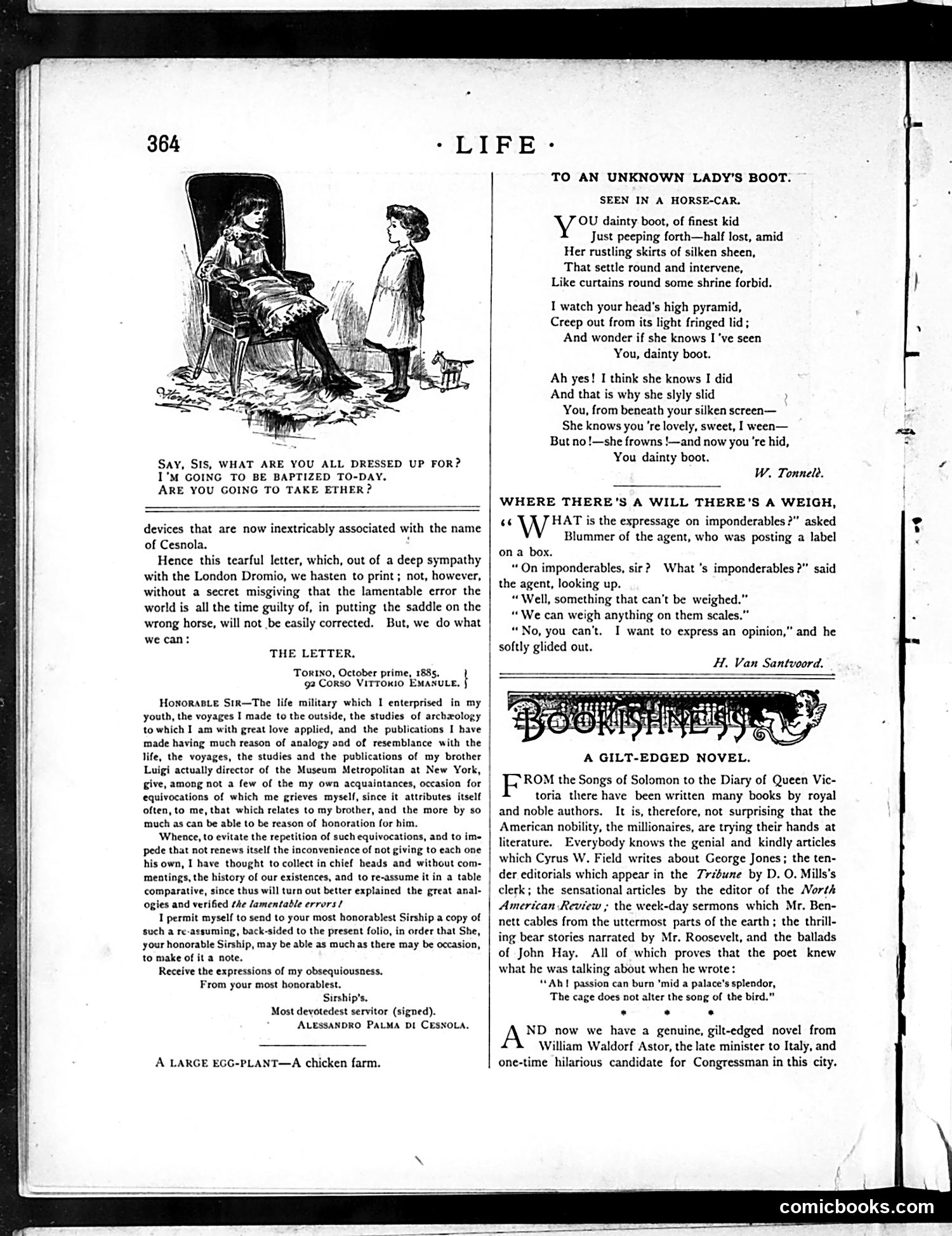
The top illustration shows a child asking an adult seated in a chair: "Say, sir, what are you all dressed up for? I'm going to be baptized to-day. Are you going to take entire?" This appears to be a simple joke about a child's misunderstanding of formal adult attire. The child assumes the well-dressed adult must be attending a baptism and asks if he'll participate ("take entire" likely meaning "take part"). The humor lies in the innocent misinterpretation—the child cannot fathom why else someone would dress formally. The page also contains poetry, letters, and book reviews typical of Life's satirical content, but these don't constitute political cartoons requiring historical context explanation.
📄 Transcribed text from this page (OCR, searchable)
Machine-transcribed from the original scan — historical spelling and the odd misread are preserved.
- LIFE: Say, SIS, WHAT ARE YOU ALL DRESSED UP FOR? I'M GOING TO BE BAPTIZED TO-DAY. ARE YOU GOING TO TAKE ETHER? devices that are now inextricably associated with the name of Cesnola. 5 Hence this tearful letter, which, out of a deep sympathy with the London Dromio, we hasten to print ; not, however, without a secret misgiving that the lamentable error the world is all the time guilty of, in putting the saddle on the wrong horse, will not .be easily corrected. But, we do what we can: THE LETTER. Tortno, October prime, 1885, g2 Corso Vitroxio Emanuce, Honorapte SiR—The life military which I enterprised in my youth, the voyages I made to the outside, the studies of archxology to which I am with great love applied, and the publications I have made having much reason of analogy and of resemblance with the life, the voyages, the studies and the publications of my brother Luigi actually director of the Museum Metropolitan at New York, | give, among not a few of the my own acquaintances, occasion for equivocations of which me grieves myself, since it attributes itself often, to me, that which relates to my brother, and the more by so much as can be able to be reason of honoration for him. Whence, to evitate the repetition of such equivocations, and to ime pede that not renews itself the inconvenience of not giving to each one his own, I have thought to collect in chief heads and without com- mentings, the history of our existences, and to re-assume it in a table | comparative, since thus will turn out better explained the great anal- ogies and veriGied the lamentable errors! I permit myself to send to your most honorablest Sirship a copy of such a re-assuming, back-sided to the present folio, in order that She, your honorable Sirship, may be able as much as there may be occasion, to make of it a note. Receive the expressions of my obsequiousness. From your most honorablest. Sirship's. Most devotedest servitor (signed). ALESSANDRO PALMA DI CESNOLA. A LARGE EGG-PLANT—A chicken farm. TO AN UNKNOWN LADY'S BOOT. SEEN IN A HORSE-CAR. OU dainty boot, of finest kid Just peeping forth—half lost, amid Her rustling skirts of silken sheen, That settle round and intervene, Like curtains round some shrine forbid. I watch your head's high pyramid, Creep out from its light fringed lid; And wonder if she knows I ‘ve seen You, dainty boot. Ah yes! I think she knows I did And that is why she slyly slid You, from beneath your silken screen— She knows you ‘re lovely, sweet, I ween— But no!—she frowns !—and now you 're hid, You dainty boot. W. Tonnele. WHERE THERE'S A WILL THERE'S A WEIGH, “cc Wwrar is the expressage on imponderables?” asked Blummer of the agent, who was posting a label ona box. “On imponderables, sir? What 's imponderables ?” said the agent, looking up. “Well, something that can’t be weighed.” “ We can weigh anything on them scales.” “No, you can’t. I want to express an opinion,” and he softly glided out. H. Van Santvoord. A GILT-EDGED NOVEL. ROM the Songs of Solomon to the Diary of Queen Vic- toria there have been written many books by royal and noble authors. It is, therefore, not surprising that the American nobility, the millionaires, are trying their hands at literature. Everybody knows the genial and kindly articles which Cyrus W. Field writes about George Jones; the ten- der editorials which appear in the 7ridune by D. O. Mills’s clerk; the sensational articles by the editor of the North American Review ; the week-day sermons which Mr. Ben- nett cables from the uttermost parts of the earth; the thrill- ing bear stories narrated by Mr. Roosevelt, and the ballads of John Hay. All of which proves that the poet knew what he was talking about when he wrote: “Ab! passion can burn 'mid a palace's splendor, The cage does not alter the song of the bird.” . . . A®™® now we have a genuine, gilt-edged novel from William Waldorf Astor, the late minister to Italy, and one-time hilarious candidate for Congressman in this city. comicbooks.com