
A complete issue · 16 pages · 1885
Life — October 15, 1885
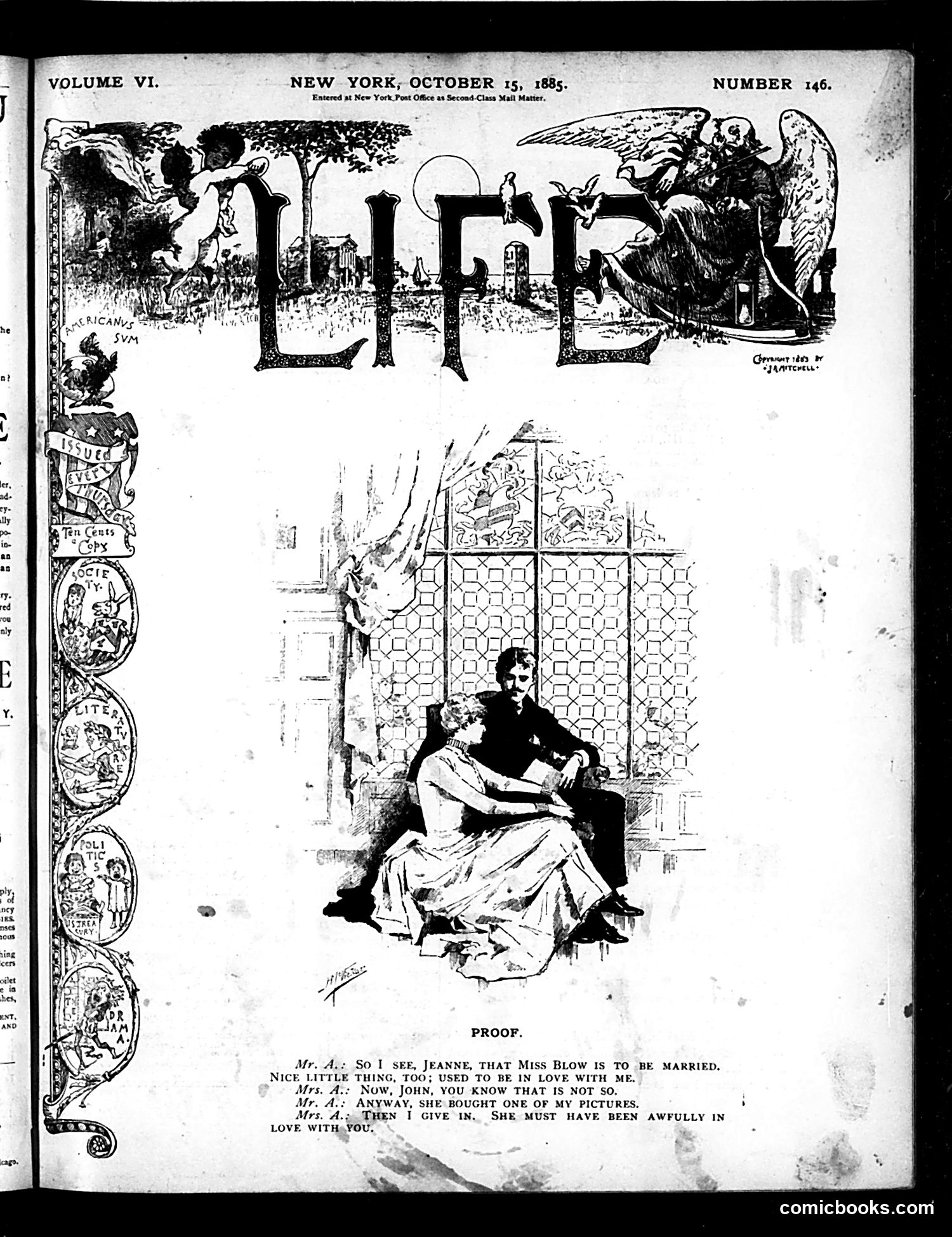
This page features a romantic illustration titled "PROOF" depicting a domestic scene between a man and woman in Victorian dress, seated together at what appears to be a window seat with decorative latticed panels behind them. The dialogue beneath reveals the satirical point: Mr. A. observes that Miss Blow is to be married to "little Thing" (her suitor), though she claimed not to be in love with him. When pressed about her sudden change of heart, she admits he bought her "one of the newest bicycles," and Mr. A. concludes "She must have been awfully in love with you"—sarcastically suggesting that material gifts, not genuine affection, motivated her acceptance of marriage. The satire mocks both female materialism and the commercialization of courtship during the 1880s.
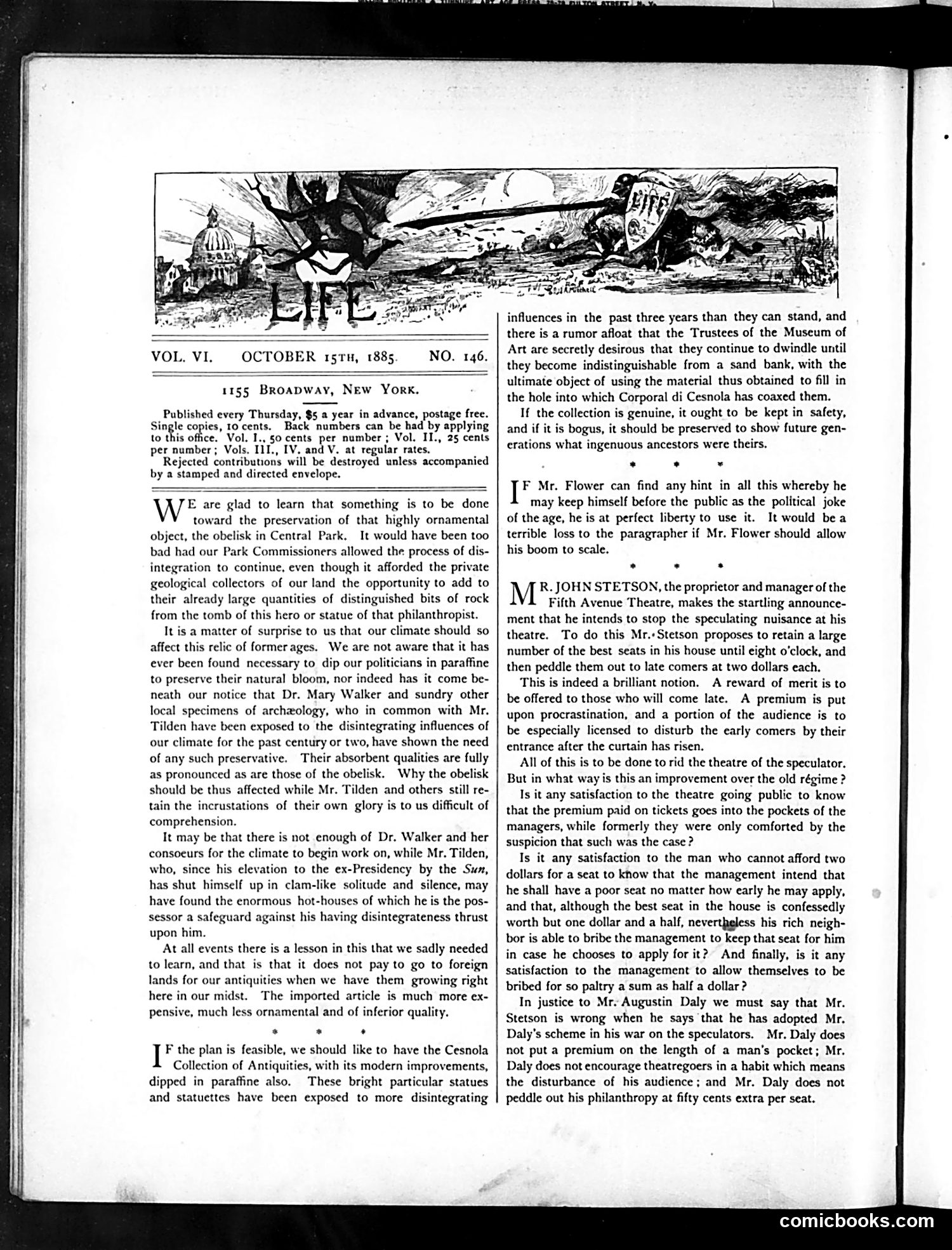
The masthead cartoon depicts a skeletal, grim figure labeled "LIFE" emerging from or looming over a landscape, with a domed building (likely the Capitol) visible on the left. The figure appears to represent Death or Mortality rather than vitality—a darkly ironic use of the magazine's name. The text discusses preservation of antiquities, the Cesnola Collection of artifacts, and Central Park's obelisk. It also critiques theater manager John Stetson's scheme to charge premium prices for late-arriving patrons at the Fifth Avenue Theatre, comparing this unfavorably to another manager's (Daly's) approach. The satire targets Stetson's commercialism and suggests his "reward for merit" scheme (charging latecomers extra) is exploitative rather than philanthropic.
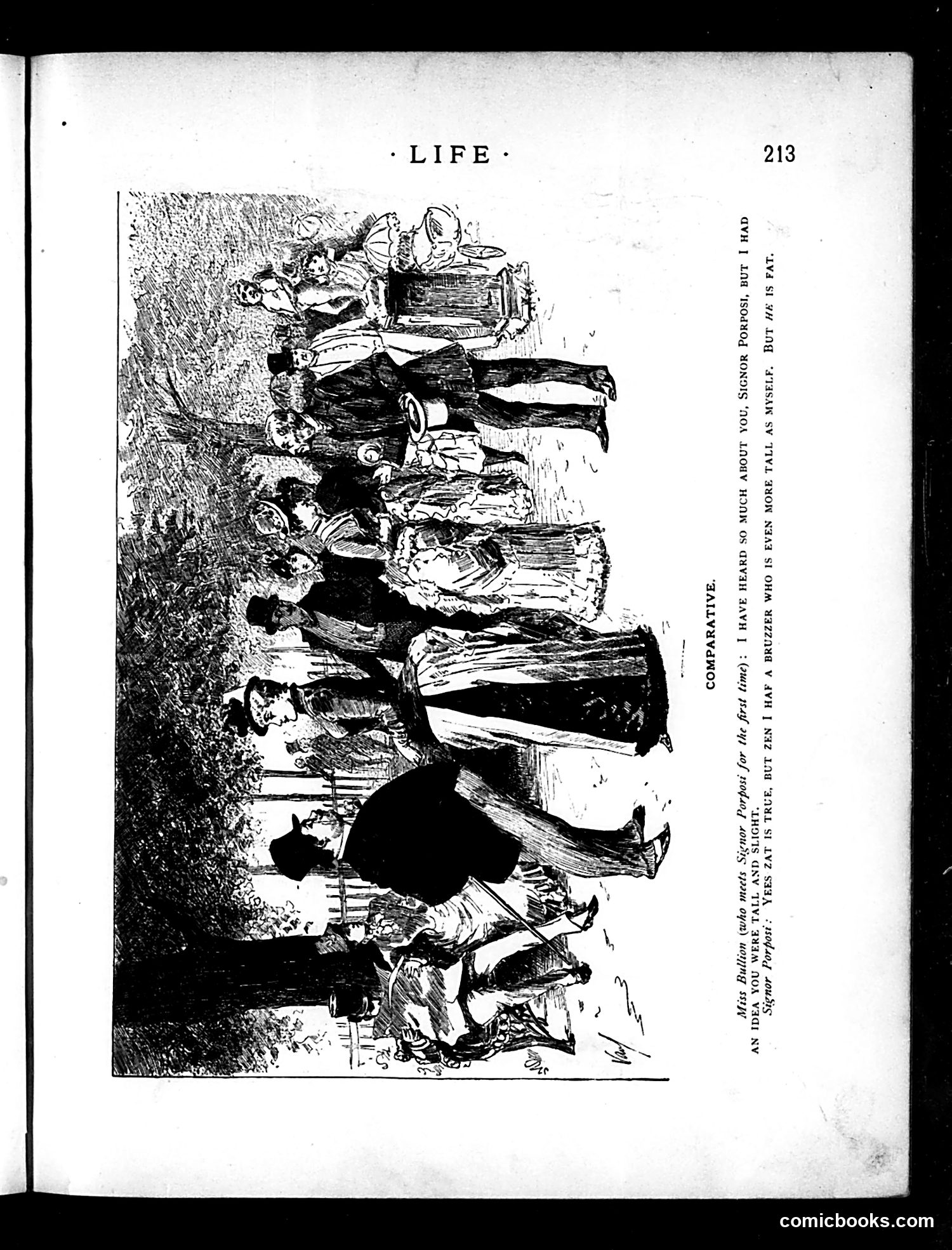
This appears to be a satirical comparison cartoon, though the image is printed upside-down on the page, making specific details difficult to discern. The caption indicates it's contrasting two scenarios related to "seven years at there" with commentary about someone being "even more tall as ever. but zen i had a bulldozer war is even more tall as ever." The sketch-style illustration shows multiple figures in period dress (appearing to be early 20th century based on clothing), arranged to invite visual comparison. Without being able to read the figures clearly or having additional context about the specific historical moment, I cannot confidently identify the particular political or social reference intended by this satire. The comparative structure suggests it's commenting on repeated patterns or hypocritical contrasts in contemporary events.
This page contains satirical commentary and verse rather than cartoons. "Hard Lines" is a poem by a bank cashier lamenting financial ruin—he's embezzled the bank's revenue and fled to Quebec to escape consequences. The humor derives from his self-pitying tone despite committing serious crime. The remaining content comprises brief satirical notes on contemporary figures and events: remarks about women (attributed to Marechal), King Thebaw of Burma's extravagant pagoda construction, accusations against Mr. Davenport regarding absenteeism, Ellen Terry's theatrical negotiations, and commentary on a baseball banner exchange between New York and Chicago teams. The satire targets vanity, poor governance, and social pretension through gossip-column style observations rather than visual means.
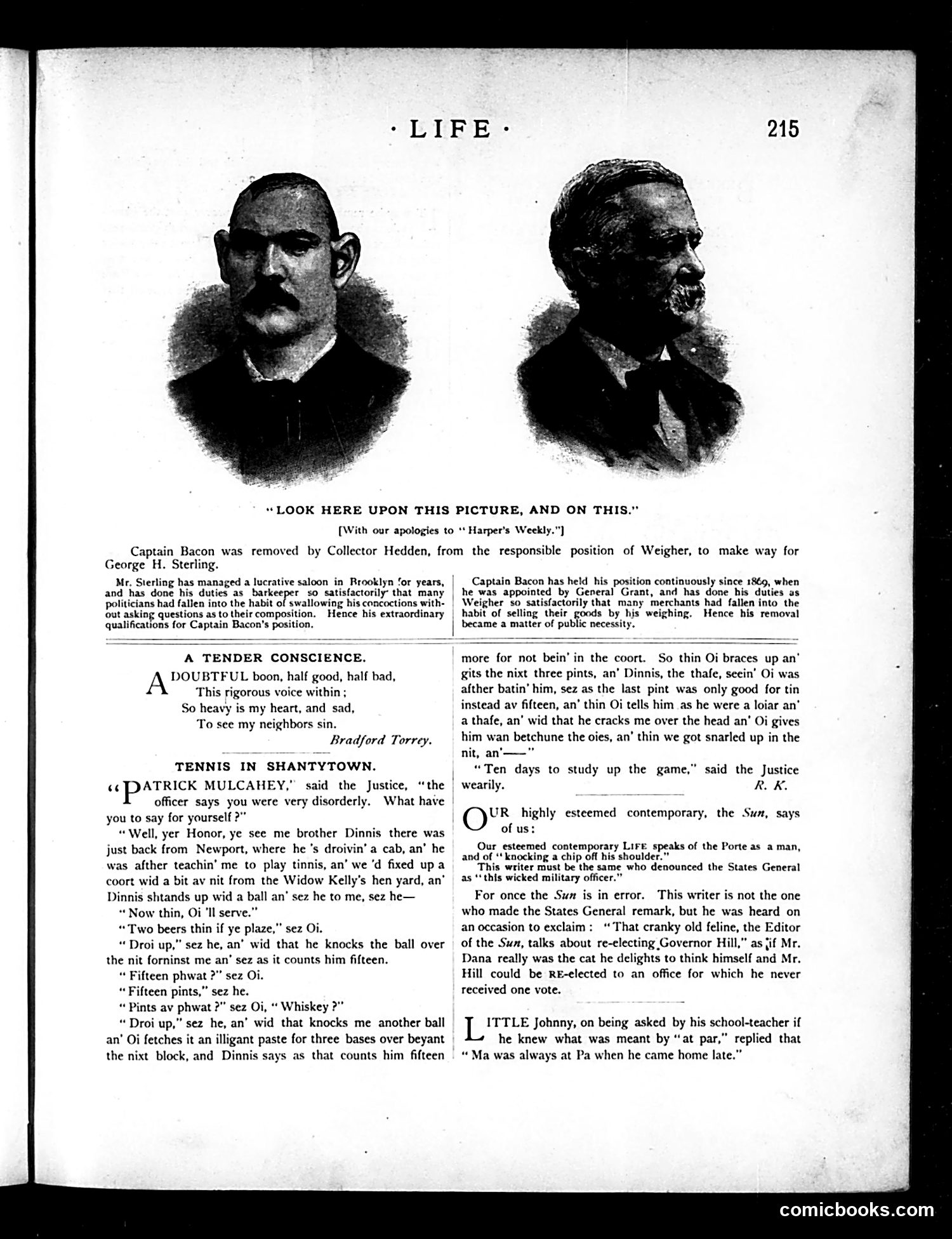
The top of this page contains two portrait engravings labeled "LOOK HERE UPON THIS PICTURE, AND ON THIS" (with an apology to Harper's Weekly). The accompanying text discusses Captain Bacon, who managed a Brooklyn saloon for years and was removed from his position as Weighter by Collector Hedden to make way for George H. Sterling. The satire appears to critique political patronage and favoritism—Bacon's removal despite satisfactory performance represents the kind of arbitrary job displacement that characterized corrupt machine politics of the era. The rest of the page contains humorous short pieces: poetry, a dialogue about tennis in Shantytown, and a brief joke about a child's misunderstanding of the phrase "at par." These are typical of *Life*'s satirical miscellany format.
This page from *Life* magazine (page 216) contains literary criticism and book reviews rather than political cartoons. The main content includes: - **"Musing"**: A poem about childhood and aging, reflecting nostalgically on the past - **Book Review**: Favorable critique of Brander Matthews' novel "The Last Meeting," praising its plot and character development - **"Books Received"**: A listing of recently published books with publishers There is a decorative header illustration for the book review section showing ornamental design elements, but no political satire or social commentary cartoons appear on this page. The content is purely literary in nature, typical of *Life*'s cultural coverage during this period.
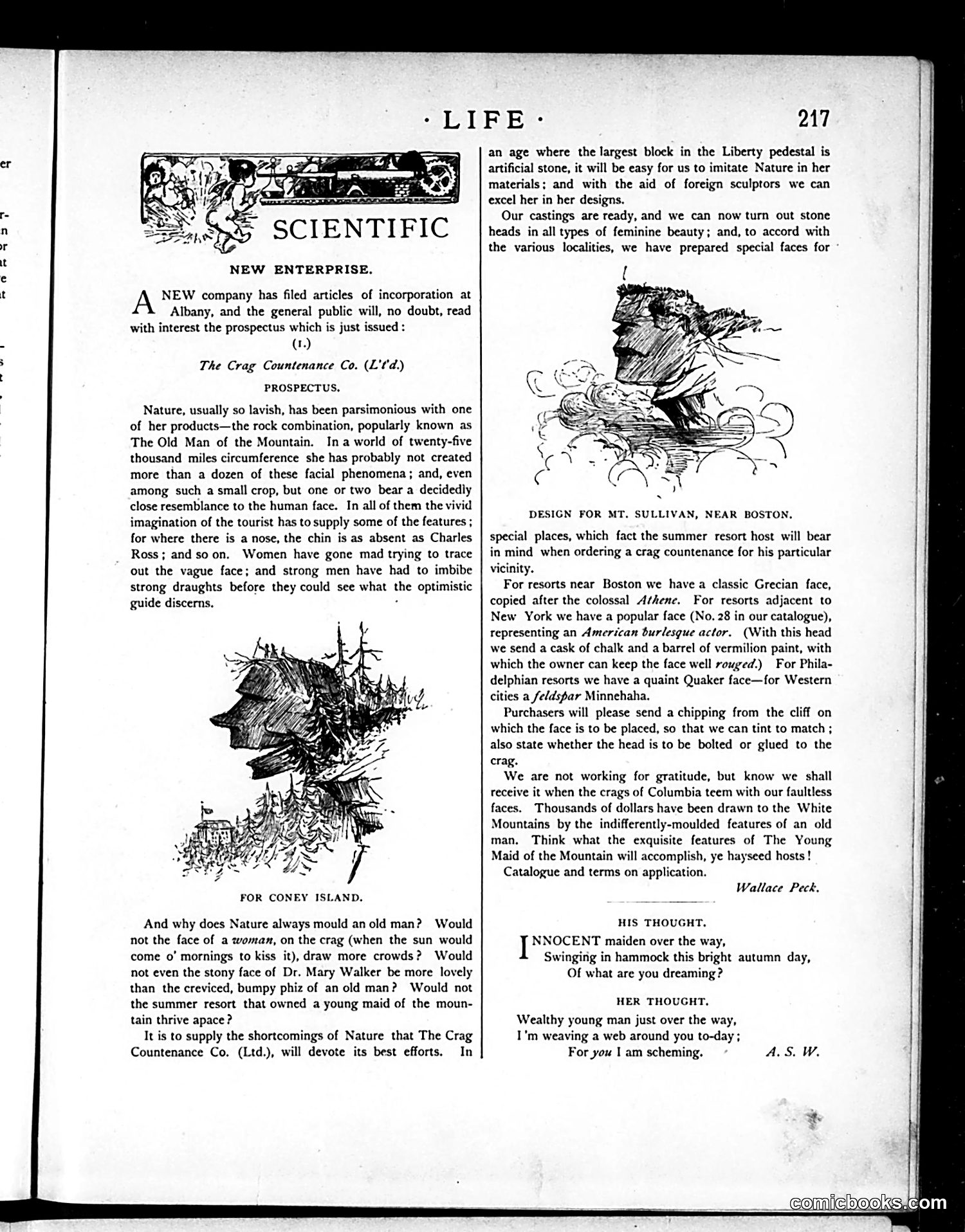
This page satirizes **The Crag Countenance Co. (Ltd.)**, a fictional company offering artificial stone heads carved to resemble natural rock formations found in mountains. The company promises to supply decorative rock faces for resort landscapes—specifically "feminine beauty" designs for summer destinations. The satire mocks Nature's "laziness" in producing only occasional natural rock faces resembling humans (like the "Old Man of the Mountain"). The company humorously offers to mass-produce what Nature rarely delivers, including a "Young Maid of the Mountain" design. The two sketched designs shown are for locations near Boston and Coney Island—popular American resorts. This is gentle, absurdist satire about commercializing and artificially recreating natural curiosities for tourist appeal during the early 20th century.
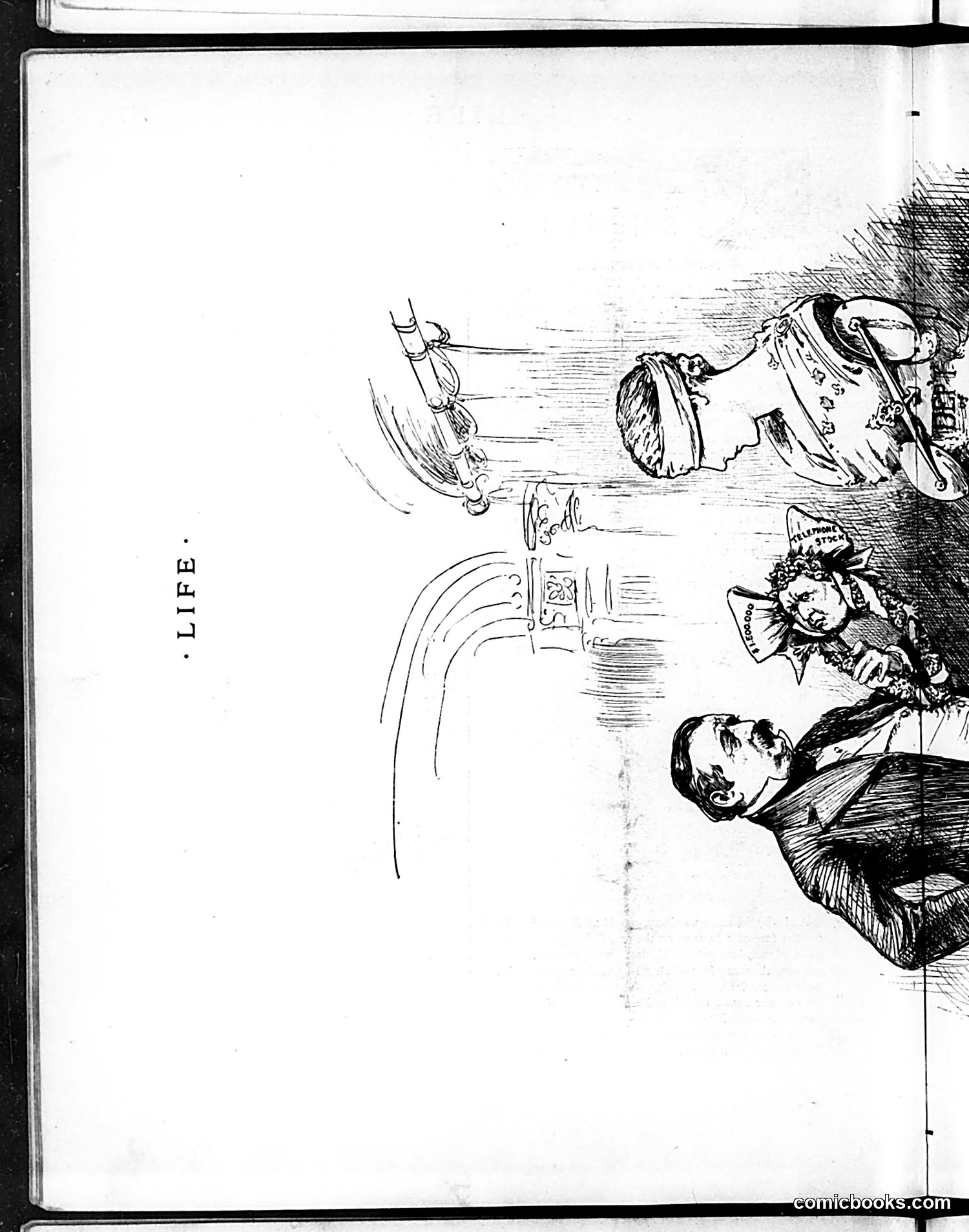
This page from *Life* magazine appears to show a satirical scene with multiple figures in period dress (likely late 19th or early 20th century), though the image is rotated and difficult to read completely. The word "LIFE" appears on the left margin, confirming this is from that publication. The cartoon depicts what seems to be a social or political scene with exaggerated facial features typical of *Life*'s satirical style. However, **I cannot confidently identify the specific figures, the particular event being mocked, or the precise political/social commentary** from this reproduction. The image quality and rotation make details unclear. To provide accurate analysis of the satire's target and meaning, I would need either a clearer image or additional contextual information about the publication date.
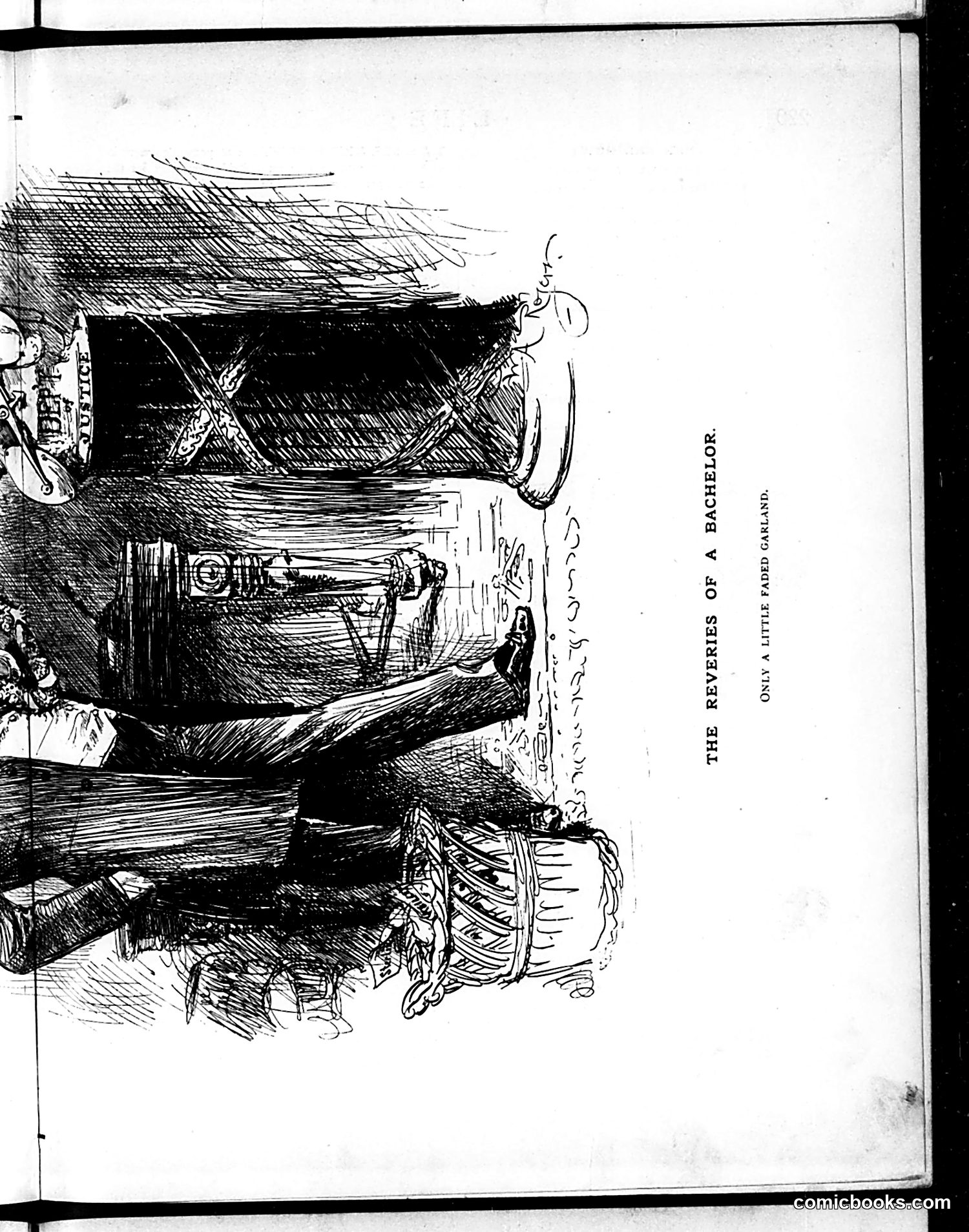
This appears to be an illustration from Life magazine accompanying a story or serialized piece titled "The Reveries of a Bachelor," with the subtitle "Only a little farmed garland." The sketch shows a man in period clothing (appears to be 19th century based on the style) in what looks like a domestic interior scene. The detailed cross-hatching and ink work is characteristic of Life's illustration style from that era. Without additional context about which installment this is or the full story text, the specific satirical or humorous point isn't entirely clear from the image alone. The title suggests the piece follows a bachelor's daydreams or romantic fantasies—a common literary theme of the period—likely presented with comedic commentary on bachelor life or courtship customs of the time.
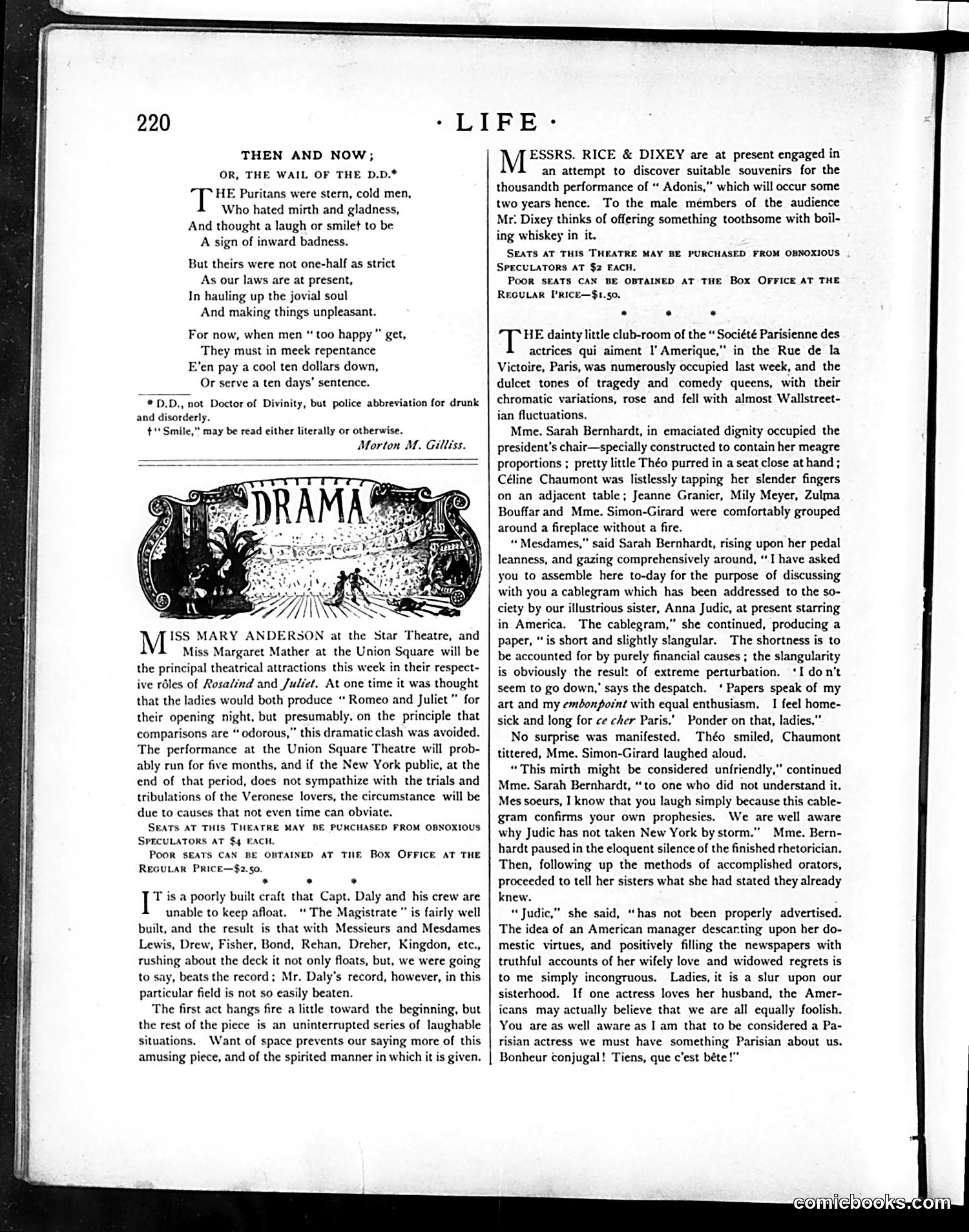
This page from Life magazine (circa 1880s) contains theatrical reviews and social satire: **"Then and Now"** satirizes American puritanism and modern laws. The poem contrasts stern Puritans—who disapproved of laughter—with contemporary society, which ironically punishes excessive happiness through fines ($10) or jail time (10 days) for drunkenness and disorderly conduct ("D.D."). The satire suggests modern restrictions are equally joyless, just legalized. **Theater reviews** discuss performances by actresses Mary Anderson and Margaret Mather in Shakespeare roles, Rice & Dixey in "Adonis," and Captain Daly's troupe in "The Magistrate." The satire targets ticket scalpers ("obnoxious speculators") who charged inflated prices ($4 vs. $2.50 regular price). **The Paris actresses section** mocks American obsession with French culture, depicting Sarah Bernhardt and other Parisian actresses discussing a cablegram from Anna Judic, an American-based actress. The tone suggests disapproval of Americans' provincial fascination with European performers. Overall: social commentary on American hypocrisy, commercialism, and cultural pretension.
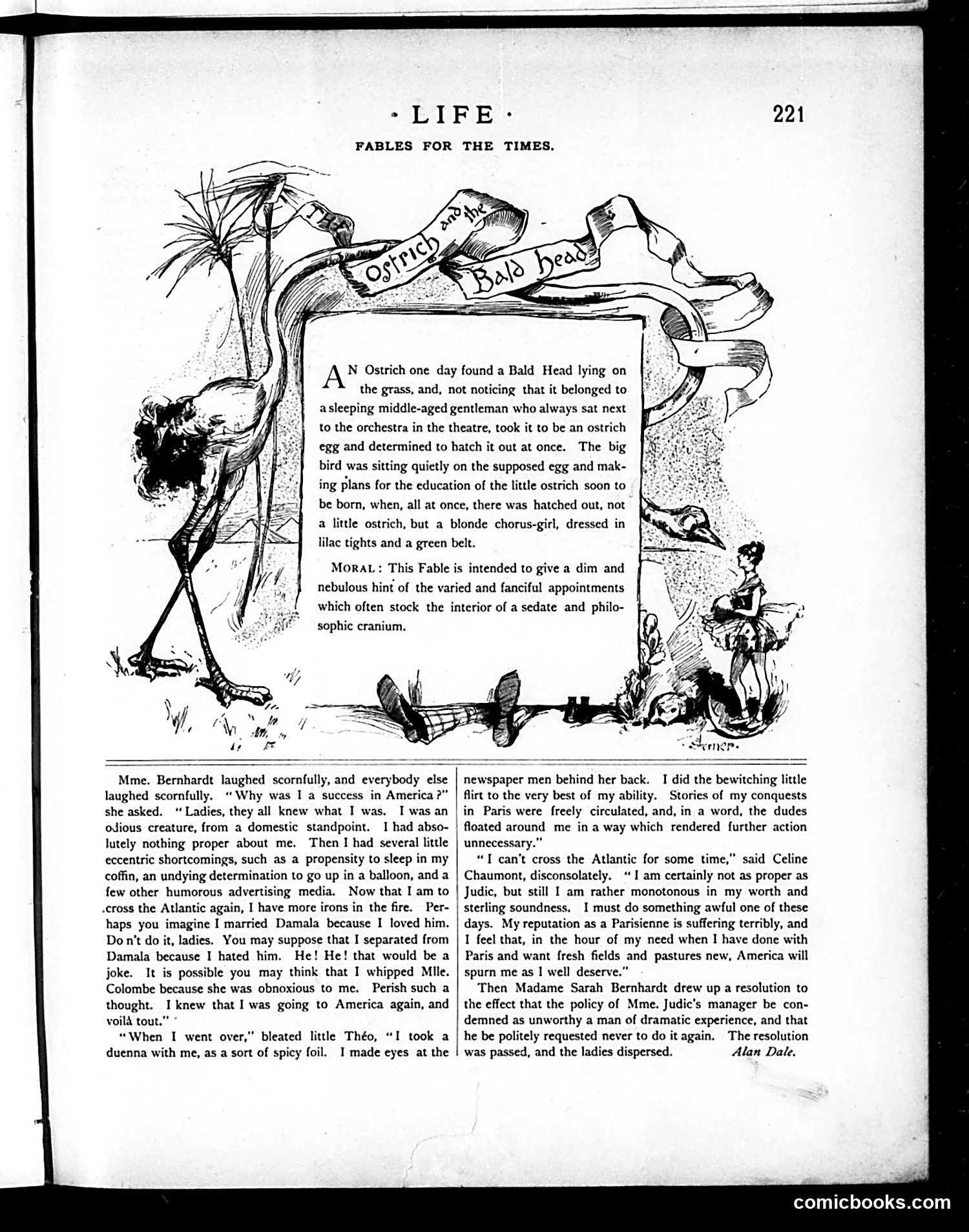
This page contains two satirical pieces about theatrical personalities, likely from the 1880s-90s. **The Ostrich Fable** (illustrated): A crude visual joke—an ostrich mistakes a bald man's head for an egg and sits on it, hatching instead a blonde chorus girl. The "moral" mocks pretentious intellectuals, suggesting that refined, philosophical gentlemen harbor ridiculous fantasies beneath their respectable exteriors. **The Bernhardt Section**: Bylined Alan Dale, this satirizes famous French actresses (Sarah Bernhardt, Judic, Celine Chaumont, and others) discussing their American tours. It mocks their calculated self-promotion—Bernhardt boasts of using eccentric antics (sleeping in coffins, balloon rides) as "advertising media" to scandalize American audiences. The piece ridicules both the actresses' transparent publicity stunts and American audiences' gullibility for such theatrical personas. The resolution condemning Judic's manager suggests disapproval of these manufactured controversies.
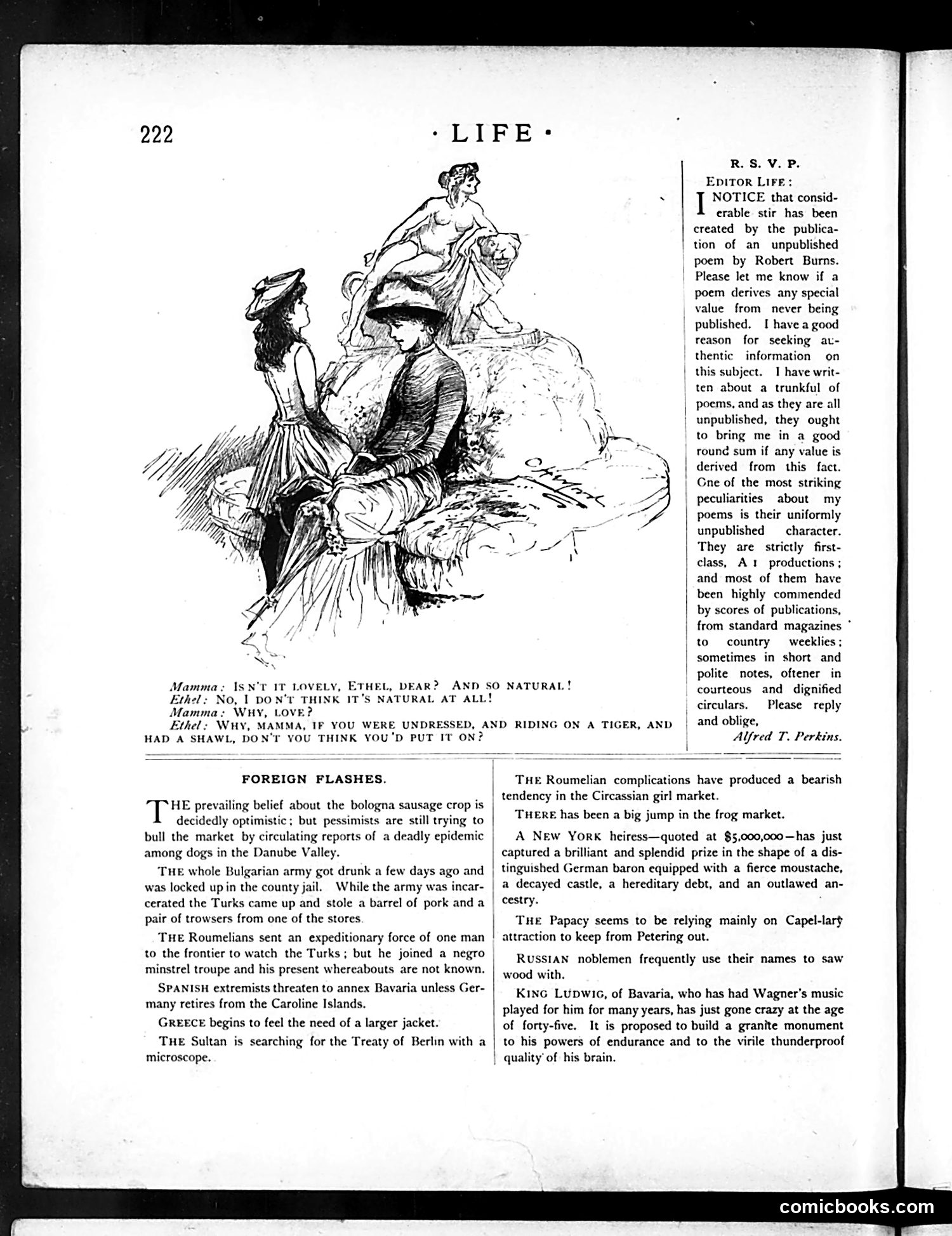
## Main Cartoon The illustrated joke depicts a woman riding a tiger while partially undressed, wearing only a shawl. The daughter (Ethel) points out the absurdity: if her mother were in such an impractical situation, wouldn't she logically put on the shawl properly rather than wear it loosely? The humor relies on the contrast between the unnatural, bizarre scenario and the practical concern about clothing. This appears to be satirizing Victorian attitudes about propriety and modesty—even in ridiculous circumstances, the focus remains on preserving decorum. ## "Foreign Flashes" Section These are absurdist political satires mocking various European nations and events. Examples include: Bulgaria's army getting drunk and jailed, Greece needing a "larger jacket" (financial strain), the Sultan searching for the Treaty of Berlin "with a microscope" (inability to find acceptable terms), and a New York heiress purchasing a titled but financially ruined German baron. The humor targets international diplomacy, national incompetence, and the commodification of aristocratic titles.
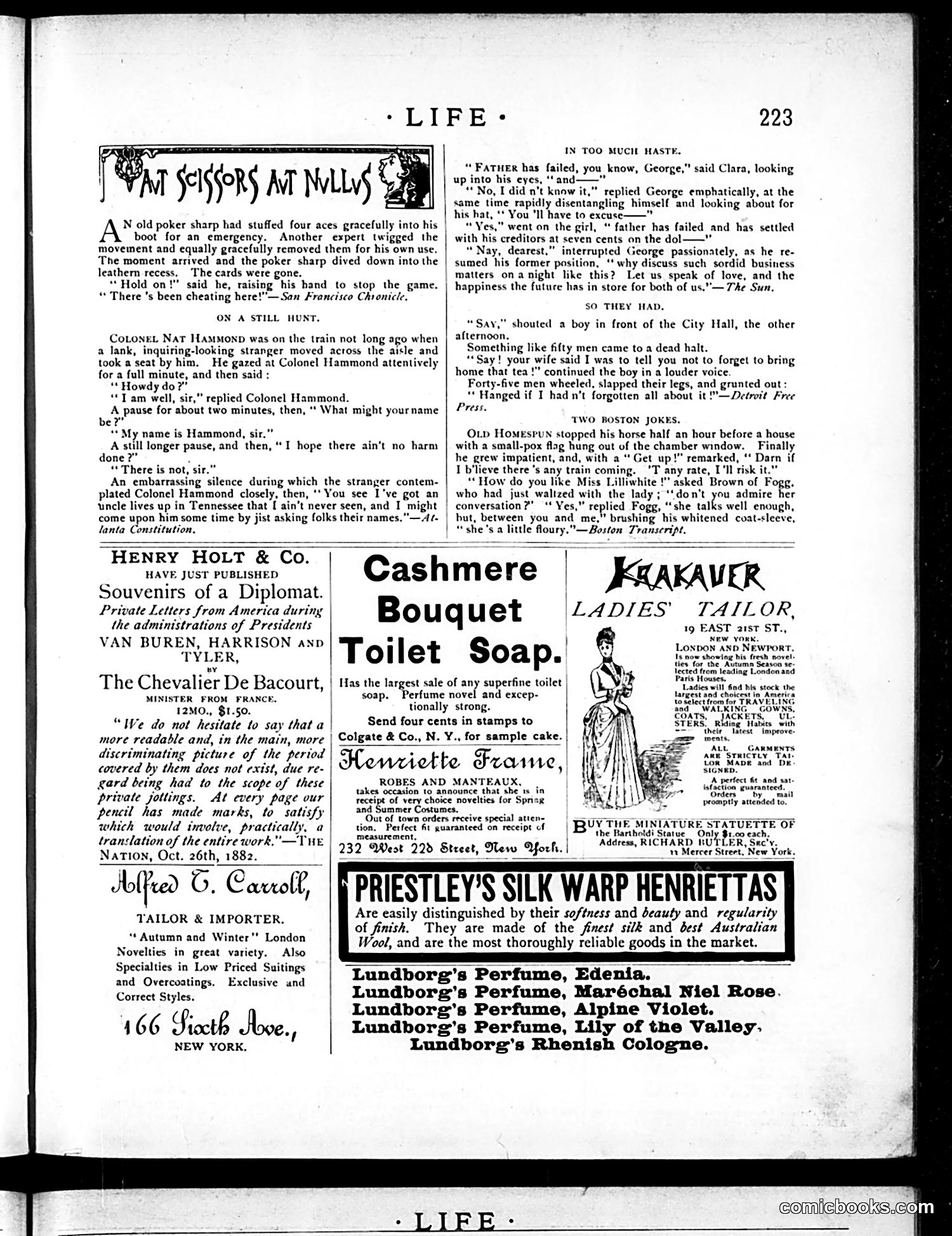
This page is primarily **advertisements and humorous anecdotes**, not a political cartoon. The page contains several brief, standalone jokes mocking ordinary people: 1. **"Ant Scissors at Nulls"**: A poker sharp who hid cards in his boot gets caught when another cheat steals them—ironically accusing *others* of cheating. 2. **"On a Still Hunt"**: A stranger repeatedly questions Colonel Hammond, hoping he's his missing Tennessee uncle. 3. **"In Too Much Haste"**: George ignores his girlfriend's news that her father has failed financially, too eager to escape the conversation. 4. **"So They Had"**: A boy publicly asks his mother's message at City Hall—revealing multiple married men forgot to bring home tea. 5. **"Two Boston Jokes"**: A traveler mocking quarantine procedures, and someone praising a woman's conversation while calling her "floury" (dusty/covered in flour). The humor relies on everyday mishaps, misunderstandings, and social embarrassment rather than political satire. The remainder is period advertisements for books, clothing, and toiletries.
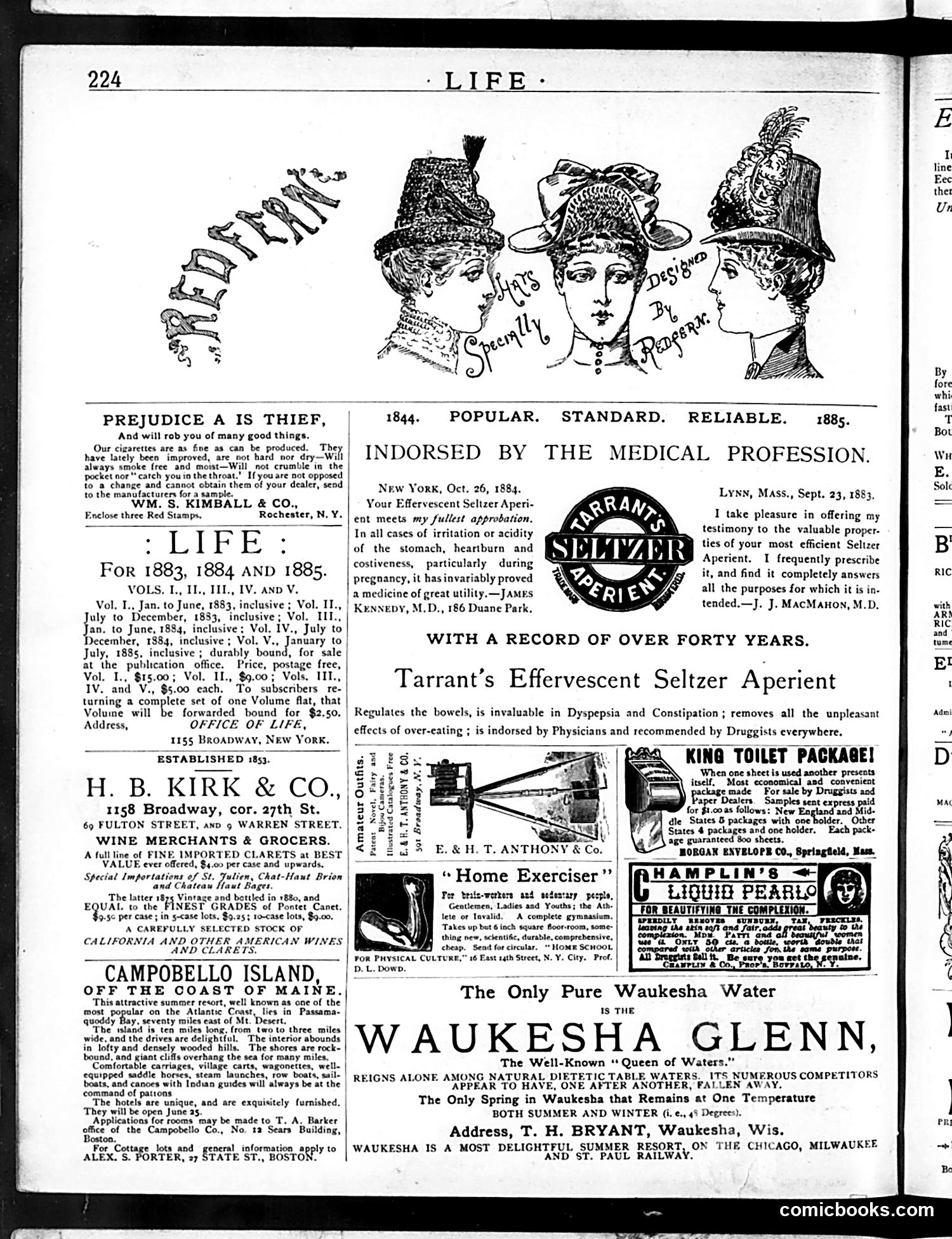
This page is primarily **advertisements and subscription information** for Life magazine itself, interspersed with period product ads. There is **no significant political cartoon or satire** to analyze. The page's small illustration at top shows four women's heads in profile wearing different fashionable hats—a common visual motif in Life reflecting contemporary women's fashion and social observations. The accompanying text fragment "Specially" and "By" suggests this relates to hat styles, though context is cut off. The substantive content consists of: - Life subscription offers (1883-1885 volumes) - Wine merchant advertisements - Tarrant's Seltzer Aperient (digestive aid) with endorsements from physicians - Tourist/resort advertising for Campobello Island - Photography equipment and exercise device ads **The "Prejudice is a Thief" cigarette ad** uses that phrase metaphorically to discourage consumers' unfounded bias against the product, claiming its quality improvements should overcome prejudgment. This is primarily a **business/advertising page** with minimal satirical content.
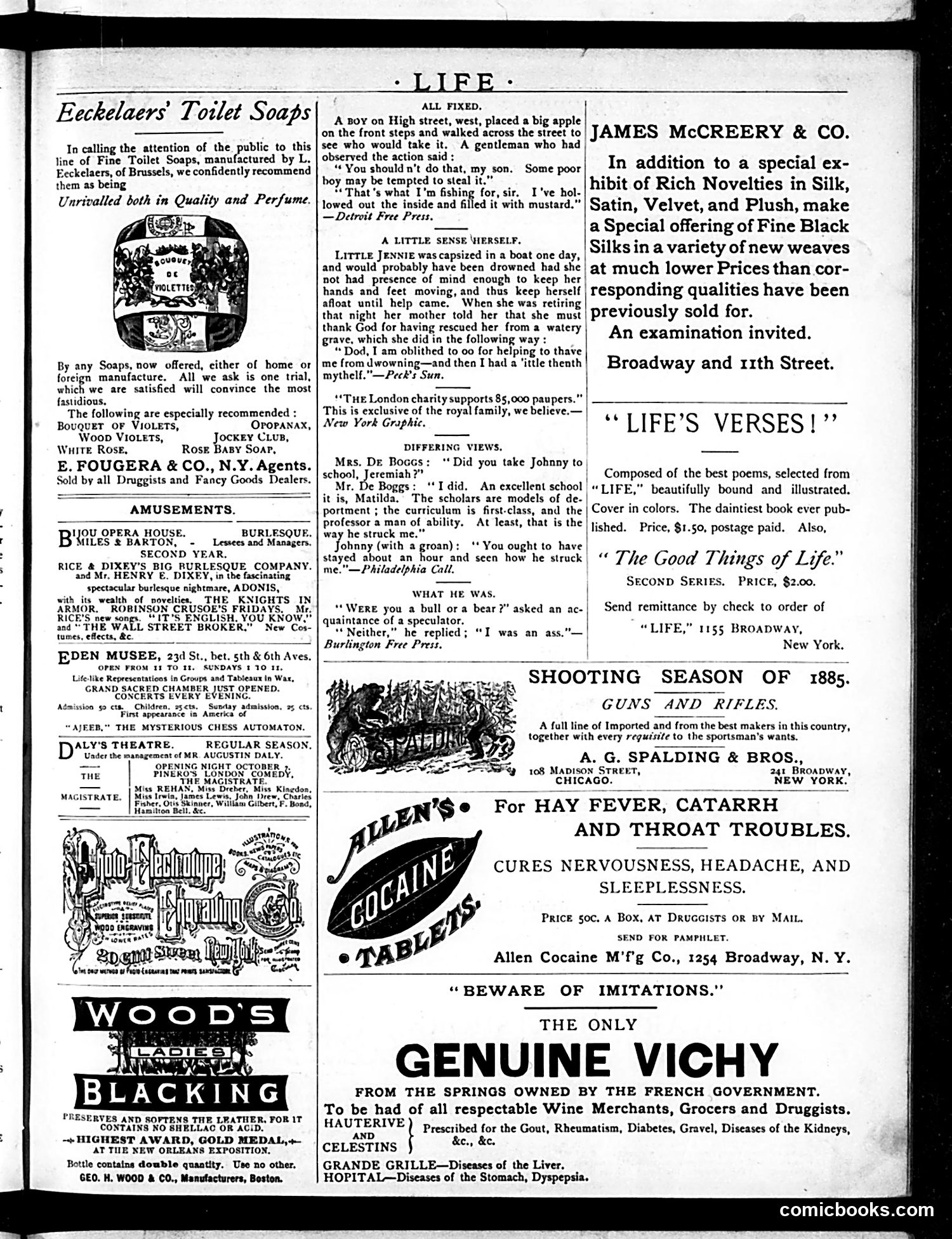
This page is primarily **advertising and light humor**, not political satire. The content includes: **Main Features:** - Product advertisements (Beckelaers soap, Wood's shoe blacking, Allen's Cocaine tablets, Vichy water) - Theater/amusement listings (burlesque shows, Eden Musee wax museum) - Brief humorous anecdotes in the "ALL FIXED" section **The Jokes:** The short comic pieces are mild social humor: a boy pranking passersby with a mustard-filled apple; a child's innocent mispronunciation thanking God; a man boasting about school quality while his son complains about being struck (hit) by the teacher; a Wall Street speculator admitting he was neither bull nor bear, but "an ass." **Historical Context:** These are gentle, family-friendly jokes typical of 1880s magazines. The cocaine tablet advertisement is notable—cocaine was legal and marketed as medicinal then. The page reflects Gilded Age consumer culture and entertainment, with no discernible political commentary or caricature.
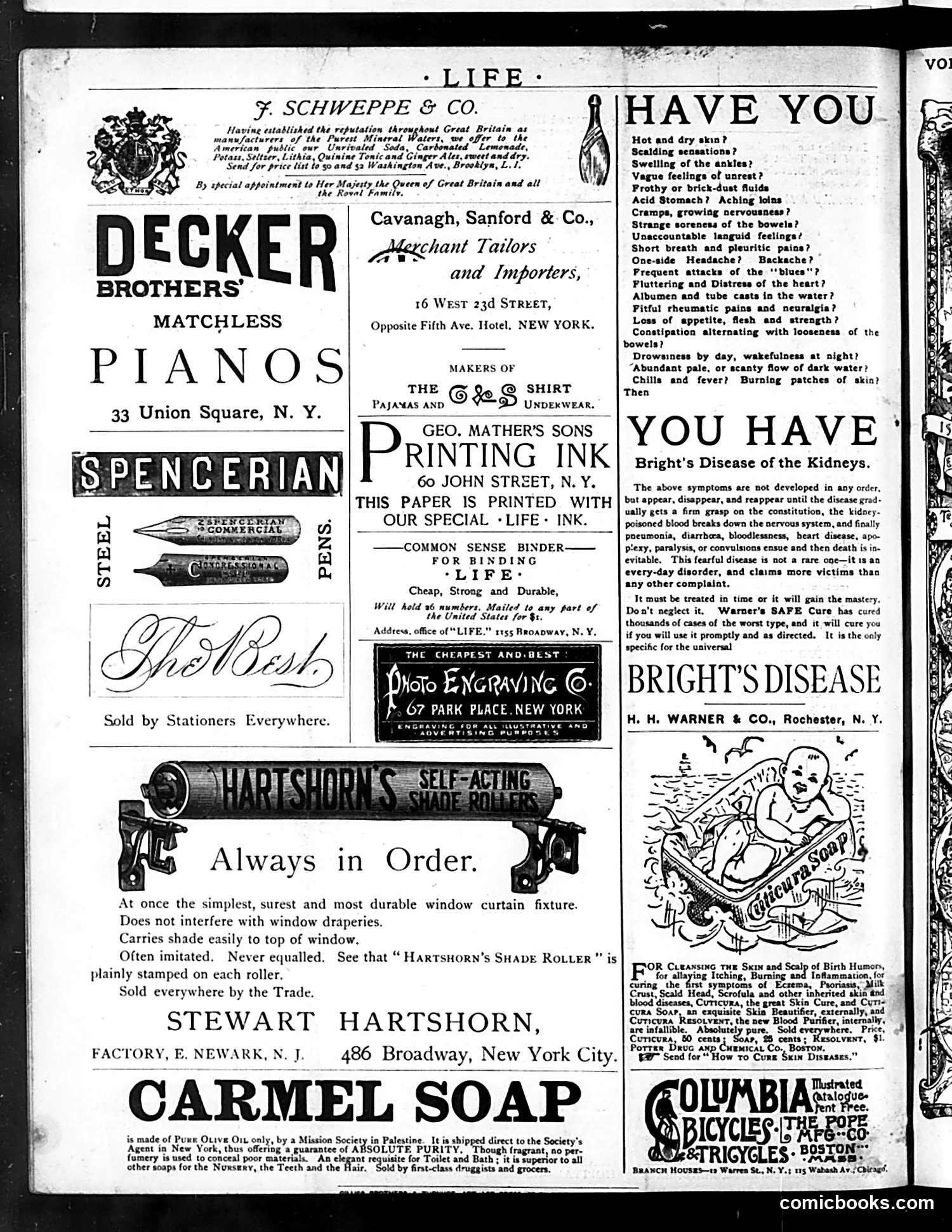
This page is primarily **advertising**, not political satire or editorial cartooning. It contains commercial advertisements for various products popular in the late 19th/early 20th century. The notable content is a prominent medical advertisement for **Warner's Safe Cure for Bright's Disease** (a kidney ailment). The ad lists extensive symptoms—from "hot and dry skin" to "burning patches of skin"—claiming they indicate kidney disease, then promises the product will cure even "the worst type." This represents a common practice of the era: **patent medicine advertising that exploited health anxieties**. The exhaustive symptom list was designed to make readers believe they had the condition, creating demand for the cure. Such ads were typical in American magazines before FDA regulation of medical claims. The page also advertises pianos, printing ink, soap, bicycles, and window fixtures—standard commercial content for a magazine dependent on advertising revenue.